Enemy of the People

Short sighted history always bothers me.  Case in point:

  …

The phrase is common enough in Ciceronian rhetoric when talking about external enemies, but he also makes very very clear the dangers of its domestic application.

O, how I wish this case afforded me the opportunity and the ability to proclaim that Lucius Saturninus, enemy of the Roman people, was killed by Gaius Rabirius.—Your shouting does not disturb me at all. Rather, it reassures me since it shows that there are some foolish citizens but not many. Never would the Roman people who remain silent have made me consul if they thought I would be shaken by your shouting. How much quieter your outcries have become already! Yes, you are checking your voice, informer upon your stupidity, witness to your paltry numbers!

Gladly, as I say, would I acknowledge, if I were in truth able or even if I were at liberty to do so, that Lucius Saturninus was killed by the hand of Gaius Rabirius. I would deem it a most glorious misdeed. But seeing that I cannot do this, what I will confess will be less efficacious for his reputation but not less for the charge against him. I confess that Gaius Rabirius took up weapons for the purpose of killing Saturninus. How is that, Labienus? What fuller confession, what more serious charge against my client were you expecting? Unless, of course, you do reckon that there is a difference between a man who has killed a man and a man who was armed for the purpose of killing a man. If it was wrong for Saturninus to be killed, weapons cannot be taken up against Saturninus without entailing a crime. If, however, you concede that weapons were taken up lawfully, then, by necessity, you must concede that he was killed lawfully.

This is Cic. Rab. 18ff.  In short, being declared an enemy of the people meant it was legitimate for anyone to kill you.   There are of course many many more examples from the Catilinarian conspiracy and Cicero’s attacks on Antony.

Lictors with rods in each hand

So still on Holliday 2002.  Normally lictors are only depicted with the fasces bundled and over their left shoulder.  The fresco representations reminded me of another strange image (RRC 301/1):

Capture.JPG

I’ve always assumed that on the coin the rod in the right hand was the threat from which the citizen is being protected. But if Holliday’s reading of the Arieti tomb is right it might just be a ceremonial representation of lictors at this time, not with a an implied threat of use.

H0lliday calls the right-hand stick/rod a commetaculum.   We don’t really know that much about this term.  Festus says the following:

commoetacula : virgae quas flamines portant pergentes ad sacrificium ut a se homines

capture1

And thus the flamen dialis is identified as holding on on the ara pacis:

Capture.JPG

Basically its assumed than since usually lictors cleared the way for priests at sacred functions the commetaculum by extension was an attribute of the lictor (see various discussions).


Another Pig

esquiline_tomb_painting1358907137883

I was reading Holliday 2002:83-91 on the Tomb of Q. Fabius on the Esquiline and wanted to re-look at color images because of how he emphasized the use of the dextrarum iunctio as a symbol concordia, fides, pax and pietas in this context (p. 88).  I started worrying about the child behind the figures.


Is that a pig?  Has anyone suggested that before? [ I admit I’m a little obsessed with Romans and their pigs. ] If so it would strengthen Holliday’s claims that Fabius the labelled figure in the front of boy might be representing a pater patratus, one of the fetiales, or perhaps the verbenarius, an idea he gets from Felletti Maj.

Holliday assumed the plant borne by this individual was in the form of a crown, but that need not be the case based Pliny NH 22.5 (0ur only source for this information):

there shall be assigned even to dull, that is to say, lowly plants all the dignity that is their due, since it is a fact that the founders and enlargers of the Roman Empire derived from this source also an immense advantage, because it was from them that came the tufts used when the State needed cures, and also the verbanae required in holy ceremonies and in embassies. At any rate both names mean the same thing, that is, a turf (gramen) from the citadel pulled up with its own earth; and on every occasion when envoys were sent to the enemy to perform clarigatio, that is to demand in loud tones the restitution of plundered property, one in particular was called verbena-bearer.

So maybe I’m crazy but doesn’t it look like vines wrapped around Fabius’  arm?


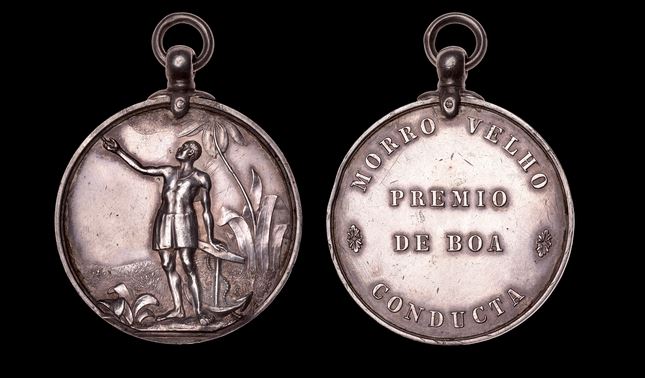
“Good Conduct”

slave-token

This token was an instrument of control used by the slave owner at the Morro Velho mine in Brazil, a British owned company long after Britain had abolished slavery in its own territories.  It appropriates imagery used by abolitionists.  I wish the seller or buyer would entrust this object to a museum willing to display it and put its function into context.  It is only the second such specimen which I know of (do you know of more?!  please let me know!), neither is in a public collection.

Here is an excerpt on this medal from a forthcoming article of mine (I also have an earlier post on this topic).  I’ll obviously have to correct the footnote prior to publication:

 Nearly the same imagery was adopted in a most disturbing manner by a notorious British slave owning company in Brazil, the Morro Velho gold mine, a mine still in operation today.[1]  In a firsthand account, Captain Burton praises the use of these medals and their role in a fortnightly inspection of all the slaves, working on the theme of how much better life is for the slaves than it used to be, and how much better off they are than their un-enslaved kinsmen (1869: 236-7).   The silver medals, commissioned from London, had been introduced into the ceremonies in 1852 and seem to have been awarded to those with five years ‘good conduct’ to mark their approaching freedom (Childs 2002: 51).  Seven years of such continuous ‘good conduct’ are said to have led to emancipation, although the mining company never chose to define what constituted ‘good conduct’, leaving the judgment inherently arbitrary (Childs 2002: 44).  Thus the abolitionist message of freedom is substituted for an illusory promise of possible freedom and the medal, like the social ritual of the muster and the uniforms, becomes part of the means of control.  It also imitates the practice of the abolitionists who had made a fashion out of wearing such medallions to advertise their own political sentiments; notice the marks left by a clip visible at the top of the illustrated medal.  Here the palm tree is used to identify the man as African and thus his status of one not yet liberated, or, if liberated, only having achieved such a state by the agency of a European power.

[1] I only know of one surviving specimen, which was sold by Baldwin’s Auctions Ltd, Auction 65, lot 1131 (4 May 2010); it was not possible to secure permission to illustrate this specimen, but an archived image can be found here: <https://www.acsearch.info/search.html?id=780251&gt;.  The auction catalogue entry reads, in part: “A note with the medal states, “Morro Velho slave medal of Freedom … given by dying slave to a missionary. Given to me by an Old Lady as a parting gift when leaving Chiswick”. The image of the slave derived, perhaps, from C F Carter’s 1834 medal to commemorate the Abolition of Slavery. Viscondessa de Cavalcanti’s Catalogo das Medalhas Brazileiras, lists the medal under “Abolition of slavery” and attributes it to 1848. She also quotes “Sr Hopkin, president of the company in 1888” who said that by 1882 all but 28 had been emancipated. Morro Velho is a complex of gold mines located near the city of Nova Lima in the Minas Gerais state of Brazil; in operation since 1835, it is the world’s oldest continuously worked mine.”


An amusement

If you asked a Roman to answer the question, ‘why do you have coins?’.  The answer is likely to have to have been some variation of ‘to pay for stuff’.  Such an imaginary conversation between a time traveling researcher (T.T.R.) with a per chance for the Socratic method might continue:

T.T.R. – Where did you get the coins?

Imaginary Roman – It’s none of your business, but it happens that these particular ones were a gift from my friend Memmius.

T.T.R. – Was he using them to pay for something?  Was he buying you?

Imaginary Roman – Don’t be rude.  He’s my friend.  I help him; he helps me.  He just happens to be a bit better off.  He knows the price of grain is up this season.

T.T.R. – Ok. Ok.  Where did he get the coins do you suppose?

Imaginary Roman – He’s got lots of state contracts for roads and supplying the army and stuff.  I sometimes do him a favor and go check on these projects for him when he’s really busy in the law courts and similar stuff.   He’s a good friend to have.

T.T.R. – So the state bought some roads off your friend.  Where did the state get them?

Imaginary Roman – It’s more complicated than that.  These arrangements aren’t all about money you know.  The magistrates take all aspects of these projects very seriously and the contractors are very patriotic.  The auspices need to be right and the character of the individual and the source of the materials. Why do you care so much about the coins anyway?  It isn’t like the really big payments are even made with coins.  The bankers and creditors and treasury have other ways and means.  We’re not some backward place without resources you know.  This is ROME.

T.T.R. – Let’s say my interest is more historical.  I want to understand what makes Roman coins special.  Can you tell me how coins are made?

Imaginary Roman – – a pause – I’ve never seen a coin made, but I assume it’s a bunch of slaves owned by the state or a state contractor.

T.T.R. – So slaves.  You all get you coins from slaves.

Imaginary Roman – You remind me of that crappy Greek play about the guy thinking about bugs and clouds and other ridiculous stuff.  Did Memmius set you up to this?  Or Gradius?  Or Lucretius?  It’s just his style.

T.T.R. – Ok. Right.  No, no joke. Forget I mentioned the slaves.  Why does the state make new coins are the old ones not good enough?  Surely you could just use ones already used by other people?

Imaginary Roman – I’m no expert, but I can’t imagine there are enough coins for all the things we’re doing.  The army gets bigger each year.  More and more people in the city means more and more money is needed for grain.  Didn’t you see all the construction?

T.T.R. – So that’s it: a practical magistrate would just spend any old coin if they could, even one from Carthage.

Imaginary Roman – Ha! Get outta town.  Pay our soldiers with their coins after we showed them the whatfore with Scipio!  My father’s father saw all their gear come in.  I bet they melted it all down and I bet most if it is still in the treasury.  Some of those carts were piled nearly three stories high with candelabras and dishes and statues and stuff.  That man even send Phalarus’ Bull back to Akragas!  That made them lazy Greeks sit up and take notice.  I saw it the last time I was down checking out one of Memmius’ grain contracts.  Total truth.  If there was a Scipio worth the name alive today, we’d have less headaches out East and better discipline right here at home.

T.T.R. – Got it.  Slightly different question.  Why does each coin seem to have different picture on it? Isn’t that confusing?

Imaginary Roman – What would they be confused with? A denarius is a denarius is a denarius.  From Gades to Syria and back.  Everyone knows what Roman coins are and what their worth.

T.T.R. – So the pictures…

Imaginary Roman – Oh these? It’s like decorations everywhere in the city.  We honor the gods as they have honored us and continue to honor us–Jupiter, Sol and Salus all be praised.  It’s good to be respectful.  Rome didn’t get where it is today without divine blessing.

T.T.R. – This one has a guy in a toga next to a trophy on it, is that a god too…

Imaginary Roman – For someone interested in history you can’t even seem to read.  That says Paullus, it must be Aemillius Paullus destroyer of the Macedonian Kingdom.

T.T.R. – Is he a god? Are you worshipping him by putting him on a coin?

Imaginary Roman – No, he’s an ancestor. The pious man knows to honor our ancestors along side the gods.  We Romans could teach the world a thing or two about fidelity.  If you’re not faithful you get nowhere in this world…

Pigs and Fides

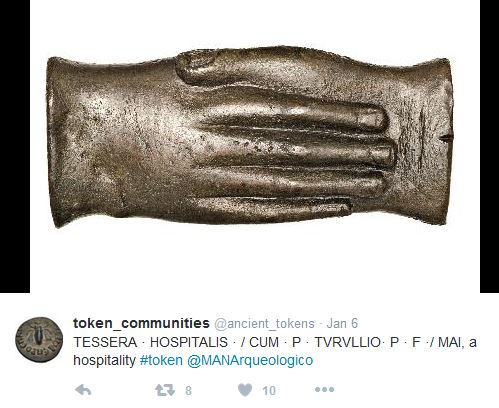
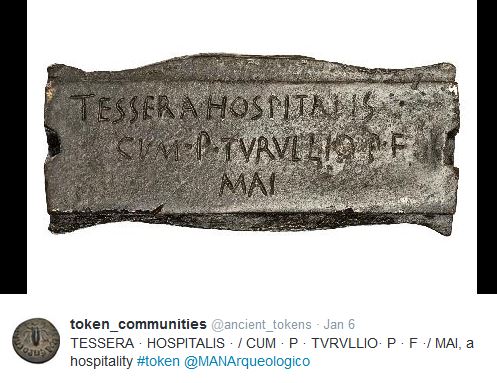
This is an idea that grew out of my last post which spiraled into tessera hospitalis, tokens of friendshipIt makes good sense that we have ones in the shape of joined hands.  The dextrarum iunctio was a common symbol of concordia and fides.  But what is up with all the half animals?  I think that it is likely to represent the animal sacrificed in the creation of the union.  I would also hypothesize that pigs are popular in this private domestic context for the same reason that we see pigs being used to seal a foedus.

Allow me to remind you of some famous numismatic pigs:

Capture.JPG

And sows:

Capture.JPG

capture

Image result for social war oath

Numismatics and Social Media

I have been taking a FaceBook break.  Just not loving the time suck and the lack of posts I care about from people I love.  I am however wondering if for professional reasons I shouldn’t perhaps pay a hair more attention to twitter.  I was doing more image research and came across the fabulous account (out of Warwick of course):

capture

And then this post that I just love:

Capture1.JPG
Capture.JPG

It made me think immediately of this one:

(Great photos in Il Tesoro del Lago 2001, p. 152-153)

And finding this image above led me to a how lovely set of images:

Image result for tessera hospitalis trasacco
Related image
Related image
Image result for tessera hospitalis trasacco
Related image
capture
Related image
Image result for tessera hospitalis trasacco
Related image

update 1.28.22:

source
source