Acrostolium (again)

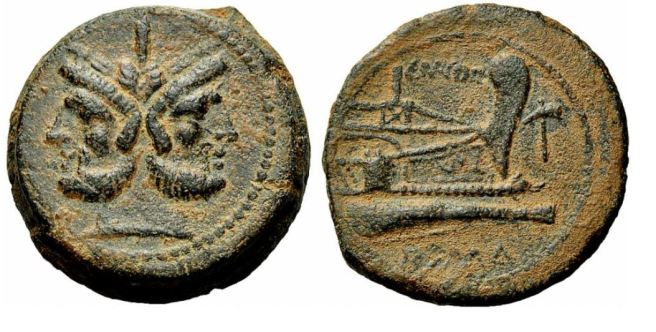
RRC 213

I lied.  I wasn’t ready to move on.  I kept poking around and my eyes caught this specimen from Andrew McCabe’s collection:

Image

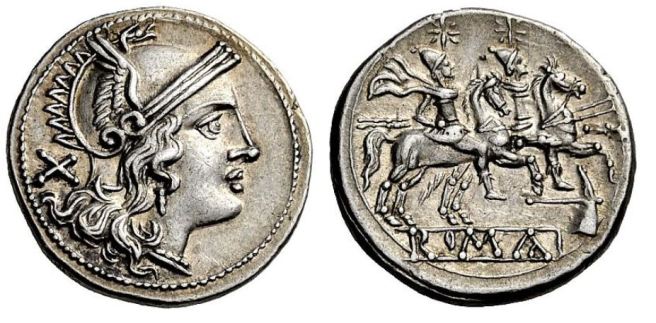
And I was surprised to see a head in the acrostolium because I thought I knew all the Roman republican types with this sort of head.  All two of them.  We discussed them at length earlier.  So I checked Crawford.  No such note.  Then the ANS and BM specimens.  Possible but nothing that really looked conclusively similar.  The auction catalogs gave slightly better results and I turned that uncia above.  The neck of the head seems really clear.  I assume that even when it isn’t clear, it is meant to be there:

Link

Figures on Prows (again)

I was poking through the ANS database thinking about the placement of symbols in relation to the main type.  Does the symbol float in the field?  Is it interacting with the figures?  Does it sit on a line suggesting it is on the same visual plane?  How can I be sure the placement is significant versus unintentional?  Of course I was looking for patterns, consistency, anything to suggest deliberate choice.  Doing this I stumbled upon the coins of Arados.  The mint is well studied and is well represented in most collections. See the specimen above.  Here are a few more:


These last two reminded me of our discussion of the seal of the Sidonians and possible precedents.  They confirm the use of the reclining figure on the prow in the region.

The first two make me think that small figures standing on prows were just part of the Hellenistic visual repertoire (esp. Athena) and that would make it more likely for the die engravers and/or designers to integrate a symbolic figure into the design proper….

So also the silver from Phaselis produced after 160BC when Rome detached it from Rhodes and added it to the Lycian Confederacy:


(It does look a wee bit Roman now doesn’t it.)

***

Enough musing back to my revisions.

Interesting Errors circa 1889

Capture

The website Forvm Ancient Coins has a Numiswiki for collaborative work.  I’m very impressed with their crowd sourcing transcription and editing of public domain books relevant to the discipline.  I stumbled upon this entry yesterday in the Dictionary of Roman Coins from 1889.   Two ‘errors’  are really intriguing.

1) The dating of the lex de limitibus.  This is the Mamilian law that proscribed the width of the strip of land dividing two properties and seems also to have governed the process by which disputes over these boundaries were adjudicated.  The date is controversial, as is the contents.   109 BC is the most common attribution, associating it with the same tribune who fought corruptions amongst the nobiles.   There are detractors though, most notably:  Morgan, L. 2007. The Moneyer C. Mamilius Limetanus. Ostraka 16.1: 195-201.  Leaving aside the modern debate, the date in this old general reference work is given as v.c. 589.  That’s A.U.C. 589 or 165 BC.  Somewhere, somehow, someone got the idea that the Lex Mamilia might have something to do with the Praetor Lentulus’ efforts to return Campanian land to ager publicus (public land) by paying off the holders.  There are two basic sources, Granius and Cicero, the former being the more substantive and narrative in quality.  This date doesn’t fit with any of the other prosopographical evidence or literary testimony.  It is most likely just flat wrong and a guess, but right now I’d give my eyeteeth to know where the idea came from.

2) An alternative obverse type.  The final sentence of the entry claims that the reverse is known with a different obverse.  Again, given the popular nature of publication there is no reference to the location or provenance of the specimen.  BUT the description is pretty clear.  It means the obverse of this type:

RRC 383/1

This error is easier to understand.  Either there was a forgery that combined the two, or some catalog entry or illustration was inadvertently created or suggested the connection, or someone looking through a collection mismembered what they saw.  [Yes, I know that’s not a real word. It should be though.]

The one problem with the otherwise fabulous quest to digitize just about everything in the public domain is that it generalizes and disseminates that information that is 70 years old, making that canonical and widely accessed knowledge.   I think this blog is slowly becoming an open access advocacy site.

81 thru 87 out of 410 days: Returning to a State of Grace

I did not coin the phrase, ‘The State of Grace, otherwise known as Brooklyn.’  That honor goes to an old friend who one December 31 I texted her asked what state she was in meaning was she still in the great Midwestern state of our birth and formative years or had she too already returned to NY.   I’ve adopted her reply as my watchword ever since.

Here I am myself.  The self I’ve chosen to be in my adulthood.  Here I know I am no better or worse than each of my neighbors.   Here I am home.

The details of domesticity and nostalgia from my sojourner on the great plains don’t have much of a place here.  The dissertation got read.  There were few to no coins except in the final chapter just to tease me a little.  The viva was won in the first moments by a brilliant opening statement far surpassing the introduction or conclusion of the written piece.  When the snake emerged, most of the committee joined in the defense.

And, yesterday was a good solid writing day with no blogging because I needed that.  I need just the peace of being at work.

80 out of 410 days: Work in Transit

20130905-095753.jpg
I have 3 hours and 15 minutes of time before being plunged into the land of my origin. My constant companion for the next five days is a Doctoral dissertation. It must be read by my return to the state of grace otherwise known as Brooklyn. Hopefully there will be some coins in it for light relief. Now to find a quiet corner of the airport. …

79 out of 410 days: Trial by Snake

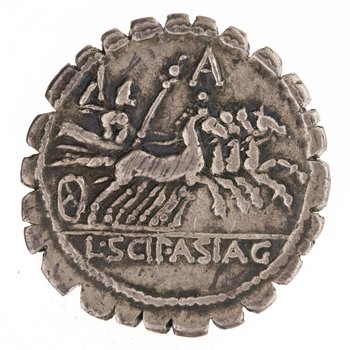
This is the coin type at the heart of the chapter I need finish by the end of the month. I don’t expect to write too much about it here as I seem to like to keep my free writing and the formal writing separate. Yesterday was mostly looking at possible (and impossible!) epigraphic references to other members of the moneyer’s family, the gens Mamilia. Today I was chasing up the references from an old article that suggested the type is all about the moneyer showing support for the Italians. Not an idea I’m ready to support, but the references he cited were all fascinating. Here’s the best of the lot:

In the bodies of these people there was by nature a certain kind of poison, which was fatal to serpents, and the odour of which overpowered them with torpor: with them it was a custom to expose children immediately after their birth to the fiercest serpents, and in this manner to make proof of the fidelity of their wives, the serpents not being repelled by such children as were the offspring of adultery. This nation, however, was almost entirely extirpated by the slaughter made of them by the Nasamones, who now occupy their territory. This race, however, still survives in a few persons who are descendants of those who either took to flight or else were absent on the occasion of the battle. The Marsi, in Italy, are still in possession of the same power, for which, it is said, they are indebted to their origin from the son of Circe, from whom they acquired it as a natural quality. But the fact is, that all men possess in their bodies a poison which acts upon serpents, and the human saliva, it is said, makes them take to flight, as though they had been touched with boiling water. The same substance, it is said, destroys them the moment it enters their throat, and more particularly so, if it should happen to be the saliva of a man who is fasting

The other references also mention snake taming, but they’re not quite as fun (Pliny NH 25.11, Serv. Aen. 7.750, Sil., Ital. Pun. 8.495-510). I find it hard to believe that Mamilius is claiming kinship with the Marsi as fellow offspring of Circe via the coin, but who doesn’t like a good snake story?! It made me think of the ritual being shown on this coin:

Propertius 8.4 helps us understand the image:

Lanuvium, from of old, is guarded by an ancient serpent: the hour you spend on such a marvellous visit won’t be wasted; where the sacred way drops down through a dark abyss, where the hungry snake’s tribute penetrates (virgin, be wary of all such paths!), when he demands the annual offering of food, and twines, hissing, from the centre of the earth. Girls grow pale, sent down to such rites as these, when their hand is rashly entrusted to the serpent’s mouth. He seizes the tit-bits the virgins offer: the basket itself trembles in their hands. If they’ve remained chaste they return to their parents’ arms, and the farmers shout: ‘It will be a fertile year.’

This seems to be part of cult of Juno Sospita, or at very least it took place in close proximity with her sanctuary and it is her head on the obverse of the coin. Here’s some recent scholarship with references. The cult at Lanuvium is rightly contextualized by the accounts of the powers to charm snakes linked to Circe and her ilk (Medea, Angitia, etc) and the origins of various Italic peoples and associations with specific Italian topography.

***

The original wire transfer is still lost. I spent a horrible time on the phone with HSBC. Again. We’re investigating other services… I took a break to write this post largely because I need to tamp down my rage to get back to writing properly.

75, 76, 77, and 78 out of 410 days: Transitions

Out of the economic chaos emerged the Civilian Conservation Corps (CCC). Its goal was two-fold: conservation of our natural resources and the salvage of our young men. The CCC is recognized as the single greatest conservation program in America and it served as a catalyst to develop the very tenets of modern conservation. The work of America’s young men dramatically changed the future and today we still enjoy a legacy of natural resource treasures that dot the American landscape.

I worked on Labor Day, but not like the men of the CCC did! I am in awe of the scale and lasting legacy of the New Deal.

Chapter six and accompanying apparatus is done, including an attempt at embedding html indexing codes. 8,667 words, excluding block quotations from primary sources. Just 1,667 words over my goal. SDA is reading for clarity before it goes out to the editor.

An editor of the book review I finished July 15 got in touch at the end of last week. The extra length won me devilish choice. Find a way to cut half of it and keep the original commission or accept a new commission for the same piece from a newer less well known journal with open access. (The editor happens to work on both journals.) In the end I decided to keep the length and will put a link on my academia.edu site in order that it might be read at some point my someone. Book reviews are perhaps the least prestigious type of publication. More like public service than something one engages in for personal career advancement. I found I couldn’t really bring myself to care too much about the relative prestige of journal and rather would have out there the fullness of my opinion.

I have 18 work days between now and when I leave for Turkey to turn the talk I gave in July into something ready for publication. That’s being realistic that I will not be working on it in Minnesota when I visit my mother (I have a whole PHD thesis to read then!), nor am I likely to work on it the day I actually participate in the PHD viva. It also saves three days prior to our flight for packing, cleaning, banking and whatever other odds and ends are needed to close up our NYC life and relocate to Turkey for 10 months.

On balance, I’m satisfied with my progress.

74 out of 410 days: Game Changing Scholarship

Image


Sometimes awesome publications just don’t get the attention they deserve. Sometimes a single inscription can completely change our reconstruction of an individual’s career and thus the shape of events and meaning of various symbolism.  Such seems the case with Díaz Ariño’s republication of the inscription first published by González, J. (1993), C. Memmius imperator, Habis 24, 281-286.  I’m sticking it up here largely just to give it attention.  RRC 427/1 doesn’t recall the moneyer’s uncle’s time in Macedonia, but instead his grandfather’s previously unknown Spanish campaigns.

There is also the great work being done by Saskia Roselaar mapping coin finds in Italy in time and space to reveal connections and patterns in those connections.  I love that she is making her work available as it develops.


73 out of 410 days: Pompey and Freedmen

Romans had a practice of granting manumission to some slaves.  Those receiving such grants held a separate status from the citizens, i.e. free men.  As freedmen they had more limited legal rights and defined obligations to their former masters, now their patrons.   That’s pretty basic, but the social function of this group certainly evolved over time and we might think about the attitudes and social conditions that preceded the evolution of the imperial freedmen.  I came across two passages today that got me thinking along those lines:

 These things I have heard; I have heard also that this theatre was not erected by Pompey, but by one Demetrius, a freedman of his, with the money he had gained while making campaigns with the general. Most justly, therefore, did he give his master’s name to the structure, so that Pompey might not incur needless reproach because of the fact that his freedman had collected money enough for so huge an expenditure.


While these men kept up their conflict, Pompey, too, encountered some delay in the distribution of the grain. For since many slaves had been freed in anticipation of the event, he wished to take a census of them in order that the grain might be supplied to them with some order and system. This, to be sure, he managed fairly easily through his own wisdom and because of the large supply of grain; but in seeking the consulship he met with annoyances and incurred some censure.

These passages would need to be contextualized by say Sulla’s mass manumission of the so called Cornelii, some 10,000 individuals, or the power he gave to Chrysogonus.  

The basic moral seems to be that benefiting too many freedman or one freedman too much is viewed with suspicion.  On the other hand our imperial sources may be reading too much of their present social reality back on to their accounts of the Republic.   

Contrast how Plutarch does not mention distributions to freedmen, but instead emphasizes that there was so much grain available it was give to foreigners as well — yet another group whose influence was a site of socio-political anxiety in the Late Republic.  Cf. the careers of Theophanes of Mitylene and Balbus.

I was getting a little lost in the literary accounts of 56-55 BC.  This post is just a little break to try to return to the coins.

100th Post: Visually Oriented

Yes. This is also 72 out of 410 days, but the 100th post seems to take numerical precedence. What is this obsession with base-10 numbers we have?!

At the beginning of this I set out some reasons why I was blogging. I’ve been asked what I get out of it by friends and colleagues: “what’s the pay off?” I’m a visual oriented person. This particular format of “picture first followed by text and more pictures and links to other tangential or directly related material” feels really natural. It’s an easy way for me to write. I find the image first and then let it flow from there.

It’s just like how I prep classes or write a conference paper or invited talk. Images are organized first with a few words on PPT slides and then i slowly craft a text while building a supplemental handout with chunks of primary sources and references to secondary literature. The three files grow simultaneously. This blog mimics for the book the conference presentation writing process prior to the chapter or article publication. Here is the playful connection of ideas. The fun and endless images, en masse and  in full color. The asides. The working out a way of saying something before it crystallizes on the page in front of me. The enthusiasm over the new-to-me discovery process rather than the certitude of a published thesis. I need a loose conception of audience and performance to motivate and inform my crafting of the words. Words that explain what I’m seeing in the images OR just words that capture the same resonance as the metaphoric image I’ve selected to reflect a loosely formed idea.

When I write conference papers I label the file ‘script’ not ‘draft’. I don’t want to confuse the oral form of the words with that which will be experienced on paper with footnotes and only a few select images.

Why do I write this way? The internet wants to categorize me as a visual spatial learner. This seems to be a Pop Ed buzz phrase. It seems to be happy fuzzy spin on how to teach autistic and dyslexic people and any one else who is a “problem” learner in some way.

Yes, this looks like me:

But, while my dyslexia and other learning disabilities are very very real, how I do “learn” doesn’t really seem to need a label. I also like sequences and statistics and spreadsheets with complex formulas. I’m a numismatist after all! And while I was a late reader (age 7 and not proficient until 9), I certainly have no aversion to reading texts, in either the literal or theoretical fashion.

So is the blog worth it? Absolutely.

postscript. It also, to a lesser extent, harnesses the power of social media distraction or internet procrastination. It means when I stop working the first place I turn to is in fact directly work related. I keeps me constantly on task. Or, demands, if I’n not on task, to explain myself. Thus, it is the outward manifestation of the superego and her big stick.

***

Full rough draft of chapter six exists as of this morning. Afternoon was spent keying in long hand, editing, checking citations, and rewriting.