162 out of 410 days: Translation and ‘Modern’ Prejudices

as in many particulars the desire of the multitude and the whim of the people were at variance with the interests of the republic

That is Yonge’s 1891 translation of a clause of chapter 103 of Cicero’s Pro Sestio.  Here is the Latin:

cum multis in rebus multitudinis studium aut populi commodum ab utilitate rei publicae discrepabat

The problem is commodum.  Cicero was a cranky old fart who had no time for the scum of Romulus’ cesspit, BUT he does not here speak of their whims.  [He’ll get to that topic just a few lines later.]  The English connotations of whims include: trivial matters not well thought out of perhaps only fleeting relevance.  That just isn’t how commodum is connoted in Latin.  It means something good and advantageous perhaps arriving at just the right moment.   It is very closely related in meaning to the next noun in Cicero’s passage “utilitate”.  Cicero’s point isn’t that the people don’t know what’s good for them.  It’s that what is good for the people is not good for the state.  It separates the identity of the people from the state.  That’s a pretty important idea to get across in the translation.  Yonge brings his own assumptions about the poor and their relationship to the upper classes to his reading of Cicero and thus sees implications that just aren’t there in the original.  

Now thanks to the public domain.  Many (most?!) readers of Cicero in translation will take Yonge’s prejudices for Cicero’s.

161 out of 410 days: Just a nice visual parallel and an update

Buste af en havnymfe (?). Hellenistisk-romersk ringsten

I was thrilled to find how much the Thornvaldsen Museum has digitized, especially their gems.  To that end here’s a nice illustration of the same subject as this obverse design from RRC 399/1:

In the past week I’ve let go a draft of a chapter to my editor.  A long overdue step.  I became very anxious about the Minucii and their column on which I’ve written many thousands of words that I no longer believe the more I look at the coins. I also wrote some about the coins of Lepidus the future triumvir.  The Minucii material may end up on this blog once I’ve figured out what I think about it all.  The Lepidus material will probably end up as a publication.   I’ve also been reading about written ballots at Rome.  I’ve struggled with the residency permit process and I’ve entertained a dear old friend.  So many words but not much blogging.

The Quaestor and his General

So I was reading about Tiberius Gracchus and came across the account of his dealings with the Numantines in Plutarch’s Life:

After this campaign he was elected quaestor, and had the fortune to serve in a war against Numantia under the consul Caius Mancinus, who was not bad as a man, but most unfortunate of the Romans as a general. Therefore in the midst of unexpected misfortunes and adverse circumstances not only did the sagacity and bravery of Tiberius shine forth all the more, but also — and this was astonishing — the great respect and honour in which he held his commander, who, under the pressure of disasters, forgot even that he was a general. For after he had been defeated in great battles, he attempted to abandon his camp and withdraw his forces by night; but the Numantines became aware of his attempt and promptly seized his camp. Then they fell upon his men as they fled, slew those who were in the rear, encompassed his whole army, and crowded them into regions that were full of difficulties and afforded no escape. Mancinus, despairing of forcing his way to safety, sent heralds to the enemy proposing a truce and terms of peace; 3 but the enemy declared that they had confidence in no Roman save only Tiberius, and ordered that he should be sent to them. They had this feeling towards the young man not only on his own account (for he was held in very high esteem by the Numantine soldiery), but also because they remembered his father Tiberius, who waged war against the Spaniards, and subdued many of them, but made a peace with the Numantines, to the observance of which with integrity and justice he always held the Roman people.  So Tiberius was sent and held conference with the enemy, and after getting them to accept some conditions, and himself accepting others, effected a truce, and thereby manifestly saved the lives of twenty thousand Roman citizens, besides attendants and camp followers.

This outstripping of one’s commander in diplomacy seems so oddly reminiscent of Sulla receiving Jugurtha’s surrender while Marius’ Quaestor.  Then there is also Scaurus’ claim to have defeated Aretas of Nabatea while Pompey’s proquaestor.  How odd is all this behavior? We could throw into the mix testimony of the decree of Lampsacus honoring their ambassador Hegesias.  Hegesias travels nearly the breadth of the Mediterranean in his efforts to secure Roman favors for his city.  He leave no stone unturned and is usually quoted for his use of kinship diplomacy mythical and otherwise.  For our purposes though we should note that he takes very seriously his diplomatic engagement with a quaestor, even after having dealt with higher ranking officials.

Update 28/11/2013: Or maybe it is a literary topos?  Consider the same characterization by Plutarch of Gaius Gracchus‘ actions in Sardinia as Orestes quaestor.  I owe the reference to the discussion by Garnsey and Rathbone in JRS 1985.  They emphasize how Gaius may have borrowed from his experience as quaestor in his grain legislation.

Update 5/7/2014: Here’s another instance of possible interest.  Snippet from Brennan, Praetorship (2000) 226:

Capture

153 out of 410 days: Translating Bread and Circuses

In my previous post on bread and circuses, I used a translation by Kline.  I admire very much Kline’s work making contemporary translations of Latin poetry available on the internet for non commercial use.  Poetry translations suffers perhaps most of all when we default to works that have aged into the public domain. Open source is the ethic way forward.  All that said as I thought about using it in my chapter I found myself concerned about pieces of the Latin not reflected in that translation.  Translation is very much interpretation, especially with such a value laden text as Juvenal’s 10th Satire!  Here are parallel sections of Kline and a much earlier translator Ramsey:

But what of the Roman Mob? They follow Fortune, as always, and hate whoever she condemns. … They shed their sense of responsibility long ago, when they lost their votes, and the bribes; the mob that used to grant power, high office, the legions, everything, curtails its desires, and reveals its anxiety for two things only, Bread and circuses. ‘I hear that many will perish.’ ‘No doubt, The furnace is huge.’


And what does the mob of Remus say? It follows fortune, as it always does, and rails against the condemned. … Now that no one buys our votes, the public has long since cast off its cares; the people that once bestowed commands, consulships, legions and all else, now meddles no more and longs eagerly for just two things—-Bread and Games!  “I hear that many are to perish.”—-“No doubt of it; there is a big furnace ready.”

I’ve decided there are a few places I can’t really live with either translation given my sense of the key portions of the Latin. Here’s the Latin:

                                                                  … sed quid

turba Remi? sequitur fortunam, ut semper, et odit

damnatos. idem populus, si Nortia Tusco

fauisset, si oppressa foret secura senectus

principis, hac ipsa Seianum diceret hora

Augustum. iam pridem, ex quo suffragia nulli

uendimus, effudit curas; nam qui dabat olim

imperium, fasces, legiones, omnia, nunc se

continet atque duas tantum res anxius optat,

panem et circenses. ‘perituros audio multos.’

‘nil dubium, magna est fornacula.’ 

So right now my own version is looking something like this:

But what of the mob of Remus? It follows fortune, as always, and hates the damned … No longer do we sell votes.  Responsibilities drain away.  Those who used to grant imperium, fasces, legions, everything, now restrain themselves, hoping all the more anxiously for two things: bread and circuses. ‘Many will perish, I hear.’ ‘No doubt, the furnace is huge.’  (Sat. 10.73-82)

The crowd being associated with Remus the murdered brother of Romulus needs to be preserved.  But perhaps most critical is the 1st person personal plural active verb “to sell”.  Juvenal gives agency to the sellers of their votes and includes himself and his reader in that group.  I shy away from reiterating ‘mob’ or ‘crowd’ as the subject of the later 3rd person singular verbs because in the sentence I’m cutting Juvenal uses idem populus  ‘the same people’ to gloss turba; populus is a much less negative terms and might as easily be rendered ‘citizen body’.  Notice especially how the past concerns of “imperium, fasces, legions and everything” are contrasted with “bread and circuses”.  The former evokes not just magisterial offices but particularly foreign policy, the later is standing for domestic affairs, the internal condition of the state.  I particularly like the word order of the last two snippets of direct discourse, but see no fluid way to reflect that in the translation.

Obviously, in places my rending is no more literally reflective of vocabulary and grammar than the other two, but few readable translations are.

Libertas with Arms Outstreched

Image

All the coins of C. Egnatius Maxsumus (c. 75-76BC) have a personification of Libertas.  Beside this representation above he also showed her riding in a biga accompanied by Victory and as a bust on the obverse of another coin.  Those representations are pretty standard and like this one the identification as Libertas is made by the inclusion of a pileus, the hat given to freed slaves. Here’s the whole reverse.   The pileus is above her in the architectural representation:

Reverse of RRC 391/2. 1944.100.1970

There’s lots to be curious about this representation.  If as Crawford says this is the temple of Jupiter Libertas why are there two cult figures?  Also, this is the first time a divinity is shown in their temple like this — a time that will become standard throughout the Roman empire for centuries.  The die cutter has gone to a lot of trouble to show the details of these figures the radiate(?) crown of Jupiter, the height of his staff, the different dress of the two figures, and their respective gestures.  The gesture of Libertas is an Orans type usually associated with priestesses in both Greek and Roman iconography. Here’s a Vestal from the early second Century AD (said to be from the Roman Forum now in the Terme Museum):

But given that the figure is just the same size and representation as Jupiter it must be a goddess and Libertas remains the best identification.  Later, Pietas will be similarly represented on coins:

Reverse of Silver Denarius, Rome, AD 196 - AD 211. 1944.100.51304

It rather understandable that Pietas could be personified through the action of prayer.  It is harder to find a divinity thus represented.  Unless we consider archaic cult figures.  Perhaps most famous is Artemis of Ephesus with her out stretched arms:

But also used in depictions of Artemis Anaitis:

Reverse of Bronze Coin, Attuda. 1944.100.47738

It is also know from some terracottas thought to represent Tanit:

Even with attributes in her hands this cult image of Athena from Abydos has a similar pose:

While I don’t put much stock in the idea that this specimen (or many other architectural coin types, with a few key exceptions) can be taken to be ‘accurate’ representations of buildings, it does seem to me the die cutter is going out of his way to represent particular cult statues here, perhaps ones of some antiquity or rendered in an archaizing fashion.

[A huge thanks to all my social media friends who shared their thoughts on this image with me!]

151, 152 out of 410 days: Visual Organization

20131117-111638.jpg

Yesterday, I decided I couldn’t see the shape of the chapter. So I moved off the computer and started sorting. 57 coins later I’ve got a pretty good sense of the intersections, but the linear narrative isn’t there yet. In the process I found a secondary topic that is just itching for independent publication as a ‘note’ somewhere. SDA had me dictate a draft of that piece to him first thing this morning so after the chapter is done I have something substantial to come back to. It was our second dictation attempt. The first was for a book review. The idea is to get more words on paper quicker with less fretting. So far so good. Okay back to my scraps of paper.

A Liberal Roman?

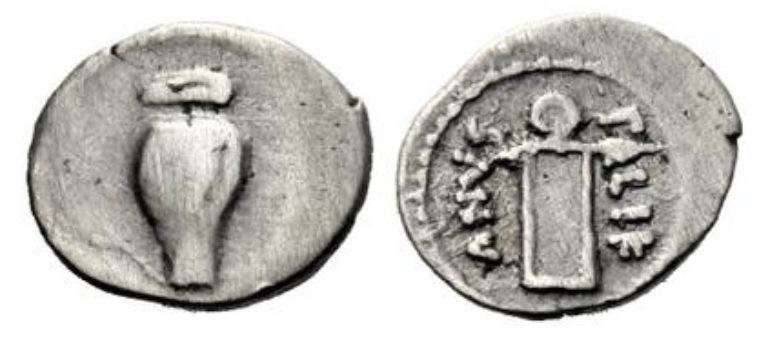
P. Licinius Nerva’s coin is pretty famous.  At least as an illustration of how the Romans voted.  It seems to celebrate voting reforms that protected the secrecy of the ballot, namely the voting bridges and the urn.  It dates to circa 110 BC [Mattingly, 113/112 Crawford].  It is a unusual coin, one of only a handful that refer directly to the rights of the citizen body that were under contemporary discussion.

reverse

With the Saturninus coin of the last post we don’t seem to have any reflection of his ‘radical’ views or concerns over agrarian policies and the grain supply.   This is often the case when we have coins of a known  historical figure.  Memorable deeds usually happened well after a man’s moneyership.  

We only know about one other incident in Nerva’s life.   As governor of Sicily he began mass emancipation of slaves claiming to be held illegally.  In the end that didn’t turn out so well for him and he probably ended up butchering those he originally freed or intended to free, but even so the initial decision is pretty radical in Roman term.  I suspect many of his peers would have thought him very very stupid indeed for trying such a thing.

Here’s Diodorus’ account (36.3 from Photius’ epitome).  Note how the initial impetus is problems with recruitment of soldiers in Asia to fight in Northern Italy!

Image

Image

Image

The Epitome of Cassius Dio put a different spin on the affair.  [I am inclined to put more emphasis on the Diodorus account.]:

Publius Licinius Nerva, who was praetor in the island, on learning that the slaves were not being justly treated in some respects, or else because he sought an occasion for profit, — for he was not inaccessible to bribes, — sent round a notice that all who had any charges to bring against their masters should come to him and he would assist them. 2 Accordingly, many of them banded together, and some declared they were being wronged and others made known other grievances against their masters, thinking they had secured an opportunity for accomplishing all that they wished against them without bloodshed. The freemen, after consultation, resisted them and would not make any concessions. 3 Therefore Licinius, inspired with fear by the united front of both sides and dreading that some great mischief might be done by the defeated party, would not receive any of the slaves, but sent them away, thinking that they would suffer no harm or that at any rate they would be scattered and so could cause no further disturbance. But the slaves, fearing their masters because they had dared to raise their voices at all against them, organized a band and by common consent turned to robbery.

Connecting ideology behind the coin to the ideology to his actions as propraetor seems a stretch, I admit! That said, most everyone is happy to do it to some degree for the Brutus coins of c. 54 BC.

Saturn, Saturninus

reverse

When Saturninus that rascally tribune of the very end of second century was a moneyer he chose types that punned on his name.  A pun that is emphasized by the abbreviation of his cognomen. It’s a rather conservative type for a man we don’t generally think of for his conservatism.  Quadrigas had already been recently revived by L. Conelius Scipo Asiaticus [103 BC Mattingly].

Reverse of RRC 311/1d. 1896.7.44

and puns too were the fashion of the time.  Compare this bull (= taurus) used by L. Thorius Balbus.  Crawford thinks the bull might be a symbol of Juno on the obverse (see p. 719 n. 8 of vol 2 of RRC). Maybe it is both.  [102 BC Mattingly]

Reverse of RRC 316/1. 1937.158.34

Anyway, the interesting thing is the Saturn, Saturninus association. It makes the choice of Saturn for the obverse of the Piso Caepio coin seem a little odd in light of our literary sources:

Image

Here’s the Broughton, MRR entry for them under 100BC, Quaestors:

Image

We might also note the use of Saturn as an obverse in 103BC [Mattingly], the year of Saturninus’ first Tribunate, by L. Memmius Gallus:

Obverse of RRC 313/1b. 1937.158.31

Mattingly has Saturninus’ offices as follows:

104 – Quaestor in charge of Grain Supply from Ostia 

103 – First Tribunate

101 – Moneyership

100 – Second Tribunate

We usually think of moneyerships being held before these other offices, but the dates of the other offices are well fixed.  So perhaps Saturninus had his ‘out of order’.  Otherwise his coins would need to be slipped back into the series earlier that 104 and that is apparently hard to reconcile with all the rest of evidence.

148, 149 out of 410 days: The Dating Game

Ideally, one dates coins by the hoard evidence.   People squirrel away pots of money and for whatever reason never come back for their savings.  These groups of coins help numismatists figure out which coins were minted in what sequence.  The numismatist takes all the hoards and tries to arrange them into a sequence of newest to oldest based on the contents.  They end up with a much more complicated version of a chart like this one with the coin makers down one side and hoards down the other with the number of attested specimens of each specimen listed:

Capture

The wear of the coins — a subjective judgment up to a point — can be used to bolster support for such a relative chronology.  So in our fictitious chart it would be reassuring if the coin of Bob was really worn and crummy  looking in the Greece hoard, but the specimens in the Bahamas and Cayman hoards were nice and shiny.  So far so good for accuracy.  But what about Gigi and Heidi?  Did they make coins at the same time?  Or, did one come before the other?  Would wear help in such a case?  Would we trust that kind of assumption?  What would we say if their coins looked really, really similar in all the fine details?  What would we say if the looked totally different, not just different subject, but as if artists with two totally polarized styles did the carving?  Would that make them less likely to have been made at the same time?  What criteria would we use to make the judgment?  Observation of stylistic similarities and differences often influences how coins are grouped in our relative chronologies.  The similarities or differences are not themselves wholly subjective, but the interpretation of their meaning is.   Even once one has a fairly decent relative chronology, it needs to be hung on an absolute dateline.

Look at the chart again.  Notice three hoards all close with coins by Frank: Exeter, Easton, and Edmonton.  And there sure are a lot of Frank’s coins left around, even in the Greece hoard.  Here the numismatist might assume that Imaginaria (the hypothetical state whose hypothetical coins we’re studying) was at war.   Wars are expensive.  Lots of coins get made to pay troops and suppliers, etc.  Lots of people also get scared and hide their coins.  And, lots of people also die, making it harder for them to come back and find their pots of coins.  Not great for them.  Very useful for the numismatist.  But can we be sure?   What would be really useful is if it turned out we had an exact date from some literary text that said that Eastalia (ancient Easton) was burned to the ground on 14 February 530 AND that a professional archaeologist found the Easton hoard under the layer of destruction firmly associated with this known historical event.  But that rarely happens.  Usually hoards are found by metal detector hobbyists in areas never likely to be professionally excavated let alone tied to a literary record.  More commonly we take stray finds of coins from controlled excavations in areas associated with major historical events to help establish a terminus ante quem for specific coin types and then tie that back into the relative chronology of the hoard evidence (e.g. Morgantina vel Numantia).

But that’s not all!  The Roman republican numismatist has many more tricks up his sleeve.  Meet our comrade: Prosopography.   It is the subtle art of constructing an Ancient Who’s Who.  It tries to figure out the inter-generational and marital relationships and career path of each known historical figure.   To do this it uses inscriptions and literary testimony and combines those with assumptions about typical naming customs in specific families, regulations governing the holding of public office and more.  Why would this help the numismatist date coins?  Well, if we know an Edgar was elected to a magistracy that had a minimum age requirement of 45 in 542 and we think the typical age for a moneyership was thirty, then maybe we can assume that the coins of Edgar were made about 527.   If it is the same Edgar and the time separating his magistracy and his moneyship were at the standard interval and if our assumptions about what that interval is are all correct.  Still, it’s better than outright guessing.  Ancient historians use the evidence they have.   We might also use this type of evidence to help our relative sequencing.  The order in which Isaac, Justin, and Kira held some later office might provide a clue to the order in which they held the moneyership.

There are also times when specific issues are tied to known historical events and that information is then tied back into our relative chronology.  Sometimes the coins are absolutely associated with an event but the historians and coins geeks like to fight about when the event really happened base on a wide range of evidence (e.g. founding of Narbo).  Other times the association of coins with a well dated historical event is based on assumptions about what the image meant to the original viewer (e.g. the oath scene on the coins TI.VETVR).  These historical arguments become relevant to the whole series as the relative chronology from the hoards is hung onto these apparently fixed points.

Surely it’s not so shaky as all this?  No, not completely.  We know there were three moneyers each year and so for the Roman Republic (not Imaginaria discussed above) we also get to divide our group of moneyers into ‘colleges’ and if we feel confident (on stylistic grounds?!) about those colleges then we can sequence our relative chronology into years more easily.  And, every once in a while we get a new big hoard with a useful closing date and it confirms and/or updates our preexisting arrangements (e.g. The Mesagne Hoard).  Good archaeological evidence also comes along periodically. And, scholars with bigger brains than mine have been working on the arrangement and refining the details for a very, very long time.   The relative chronology is likely to shift but not drastically so.  The absolute chronology is probably good within at least five years (so Crawford himself, RRC I p. 74 speaking about the 2nd century in particular).

The problem comes in how both numismatists and historians (and archaeologists too?) treat the years given to coins.  Certitude is a dangerous thing.  RRC for most types affixes a specific year.  Modern databases are great things but most aren’t programmed to accept the input of anything but a specific year or range of years.  None of the major coin databases I use have included data about post-Crawford dates.  This creates a default to Crawford.   However, updating the dates to new scholarship doesn’t really fix the intellectual problem.  The dating of any one coin in the series is usually based on dozens of assumptions about the plausibility of its place in the sequence and the relationship of that sequence to real time.   There is no one place any scholar, let alone student, can go to have all thought assumptions spelled out for the individual coin type.  The discussion and charts are condensed and focused on portions of sequence and their interrelationship.    It’s not a house of cards, but it is not bedrock either.  There is no open invitation to inspect the foundations in the minutia.

And the minutia is often what interests historians.

A few precious coins once in a rare while get their own independent date based on other criteria.  When the historian opens a coin catalog or database each type has a specific year or year range attached to it.  This then informs how the type is discussed along side literary accounts.  The archaeologist may even use these dates to determine the deposition dates of certain related finds.  Dates are one of the things that makes coins relevant to other discussions.  Change the date of a coin by a few years or even just change the sequence of two coins and the whole picture changes.

Crawford dates this coin to 134 BC.  Mattingly to 133 BC.  Not that big of a difference.  Both use this hoard  as the basis of their arguments.

reverse

However, this very similar coin showing the same monument is put five years later in 128 BC by Mattingly, but one year earlier, 135 BC, by Crawford.  Mattingly has the advantage of the “New Italy Hoard” to reverse the relative position of the two coins and suggest a gap between their issue. [Hersh, NC 1977: 24-27 with Crawford,  Survey Num. Research 1979: 172f. and which for some reason I can’t find in the Hoard Database. Grr.]

reverse

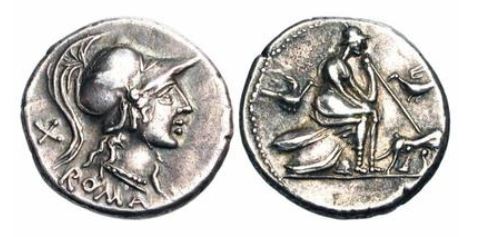
Thus we now think the representation of the monument became more elaborate not less in the second representation and that it was revived rather than continued. (I find a a satisfying logic in the fact that the earlier coin with its radical departure from traditional Roman coin iconography would say ROMA on it.)  Moreover, where do we fit this celebration of the Minucius who suppress the populist Maelius and then distributed his grain to the people at a low price for which he was honored with said monument.  (I link here to Livy, but there are also relevant references in Dion. Hal. 9.4, Pliny NH 18.15 and 34.21.)  Obviously there is some link between this narrative, the coin image used at this time, and the political circumstance surrounding Tiberius Gracchus’ famous tribunate of 133 BC.  But what?   We used to think it was the image used the year before Gracchus now we need to consider what it means for the imaged to be deployed in the same year and for the image to be revived five years later.   And then what about this coin of M. MARCI MN.F?

reverse

Everyone is pretty sure those big ears of grain popping up under victory recall an ancestor (even his father perhaps?!) who distributed grain at a cheap price as aedile (Pliny, NH 18, 15).  But as far as I can tell the hoards help us not a lick on the relative chronology between this assertion and the similar one made by the first Minucius coin above.   Mattingly fits it in the year before and sees the Minucius as an elaborate rebuttal to Marcius’ claim.   Crawford has it coming after.  The historian worried about the political climate at the time of the Gracchi would sorely like to know which.

Enough. For now.