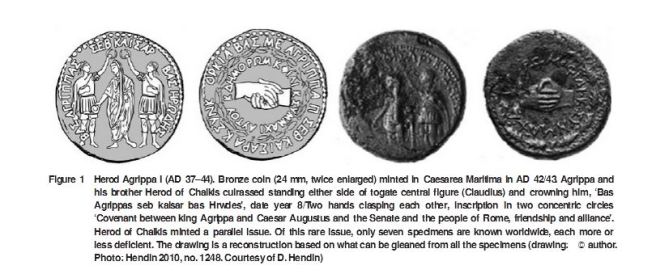
This image is from this 2013 article by Andreas Kropp. He also has some comments on the coin type in his monograph of the same year on p. 39 and here in this other article. I wanted to put it up here to connect it with my earlier post on the iconography of crowning, esp. as it has two figures doing the crowning as in the literary testimony from Demosthenes quoted there AND because it helps us think even more about the power structures implied by the act of crowning, as well as by hand clasping iconography of the reverse.
Update 2/27/16: cf. also RRC 470/1c: What’s interesting is that the crowning is symbolically equivalent here supplication with a branch….
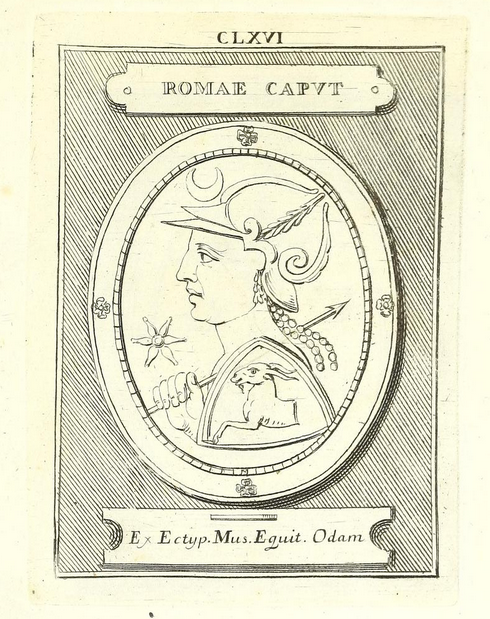
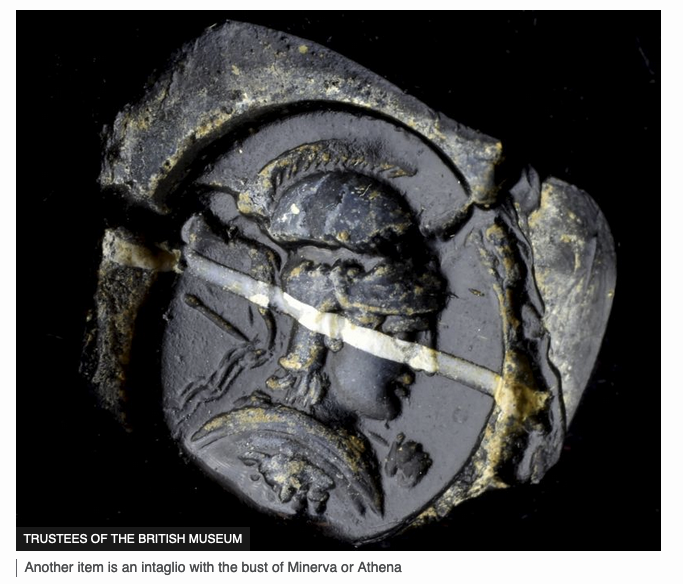
This obverse type Crawford identifies as Roma (292/1) on the basis of comparison with this gem (apologies for poor image) which (apparently) bears the inscription AVE ROMA:
Links to original publication on Archive.org
I just wanted to throw up this coin type (494/35) as well to put all three next to each other for future reference:
Links to acsearch.info entry
Notice the emphasis put on rendering Roma’s hand clutching the spear before the shield. Also notice the variation in shield designs.
Update 4/25/16:
Little did Crawford know there was a better parallel right in the BM collection (1923,0401.408). Notice the star and crescent which has become crescent and denomination mark on the denarius. Even the shield design is the same!
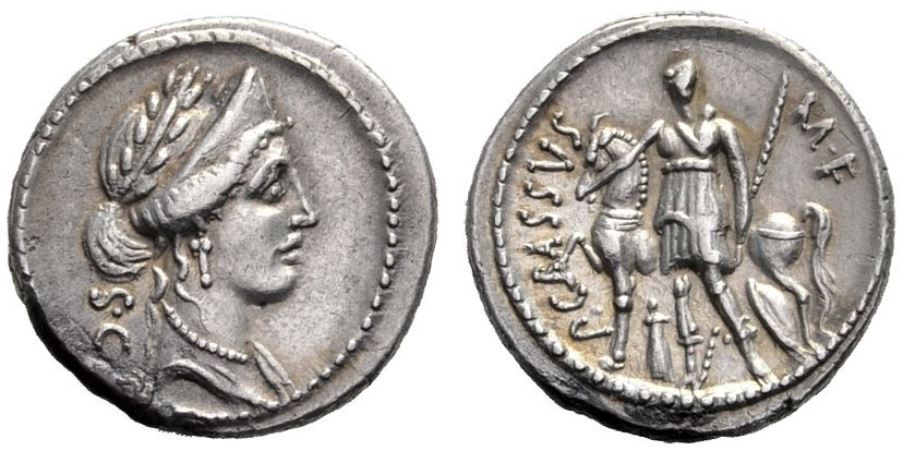
This type (430/1) minted by the son of the the Triumvir, Crassus, doesn’t I think get enough attention. The Venus is clearly Venus Victrix who appears on Pompeian types (cf. esp. 424/1 and 426/3) and will soon be co-opted by Caesar (cf. 465). The reverse shows a standing Amazon leading her horse with her face in 3/4s profile. This and the shield and cuirass below the horse make me 90% certain this is a statue being portrayed or at very least the designer is borrowing from a well known statue type and the cuirass and shield are part of the support system of the horse statue.
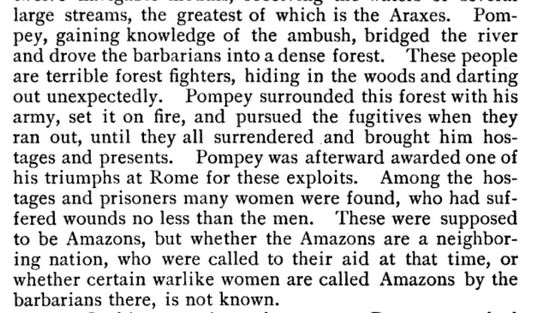
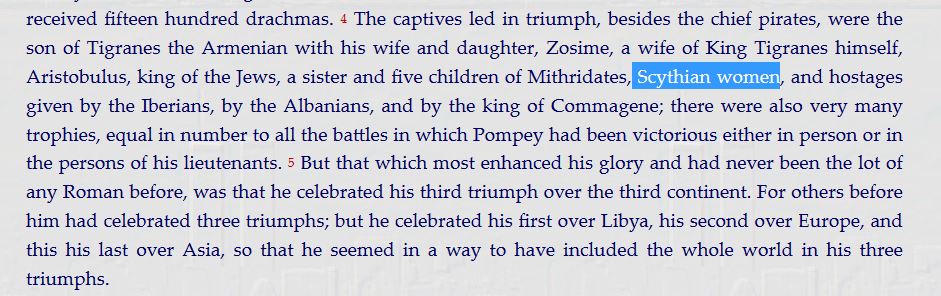
The reverse brought to mind this passage from Appian about Pompey’s adventures with the Amazons (12.103):
I feel I’m forgetting some famous Amazon statues at Rome in the republican period that would be relevant in this context. I’ll remember at some point, or not.
Is it then a proverb of ours or of yours that a Phrygian is usually made better by beating? What more? Is not this a common saying of you all with respect to the whole of Caria, if you wish to make any experiment accompanied with danger, that you had better try it on a Carian? Moreover what saying is there in Greek conversation more ordinary and well known, than, when any one is spoken of contemptuously, to say that he is the very lowest of the Mysians? For why should I speak of Lydia? What Greek ever wrote a comedy in which the principal slave was not a Lydian?
As the sella curulis and fasces come up again and again on the republican coin series, I wanted to put a note up here of this iconography from Vulci (c. 300-280 BCE).
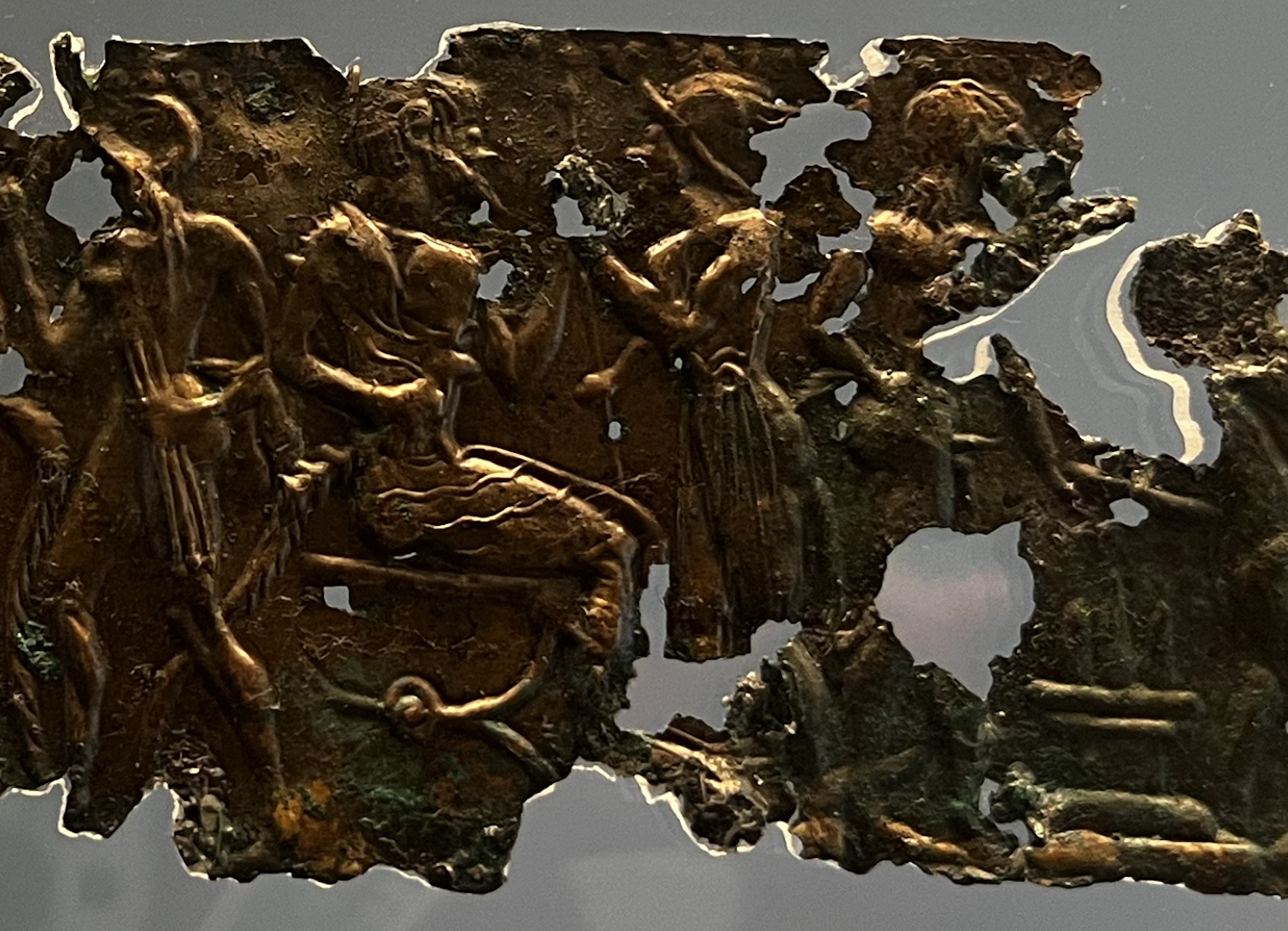
This is the front of the sarcophagus of Ramtha Vishnai and Arnth Tetnies (Now in the MFA Boston). The couple join right hands on the far left of this snippet (the center of the panel itself). Behind the husband are his attendants, one carries a chair and the other a rod, and then behind these are the musicians.
Update 20 Apr 2023:
Spotted this curule chair on a long small bronze relief in the Vatican 2023-04-15. More pictures of the same relief are in my camera back up on dropbox if they every become relevant.
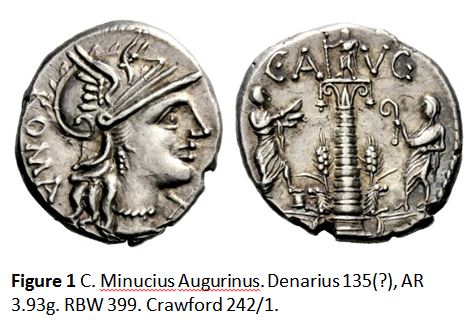
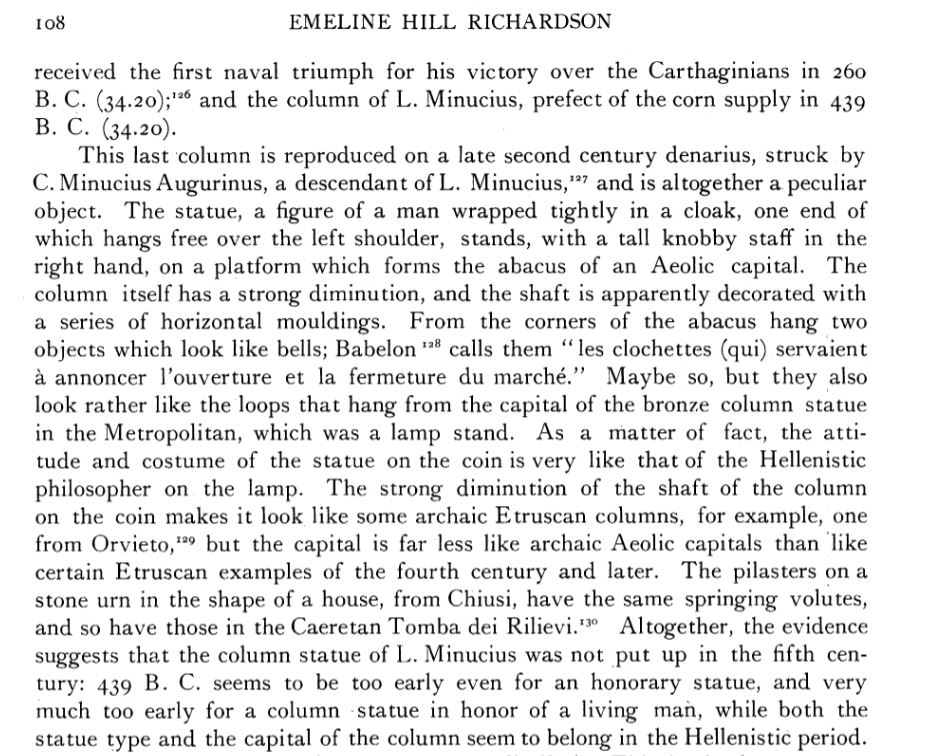
Off blog (and a little on the blog) I’ve worried quite a bit about the coins of the Minucii. I came across a different view of potential comparative iconography today, the work of a mid 20th century Etruscan scholar.
links to JSTOR
It was easy enough to get an image this:
I’ll have to track down her other references later…
Oh how I love a good digitized book! A FB friend helped me decoded that Crawford reference I was worrying about a while back. Which, in turn, led me to discover the joys of this late 19th century reference work and its rich repository of images.
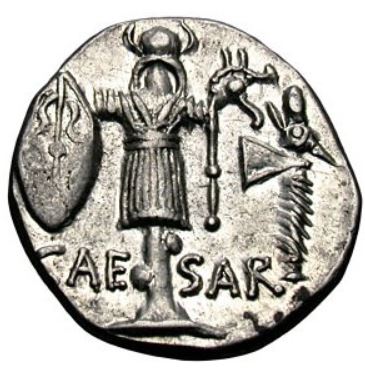
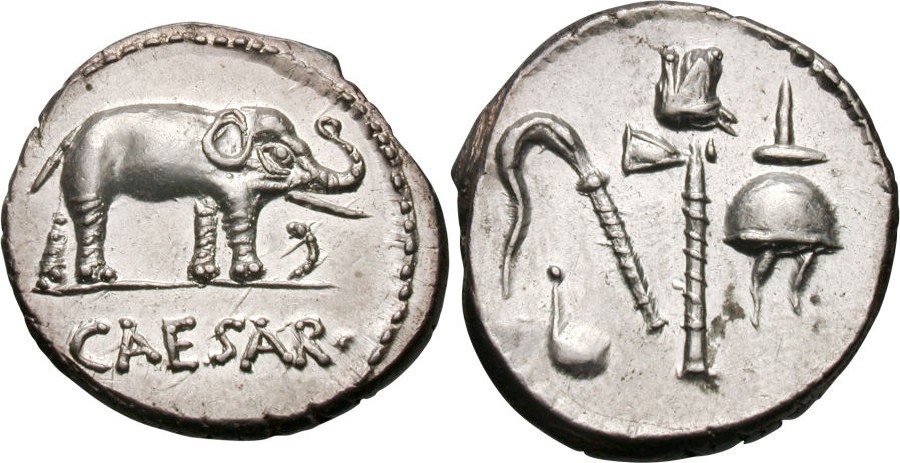
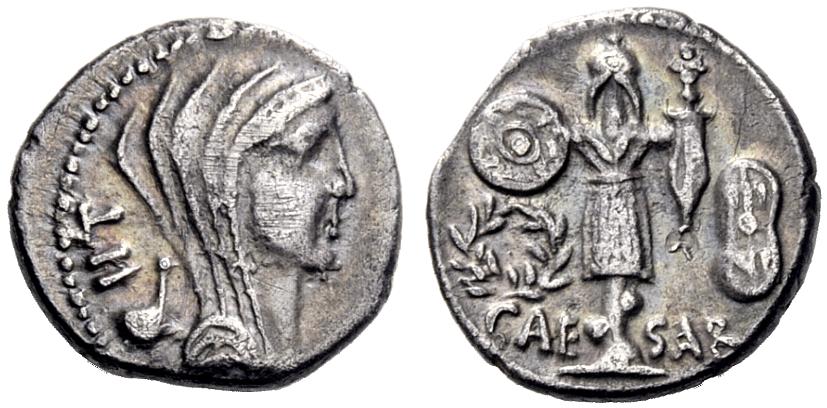
One of the delights of Caesar’s early Civil war coinage (RRC 452) is the attention that is given to the military attributes. Often the axe is off flan on the silver or worn away so as to obscure the wolf (or dog) head terminus (it is easier to see on the gold; cf. also 532/1). Also notice the Gallic helmet is imagined with double horns. Crawford does not both to mention either feature. I’m worried a little about this axe. Compare it to the axe on the reverse of Caesar’s famous elephant coin.
links to acsearch
The theme of this reverse is clearly priestly implements, but I can’t find a single other non-Caesarean priestly axe with an animal terminus. They might exist (I didn’t waste that much time on this!), but they certainly aren’t common. (Cf. priestly implements on architectural relief, numismatic examples). So is the wolf headed axe specifically Caesarean? Or Gallic? Or both? Did Caesar make his own axe as high priest a trophy of his Gallic victories? Now that’s a highly speculative claim. OR, is the axe next to the trophy actually more like the wreath on this other Cesarean coin:
links to acsearch entry
There is a strong contrast between the attributes of the trophies on this series. It is hard not to imagine that a different victory is not here being celebrated. Is that a Macedonian shield?
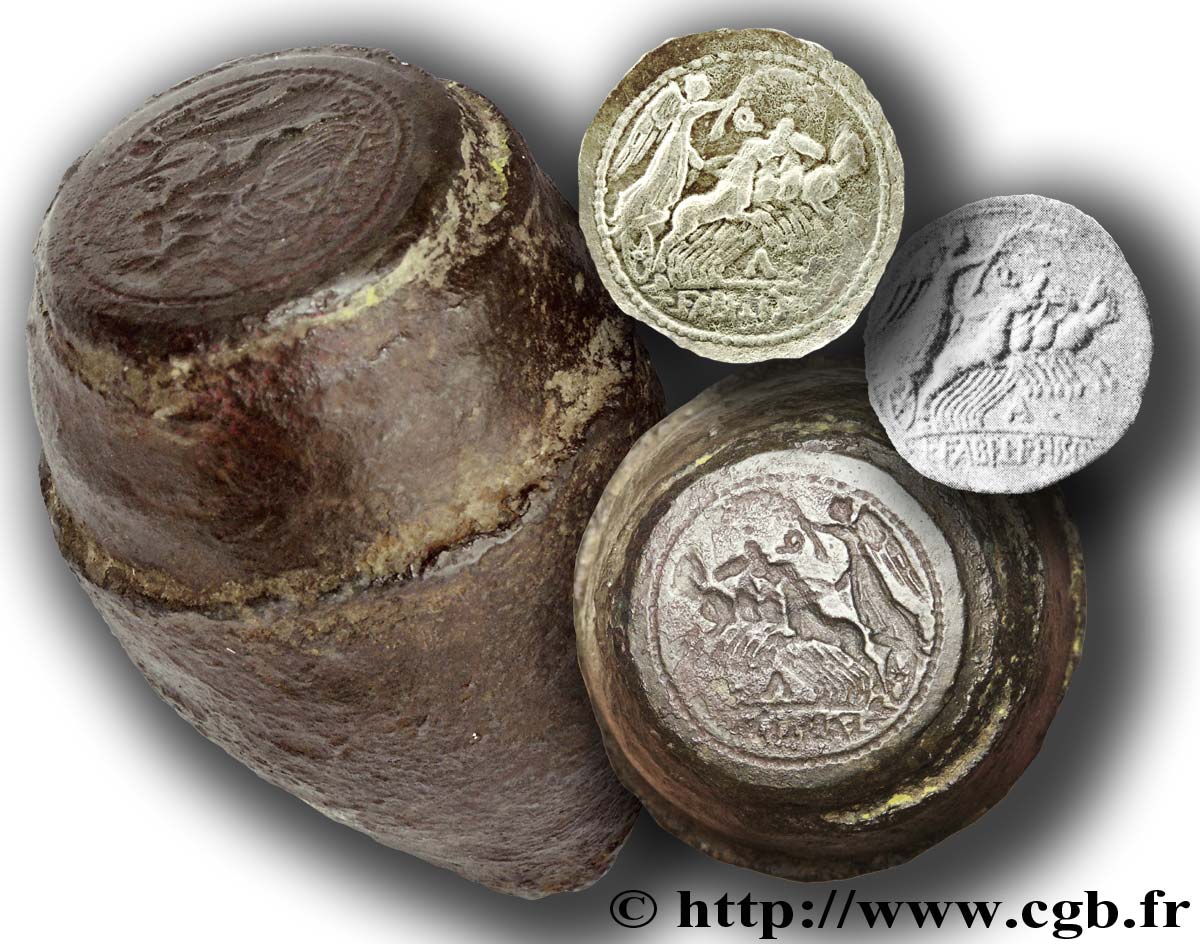
Gosh, I wish I knew where this piece ended up and that that place is a museum with a culture of laboratory testing. There is so much more I want to know about this piece.
Here is part of the sales catalogue entry in English:
For this type, Michael Crawford noted [an estimate of] six mint marks (A, [B unattested in RRC], C, D, E, F, RRC I, table XXXI, p. 383). The author reports that each letter is attached to a single die. This die, found near Orange, in a chance discovery area has been declared to the D.R.A.C. Provence-Alpes-Côte d’Azur in 2005. We determined that it was a die of the Roman Republic for coins struck on behalf of Lucius Fabius Hispaniensis in 82-81 BC . in a traveling workshop (Crawford No 366/2B). This die measures 53 millimeters by 34.5 millimeters and weighs 261.23 grams. The etched portion is 22 millimeters, 18 at beading. This die, in our view, consists of two distinct parts, probably tempered iron carrying the engraving and set in a tapered iron support, definitely soft iron, having a small bulge in the widest part. This money was used to strike the back of the copy of the British Museum (BMC / RR. II, p. 355, n ° 29, pl. C, No. 5, from the collection of the Duke of Blacas). Found in the South East of Gaul by Province (Narbonne), could it be that we are in the presence of a traveling workshop, moving with the troops going to Spain or rather returning to Spain? The die is not voided in anyway. It is not very worn either. It shows no break or trace die of deterioration or surface alteration. It seems official. With the copy of the British Museum, we have evidence that it was used. However, it has an alteration in the legend which seems to prove that the BM specimen was struck before the current state of our die. Finds of dies are exceptional, cf. JB Giard BN / R. I, p. 18, pl. I which lists the seven dies of the time of Augustus and BN / R. II, p. 7-10 that lists nineteen dies for the period between Tiberius and Nero. Most of these coins have been found in Gaul and Spain. The finding of dies of the Republic is exceptional.







 Liv Mariah Yarrow