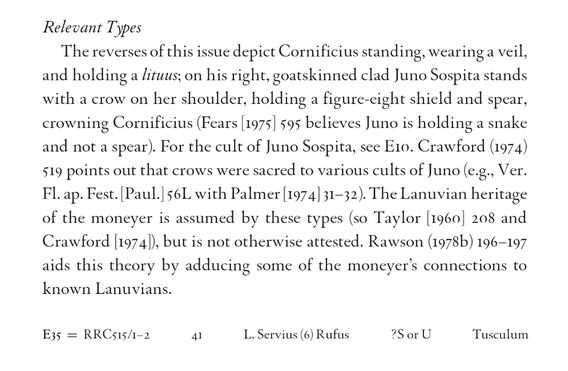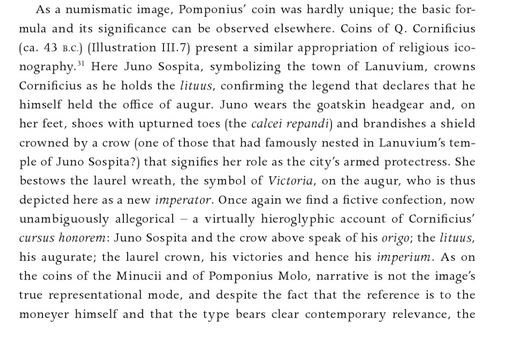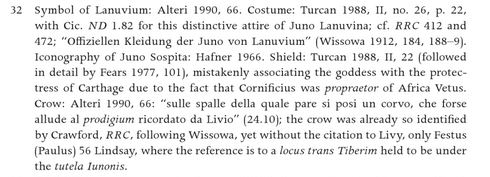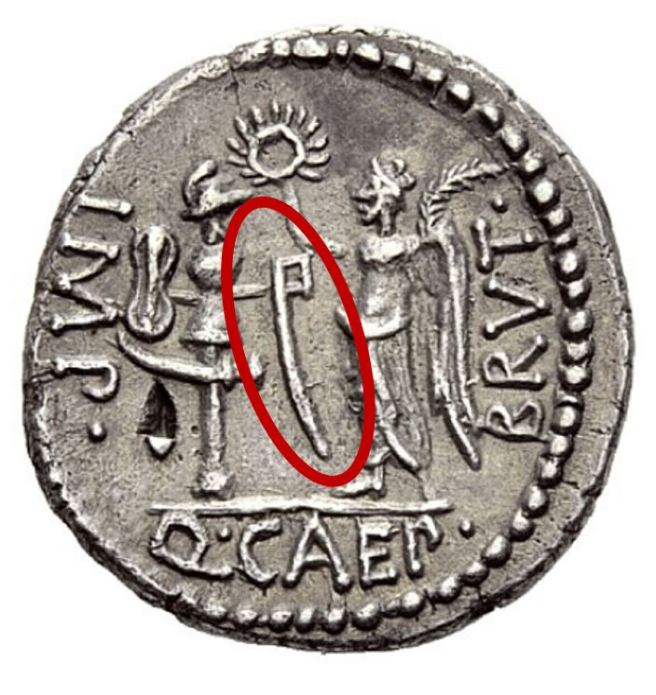
SC on the coins of Faustus

Links to acsearch.info entry

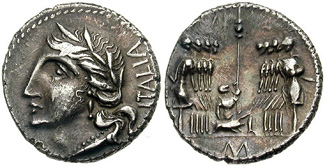
So only two of Sulla Faustus’ types have S.C. on them (426/3, 426/4a, and 426/4b).  Both of these also honor Pompey with there types and suppress the name of the moneyer by using ligature.  I wonder if we can’t connect that S.C. with the degree mentioned in Cicero’s letter to his brother:

On the 5th of April, by a decree of the senate, a sum of money amounting to CCCC sestertia was voted to Pompey for the business of the corn-supply. But on the same day there was a vehement debate on the Campanian land, the senators making almost as much noise as a public meeting. The shortness of money and the high price of corn increased the exasperation.

This is in the year 56BC.  Notice the coin type above actually refers to the command over the grain supply.  Here’s Broughton MRR II.211:

Capture.JPG

Of course numbers in manuscripts are always subject to corruption, but it seems likely that Faustus’ extra minting was because of this!

2/28/16:

Cf also this passage from Dio:

The fact, however, that Caesar’s influence was increasing and the people admired his achievements so much that they dispatched men from the senate, on the supposition that the Gauls had been completely subjugated, and that they were so elated by their hopes based on him as to vote him large sums of money, was a cruel thorn in Pompey’s side.

Sulla’s Hercules

Capture
Links to Acsearch.info entry

So I’ve never been really that in love with the Melqart explanation of this obverse.

Lenaghan L. H. – Hercules-Melqart on a coin of Faustus Sulla. ANSMusN 1964 XI : 131-149.

I’m more interested in how the FEELIX is juxtaposed with this Hercules.  I want to follow up on Sulla’s devotion to Hercules.  Here’s Keaveney in the 2005 edition of his book (orig. 1982):

Capture
Capture1

And a link to that last citation.

Santangelo will have something smart to say on this as well I’m sure… I’ll follower up later.

[CRRO 426/2 entry]

(source ; academic online citations of same)
(search engine, but note Clusium inscription missing!)

Slaves and Roman Religious Festivals

At some point when I have time, I’d like to read Cicero, On the Responses of the Haruspices 22-27 against Dionysius of Halicarnassus, 7.68.   The former describes the disruption of the festival of Great Mother by Clodius, the latter a legendary event from the time of Coriolanus when a slave accidentally appeared to have led a procession in honor of Jupiter (Cf. Plutarch too).

The religious status or non status of slaves is interesting, as is it to think about what more recent events Dionysius may have been using as lens to understand the legendary past….

More on Goat Horns

Capture.JPG

The little nubbins sticking out of the head of Demetrius Poliorcetes (if that’s the correct identification of these statues) are the base of goat horns that have broken off.  These  aren’t on a helmet, but are still clearly part of the royal iconography of Philip V’s predecessors on the throne of Macedonia.  (Images and Discussion from Pollitt; Cf. also Ridgeway 1990: 125).

My concern over the identifications is based on the oft-stated ‘similarity’ between portraits in the round and coin iconography for Demetrius.  On the coins he wears bull horns from the his temples not goat horns from his hairline right over his forehead:

Capture1

Capture2

Coins link to Acsearch.info.   I chose these two types both for the portrait variations they represent, but also as nice comparative examples of early Hellenistic horse and rider iconography and a nice clear aplustre as a naval victory symbol.

Crowning and Personifications in the Early Hellenistic Period

Capture
Links to Beazley Archive

I’m still worried about the development of the iconography of crowning and its symbolism. In whom does the power lie?  The crowned or the crowner?  Which is the superior position?  Most of the time it seems to be the crowned but not always…  Anyway here are two more early images to throw into the mix.

Capture
Links to pdf of original academic publication

Earlier posts on the same topic.


Scaurus’ Aedileship and Pompey’s Theatre

So I was reading a old blog post as I’m writing about Scaurus’ aedile issue for other reasons.  This made me re read this passage of Pliny below.  Do you know what’s really weird about this?  At the very moment Scaurus is importing 360 columns for a temporary theater, his former commander Pompey is in the process of building a REALLY opulent permanent theatre on the Campus Martius that will be dedicated in just 3 short years.  Pliny tells us that largest of the columns went to Scaurus’ atrium afterwards, but what about the rest?!  Did he auction them off?  Did they end up in Pompey’s theatre complex.  Was the whole thing a way of getting extra mileage and spectacle out of the Pompeian building project.  How did Pompey feel about it if it wasn’t?  Surely upstaging your former commander was a bad idea.  How did Pompey feel about Scaurus’ claiming the Aretas victory… ? The politics of 58BC makes my brain hurt.

Pliny NH 36.116:

In the ædileship of M. Scaurus, three hundred and sixty columns were to be seen imported; for the decorations of a temporary theatre, too, one that was destined to be in use for barely a single month. And yet the laws were silent thereon; in a spirit of indulgence for the amusements of the public, no doubt. But then, why such indulgence? or how do vices more insidiously steal upon us than under the plea of serving the public? By what other way, in fact, did ivory, gold, and precious stones, first come into use with private individuals? Can we say that there is now anything that we have reserved for the exclusive use of the gods? However, be it so, let us admit of this indulgence for the amusements of the public; but still, why did the laws maintain their silence when the largest of these columns, pillars of Lucullan marble, as much as eight-and-thirty feet in height, were erected in the atrium of Scaurus? a thing, too, that was not done privately or in secret; for the contractor for the public sewers compelled him to give security for the possible damage that might be done in the carriage of them to the Palatium. When so bad an example as this was set, would it not have been advisable to take some precautions for the preservation of the public morals? And yet the laws still preserved their silence, when such enormous masses as these were being carried past the earthenware pediments of the temples of the gods, to the house of a private individual!

Hybrid or Imitation?

Capture
Links to acsearch.info entry

NAC cataloging is usually above question, but I’m going to need some die links to convince me that this is actually a hybrid and not an ancient imitation.  I agree with what ever ancient decided to cut it open to check it’s purity.  It looks a wee bit fishy as an authentic product of the Roman mint.  (Although I acknowledge controls on the style of dies isn’t particularly strong at the mint)  It’s an interesting specimen either way!