Troublesome Quadrupeds

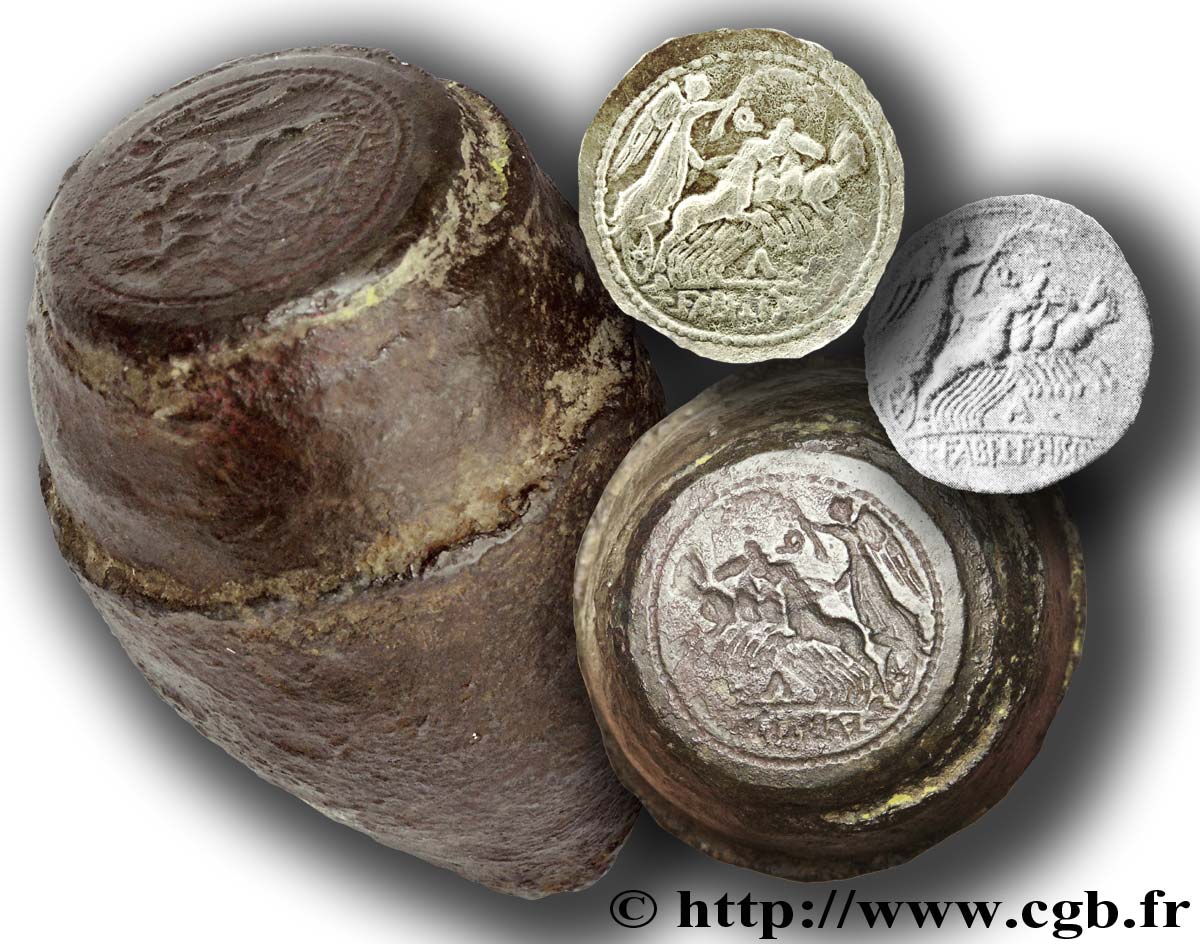
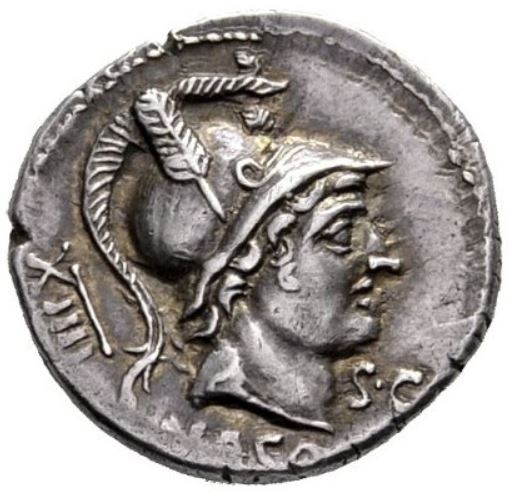
Silver coin.
RRC 123/1; BM registration no. 2002,0102.572

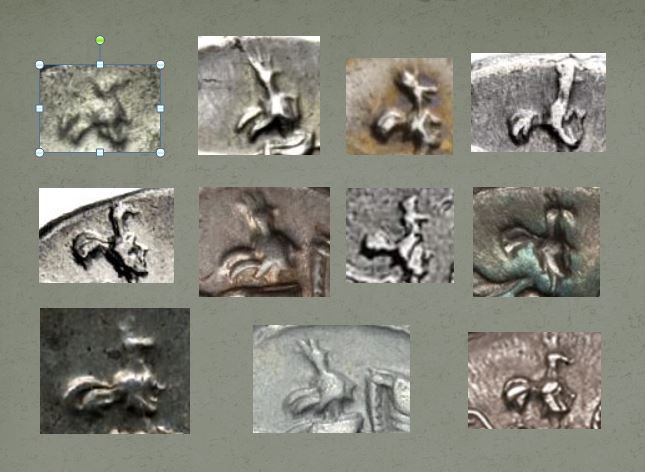
Crawford labels this quadruped as a ram.  Not a great fit.  Hersh thought differently:

Denarius circa 206-195, AR 4.30 g. Helmeted head of Roma r.; behind, X. Rev. The Dioscuri galloping r.;
below, ram r. In exergue, ROMA in linear frame. Sydenham –. Crawford 123/1. Extremely rare. Lightly toned and extremely fine The symbol on this issue has been called a ram and a calf, but Charles Hersh, in his review of Crawford, asserts that it is, in fact, a heifer, and that the distinguishing feature is abundantly clear on his specimen, now in the BM Collection. In any event, the coin a great rarity. (RBW) [NAC 61 (5/10/11) lot 561
I hate to disagree with Hersh, but I don’t think that’s an udder hanging down.  I was misled by the sales catalogue! Shame on me for not checking immediately!  I even have the review on file.Capture.JPG

I think it really must be a calf, a male calf (JUST LIKE HERSH SAID).   I submit as evidence specimens of RRC 526:

Reverse of RRC 526/2. 1960.170.9
Reverse of RRC 526/2. ANS 1960.170.9
Reverse of RRC 526/4. 1935.117.30
Reverse of RRC 526/4. ANS 1935.117.30.
Reverse of RRC 526/1. 1967.153.37
Reverse of RRC 526/1. ANS 1967.153.37.

Can we by extension guess that moneyer might be a Vitulus?!  Or perhaps its too early for such punning symbolism.  The main family to use the cognomen in the 3rd century were the Mamilii, namely the consuls of 265 and 262 BC.

Of course bulls and bull calves and Italian identity go together more generally (Pobjoy 2000: 201):

Image

But then again it could just be just another symbol to distinguish the series.  Something vaguely thematically appropriate (abundance, sacrifice …) but of no special significance.

The Shape of the Letter A

RRC 111/1, Central Italy (?) circa 211-208, AR 4.03 g. NAC 61 (5/10/11), lot. 498.
RRC 126/1;uncertain mint circa 206-200, AR 4.56 g. NAC 61 (5/10/11) lot 571

I enjoy how these two coins together illustrate the variety of acceptable forms of the letter A in the Latin alphabet at the end of the third century.  That on each specimen two very different forms of the same letter co-exist warns the epigrapher against using these letter forms alone as a dating criteria.  It also suggests to me that certain names were rendered in particular ways habitually.  Compare for instance the VAR ligature of RRC 126/1 with that C.VAR ligature of RRC 74/1 (links to BM specimen).  ROMA has an open single bar A because that’s just how the word looks right. 

The thing to read on Latin epigraphy these days is Alison Cooley’s book.  If you’re looking for something online this old school book is fun and still somewhat useful.  Also see Gordon’s guide.

Representing the Defeated Enemy, or the Appropriation of Symbols

First a little context:

To my mind one of the most interesting aspects of the secondary marks on the early denarius, victoriatus and related issues is when they begin to experiment with different types of secondary symbols.  Most of the secondary symbols that appear on the coinage of the Hannibal War had already been in use as control marks on the didrachm series with Roma and Victory (RRC 22): cornucopia, crescent, caduceus, anchor, rudder, dolphin, star, pentagram, club, corn-ear, wreath, and so on…. These are relatively common symbols into which its dangerous to read too much particular meaning.   Other issues are signed by the responsible magistrates, most certainly on Sardinia (RRC 63-65) and Sicily (RRC 7475).    I particularly like how we can see the development towards longer abbreviations on Sardinia. The praetor of 211 BC just uses the first letter of his nomen, ‘C’ for L. Cornelius Lentulus (RRC 63).  The praetor of 210 uses two letters, ‘MA’ for P. Manlius Vulso (RRC 64).  And finally in 209, the praetor C. Aurunculeius uses three letters ‘AVR’ (RRC 65).  We don’t know the position or identity of the Sicilian magistrates, C.VAR and C.AL, but c. 209-208 they choose to use their praenomen initial, as well as an abbreviation of their nomen.  This type of signing of issues by junior officials will become standard at Rome in the future.  We can look to the signed Egadi rams for a possible comparable phenomenon.  On other issues the letters seem to be used to designate the place of issue rather than a magistrate, such as at Luceria, Canusium and Corcyra (RRC 97-98A, 100, 101).  The place names and magistrates names may simply be thought of as functional elements for the purposes of identifying the source and/or authority behind the issue.  We need not read them as acts of self-aggrandizement.

Then there are the other abbreviations the resolution of which is more controversial: are they indicating magistrates or places? (e.g. RRC 92-95).   We can easily find places to match the abbreviations, but then fitting those places as possible mints into the historical narrative of the Hannibalic War becomes very problematic.  I’m not proposing to resolve these difficulties here.

It has long been recognized that the wheat-ear functions as symbol of Sicily on certain issues.   More interesting are some of the more ‘creative’ symbols used by the Sicilian mint, one’s we’re not absolutely positive about their identification.  A possible bit-drill (so Hersh for RRC 77) and measuring stick (RRC 78) and the pick-ax that might be a canting pun (RRC 73), but also isn’t that different from the ceremonial hammer found on coins from central Italy (RRC 59).   Then there is also the very odd serrated issue of denarii with a wheel (RRC 79).  Did the Sicilian mint have a fashion for practical tools as symbols?  Why?

On to the meat of the matter:

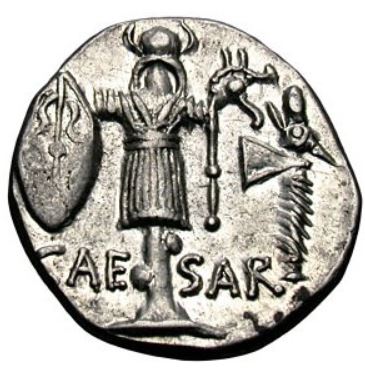
The Sicilian symbols help us see that there was room for experimentation with the range of symbols.  The introduction of three new symbols onto the coinage stand out in particular: the torque, the falcata, and the carnyx and shield.  None of these elements are typical elements in Hellenistic art, but are instead identifying attributes of Roman enemies, especially elements that the Roman troops actually encountered on the battlefield.  Both the torque and the carnyx appear frequently enought on the republican series and other media to make them familiar symbols to numismatists and art historians alike.  That said, their first appearance on the coinage is noteworthy.  These issues borrow a symbol of the enemy and display it on the coinage like a trophy of war, the appropriation of the symbol representing the defeat of the fearsome aggressor.   The torque victoriatus is very rare (RRC 91/1a; two in the BM and one in trade). Frankly, if we didn’t have a preconceived idea of what a torque looked like it would be a difficult symbol to decode, looking rather like an omega.   The carnyx and Gallic shield is far more common and the iconography beyond dispute (RRC 128; examples in trade, ANS specimens).  The falcata is called a knife by Crawford, but as one independent scholar has recognized, the republican coins are clearly representing the typical Iberian weapon.

File:Falcata íbera (M.A.N. Madrid) 03.jpg
Discovered in 1867 in Almedinilla (Province of Córdoba, Andalusia, Spain). Now in the National Archaeological Museum of Spain.

The falcata is depicted in Iberian funerary art as well (Blázquez 1988: 506; cf. Osuna relief).  It’s two occurrences on Roman coins should be seen as akin to depictions of carnyx, i.e. as appropriated symbols of the defeated enemy.

All of this is important because, taken together, these three types represent a critical development in the ‘money as monument’ phenomenon at Rome.  Just as actual torques, carnyces, shields, and falcatae were displayed in Rome as the spoils of war –dedicated in temples and hung on the houses of the generals as lasting testimony to the victories — so too the alien symbols on the coinage testify to the defeat of a specific formidable foe.

This is perhaps a natural evolution from, say, the display of enemy ship rams on war monuments and their appearance on the coins.

The later evolution of this phenomenon is well discussed by Claire Rowan.

On this topic also see this newer post.

Images stablized 18 Dec 2024. The rest remains unchanged, but see my 2021 book for more recent thoughts.

323 out of 410 days: A Slight Rotation

The JD collection of Roman Republican Coins part II – session II; A. Licinius Nerva. Denarius 47, AR 3.88 Babelon Licinia 24. Sydenham 954a. Sear Imperators 30. Crawford 454/1.

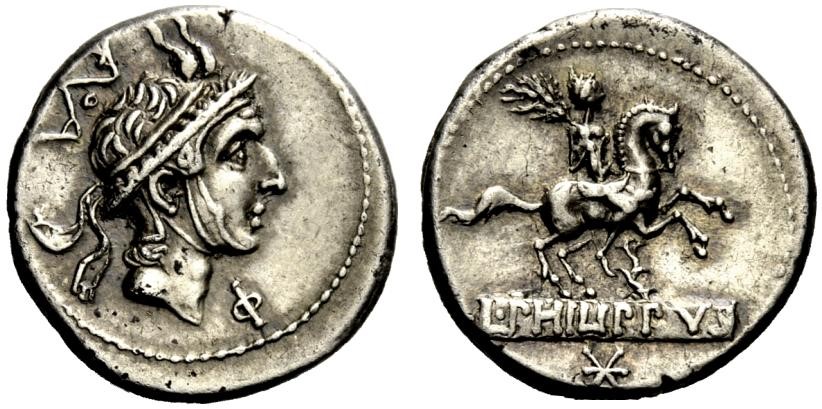
This beautiful specimen has been photographed just like most specimens are.  This orientation of the reverse is necessary to have it match Crawford’s description, ‘Horseman galloping, r., with r. hand dragging naked warrior, who holds shield in l. hand and sword in r. hand.”  The difficulty with the photography and this description is that it ignores the ground line.  Here’s the same image slightly rotated.

Image

The warrior is kneeling.  He may be wearing pants.  He’s clearly a ‘long haired barbarian’.  The horse is rearing.   And, the most likely interpretation of the scene is that the barbarian is stabbing the horse.   If you remember from a couple of posts ago, having two horses cut out from under him (and living to fight on) was part of the heroic career of Sergius.  Facing horse stabbing enemies is part of the motif of the brave Roman warrior.   And, it shows up in artistic representations left right and center.   I don’t have to collect the information because one military historian, Prof. Michael P. Speidel (University of Hawaii – nice work if you can get it!), has collected a whole chapter’s worth of examples.  I kid you not, chapter 17 of his book, Ancient Germanic Warriors (Routledge 2004) is called ‘Horse Stabbers’.   While his presentation of the evidence is strictly non-chronological and I don’t always agree with his interpretation of the evidence, he cites all his primary sources and does a fine job of making clear that Romans (and the Greeks) thought a horse stabber was a very scary thing indeed.

Does this help with answering which heroic ancestor this was?  Not particularly.  But Brennan, Praetorship (2000) 228, 246, esp. n. 38 and 39 on p. 344, relies on  Obsequens 22 and Frontinus Str. 2.5.28 to suggest that Licinius Nerva the Macedonian Praetor of c. 142 (Liv. Per. 53, Var. R. 2.4.1-2 and Eutrop. 4.15) was engaged in difficult combat with the Scordisi and perhaps the Iapydes on the Northern frontier of his province.

319 out of 410 days: A Misguided Celebration of Archaeology

Image

Yenikapi is Istanbul’s major new transportation interchange center.  It links the Marmaray (the new train under the Bosporus) with two of the city’s existing subway lines and has easy foot transfers to the ferry ports and tram and bus systems.  It’s fabulous.  It could teach NYC not just a thing or two, but dozens upon dozens of things.  It also happens to be on the site of the Theodosian harbor.   You can still look down into the massive open air pit filled with hundreds of crates of finds, bones, amphora, and the detritus of everyday life.  And some awesome exposed piers with reused marble facing.  It should be on every history and transport buff’s must see list for Istanbul.

The artistic displays in the station are meant to celebrate the layers of history exposed by the building of the station.  Mostly this is very successful.  However, the display pictured above makes me mad.  Not for the loose interpretation of stratigraphy or historical inaccuracies.  It’s art.  It’s an impression.  It doesn’t have to be true in a scholarly sense, to be true the spirit of the thing.  A transportation hub isn’t a museum.  [Although they do that pretty well in some places in Rome…]

What infuriates me is the sprinkling of fake gold coins throughout the model to make is glittery and appealing.

Treasure hunting is a huge problem in Turkey, not unlike many countries.  I’m not talking about the professional looting of antiquities.  That’s a problem but it’s an organized crime executed by people who know exactly what they are doing.   By contrast, treasure hunting comes from a lack of public education about the value of archaeology for its own sake.  There are no gold coins hidden under the pictures of birds in the Roman mosaics.   Smashing necropolis with sledgehammers or bulldozing Hellenistic foundations will not lead to a pot of gold.

Turkey’s museums are doing an awesome job educating visitors about problems with both looting and treasure hunting.   But, the average Turk who might think about treasure hunting is not the target audience of those museums. The display at Yenikapi will be seen by millions upon millions of Turks and foreign visitors.  The impression it gives is one that gold coins are the bread and butter of archaeology at all levels and all civilizations.  This can only but feed the imagination of the misinformed.

We need to do a better job educating the general public about the historical, cultural, and social value of archaeological finds, not as treasure but as time capsules that can open up a whole new world of knowledge.   Knowledge we can all partake in.  Discovers that cause awe and wonder.  Insights that will enrich our lives.

This display does not help.

Sergius, The Disabled Veteran

Update 10-13-25: In my 2021 Book, see page 54 and 100-102 on this topic. There are also a variety of other later posts on this coin type on this blog.

RRC 286/1. ANS 1941.131.92.

Really some of Pliny’s best writing in the Natural History:

But, although these cases exhibit great achievements of valour, yet they involve still greater achievements of fortune; whereas nobody, in my judgement at all events, can rightly rank any human being above Marcus Sergius, albeit his great-grandson Catiline diminishes the credit of his name. Sergius in his second campaign lost his right hand; in two campaigns he was wounded twenty-three times, with the result that he was crippled in both hands and both feet, only his spirit being intact; yet although disabled, he served in numerous subsequent campaigns. He was twice taken prisoner by Hannibal (for it was with no ordinary foe that he was engaged), and twice escaped from Hannibal’s fetters, although he was kept in chains or shackles on every single day for twenty months. He fought four times with only his left hand, having two horses he was riding stabbed under him. He had a right hand of iron made for him and going into action with it tied to his arm, raised the siege of Cremona, saved Piacenza, captured twelve enemy camps in Gaul: all of which exploits are testified by his speech delivered during his praetorship when his colleagues wanted to debar him from the sacrifices as infirm—a man who with a different foe would have accumulated what piles of wreaths! inasmuch as it makes the greatest difference with what period of history a particular man’s valour happens to coincide. What civic wreaths were bestowed by Trebbia or Ticino or Trasimeno? what crown was won at Cannae, where successful flight was valour’s highest exploit? All other victors truly have conquered men, but Sergius vanquished fortune also.

Just reminded me of conversations about how Veterans are treated depending on the public’s perception of the war in question.  WWII vets as the greatest generation vs. Vietnam vets fighting for POWs to be remembered.  The stigma of PTSD for the soldiers returning from Iraq and Afghanistan.

At least Sergius got a coin in the end.  Notice he holds his sword in his left hand.  (As well as the decapitated head.)

Shame about his great grandson.

Update 2/7/2018:

VAN LOMMEL, K. Heroes and outcasts : ambiguous attitudes towards impaired and disfigured Roman veterans. The Classical world. 109, (1)1, 91-117, ISSN: 00098418.

317 out of 410 days: Private Commerce at the start of the Hannibalic War

 He further embittered the senate against him by his support of C. Claudius; he alone of all the members was in favour of the measure which that tribune introduced. Under its provisions no senator, no one whose father had been a senator, was allowed to possess a vessel of more than 300 amphorae burden. This was considered quite large enough for the conveyance of produce from their estates, all profit made by trading was regarded as dishonourable for the patricians. The question excited the keenest opposition and brought Flaminius into the worst possible odium with the nobility through his support of it, but on the other hand made him a popular favourite and procured for him his second consulship.  (Livy 21.63.3-4)

This passage not incorrectly gets cited widely as evidence about restrictions on Senators engaging in commerce (exempli gratia).  Nothing wrong with that.  The same chapter of Livy gets discussed most often for the narrative tradition that blames Flaminius for the disaster at Lake Trasimene in the Hannibalic War.  Flaminius brings down divine wrath by not following proper religious procedures in his second consulship, because he’s afraid the nobles angered by his restriction of their potential financial gain will block his leaving for his province by claiming bad auspices.  Thus, he sneaks out to his province as a privatus.   So, by extension the disaster at Trasimene is all a result of a consul supporting popular legislation.  Moral of the story: a factious nobility is a threat to the well-being of the state.  Not a bad Augustan age moral really.

But here’s my question.  Why, oh why, did some tribute or the electorate in general care a rat’s ass about senators engaging in commerce? What the heck made this legislation ‘popular’ in any sense? Why at this moment in time?  The Gauls had been quieted.  The Adriatic shipping ways were strongly in Roman control.  Sicily and Sardinia had standing governors.  The Romans still probably thought at this moment that imminent war with Carthage and the Barcids would be fought in Spain and Africa.  Is this Livy’s interpretation of a list of legislation, elections, and events?  Or someone else’s?  Perhaps restrictions on senatorial commerce could be seen as popular with the equites if there is any grounds for understanding them as a merchant class at this point in time, but I’m not sure I’m comfortable with that reading.

[I got here as I was ruminating on the state of finances at Rome during the early years of the Hannibalic War.]

314 out of 410 days: Descriptive Legends

obverse
RRC 316/1. ANS 1937.158.34 Obverse: I·S·M·R – Head of Juno Sospita right, wearing goat-skin. Border of dots.

I was thinking about the use of legends on the republican series to label or describe the images.  The above type is a nice example of the use of abbreviation to do so.  We can resolve it based on longer inscriptions in other contexts.

Image
CIL I2 1430 cf. I2 p. 987 = XIII 1030* = XIV 2090 = ILS 3097 = ILLRP 170 = Suppl. It. – Latium vetus 1, 72

I wanted to think about the phenomenon over time and by type of usage.  So I created a little color coded chart.  No promises I didn’t miss a few or mis-transcribe a couple, I didn’t want to give this too much time.

Capture

My groupings are pretty subjective, pink for hard to recognize gods, peach for divine qualities/virtues — aren’t those two pretty much the same thing?  Green for Kings, but then I threw in Faustulus because where else would he belong in these categories?  Blue for the accomplishments of individuals.  This can be hard to separate from the moneyer’s name and titular.   A slightly darker blue for military accomplishments and a slightly lighter blue for religious acts.  Purple is for buildings and monuments, but not statues.  Mud is for personifications of place.  I’ve left uncolored others that are not readily paralleled elsewhere in the series.

I’d say 63 BC onwards is the real ramp up in this coin epigraphy if we can call it that.  The trend is towards longer more complete legends, rather than just ‘helpful hints’.  It’s still a long way from the Imperial habit of labeling most reverse types.

[Of course, I’m also ignoring the question of when ROMA is labeling the goddess and when its indicating the minting authority. And, yes, I just gave up transcribing at 431/1.  I’ll save the file and come back to it later, if it should prove useful.]

Update 1/11/16: The Φ on RRC 293/1 should have been on the above chart!

313 out of 410 days: Janiform Heads

Image result for culsans

I’m worrying about the janiform heads on the quadrigati and prow bronzes today and how they might relate to each other and Roman cult practices.  This is bringing me back to a number of different posts on related subjects and has led me to some other goodies as well.

First, the three earlier posts to catch you up on my thinking:

145 out of 410 days: Argos Panoptes?

237 out of 410: Similar Images, Different Interpretations?

Dei Penates Publici and the Dioscuri

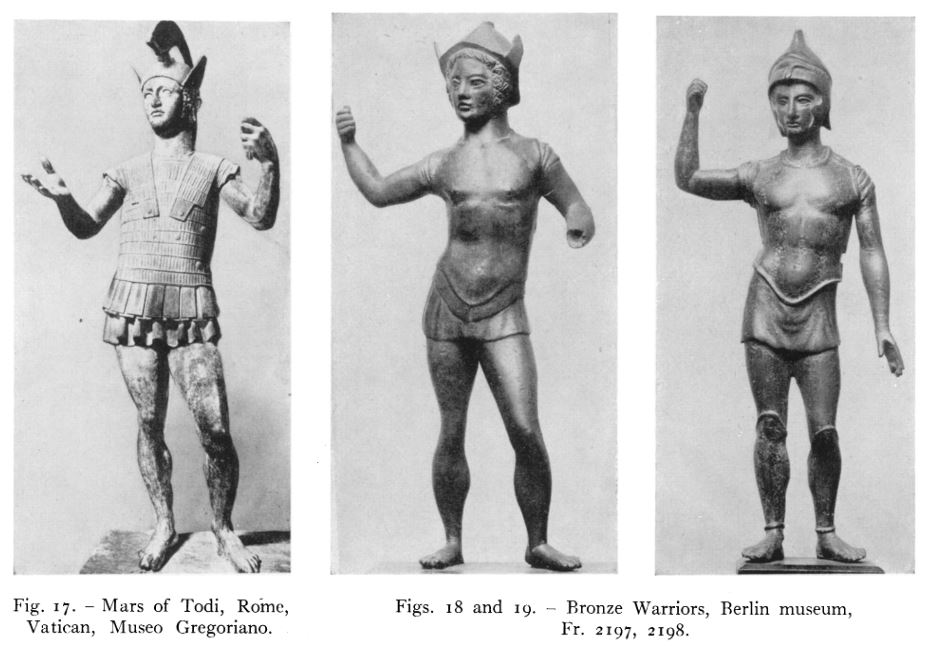
Here’s Meadows succinct footnote in his Mars Eagle essay on scholarly views:

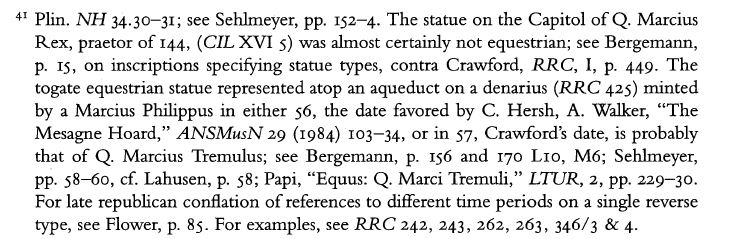
Image

[More recently there is W. Hollstein’s ‘Ovids « Fasti » und das « aes grave » mit der Prora’ in Noctes Sinenses ; Festschrift fur Fritz-Heiner Mutschier zum 65. (2011), 59-67.  I’m not convinced by the idea of the types as references to 241 BC, but he raises many interesting observations.]

[Image lost]

“Head terracotta two-faced deity, from Vulci. III-II century. B.C. Vulci Archaeological Museum. The head comes from a rich votive deposit, found at the North Gate of the city, whose materials are stored partly in Rome, in the National Etruscan Museum of Villa Giulia. The image of the god Janus takes the type of the Roman Empire, characterized by thick beard (perhaps influenced by coin types), rather than the Etruscan youth.”  (cf. first image above)

I was leaning towards a ‘Penates as Dioscuri, Dioscuri as Penates’ reading and then I came across the bizzare late passage below.   Over 700 years after the coins.  This is the only know association of Janus with Penates, and yet looking at the coins and the young Etruscan bifrons deity, Culsans, I’m almost tempted to believe Procopius that on some level the identity of Janus was tangled up in Roman minds with that of the Penates…and the Dioscuri… and probably the Lares too.  I’m no scholar of religion.   I’ve no idea how this worked in the experiences of individual Romans, but the iconographic borrowings and overlaps seem clear enough…

Procopius’ Histories (5.25.20):

ὁ δὲ Ἴανος οὗτος πρῶτος μὲν ἦν τῶν ἀρχαίων θεῶν, οὓς δὴ Ῥωμαῖοι γλώσσῃ τῇ σφετέρᾳ Πένατες ἐκάλουν.

At that time some of the Romans attempted secretly to force open the doors of the temple of Janus. This Janus was the first of the ancient gods whom the Romans call in their own tongue “Penates.” And he has his temple in that part of the forum in front of the senate-house which lies a little above the “Tria Fata”; for thus the Romans are accustomed to call the Moirai. And the temple is entirely of bronze and was erected in the form of a square, but it is only large enough to cover the statue of Janus. Now this statue, is of bronze, and not less than five cubits high; in all other respects it resembles a man, but its head has two faces, one of which is turned toward the east and the other toward the west. And there are brazen doors fronting each face, which the Romans in olden times were accustomed to close in time of peace and prosperity, but when they had war they opened them. But when the Romans came to honour, as truly as any others, the teachings of the Christians, they gave up the custom of opening these doors, even when they were at war. During this siege, however, some, I suppose, who had in mind the old belief, attempted secretly to open them, but they did not succeed entirely, and moved the doors only so far that they did not close tightly against one another as formerly.

And just for the record we can’t assume that that statue in the temple of Janus as it is described for us was in anyway an ‘original’ representation of the God:

And then besides, King Numa dedicated the statue of the two-faced Janus; a deity who is worshipped as presiding over both peace and war. The fingers, too, are so formed as to indicate three hundred and sixty-five days,or in other words, the year; thus denoting that he is the god of time and duration. (Pliny NH 34.33)

If the fingers represented the days of year and counted 365 then Pliny and by extension Procopius were looking at a statue created after Caesar’s reform of the calendar presumably from the Augustan restoration of the temple (so Graf in Brill’s New Pauly, s.v. Ianus).

Update 2/15/2016:

From this article.

CaptureCapture1Capture2