Skip down to the third section for fun ancient stuff.
warm up writing
(almost) 11 year olds are good humans
What a weekend. Thursday, Friday I solo parented to let my beloved get some time in the field and prepped for kiddo’s family birthday party. Then late Friday afternoon when I called my mother-in-law to find out if her coleslaw recipe could be wholly or partially make a head (this, after constructing three lasagnas from scratch, and the red velvet cake)…
I learned that through a grand miscommunication/misunderstanding, my family was expected at a family dinner almost immediately 30 minutes away. So I dropped party prep and loaded kids in the car. That was ‘only’ 12 at table. Saturday I hosted 17, and then we were back at my in-laws with 14 for Sunday dinner. So many cousins. Honestly though it all went incredibly well. I married well and I’m only writing because I’m so mentally locked into family mode and I have the actual kids birthday to mark tomorrow and then a friends slumber party to prepare for next Saturday, that with out some warm up writing there is no way I’m going to get to the focused goals of the day.
There is a layer of sadness in my heart that my family at the moment is family of choice and my kiddos. Every morning I wake up and am grateful to get to chose to be in partnership with my beloved and raise our awesome kids and that he comes with a giant functional supportive family. And, my family of choice all showed up form me as I hosted. I’ve always known that trust and kinship are built on shared positive experiences and willingness to show up. And, yet I cannot help but grieve the wounds in my bio family, the effects of the inter-generational baggage and the alienation this has created. The survivors guilt I carry and my willingness to do anything to make sure my kids walk into the future with as few scars as possible and as many skills to identify health boundaries and safe humans as possible. I know this vague. None of the story really needs to be told, at least not now. It is just with all the joy of my intense holiday weekend I’m still coming into the week with a wistful sadness. A touch of grief for the relationships I don’t have, even as I try to construct a plausible narrative of my own origin story for myself, one that honors all that is good about my familial connections and the struggles of others that have let me thrive.
looking ahead for the week
I’m in good shape for my WashU talk. Last week, I cranked out the first 20 slides for the deck and they are a aesthetically pleasing (without the overkill on design I used to do to procrastinate), I’ve synthesized past work with new data I’ve collected over the past year especially the particle accelerator experiments and what and why I think more experimentation is valuable, and am well on my way to being able to tell the story of the relevance of this work. The WashU talk I want to focus on broader religious contextualization, in May at ICS I am aiming to focus more on the context of Nemi itself as an archaeological site: so much work to do on that still, and in Warsaw in October I’m planning to give a more economics focused version where I try to talk about the nature and variety of (co-existing) monetary systems. I want to keep working on the research and planning out of all these talks as that is my fun stuff, the work that carried me with it through its own momentum. But it is not the tasks of today. Excited to share my WashU deck next week.
I need to give my study abroad some attention. Last year my Rome trip made me nervous because it was the first time and I didn’t know how the pre-trip logistics were supposed to go. This time I know how it should or could work and every hiccup finds me impatience and a little resentful. The main source of my intolerance has nothing to do with my partners in this work, but rather that my beloved and I have decided it is not right for my family to come to Rome this summer and I would never have agreed to lead the trip if I thought it would mean 3 weeks away from my beloved and kiddos. I love my garden and home office. And while solo travel is fun, I tend to get desperately homesick for my family at about 8-10 day mark. We made the right choice and yet it has changed my relationship to the trip and its planning. It is now far more in the necessary task side of my brain, than the fun, exciting adventure side. Also chairing took me out of the classroom, too much really. I don’t feel as connected to these students as I did to last year’s cohort. We’ll get there and I’ll love it, but the joys of family are more tempting at the moment.
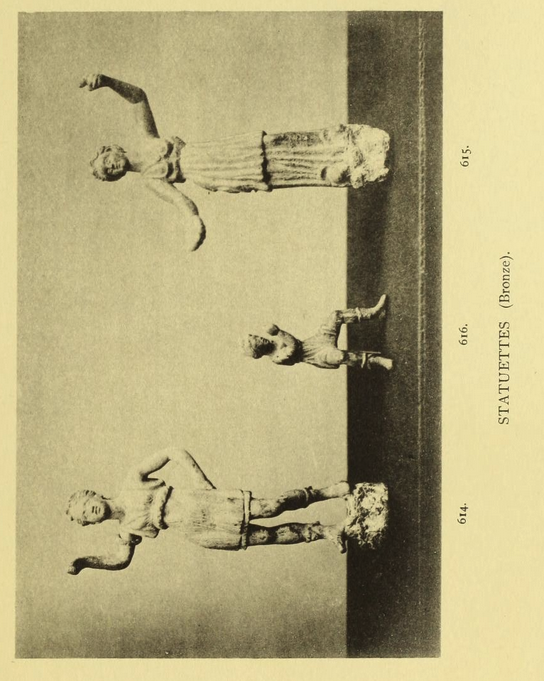
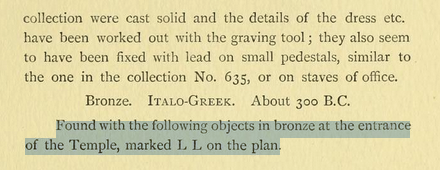
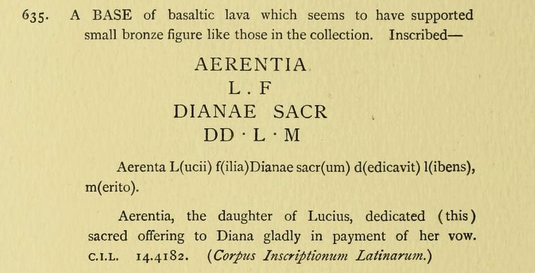
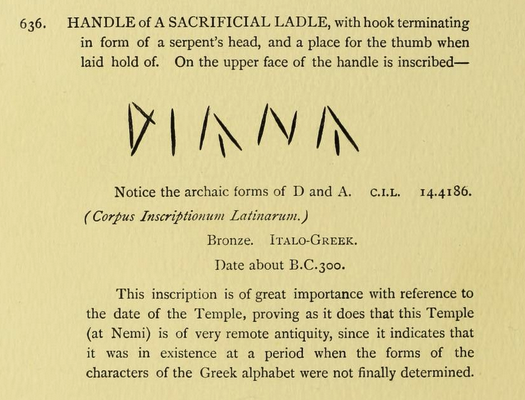
20 April, 5 pm, is the next grant proposal deadline I have to hit. I’ve got a great project. I want to pitch an internal investigation of the bronze votive statuettes from Nemi to compare to our aes grave data. I have had a strong suspicion since 2023 when we did surface analysis that these statuettes hold the key to contextualizing aes grave. I think they may be made from the same junk metal slurry and may even serve similar functions. If I write a good enough grant and am successful in my application I should be able to confirm this by early 2027 and lean more into this hypothesis. Normally these proposal calls come every 6 months, but the ISIS facility has a long shut down coming and there will not be another call for a year or more as they update the facilities. Also right now I have UK affiliation, I hope to find more such affiliations for future collaborations but this is not a given. It’s a now or never cross my fingers and hope sort of case, but of course I’ve got to write the damn thing and give my research partners, the actual scientists the opportunity to review and supplement my experiment design, so really I better get that done by Friday.
Finally, I’m typing this on my Mac. I love my mac. The pXRF software does not run on Mac. My research partner is in Romania with the pXRF. We’ve got a short window for equipment hand off early next week before I leave for St. Louis. I one managed to get it to run on my ancient previous PC laptop I think. I’ve never managed to borrow a machine from my college that would let me run the software. I also need a training refresher course on these analyses. One can buy a PC for under 200 dollars these days, and one worth owning (kinda) for under 500. Do I bite the bullet? My kids would love having a laptop to play with but I hate spending money on a mono tasker. I guess the thing to do is boot up my old machine and see if it seems to function and then bring it to Brooklyn for a test run next Monday and trust that if it doesn’t work, can go to a shop in NYC and throw money at the problem. Yuck.
I also owe lots of people emails sorry if you are one.
Something fun
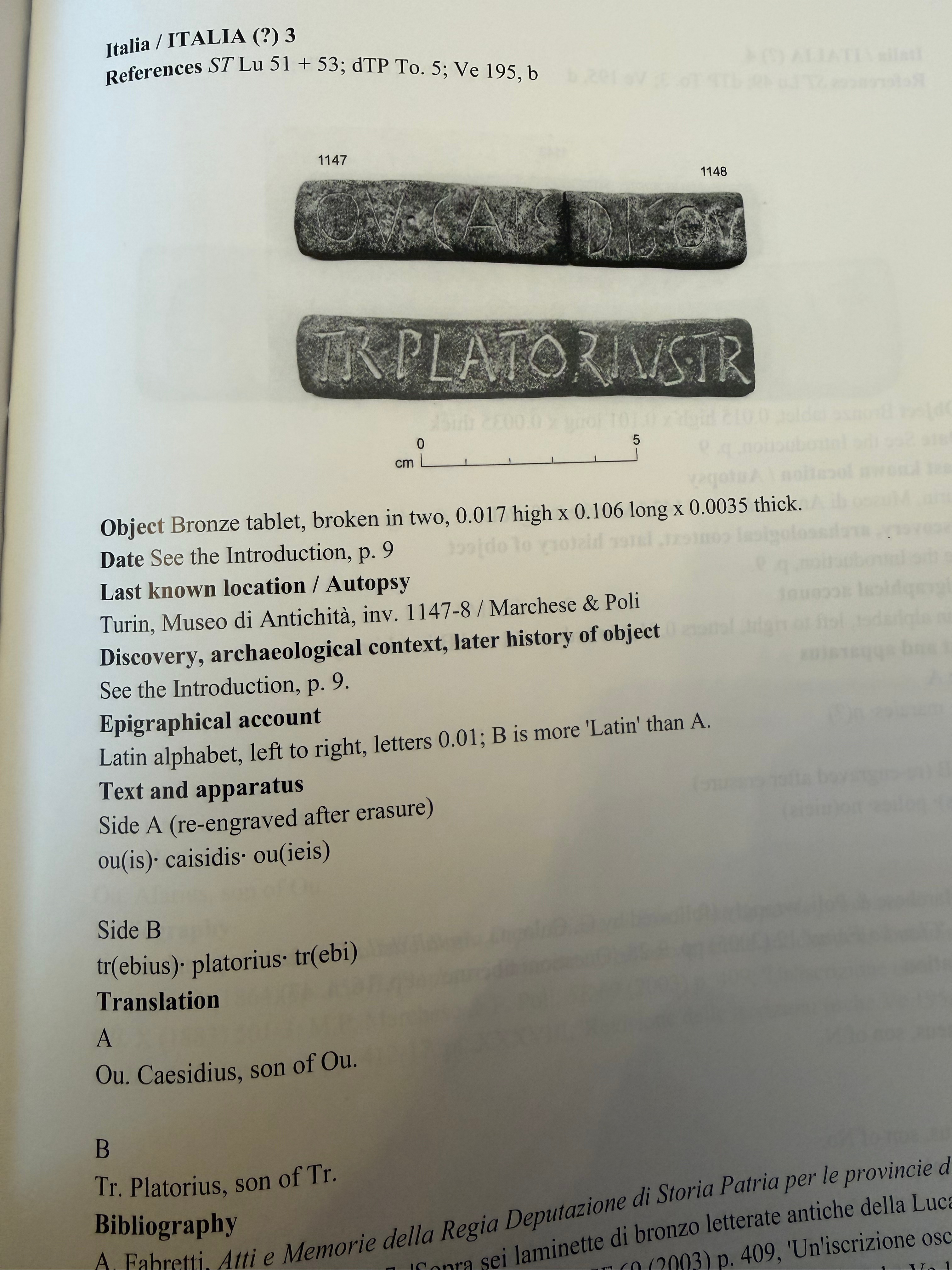
In an edited volume for Elaine Matthews, Michael Crawford proposed a theory which he himself acknowledges cannot be confirmed, namely that the Italian state may have used bronze tablets like the one below for drawing lots as part of its federal system of government.
Crawford, Michael H. “Onomastics and the Administration of Italia/Víteliú.” Onomatologos. Studies in Greek Personal Names Presented to Elaine Matthews, Oxford (2010): 276-279. [PDF on File thanks to ILL]
I’m totally intrigued by this theory and in love with the idea we might have material culture beyond the social war coins to connect to the first Italia to try to understand the project of those who rejected Rome’s rule.
Any yet the more I think about these objects the more concerned I am that they have two names. How would that work for drawing lots? Why pair individuals in a random system of assigning responsibility? Could they be some variant of the tesserae nummularii? But that doesn’t really work either. No way to attach them to anything. No verbs not suggestion the names correspond to a dating system.
But wait what if they are magistrates (duumviri of some sort) that provide the year for some Italic community. If we could find the pairings existing else were on other epigraphy that might provide a hint…
Ah well. Just a stray point of interest.
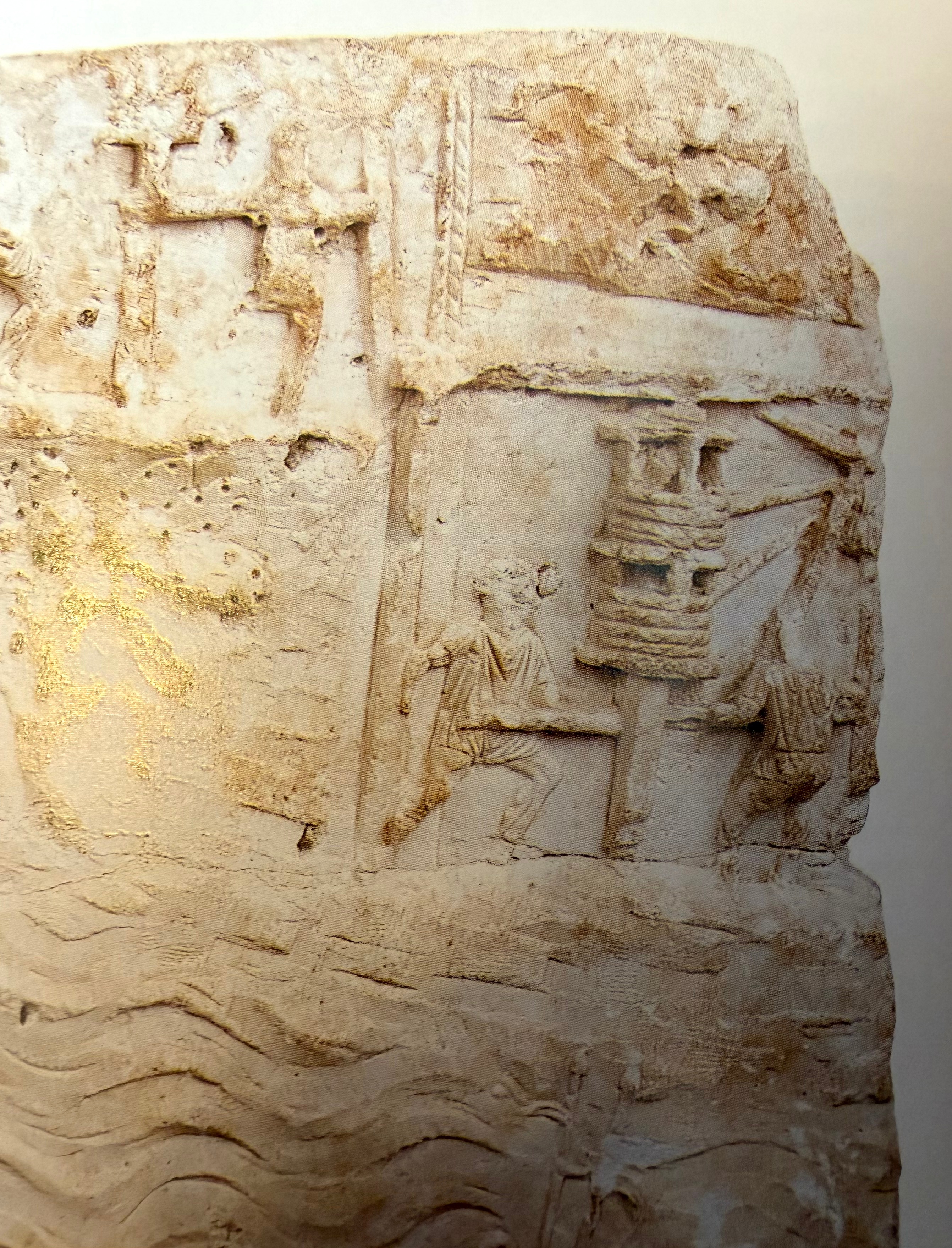
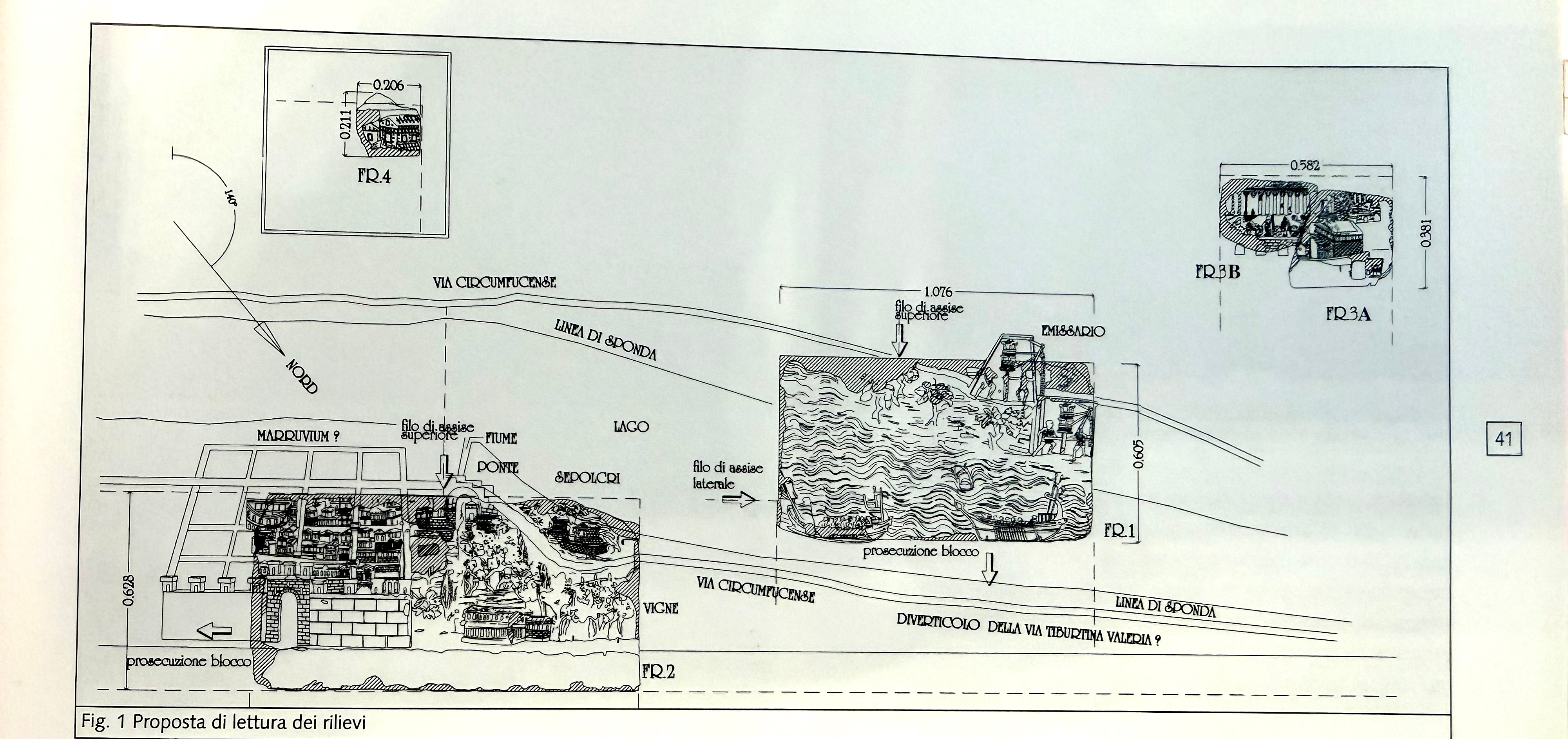
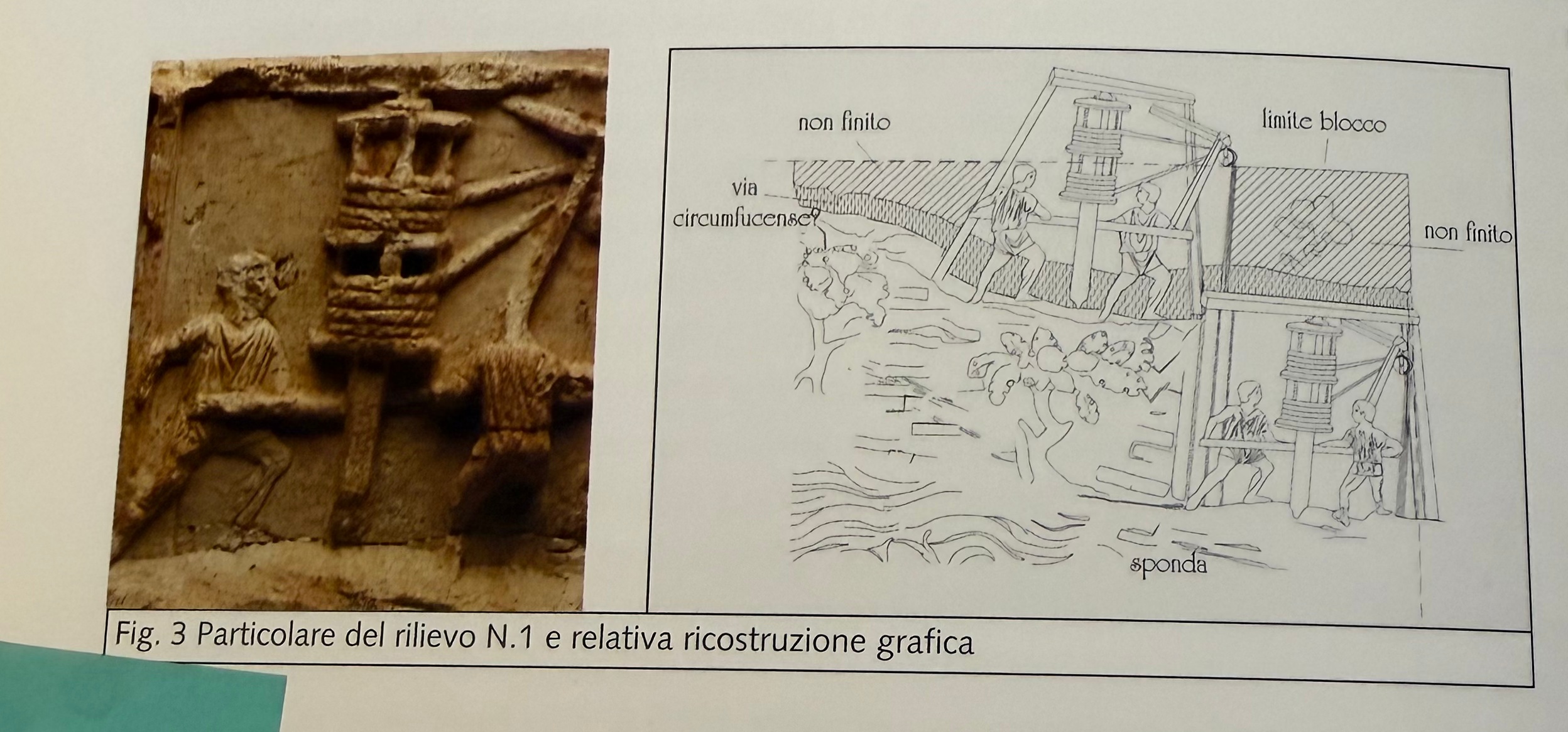
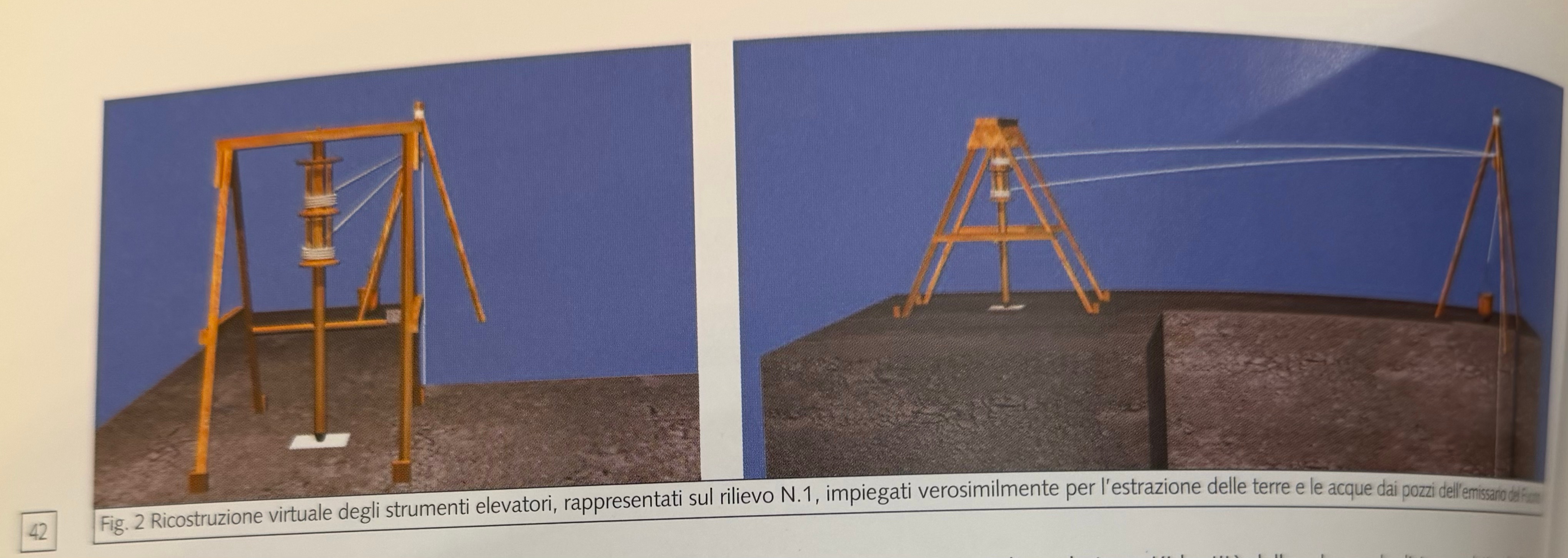
The other fun thing rattling around in my head is this winch machine seemingly for controlling water flow on a relief found in the draining of the Fucine lake in the Torlonia collection and said to be on display Museo del Castello Piccolomini di Celano. I love driving in the Abruzzo with my beloved. If he were joining this summer this castle would be an ideal roadtrip destination. Ah well, another year.
As you know I’m interested in the technology on the Fabatus series and I think both Fabatus and Papius show capstans
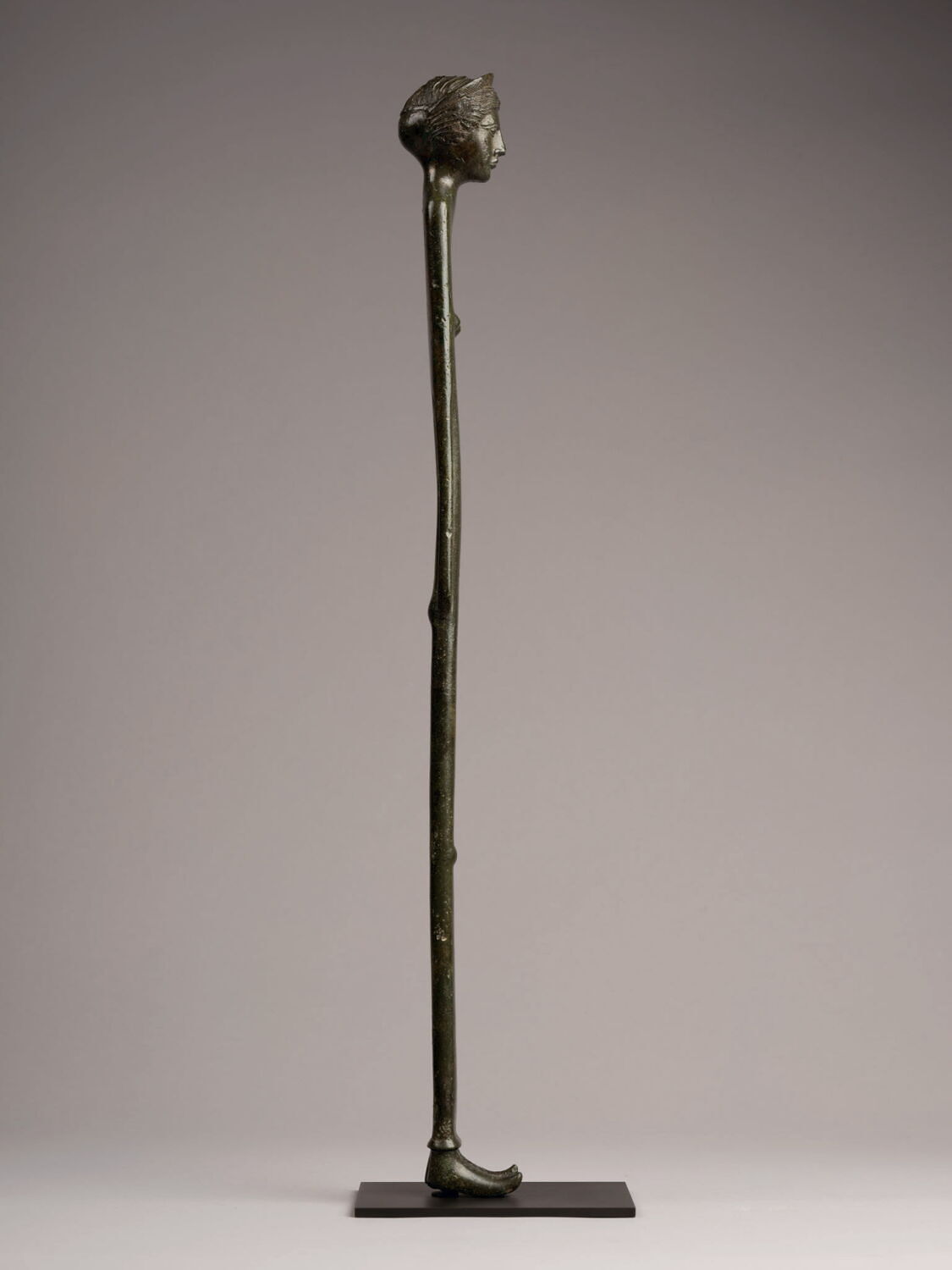
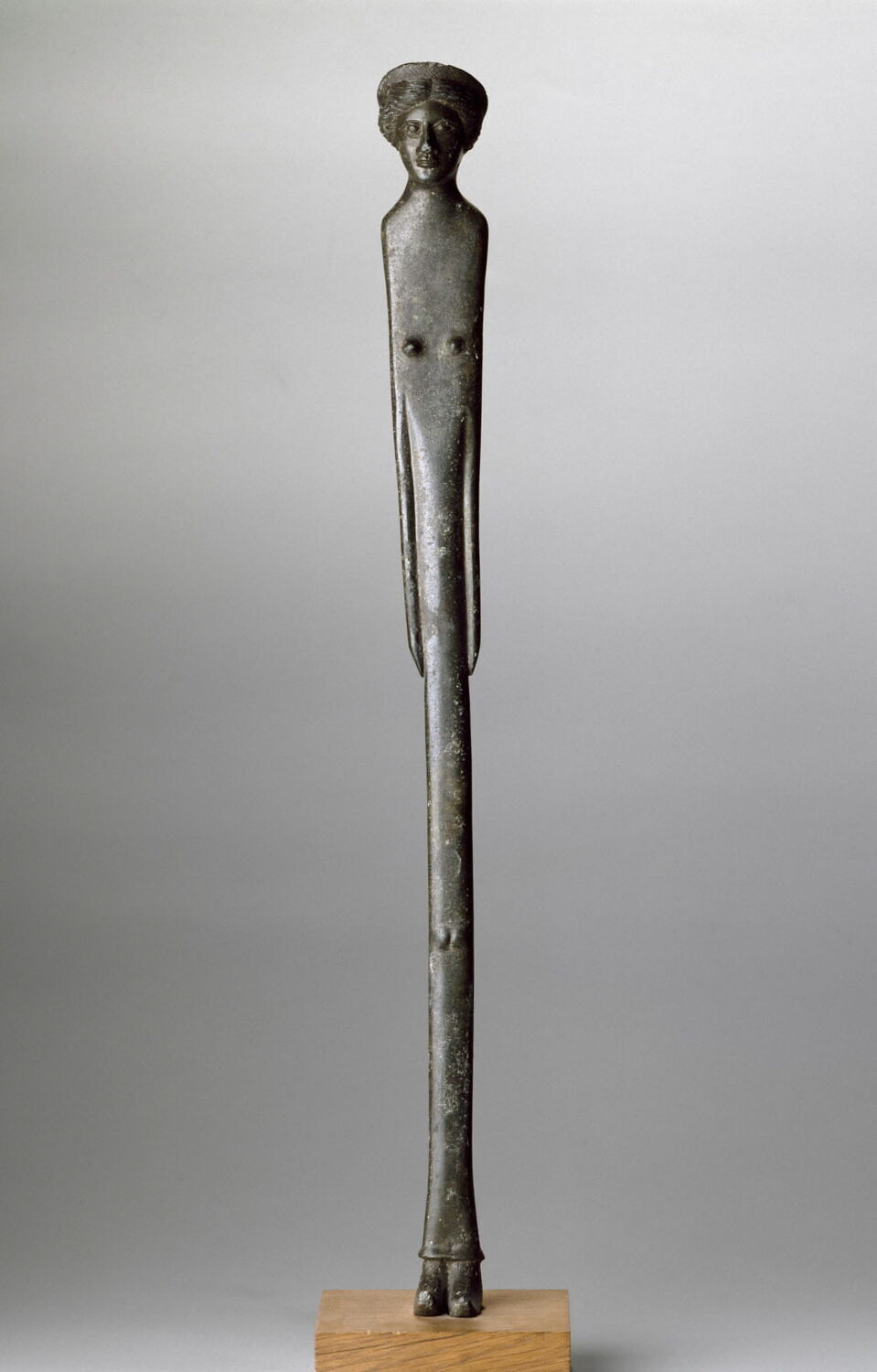
Thus I really am very curious about this relief and its technology. The relief is dated to the mid 2nd century CE based on parallels with Trajan’s column I presume. The images here are from Il Tesoro del Lago (Carsa Edizioni 2001). In the same book is a list with a few illustrations of the 338 bronze coins. The vast majority of these coins seem to be 1st Punic war coins and to have been deposited by worshippers at Lucus Angitiae. The coins were recovered during construction for the lake drainage. Another place I’d love to roadtrip to. The collection has such strong parallels to Nemi on a smaller scale that I may want to use it as a parallel case study. And you guessed it there are also bronze votives that seem to come from the same locale. Again I feel vindicated by my past belief that one always buys the book when the book is being sold a a small provincial museum or site. I think I picked this one up in 2012 at Alba Fucens.
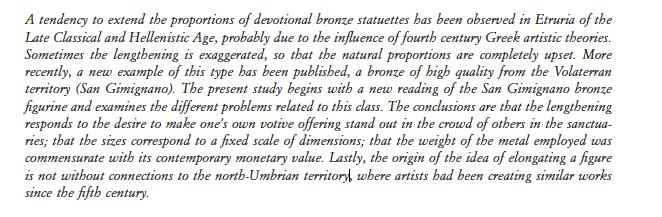
Maggiani, Adriano, « Un dono votivo da quindici assi. Nota su un nuovo bronzetto allungato dal territorio di Volterra. », Studi Etruschi, 83, 2021, p. 209-237, p. 210, 221, 234, fig. 1a, 7c.
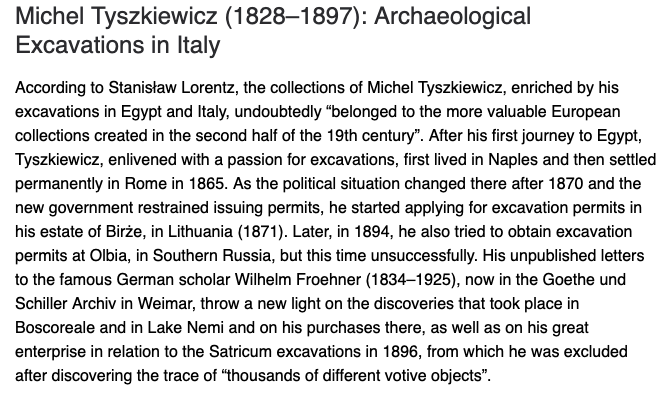
Kazimierczak, Mariola, « Michel Tyszkiewicz (1828-1897) et les fouilles archéologiques en Italie », Światowit, 57, 2018, p. 237-248, p. 244, Figure 5 et 6 page 244 (academia.edu copy)
I”m resisting doing a deep dive on Tyszkiewicz at Nemi this very moment but the realization that his letters document his experience at Nemi makes me even more eager to get my hands on Savile’s own papers. Surely someone in my network knows Kazimierczak and might offer me an introduction to her. I’d love to review the letters specifically about Nemi.
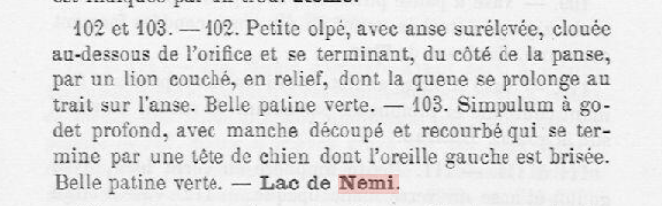
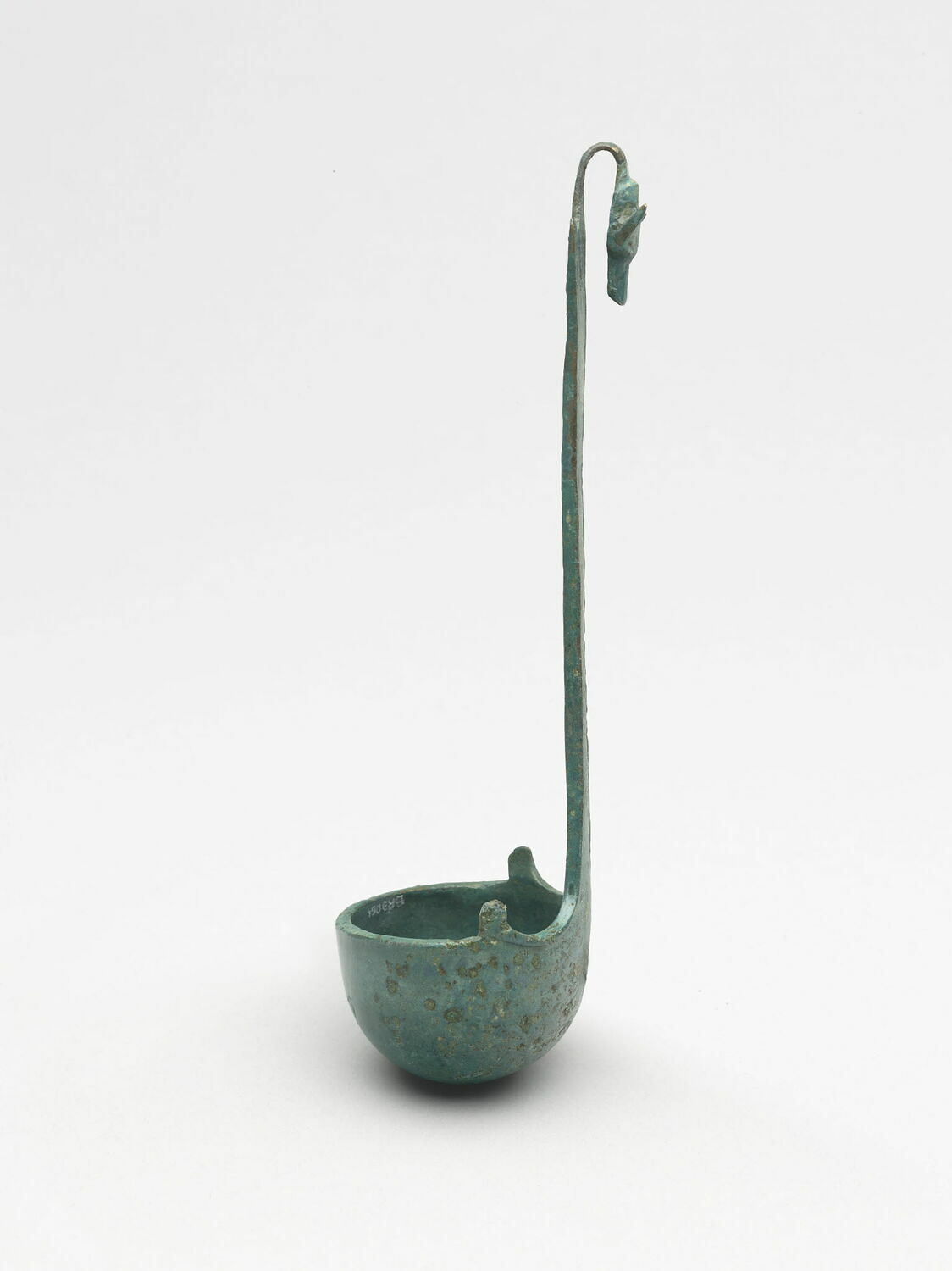
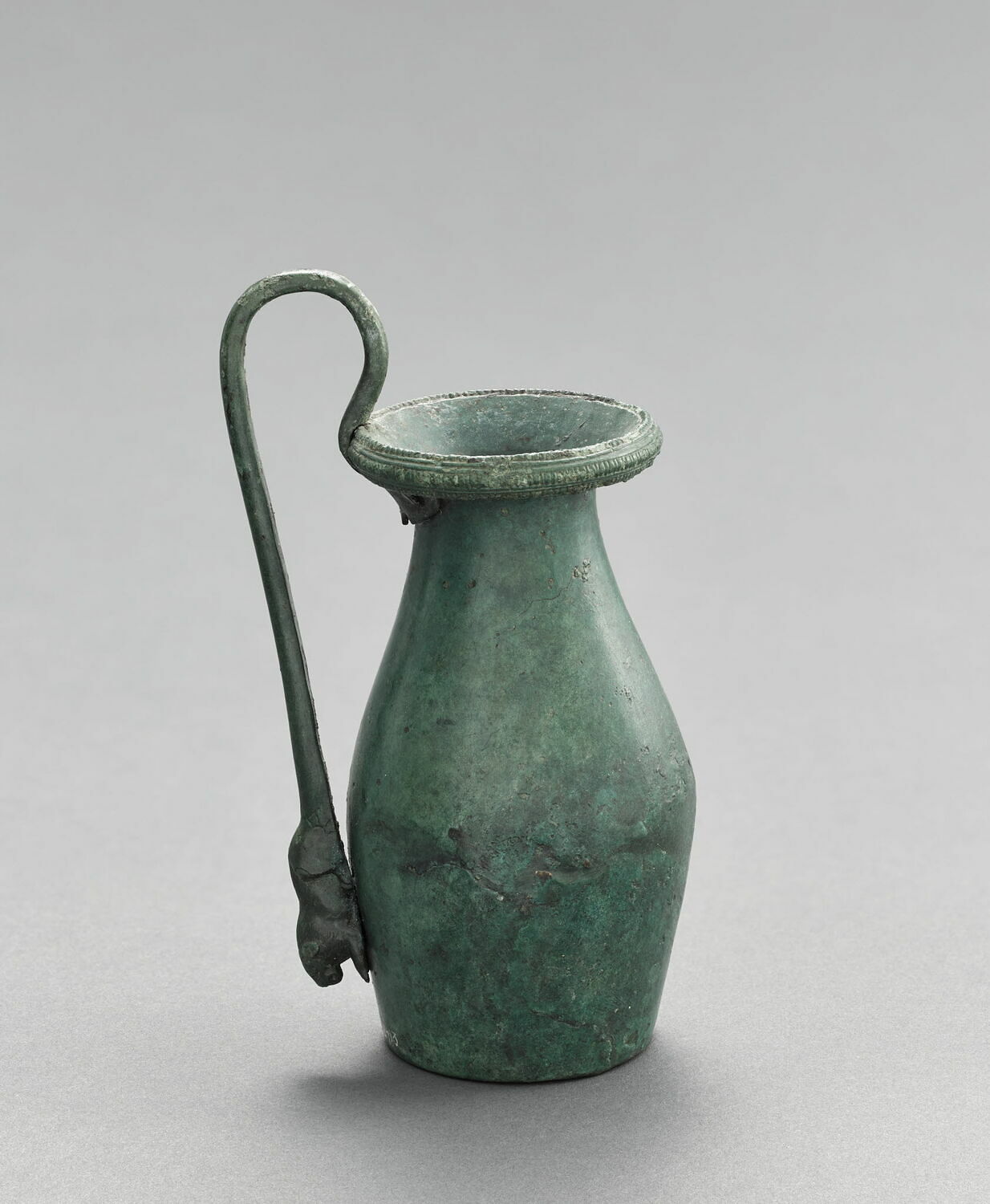
The following items are said to be from the lake Nemi and came to the Louvre in 1900 from Martinetti, Angelo and
Morel, François. Neither name means anything to me yet and the bibliography of the museum doesn’t seem to help with find spot details beyond confirming that the objects were associated with this location as early as 1901.
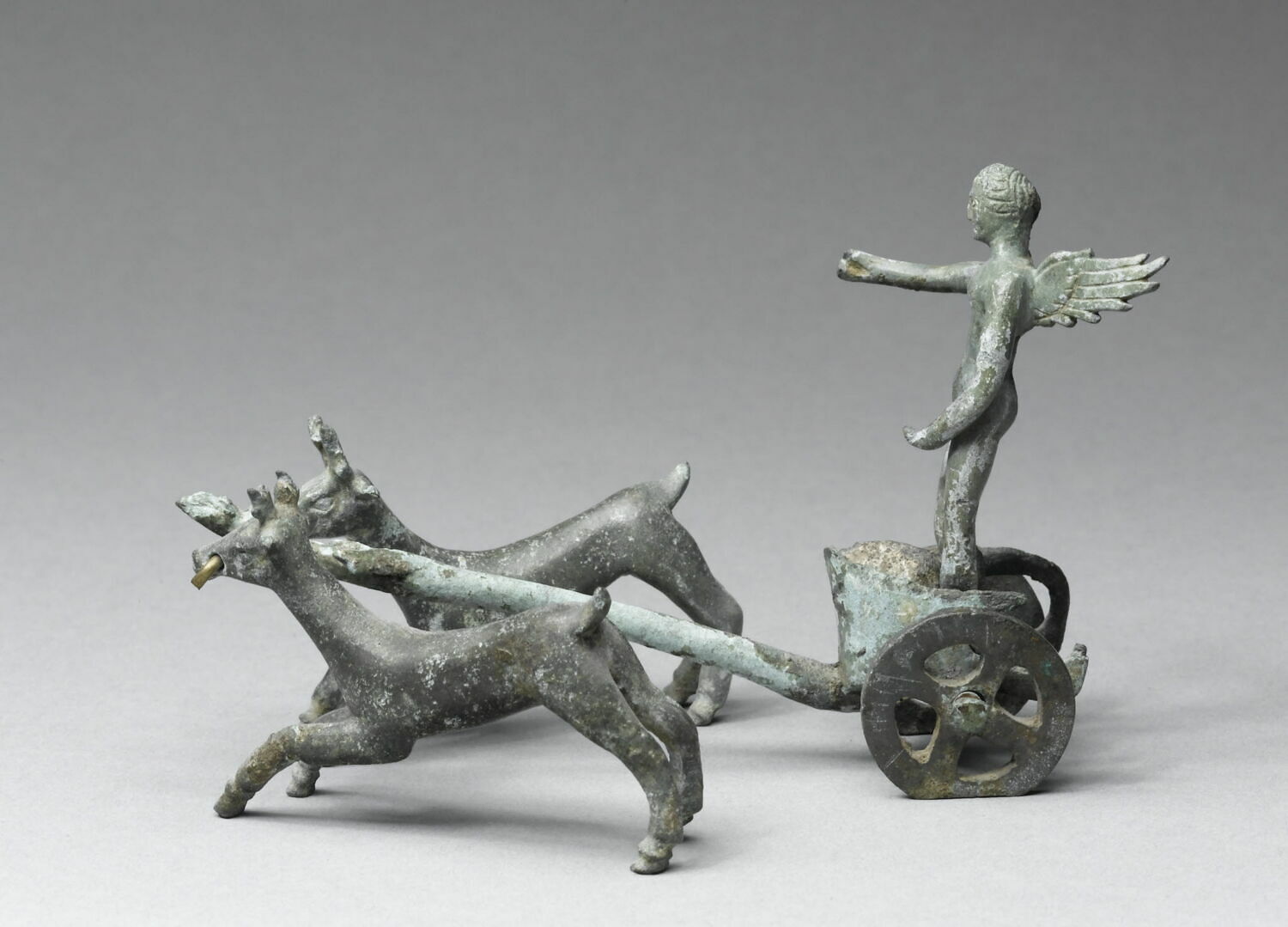
Alessandro Castellani was the source of this charming little statuette group in 1896 also said to be from Nemi. It was exhibited in Copenhagen for show focusing on Nemi Bronzes (I wonder if there is a catalogue from that show in 2014).
Besides these objects most things associated with Nemi at the Louvre are early modern landscapes. I did stumble on the archaeological artist GESLIN Jean Charles whose drawings are very compelling but unrelated to my present work.
Frustratingly while objects and aes rude are roughly contextualized in the find locations, not so the coin, cast or struck…. Here is what we do know.
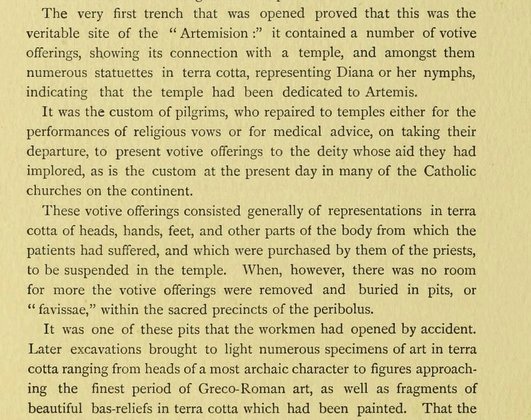
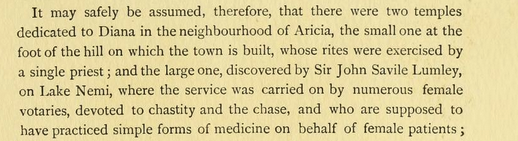
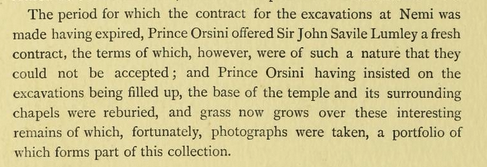
My surmise is that Savile wrote most of the following himself and that his papers and correspondence will reveal more details. He was clearly unhappy with his partnership with Orsini who wanted to dig for treasure for the art market, it seems at present.
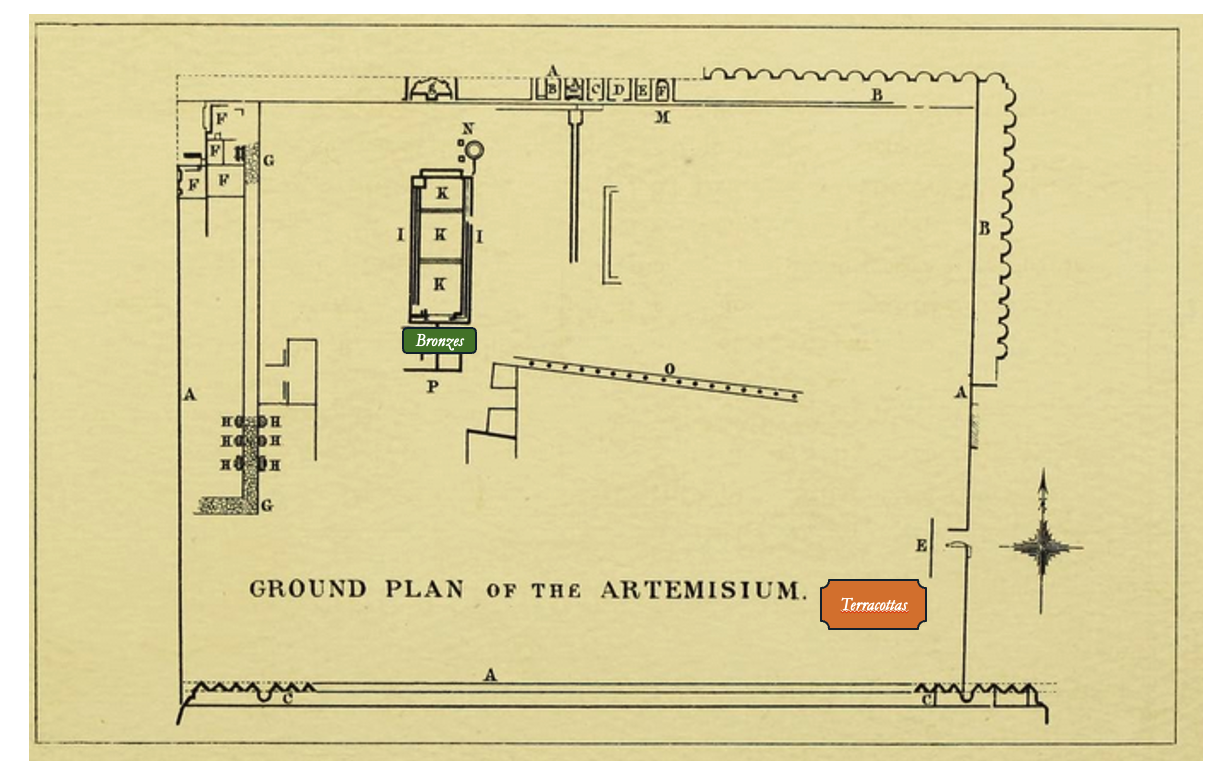
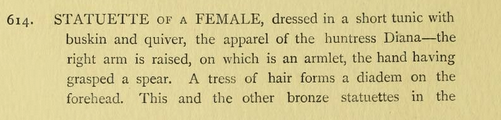
Frustratingly there is no account of where the bronze statuettes were found when they are discussed, but below there is an account of where some were found.
…
Here follows a discussion of the cast and struck coinage but with no indication that it was found in the same location as the aes rude.
This is a very long very boring post. Please do not read it. It is for my own reference.
Pena, María José. “« Diana Augusta » y el « collegium lotorum » (CIL XIV 2156) : los « piacula » del emperador Claudio.” Fortunatae 32 (2020): 539-556. Doi: 10.25145/j.fortunat.2020.32.36
An inscription from the 1st century AD, discovered in Ariccia (Latium) and dedicated to Diana, is examined. It was set up by two curatores of a collegium lotorum, whose functions are otherwise unknown. The term lotores is analyzed. A possible connection is suggested with another inscription from the sanctuary of Diana at Nemi (within the territory of Ariccia), as well as with the piacula performed in the year AD 50 on the orders of Emperor Claudius. Finally, some considerations are offered on purification by water.
Garmi, Déjla and Meunier, Laure. “Les textiles archéologiques romains découverts en contexte nautique et portuaire: les cas de Rezé / Ratiatum (Loire-Atlantique) et de Lyon / Lugdunum (Rhône).” Gallia 77, no. 1 (2020): 187-211. Doi: 10.4000/gallia.5513
The excavations of the Roman harbor of Rezé, carried out between 2013 and 2016, yielded a collection of twenty‑one textile elements, exceptionally well preserved thanks to the humid environment. Two categories of objects can be distinguished within this assemblage: textile “pebbles” and sail elements. The pebbles consist of textiles that were folded and rolled so as to form a ball, and were then tarred. These textiles may have been used for the waterproofing of boats or of cofferdams, which were temporarily employed during the construction of the Roman quay caissons. All of the collected textiles have been subjected to technical analysis and are compared in terms of manufacturing processes, waterproofing techniques, and finishing, as well as set against finds from Lyon–Saint‑Georges, Giens, Nemi, and Egypt.
Skovmøller, Amalie. “Painting Roman portraits : colour-coding social and cultural identities.” In Family lives : aspects of life and death in ancient families, edited by Kristine Bøggild Johannsen and Jane Hjarl Petersen. Acta Hyperborea; 15, 315-335. Copenhagen: Museum Tusculanum Pr., 2019.
Polychromy can be interpreted as a color code that conveys important aspects of cultural and social identities. This can be demonstrated through the example of the polychromy of a group of Roman portrait sculptures from the so‑called Room of the Fundilia in the sanctuary of Diana Nemorensis at Nemi, dating to the mid‑1st century AD. Knowledge of the manner in which color was applied helps to decipher and investigate more complex social and cultural constellations. The polychrome portraits should not be understood merely as representations of Roman men and women; rather, they actively contributed to reinforcing a sense of a shared lived reality.
Pena Gimeno, María José. “CIL XIV 2213 y las magistraturas del « municipium Aricinum » (Lacio).” Anuari de Filologia. Antiqua et Mediaeualia 8 (2018): 719-734. [PDF]
After some general considerations on the epigraphic documentation of the sanctuary of Diana at Nemi and of the municipium of Aricia, within whose territory the sanctuary is located, the study focuses on inscription CIL XIV, 2213, a dedication to Diana. This inscription is regarded as the earliest find from the area, discovered in the 16th century and already known to Pirro Ligorio and Maarten de Smet. On the basis of this testimony, the municipal magistracies attested by inscriptions are examined, with particular attention paid to CIL XIV, 2171 and CIL XIV, 4196.
Summary highlights:
On the adjective nemorensis;VIf CIL XIV 2213 is set aside as false, only three authentic epigraphic attestations of nemorensis remain:
CIL XIV 2212 – dedication to Deanae Nemorensi (Antonine period).
CIL III 1773 – dedication from Dalmatia by Ti. Claudius Claudianus, a cohort prefect.
A funerary altar from Genzano mentioning the collegium lotorum nemorensium.
nemorensis is not an epithet of Diana but a toponymic adjective derived from nemus, the wooded area around Lake Nemi
CIL XIV 4196: Basalt fragments from a circular base dated to the mid‑1st century BC. names two aediles, one of whom belongs to the gens Accoleia—a family possibly connected to Octavian during the civil wars? The circular base likely supported a statue intended to be viewed from all sides, perhaps connected with the iconography seen on the denarius of P. Accoleius Lariscolus (43 BC). The three‑figured image on the coin probably reflects a Trivia concept rather than an actual cult statue.
Boldrighini, Francesca. “Frescoes from Nemi’s theatre: a dressing room ?.” In Context and meaning : proceedings of the twelfth international conference of the Association internationale pour la peinture murale antique, Athens, September 16-20, 2013, edited by Stephan T. A. M. Mols and Eric M. Moormann. BABesch. Supplement; 31, 107-112. Leuven ; Paris: Peeters, 2017. [academia.edu offprint]
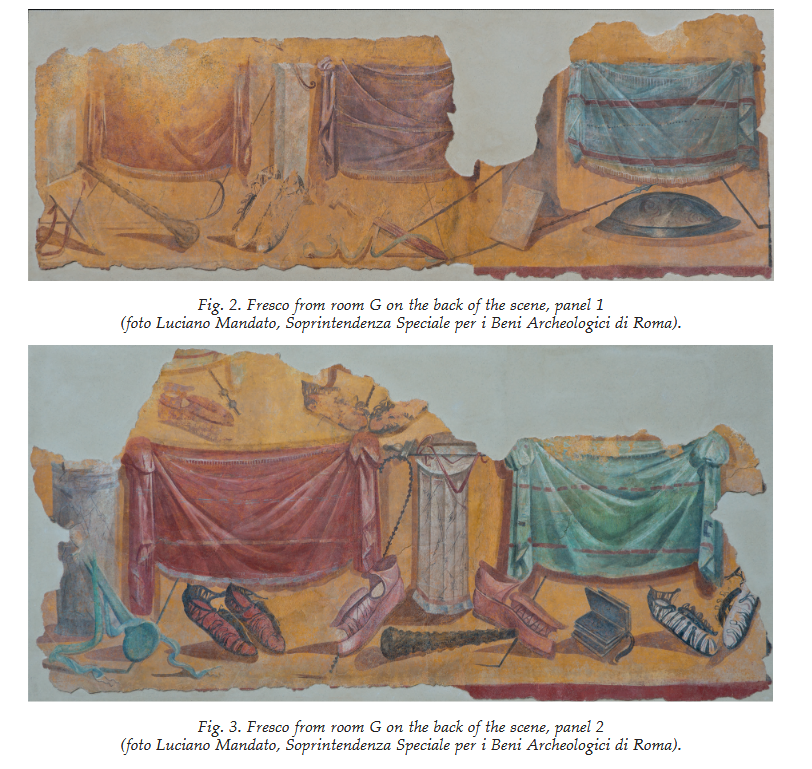
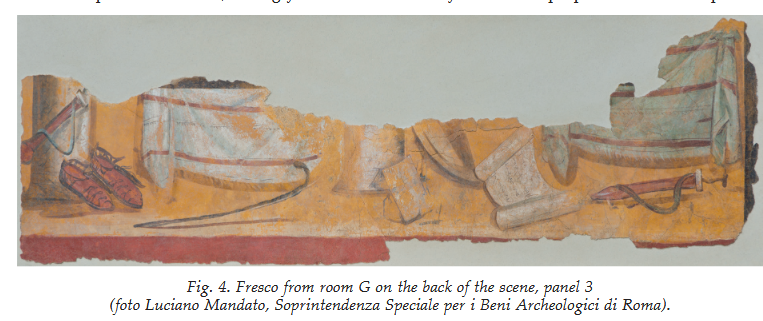
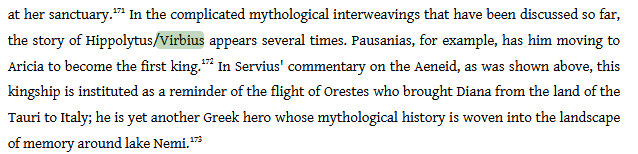
excavations carried out in the 1930s in nemi, uncovered a small theatre adjoining the sanctuary of Diana Nemorensis. A room behind the scene, possibly a dressing room, preserved an interesting painted decoration, now housed in the national roman Museum at the Baths of Diocletian. the unusual paintings represent a series of shoes and weapons on a background of fringed drapes and low pillars and columns; even more unusual is the repre- sentation of written tables and scrolls among them. the frescoes, probably accomplished within the 1st century AD, were possibly related to the shows performed in the theatre.
The wax tablet book in the bottom image is my favorite! And the scroll below and other writing elements:
Pena, María José. “Hipólito-Virbio, San Hipólito y Pirro Ligorio.” Cuadernos de Filología Clásica. Estudios Latinos 37, no. 2 (2017): 265-282. Doi: 10.5209/CFCL.57805 [PDF]
The goal of this paper is to study a double literary tradition derived from Hippolytus’ death, his resurrection by Asclepius and his second life in Italy as Virbius, the minor god of Diana’s sanctuary at Nemi (Latium). The Latin tradition (Virgil, Ovid, Seneca) leads to a christian saint, whose martyr-dom we know through one of Prudentius’ hymns and whose history is complicated by the discovery in the 16th century of a statue restored by Pirro Ligorio and identified with the saint. On the other hand, Ligorio is related to the first epigraphic findings from Nemi-Aricia and was the ‘creator’ of a series of epigraphic fakes related to Hippolytus-Virbius. All this without forgetting that Ligorio’s patron was the cardinal Ippolito d’Este
cf. Pena, María José and Oller, Marta. “Hipólito y Orestes en el santuario de Diana en Nemi: contaminaciones mitográficas antiguas y modernas : análisis crítico de las fuentes literarias.” Latomus 71, no. 2 (2012): 338-372.
Los textos base serán el pasaje de ver G.Aen.7.761-780, y otros dos de Ov.Fast.3.261-276 y Met.15.479-546.
And Virbius, Hippolytus’s son, most handsome, went
to the war, whom his mother Aricia sent in all his glory,
He was reared in Egeria’s groves, round the marshy shores,
where Diana’s altar stands, rich and forgiving.
For they tell in story that Hippolytus, after he had fallen prey
to his stepmother Phaedra’s cunning, and, torn apart by stampeding
horses, had paid the debt due to his father with his blood,
came again to the heavenly stars, and the upper air beneath
the sky, recalled by Apollo’s herbs and Diana’s love.
Then the all-powerful father, indignant that any mortal
should rise from the shadows to the light of life,
hurled Aesculapius, Apollo’s son, the discoverer
of such skill and healing, down to the Stygian waves.
But kindly Diana hid Hippolytus in a secret place,
and sent him to the nymph Egeria, to her grove,
where he might spend his life alone, unknown,
in the Italian woods, his name altered to Virbius.
So too horses are kept away from the temple of Diana
Trivia, and the sacred groves, they who, frightened
by sea-monsters, spilt chariot and youth across the shore.
Ov. Fast. 3.261-276:
Teach me, nymph, who serves Diana’s lake and grove: Nymph, Egeria, wife to Numa, speak of your actions.
There is a lake in the vale of Aricia, ringed by dense woods, And sacred to religion from ancient times. Here Hippolytus hides, who was torn to pieces By his horses, and so no horse may enter the grove. The long hedge is covered with hanging threads, And many tablets witness the goddess’s merit. Often a woman whose prayer is answered, brow wreathed With garlands, carries lighted torches from the City. One with strong hands and swift feet rules there, And each is later killed, as he himself killed before. A pebble-filled stream flows down with fitful murmurs: Often I’ve drunk there, but in little draughts. Egeria, goddess dear to the Camenae, supplies the water: She who was wife and counsellor to Numa.
Translation taken from: Hermans, A. M. (2017). Latin cults through Roman eyes: Myth, memory and cult practice in the Alban hills. [Thesis, fully internal, Universiteit van Amsterdam] Chapter 2: Diana Nemorensis and her worshippers
His mind versed in these and other teachings, it is said that Numa returned to his native country, and took control of Latium, at the people’s request. Blessed with a nymph, Egeria, for wife, and guided by the Muses, he taught the sacred rituals, and educated a savage, warlike, race in the arts of peace.
When, in old age, he relinquished his sceptre with his life, the women of Latium, the populace, and the senators wept for the dead Numa: but Egeria, his wife, left the city, and lived in retirement, concealed by dense woods, in the valley of Aricia, and her sighs and lamentations prevented the worship of OresteianDiana. O! How often the nymphs of the lakes and groves admonished her to stop, and spoke words of consolation to her!
How often Hippolytus, Theseus’s heroic son, said to the weeping nymph: ‘Make an end to this, since yours is not the only fate to be lamented: think of others’ like misfortunes: you will endure your own more calmly. I wish my own case had no power to lighten your sorrow! But even mine can. If your ears have heard anything of Hippolytus, of how, through his father’s credulity, and the deceits of his accursed stepmother, he met his death, though you will be amazed, and I will prove it with difficulty, nevertheless, I am he.
Phaedra, Pasiphaë’s daughter, having tried, vainly, to tempt me to dishonour my father’s bed, deflected guilt, and, (more through fear than anger at being rejected?), made out I had wanted what she wished, and so accused me. Not in the least deserving it, I was banished by my father from the city, and called down hostile curses on my head.
Exiled, I headed my chariot towards Troezen, Pittheus’s city, and was travelling the Isthmus, near Corinth, when the sea rose, and a huge mass of water shaped itself into a mountain, and seemed to grow, and give out bellowings, splitting at the summit: from it, a horned bull, emerged, out of the bursting waters, standing up to his chest in the gentle breeze, expelling quantities of seawater from his nostrils and gaping mouth. My companions’ hearts were troubled, but my mind stayed unshaken, preoccupied with thoughts of exile, when my fiery horses turned their necks towards the sea, and trembled, with ears pricked, disturbed by fear of the monster, and dragged the chariot, headlong, down the steep cliff.
I struggled, in vain, to control them with the foam-flecked reins, and leaning backwards, strained at the resistant thongs. Even then, the horses’ madness would not have exhausted my strength, if a wheel had not broken, and been wrenched off, as the axle hub, round which it revolves, struck a tree. I was thrown from the chariot, and, my body entangled in the reins, my sinews caught by the tree, you might have seen my living entrails dragged along, my limbs partly torn away, partly held fast, my bones snapped with a loud crack, and my weary spirit expiring: no part of my body recognisable: but all one wound. Now can you compare your tragedy, or dare you, nymph, with mine?
I saw, also, the kingdom without light, and bathed my lacerated body in Phlegethon’s waves: there still, if Apollo’s son, Aesculapius, had not restored me to life with his powerful cures. When, despite Dis’s anger, I regained it, by the power of herbs and Paean’s help, Cynthia, created a dense mist round me, so that I might not be seen and increase envy at the gift. And she added a look of age, and left me unrecognisable, so that I would be safe, and might be seen with impunity. She considered, for a while, whether to give me Crete or Delos to live in: abandoning Delos and Crete, she set me down here, and ordered me to discard my name that might remind me of horses, and said: “You, who were Hippolytus, be also, now, Virbius!” Since then I have lived in this grove, one of the minor deities, and sheltering in the divinity of Diana, my mistress, I am coupled with her.’
Egeria’s grief could not be lessened, even by the sufferings of others: prostrate, at the foot of a mountain, she melted away in tears, till Phoebus’s sister, out of pity for her true sorrow, made a cool fountain from her body, and reduced her limbs to unfailing waters.
cf. also Pasqualini, Anna. “Oreste nel Lazio: percorso della leggenda e funzioni del mito.” In Οὐ πᾶν ἐφήμερον: scritti in memoria di Roberto Pretagostini : offerti da colleghi, dottori e dottorandi di ricerca della Facoltà di Lettere e Filosofia, edited by Cecilia Braidotti, Emanuele Dettori and Eugenio Lanzillotta., 1091-1113. Roma: Quasar, 2009.
The myth of Orestes as the founder of the sanctuary at Aricia presents certain discrepancies across the various sources (Hyginus, Fab. 261—cited by Servius in his commentary ad Aen. 2.166, and revisited in 6.136; Pseudo-Probus, Commentarius in Verg. Buc. et Georg. 3; Schol. in Theocr. pp. 2–3 [Wendel 1914]; and Theon of Alexandria, pp. 13–22 [Wendel 1914]). As a symbol of the transition from a state of savagery to one of civilitas (civilization), the myth exemplifies the establishment at Nemi of a complex of motifs derived from diverse cultural matrices—most notably Cumae and Rhegium. Specifically, the sanctuary’s Scythian associations were juxtaposed with its Magna Graecian mythical heritage once the Romans came into contact with the actual geographical settings of the Iphigenia in Tauris. During the Augustan era, Orestes was subsequently exalted as the avenger of his father’s death—a status underscored by the ceremonial transfer of his remains from Ariccia to Rome; however, given that the myth itself characterized him as afflicted by madness, this choice was eventually abandoned in favor of the figure of Aeneas.
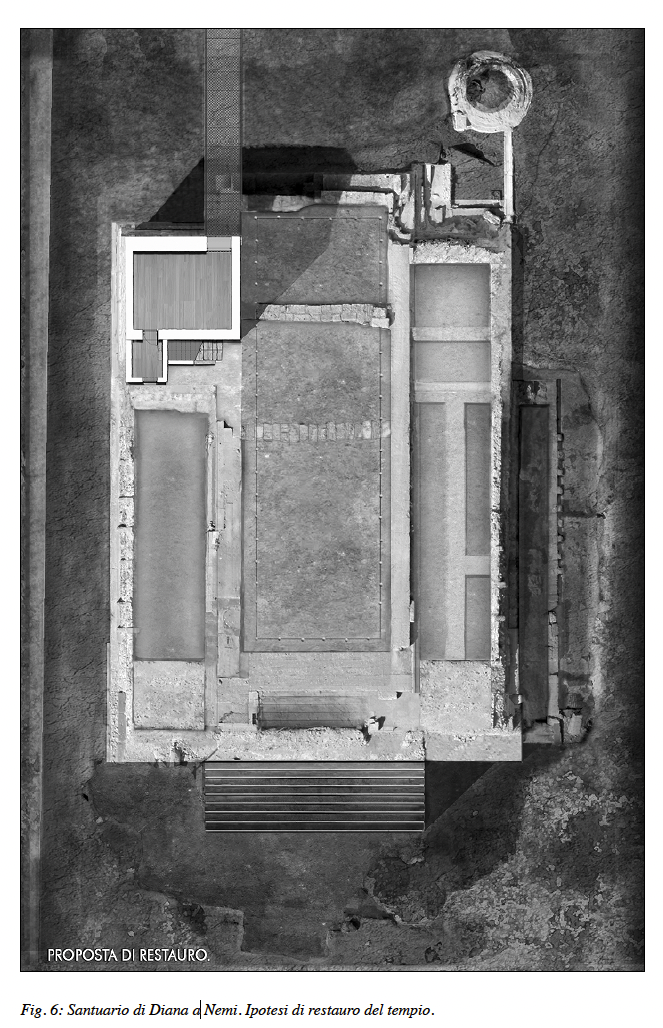
Romagnoli, Laura and Batocchioni, Guido. “Allestimenti e restauri di antichi luoghi sacri: un motivo di studio per la restituzione di un’immagine compiuta.” In Vestigia: miscellanea di studi storico-religiosi in onore di Filippo Coarelli nel suo 80° anniversario, edited by Valentino Gasparini. Potsdamer Altertumswissenschaftliche Beiträge; 55, 727-740. Stuttgart: Steiner, 2016.
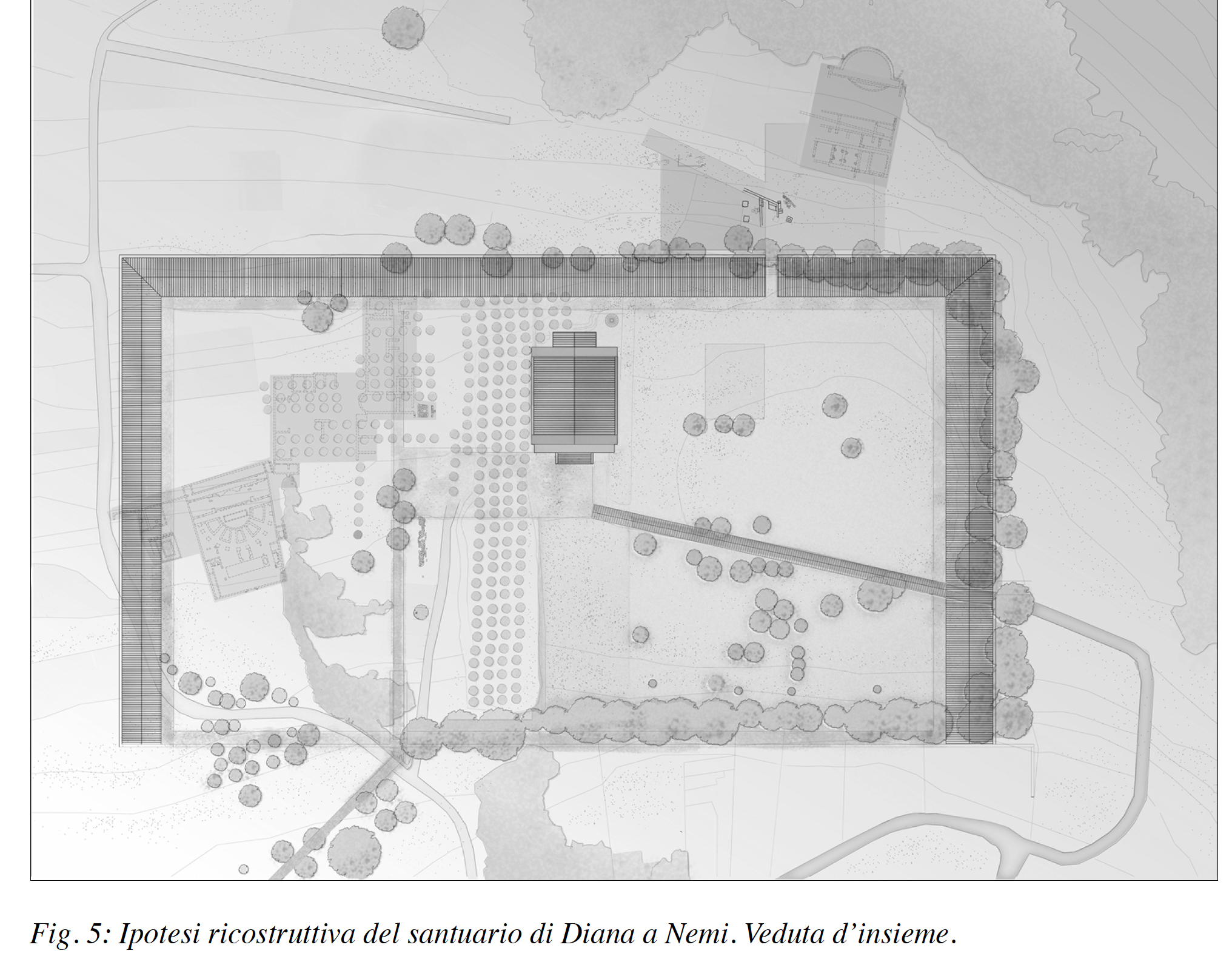
The article imagines what it would take to restore the sanctuary of Diana at Nemi to be accessible and inspiring to visitors while accurating conveying and preserving archaeology.
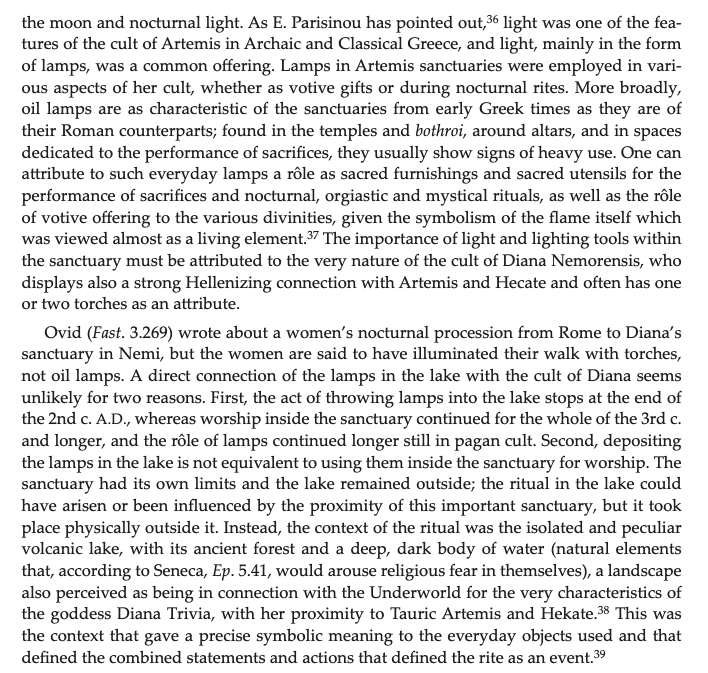
Diosono, Francesca and Cinaglia, Tiziano. “Light on the water: ritual deposit of lamps in Lake Nemi.” Journal of Roman Archaeology 29, no. 1 (2016): 451-468. Doi: 10.1017/S104775940007224X
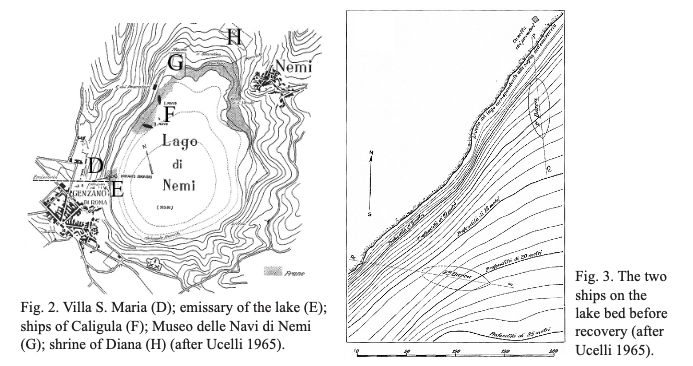
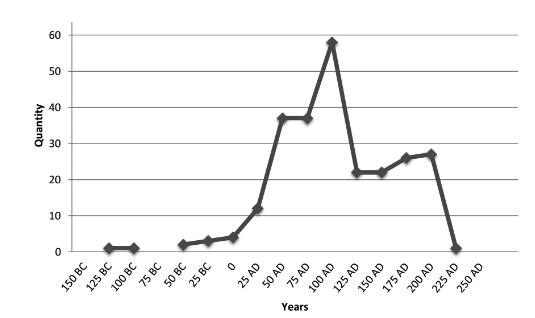
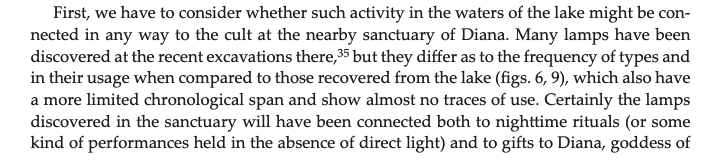
Following attempts beginning in Renaissance times, in 1927 the decision was taken to lower the level of Lake Nemi to the floor where the hulls of two ships belonging to Caligula lay, using pumps. These operations, conducted between 1928-1932, concluded in 1936 with the opening of the Museo Nazionale delle Navi Romane, where the ships were displayed. The ships were destroyed in 1944. But in addition to the materials belonging to the ships themselves, a number of other materials were gathered from the lake bed, including coins and bronze and terracotta objects. Lamps constitute the majority of these materials. The presence of nearly 250 lamps on the lake bed must be assumed to be due to a deliberate action that was repeated over time. The chronological span of almost all the lamps, from the middle of the 1st to the end of 2nd cent. A.D., is too long to argue for an isolated event. The different types and workshops represented also suggest that we are dealing with an act performed on numerous occasions, for each of which the materials were acquired on the retail market. That characteristic suggests that the lamps featured in an individual ritual practice, ending with their deposition on the waters of the lake.
I wonder if the lamps were the less common offering and torches were more usually thrown in the lake but do not remain for use to use as context.
Cinaglia, T. and T. Leone 2014. “Le lucerne,” in Nemi 2014, 499-520
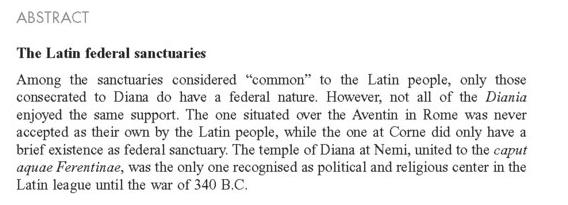
Martínez-Pinna Nieto, Jorge. “Los santuarios federales latinos.” Revue Belge de Philologie et d’Histoire = Belgisch Tijdschrift voor Filologie en Geschiedenis 92, no. 1 (2014): 41-56. Doi: 10.3406/rbph.2014.8539 [open access]
Cf. Martínez-Pinna, Jorge. “Observaciones sobre el origen de le Liga Latina.” Mediterraneo Antico 15, no. 1-2 (2012): 409-423.
Coarelli, Filippo. “Da Nemi a Pesaro: la testa bronzea tardo-arcaica di Copenaghen.” In Hesperìa : studi sulla grecità di Occidente. 30, L’indagine e la rima : scritti per Lorenzo Braccesi, edited by Flavio Raviola, Maddalena Bassani, Andrea Debiasi and Elena Pastorio., 355-359. Roma: L’Erma di Bretschneider, 2013.
A new document is presented—a drawing of a head in profile bearing the concise caption “bronze head found in a river”—contained within a series of previously unpublished notes compiled by the Pesaro-based scholar and collector Annibale degli Abati Olivieri (18th century). This document makes it possible to rule out a Nemi origin for the late-Archaic bronze head now in Copenhagen and to propose instead that it originates from the territory of Pesaro—as is the case for the majority of objects listed in Olivieri’s catalogue. Furthermore, based on stylistic grounds, it is hypothesized that the head was produced in an Etruscan workshop on the Tyrrhenian coast—likely Cerveteri—around 500 BC, and that it represents a votive image of Hercules originally housed in an Archaic sanctuary within the Pesaro territory, associated with the Novilara culture.
Rigato, Daniela. “Tra « pietas » e magia: gemme e preziosi offerti alle divinità.” In Oggetti-simbolo: produzione, uso e significato nel mondo antico, edited by Isabella Baldini Lippolis and Anna Lina Morelli. Ornamenta; 3, 41-55. Bologna: Ante Quem, 2011.
Through the study of two epigraphic documents (CIL 14, 2215 from Nemi and CIL 2, 3386 from Guadix, Spain), he/she demonstrates that the practice of donating gems and precious stones to deities is not necessarily linked to magical or therapeutic meanings, but should instead be understood as a manifestation of pietas.
Moltesen, Mette. “Diana and her followers in a late republican temple pediment from Nemi: a preliminary note.” In From Artemis to Diana: the goddess of man and beast, edited by Tobias Fischer-Hansen and Birte Poulsen. Acta Hyperborea; 12, 345-367. Copenhagen: Museum Tusculanum Pr., 2009. [ILL requested. V eager to read.]
A terracotta torso of a woman in the Museum of Fine Arts, Boston (inv. 86, 692) belongs with a group of fragmentary terracotta figures in the Castle Museum, Nottingham (inv. nos. 189 ; 191 ; 192 ; 193 ; 194 ; 195 ; 199 ; 218). The figures are the same as those seen in photographs taken in 1885 during excavations in the sanctuary of Diana at Nemi by Sir John Savile Lumley (Rome, Deutsches Archäologisches Institut, negs. 4724 ; 4717). In all we have parts of at least 15 figures. They likely date to the second or third quarter of the 2nd cent. B.C. and were displayed in a temple pediment at the sanctuary of Diana in Nemi.
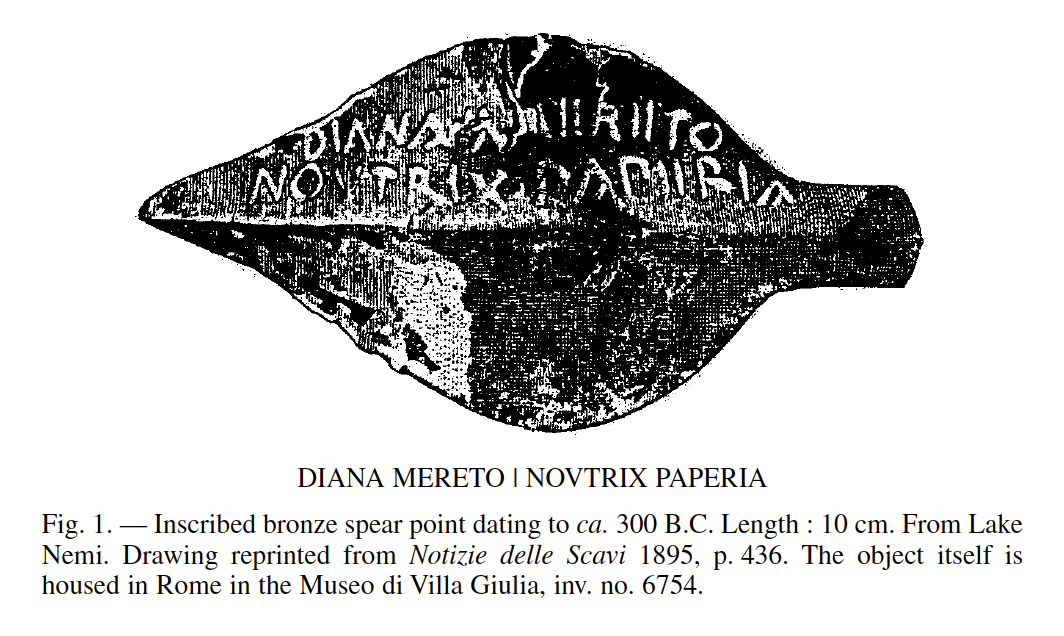
Holland, Lora L.. “« Diana feminarum tutela ? » :: the case of « noutrix Paperia ».” In Studies in Latin literature and Roman history. 14, edited by Carl Deroux. Collection Latomus; 315, 95-115. Bruxelles: Latomus, 2008. [pdf]
Inscription (AE 1896, 13 = CIL I², 45) on a bronze spearhead (Rome, Villa Giulia Museum, inv. 6754) discovered in the late 19th century at the Sanctuary of Diana at Lake Nemi, within an archaeological context containing anatomical votive objects—including breasts. Dating to approximately 300 BC, the dedication “Diana mereto / noutrix Paperia” was likely offered not by a slave, but by a freedwoman of the gens Papiria, where she served as a wet nurse. The absence of a cognomen aligns with the onomastic practices of the period. This role conferred significant social standing upon the woman who held it, empowering her to address the deity in her own name. The choice of a spearhead clearly demonstrates that this was by no means a petition pro lacte (for milk)—despite the votive objects discovered nearby—and that Diana is here regarded as the patroness of freedpersons and of those who assert agency over their own lives, rather than as the protectress of womanhood.
This reminds me I need to go through all the late 19th century NSc to find refs to Nemi.
D’Ambra, Eve. “Maidens and manhood in the worship of Diana at Nemi.” In Finding Persephone: women’s rituals in the ancient Mediterranean, edited by Maryline G. Parca and Angeliki Tzanetou. Studies in ancient folklore and popular culture, 228-251. Bloomington (Ind.): Indiana University Pr., 2007. [ILL requested]
Eleven Roman funerary portraits in sculpture and seven reliefs from the 1st-3rd cents. A.D. depict girls and young women in the guise of Diana, a goddess whose resistance to categories of gender and mature sexuality, as recent research on her sanctuary at Lake Nemi has demonstrated ( => 72-06976 and 74-14352) appealed to mourning parents. The goddess’ status as chaste maiden reflected the girls’ stage of life, but as huntress she also signified a heroic mode of representation or even virtus. Deceased girls were endowed with virtus in compensation for their untimely death.
Bilde, Pia Guldager and Moltesen, Mette. A catalogue of sculptures from the Sanctuary of Diana Nemorensis in the University of Pennsylvania Museum, Philadelphia. Analecta Romana Instituti Danici. Supplementum; 29. Roma: L’Erma di Bretschneider, 2002
I looked for a copy to buy but I think I’ll ILL as I’m not convinced it will be that useful over the long haul.
Pasqualini, Anna. “L’ incesto di Silano e il bosco di Diano: (Tac. Ann. 12.8.2).” Analecta Romana Instituti Danici, no. 27 (2001): 141-149.
On the day of his wedding to Agrippina, Claudius had rites performed in the lucus of Diana at Nemi to expiate the incest committed by L. Iunius Silanus and his sister. The Lucus Dianius is linked to a very ancient phase of Roman and Etruscan religion, to King Tullus Hostilius, and to the gentile social order. There, Diana and the goddess Egeria were venerated—both patronesses of fertility, women, and newborns.
Green, Carin M. C.. “The slayer and the king: « rex nemorensis » and the sanctuary of Diana.” Arion 3rd ser. 7, no. 3 (1999-2000): 24-63.
In Aen. 6, 136-141, the golden bough’s function as a talisman for Aeneas on his journey to the underworld and the connection between Augustus’ family and (Lake) Nemi, home to a renowned sanctuary of Diana, confirm Servius’ connection between the bough, the death of Misenus, and the ritual of the « rex nemorensis ». This native Italic cult, marked by mortal combat between a fugitive slave and a priest of Diana, offers Vergil a pattern that grounds the poem through a powerful Latin ritual that mirrors the conflict between Turnus and Aeneas for kingship. More generally, the ritual of the « rex nemorensis », by enacting the easily subverted relationship between hunter and hunted, ruler and slave, embodies the primitive, uncivilized, and ultimately unchanging core of kingship and power.
I guess I’m going to have to decide if I believe this rex nemorensis is a historical reality or just stuff Romans like Vergil like to imagine and think about.
Fea 1820 (about Fea who originally claimed the town of Nemi as the site of the temple in 1798)
“I have never doubted the greater elevation of Lake Nemi—or rather, Lake Genzano—relative to the other lake; this has been my conviction ever since October 1791, when, in the company of His Excellency Count D. Alessandro de Sousa Holstein—Minister Plenipotentiary of His Most Faithful Majesty to the Holy See—I examined the lake in minute detail. Traversing it in a small boat, I observed its modest Emissary, the supposed remains of the Temple of Diana Nemorensis situated along the lake’s lower edge, and the outlet where, just beyond, in the Ariccia valley, the water turns a grain millstone.
“I have also observed repeatedly—most recently on the 16th of this month, accompanied by local experts—that the spring which feeds Lake Albano must, by reasonable conjecture, lie beneath Palazzolo. It is situated in the direction of the high mountain peak from which, at specific elevations, the waters for the Albano and Castelli aqueducts are collected; yet, it is nowhere visible upon the lake’s surface, nor is there any sign of bubbling or agitation—the current simply flows directly and placidly toward the Emissary.
“Kircher notes that Lake Nemi possesses three visible springs, which he has marked in his copperplate engraving. Of these, the largest—which I have personally examined—is fully exposed beneath the town of Nemi; it cascades down with great force from a considerable height above the lake, and is so copious that, immediately upon reaching the bottom, it sets three grain mills in motion. From the point where these springs emerge down to the lake itself, there remains a notable difference in elevation. The water, having subsequently flowed through the aforementioned small Emissary into the Ariccia valley, turns the aforementioned millstone—which belongs to Genzano—from a proportionate height, requiring no artificial damming or diversion, unlike the mill powered by the Albano Emissary; furthermore, it serves to irrigate the valley itself. And finally, as it flows toward the sea, it assumes the renowned name of the River Numicus.” [Machine translation]
…
“A further argument compels me to reject the hypothesis of this connection—specifically, the notion that water flows from Lake Nemi into Lake Albano. This argument rests on the observation that the volume of water seen gushing into the former lake beneath Nemi is precisely equal to the volume flowing out into the Ariccia valley; in both locations, this water serves to power millwheels with equal force.
“Furthermore, if we take into account the mythological history of the Temple of Diana Taurica—also known as the Temple of Nemi—so renowned in antiquity and predating the very foundation of Rome (regardless of its original architectural form), one could never conceive that it was erected in the lowlands, on the lakeshore beneath Nemi and adjacent to the aforementioned spring—as was asserted by Argoli (1), Holstenius (2), Father Volpi (3), and other modern scholars—unless the Emissary had already been constructed. However, for these and various other local and historical reasons, I have conclusively demonstrated elsewhere (4) that the Temple was situated precisely where the town of Nemi stands today—a town that still retains its name, derived from the Latin word Nemus.”
This is a follow up to a post on RRC 486/1, all part of the larger recurrent theme of Nemi.
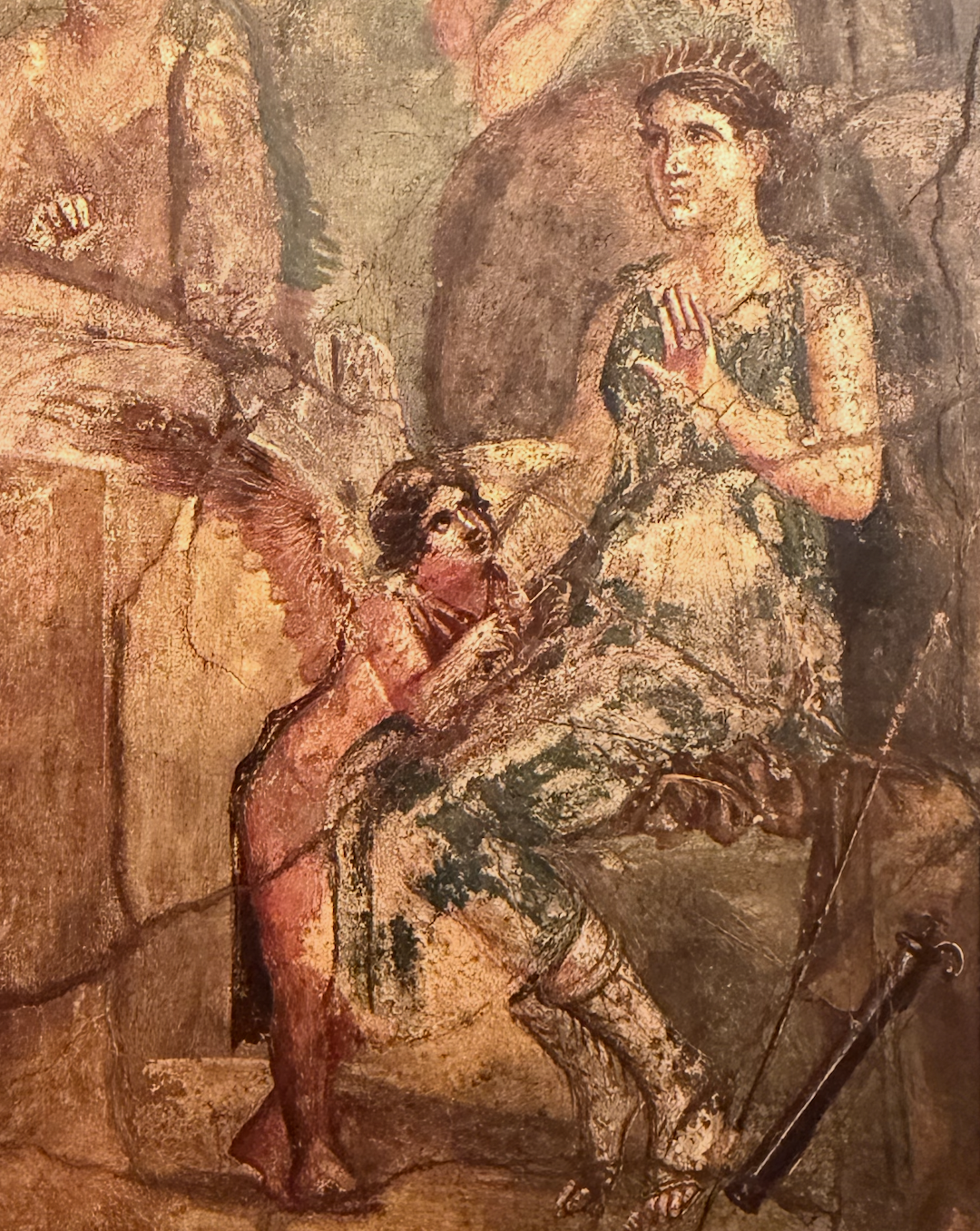
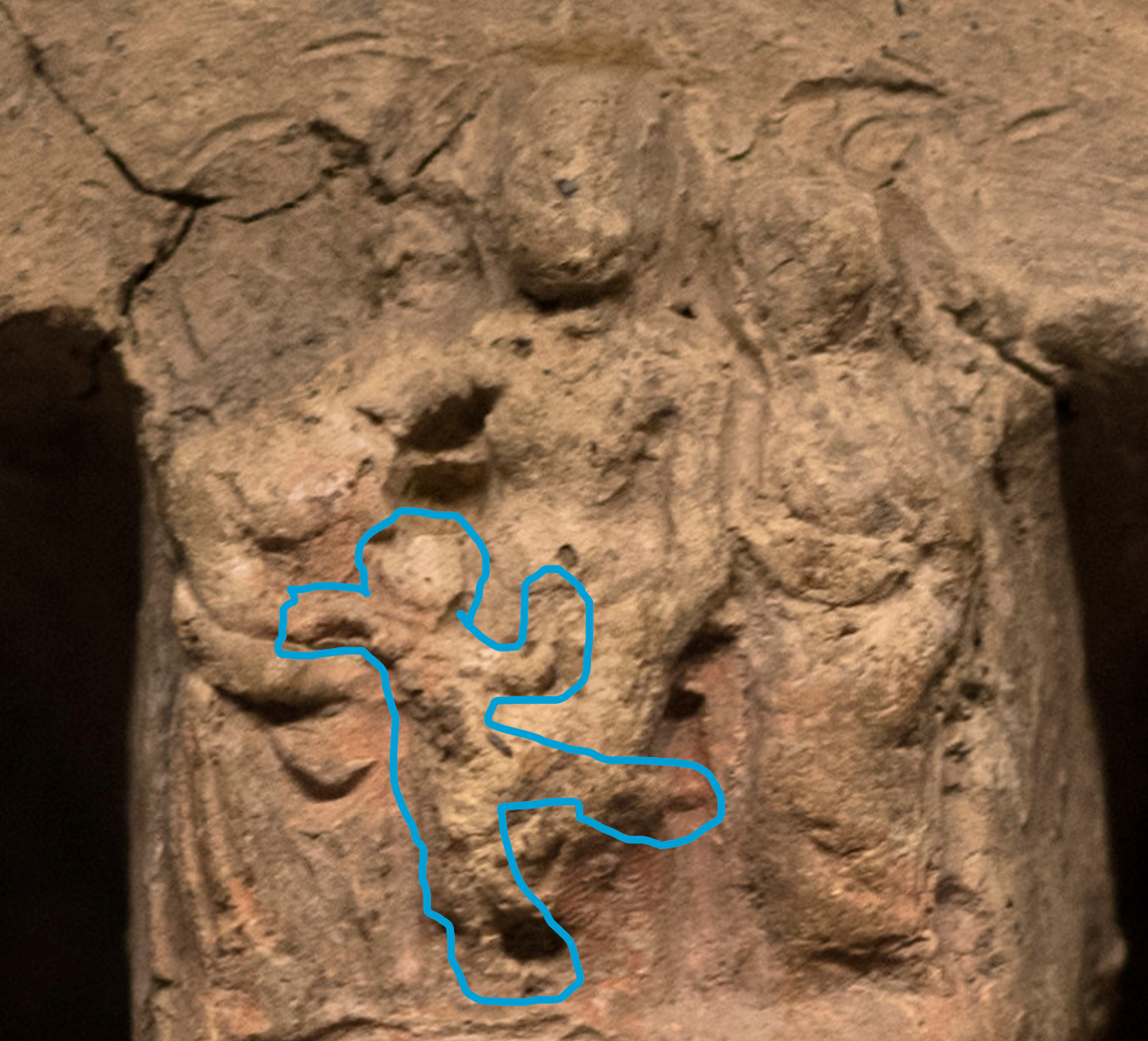
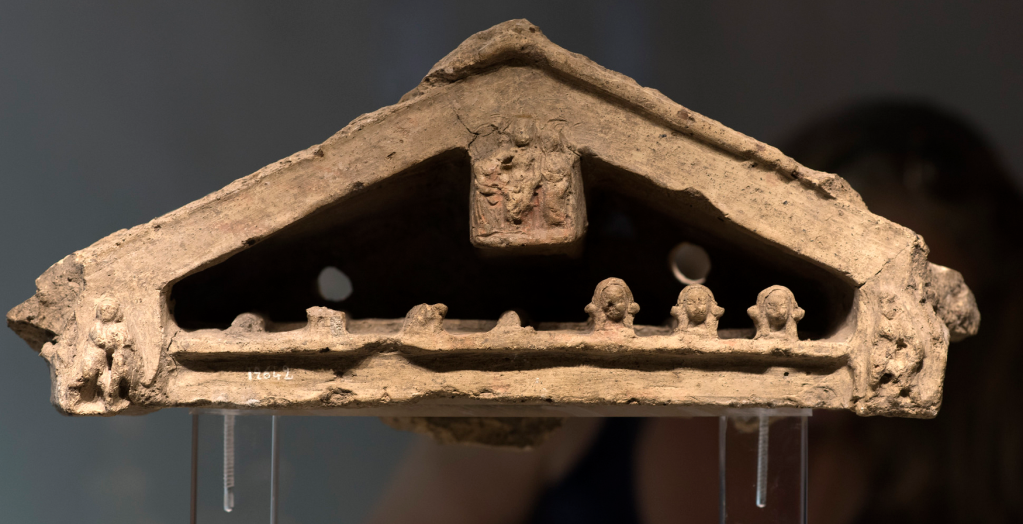
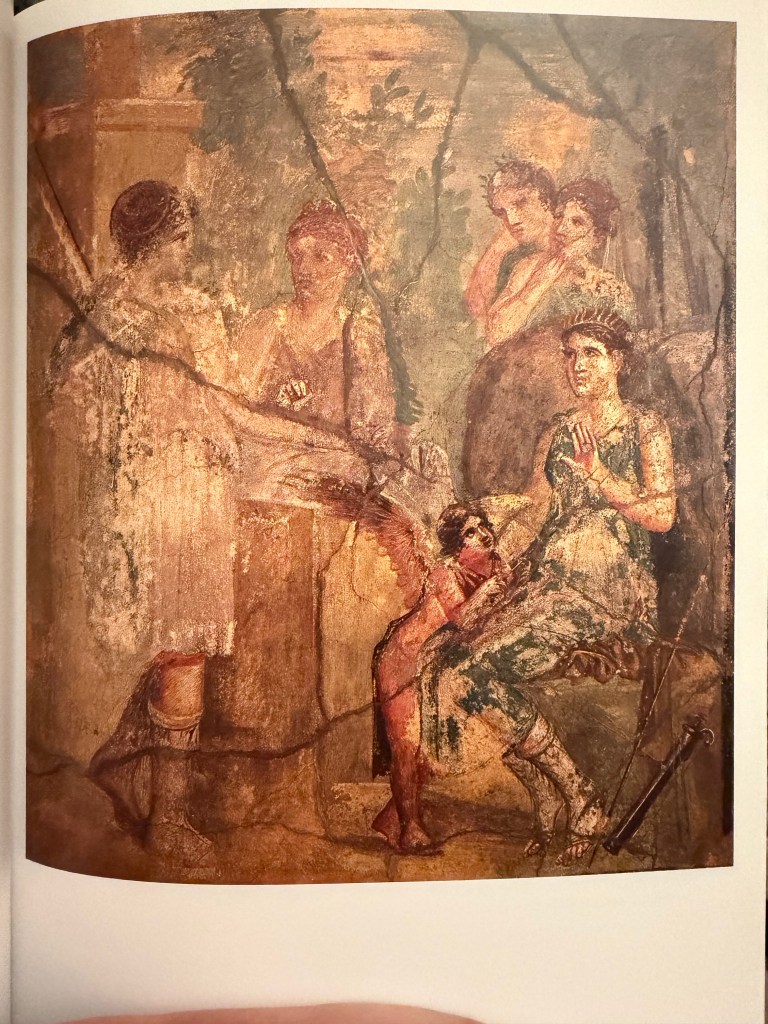
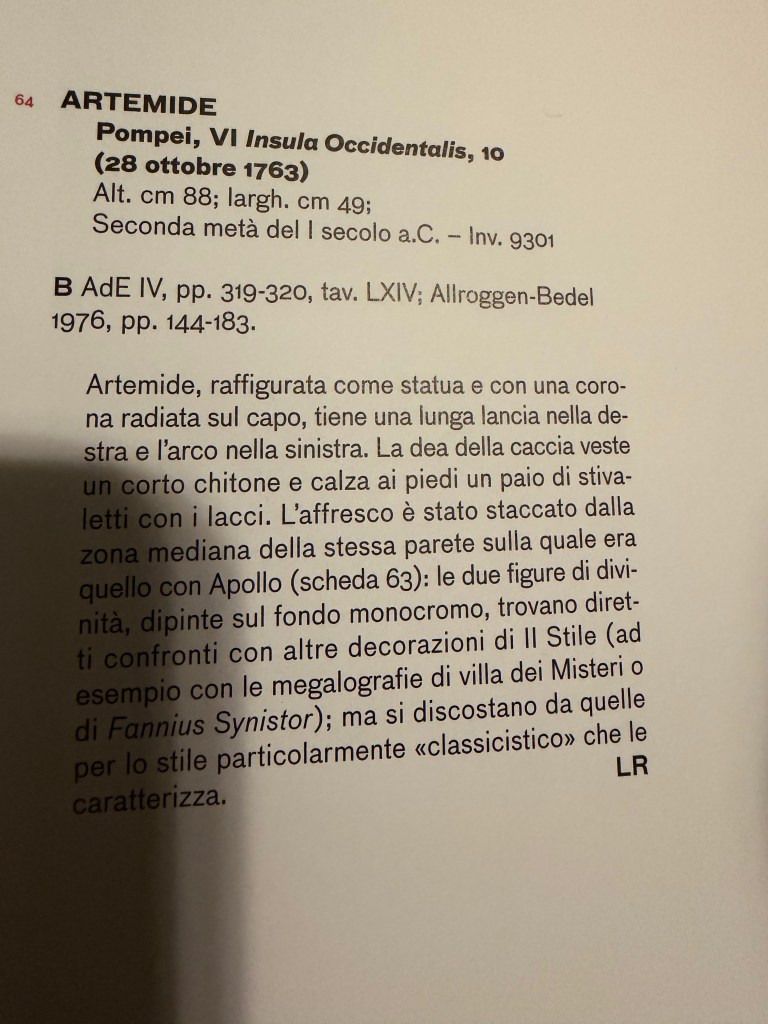
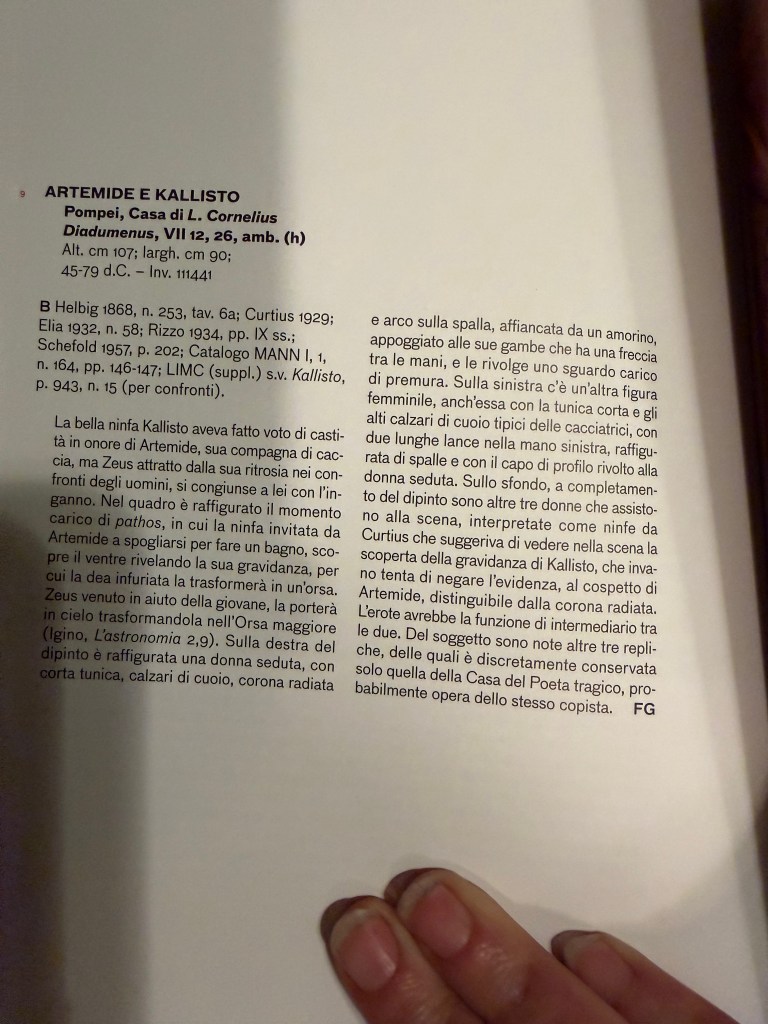
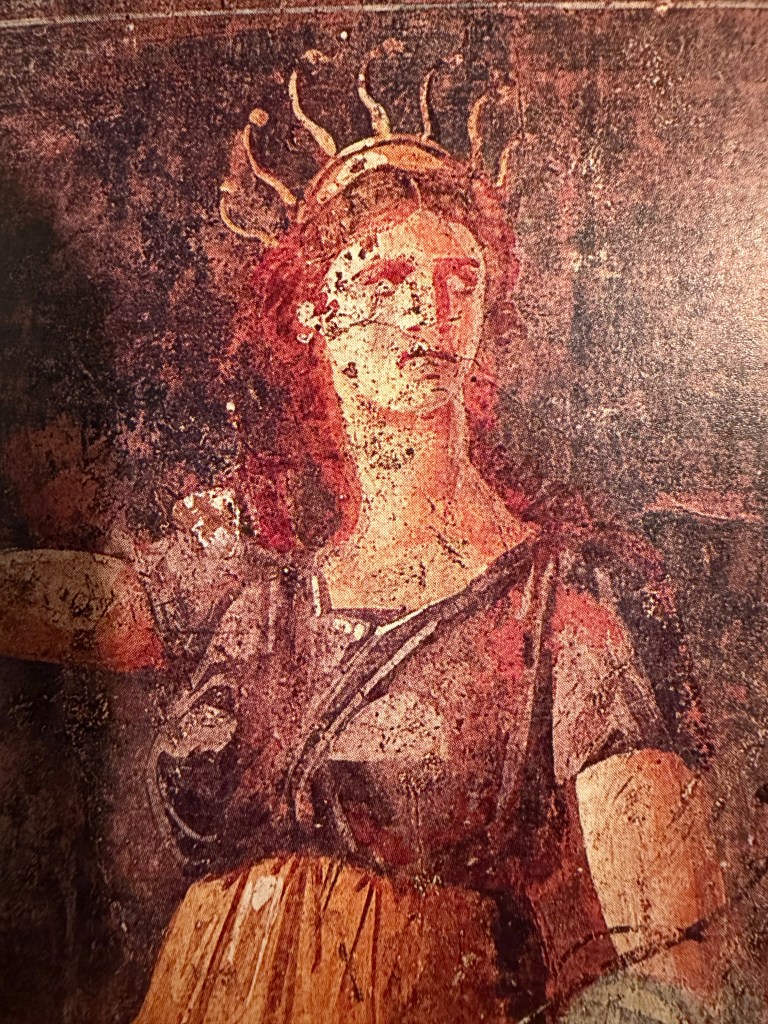
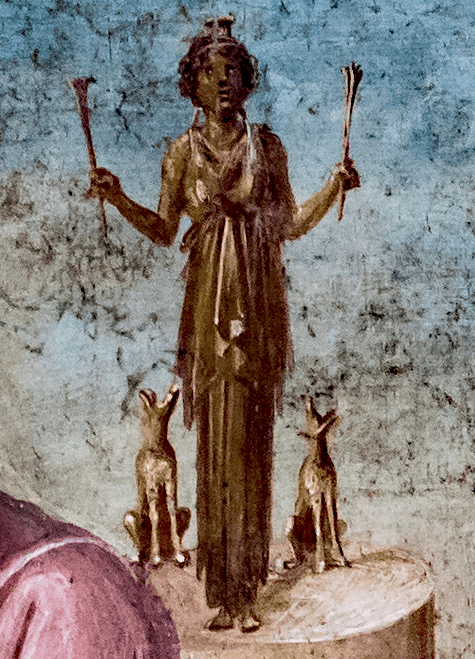
This representation of Diana (Artemis) feels important because it is the first time I’ve seen her with a child (in this case a cupid) leaning over her lap. It seems a good parallel for the three figure design on the pediment of the model temple found at Nemi (earlier post).Images from Naples Catalogue
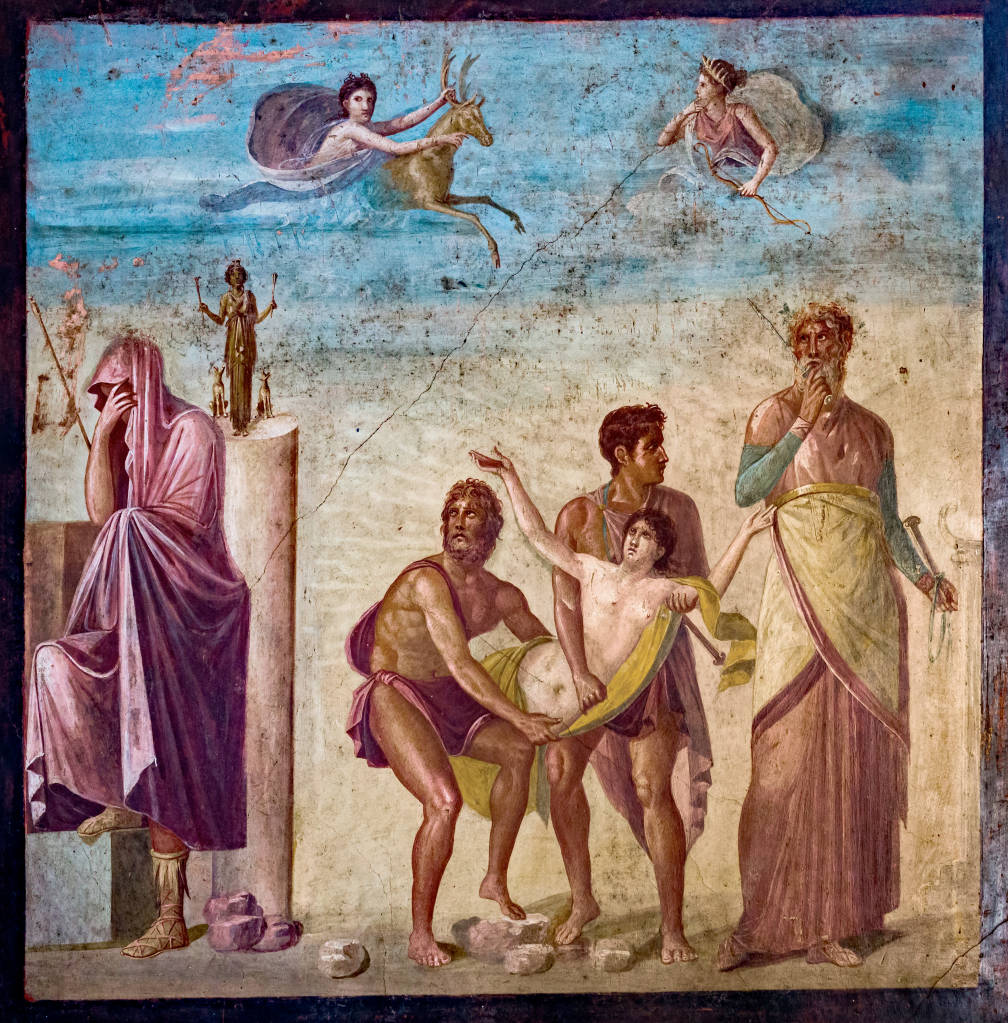
The other intriguing thing. New to my eyes is this wavy radiate crown. It is even in the Iphigenia fresco and thus I’ve seen it many times before.
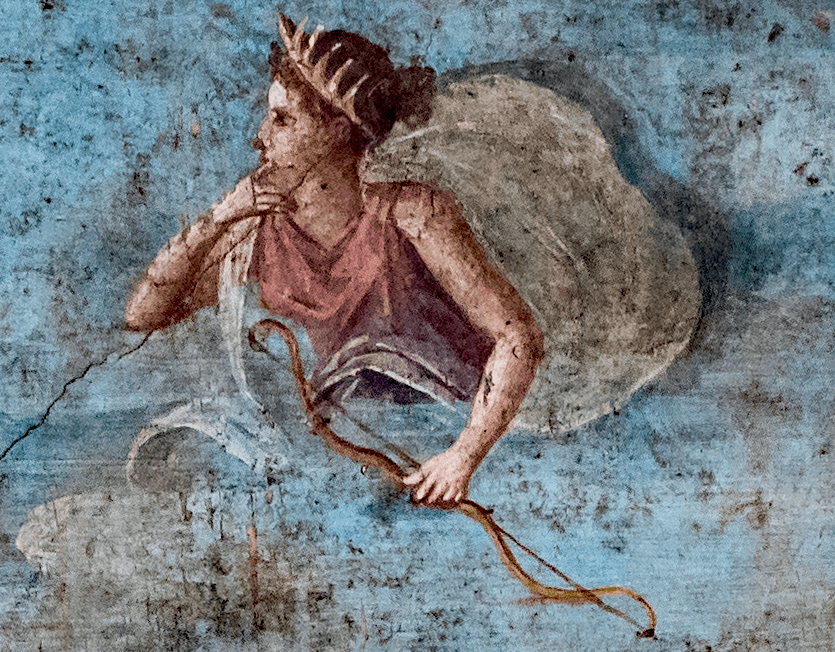
I should have also remembered the standing figure of Diana/Artemis in this fresco. Its raised arms are in a very similar position to those on reverse of RRC 486/1. Note also similarity in costume. The curious thing is that in almost all these statue depictions in fresco of Artemis she holds torches. And yet no torches are on the coin design. Also notice how Diana/Artemis in the sky has the same gesture as Agamemnon. Never noticed that before.
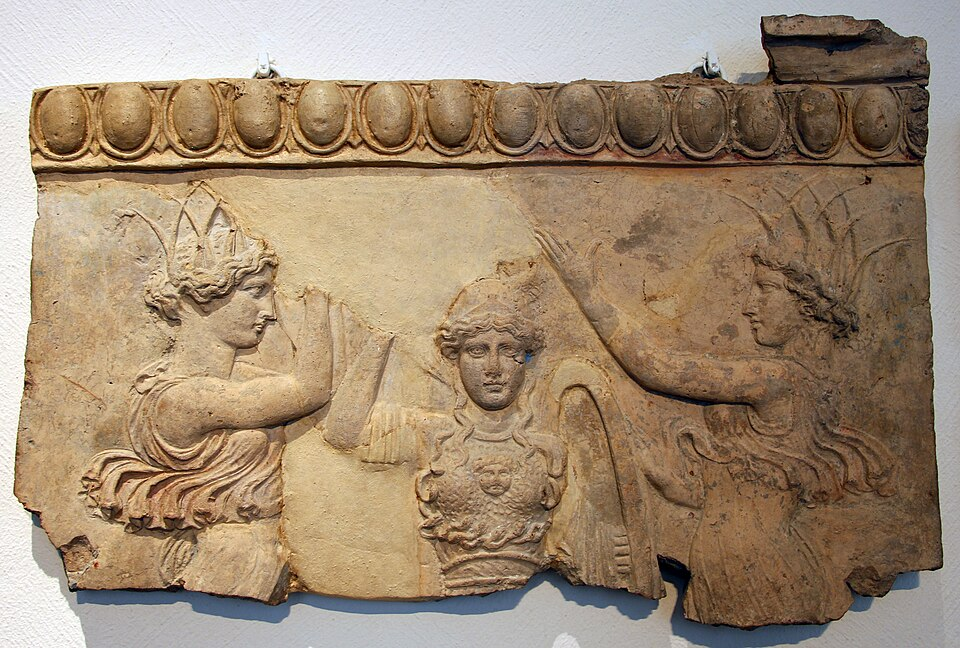
The radiate crown brought to mind, the head gear of the two figures adorning a statue of the palladion on my favorite Campana plaque, but I think it is likely a false connection.
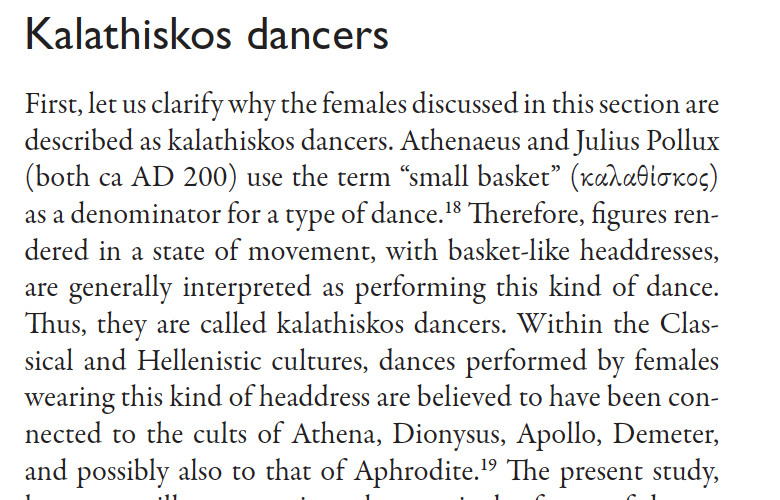
Berlin examplefrom Habetzeder, Julia. (2012). Dancing with decorum The eclectic usage of kalathiskos dancers and pyrrhic dancers in Roman visual culture. Opuscula. Annual of the Swedish Institutes at Athens and Rome. 5. 7-47. 10.30549/opathrom-05-02. [pdf]
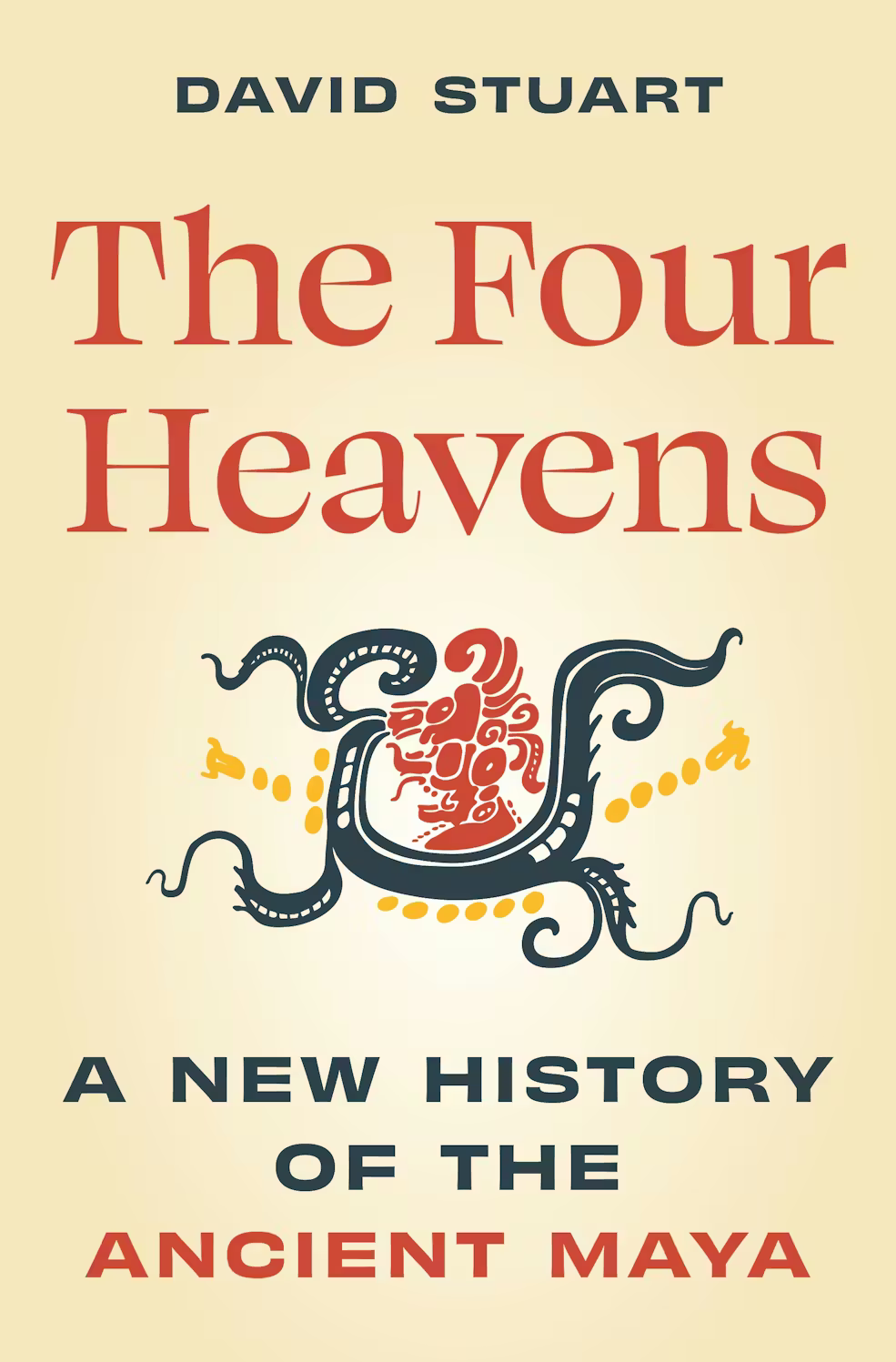
“Maya history was seemingly lost forever when the first Europeans encountered the great ruins of ancient cities in what is today Mexico and Central America. Today, with the recent decipherment of their ancient writings, the story of the Maya can now be told from their perspective. Stuart traces the rapid emergence of permanent settlements in the rainforest, which gave rise to monumental architecture and a flourishing urbanism and ushered in the Classic period of Maya civilization beginning in the mid-second century CE. He reveals a world of majestic royal courts tightly bound together by marriages, shifting alliances, and warfare, much of it driven by the ambitions of two major dynasties, the Kanuls and Mutuls. Stuart describes how the long-standing rivalry between these two great houses shaped the fates of the surrounding kingdoms and may have set the stage for “the Great Rupture” of the ninth century, when the royal courts buckled under the weight of internal strife, social unrest, and environmental crisis, transforming Maya civilization yet again.”
I’m obsessed with this book. I downloaded the audiobook on lark when a colleague who works on Ancient China shared a picture of his own copy on FB. I did not expect it to have such a drastic effect on my conception of my own field and its place in Ancient Studies writ-large. I think I am finally and utterly convinced that Global Ancient History is ‘a thing’ and that it valid and even necessary for those of us who specialize in one culture to understand and appreciate the methods and challenges and insights of others working on other ancient cultures. (Sorry to come late to this party…)
To be clear, I’ve not finished the book, but I need to write about it in media res to create some room in my brain for today’s work on my own materials. I also apologize to everyone I’ve texted and gabbed to about it the last few days. It seems to be the only thing I can talk to anyone, and I mean anyone. I realize part of this is the its new to me, so it must be new to you phenomenon. I trust and hope that at least some of my colleagues, friends, and family are better exposed to Meso-American Pre Colonial histories than me.
Why do I love this book?
It seamlessly, and in a compelling narrative style, integrates the story of the people themselves with…
The history of scholarship, how we know what we know and the personalities and contexts that shaped their work for both good and bad. Here particularly I love how he acknowledges those whose work often goes uncredited, indigenous scholars and memory keepers, women. The shout out to Alice Kober was so unexpectedly perfect. Stuart allows us to vicariously enjoy the wonder and joy of first insights and first glimpses of ruins, while not losing sight of power dynamics, missteps, and misconceptions. The story is richer for the shades of gray, few heroes, few true villains. And without the shades of gray I don’t think I could have been so moved and horrified by Bishop Landa’s book burning. One of the greats crimes I know. Which brings us to…
The history of epistemicide (the intentional erasure of knowledge as a colonial tactic – he doesn’t use epistemicide but what he describes is the very definition of the phenomenon. Stuart spells out clearly the advantages to the colonial powers of presenting the inhabitants of these lands as timeless, primitive peoples without any knowable past (or future)).
The effects on looting and the art market on the state of our knowledge (I’d love a hair more here on how economic conditions motivate local communities to participate in this and how the collecting desires of museums and individuals feeds (and launders) this black market industry, but maybe it is coming in future chapters I’ve not yet read.)
The distinguishing of linguistics and archaeology and art history from HISTORY while still fully integrating these into the story of the people over the sweep of time.
The commitment of author and publisher to having the audiobook read by Timothy Andrés Pabon who fluently reads the Mayan names and sentences into the text, giving (at least an illusion) that we today can hear again some of these peoples.
a consistent re iteration of the lineage and cultural connections between the living Mayan peoples today and those of antiquity. Far too often I’ve heard people question if people of the modern nation state of Greece are really the descendants of the ancient Greeks of the temples and texts. In all of this is a dismissive tradition of racism that centers northern European powers as the intellectual and imperial heirs of Mediterranean cultures be it Christianity or Rome or Athens. To say nothing of Aryan master race theories that give us today’s ancient alien conspiracy theorists. Again, I’d love it if Stuart came out and directly engaged with this but he is clearly rebutting it every step of the way.
crystal-clear periodization and re iteration of key cultural features such that I feel like my mental map is growing and a sequence of events and their connection to real time emerging.
the constant reminder that this may be a new history but that it is incomplete and that we can and will learn more as we move into our own future. That space to be wrong, that space to be curious, is something I so yearn for …
So now you’re wondering if I see any lessons or parallels. So many! Each new chapter gets me more excited.
Hellenistic and Roman Italy made incredible use of Terracotta in its first phase of Monumentalization where as the Maya seem to have first build large earthworks and then quickly massive stone complexes. Roman Italy leans into stone quite rapidly though. Both the Maya and Romans discover the incredible versatility of plaster for both 2D and 3D artistic architectural decoration.
The shift from communal religious identity in the arts of the pre-classical Maya to the dynastic arts of the classical reminds me intensely of the shift from republic to empire. Same, but different. The 9th century cultural change leading the Maya to new ways of life outside the control of dynastic structures bears some resemblance to the dissolution of Rome and how individual patterns of life seem to become more focused on the local without the central power figures.
I can immediately think of parallels for connections of ruler and gods, the animistic approach to the natural world and the divine, the listing of events and the measuring of time as a means of expressing control and power, the intense devotion to ancestors, the claiming of shared ancestors for political purposes, the use of visible public religious ceremony to re enforce social hierarchies, the use of competition as spectacle and avenue for social cohesion, the blurry boundary between history and legend, the monumental epigraphic habit, the labeling of figures in art, even the lists on cups, to say nothing of the importance of cultural exchange with their neighboring cultures (esp. to the south), and how their own traditions and prestige were borrowed by other seeking regional status in future generations.
Ok… enough for now. I need to focus on my own work. I cannot wait for my copy of the book to arrive for the illustrations. I anticipate the more I listen the more I may post about all of this.
Leventi, Ifigeneia. “Μαρμάρινα μετάλλια (« tondi ») της ελληνιστικής περιόδου: μία επανεξέταση.” In Πολύτροπος : τιμητικός τόμος για τον καθηγητή Νικόλαο Χρ. Σταμπολίδη [Nikolaos Chr. Stampolidis]. 1, edited by Manolis I. Stefanakis, Mimika Giannopoulou and Maria Achiola., 567-582. Rethymno: Mesogeiaki Archaiologiki Etaireia, 2023. [available via academia.edu with many nice illustrations]
Draws heavily on
Palagia 2019: O. Palagia, “Pergamene Reflections in the Sanctuary of Diana at Nemi”. Στο S. Hemingway και K. Karoglou (επιμ.), Art of the Hellenistic Kingdoms. From Pegamon to Rome, New York: The Metropolitan Museum, 83-90. [I own book in PA, but writing this post from Brooklyn.]
Machine translation of relevant sections of Leventi:
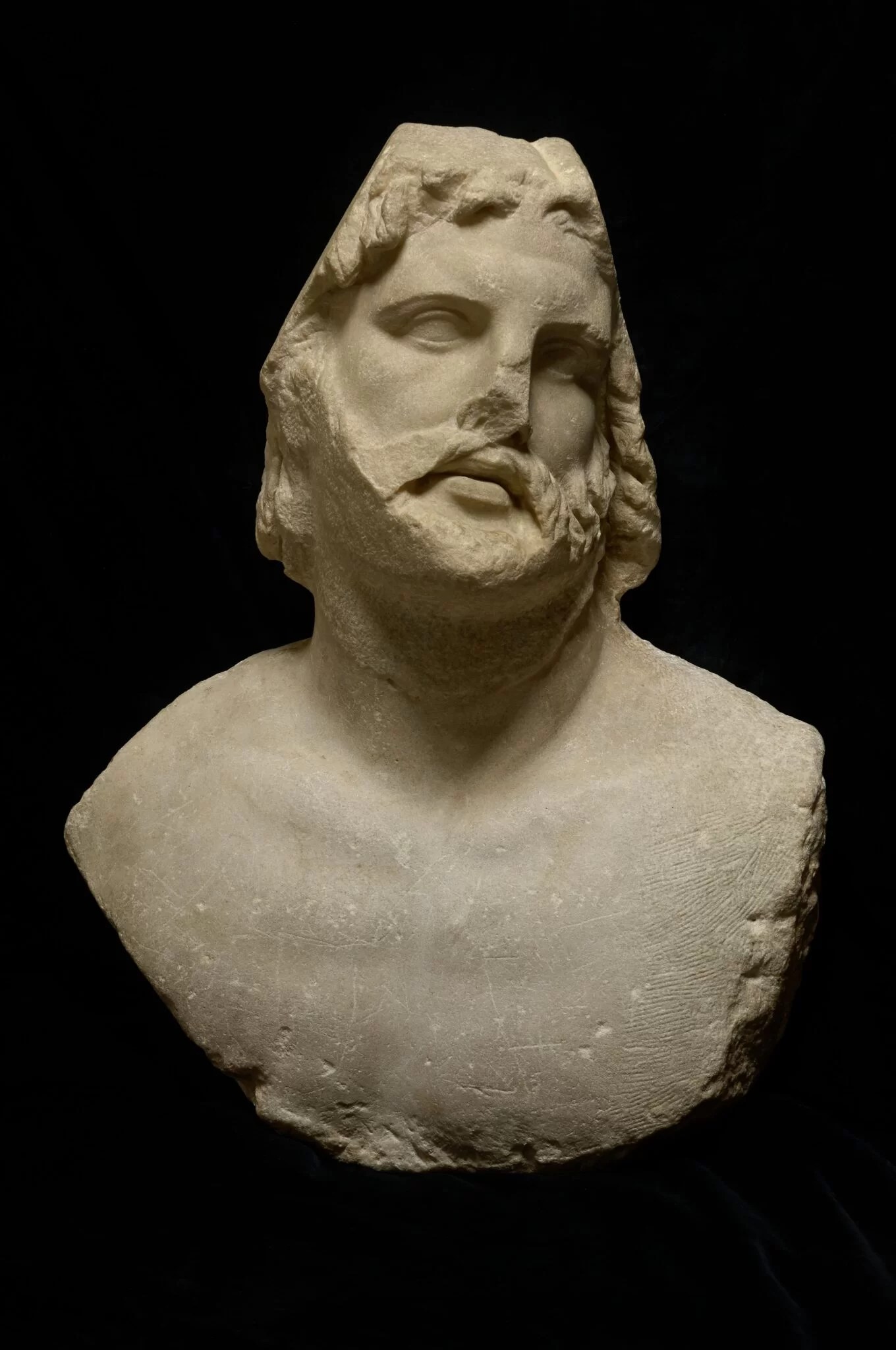
“…The most recently identified monument of this category is the larger‑than‑life bust of Asclepius, carved in Parian marble and now housed in the Castle Museum, Nottingham (inv. no. N 832). It originates from the sanctuary at Nemi and is executed in a Pergamene style. The sculpture was studied by Olga Palagia, who attributed it to a Greek sculptor and dated it to around 100 BC.
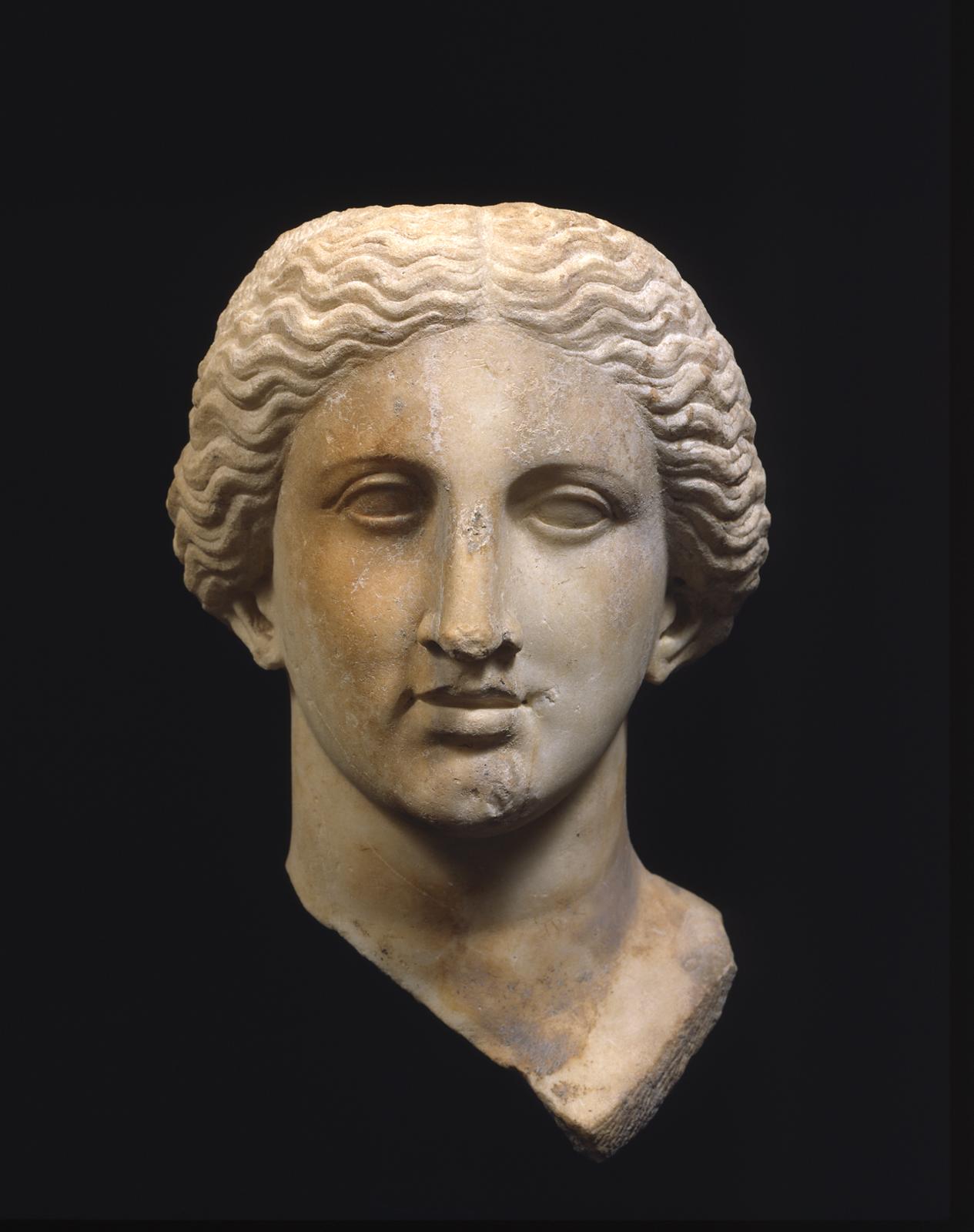
“Palagia further proposed that a similarly conceived monument originally included a second over‑life‑size and approximately contemporary head of Diana, also from the same sanctuary and now held in the University of Pennsylvania Museum, Philadelphia (inv. no. MS 3483).
“Both sculptures are best interpreted as marble medallions (tondi), belonging to the same sculptural category as those discussed elsewhere in this study. Their scale, marble type, and stylistic features support their inclusion among the Late Hellenistic Greek marble medallions, rather than as Roman Imperial creations.
…
“The Asclepius from the medallion at the sanctuary of Diana at Nemi, though fragmentary, likewise shows typological affinity with the Asclepius statues from Munychia (Athens) and Ostia.
…
“conclusion
“The use of inset elements (piecing), especially for parts of the skull and hair, is common in Late Hellenistic marble medallions. Such inserted pieces may have been marble or plaster (Kalydon, Pergamon). In some cases, the circular frame itself—or part of it—or even the head was inset (Delos).
“The fully sculpted busts are usually life‑size and decorated gymnasia (Kalydon, Pergamon) or sanctuaries (Delos, Nemi), though larger‑than‑life examples are also known (Mahdia, Nemi, Pergamon Gymnasium). They were typically installed on interior walls, and more rarely in temple pediments (Delos).
“The principal centers of production—whether the works were carved from Pentelic or, more commonly, Parian marble—were overwhelmingly Athens, and secondarily Pergamon. Pentelic marble predominates at Kalydon, with the exception of the Parian marble used for the head of Leontas. At Mahdia, Pentelic marble was mainly employed, with Parian marble used in at least one case.
“It is entirely possible that Athenian sculptors worked on site. In the case of the head of Zeus from Kalydon, the reverse clearly shows that it was carved from a reused statue fragment representing the lower torso and upper thighs of a boy.
“The practice of adapting sculptural prototypes without creating exact replicas is characteristic not only of the Kalydon medallions, but also of examples from Mahdia and Atalante. These monuments represent the last phase of a period in which faithful copying of Classical monuments—even in free‑standing sculpture—was not yet the norm. This practice would only gradually become established in the early Imperial period.
“Nevertheless, exact copies do appear among the monuments discussed here, such as the Heracles head from Kalydon and the Satyriskos from Mahdia, which reproduces the head from the contemporary Invitation to the Dance group. Alongside these are works such as the heads of Zeus and Eros from Kalydon, and Asclepius from Nemi, which represent variations on Late Hellenistic sculptural types.
“The production of these monuments should therefore be placed in the second half of the 2nd century BC and the early decades of the 1st century BC. No securely dated examples from the early 1st century AD have yet been identified. The type, however, was revived in the later Imperial period, where it enjoyed renewed popularity—especially in the depiction of private and imperial portraits.”
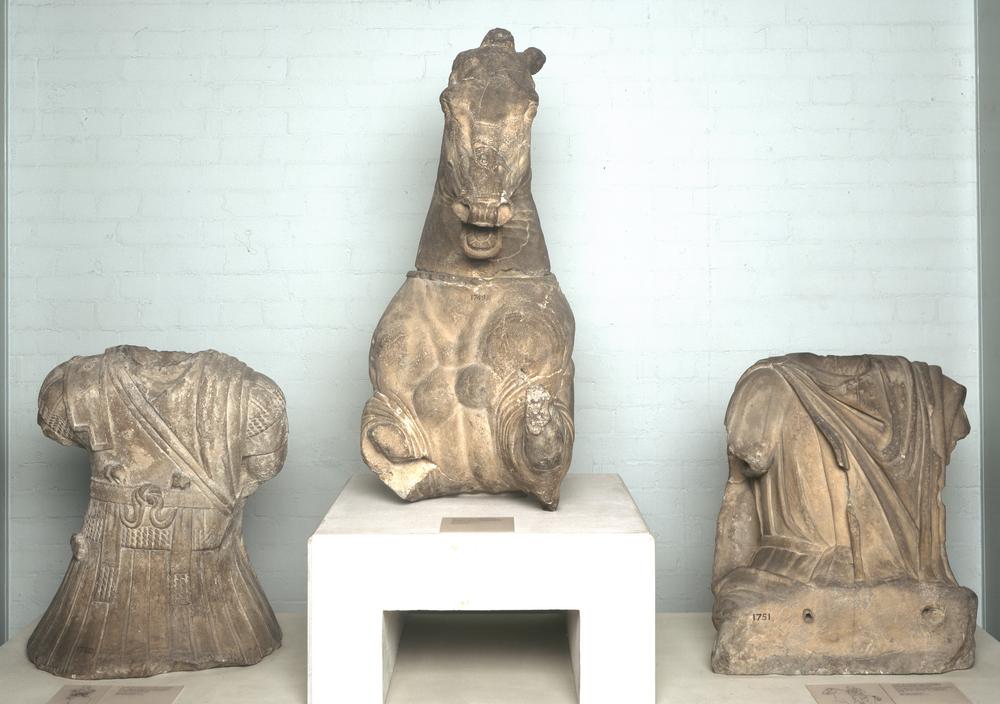
If Leventi is correct about this date then we would have to see this Hellenistic intervention at Nemi as predating say the interventions at other regional cult sites like Murena’s interventions at Lanuvium after his time fighting Mithridates. The question in both cases is whether the sculptures were created for the precise location or taken as plunder in the Greek East before being re-homed in Republican Italy.
BM artifacts from Lanuvium Rider group. Most of the Lanuvium materials are in LeedsLeeds objects photographed by Carole Raddato while on loan to Frankfurt
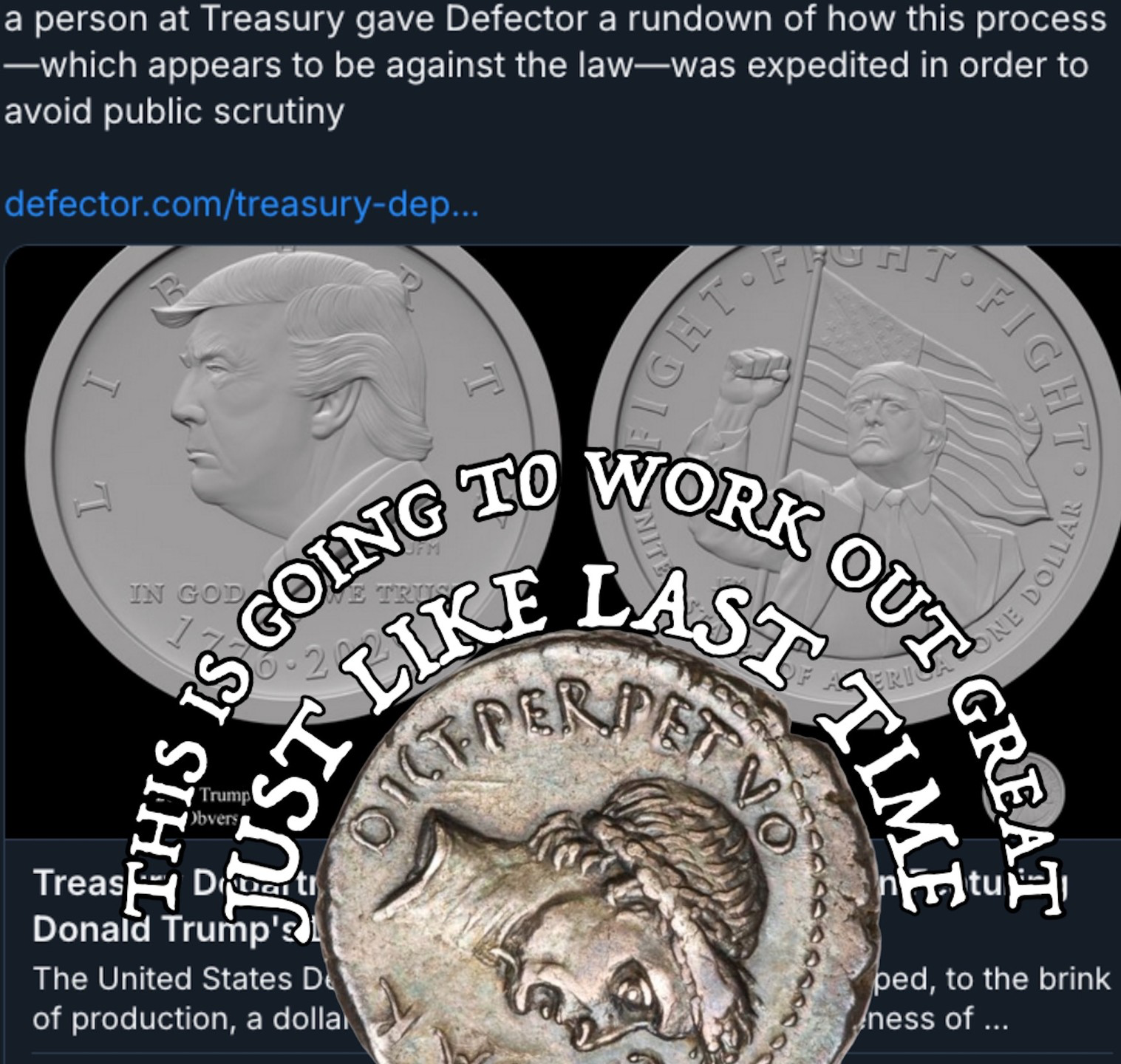
The news stories are fine, the memes rub me the wrong way.
I hate to be a pedant. Or, rather, I love to be a pendant, but worry I’ll get that side-eye people give when they want to know why you cannot take a joke or just enjoy it quietly.
It is a compulsion to be accurate. I cannot resist correcting this meme and dropping some historical context on anyone who will give me the time of day.
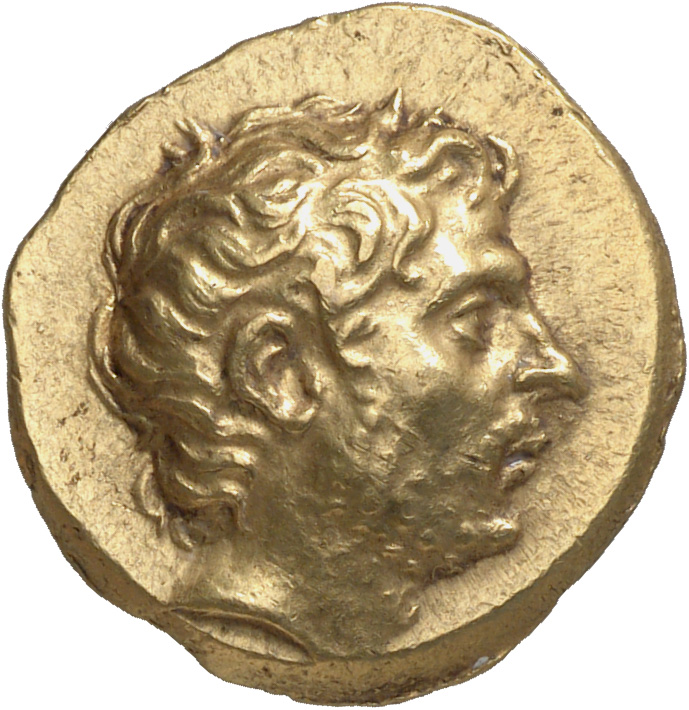
The image on the left is a posthumous portrait of Alexander the Great. That means, AFteR hE wAs DEaD, people.
This obverse type was struck by Lysimachus 323 – 281 BCE and probably some issues even later by others. It was part of Lysimachus’ bid to be one of the successful Diadochi, or successors of Alexander. He connects himself to Alexander by showing Alexander as the son of Ammon (those horns!), and thus a (semi!) divine figure. The diadem is a symbol of kingship, particularly kingship based on struggle, the spear-one territory. Lysimachus failed. The Attalid dynasty rose in his place. He thought just because a man was a eunuch he was without ambition. Sex difference does not determine capacity to lead.
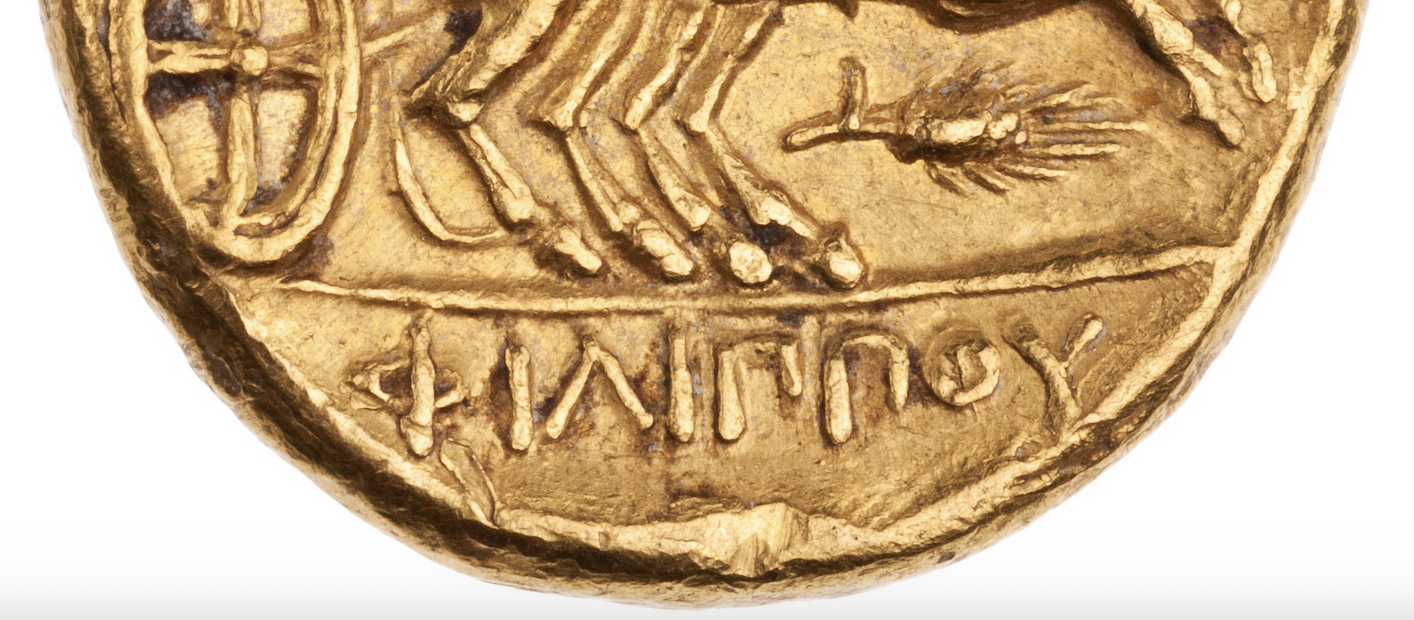
What is a better historical parallel to Trump signing the dollars? Well, a signature, of course. We might talk about Alexander’s father signing coins, the famous Philippoi gold coins that funded the power of his Macedonian dynasty and are so often discussed in literature.
And yet, what makes this signature on the coin so interesting–I’m sure there are other earlier examples, I’m not claiming this is a first, just a v famous example–if that Philip is not King OF anything, he’s just Philip, sovereignty rests in him alone, not the idea of a people or a place. Only he guarantees this coinage. So this too is not a very good historical parallel. Trump is signing the bills not replacing the issuing identify underwriting the worth of the dollar.
I see this as a means of assuaging Trump’s (bruised?) ego after the apparently stalled or aborted attempt to put his head on coin. Here’s the news story from last October.
So is there a good parallel for Trump’s signature on the dollar from the ancient world. Our founders idealized the Roman republic so we might as well look there to start.
Flamininus was the first living Roman (or really any Roman) to get his head on a coin. Basically, this looks like Greeks and Romans trying to figure out in 196 BCE what the status of Roman commanders were and how to treat them, when they behaved like Hellenistic kings. Do you honor them as kings? The coin type is only known from a handful of specimens and looks like a failed experiment. The next living Roman is Julius Caesar during his dictatorship and he got stabbed by his besties shortly there after. A failed experiment? Not really. Those besties then put their portraits on coins. Uber hypocrisy.
BUT we’re not talking about portraits but about signatures, the adding of individual authority to state authority and perhaps beginning to symbolically conflate the two. Julius Caesar certainly tied his own identify to Rome’s and what he started Augustus did much much better and more adeptly, creating a monarchy dressed up in the garb of a republic, but no republic at all.
Was this all new or had others experimented in this vein before? When had a supreme commander signed the coinage that was also associated with the authority of the state, not his identity alone?
Sulla marched on Rome in 88 BCE to overturn the Marian shenanigans that threatened to strip him of his command against Mithridates. After he was satisfied he’d got his way, he went East acting as any warlord would. Meanwhile back at the Ranch Rome, the Marians seized power, what we now call the Cinnan Regime. During this period, the Romans basically had two sets of individuals both with large armies claiming to be legitimately acting with the imperium of the Roman people. Imperium might here be translated here as authority, but it was basically the right to impose the will of the Roman people through any means necessary. Yes, it gives us our English words, Empire and Imperial.
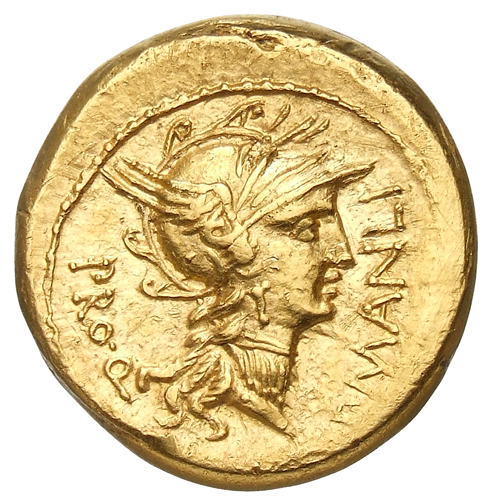
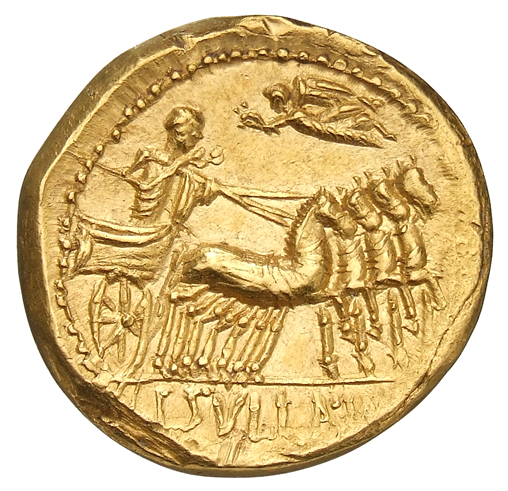
So Sulla decided he has to retake Rome the city from the individuals he deems illegitimate (they of course said the same thing about him). On his way back, with lots of Eastern loot, he stops off in Athens and leaves his mark on their coins. He also there strikes some coins on Roman weight standards focusing on himself with no obvious nod to the authority of Rome itself. Then comes the coins above. They are in many ways conservative and old fashioned in style. On the obverse is the head of Roma. Roma has pretty much fallen off Roman coin designs for the whole of the previous two decades, appearing only once in the interim. Sulla is clearly reviving Roma to flag his association with conservative traditional views of the state. Likewise he allows his quaestor (roughly elected accountant-in-chief or CFO) to sign and issue on his behalf. The reverse has his name, signature if you will, and even an image of him as triumphant (a future event!), but it is not explicit that he is the authority. He is part of the authority but he still centers Rome as Rome.
Is this a perfect parallel? No. History rhymes more than it repeats, as the saying goes. But it does tell us something about how Caesar and then Augustus might have had precedence in how they conceived of their personal identities as entangled with that of Rome. I also think it may help us see clearer that Trump is open and eager to conflate his personal identity with that of our national identity.
If this is disturbing to you, I invite you to find a street corner and meet a few neighbors who are equally disturbed. I believe in our republic. I love my country. No Kings. Only “we, the people” are sovereign, but we must exercise our rights and fulfill our responsibilities.
My lovely colleague Dr. Nudell is a fellow blogger who has a weekly tradition of publishing varia in which he collects and reflects on his week’s reading, inspiration, and thoughts. He periodically links to this blog, for which I am very grateful. My brain feels full and I wish to write with my morning coffee, but I have no one topic in mind and no particular desire for personal introspection style writing. I decided to take a page from him and just do a round up of things I wish to keep in my intellectual storehouses for future reflection.
This article hit hard. Princeton and the Ivies get the spotlight on these issues, but allow me to posit that they are perhaps even more fraught and painful on underfunded struggling state schools. My campus is still torn apart by the events of May 8, and even this week new hypocrisies of policy enforcement have emerged.
Among the key points that ring deeply true are the eroding and even erasure of shared governance. College presidents and the broader executive leadership teams construe the structures of shared governance much as Roman emperors used the remnants of the republican constitution to legitimate their control. The paternalistic approach to leadership sets up a dynamic wherein not just students, but also faculty and staff are positioned as childlike: reckless, unaware, and in need of protection and guidance, rather than as colleagues in the work of the university.
Likewise, Padilla Peralta, critiques the imposition of time, place, manner restrictions on free speech. He draws on speech-act theory to point to the functions of speech beyond persuasion and also addresses inequalities of between what and whose speech is protected and institutionally amplified.
These are perhaps the biggest points, but I was equally grateful for his discussion of how contingent labor (adjuncts!) and staff speech is not accorded the same freedom as those of us with the privilege of tenure. He interrogates the audience of the book and the ways in which alumni and external funders (donors) are prioritized and targeted for appeasement and justification of university policies around speech and protest. In many ways those of us in the university are not the audience at all. We know where our free speech is curtailed by policy and cultural norms. We know that reputation is valued over our rights, and even our responsibilities.
Padilla Peralta has chosen to leave Princeton for Arizona State. We often assume that professors with a platform and a willingness to be in the public eye are obsessed with personal status. And, in truth, some are. I admit to having concern for my own dignitas and honos. Padilla Peralta’s has many critics and skeptics in our discipline–do not tell me you haven’t been in conversations with the eye rolls and dismissive comments, because if people will say them to me, they will surely say them to anyone. I, however, know I’ve never had a better ally in uplifting and amplifying the voices and careers of young scholars, especially those without access to the ivies or even the disposable income to get train to one. Our voices are different. Even as we are both republican historians with a near obsessive need to focus on the details and a love of Theory, capital T. Our experiences are different. Even as we are both individuals who experienced being unhoused as children and through slew of scholarships to private educational institutions eventually found ourselves in graduate school at Oxford. A great deal of that difference has to do with race. I often wonder if I am so much less threatening to colleagues and my speech more acceptable because I am white, I don’t have the platform afforded by an ivy affiliation, and my femininity allows my own advocacy to be construed as gentle and nurturing, individual rather than political. Or, maybe I’m delightfully unaware of how colleagues in the wider field trash-talk me in a similar manner behind my back. All of this to say that I think Padilla Peralta will love the work he can do at Arizona State. I only wish CUNY had the vision and resources to make him a counter offer.
Oh. I guess this post did have a theme.
Right. There was other varia I’m sure of it.
Yesterday, I finally got to read the amazing profile in our alumni magazine of Dr. Lawrence Brown III, a fellow numismatist who specially for coin on US issues. The profile mentions not one word about coins, but that is just fine. Dr. Brown’s life story is inspirational. You will never find a better embodiment of the American dream, a true hero. His service to the country and his community are inspirational. His story is about why she need to be funding public education and not just in ‘trades’ or economically driven industries. I couldn’t be prouder Brooklyn College is part of his journey and that he continues to give of his wisdom to our campus community, most especially our students!
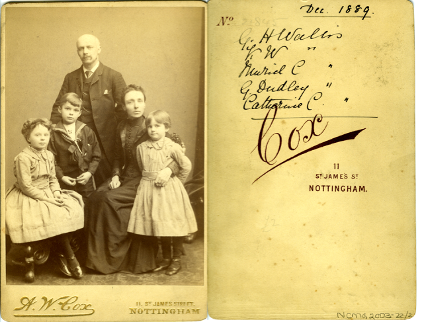
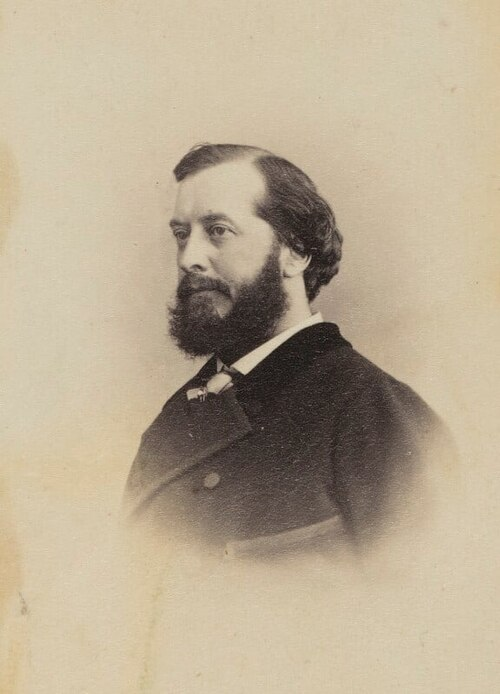
Having seen the extensive excavation photography, I’ve long wondered about notes and papers associated with the same. So yesterday, I decided to poke around the National Archive catalogue helped me find that Sir John Savile Lumley-Savile, 1st Baron Savile of Rufford (1818-1896)’s papers and correspondence are on deposit with the Nottinghamshire Archives. I’ve written to see how much materials is there from his as the UK ambassador in Rome (1883 onwards). I need to decide if I budget for a trip to Nottingham to hold and feel those papers (I yearn to do so!) or if instead I pay to have a local researcher digitize the collection. I do love the archive.
In the process of tracking down the institution holding those papers, I learned more about the family. I’ve posted to social media before about how this Lord Savile was the eldest of the five children borne out of wedlock to his father and how I cannot find his months name, just that she was ‘of french extraction’. Interesting and strange. Even stranger, as eldest, his father left the estate to a younger brother. He didn’t inherit until his brother died. There is a story there. Why didn’t the father marry, why did he not prefer his eldest? That same father was apparently MAIMED AS CHILD through the violence of his own father, my Lord Savile’s grandfather. Is this why my Lord Savile never married or had children? His estate and title was inherited by a nephew and my the early 20th century when a 12 year old inherited the executors sold of the family seat, Rutherford Abbey. It all screams inter-generational dysfunction.
Frankly, I want to read ALL the letters rather than just those related to the excavation. The human is as fascinating as the problems and questions I have regarding the context of the finds.
I’ve also learned that Lord Savile has no known entanglements with enslavement or the profiting from enslaved labor, he was an artist himself, and collected art of all periods. He is becoming human in my mind’s eye.
I’m not sure where my Nemi obsession is heading but it is definitely gaining momentum beyond the coins. I think I can do much good story telling about religion, economy, and disciplinary history through this exceptional case study.
Is that it? Surely I had more in my brain. I think that is all I need to write before 8 am. Perhaps more later.
If you’re still here. Perhaps you are feeling tired. Maybe you need some inspiration. Here’s a favorite poem.
For Margie Smigel and Jon Dopkeen
You are holding up a ceiling with both arms. It is very heavy, but you must hold it up, or else it will fall down on you. Your arms are tired, terribly tired, and, as the day goes on, it feels as if either your arms or the ceiling will soon collapse.
But then, unexpectedly, something wonderful happens: Someone, a man or a woman, walks into the room and holds their arms up to the ceiling beside you.
So you finally get to take down your arms. You feel the relief of respite, the blood flowing back to your fingers and arms. And when your partner’s arms tire, you hold up your own to relieve him again.
And it can go on like this for many years without the house falling.
This poem is titled, A Marriage, and was written by Michael Blumenthal, and published in a book called Against Romance. We printed it in our wedding program. In may ways if feels as sacred to my marriage as our vows or our very origin story. It encapsulates our partnership and shared endeavor. That every moment is a choice. a re commitment. Lately when life is hard we’ve been re formulating metaphor to say that there are times when we’re so tried holding up the roof takes both our arms together standing shoulder to shoulder. If you didn’t know the poem was written with a marriage in mind you might take it also a metaphor for any share work and the solidarity necessary to move forward in to the future or some times just tread water.
I had the urge to purge a bit here in my Brooklyn office. I’m horrified to find that one set of filing cabinets is locked and I don’t seem to have a key. Secretary is requesting one. Not that there can be anything that important in there given how long it has been since I opened it.
I’m instead tackling a draw labelled off-prints. I’ve not used it actively since 2013 based on the top level of detritus shoved inside. And yet it is still hard to purge. I’m trying to follow the rule everything online goes. And the rest is set aside to scan. Do you know how hard it was to put a Mesagne hoard print out in the recycling bin?! It is fine. I will never use that piece of paper, it has no notes on it. Literally just a bad print out.
I found a piece of paper with the large scrawl of Bob Viscusi my old mentor long past. It has a list of places outside Rome, including Castello Orisini. Lately I’ve been thinking a great deal about Orsini because of Nemi. It felt like a whisper, a blessing from the past on my present. I have no idea what we were discussing that day. It has no date. I’m guessing maybe early 2012 before I took my beloved to Rome for the first time. Perhaps it is a list of places Bob wanted me to experience. I’m keeping it.
Ooo I found handouts and lots of notes from the Yale 2015 conference on Dionysius of Halicarnassus. Gold dust.
The process is proving hard and overly nostalgic. I have a stack of stuff already I want to scan to PDF to ensure I can have it on ready access. I feel I could just keep it all to re read in retirement. I know this is wrong.
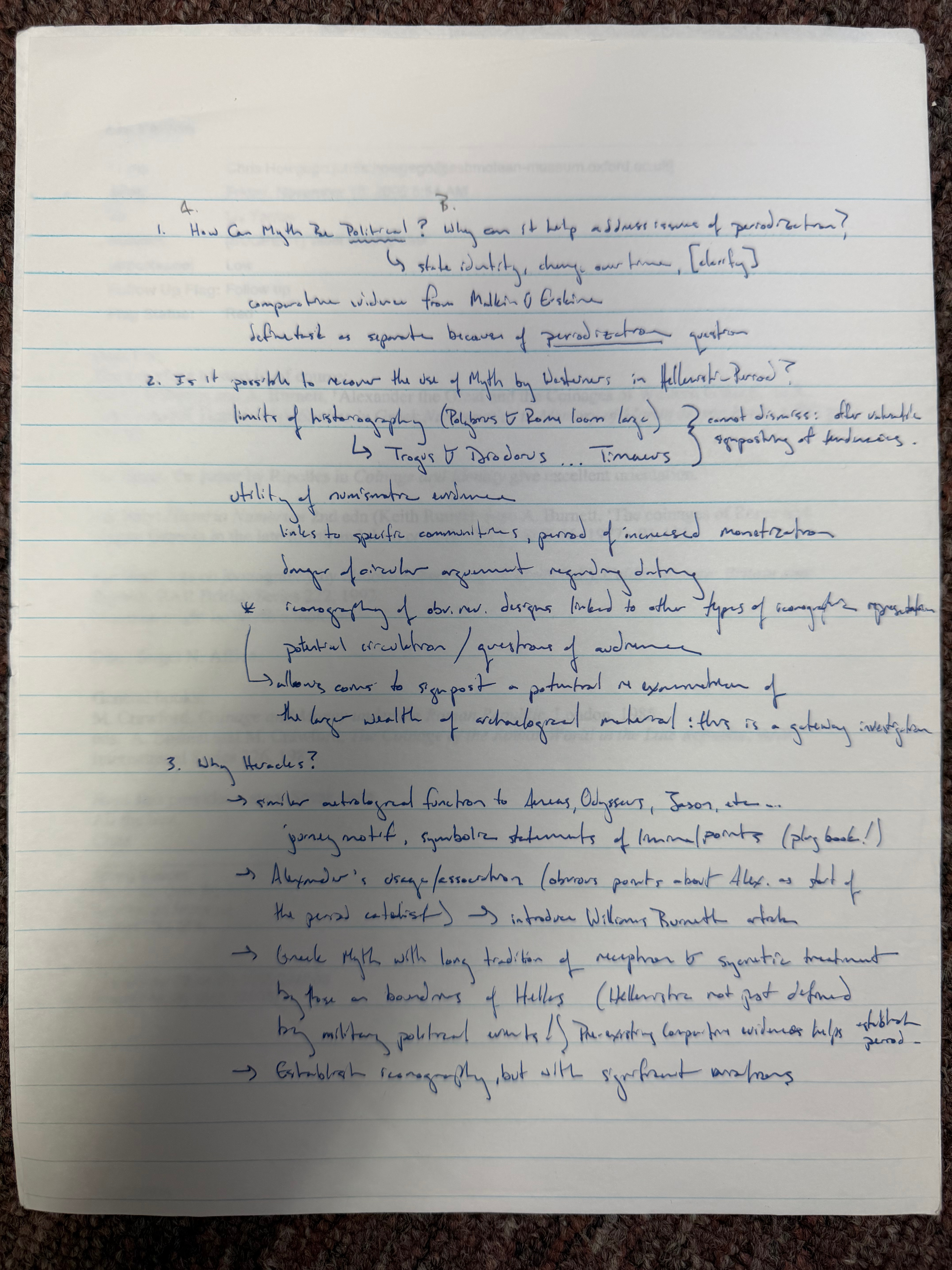
I also found an outline I made by hand late 2005, early 2006 for a seminar paper I gave on my 30th birthday in Oxford.
I find it astounding how much of my methodologies and questions of interest have remained stable for 20 years.
And I see now that I was pretty good even then at roughing out the big picture, even as I was struggling intensely with finding my voice and feeling like I was doing justice to the evidence. The joy of this blog is watching that voice develop and using hyperlinks to track my sources rather than this rather overwhelming draw of papers. I did however find a remarkably systematic organization beneath the haphazard top layer.




 Liv Mariah Yarrow
_-_Napoli_MAN_9112_-_01.jpg)

.jpg)