This below was a useful exercise, but mostly I find myself completely irritated by the lack of detail about find spots and the nature of the coins and other small finds. There is plenty of evidence of the bad blood between Orsini and Savile and their different approaches to excavation (treasure hunting). I don’t really recommend reading the stuff below unless you like me are obsessive about Nemi and then you should probably read the Italian yourself.
Here is a link to all the modern database listing of Nemi epigraphy with modern bibliography on it. A corpus of 121 inscriptions. Select review of earliest dedication and connections with Rome seem the next step.
1882: 434
“During the construction of the cast-iron siphon—intended to convey a portion of the waters from the Nemi mills to Albano—a trench was excavated along the route of the ancient Appian Way, spanning a length of over 1,500 meters; this corresponds to the distance separating the celebrated substructure of the Ariccia slope beneath Colle-Pardo from the tomb known as the Tomb of Arruns, located at the site called La Stella. The paving of the Appian Way was uncovered at several points, at varying depths, and the pipes of the siphon were laid directly upon it.
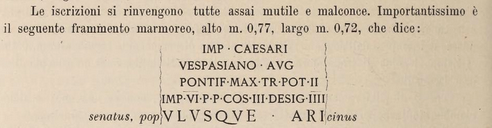
“At the precise location where the road to Vallericcia diverges from the Appian Way—situated 10 meters from the circular ruin known as Il Torrione (of the Chigi)—the remains of a noble and opulent monument were discovered. According to the opinion of the aforementioned Professor Lanciani—who was dispatched to the excavation site by the Ministry—this structure does not appear to be sepulchral in nature, particularly given that the site of the discovery seems to correspond to the interior of the ancient complex of Ariccia. Eleven marble blocks were recovered; some attain a considerable length of 2.70 meters. They belong primarily to the entablature, which is adorned with an exquisitely elegant frieze, as well as a cornice and architrave featuring intricate carving across all their constituent elements. One block retains the channels characteristic of rusticated masonry; two others belong to a large monumental inscription. This inscription—which I reproduce here based on the transcript provided by Cavaliere Lanciani—measured 1.52 meters in height and (presumably) 3.00 meters in length, and was framed by a gola molding and a listello fillet. The letters in the first line stand 0.17 meters high, while the remaining letters measure 0.14 meters.
1885:159-160
Machine translation
“In the area of the Temple of Diana Nemorense, near Lake Nemi in the Giardino district, several investigations were undertaken; these led to the following discoveries, as reported by Mr. L. Borsari. The temple’s *favissae* have been identified, consisting thus far of four chambers situated at a depth of 4.50 meters below ground level. These chambers are currently filled with terracotta votive offerings—some of mediocre workmanship, but the majority of poor design. Approximately five hundred of these items have already been collected; they consist of heads, legs, hands, feet, uteri, eyes, noses, various animals, and statuettes of different deities. Several antefixes that once adorned the roofline were also discovered; among these, one depicting the effigy of Diana—adorned with a *stephane* and holding a bow and quiver—is particularly noteworthy. Furthermore, various architectural fragments were unearthed, including column drums, cornices, and friezes featuring egg-and-dart molding, dentils, and similar elements.”
1885: 192-193
“The excavations carried out at the locality known as “Il Giardino,” near the Lake of Nemi, have yielded the following discoveries.
Along the southern side of the sacred precinct—in the center of which stand the ruins of the Temple of Diana—several small chambers were excavated (albeit only partially); these were filled with votive objects made of terracotta, stone, and marble. The terracotta objects—including feet, legs, phallic symbols, hands, arms, masks, female figurines, and animal figurines—have already been described in previous reports (cf. Notizie, 1886, p. 159). To this series of terracottas must be added a series of monochrome black vessels, as well as cups featuring female protomes on the interior bowl, decorated with reddish-black lines against a yellowish background. The most noteworthy marble pieces are:
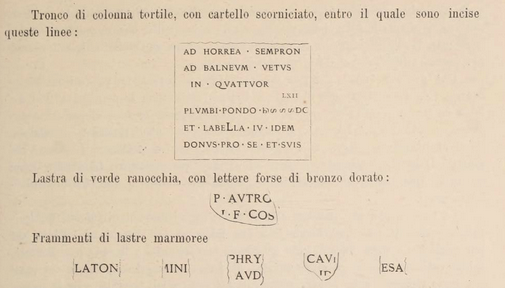
Near the chamber where the exquisite terracotta antefixes—depicting the bust of Diana flanked by the symbols of her quiver and bow—were discovered, several flat or flanged bronze pieces came to light; these appear to be roof tiles, particularly given that one of them bears the mark “XX,” corresponding to the sequential numbering of the individual components that formed the roof structure.
On the northern side of the sacred precinct, several bathing rooms were uncovered, along with traces of a piscina (pool) fed by a lead pipe bearing the inscription:
PAMPHILVS • AVG • N • SER • FEC
Finally, in the center of the platform, the perimeter walls of the sanctuary were discovered; these are constructed of tufa and peperino stone, featuring a magnificent and imposing base molding. The temple measures 15.90 meters in width (including the projection of the molding) and 30.00 meters in length. The pronaos (portico) was adorned with fluted columns made of peperino stone—which were originally covered in stucco—each measuring 0.94 meters in diameter.
1885: 227-228
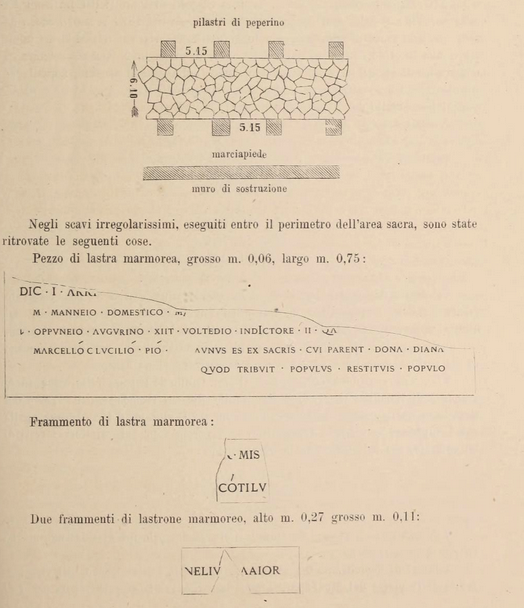
“The most notable discovery made in the vicinity of the Artemision in recent weeks is that of the road descending from the Genzano saddle to the lake, leading to the platea—or sacred precinct—of the temple while skirting the northern-facing retaining wall. In the excavated section, the road measures 6.10 meters in width and reveals two distinct pavement layers superimposed upon one another—an indication of alterations made to the road’s elevation and gradient in the stretch immediately adjacent to the sanctuary. The thoroughfare is flanked by a double row of peperino pillars, spaced 5.10 meters apart from corner to corner. Running between the road and the base of the retaining wall is a crepidine (stepped platform), averaging 1.50 meters in width. The paving slopes toward the lake.
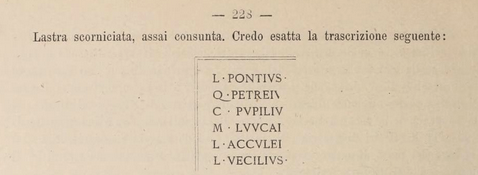
1885: 344
“Searches continued in the area of the Temple of Diana Nemorensis; to the left of the precinct described in previous reports, excavations were conducted within a chamber whose nature and condition cannot yet be determined. Among the excavated spoil, a larger-than-life marble bust was discovered, which originally must have depicted Jupiter. However, due to deliberate mutilations it has undergone, it now resembles a barbarian with a thick mustache.
1896 has extensive details on ships prior to their being brought to the surface
1885: 254-255
“Continuing his excavations in the area of the so-called “Garden,” His Excellency the British Ambassador has recovered the following items from the fill soil surrounding the Temple of Diana:
A very long lead pipe, bearing an impressed stamp indicating a capacity of 15 quinariae.
A small terracotta statuette—one-third life-size—of exquisite craftsmanship and modeled by hand, representing Victory.
A similar statuette, representing Diana the Huntress, with a greyhound to her right.
Another similar statuette—of great charm—featuring a hairstyle reminiscent of the finest Tanagra figurines, with a mantle draped across the bosom and the left arm bent at the elbow. It retains traces of original paint.
A terracotta antefix, likewise hand-modeled and painted. The lower half of a male figure remains, clad in a short tunic and breeches, striding toward the right.
Approximately four hundred terracotta objects: complete figures (female, male, and juvenile), heads, arms, legs, feet, symbols of generation, paired figurines, animal figurines, etc.
Vessels of bucchero and Arretine ware.
A small bronze hoe (sgomarello), with a handle measuring 0.35 meters in length, upon which a name has been incised.
Fifteen exquisitely elegant small bronze statuettes—mostly depicting Diana—in various poses.
Approximately sixty pieces of aes grave signatum (cast bronze coinage), comprising the full range of subdivisions of the as libralis down to the sextans.
Approximately two hundred asses and subdivisions thereof, of Consular coinage.
A silver denarius struck in Campania featuring the Janus-head type, with the inscription ROMA beneath the quadriga. Approximately 300 imperial bronze coins, including a large bronze or small medallion of Antoninus bearing an allocution scene. A great number of bronze implements, in fragments. Approximately 20 pieces of *aes rude*.
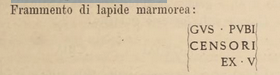
1885: 317-321
“The excavations carried out by His Excellency the British Ambassador have given rise, in recent days, to very notable discoveries. The immense artificial plateau of the Artemisium (45,000 m2) is limited towards the east, that is towards the mountain, by a wall which supports the vertical cut of the mountain itself. The wall is decorated with semicircular niches and with porticoes of Doric columns. In the imperial period, this portico underwent a transformation, identical to that found in the portico which surrounds the square of the Ostia theatre (see Notizie 1881, p. 10i>, plate I). Partition walls were erected between two or more consecutive columns and the rear retaining wall; in this manner, the colonnade was transformed into a row of votive cells, the width of which is constant, while the depth varies from one to three intercolumniations. Presented here is the ground plan of one such cell, partially uncovered on August 25th and 26th.
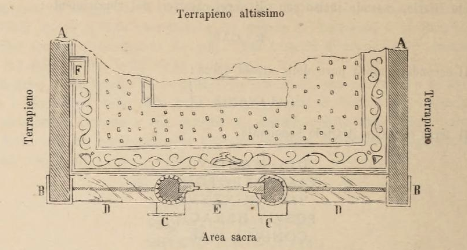
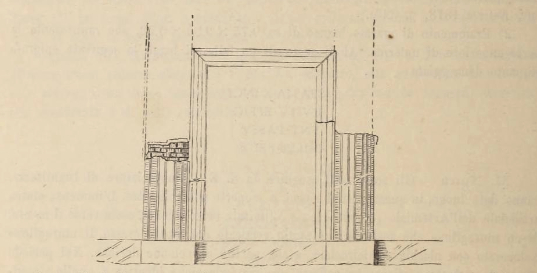
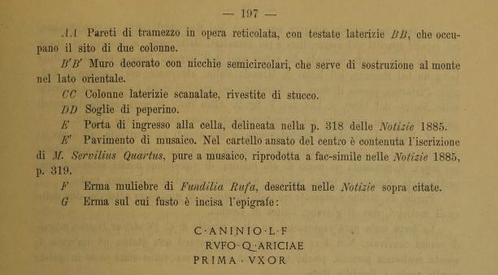
A A Partition walls in *opus reticulatum*, with brick end-piers B B, which occupy the site of two columns. C C Brick columns 1.00 m in diameter, featuring a facing of fluted stucco painted red. The capitals—of the Tuscan-Doric style and finely carved in *peperino* stone—were discovered in front of the *cella*. The columns lack bases; they rest upon large travertine blocks sheathed in marble. D D *Peperino* thresholds, one meter thick and two meters long. They feature a “blind” groove—or longitudinal channel—into which a marble parapet was set. E Entrance doorway to the *cella*, constructed as follows:
The threshold is made of marble in its front half and of peperino in its inner half. The jambs and the lintel are carved from marble. The jambs penetrate twelve centimeters into the core of the brick column, and are thereby supported by the column.
The floor of the cella consists of a chiaroscuro mosaic dating to the first century of the Empire. It comprises a broad border—or meander—featuring volutes emerging from canthari; a monochrome field (black with white cubes); and a central, white-grounded tabula ansata cartouche, within which the following inscription is rendered in letters of exquisite form:

The right-hand extremity of the epigraph must have been destroyed prior to the third century, as the restoration mosaic occupying that space is of a quality nearly equal to that of the original mosaic.
At the location marked on the plan with the letter F, a female herm of exquisite craftsmanship lay prostrate upon the floor. The shaft—the surface of which is lightly sculpted to simulate a full-length tunic cinched beneath the bust by a sash—stands 1.48 meters high, excluding the plinth and the sub-plinth. Upon the plinth—which measures… meters in height— At 0.23, the following inscription is incised in letters of moderate size:
FVNDILIA • C • F • RVFA PATRONA • DOCTI
The head—a restoration from antiquity—depicts the features of a mature woman, with a slender, aquiline nose and an expression that is somewhat sorrowful and stern. The hairstyle is characteristic: the hair is parted on the left side and smoothed down so that it creates very little volume. It is gathered into two braids which, curving upward just below the ears, terminate in a highly prominent knot atop the head.
This noblewoman must have erected other monuments and offered other gifts within the ara (altar) executed by M. Servilius Quartus. Her name appears once again on a marble plinth, broken in half:
F VNDI • C • F • RVl
There is a third broken plinth bearing the epigraph:
(tontivs • cl: f • d • d • d • l • m
that is: Dianae donum dedit libens meritae (He willingly gave this gift to Diana, in return for her favors).
A great number of votive objects were collected both inside and outside the cella described above. From the deeper strata of the sacred precinct come fragments of Italo-Greek black-glazed pottery with polychrome decoration, a most elegant phiale of polychrome glass paste, and an extraordinary quantity of aes grave signatum. Closer to the surface, mold-made terracotta figurines and bronze statuettes of exquisite craftsmanship—cast and subsequently finished with a burin—were recovered. These generally depict Diana the Huntress. I also noted a pair of shoe soles made of thin bronze sheeting.
…a small rectangular mirror—I am unsure whether of steel or silvered metal; two bronze tridents; and terracotta antefixes featuring high-reliefs depicting hunting scenes, etc.
Excavations toward the end of August progressed slowly, owing to the depth of the overburden and the obstruction caused by ruins consisting of flint shards. In the cella of M. Servilius Quartus—described previously—the following objects were discovered:
a) A herm of bigio marble, similar to that of Fundilia Rufa; the head—which had been reattached in antiquity—has not yet been recovered. Upon the chest, it bears the following inscription:
Q^HOSTIVS • CLi F • CAPITO RHETOR
b) A fragment of a plain frieze, bearing the following initials:
A L I S
c) Several large bipedalis tiles, bearing a circular stamp:
0 d DIONYS DOMIT P F LVCIL PAETETAPRCOS X
d) 6.75 meters of elegantly carved cornice. Within the coffers situated between the small modillions, the following symbols are carved in high relief: small rosettes, helmets, breastplates, greaves, small round shields (parmulae), quivers, bows, tortoises, bull’s heads, asps, frogs, and fish. Situated in front of the temple façade—and at a distance of approximately fifteen meters from it—a wall of ashlar masonry was discovered, constructed with singular precision. It is not possible to pass judgment upon these structures surrounding the main sanctuary until a ground plan and a double cross-section have been surveyed; what is certain, however, is that the sacred precinct—fully three hundred meters in length and one hundred and fifty in width, and originally entirely open—eventually became crowded, over time, with an almost continuous array of buildings, the most recent of which date to the 2nd century of the Empire. I have compiled the catalogue of the most ancient sacred votive deposit discovered to date; it would be futile to publish it before the excavations are complete. I will mention only that, at present, it consists of eighteen pieces of aes rude and one hundred and twenty-two pieces of aes grave signatum, subdivided as follows: nine libral asses, three semisses, thirty-two trientes, twenty quadrantes, twenty-six sextantes, and thirty-two unciae.
To this series must be added approximately one thousand coins, comprising both Italo-Greek and Republican issues. Imperial coins are very few in number—perhaps twenty or so.
Discovered within a drainage channel was a bronze object of exquisite archaic craftsmanship and perfect patina: it depicts a Faun—bearded (with a pointed beard), tailed, and ithyphallic. It is possible that this object served as the handle for the lid of a cista—a hypothesis further supported by the fact that, in that very same location, I observed fragments of a cylindrical vessel made of sheet metal scattered among the soil.
Along the left flank of the temple, a great number of terracotta stands for votive offerings have also been uncovered. These take the form of small columns—hollow on the interior—ranging in height from 50 to 60 centimeters. Their bases are sometimes square (comprising a plinth and a *torus* molding) and sometimes round (consisting solely of a plinth); the vertical face of the plinth, or the curved surface of the *torus*, bears geometric ornamentation—executed in red against a white background—which, at first glance, resembles lettering. Both the square and the round bases are pierced by four holes, through which lead-set pins were passed.
1887: 23-25
New excavations in the area of the Temple of Diana, conducted from December 17, 1886, to January 31, 1887. Report by Mr. Luigi Borsari. On the 17th of last December, new archaeological investigations were undertaken by Mr. Luigi Boccanera in the area of the Temple of Diana Nemorense, on the shores of Lake Nemi, within the tract of land known as Prato-Giardino, owned by Prince Don Filippo Orsini. Systematic excavations were carried out, commencing at the center of the temple’s second large terrace—where remains of colossal arches still stand, built to withstand the thrust of the hillside—and where, two years ago Excavations were carried out in search of artifacts, as reported in the Notizie of 1885 (cf. pp. 159, 227, 317, 344, 428, 478).
To date, no remains of buildings have come to light. Only a few rows of peperino blocks were noted—blocks which I believe belonged to the pavement level of the quadriporticus—a hypothesis further supported by the discovery of a small drain, constructed from hollowed-out slabs of Gabine stone.
Much as in the previous excavations, an extraordinary quantity of votive offerings is being uncovered. These consist almost entirely of bronze objects, scattered at a depth of approximately 4.00 meters within a stratum of ash, charcoal, and marshy soil—a layer running parallel to the level of the paved platform (platea) and having an average thickness of 0.50 meters. In certain spots, there is not merely a single layer, but several, superimposed one upon the other.
Foremost among these objects, the coins deserve special mention; by the end of January, their total count had reached 824. They present no peculiarities of any kind; indeed, they are all common and well-known types. Many are pieces of aes grave, pertaining exclusively to Latium, and consistently reproduce the standard types of the as, triens, quadrans, and sextans—types illustrated in Plates XXXIV–XXXVII of Garrucci’s Monete d’Italia (Rome, 1885).
Other coins are of Campanian mintage and of equally familiar types, depicting Mercury on the obverse and a ship’s prow on the reverse; or the head of Apollo or Minerva on the obverse, with an anthropomorphic bull—crowned by Victory—on the reverse; or, finally, the radiant head of the Sun on the obverse, with the bust of a horse on the reverse. Four silver coins were also recovered, one of which was in excellent condition; its obverse bears the well-known type of the beardless Janus head, while the reverse depicts Jupiter hurling a thunderbolt from a quadriga driven by Victory, with the legend ROMA inscribed beneath (cf. Garrucci, op. cit., Plate LXXVIII).
The bronze votive figurines recovered to date total 57; they average between 7 and 8 centimeters in height, and almost all depict Diana the Huntress. Some portray the Lares; however, for the most part, they are extremely crude works, entirely devoid of artistic merit.
Of fine design and in excellent condition, however, is a small bronze statuette depicting Diana the Huntress in the act of drawing her bow. It stands 0.25 meters tall, and beneath its feet, it retains very long, curved pins that served to anchor it to its base.
Of particular interest for the study of figurative antiquities is a small herm of Juno—also in bronze—standing 0.49 meters tall and executed in a style leaning toward the Archaic. The goddess is adorned with stephanai (crowns), and of her body, only the breasts and knees are articulated, indicated by corresponding raised bosses. Her feet are encased in a type of pointed, narrow, and curved shoe (calceoli repandi), similar to those seen in depictions of Juno Sospita or Juno of Lanuvium.
On a small vessel with an inverted rim—0.07 meters in height and notable for the beautiful patina covering it—the following legend can be seen incised (graffito) around the rim:
CN-Q-ET-MED- DIANA
A block of extremely compact Gabine stone bears the following archaic inscription, carved in fine characters:
DIANA
M-LIVIO:-M-<F PRAITOR-DEDIT
The stone—measuring 0.57 x 0.57 meters and terminating at the bottom in two small feet—undoubtedly served as the base for a statue of nearly life-size proportions, as evidenced by the impressions of feet and pins remaining on the upper surface of the block.
Furthermore, the hypothesis that this statue represented the Goddess named in the inscription is supported by the discovery of a bronze quiver found at the same site.
Finally, the following objects were recovered: a carnelian scarab—slightly damaged near the head—featuring a carved figure of a Satyr on its reverse side; one gold ring, three silver rings, and twelve bronze rings; fragments of thin gold foil; two small globes of enameled glass paste; and two hundred and two miscellaneous bronze fragments—including a great number of small bronze buttons of a conchoidal shape with convex shanks, varying widely in diameter.
1887: 120-121
Nemi — The excavations undertaken by Mr. Luigi Boccanera in the area of the renowned Temple of Diana on Lake Nemi were continued throughout the month of March and yielded new objects belonging to the votive deposit of that sanctuary. With the exception of a few terracotta figurines—of common forms and possessing no artistic merit—the other pieces are, for the most part, made of bronze; coins predominate among them, having been collected in the hundreds, and must be added to those previously reported (cf. Notizie 1887, p. 24). Bronze objects of the Latium type are relatively rare; conversely, coins of Campanian mintage are abundant. Several silver coins were also recovered. The other bronze objects consist of votive statuettes, animal effigies, spearheads, nails, rings, vessel handles, and buttons. Particularly noteworthy is a small bronze vessel, 0.06 meters in height, preserved in its entirety and complete with its handle; in form, it resembles another vessel upon whose rim appears the inscription reproduced on page 24 of the aforementioned Notizie. On the bottom of this new votive offering, too, is incised an inscription in exceptionally clear characters, which reads:
ARR: DIANA
Also worthy of close attention are two bronze plaques inscribed with votive legends, reproductions of which—rendered via phototype process at actual size—are provided here.
The first plaque—0.17 meters in length and 0.035 meters in height (Plate III, Fig. 1)—bears an inscription executed with a chisel in exceptionally clear fashion:
POVBLILIA-TVRPDILIA:CN-VXOR HOCE: SEIGNVM-PRO-CN-FILIOD DIANAI: DONVM- DEDIT . Following the letter R at the end of the first line, and beneath the letters IA of DIANAI at the beginning of the third line, one can discern the holes through which the nails passed to secure the plaque in place. Another small hole is situated beneath the final letter of TVRMILIA, positioned between the first and second lines. The second plaque—being thinner, and consequently less well-preserved (Plate III, Fig. 2)—nevertheless displays a legend that remains almost entirely intact, even though it was executed in fine, shallow strokes and inscribed by an unsteady hand. That nothing is missing can be established by the symmetrical arrangement of the words, as well as by the physical evidence: specifically, the presence of two holes—one on the right and one on the left—intended for the insertion of nails; these holes were, as a general rule, positioned at the points where the inscription concluded. If this interpretation is correct, only a single difficulty arises in the reading of this inscription—specifically within the first line, or rather, confined to the very last letter of that line—given that the initial letter C is perfectly legible. We would therefore have:
C-MANLIO:A (1)
COSOL-:PRO . POPLO
ARI MI
It does not appear that the final letter of the first line should be read as an O; for although open-bottomed Os are indeed visible elsewhere on the bronze itself, it never happens that one of the lateral strokes fails to show at least a slight curvature—whereas in the present instance, the right-hand stroke would descend in a perfectly straight line. It would, conversely, be a straightforward matter to read CI; and thus to link these two letters to the preceding A, recognizing therein the beginning of the cognomen ACIdinus—thereby attributing the entire inscription to the consul Manlius Acidinus, who held the fasces in the year 575 ab urbe condita (179 B.C.E.). This hypothesis would be corroborated by the fact that, on the authority of Julius Obsequens (Ch. 7; C.I.L. I, p. 486), this consul’s praenomen was precisely C(aius)—as appears on our bronze—whereas all other documentary sources assign him the praenomen L(ucius) (cf. C.I.L. I, 588, and the Fasti Capitolini, ibid., p. 436). However, the matter would remain open to doubt due to the omission of the patronymic; not to mention that there would be insufficient space remaining to accommodate the entirety of this cognomen—just as it would be exceedingly difficult to explain the nature of this consul’s connection to the Ariminenses.
1887: 195-198
Excavations in the Area of the Temple of Diana. Report by Mr. Luigi BORSARI. Continuing throughout the month of April and into the first days of May, excavations in the center of the second terrace of the Temple of Diana Nemorense (cf. *Notizie* 1887, p. 120) yielded further artifacts constituting the sacred votive deposit—items similar to those described in previous reports. Once again, bronze coins were recovered—mostly Latium *asses* and coins of Campanian mintage—along with small bronze figurines depicting Diana the Huntress; various animal figures; buttons and rings; spearheads; tridents; and fibulae. A small silver *simpulum* (ladle) merits particular attention; measuring 0.08 meters in length, it features a curved handle terminating in the form of a swan’s neck and head. Inscribed upon the handle, using a technique of dense, minute dotting, is the legend: OV – SCARBENIO – CL. Subsequently, several rectangular tufa bases intended to support statuettes—likely of Diana—were recovered; the lead-set dowels used to secure the statuettes in place remain visible on the upper surfaces of the bases. The largest of these bases measures 0.47 x 0.27 x 0.25 meters and bears the following inscription: | AVRILIVS:C-F PORZIO R ITERVMESSDIDII \EISDEM: CONS©L | PROBAVIT The indication of paternity demonstrates beyond doubt that this individual was C. Aurelius C. f. C. n. Cotta, who—together with P. Sulpicius Ser. f. P. n. Galba Maximus II—held the consular office in the year 554 *ab urbe condita* (cf. *CIL* I, p. 496, 526), having attained the praetorship two years prior (Liv. xxx, 26). The smaller piece measures 0.29 m by 0.16 m and is fragmentary; consequently, of the inscription engraved upon it, only the following remains: 2 LEACIIVS=L: QCALLVS Ti o £ Furthermore, the following two fragments were recovered. One—on a chip of tufa measuring 0.13 m by 0.09 m—bears the letters: Li
The other, on a marble slab measuring 0.11 x 0.06 meters, bears the following inscription in fine lettering:
ONIVS AE:D:V:
ANI
The latter half of May was devoted to completing the excavation of the cella situated in the center of the substruction wall—specifically, within the vertical face cut into the eastern side of the hill. It was in this very cella that poorly directed investigations had been conducted two years earlier, when excavations were carried out on behalf of His Excellency the British Ambassador to our Court. A plan illustrating said cella, together with a description of the objects discovered therein, was published by the distinguished Professor Lanciani in the Notizie (1885, pp. 317 ff.); furthermore, extensive commentary regarding this same discovery was provided by the distinguished Helbig in the Bullettino dell’Istituto for the same year (pp. 225 ff.).
The most significant objects recovered during this initial phase of excavations were: the herm of Fundilia Rufa, surmounted by a portrait bust (Notizie 1885, p. 319; Bull. Inst., p. 227); and the shafts—lacking their busts—of the herms of Q. Zostius Q. f. Capito, rhetor (Notizie, loc. cit., p. 320; Bull. Inst., p. 236); of Z. Aenius Faustus, quart(arum) par(asitus) Apol(linis); of Licinia Chrysario; and of Staia L. l. Quinta (Notizie, loc. cit., p. 479; Bull. Inst., loc. cit., p. 286).
The fact that the excavations conducted in 1885 had indeed been poorly directed has now been conclusively demonstrated: within the very chamber where investigations had previously been abandoned—on the assumption that the site would yield no further archaeological harvest—several sculptures of considerable merit were subsequently recovered, as shall be noted in the details that follow. To better assess the matter, one need only cast a glance at the illustrative plan appended here, comparing it with the one depicting the chamber itself, published in MNozzzie (1885), p. 318.
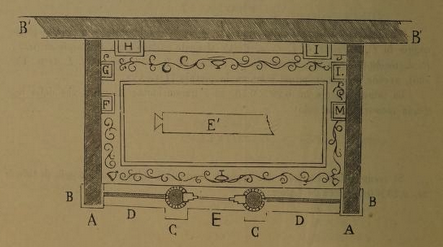
The superimposed bust is a work of fine craftsmanship, reminiscent of the style of the early Imperial period, and depicts an adult male with short hair and no beard.
H: Marble statue, 1.78 meters in height, depicting a woman of a matronly type—
of mature age, slender, with an aquiline nose—clad in a full-length tunic with fine pleats
and a voluminous mantle. On the plinth, the following inscription can be read:
FVNDILIAE – C – F. PATRONAE
The head is a separate attachment and bears a striking resemblance to the one affixed to the herm of Fundilia Rufa, discovered during previous excavations at the spot marked on the plan with the letter I, as mentioned above. In this new head, too, the hairstyle is distinctive. Two braids, descending behind the ears, are gathered at the crown of the head and tied together there with a ribbon. However, the knot that would have formed at this point—as seen on the previously discovered head—is missing; nevertheless, the dowel that supported it remains visible, indicating that it had fallen off in antiquity.
I: Marble statue, 1.15 meters in height, depicting a figure of mature age, clad in a toga and adopting an oratorical pose. On the plinth, the following can be read:
| _ C* FVNDILIVS : DOCTVS – APOLLINIS – PARASIT
The same inscription is repeated on the scrinium (scroll case), located at the bottom right,
and is arranged as follows:
C- FVNDILIVS DOCTVS : APOLLINIS: PARASITVS:-
LZ: Herm featuring a female bust, bearing the following inscription:
STAIA:= Le L’*QOWNINFA
The superimposed head depicts a woman in the prime of life—of striking beauty—with her hair parted down the middle; it is smooth at the crown, then falls in ringlets at the sides before being gathered into braids at the nape of the neck, in keeping with the fashion of the early years of the Empire. This excellent sculpture finds a close parallel in the bust of Minatia Polla, discovered in the tomb of Sulpicius Platorinus—located near the Aurelian Wall within the gardens of the Farnesina—and described in the Notizie of 1880 (p. 133, Plate V, Fig. 2). Another herm shaft bearing the name of this freedwoman was discovered during earlier excavations, as previously noted above. M: A head that fits perfectly, and which must therefore be attributed to the herm of Q. Hostius Q. f. Capito, the rhetorician—a herm discovered in 1885, as also mentioned above. It portrays a man of mature age, with a noble, stern expression and a distinctly Roman physiognomy; he possesses regular features, very short hair, and is beardless. Finally, three life-size marble heads were recovered, two of which are female portraits: one of a young woman, the other of an elderly woman. The third head appears to represent another portrait of C. Fundilius Doctus, adorned with a convivial wreath. The presence of both a statue and a herm dedicated to this same individual should come as no surprise, given that a statue and a herm had also been placed in this very
shrine in honor of Fundilia Rufa.
1888: 193-196
Early in the current year, excavations resumed on the property of Prince Orsini—specifically at the locality known as Prato-Giardino near Nemi—where the remains of the famous Temple of Diana Nemorensis lie concealed. The initial exploratory probes, conducted at the site excavated during the previous year (cf. *Notizie* 1887, p. 23 et seq.)—that is, almost precisely at the center of the temple’s second large terrace—yielded three terracotta antefixes depicting female heads. One of these, nearly intact, bears the attributes of Diana—namely, a bow and a quiver—and closely resembles those discovered in previous years (*Notizie* 1885, p. 193). Also recovered from the site were a large iron knife, a spear shaft of the same metal, and the upper-left corner of a large bronze cornice, which still bears the inscription:
LAVRENTES
P LVCRETI CLEMENT
Furthermore, one hundred and forty-three bronze coins of various sizes were recovered, identical in every respect to those discovered previously (cf. *Notizie* 1887, p. 24); along with several votive figurines in bronze and terracotta, and various *ex-votos*—specifically hands, feet, and legs—as well as miscellaneous bronze fragments of no particular significance.
Additional investigations were conducted on the eastern side of the temple, adjacent to the *cella* that had been brought to light—partly in 1885 and partly in 1887—the ground plan of which was published on page 196 of the *Notizie* for the latter year. According to reports submitted by Mr. Borsari, three other *cellae* belonging to the temple were identified; however, these had been stripped of their contents and were, in terms of architectural decoration, considerably less elaborate than the *cella* mentioned above.
Among the objects recovered were: An iron knife, measuring … meters in length. 0.25 x 0.03 m, with a ring—likewise of iron—at the end of the handle. An iron bell with a clapper, 0.07 m high and 0.04 m in diameter. A male torso of white marble, 0.40 m high, heavily damaged. A male head of white marble—undoubtedly a portrait—which must have originally been mounted upon a herm shaft. A small terracotta amphora with two handles, broken at the rim, 0.25 m high. A white marble plinth—fragmentary and heavily eroded by the action of water—measuring 0.30 x 0.25 m; on its front face, the final portion of a dedicatory inscription remains visible, executed in letters of mediocre quality that are now quite faint. It reads:

The dots are uncertain. Finally, a small base of black marble was discovered; it must have originally supported a small bronze statuette, the lead-set pins for which still remain in place. The base is perfectly square; it measures 0.12 m per side and bears inscriptions on three of its faces, with a distinct epigraph on each. As revealed by an examination of paper squeezes, the text reads:
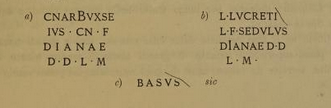
Subsequently, a highly significant epigraphic fragment was discovered, the text of which is derived from a paper squeeze. It is incised upon a slab of white marble—0.12 meters high and 0.22 meters wide—and almost certainly served to adorn the pediment of a small votive shrine dedicated to the Goddess for the well-being of the family of Emperor Claudius. It reads as follows:
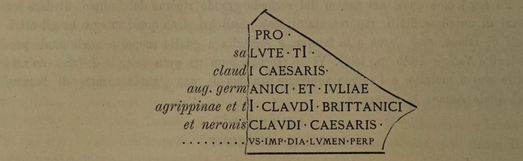
The name of the dedicant remains unknown—he who, for the well-being of the members of the Imperial family and as a votive offering to the Goddess [imp(eri0) Dia(nae)], dedicated a perpetual lamp to the Goddess herself within that shrine, which our marble slab once adorned.
Excavations in the Santa Maria District. Note by Mr. Luigi Borsari.
On November 7th of last year, Mr. Luigi Boccanera undertook a series of archaeological investigations in the Santa Maria district, within the territory of the Municipality of Nemi—specifically on the plots of land designated by cadastral map numbers 931–940.
Located at this site are magnificent ruins belonging to a spacious apsidal hall, or—more likely—to a vast nymphaeum. The vault is truncated shortly after its springing point, and the curved wall upon which it rests is constructed of fine brickwork. Set into this wall are four ornamental niches.
The investigations conducted within the center of this nymphaeum demonstrated that the structure had been left unfinished by the ancients themselves, for reasons that we are certainly unable to surmise.
The yield of this excavation amounts to very little: specifically, five fragments of grey marble columns (0.50 meters in diameter), and two granite columns—broken into multiple pieces—measuring 2.85 meters in length and 0.47 meters in diameter. Additionally, several fragments of figured terracotta were collected; these are quite common and are typical of the clay friezes frequently encountered at ancient suburban sites.
Since these investigations proved fruitless, Mr. Luigi Boccanera shifted his inquiries to the adjacent property, owned by Mr. Giuseppe Monti, DIS, Map No. 945.
Located at this site was a section of a substantial and magnificent villa—a complex of structures that extends for some distance into the adjacent vineyards and onto land owned by the Sforza-Cesarini family.
The building conforms to the typical style of Roman villas: that is, it consists of large, superimposed terraces. The upper level is paved with large slabs of white marble and rests upon spacious vaults, which are supported by sturdy walls of opus reticulatum dating to the first century of the Empire.
The lower level is constructed of simple lime mortar. The villa remained inhabited until late antiquity—a fact attested to by a few very coarse and common ceramic fragments (such as oil lamps), and, above all, by the restorations carried out on the original structures. The opulence of the villa is borne out by the multitude of marble fragments of every color, as well as by traces of painted plaster that once adorned its walls.
It is impossible to adequately describe the devastation and ruin suffered by this edifice—whether at the hands of man, or due to the lateral thrust of the mountain and the subsequent landslides that occurred over the course of centuries.
Among the architectural decorative elements are several Corinthian capitals, a few white marble column bases, and a fluted gray marble pilaster, broken at its upper section.
In several rooms situated on the first terrace of the villa—the floors of which lie barely above the water level of Lake Nemi—the following objects were discovered:
a) Six herm shafts, fashioned from white and gray marble, measuring a total of 1.40 m x 0.34 m x 0.23 m. One of these bears an inscription carved into its upper section:
MENANAPOZ
Below this, a recess is visible within the marble—the socket into which a bronze phallus was originally intended to be set.
To one of the remaining five shafts belongs a marble female head of the Apollonian type. This sculpture underwent extensive restoration in antiquity.
b) Fragments of the shafts of elegant marble candelabra, adorned with leaf motifs.
c) A magnificent rectangular basin (vasca) of Porta Santa marble, measuring 0.78 m in height, 1.40 m in length, and 0.30 m in thickness.
d) Fragments of the rim of a large white marble krater (mixing bowl), decorated with ovolo and fluting motifs. e) Various pieces of a marble screen.
f) Shaft of a herm, made of light green marble.
g) Various marble fragments, among which the following are noteworthy: part of a human head; part of a life-size leg; a small lion, lacking its head and legs.
h) Piece of white marble, trapezoidal in shape, measuring 0.57 x 0.21 m, bearing the following letters incised on its upper surface:
GL
i) Circular plinth of white marble, 0.78 m in diameter, with three handles along its circumference—similar to those currently used on rotating statue plinths.
!) Fragments of a terracotta frieze, depicting in high relief the scene of Pasiphaë and Daedalus, featuring the wooden cow constructed by the latter. It is identical to the terracotta piece published by Campana in Plate LIX. [Louvre plaque of the same type acquired 1862 another acquired same date]
m) Fragments of other terracotta friezes, reproducing the well-known depictions of the Satyrs’ grape harvest and of masks amidst attributes of Neptune—similar to those published by Campana in Plates XXXIX and XL.
n) Large bipedal tiles, one of which bears an impressed stamp (Marini 815): (Cn. Domiti Am)oeni: May he who made this prosper A ribbon-tied wreath flanked by two palm branches o) On one tile, a rectangular stamp is legible, bearing the name A#i(us) in ligature (cf. C.I.L. XIV, 4090, 28): Caduceus — ZI — Palm branch
1888: 392-394
Excavations in the Area of the Temple of Diana. Note by Mr. Luci BORSARI.
The excavations, which continued in the area of the Temple of Diana Nemorense (cf. Notizie 1888, p. 193) from mid-March of last year through the end of May—at which point the excavations were suspended—have brought to light numerous additional pieces from the abundant sacred votive deposit scattered across the entire second terrace of the temple.
The collected objects may be enumerated as follows: — Bronze. Approximately two hundred and thirty coins, the majority of Campanian mintage and of a common type. More interesting—albeit common—are the pieces of aes grave of Latium origin, reproducing the types of the asses, trientes, quadrantes, and sextantes, which were previously discussed in Notizie 1887, p. 24.
A small vessel, 0.10 m in height.
The foot of a statuette.
Five figurines depicting Diana the Huntress, armed with a bow; height: 0.08 m.
Three rods, 0.14 m in length.
A small cup, 0.03 m in height and 0.035 m in diameter.
An almond-shaped pendant.
A quadrangular bell measuring 0.04 m × 0.04 m × 0.034 m.
A trident.
Nine large fibulae, several pins, and various convex buttons of differing diameters.
Iron. Three spearheads: one 0.28 m in length, and two measuring 0.39 m. A knife blade, 0.12 m in length. A small hammer, 0.34 m in length.
Terracotta. Eleven votive statuettes, approximately 0.18 m in height. Votive hands and feet.
A six-spouted lamp, bearing the stamp: L-MVNSVC
Another lamp with the stamp: L::MVNTHRE. Another, featuring a decoration of theatrical masks on its upper surface, and bearing the stamp FORTIS underneath. Two other lamps, lacking any maker’s mark.
Glassware: A lachrymatory and a small globular bead intended for a necklace. Among the inscribed objects, the following were recovered: A small fragment of slate, measuring 0.45 x 0.24 m, upon which the following letters remain:
Rogi. A fragment of travertine, measuring 0.17 x 0.14 x 0.10 m, upon which one reads: L’F’PINTIA dian\AE + D’D’L-M.
A marble base, measuring 0.53 x 0.37 x 0.28 m. It bears the following dedicatory inscription:
ocra z A GRAE [e 2 |N IVNONI | d. sl
- Excavations in the Santa Maria District.
In the *Notizie* [Archaeological News] of the current year (p. 194), mention was made of the archaeological investigations undertaken by Mr. Luigi Boccanera in the Santa Maria district—within the territory of Nemi—specifically on the estate owned by Mr. Giuseppe Monti. It was likewise noted that the magnificent and prominent villa then being uncovered appeared to extend into the adjoining Sforza-Cesarini property as well. Now, however, the excavations have demonstrated that the complex of ancient structures constituting that *suburbanum Nemorense* (Nemi suburban estate) terminated precisely at the modern boundary between the two aforementioned properties.
The objects collected on the Monti estate offer nothing singular and are limited to the following: — An ornamental bronze boss featuring a protome of Diana, with a quiver hanging from her shoulders. A solid lead disc was subsequently attached to this bronze piece, which was then utilized as a counterweight; it stands 0.12 meters high. A coin of Augustus, bearing the reverse inscription: Providentia Augusti. A small bronze lid, 0.14 meters in diameter. Fragments of terracotta decoration.
These objects were discovered inside a small chamber with opus reticulatum walls, measuring 4.70 meters in length and 2.20 meters in width. The walls were preserved to a height of 3.20 meters. Upon the completion of these excavations, Mr. Luigi Boccanera conducted further investigations in the locality known as Zancioni—on an estate owned by Ms. Francesca De Angelis—situated within the area of the first large terrace of the Temple of Diana, on the southwest side of said sanctuary.
Several buttressed piers were brought to light; these served as substructures for the temple’s intermediate terrace. Their construction is identical to the defensive masonry works found on the adjacent property, in the locality known as Prato-giardino.
Among the finds were a remarkably well-preserved bronze coin of Lucilla, and several insignificant fragments of Arretine ware cups; on one of these fragments, within a small cartouche, the following stamp—rendered in raised letters—can be read:
SATVRN
This stamp belongs to the renowned potter Saturninus, who worked in the workshop of M. Perennius.
1888: 709-708
New excavations in the area of the Temple of Diana. Report by Prof. R. LANCIANI.
Mr. Luigi Boccanera has undertaken, with permission from the Ministry, antiquities research on the Marianicci estate, known as Giardino, in the Nemi area. The work has not uncovered any written or sculpted monuments, but it is of considerable topographical and architectural interest. They have already demonstrated that the sanctuary of Diana Nemorensis did not occupy only the artificial esplanade of the “Garden,” however vast it appears to us, but that it extended with its outbuildings far beyond the peribole, on the north, east, and south sides. Only the west side appears to have contained no outbuildings, so that nothing would disturb the beautiful view of the lake and its crater-shaped basin, which can be enjoyed both from the temple’s summit and from the edge of the esplanade.
The Marianicci estate borders the peribole on the eastern side, which faces the mountain. It appears to contain a building arranged in terraces and steps, constructed with irregular pieces of peperino, and covered with round vaults. Four rooms were discovered there. The first and second rooms, each measuring 5.70 x 3.00 m, have …a mosaic pavement composed of large, irregular tesserae: the third room (towards the right) features a floor of *opus signinum* and walls covered in fine plaster, with a yellow-ground dado, white-ground panels, and bands of dark red (*morellone*). A fragment of plaster preserves the figure of a wading bird, painted with great spontaneity and vividness of color. Among the rubble, the following items were recovered: a piece of roof tile bearing a rectangular stamp with large letters reading L:DOMI/; an Arretine ware cup; an *as uncialis* coin; and a bone pin. I have examined the inscribed marble slab mentioned in the *Notizie* of last June (p. 393). I reproduce its text here because the third line requires emendation, and also to note that the object in question is not a statue base, but rather a *pulvinated* altar: OCTA\ & GRAE |N IVNONI| |D|d.

 Liv Mariah Yarrow