Compare with the lead tokens with Diana in the last post . The token type database from Warwick seems to be down for updates. I think they are shifting the back end data structure.
N.B. Rowan gives a great synthesis of Nemi token finds (p. 122-126).
Rowan, Clare. Tokens and Social Life in Roman Imperial Italy. Cambridge: Cambridge University Press, 2023. Which I’ve been reading in PB but is available OPEN ACCESS.
Her visual reading is valid as are her orans parallels but I put more emphasis on the archaizing style and thus cannot agree that the image represents modern worshippers. (See earlier post).
She also cites Morpugo, NSc 1931: 281, no. 111 for testimony that 3 lead tokens were found during excavations of the Nemi theatre (p. 192). The theory she entertains here is that these tokens may have been used to mediate the distribution of food or drink (cf. Evans 2018: 114.1). She points back to her discussion of Martial in chapter 2. This whole discussion of largess and tokens at triumphs and religious festivals is highly relevant to my speculative interpretation of so called aes signatum (roman currency bars) offered at the end of my 2021 article. I need to revisit.
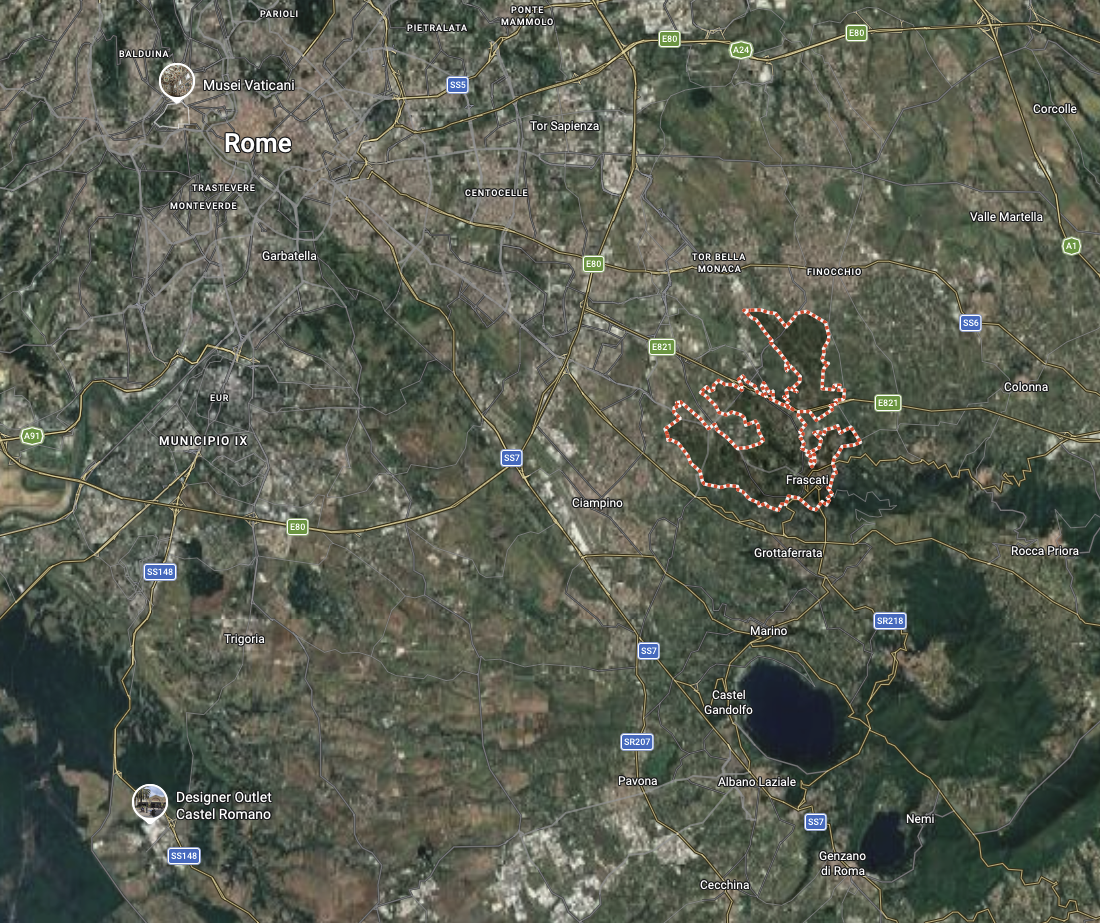
Machine Translation of the 1897 report:
On a Lead Tessera Discovered at Villa
Torlonia.
In November 1896, at Villa Torlonia, water that had accumulated near the garden’s dividing wall—situated beneath the woods rising above it—caused a section of the retaining wall, approximately 15 meters in length, to collapse. Amidst the soil—alongside several fragments of various marbles—the small lead plaque depicted here was recovered. It has a maximum diameter of 27 mm and a thickness of approximately one millimeter; the imagery, which appears on only one side, seems to have been executed with a punch rather than cast. It presents—resting upon a line indicating a ground plane—a figure of Diana running toward the left, her garments fluttering, a mantle draped like a nimbus above her head [velafactio!], and a lunar crescent upon her brow. Surrounding the figure within the field are four six-pointed stars: one positioned low in front of her, and three positioned high behind her. Above the figure, the inscription runs in large characters:
SVBCVRA
The upper extremity of the letter S extends into a palm leaf that curves to follow the circular contour of the plaque. Another palm leaf rises from the ground on the left.
There has been much debate regarding the intended use of such tesserae; some have believed them to be a type of gaming token, while others have regarded them as a form of admission ticket or identification badge.
Dr. Rostovtzeff—who is currently engaged in a study of this specific class of artifacts—informs us that tesserae of this nature are frequently encountered, particularly in Tusculum. In that city, there existed corporations or societies known as the Juvenes Tusculani—analogous to the Epheboi found in certain Greek cities—which were also referred to as the Sodales lusus iuvenalis Tusculani. These lead plaques likely served as tokens for distributions—issued on behalf of the Emperors by the curatores iuvenum (or lusus iuvenum)—during the annual festivals and games. The tesserae known to date belong mostly to the 1st century of the Imperial period and do not extend beyond the beginning of the 2nd century; stylistically, our specimen—which features a die hitherto unknown—fits precisely into this era, that is, the early 2nd century. Diana is depicted on a lead tessera which also appears to be attributable to Tusculum (!); furthermore, the word subcura should be restored as subcura(tor), given that the abbreviation cur is frequently found on similar tesserae and in certain inscriptions (?).
To provide a more solid foundation for the wall, a trench measuring 3.00 x 1.00 meters and 2.30 meters deep was excavated at the site. During this operation, beneath the dividing wall, a section of opus reticulatum (reticulated masonry) made of peperino stone was encountered; it was tapered—measuring 0.85 meters at the top and 0.60 meters at the bottom—and oriented toward the south, forming a right angle with another stretch of the same reticulatum work, which ran nearly parallel to the dividing wall. Embedded within this reticulatum wall was a recessed block of peperino (measuring 0.20 x 0.20 x 0.18 meters), featuring a small, bowl-like depression carved into one of its faces.
Also recovered were shards of coarse pottery; a marble slab; fragments of decorative facing (sectilia?) in Africano and Giallo Antico marble; a cornice fragment in Rosso Antico marble; roof tiles; and several seashells—remains likely belonging to a Roman villa.
Embedded in the soil, several disintegrated skeletons were found, along with six skulls in varying states of preservation.
The subsoil appeared disturbed and thoroughly churned up.
L. MARIANI.

 Liv Mariah Yarrow