
A hoard of denarii was found in V.4.3 Pompeii. House. Casa di un Flamine. Excavated 1842 and 1899. Bombed in 1943.
There are some republican specimens, all very worn, but the most exciting thing about this hoard is that it helps us understand the domestic context in which coins were stored along side other valuable artifacts, including representations of the household gods.
Machine translations
“… in the room opening onto the eastern side of the small atrium, the hollow impressions of two small cupboards—each resting upon a rectangular terracotta base—were discovered on the 9th. One of the two small cupboards apparently contained a small drawer, the ornamentation of which included several spiral-shaped rods and strips of glass paste. The objects found therein are as follows:
A hoard consisting of one hundred and thirty silver coins and fifty-four bronze coins, classified as follows by my colleague, Prof. Ettore Gabrici:
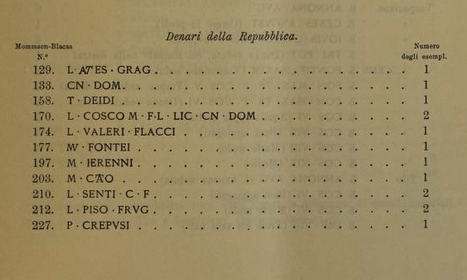
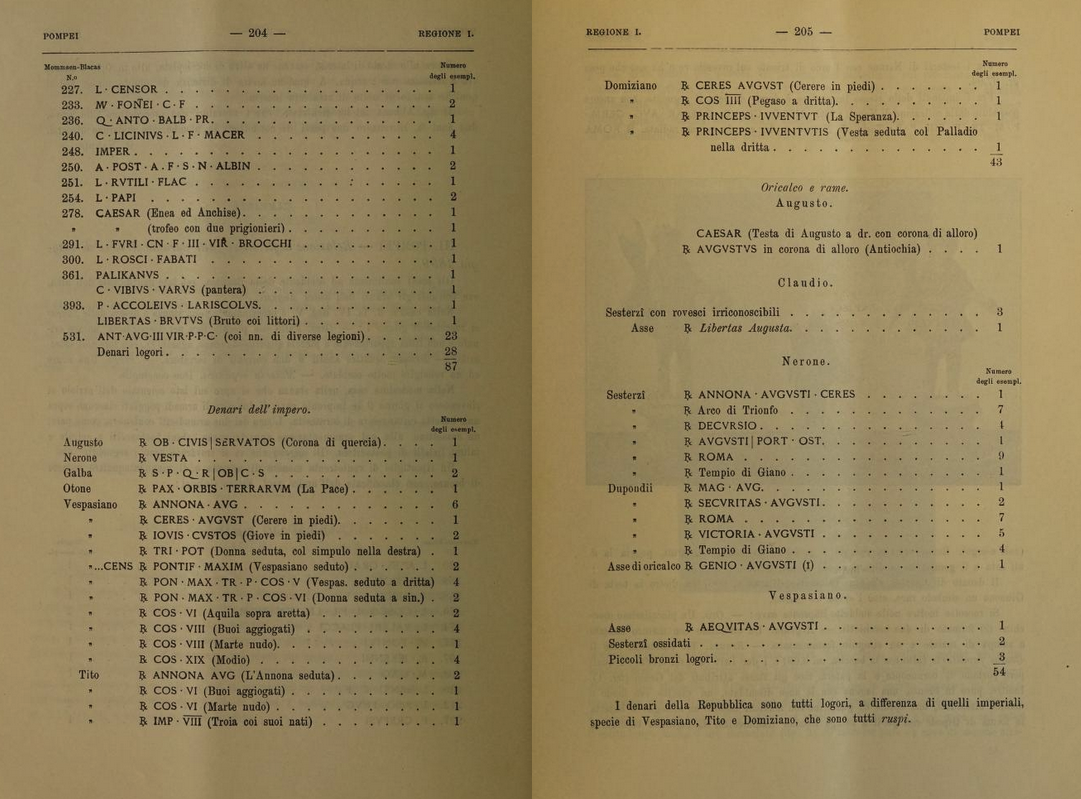
The Republican denarii are all worn, unlike the Imperial ones—particularly those of Vespasian, Titus, and Domitian—which are all in mint condition (*ruspide*).
Among the sestertii of Nero featuring the triumphal arch on the reverse, there is one weighing 37.04 grams. Among the dupondii of the same emperor, the following specimen—not yet represented in the Naples collection—is worthy of note: IMP · NERO · CLAVD · CAESAR · AVG · GERM · P.M. · TR.P. · XII · P.P. — Head of Nero facing right, wearing a radiate crown. — Rev: ROMA (in the exergue). Roma, armed, seated to the left. resting her right hand on a spear shaft and her left elbow on a *clipeus*; on either side appear the letters S C.
The *denarius* of Roscius Fabatus (Mommsen-Blacas no. 300) features a rare symbol behind the head of Juno: specifically, a herm of Silenus.
The following items were also recovered from the aforementioned hollow impressions: —
Gold. A very small earring (?) formed of two tiny hoops. — Silver. A spoon with a handle terminating in a pig’s hoof, and a fragmentary *simpulum*. —
Bronze. Three statuettes: namely, a *Genius familiaris* (0.08 m high, including the base) and two *Lares* (0.125 m high)—figures which, however, bear a cornucopia and a *patera*, the very same attributes as the *Genius* (Fig. 1). Furthermore—also in bronze—a *lagena* with detached handles; a small jar with a detached base and handle; a sort of small basket with hinged handles; a stand or base in the form of a tripod, featuring lion-paw feet interspersed with openwork foliage; another similar, smaller stand; a funnel; a saucepan bearing the well-known maker’s mark on its handle (C.I.L. X, 8071, 29); two pairs of tweezers; a small needle for making sacks; a surgical probe (*specillum*); a bracelet (*armilla*); three escutcheons from locks; eight studs fitted with rings; a very small steelyard beam with a conical sliding weight; three small handles fitted with hooks; two door staples; small herringbone-pattern chains attached to rings; and a netting needle.
Amber. A seated, draped figurine (headless); a seated *putto* (lacking the right arm and the tips of the feet); and a fragmentary, unrecognizable quadruped figurine.
Marble. A statuette of Venus Anadyomene (0.365 m high, including the circular base), notable for the red paint applied to the drapery resting upon the *alabastron* positioned beside her, and for traces of gilding on the hair, navel, and pubic area; across her chest runs the customary long, crossed golden cord (Fig. 2). A marble egg—specifically of *marmor Africanum*—was also recovered.
Glass: A small cup containing yellow pigment; two other small vessels featuring an elliptical escutcheon engraved with the figure of a nude hero resting his right hand upon his helmet (Achilles preparing to arm himself?). Furthermore—also of glass—nine unguent bottles, two small jars, a perforated button, and thirteen standard buttons (plus half of another) were found.
Rock Crystal: A tiny stopper, perforated at the top.
…

 Liv Mariah Yarrow