This is a very long very boring post. Please do not read it. It is for my own reference.
- Pena, María José. “« Diana Augusta » y el « collegium lotorum » (CIL XIV 2156) : los « piacula » del emperador Claudio.” Fortunatae 32 (2020): 539-556. Doi: 10.25145/j.fortunat.2020.32.36
An inscription from the 1st century AD, discovered in Ariccia (Latium) and dedicated to Diana, is examined. It was set up by two curatores of a collegium lotorum, whose functions are otherwise unknown. The term lotores is analyzed. A possible connection is suggested with another inscription from the sanctuary of Diana at Nemi (within the territory of Ariccia), as well as with the piacula performed in the year AD 50 on the orders of Emperor Claudius. Finally, some considerations are offered on purification by water.
- Garmi, Déjla and Meunier, Laure. “Les textiles archéologiques romains découverts en contexte nautique et portuaire: les cas de Rezé / Ratiatum (Loire-Atlantique) et de Lyon / Lugdunum (Rhône).” Gallia 77, no. 1 (2020): 187-211. Doi: 10.4000/gallia.5513
The excavations of the Roman harbor of Rezé, carried out between 2013 and 2016, yielded a collection of twenty‑one textile elements, exceptionally well preserved thanks to the humid environment. Two categories of objects can be distinguished within this assemblage: textile “pebbles” and sail elements. The pebbles consist of textiles that were folded and rolled so as to form a ball, and were then tarred. These textiles may have been used for the waterproofing of boats or of cofferdams, which were temporarily employed during the construction of the Roman quay caissons. All of the collected textiles have been subjected to technical analysis and are compared in terms of manufacturing processes, waterproofing techniques, and finishing, as well as set against finds from Lyon–Saint‑Georges, Giens, Nemi, and Egypt.
- Skovmøller, Amalie. “Painting Roman portraits : colour-coding social and cultural identities.” In Family lives : aspects of life and death in ancient families, edited by Kristine Bøggild Johannsen and Jane Hjarl Petersen. Acta Hyperborea; 15, 315-335. Copenhagen: Museum Tusculanum Pr., 2019.
Polychromy can be interpreted as a color code that conveys important aspects of cultural and social identities. This can be demonstrated through the example of the polychromy of a group of Roman portrait sculptures from the so‑called Room of the Fundilia in the sanctuary of Diana Nemorensis at Nemi, dating to the mid‑1st century AD. Knowledge of the manner in which color was applied helps to decipher and investigate more complex social and cultural constellations. The polychrome portraits should not be understood merely as representations of Roman men and women; rather, they actively contributed to reinforcing a sense of a shared lived reality.
- Pena Gimeno, María José. “CIL XIV 2213 y las magistraturas del « municipium Aricinum » (Lacio).” Anuari de Filologia. Antiqua et Mediaeualia 8 (2018): 719-734. [PDF]
After some general considerations on the epigraphic documentation of the sanctuary of Diana at Nemi and of the municipium of Aricia, within whose territory the sanctuary is located, the study focuses on inscription CIL XIV, 2213, a dedication to Diana. This inscription is regarded as the earliest find from the area, discovered in the 16th century and already known to Pirro Ligorio and Maarten de Smet. On the basis of this testimony, the municipal magistracies attested by inscriptions are examined, with particular attention paid to CIL XIV, 2171 and CIL XIV, 4196.
Summary highlights:
On the adjective nemorensis;VIf CIL XIV 2213 is set aside as false, only three authentic epigraphic attestations of nemorensis remain:
- CIL XIV 2212 – dedication to Deanae Nemorensi (Antonine period).
- CIL III 1773 – dedication from Dalmatia by Ti. Claudius Claudianus, a cohort prefect.
- A funerary altar from Genzano mentioning the collegium lotorum nemorensium.
nemorensis is not an epithet of Diana but a toponymic adjective derived from nemus, the wooded area around Lake Nemi
CIL XIV 4196: Basalt fragments from a circular base dated to the mid‑1st century BC. names two aediles, one of whom belongs to the gens Accoleia—a family possibly connected to Octavian during the civil wars? The circular base likely supported a statue intended to be viewed from all sides, perhaps connected with the iconography seen on the denarius of P. Accoleius Lariscolus (43 BC). The three‑figured image on the coin probably reflects a Trivia concept rather than an actual cult statue.
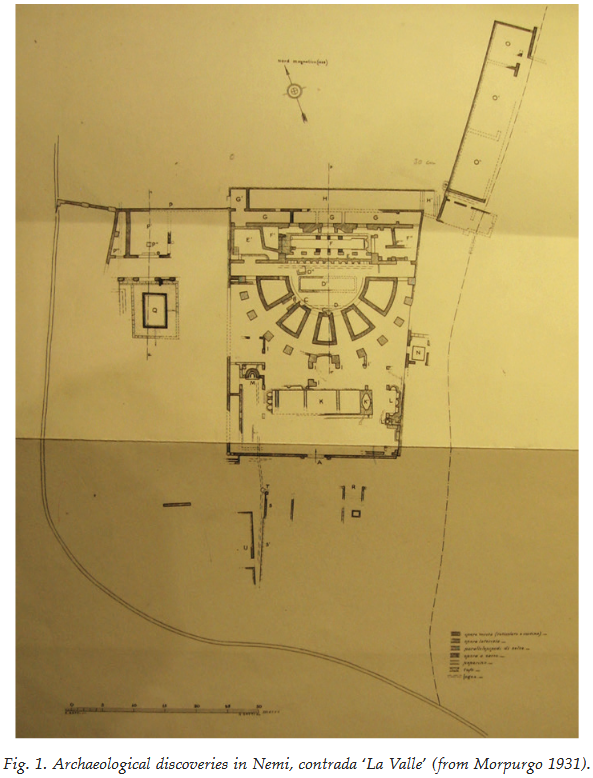
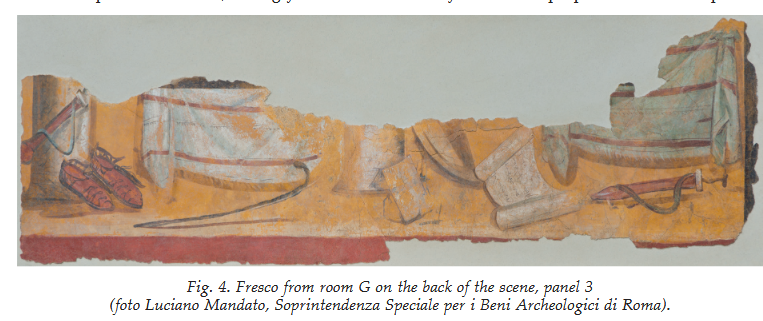
- Boldrighini, Francesca. “Frescoes from Nemi’s theatre: a dressing room ?.” In Context and meaning : proceedings of the twelfth international conference of the Association internationale pour la peinture murale antique, Athens, September 16-20, 2013, edited by Stephan T. A. M. Mols and Eric M. Moormann. BABesch. Supplement; 31, 107-112. Leuven ; Paris: Peeters, 2017. [academia.edu offprint]
excavations carried out in the 1930s in nemi, uncovered a small theatre adjoining the sanctuary of Diana
Nemorensis. A room behind the scene, possibly a dressing room, preserved an interesting painted decoration, now
housed in the national roman Museum at the Baths of Diocletian. the unusual paintings represent a series of shoes
and weapons on a background of fringed drapes and low pillars and columns; even more unusual is the repre-
sentation of written tables and scrolls among them. the frescoes, probably accomplished within the 1st century AD,
were possibly related to the shows performed in the theatre.
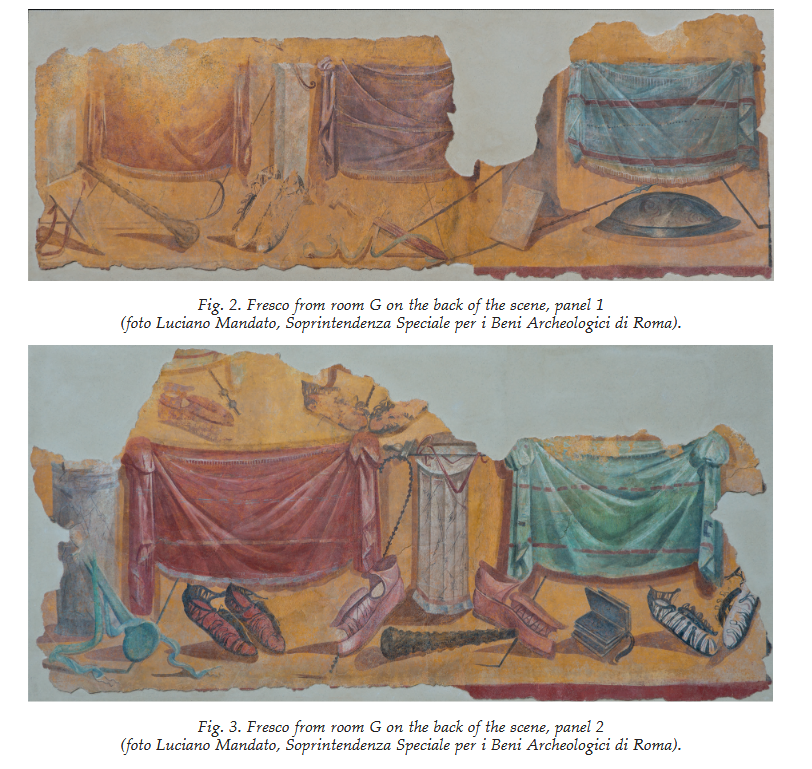
The wax tablet book in the bottom image is my favorite! And the scroll below and other writing elements:
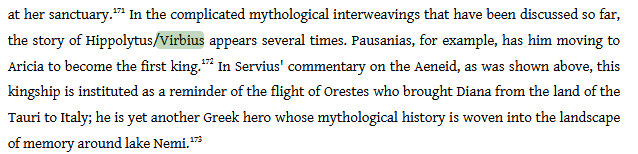
- Pena, María José. “Hipólito-Virbio, San Hipólito y Pirro Ligorio.” Cuadernos de Filología Clásica. Estudios Latinos 37, no. 2 (2017): 265-282. Doi: 10.5209/CFCL.57805 [PDF]
The goal of this paper is to study a double literary tradition derived from Hippolytus’ death, his resurrection by Asclepius and his second life in Italy as Virbius, the minor god of Diana’s sanctuary at Nemi (Latium). The Latin tradition (Virgil, Ovid, Seneca) leads to a christian saint, whose martyr-dom we know through one of Prudentius’ hymns and whose history is complicated by the discovery in the 16th century of a statue restored by Pirro Ligorio and identified with the saint. On the other hand, Ligorio is related to the first epigraphic findings from Nemi-Aricia and was the ‘creator’ of a series of epigraphic fakes related to Hippolytus-Virbius. All this without forgetting that Ligorio’s patron was the cardinal Ippolito d’Este
cf. Pena, María José and Oller, Marta. “Hipólito y Orestes en el santuario de Diana en Nemi: contaminaciones mitográficas antiguas y modernas : análisis crítico de las fuentes literarias.” Latomus 71, no. 2 (2012): 338-372.
Los textos base serán el pasaje de ver G.Aen.7.761-780, y otros dos de Ov.Fast.3.261-276 y Met.15.479-546.
And Virbius, Hippolytus’s son, most handsome, went
to the war, whom his mother Aricia sent in all his glory,
He was reared in Egeria’s groves, round the marshy shores,
where Diana’s altar stands, rich and forgiving.
For they tell in story that Hippolytus, after he had fallen prey
to his stepmother Phaedra’s cunning, and, torn apart by stampeding
horses, had paid the debt due to his father with his blood,
came again to the heavenly stars, and the upper air beneath
the sky, recalled by Apollo’s herbs and Diana’s love.
Then the all-powerful father, indignant that any mortal
should rise from the shadows to the light of life,
hurled Aesculapius, Apollo’s son, the discoverer
of such skill and healing, down to the Stygian waves.
But kindly Diana hid Hippolytus in a secret place,
and sent him to the nymph Egeria, to her grove,
where he might spend his life alone, unknown,
in the Italian woods, his name altered to Virbius.
So too horses are kept away from the temple of Diana
Trivia, and the sacred groves, they who, frightened
by sea-monsters, spilt chariot and youth across the shore.
Ov. Fast. 3.261-276:
Teach me, nymph, who serves Diana’s lake and grove:
Nymph, Egeria, wife to Numa, speak of your actions.
There is a lake in the vale of Aricia, ringed by dense woods,
And sacred to religion from ancient times.
Here Hippolytus hides, who was torn to pieces
By his horses, and so no horse may enter the grove.
The long hedge is covered with hanging threads,
And many tablets witness the goddess’s merit.
Often a woman whose prayer is answered, brow wreathed
With garlands, carries lighted torches from the City.
One with strong hands and swift feet rules there,
And each is later killed, as he himself killed before.
A pebble-filled stream flows down with fitful murmurs:
Often I’ve drunk there, but in little draughts.
Egeria, goddess dear to the Camenae, supplies the water:
She who was wife and counsellor to Numa.
Translation taken from: Hermans, A. M. (2017). Latin cults through Roman eyes: Myth, memory and cult practice in the Alban hills. [Thesis, fully internal, Universiteit van Amsterdam] Chapter 2: Diana Nemorensis and her worshippers

His mind versed in these and other teachings, it is said that Numa returned to his native country, and took control of Latium, at the people’s request. Blessed with a nymph, Egeria, for wife, and guided by the Muses, he taught the sacred rituals, and educated a savage, warlike, race in the arts of peace.
When, in old age, he relinquished his sceptre with his life, the women of Latium, the populace, and the senators wept for the dead Numa: but Egeria, his wife, left the city, and lived in retirement, concealed by dense woods, in the valley of Aricia, and her sighs and lamentations prevented the worship of Oresteian Diana. O! How often the nymphs of the lakes and groves admonished her to stop, and spoke words of consolation to her!
How often Hippolytus, Theseus’s heroic son, said to the weeping nymph: ‘Make an end to this, since yours is not the only fate to be lamented: think of others’ like misfortunes: you will endure your own more calmly. I wish my own case had no power to lighten your sorrow! But even mine can. If your ears have heard anything of Hippolytus, of how, through his father’s credulity, and the deceits of his accursed stepmother, he met his death, though you will be amazed, and I will prove it with difficulty, nevertheless, I am he.
Phaedra, Pasiphaë’s daughter, having tried, vainly, to tempt me to dishonour my father’s bed, deflected guilt, and, (more through fear than anger at being rejected?), made out I had wanted what she wished, and so accused me. Not in the least deserving it, I was banished by my father from the city, and called down hostile curses on my head.
Exiled, I headed my chariot towards Troezen, Pittheus’s city, and was travelling the Isthmus, near Corinth, when the sea rose, and a huge mass of water shaped itself into a mountain, and seemed to grow, and give out bellowings, splitting at the summit: from it, a horned bull, emerged, out of the bursting waters, standing up to his chest in the gentle breeze, expelling quantities of seawater from his nostrils and gaping mouth. My companions’ hearts were troubled, but my mind stayed unshaken, preoccupied with thoughts of exile, when my fiery horses turned their necks towards the sea, and trembled, with ears pricked, disturbed by fear of the monster, and dragged the chariot, headlong, down the steep cliff.
I struggled, in vain, to control them with the foam-flecked reins, and leaning backwards, strained at the resistant thongs. Even then, the horses’ madness would not have exhausted my strength, if a wheel had not broken, and been wrenched off, as the axle hub, round which it revolves, struck a tree. I was thrown from the chariot, and, my body entangled in the reins, my sinews caught by the tree, you might have seen my living entrails dragged along, my limbs partly torn away, partly held fast, my bones snapped with a loud crack, and my weary spirit expiring: no part of my body recognisable: but all one wound. Now can you compare your tragedy, or dare you, nymph, with mine?
I saw, also, the kingdom without light, and bathed my lacerated body in Phlegethon’s waves: there still, if Apollo’s son, Aesculapius, had not restored me to life with his powerful cures. When, despite Dis’s anger, I regained it, by the power of herbs and Paean’s help, Cynthia, created a dense mist round me, so that I might not be seen and increase envy at the gift. And she added a look of age, and left me unrecognisable, so that I would be safe, and might be seen with impunity. She considered, for a while, whether to give me Crete or Delos to live in: abandoning Delos and Crete, she set me down here, and ordered me to discard my name that might remind me of horses, and said: “You, who were Hippolytus, be also, now, Virbius!” Since then I have lived in this grove, one of the minor deities, and sheltering in the divinity of Diana, my mistress, I am coupled with her.’
Egeria’s grief could not be lessened, even by the sufferings of others: prostrate, at the foot of a mountain, she melted away in tears, till Phoebus’s sister, out of pity for her true sorrow, made a cool fountain from her body, and reduced her limbs to unfailing waters.
cf. also Pasqualini, Anna. “Oreste nel Lazio: percorso della leggenda e funzioni del mito.” In Οὐ πᾶν ἐφήμερον: scritti in memoria di Roberto Pretagostini : offerti da colleghi, dottori e dottorandi di ricerca della Facoltà di Lettere e Filosofia, edited by Cecilia Braidotti, Emanuele Dettori and Eugenio Lanzillotta., 1091-1113. Roma: Quasar, 2009.
The myth of Orestes as the founder of the sanctuary at Aricia presents certain discrepancies across the various sources (Hyginus, Fab. 261—cited by Servius in his commentary ad Aen. 2.166, and revisited in 6.136; Pseudo-Probus, Commentarius in Verg. Buc. et Georg. 3; Schol. in Theocr. pp. 2–3 [Wendel 1914]; and Theon of Alexandria, pp. 13–22 [Wendel 1914]). As a symbol of the transition from a state of savagery to one of civilitas (civilization), the myth exemplifies the establishment at Nemi of a complex of motifs derived from diverse cultural matrices—most notably Cumae and Rhegium. Specifically, the sanctuary’s Scythian associations were juxtaposed with its Magna Graecian mythical heritage once the Romans came into contact with the actual geographical settings of the Iphigenia in Tauris. During the Augustan era, Orestes was subsequently exalted as the avenger of his father’s death—a status underscored by the ceremonial transfer of his remains from Ariccia to Rome; however, given that the myth itself characterized him as afflicted by madness, this choice was eventually abandoned in favor of the figure of Aeneas.
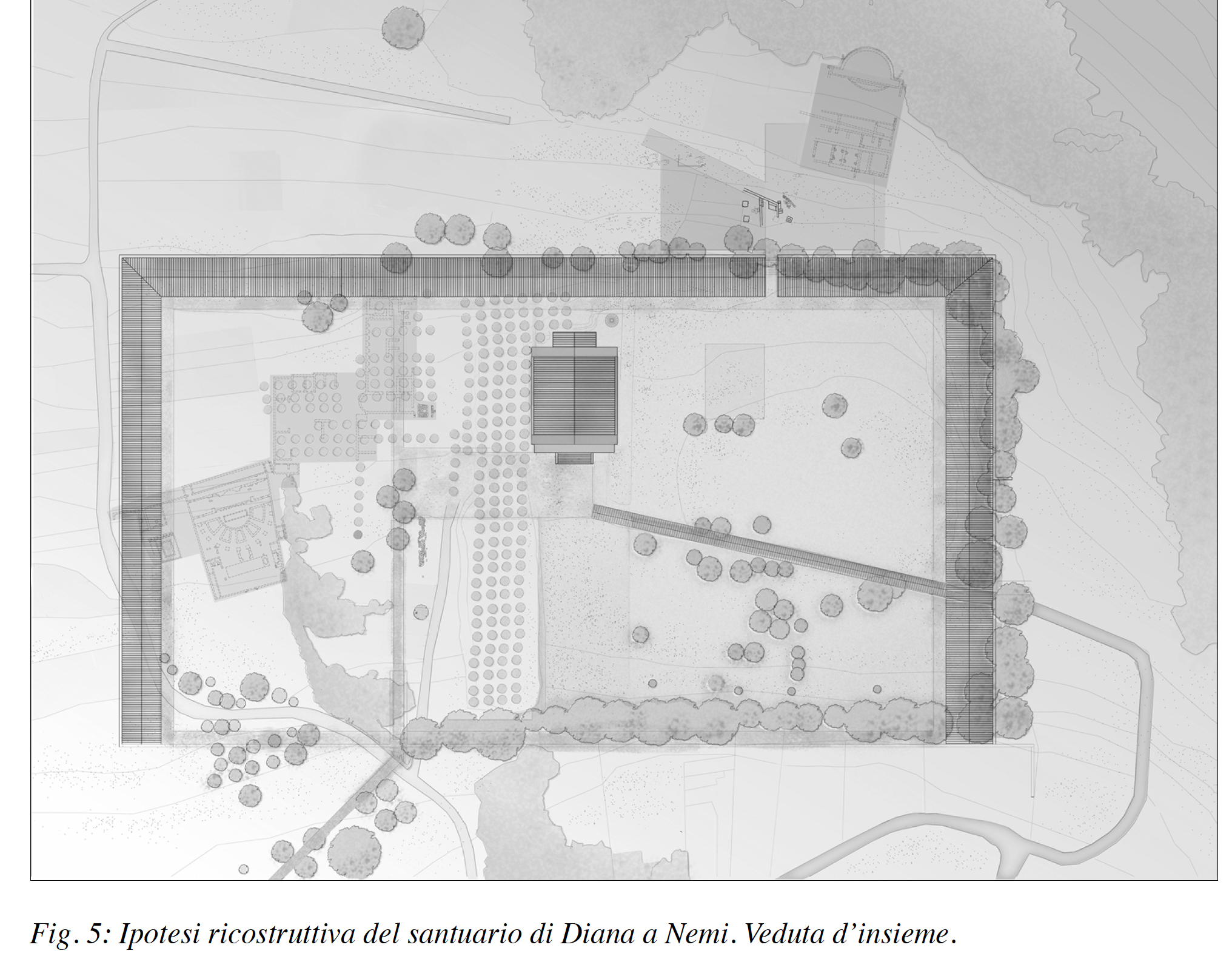
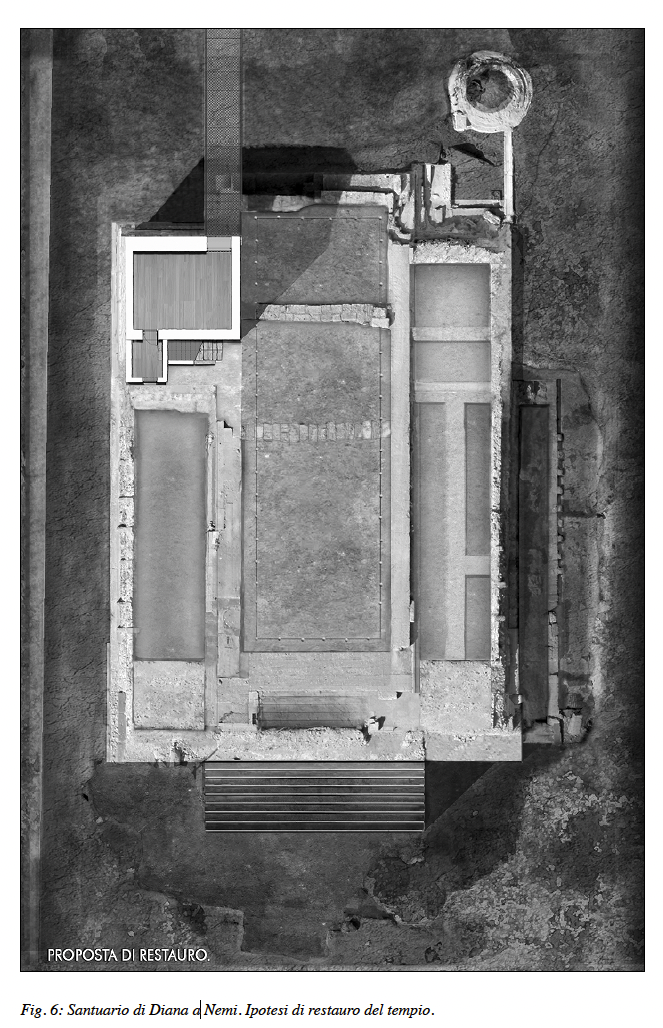
- Romagnoli, Laura and Batocchioni, Guido. “Allestimenti e restauri di antichi luoghi sacri: un motivo di studio per la restituzione di un’immagine compiuta.” In Vestigia: miscellanea di studi storico-religiosi in onore di Filippo Coarelli nel suo 80° anniversario, edited by Valentino Gasparini. Potsdamer Altertumswissenschaftliche Beiträge; 55, 727-740. Stuttgart: Steiner, 2016.
The article imagines what it would take to restore the sanctuary of Diana at Nemi to be accessible and inspiring to visitors while accurating conveying and preserving archaeology.
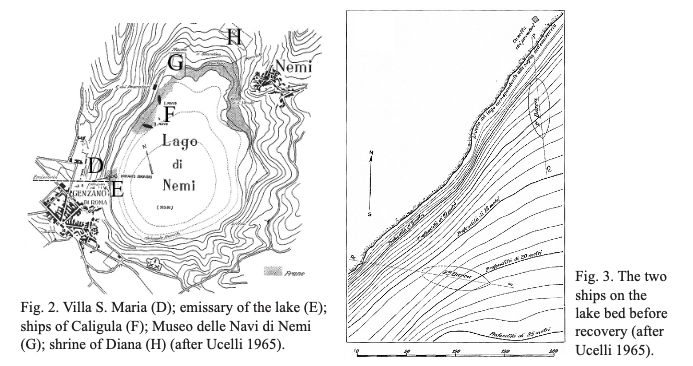
- Diosono, Francesca and Cinaglia, Tiziano. “Light on the water: ritual deposit of lamps in Lake Nemi.” Journal of Roman Archaeology 29, no. 1 (2016): 451-468. Doi: 10.1017/S104775940007224X
Following attempts beginning in Renaissance times, in 1927 the decision was taken to lower the level of Lake Nemi to the floor where the hulls of two ships belonging to Caligula lay, using pumps. These operations, conducted between 1928-1932, concluded in 1936 with the opening of the Museo Nazionale delle Navi Romane, where the ships were displayed. The ships were destroyed in 1944. But in addition to the materials belonging to the ships themselves, a number of other materials were gathered from the lake bed, including coins and bronze and terracotta objects. Lamps constitute the majority of these materials. The presence of nearly 250 lamps on the lake bed must be assumed to be due to a deliberate action that was repeated over time. The chronological span of almost all the lamps, from the middle of the 1st to the end of 2nd cent. A.D., is too long to argue for an isolated event. The different types and workshops represented also suggest that we are dealing with an act performed on numerous occasions, for each of which the materials were acquired on the retail market. That characteristic suggests that the lamps featured in an individual ritual practice, ending with their deposition on the waters of the lake.
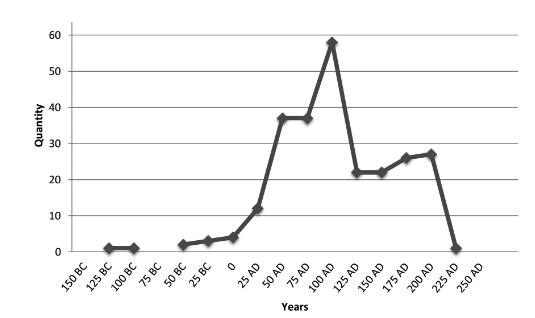
I wonder if the lamps were the less common offering and torches were more usually thrown in the lake but do not remain for use to use as context.
Cinaglia, T. and T. Leone 2014. “Le lucerne,” in Nemi 2014, 499-520
- Martínez-Pinna Nieto, Jorge. “Los santuarios federales latinos.” Revue Belge de Philologie et d’Histoire = Belgisch Tijdschrift voor Filologie en Geschiedenis 92, no. 1 (2014): 41-56. Doi: 10.3406/rbph.2014.8539 [open access]
Cf. Martínez-Pinna, Jorge. “Observaciones sobre el origen de le Liga Latina.” Mediterraneo Antico 15, no. 1-2 (2012): 409-423.
- Coarelli, Filippo. “Da Nemi a Pesaro: la testa bronzea tardo-arcaica di Copenaghen.” In Hesperìa : studi sulla grecità di Occidente. 30, L’indagine e la rima : scritti per Lorenzo Braccesi, edited by Flavio Raviola, Maddalena Bassani, Andrea Debiasi and Elena Pastorio., 355-359. Roma: L’Erma di Bretschneider, 2013.
A new document is presented—a drawing of a head in profile bearing the concise caption “bronze head found in a river”—contained within a series of previously unpublished notes compiled by the Pesaro-based scholar and collector Annibale degli Abati Olivieri (18th century). This document makes it possible to rule out a Nemi origin for the late-Archaic bronze head now in Copenhagen and to propose instead that it originates from the territory of Pesaro—as is the case for the majority of objects listed in Olivieri’s catalogue. Furthermore, based on stylistic grounds, it is hypothesized that the head was produced in an Etruscan workshop on the Tyrrhenian coast—likely Cerveteri—around 500 BC, and that it represents a votive image of Hercules originally housed in an Archaic sanctuary within the Pesaro territory, associated with the Novilara culture.
- Rigato, Daniela. “Tra « pietas » e magia: gemme e preziosi offerti alle divinità.” In Oggetti-simbolo: produzione, uso e significato nel mondo antico, edited by Isabella Baldini Lippolis and Anna Lina Morelli. Ornamenta; 3, 41-55. Bologna: Ante Quem, 2011.
Through the study of two epigraphic documents (CIL 14, 2215 from Nemi and CIL 2, 3386 from Guadix, Spain), he/she demonstrates that the practice of donating gems and precious stones to deities is not necessarily linked to magical or therapeutic meanings, but should instead be understood as a manifestation of pietas.
- Moltesen, Mette. “Diana and her followers in a late republican temple pediment from Nemi: a preliminary note.” In From Artemis to Diana: the goddess of man and beast, edited by Tobias Fischer-Hansen and Birte Poulsen. Acta Hyperborea; 12, 345-367. Copenhagen: Museum Tusculanum Pr., 2009. [ILL requested. V eager to read.]
A terracotta torso of a woman in the Museum of Fine Arts, Boston (inv. 86, 692) belongs with a group of fragmentary terracotta figures in the Castle Museum, Nottingham (inv. nos. 189 ; 191 ; 192 ; 193 ; 194 ; 195 ; 199 ; 218). The figures are the same as those seen in photographs taken in 1885 during excavations in the sanctuary of Diana at Nemi by Sir John Savile Lumley (Rome, Deutsches Archäologisches Institut, negs. 4724 ; 4717). In all we have parts of at least 15 figures. They likely date to the second or third quarter of the 2nd cent. B.C. and were displayed in a temple pediment at the sanctuary of Diana in Nemi.
Holland, Lora L.. “« Diana feminarum tutela ? » :: the case of « noutrix Paperia ».” In Studies in Latin literature and Roman history. 14, edited by Carl Deroux. Collection Latomus; 315, 95-115. Bruxelles: Latomus, 2008. [pdf]
Inscription (AE 1896, 13 = CIL I², 45) on a bronze spearhead (Rome, Villa Giulia Museum, inv. 6754) discovered in the late 19th century at the Sanctuary of Diana at Lake Nemi, within an archaeological context containing anatomical votive objects—including breasts. Dating to approximately 300 BC, the dedication “Diana mereto / noutrix Paperia” was likely offered not by a slave, but by a freedwoman of the gens Papiria, where she served as a wet nurse. The absence of a cognomen aligns with the onomastic practices of the period. This role conferred significant social standing upon the woman who held it, empowering her to address the deity in her own name. The choice of a spearhead clearly demonstrates that this was by no means a petition pro lacte (for milk)—despite the votive objects discovered nearby—and that Diana is here regarded as the patroness of freedpersons and of those who assert agency over their own lives, rather than as the protectress of womanhood.
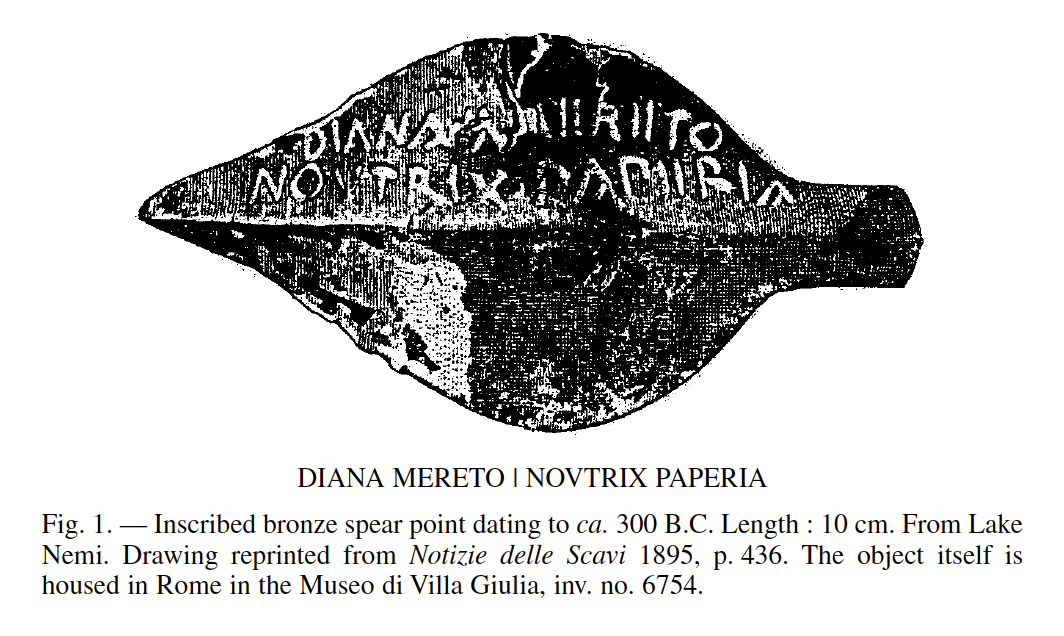
This reminds me I need to go through all the late 19th century NSc to find refs to Nemi.
- D’Ambra, Eve. “Maidens and manhood in the worship of Diana at Nemi.” In Finding Persephone: women’s rituals in the ancient Mediterranean, edited by Maryline G. Parca and Angeliki Tzanetou. Studies in ancient folklore and popular culture, 228-251. Bloomington (Ind.): Indiana University Pr., 2007. [ILL requested]
Eleven Roman funerary portraits in sculpture and seven reliefs from the 1st-3rd cents. A.D. depict girls and young women in the guise of Diana, a goddess whose resistance to categories of gender and mature sexuality, as recent research on her sanctuary at Lake Nemi has demonstrated ( => 72-06976 and 74-14352) appealed to mourning parents. The goddess’ status as chaste maiden reflected the girls’ stage of life, but as huntress she also signified a heroic mode of representation or even virtus. Deceased girls were endowed with virtus in compensation for their untimely death.
- Bilde, Pia Guldager and Moltesen, Mette. A catalogue of sculptures from the Sanctuary of Diana Nemorensis in the University of Pennsylvania Museum, Philadelphia. Analecta Romana Instituti Danici. Supplementum; 29. Roma: L’Erma di Bretschneider, 2002
I looked for a copy to buy but I think I’ll ILL as I’m not convinced it will be that useful over the long haul.
- Pasqualini, Anna. “L’ incesto di Silano e il bosco di Diano: (Tac. Ann. 12.8.2).” Analecta Romana Instituti Danici, no. 27 (2001): 141-149.
On the day of his wedding to Agrippina, Claudius had rites performed in the lucus of Diana at Nemi to expiate the incest committed by L. Iunius Silanus and his sister. The Lucus Dianius is linked to a very ancient phase of Roman and Etruscan religion, to King Tullus Hostilius, and to the gentile social order. There, Diana and the goddess Egeria were venerated—both patronesses of fertility, women, and newborns.
- Green, Carin M. C.. “The slayer and the king: « rex nemorensis » and the sanctuary of Diana.” Arion 3rd ser. 7, no. 3 (1999-2000): 24-63.
In Aen. 6, 136-141, the golden bough’s function as a talisman for Aeneas on his journey to the underworld and the connection between Augustus’ family and (Lake) Nemi, home to a renowned sanctuary of Diana, confirm Servius’ connection between the bough, the death of Misenus, and the ritual of the « rex nemorensis ». This native Italic cult, marked by mortal combat between a fugitive slave and a priest of Diana, offers Vergil a pattern that grounds the poem through a powerful Latin ritual that mirrors the conflict between Turnus and Aeneas for kingship. More generally, the ritual of the « rex nemorensis », by enacting the easily subverted relationship between hunter and hunted, ruler and slave, embodies the primitive, uncivilized, and ultimately unchanging core of kingship and power.
I guess I’m going to have to decide if I believe this rex nemorensis is a historical reality or just stuff Romans like Vergil like to imagine and think about.
…

 Liv Mariah Yarrow