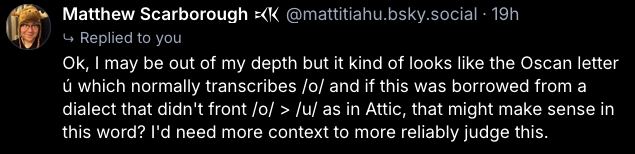
This reply arrived late yesterday as I was all in on the apex theory of Musa’s name. I still think that is most likely, but I thought v briefly I should consider if the name might be Oscan.
First stop Katherine McDonald’s website, a leading expert and great at making resources available to the rest of us. The books I want to consult but cannot yet:
Helmut Rix (2001) Sabellische Texte.
Michael Crawford (2011) Imagines Italicae. [PDFs now on file]
I put out a bsky call to see if someone might have shareable pdfs [it worked!]. These are the moments really wish I was at an institution with a research library attached. I know I can check these in a month in person at the ICS, or I could ILL (a major resource ask to ship the physical book) and I really just want to do a quick scan. Sure I could drive to Princeton, but that’s 4 hour commitment. Ditto Columbia etc. And then there is always the convo about whether I’m allowed in to the library as scholar from another institution. I hate it. I think I might just purchase Imagines Italicae, but I’ll pause for a moment as it is NOT CHEAP. We’ll see how tax season goes. Ok enough whining.
Salomies, Olli. (2012) “The Nomina of the Samnites. A Checklist,” Arctos 46, 137-185.
This let me confirm Musa is not an attested Oscan name.
But look here! Pomponius is!
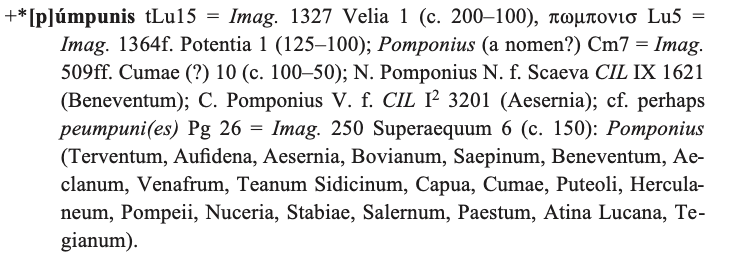
Isn’t that fun?!
Farney 2007 discusses the Pomponii primarily as Sabine, not Samnite or Oscan (p. 120-122, and passim)
Based on Salomies’ list of attestations of the gens as an Oscan name here’s spread [edit: missing Potentia].
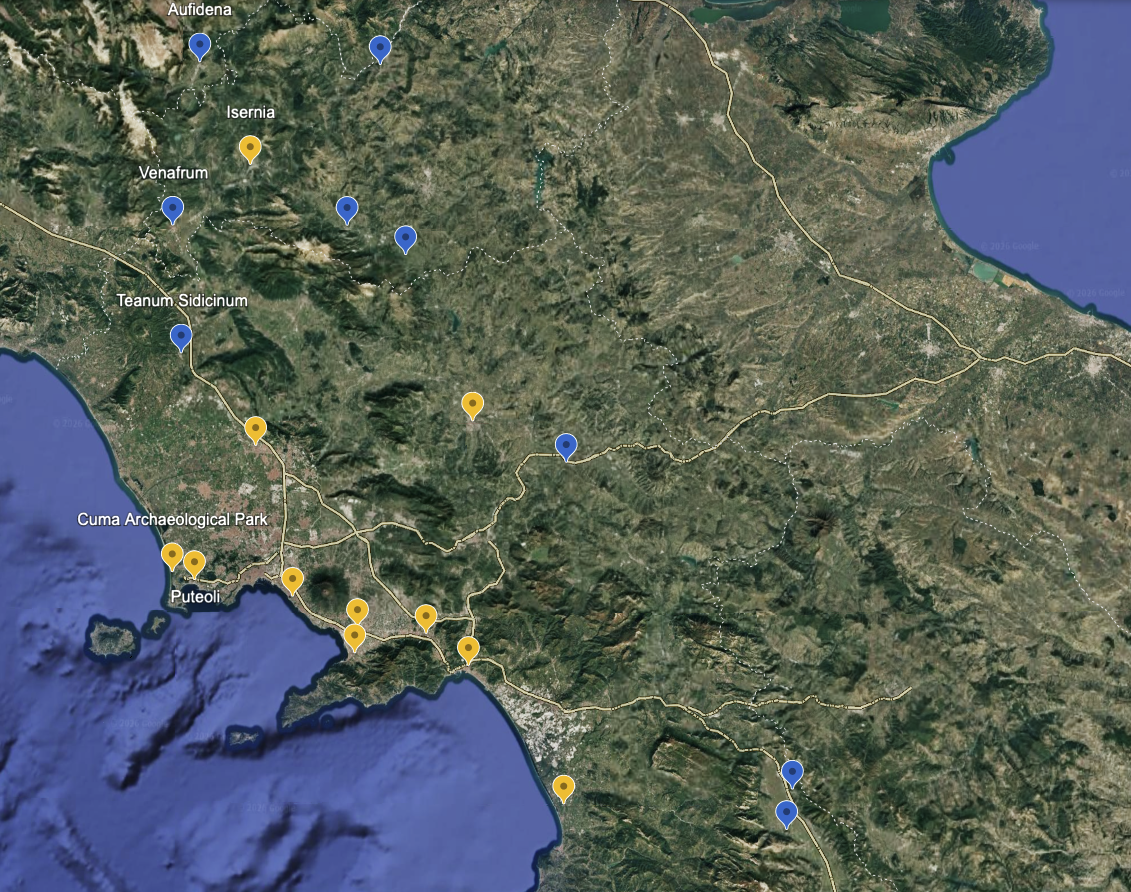
Google Earth kept crashing, I’m guessing my internet cannot handle it with a full household of other people having fun doing weekend stuff online. But I got this drawn before I stopped fighting it. It’s ugly but complete except for Potentia and some labels (color is meaningless) and you can manipulate the view if you can access google earth without it crashing on you. I’ve got to find a better means of mapping…
So what does the marked V that is often used for O look like.
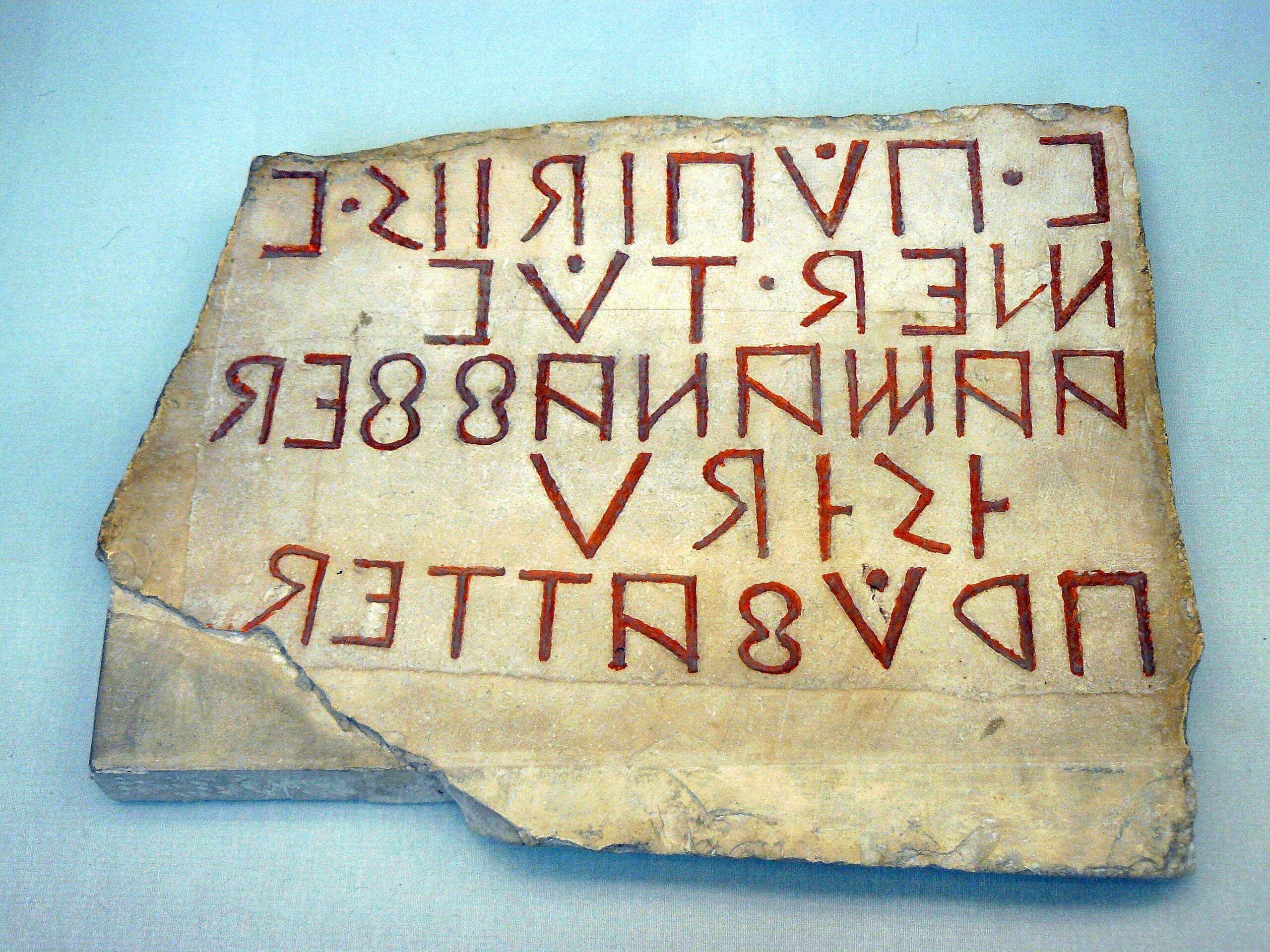
Interesting but could this explain the orthography of MVSA on RRC 410? I am not convinced, but I don’t want to lose the idea.
We’ve also been discussing the orthography of FVRI on RRC 414 and I can find no suggestion this gens is associated with the Oscan language.

 Liv Mariah Yarrow
One thought on “Probably not Oscan”