
Part one, two weeks old.
I’m at the airport. Can I tell you how much I love the day flight?! Instead of trying to pretend one can compress 12 hours into 6 overnight and function the next day. I get to be out of time for just one day, go to bed ‘early’ by my own body clock and still function tomorrow. No performance, little to no jet lag. I’ve scheduled the flight to bang out a little supplementary grant request to augment some other research and maybe snag myself a student assistant to share the grunt work of the project. I’ve got a little wool and a crochet hook and a late 19th century detective novel audio book. But I think once I finish that little grant, I really just want to indulge in more antiquated coin stuff. Fingers crossed the internet on the plane is marginally acceptable.
Early in this volume we had mention of coins (bronze, silver, gold) being found by ordinary people around Orvieto and sold to a local enthusiast but with no significant details of interest. There was also a long lovely account in Latin of a “new” type deemed to be of importance to the history of Catania. While I found the language interesting, I wasn’t moved to dig further as not really my area.
I thought the year was going to be a bust for finds of interest to me. But then I got three hoards in short succession.
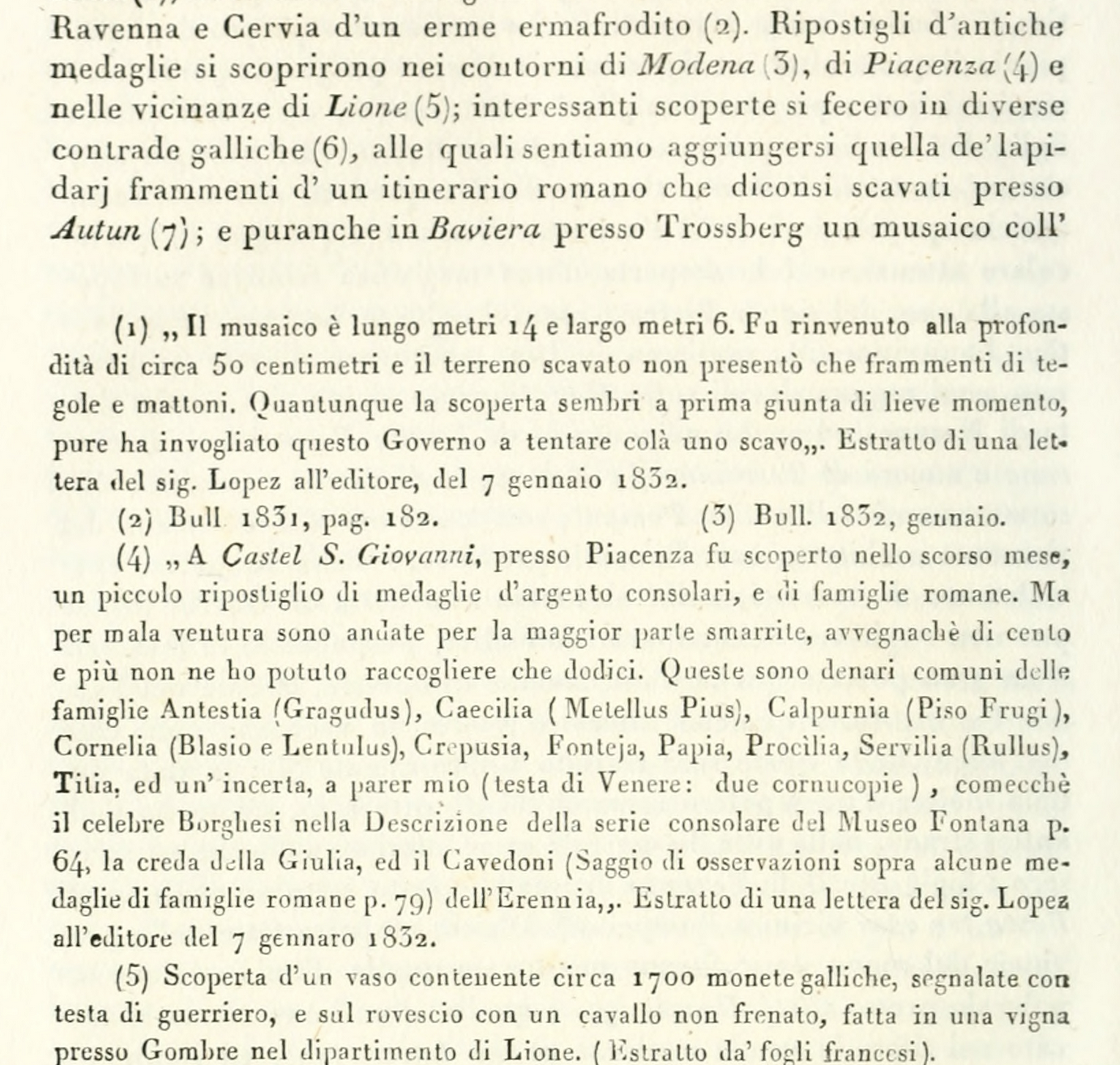
Contorni at Modena (must find report!)
Gallic hoard of ~1700 specimens from near Lyon.
And, jackpot! a letter on a hoard of Castel S. Giovanni near Piacenza of republican material with lamentations of lack of content preservation but enough that we can say it is likely post 58 BCE base on absence of Capurnius Piso Frugi from Mesagne. But with most of the types observed associating the majority of the coins with the late 80s and early 70s. The Sullan Venus/Cornucopiae is indeed interesting.
Part two.
I’m on the return voyage once again at the airport early and feeling like self indulging in old publications, still in 1831 (link above).
This year a correspondent reports a type from the city of Lysinia saying prior to this there was no record of any coinage of this city. He found the coin in a mass of numismatic material recently shipped to him in Italy from Constantinople. Today we know of 7 types struck by the city. The coin described appears to be RPC V.3. 73872.
I moved on to 1832.
There is a fascinating narrative of discoveries between January and June 1831 including much of what I think is the house of the faun and also the discovery of a woman, her child, and some personal belongings. The end of this report makes allusion to many small finds without specifying where in the excavation area they were found but most tantalizing to me is the several hundred silver coins mostly of the republican period. This is squashed in with reports of gems and jewelry. (p.9)
The reports of spring 1832 excavations at Volterra (p. 161-163) say that in many of the tombs one or more Roman bronze coin was found. The descriptions are vague and the treasure hunters clearly disappointed they didn’t find better loot, but in one case they mention that the coin had the head of janus and a ship prow.

 Liv Mariah Yarrow