I thought I was getting over my cat grief. Nope. My lovely artist neighbor presented me with a painted portrait of my dear, demonic Odysseus as an angel flying over my house. I’ve been sobbing and blubbering ever since. So I’m going to be self indulgent now and just poke around in old books to make myself feel better.My beloved has confiscated the painting and put it somewhere safe until it stops triggering such astrong emotional response.
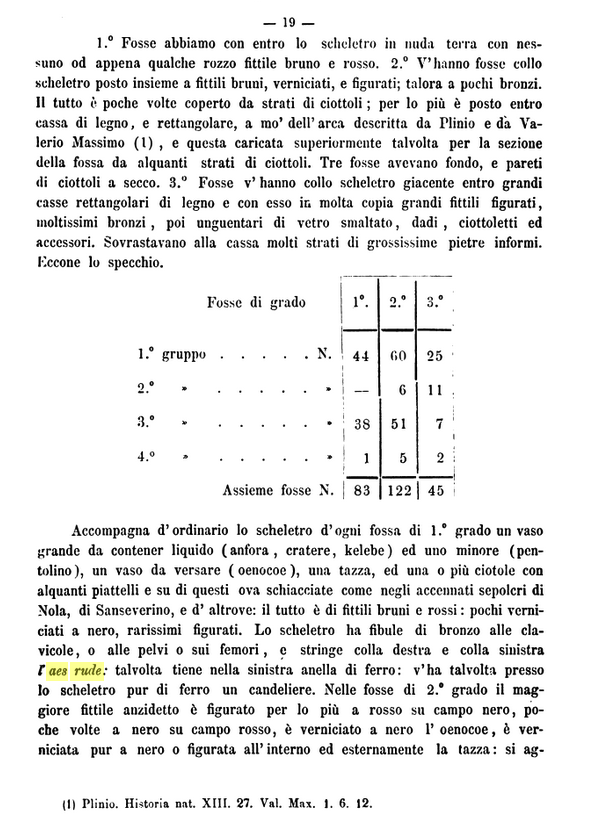
“The skeleton of each grave of the first type is usually accompanied by a large vessel for containing liquid (an amphora, crater, kelebe) and a smaller one (a saucepan), a vessel for pouring (oenocoe), a cup, and one or more bowls with several small plates and on these flattened eggs as in the aforementioned tombs of Nola, Sanseverino, and elsewhere: everything is made of brown and red earthenware: a few are painted black, very rarely are figured. The skeleton has bronze fibulae on the clavicles, or on the pelvis or on the femurs, and holds aes rude in the right and left hands: sometimes he has an iron ring in the left hand: sometimes there is a lamp stand, also of iron, near the skeleton.”
The second type (p. 20) is also said to hold aes rude in a hand (not specified which). The speaker now refers to photographs not in the publication but shown to the audience of his excavations at Certosa:
Observe, among the first, that little boy who holds the aes rude in his tender right hand, and clutches a bronze armlet in his left; do you see the group of rough earthenware pieces that are to his left?
Look at the other one, a little older: he also has the aes rude in his right hand, a fibula rests on the eye of the left femur, and nearby is a bowl containing crushed eggs. Look at the third small skeleton, also with the aes rude in his right hand, and the four bowls, and the eleven small plates, along with the small pot and the human-faced oenochoe? The other skeleton is somewhat larger: it also holds the aes rude in its left hand, and a fibula is on its chin. This skeleton had its head not facing south, but south. Do you see the cotyle and the oenochoe not on the left but at the foot, as if to say, north?
And here is the beautiful skeleton of the adults with a very beautiful skull of the Etruscan type and the two adjacent ones of the Umbrian type: do you see the aes rude, which the third is still holding tightly in his right hand and the necklace of amber beads, which lies stretched out from the neck to the chest? Observe the other group of three adults too: how all the skulls have the imprint of the Umbrian type, and how they all still hold the aes rude and fibulae, like the clay figures on the left! And in the skeleton, separately, do you see the three bronze bracelets, two on the left arm, the third on the right? But the last pit is very singular. You will soon see two skeletons in a pit: I will say that one pit had the skull and fragments of a woman’s skeleton and burnt bones. In the extracted pit, observe: here are two supine skeletons. One is of a very old woman, the other on the left is of a boy, who is just over two years old: observe that the woman also has an aes rude in her right hand, a pin and a fibula on her chin, the smaller skeleton also has a bronze armlet on his left, almost on his chest some amber pearls and a pendant: to the left of the two skeletons are a cup, a goblet, a lechito and a figured kelebe.
We now jump ahead in the discussion to pages 46-47. Here I’m getting very excited because we see the origins of the belief that aes rude MUST have intrinsic value.
Never, gentlemen, has the aes rude been so clearly exposed as has been done by the excavations of Certosa, although it has been found in tombs on other occasions [cf. Todi]. You saw it discovered in the burnt remains together with the remains of the pyre. You still see it clutched in the hands of skeletons, but the analyses I have deduced are very important.
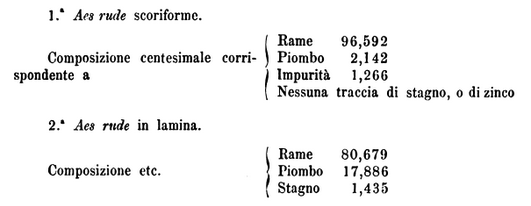
The aes rude of Certosa, as elsewhere, does not have a single form: rather, there are four distinct forms: here is the aes rude in the form of slag, or colo; in the form of a slab, in the form of rods; in the shape of more or less ovoid and almost oblong disks. And that ribbed fragment, and those two with lines, would they be fragments of aes signatum? And would a true aes signatum be the 0.03 disk crossed by three parallel lines? It was in the face of these differences in shapes that a problem arose in my mind. Are these shapes, gentlemen, accidental, arbitrary, or are they shapes given specifically to the aes rude to establish a monetary value specific to each shape? And could this monetary value of the aes rude depend on the elements that compose it, that is, on its different alloy? It is certain that if the alloy is different, it could not be indifferent, therefore the value of the aes rude would be only one, but rather, I said, its monetary value must be proportional to its alloy. And would the different forms described have ever been used to distinguish this value? Thus reasoning, I turned to the very accurate Professor Casali, and here are the analyses resulting from three of the forms of the aes rude, having only a single specimen of the fourth.
This is fantastic but wow the logical fallacy of thinking all the aes rude of the same basic shape would have the same basic composition. These are percentages. Rame is Copper, Piombo is Lead, and Stagno is Tin. Given the date of publication only wet chemistry was possible. I’d love to know the technique. Did they use the whole object or just part of the object? I’d also love a modern dating of these tombs, perhaps based on pottery serration.
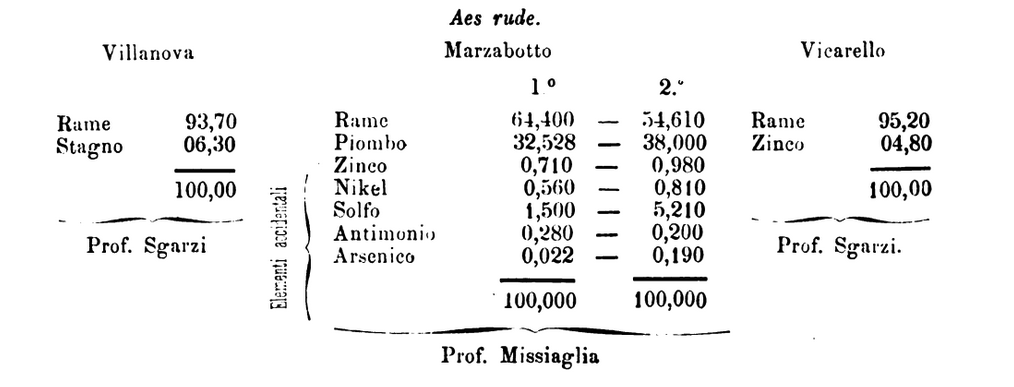
He further observes that the first and second varieties of aes rude appeared as shapeless masses, ashen in color, without luster, and brittle when hammered. The one in a sheet, when coated with azotic acid, initially dissolved easily, later abandoning approximately 1/3 of its quantity of metallic substance, which was refractory to the action of the acid itself, aided also by the heat. Such a fact, which repeated itself several times, induced the writer to test this portion of the alloy separately, which was found to be composed of lead and tin, and a small quantity of copper. And since, when inspected with a magnifying glass, the said substance was found to be compact and not very porous, the writer himself infers that it was a special alloy, formed in the molten mass of bronze during its slow cooling. Gentlemen, therefore, the chemical analysis confirms my deductions: the aes rude therefore has a different alloy according to its different shape; first the scoriform aes rude, then the aes rude in sheets, then the aes rude in rods and these three alloys gradually increase its value perhaps in the following scale: 1st the scoriform aes rude, 2nd the sheet aes rude, 3rd the aes rude in rods? Our aes rude then differs from the aes rude of Marzabotto [also from a necropolis], the one in rods approaches the aes rude of Villanova, the scoriform one for copper approaches the aes rude of Vicarello (1).
I’m trying to wrap my head around this extrapolation from single objects. I’m so proud of Prof. Missiaglia for texting TWO specimens. I also trust his results because of the detail. The Vicarello numbers REALLY surprise me. What is that Zinc number coming from I’ve never seen anything like it and it worries me. (Copper Zinc Alloys). How did Sgarzi get his specimen from Vicarello, were these reports published anywhere? For Marzabotto we have Gozzadini’s publication on the ancient necropolis (maybe? I cannot find it…).
Our author circles back to invoke the aes rude in his conclusions (p. 55)
…And these elements, which hint at remote ages, are they not confirmed by the aes rude gradually developing from scoriform to laminate, to rods, to obeli, and then up to the presumed aes signatum, the aes signatum, marked precisely, according to the illustrious Mommsen, first by Servius Tullius in Rome? It is certainly true that Felsina must have had its own currency in the development of the times.
While we must reject the chronology and correlation between form development and metallurgical content, these observations detailing the position of the finds and the wet chemistry is invaluable.
I wonder where I could find Zannoni’s excavation photos. …


 Liv Mariah Yarrow