Yes this is further self indulgence but certainly useful. Scroll down for the asses found in etruscan tombs!
1829, In house of Castor and Pollux at Pompeii 45 gold and silver coins were found in an area described and the women’s quarters in a bronze lined box.
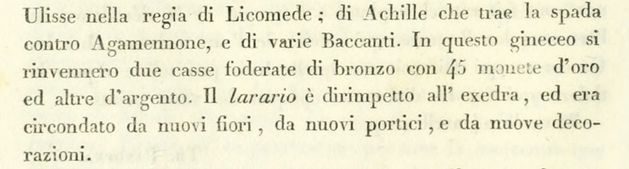
The same report also talks about performing excavations in front of the king and queen of Bavaria. The king got to see imperial bronze coins excavated before the gate of the temple of Augustus. The queen got to see some well preserved bronze coins excavated in a shop. Planted objects? I’m guessing not as they don’t seem that ‘exciting’. Still weird to watch excavation as a form of entertainment…
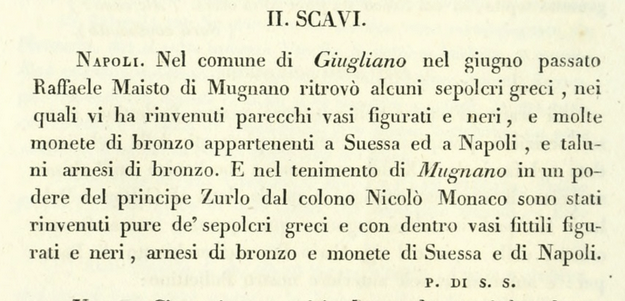
Naples. In accordance with the sovereign concession to communicate to the Institute the reports received by the Neapolitan government regarding the excavations in the kingdom, the Prince of Sangiorgio received the following information extracted from a report by the Intendant of Naples: namely, that on the 28th of last April [1829] three tombs had been discovered in Mugliano, located in the district of Casoria, in which various ancient objects were found: these include some terracotta vases with black glaze, two broken bronze fibulae, and twenty-five coins of the same metal; of which twelve coins belong to Suessa and thirteen to Naples.
Can we call this a hoard? We can’t really say from this description if all 25 coins were found in the same tomb or if some in one and some in another. My guess is that this if better documented would be a very nice little assemblage of vernice nera with petites estampilles with coins of the First Punic War. But on this testimony it is only a guess. Naples IΣ series bronzes are often found with the short lived Suessa Bronzes. In the same bulletin we have a later report that seems like it might be the same incident as quoted just above. Were there three, two, or just one discovery? I think two perhaps. Giugliano is a long way from Casoria. But Mugnano perhaps shouldn’t be confused with Mugliano?! Interesting though that the coin finds are all discovered in the same way.
1830.
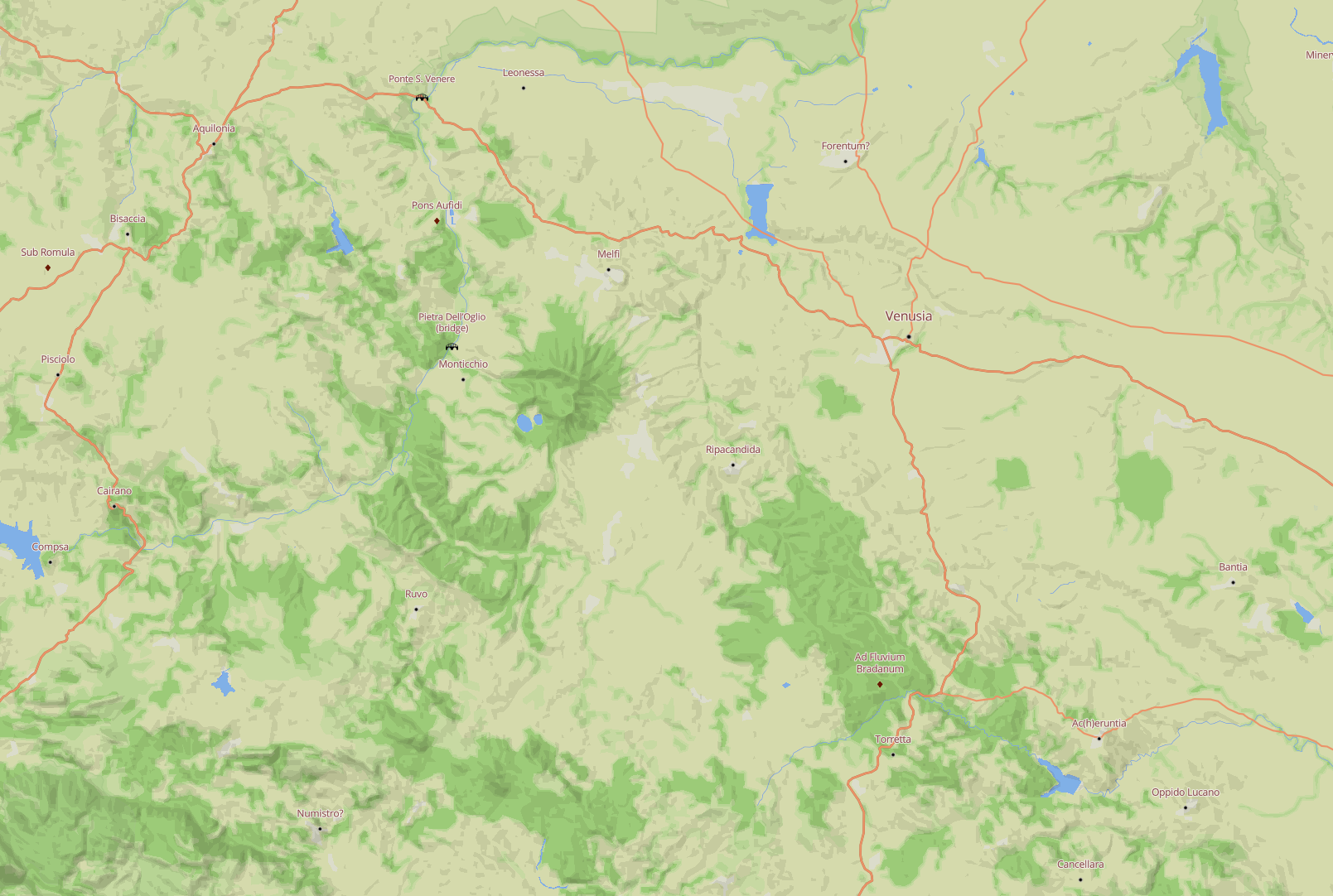
Considerable remains of an ancient bridge can be seen on the river that intercedes between Barile and Ripacandida, which further down takes the name of Divento, and in the vicinity of Barile, consular coins have been found, and still are found, in abundance, and almost all of them are silver.
I presumed based on reading this that I’d be able to spot the likely road or bridge on the new itiner-e. That’s the new roman road online map that has made a splash. To place Barile you’ll need to use the google screen shot to help you eyeball it. I see no particular reason this place should have a reputation for turning up republican silver coins and the road for that bridge is certainly not yet traced.
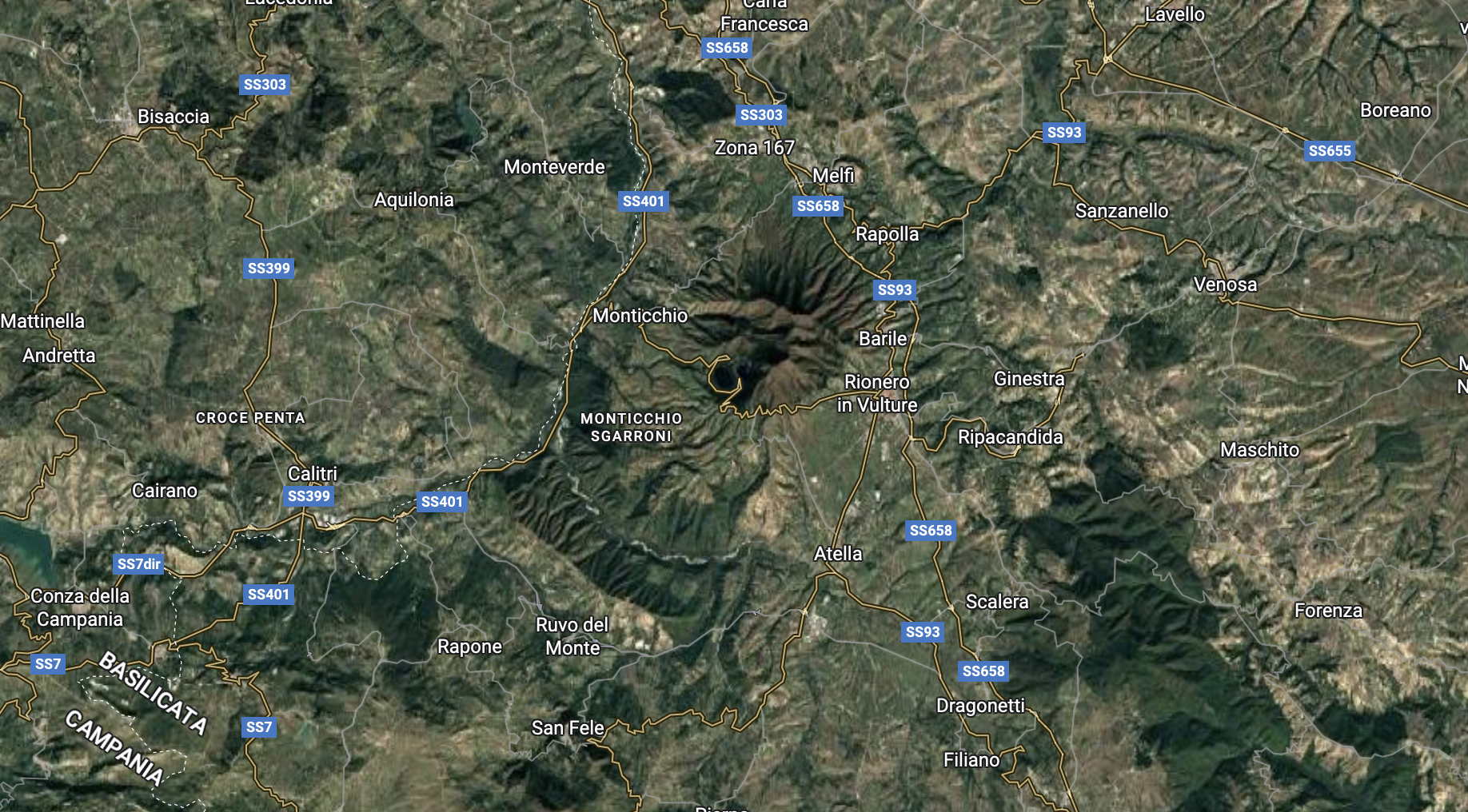
This feels like a jackpot of a testimony.
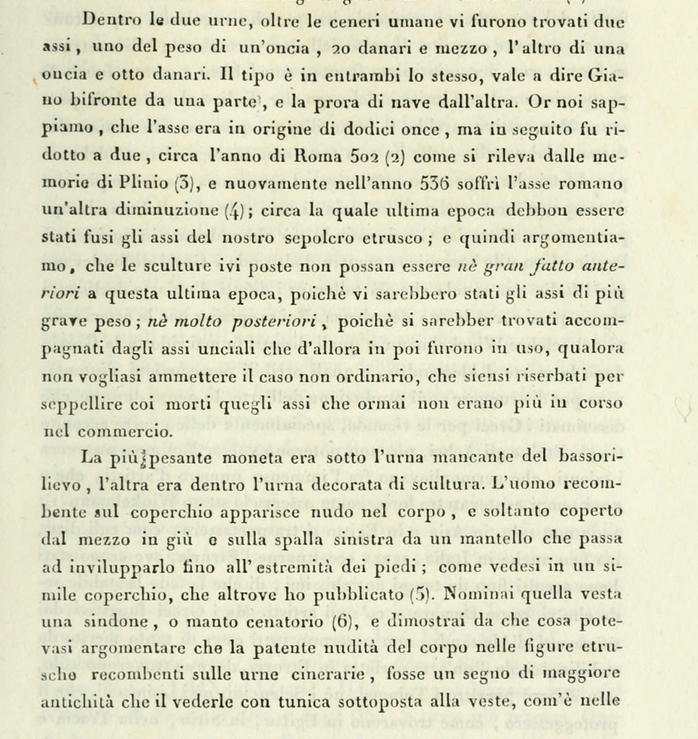
Inside the two urns, among the human ashes, two asses were found, one weighing one ounce, 20 denarii and a half, the other one ounce and eight denarii. The type is the same in both, that is, Janus bifrons on one side, and the prow of a ship on the other. Now we know that the as was originally twelve ounces, but was later reduced to two, around the year of Rome 502 as is revealed in the memoirs of Pliny, and again in the year 536 the Roman as suffered another diminution. It is around this latter period that the asses of our Etruscan tomb must have been created; and therefore we argue that the sculptures placed there cannot be much earlier than this latter period, since the asses of heavier weight would have been there; or much later, since they would have been found accompanied by the uncial axes that were in use from then on, unless we wish to admit the unusual case that those asses that were no longer in circulation were reserved for burial with the dead. The heaviest coin was under the urn missing the bas-relief, the other was inside the urn decorated with sculpture.
An uncia in 19th Century Italy was approximately: 26.73g, a denaro was 1/24 of the uncia. The heavier As weighted about 49.6g. This puts it at the tail end of the anonymous struck bronzes and right before we start to get symbols (Crescent, Cornucopia, Apex and Hammer). So we’re probably looking a coins struck during the Second Punic War but the latter portion right at the very end of the third century BCE. The lighter As weighed about 35.64. This would put it in the era where most of the asses have symbols and or initials. Dating is disputed but first quarter or first third of the second century BCE. Weights very a great deal and specimens stay in circulation a long time. Below I give the approximate find spot.
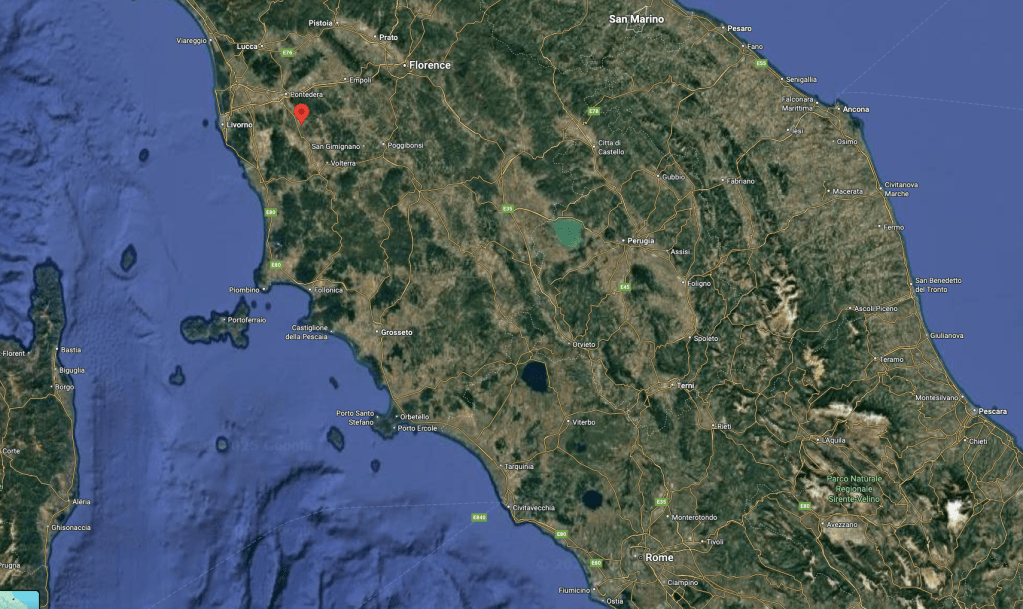
Regarding Modena!
Since April 1828, when the collection of ancient Roman marbles was decreed, not a few ancient marbles have subsequently come to public view, some from underground and some from unknown and distant places; and two more treasures, one of over a thousand denarii from Roman families in the autumn of 1828, and another of one hundred and thirty coins of lesser silver from Gordianus Pius to Claudius Gothicus, in the autumn of 1829.
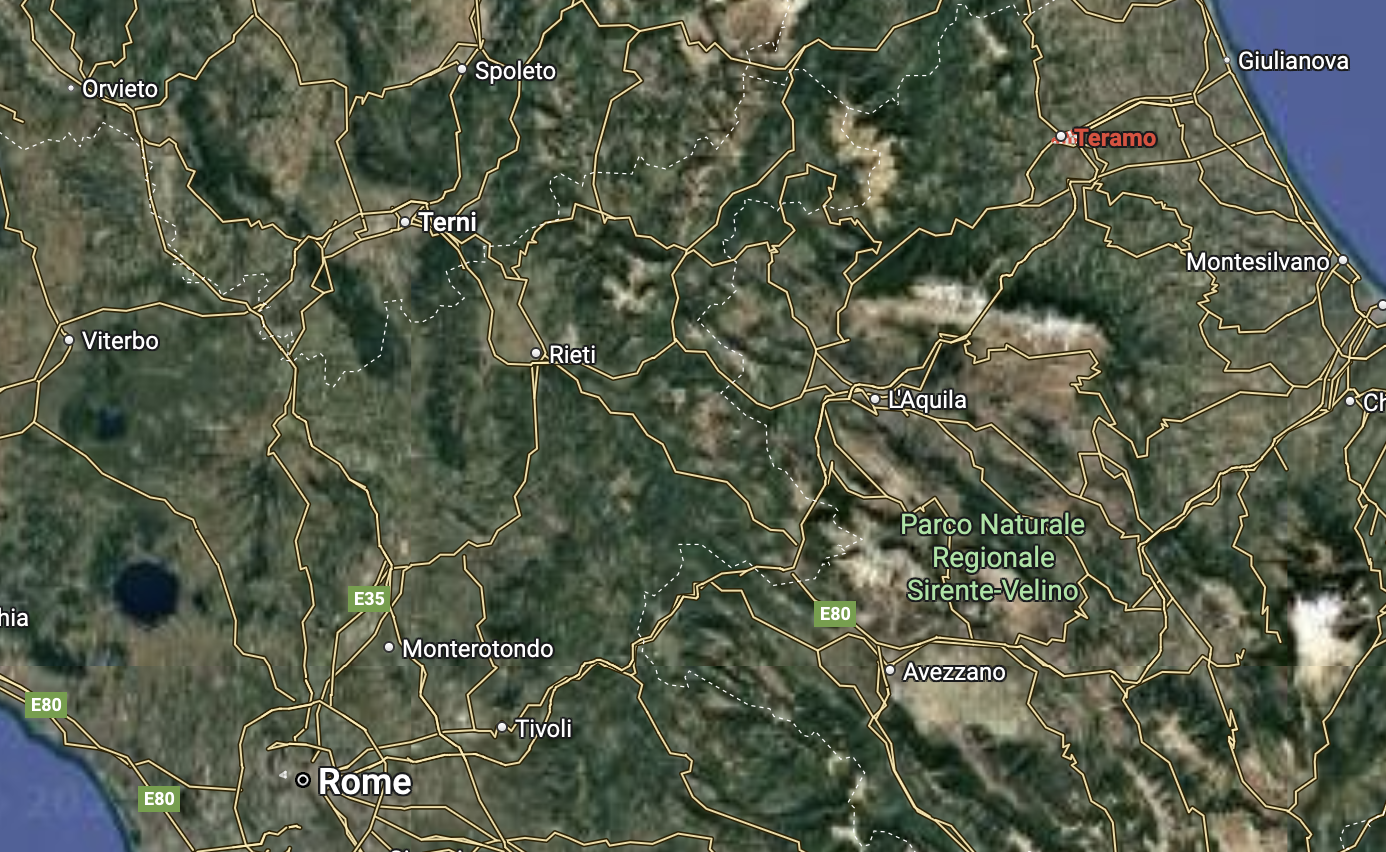
Social War hoard found in Teramo!
Teramo. In Giulia, in the province of Teramo, 1216 silver coins were found last year [1829], almost all belonging to the Tituria family, of which sixty-two of the best preserved and most valuable were purchased for the royal museum.
Gold Hoard at Capua
I forgot to mention some time ago that, while excavating the underground parts of the Campanian amphitheatre, a few months ago, 40 imperial gold coins were discovered, the oldest of which are from Augustus, and the most recent are six from Alexander Severus. Among these coins are two of great value, namely a Pertinax and a Man. Scautilla: in addition, many rare reverses. It should be noted that these coins, as they date closer to the time of Alexander Severus, are in better condition, so that those of this emperor are not only very well preserved, but still show the preserved stamp that the coins have when they come out of the die; which gives rise to the well-founded argument that the treasure was hidden during the time of this emperor. Many gold coins were also found in various places, during the excavation of all parts of this amphitheater, among which two very large medallions of the same number as those surrounded are worthy of note: one of F.L. Valentinian, the other of Anastasius, which seemed to clearly demonstrate that this amphitheater was in full use up to the beginning of the sixth century of Christ.
(i) The eminent Marquis Arditi, director of the exchanges of the kingdom of Naples, through Mr. Bonucci, has sent us the specified note of the said 40 coins and 4 medallions. They are 4 with the image of Nero, 6 of Vespasian, 2 of Domitian, 2 of Trajan, 7 of Hadrian, 2 of Antoninus Pius, 3 of Marcus Antonius, 1 of Luius Verus, 1 of Pertinax, 1 of Septimius Severus, 2 of Caracalla the son, 6 of Severus Alexander, 1 of Sabina the wife of Hadrian, 1 of Faustina the Elder , and one of Manilia Scantilla, wife of Didius Julian: 1 Medallion in bronze with the image of Trajan Decius, 1 of bronze of Valentinian, 1 coin similar to Antoninus, one small ivory head of Medusa in fine work. Both the gold coins, as well as the other objects described, were found in a corner of the substructures of the area of the said amphitheatre.
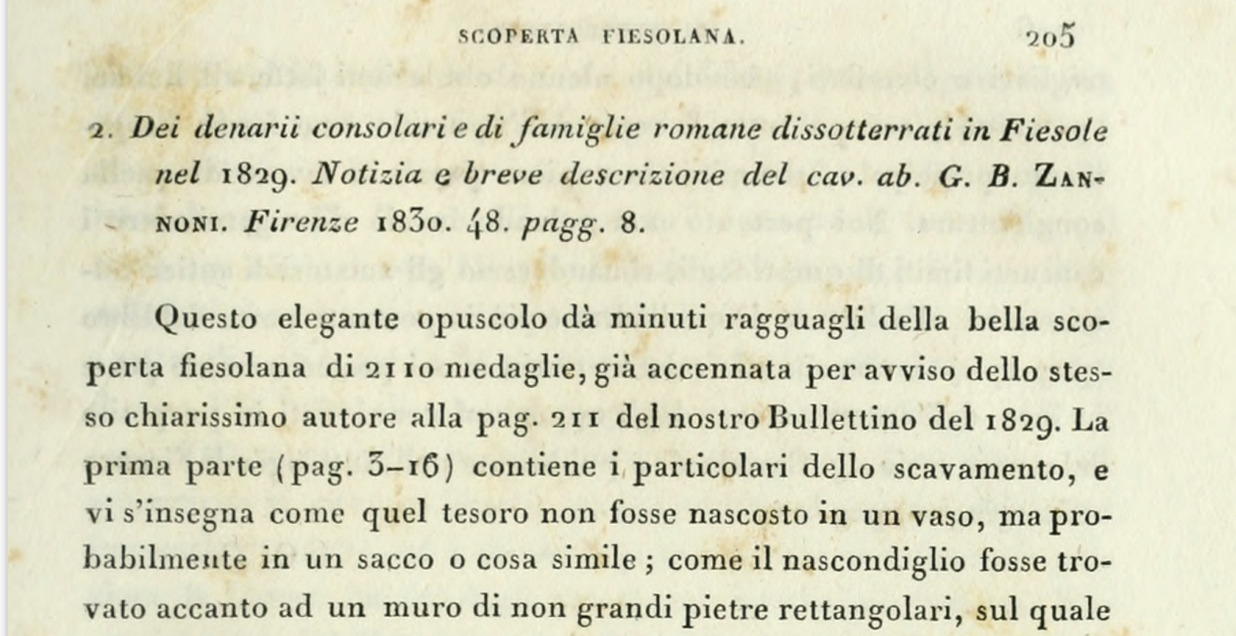
None of the numbers agree. Here is it says 2,110 coins. Crawford 1969 says of over twice the number: 2,004 denarii. Lockyear catalogues 2,006. I opened Backendorf as I often do and then put it back down as it does not have clear indices.

 Liv Mariah Yarrow