
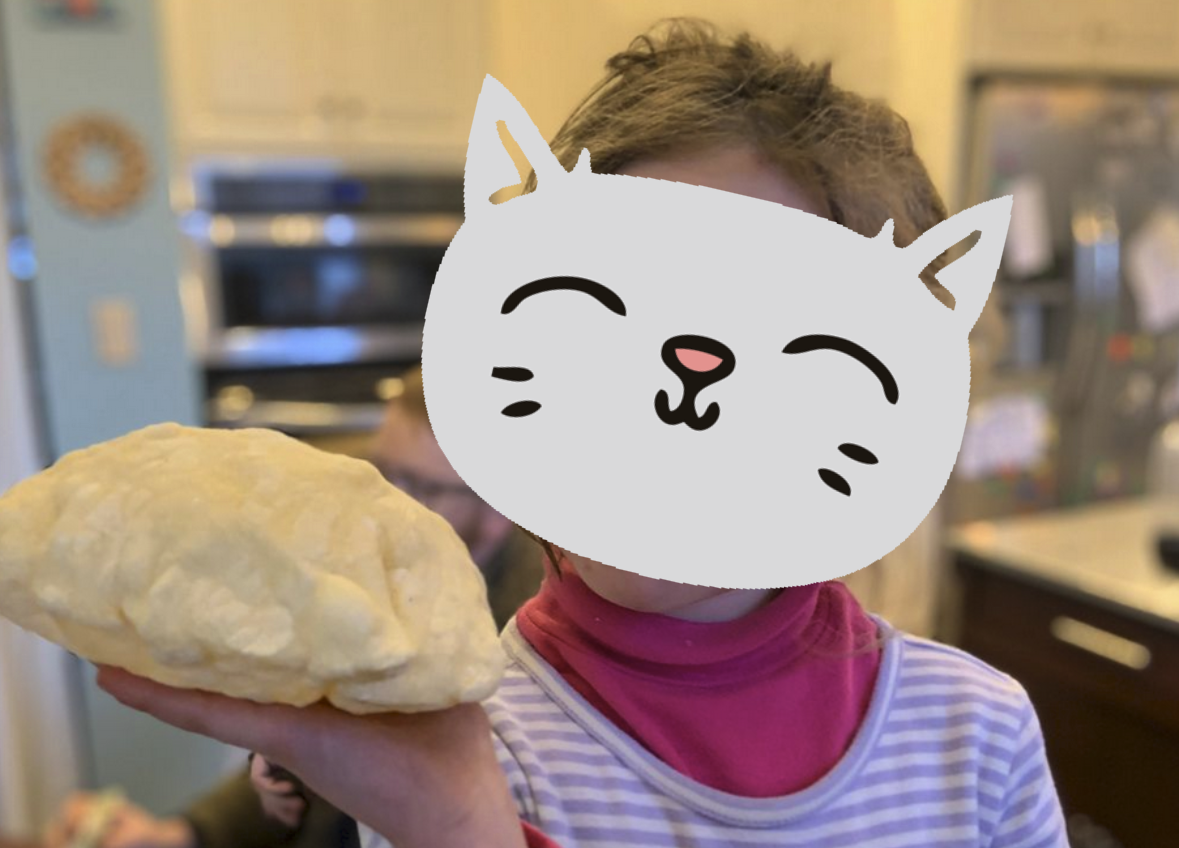
A colleague asked for my puffy pita recipe. I don’t really like recipes. They are so bossy and rigid. Where’s the story with all its beautiful digressions in that?
The amount of bread you end up with depends on how much liquid you use to begin.
Some where between 8 to 16 oz is a great place to start, so let’s say 12 oz.
Because we’re going to cook the bread v fast and v hot to hope to get a glorious puff of steam between the layers, water is our best choice, BUT if you have milk, left over breakfast cereal, stock, juice, beer, soup, or really anything, you could use it in your bread.
Time and temperature and amount of yeast all work together for final fermentation. If you start with cold water it will go slower. If you start with warm water everything goes faster from the start. Don’t go over 115 degrees F. I usually aim for 110.
Stir in a few spoonfuls of flour into your water and if you feel like adding a spoonful of honey or sugar go ahead. The liquid should look milky and smooth but still liquid, not too pasty.
If you have all day or overnight try a 1/2 to 1 teaspoon dried yeast. If you’re on a deadline of 2 hours or so go with a full tablespoon and be sure to use warm water and a little sugar boost. After you stir in the yeasty beasties you must wait for them to wake up. (or not, if you have all the time in the world and just want to mix and forget).
As they wake up they start belching their lovely gases and bubble and foam gather on the top. 15 to 30 minutes is a good estimate on how long to let it develop, but if you get stuck on a work call or lost in a good book for a few hours it will be fine, perhaps better for being ignored.
The ambient temperature matters a great deal at all the waiting stages. If you live in a hot NYC apartment just leave it on the counter. If you live in a drafty old house you can stick the bowl in the microwave (don’t turn it on!) and it will be well insulated, or, my personal favorite, is to put water in my instant pot and set it to the yogurt setting and rest the bowl on top. Your oven might even have a yogurt setting you can use.
Now we feed and exercise our yeasty beasties. I use a stand mixer with a bread hook, but this is just for ease.
I start the mixer at the lowest setting and then start adding flour rather slowly maybe a 1/2 cup at a time. When I’m at the pasty sticky stage, before it wants to come together in a ball, I add in a few glugs of olive oil — at least a tablespoon not more than a 1/3 cup. This is optional, but delicious. And, more salt than ever seems reasonable. If you started with a full two cups of water, give it a generous full tablespoon of salt. It won’t be too much. If you’re salt-phobic add at least a teaspoon even for just one cup of liquid. Salt makes the bread taste better but also inhibits the yeasty beasties growth, thus we let the beasties get a head start before we add it in. Keep adding flour and wait for the dough to form a ball and start thunking around the machine. Slowly continue adding flour until the sides are mostly clean.
Now watch as the machine keeps kneading the dough. If you like precision set a timer for 4 minutes. Turn it off. let it rest three minutes. Turn it on again for three minutes and call it done.
OR keep inspecting the character of the dough. The yeasty beasties are helping the gluten stretch into long smooth chains. The dough should not break and should become far less sticky. It will become smooth and elastic.
Now after all this work the yeasty beasties need a rest someplace warm. (or in the fridge over night or just on the counter if you want to ignore them for a long time)
Come back after an hour or two and peak. If the dough is doubled, punch it down.
If you have time, wait another hour or two and punch it down again.
Double rising really helps the dough mature and the yeastie beasties to release their gases throughout.
Did you forget your dough and let it rise too much and did it collapse? NO PROBLEM! put some flour on the counter scrape the dough mess on to it. Fold it a few times tenderly and tell it you still love it. Promise it you’ll check on it in just an hour or so. When it looks happier, you may now continue.
After the last punch down it is time to prep the oven.
You need the hottest oven possible and ideally a very hot cooking surface. My oven isn’t very good. It barely wants to hold 450 and rapidly loses heat when I open the oven. So I bought some oven bricks. When I make pita these go in the bottom of the oven to help with heat retention through the baking process. You vould also use your old cast iron pans in the bottom of the oven to help with heat retention. Add your pizza stone or iron griddle on to a middle baking shelf now. Cast iron pans will also work for the pita cooking surface, but less well than a stone or a griddle. Put your oven on its highest setting and let it all heat up.
Divide the dough into an even number of pieces each the size of a small clementine. Form the pieces into balls by pinching the loose edges together until the outside is completely smooth.
Ideally you now leave these little balls to rest a bit more. Maybe 30 to 40 minutes, but I am usually too impatient and they only get the time I spend on forming the other balls and waiting for the oven to heat.
On a lightly floured surface roll each piece as flat as you absolutely possibly can. The stretchy dough will spring back. Sometimes I roll them all out and then go back and give each piece a second roll right before it goes in the oven.
Your goal is to get that piece of flat dough onto the hot stone or griddle in the oven as fast as possible while loosing as little oven heat as possible. Having someone open and close the oven door for you can really help.
Ok now you have one or two in the oven. Turn on the oven light and watch. They should puff. It starts with a few bubbles and then all the bubbles grow together. Once you’re sure it has stopped puffing. Get your tongs and quickly open and v v gently flip the bread. (Some people just give it one more minute and no flip.)
Give it a moment longer and then pull it out and eat it straight away.
I tend to serve dinner in the kitchen on nights I make pita and get the whole family involved. The kitchen table is filled with lots of little dips (hummus, labneh etc…) and salads to eat with the pita.
Dammit I’m hungry now.
And remember even without any puff, fresh baked flat bread is still delicious.


 Liv Mariah Yarrow