
This particular mosaic from Piazza Armerina has been the most sticky in my brain. And I hope writing about it will help.
The mosaic is located at the star on this public domain site plan from wikimedia. This set of rooms is sometimes considered private family quarters. The dating of the mosaics are disputed but definitely no earlier than the tetrarchy and perhaps even mid to late 4th century. As I learn more I’m sure I’ll have more opinions.

So let’s start with good old fashioned visual description.. There are five registers summarized as as follows. I’ll treat each in turn below.
(A) in the Apse two seated women making flower crowns
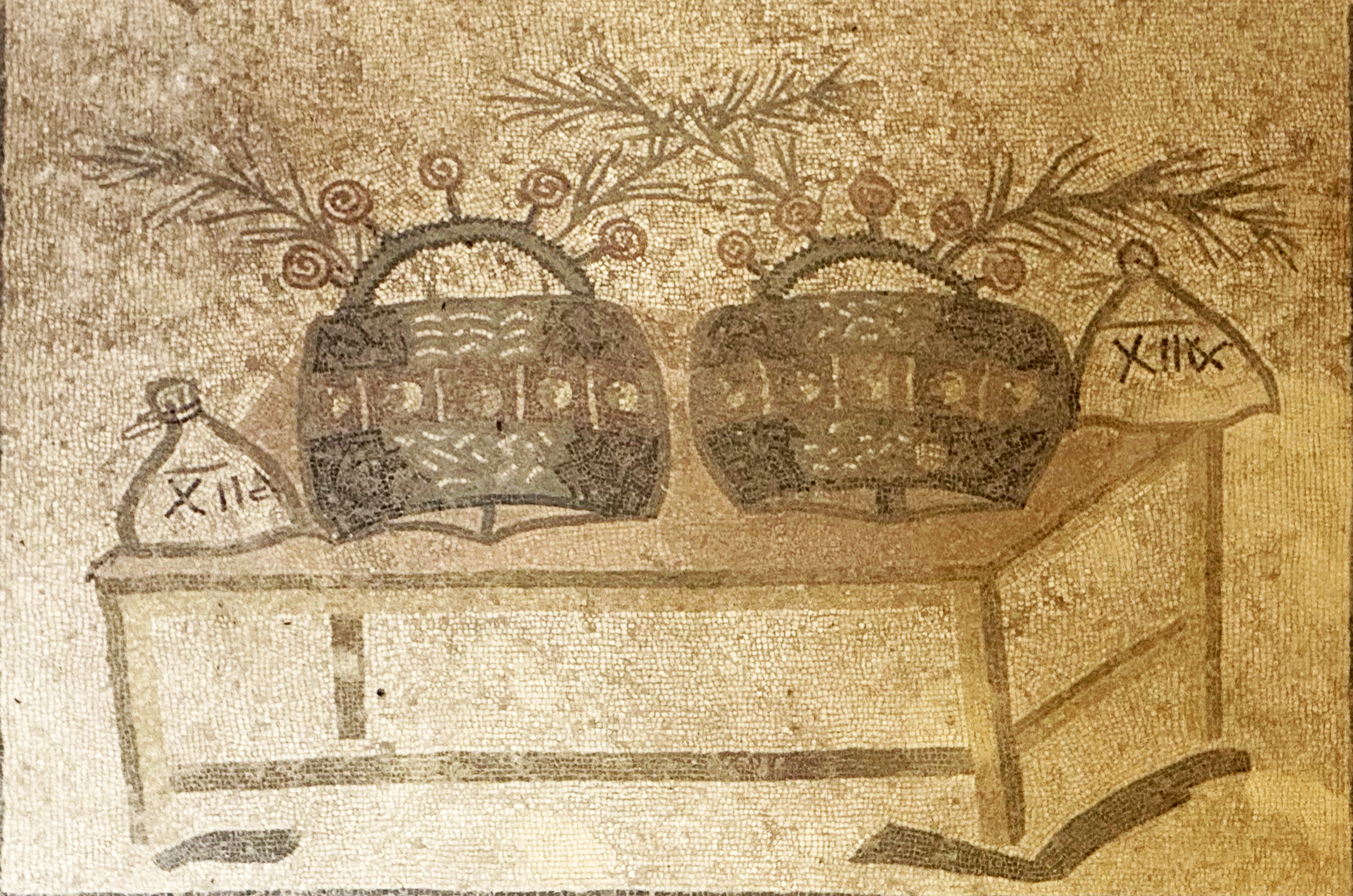
(B) The narrowest register between the columns a prize table
(C) Five standing male figures with musical attributes
(D) three standing figures, two inanimate objects, two more standing figures
(E) Three obscured (figures/objects), an inanimate object, two standing figures
Taking them in order. The photos used here (unless otherwise attributed) were taken by myself or my beloved. I’ve used Photoshop to de-skew the angles using rectilinear elements within the images themselves (i.e. the mosaic borders). I’ve also sharpened contrast to make details easier to observe.
Register (A)
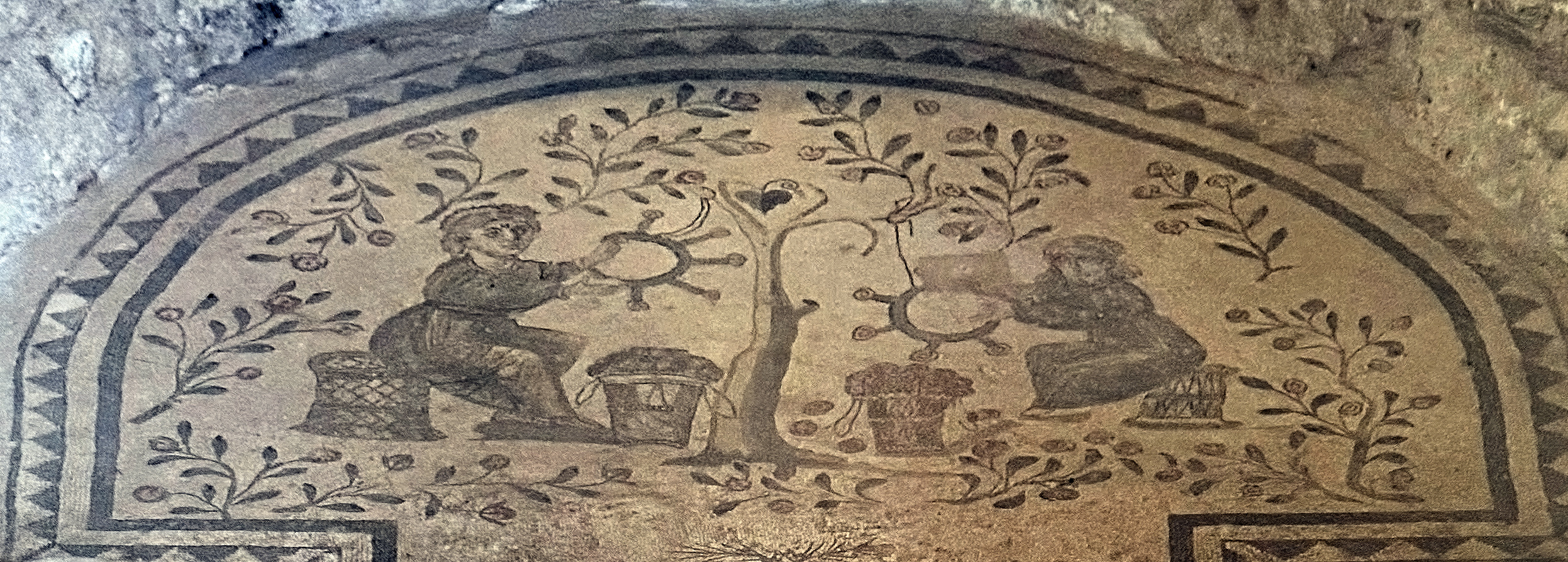

At first glace the image is one of pleasing symmetry but in every detail the artist(s) break the perfection for heightened naturalism. The ‘tree” trunk curves left, and has only one broken branch on the left, on the right there are three all smaller than the one on the left. The right root is shorter than that on the left. A single heart shaped leaf is framed by the fork of the two upmost branches. It connects to the top of the left branch but has a vine-like spiral pointing to the right. From a branch on each side of the tree a crown is tied to support the work of the seated women. The left hand crown has a thicker or double band connecting it to the tree branch. The right hand crown is tied with a single line but wee can also see the short tail of this string as it is knotted around the branch.
The body postures of the two women echo each other nearly exactly they’re furthest legs are bend back, their form post legs come forward. Their further hands hold their respective crowns and their foremost hands reach out to each other and they seem to make eye contact. Here the similarity ends they’re garments are different colors. The left figure has a prominent belt and headband; the right figure a necklace. They seem to have different shades of hair, but of this I’m less confident. Their hair styles are clearly different, but they both have the v mark between their eyebrows.
Each woman sits on a stool that appears to be woven. The left hand stool has a checker or crisscross pattern, the right hand a zigzag. Both have a central band and a slightly flared top and bottom. Probably because (I would assume) this is the basic construction of such stools. Their flower baskets have similar minor differences, while still sharing the same basic conical form with two broad bands, narrow, bottom, top, and middle bands and two loop handles on either side. The contents are represented as two rows of flower heads the top being narrower than the bottom. The left basket has as its top band of its body a broad zigzag, the bottom is checkered or crisscross in pattern. The right basic has a narrow zigzag for both top and bottom body bands. The color and shape of the flower contents seems slight different. The top lip of the right basket is slightly broader. The right basket has a few flower heads scattered around it and a long shadow; all elements missing from the left basket. The scene is surrounded by irregular branches with leaves and flowers. Perhaps we are meant to interpret the branches as recently pruned fro the central tree? The leaf shape is different between the branches (ovoid) and the trunk (heart-shaped), but perhaps the heart shape is to remind of of evergreen ivy and indicates the tree is not truly dead, only hard cropped for the season.
The closest comparanda for these images within the villa itself are shown below. In the top register short squat female figures with v-shaped forehead markings pick flowers. In the next register down has taller more slender females with out forehead markings. The left hand figure makes flower garlands rather than crowns but the garlands are hung from a pruned trunk clearly meant to be the same plant from which the flowers are harvested. The trimmed branches seem to lay between the seated woman and the garlands she constructs. The composition shows similar tendencies towards ‘false symmetries’.

Register (B)
Before visiting Piazza Armerina IRL I had already talked about some of the mosaics on this blog. Particularly how the prize table depictions can help us better understand numismatic imagery.
This table holds from left to right:
(i) a money bag marked with an XII with a line above and another symbol perhaps something like a lower case “d”
(ii) a large prize crown with a middle band in a different color decorated with circles and vertical lines in another lighter contrasting color. From the top of the prize crown rises a flower crown with five flowers depicted as red and white spirals, these closely echo the crowns with five flowers similarly depicted in register A. Two palm fronts also emerge from the crown.
(iii) the same with minor variations in the depiction of the top and bottom band of the prize crown.
(iv) a money bag marked XIII with a line above followed by another X.
How do we interpret the numbers on the bags. A good question. I’m not fully satisfied I know, but I’ll build on what I said in my earlier post. The line above multiplies by a thousand. So the left bag might read 12,500 if the symbol to the far right is a lower case D and is also roman numeral. There is no indication of denomination as in the other prize table discussed in the other post. If this interpretation is correct, then the right hand bag could be 13,010. These seem random numbers and maybe they are just that, random numbers the artist(s) made up for decoration.

Register (C)

Register “C” is not a well preserved but is still better than most. Each of the five figures is somewhat distinct and thus we will describe in turn left to right before considering the composition as a whole.
(i)
The first figure is all in white. The top garment is worn over tunic with broad stripe visible on his right shoulder. The top garment is likely a toga but I hesitate to confidently identify it as such. The bindings on the sandals reach almost to the bottom of the drapery. On his head is a crown with five protrusions, likely flowers. The crown, like the palm frond in his left hand, echo the iconography of the prize table above, even as the flowers are not the same shape, color or pattern. The figure raises his right hand palm up in a gesture often associated with oratory/declamation. V mark is clear on the forehead. The body proportions are squat almost childlike.

(ii)

The second figure might be female. The damage on the top of the figure makes me hesitate. I see no long hair and no breasts or typically female jewellry. The feet a fully slippered and the garment consists of at least three pieces an under garment in reddish tones, a darker bluish over garment and a reddish cloak. The lighting and the dust and photography makes me hesitant to say anything much about pigments. Again the forehead V. The hair is largely obscured by damage and what seems to be a crown of overlapping leaves or leaf shapes with a center circle medallion.
The stringed lyre-like instrument rests on a small table. The bottom of the instrument rest flat on the table top and is shaped almost as an open book with its fan of leaves on each side. There appear to be four strings but I am not confident–they’re could be more. They attach to long almost triangular pegs protrude down from the top bar. The top of the bar is smooth and each end has a ball. The two side arms seem to curve slightly towards the player and widen as they join the odd shaped base. We see the instrument resting at an angle on the table by aid of a small black support. The player has both hands on the strings. One in front one in back like a modern harp player. There is no suggestion of a plectrum.
(iii)

This figure kinda kicked off my obsessive need to interpret and better understand this mosaic. His crown looks like pipe organs. I love pipe organs in antiquity but find it odd I’ve not posted much about them on the blog. They appear in this past post because of the manual bellows. Basically I looked at this guy and asked why were the pipes on his head not on the table and the stringed instrument being held by hand. Lets say the object isn’t even an organ (lots of images below), but instead just upside down pan-pipes: WHY on the HEAD! He touches his head with his left hand in a gesture of self crowning. This type of gesture is completely normal for athletes even if it is more typical for them to crown themselves with their right hand than their left, we do have left handed parallels (RPC examples; as well as examples from the athletes in the mosaics from the Baths of Caracalla now in the Vatican).
His empty right hand is held out in a waist level palm up gesture. It is a gesture often intended to indicate the importance of something. Is he gesturing to the table and its odd use as a stand for the stringed instruments where we might expect to see his pipes resting? Yet his isn’t suggested by his gaze which seem to be offer to his left.
Is this meant to be funny? They are all rather stocking figures with the V s on their foreheads. Are they imitating common activities but doing them just slightly wrong for our amusement? I lean toward no but I will keep the theory in mind.
In dress he echoes the first figure (i). Mostly white with just a few details. A garment draped over his left shoulder revealing an undergarment (tunic) with a stripe on his right shoulder. This tunic appears to have long sleeves with broad dark cuffs. There is a dark decorative circle in the bottom left hem of his garment. His sandals are much less elaborate in their strapping and lower as well. His legs are bare between the sandals and the hemline.
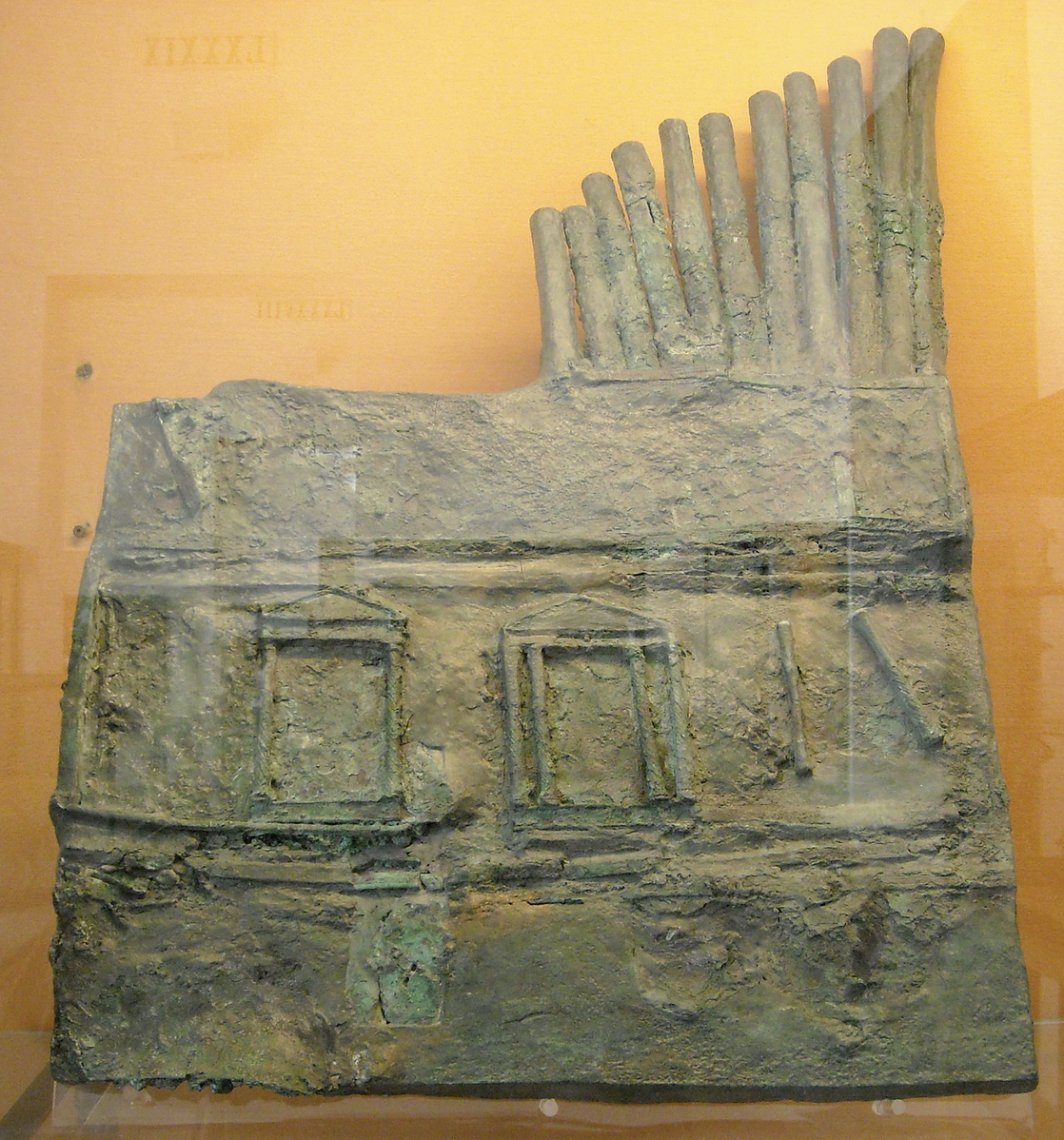


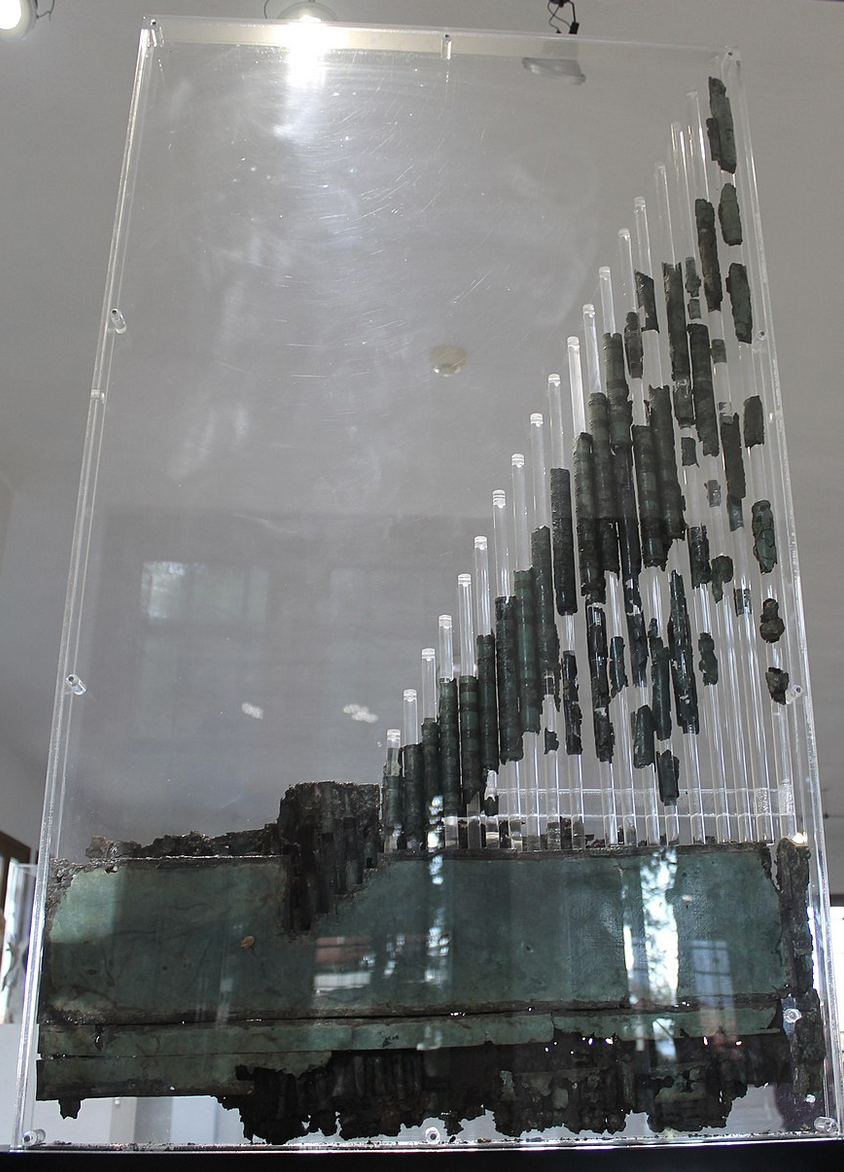

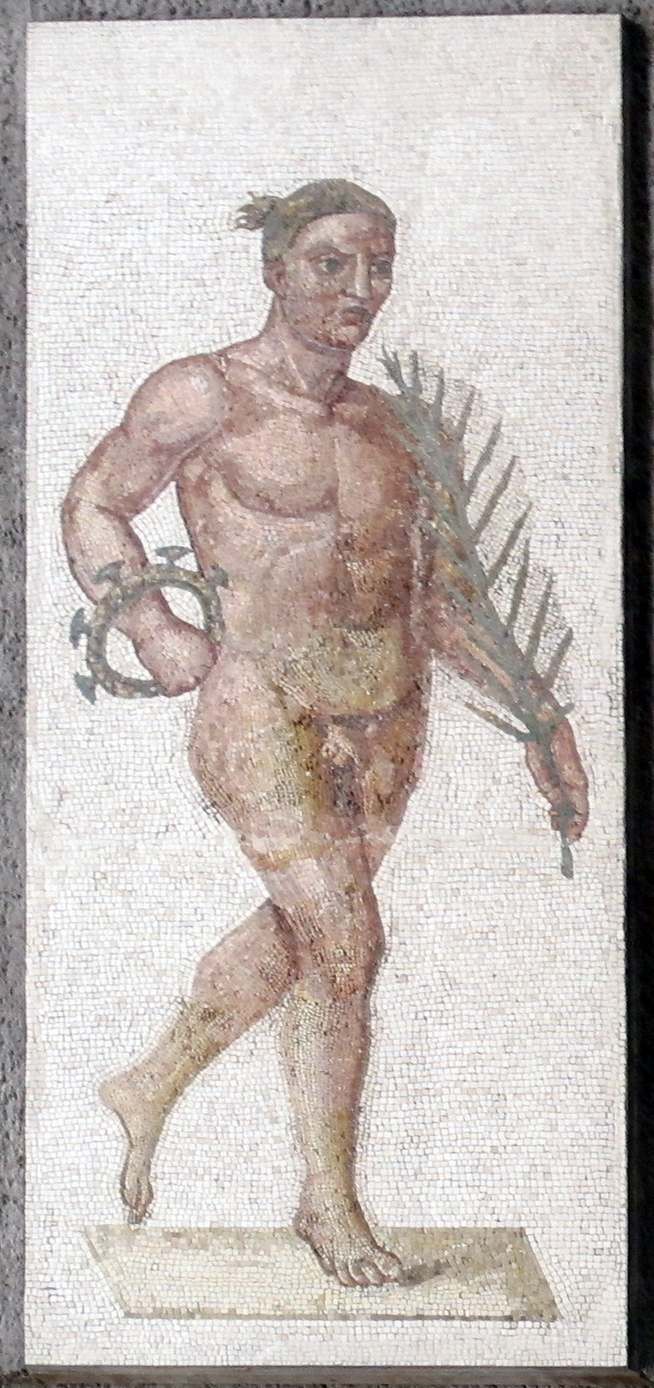
These athletes from the baths of Caracalla show the five pointed crowns and palms as contest prizes. The left figure also demonstrates an act of self crowning.

(iv and v)
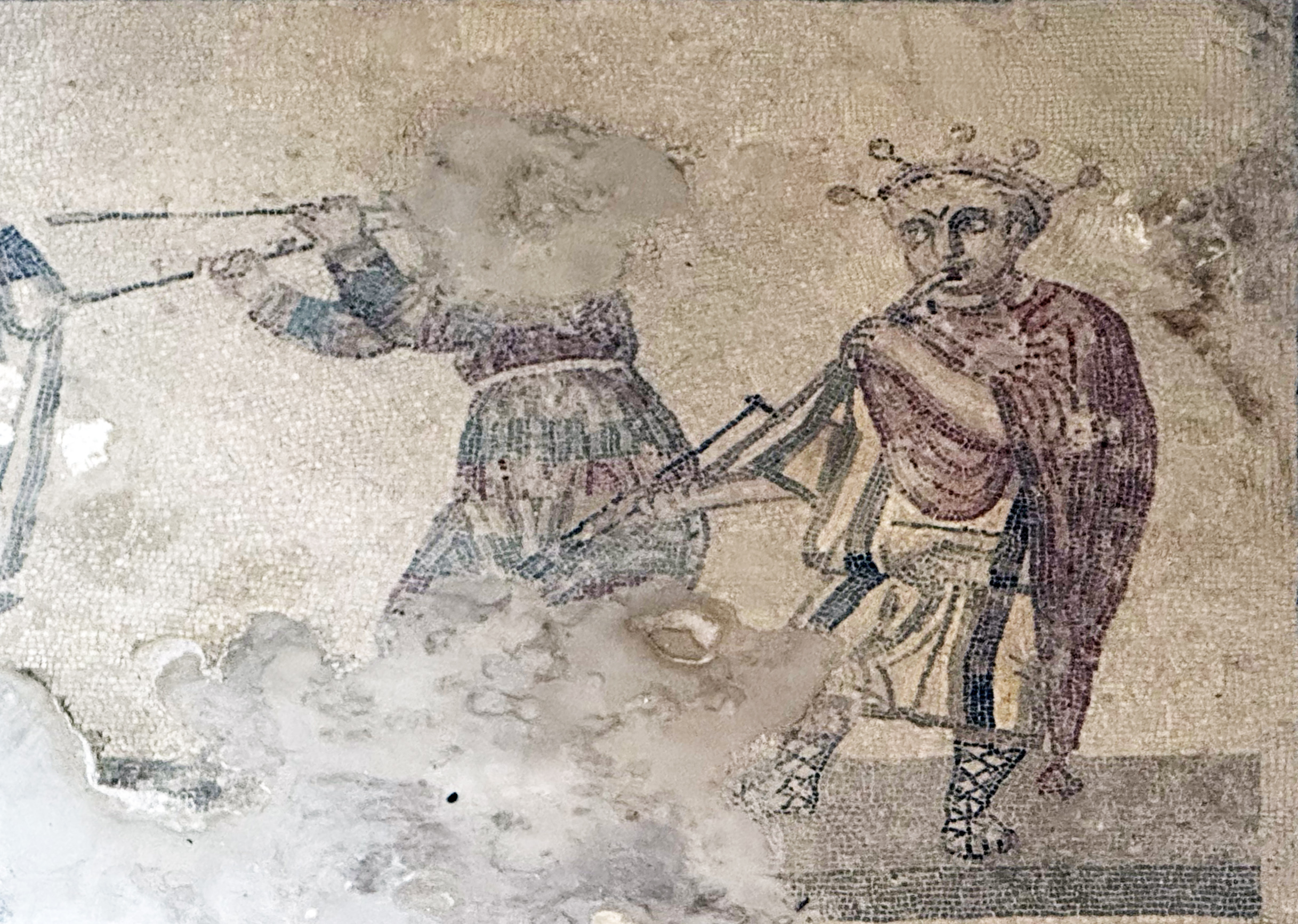
Figure iv may be female but beyond the high waist-ed, long sleeved horizontally striped dress there is little remaining of the figure to allow us to be certain. The figure plays the double auloi (flute) with raised elements along the shaft (cf. reference images for RRC 412/1, no. 127)
Figure v is clearly male he wears a double striped white tunic belted low on his waist. A reddish cloak covers his shoulders and hangs down on his left side ending in a tassle. His sandals or boots come up almost to the hem of the tunic and the strapping pattern is even more dense than on figure i. Like figure i he wears a five pointed crown, potentially represented flowers but not depicts in the same manner as those in register A or B. Again we have the v on the forehead.
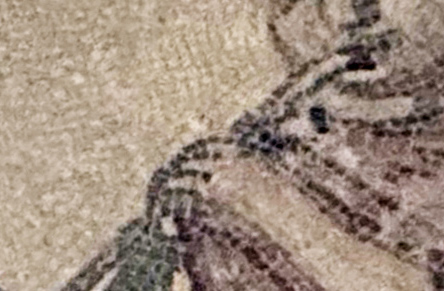
The instrument is curious and I do not have good parallels. I give close up images of key details below. The mouth piece seems distinctive. This is common enough on depictions of single wind instruments (cf. reference images for RRC 412/1, no. 20). The player’s left hand uses an over hand grip or fingering close to the mouth piece, while his right hand uses an under hand grip or fingering much lower on the instrument, such that his arm is almost fully extended and there is only a slight bend in his elbow. I’m most curious about the black bar on the top of the instrument. What is its function? I’ve never seen a wind instrument with this feature. Could it be a slide of some sort?! Did that exist in antiquity?
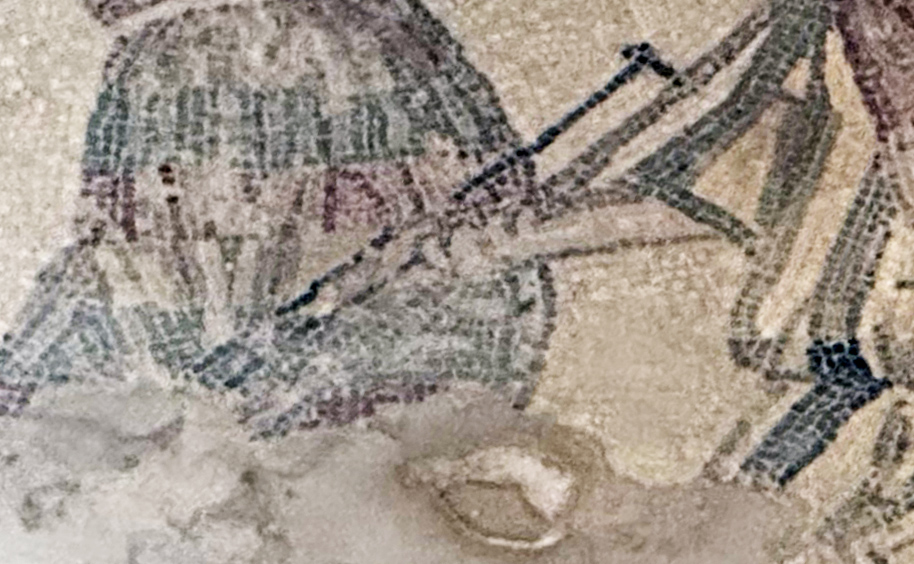
Perhaps the best parallel for these two figures are the figures from the Patras mosaic below. The far left figure seems to play a wind instrument with a similar elevated linear element near a female figure (right most in this cropping). The figure in the middle may be a judge. He could be equivalent to to figure (i) in this register.

Stepping back how can we see the five figures as a group belonging on a single register together?
I’d read this composition and three men and two women. All the men wear striped tunics. While none of the figures is identical they closely echo each other from the outside in, again using principles of what I’ve been calling false symmetry. So the two outer most figures both have the five pointed crowns and tall extra strappy sandals. All the male figures extend their right arm but the elevation of the hand decreases left to right. The two female figures face inwards helping direct our focus to the mirroring center of the composition. their hands are closer together with arms bent and raised to about chest height. The harp on a stand and the crown of pipes are the historically strangest elements but they nicely visually echo each other as linear inanimate objects on either side of the center point of the composition.
If we had to describe the scene we might say these are winners in a musical competition, if we allow the right hand figure to be a singer. Otherwise we may call them competing performers to be more generalized.

Further reference images


Register (D)

This register has three figures (i, ii, and iii), two inanimate objects (iv and v) and two further figures (vi and vii). Again we’ll describe each as they can be seen in their presently heavily damaged condition.
(i and ii)

These two figures are dressed in near monochrome dark collars. Each may have a darker narrow stripe running down from each shoulder. The left hand figure has a white narrow line as if the dress is belted under the breasts. No hands are visible but seem to be hidden within voluminous sleeves. There may be traces of longer hair on the right hand shoulder of figure (i). A single slipper on the right hand foot of figure (i) peaks out from the floor length garment. The head is turned slight upwards and towards the center of the composition, even with the damage at least part of the forehead v is visible. Figure (ii) is badly damaged but clearly stands just in front of and to the left of figure (i) and they are too be considered closely related.
(iii and iv)
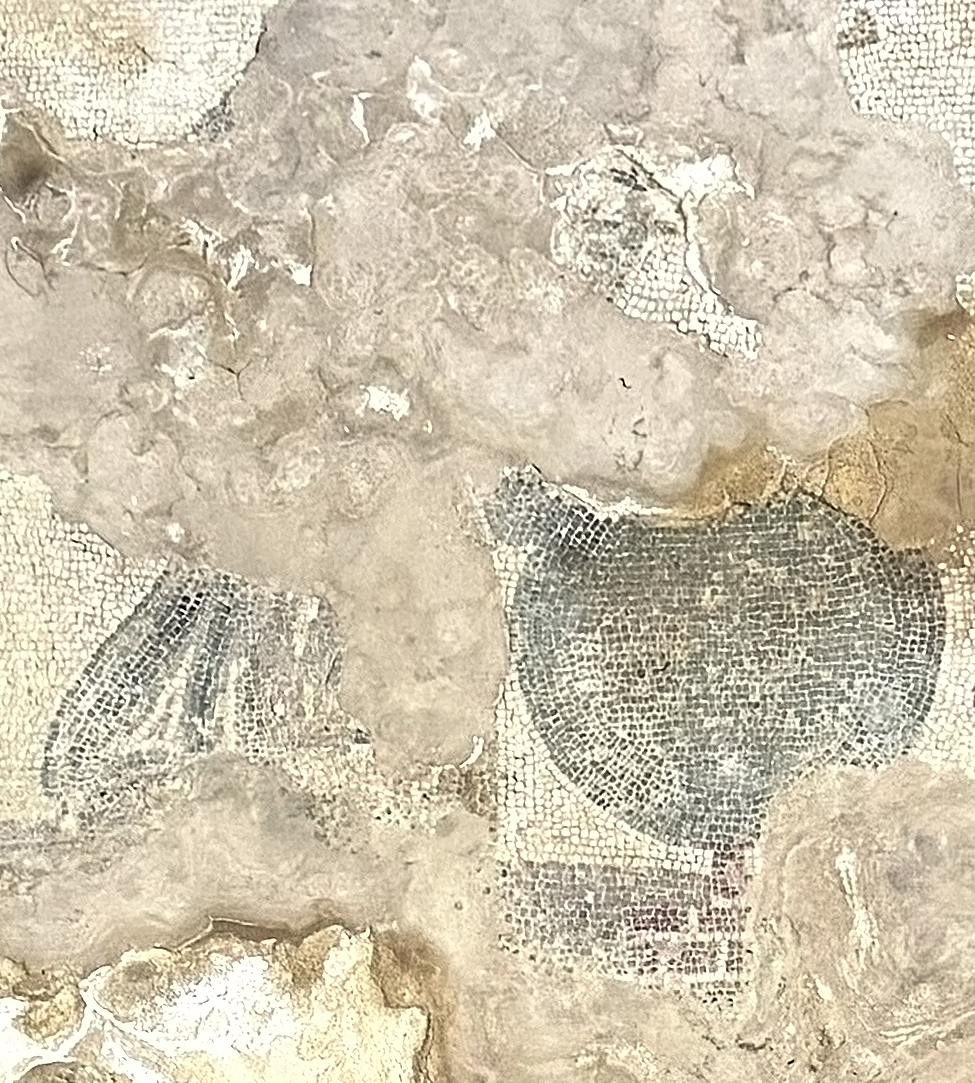
All we have of figure (iii) is a small section of their billowing garment of a similar shade to the figures (i and ii). The billowing suggests movement towards the center of the composition and perhaps interaction with object (iv). The top of object (iv) is also lost as is a little of the bottom right hand corner. The basic shape is of a rather round bellied amphora, notice the circular handle visible on the upper left corner of what remains. It rest on a narrow pole merging from a pyramidal base of a reddish color seemingly made of rectilinear blocks (bricks? stones?). A similar more elaborate base is visible in register E and will be discussed below.
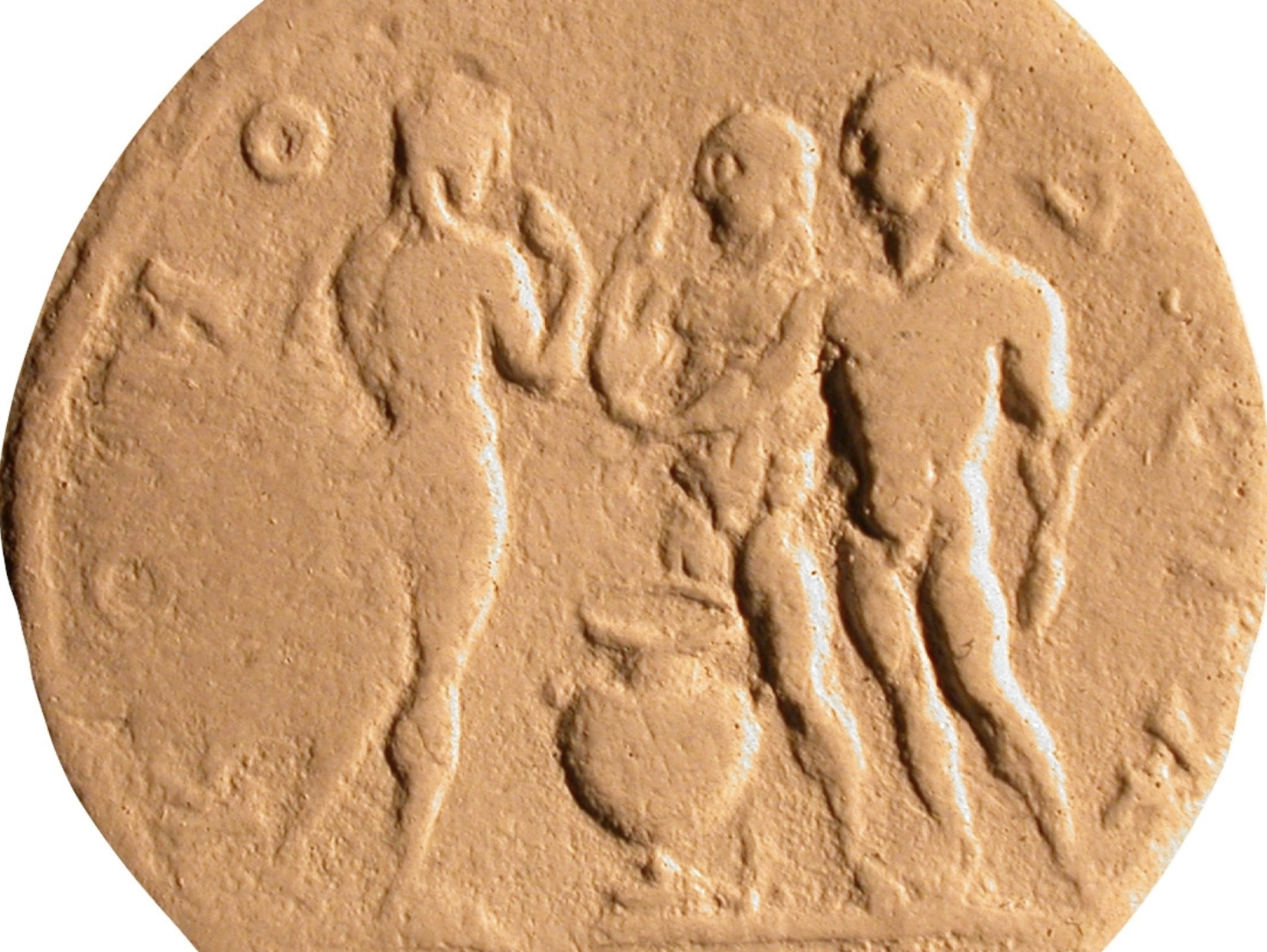
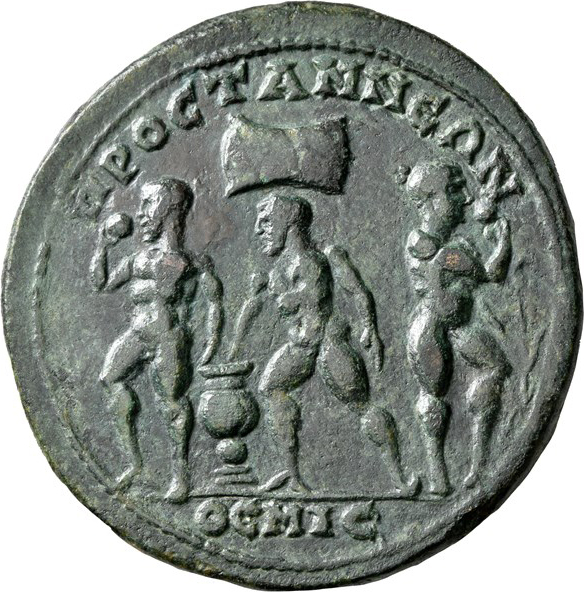
Amphora are often depicted near prize tables. See below for the mosaic from Patras and further discussion of it. When on the prize table they are often interpreted as prizes themselves — think of the Panathenaic vases from centuries earlier. However, amphorae were also used for sortition or drawing lots to decide in a fair and random manner the order in which individuals were to compete and perhaps even who would be matched with whom in some instances. From the time of Commodus onwards we find the motif on Roman provincial coinage primarily from Asia Minor. Three figures is the most common depiction. But we have one instance of a man looking away as he sticks his hand in the vase to draw his lot.
I propose that we have a similar scene of lot drawing ahead of competition in this mosaic. Figure (iii) draws.while Figures (i and ii) observe in the interests of fairness. While this type of drawing for lots is best attested for athletics, we also know that a different randomization of order was used in the circus (past posts). The Patras mosaic to which we will return below provides clear points of commonality between athletic and artistic competitions.

(v)
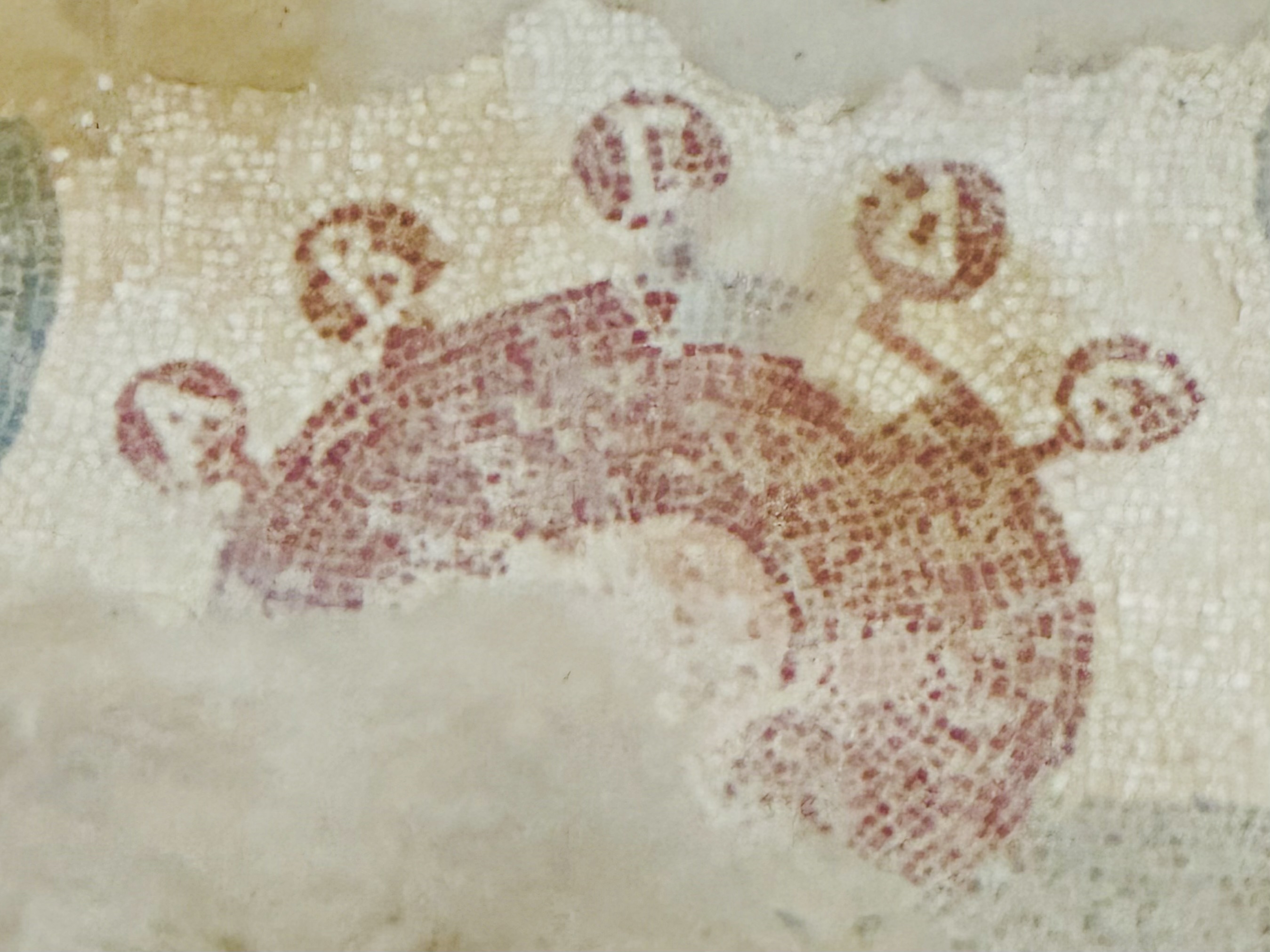
Object (v) is the other major oddity which sparked my deep interest (obsession?) with this mosaic since our visit last week to Piazza Armerina. A red ‘donut’ with five circles radiating out from the top half with the letters A, B, Γ, Δ, E. I failed to get a copy of the label on the site, but I’m positive it suggested these were musical notes and possibly an instrument. This cannot be right. Musical notation worked on different principles and this resembles no known instrument.
Our best clue is that another such object is depicted in register (E) and it like the amphora, object (iv), rests on a tiered stand made out of blocks.

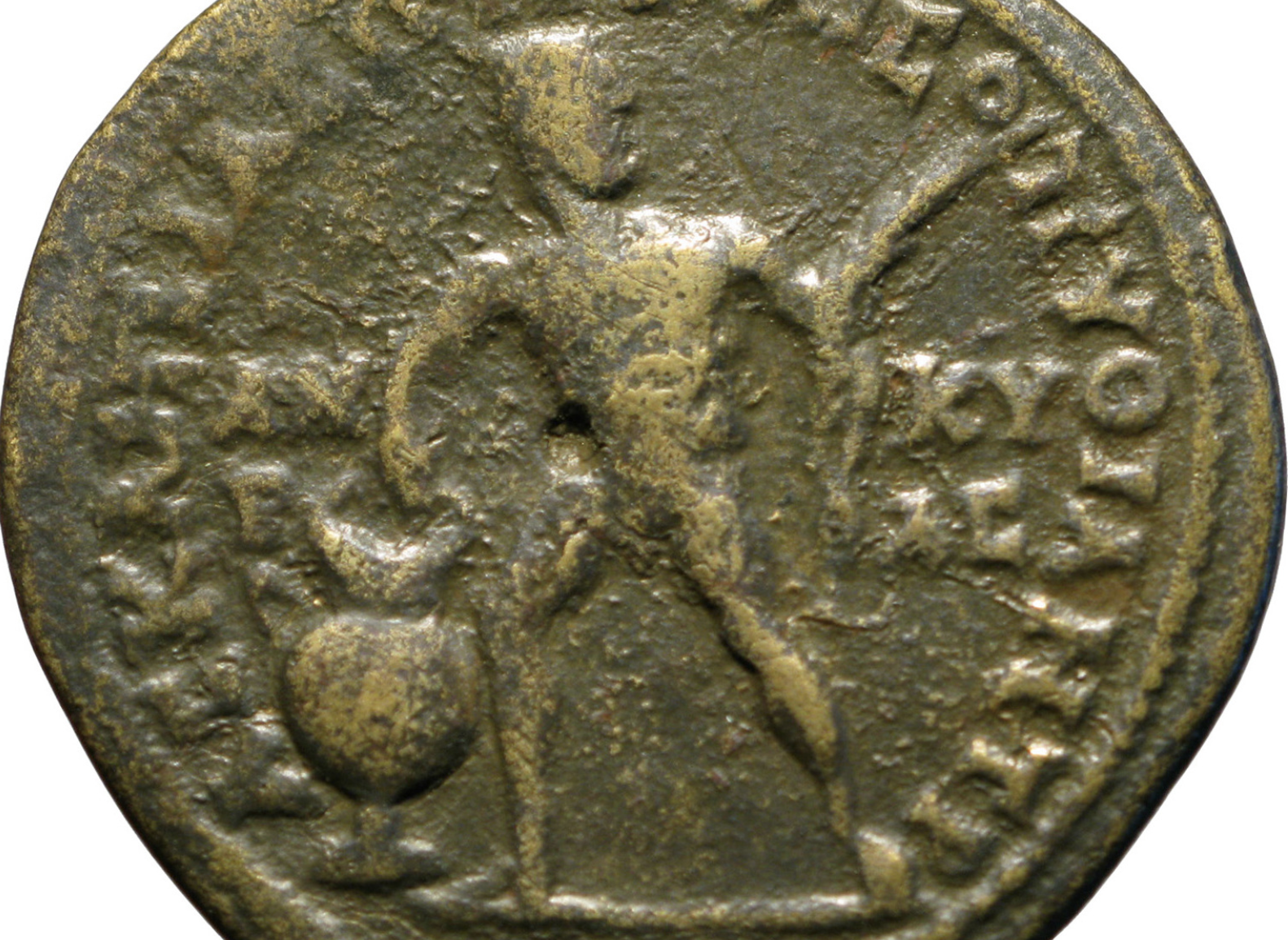
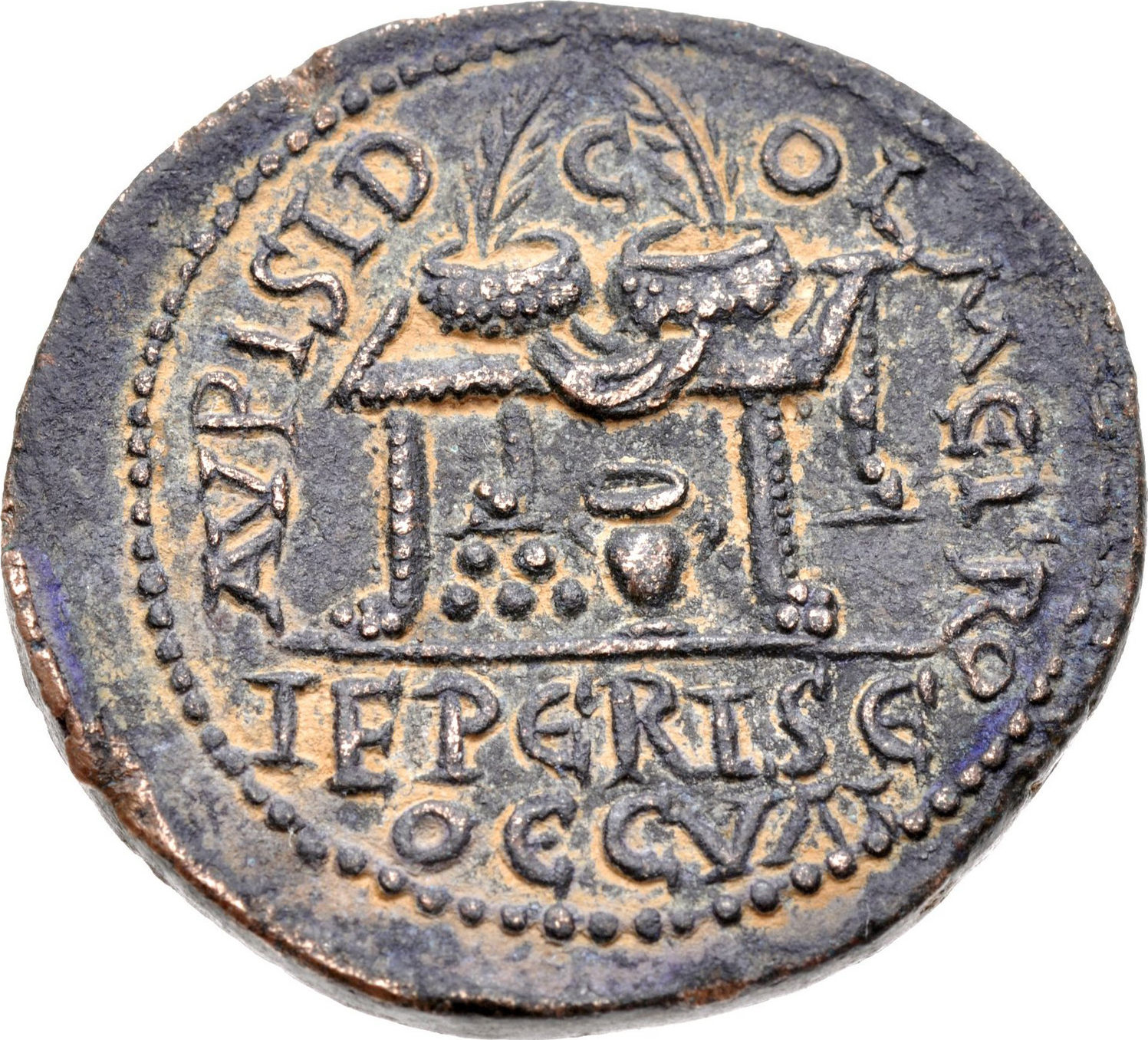
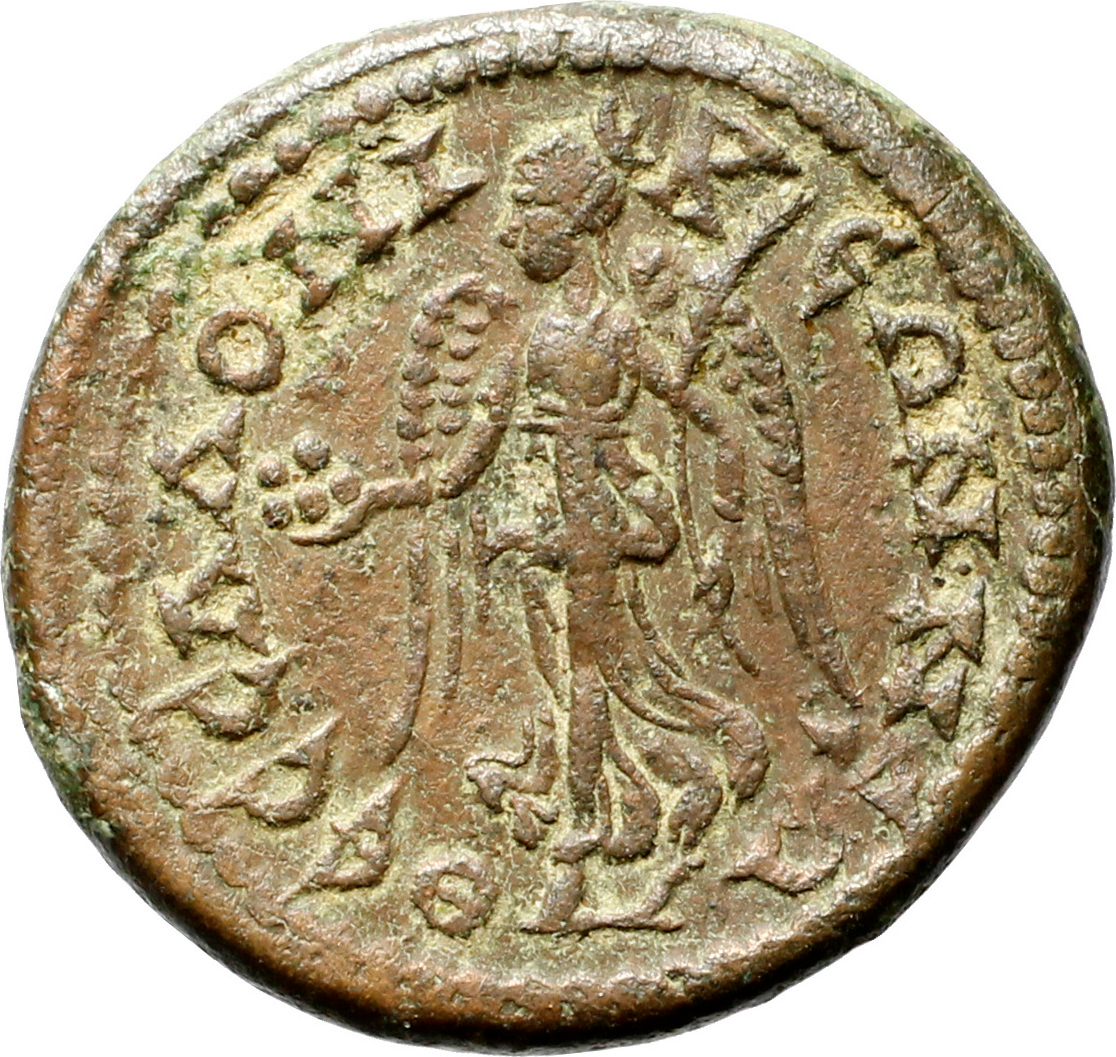
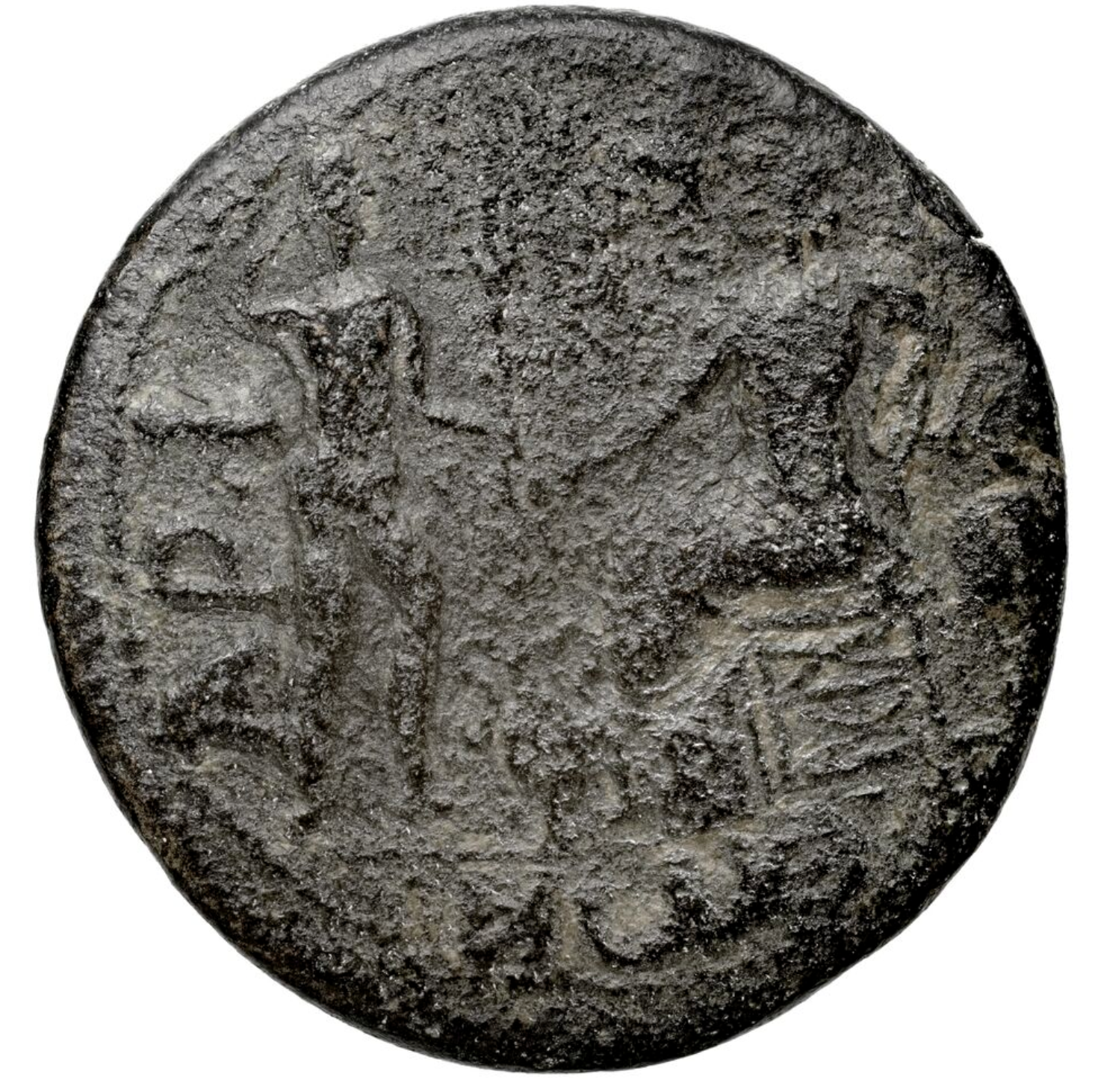
To this end I decided to look further at depictions of vases in agonistic art. On more than 143 different Roman provincial coin types there is a collection of five balls, nearly always called “apples”. Sometimes there are on the crowns, or next to the crowns on the table. Below I show an example of them under the table next to the vase and another rare example of Victory holding the five balls. I am no means certain these five balls are related to those on the “doughnut” stands in the mosaic, but I consider it a possibility. I see two potential interpretations. These are the balls that go into the vase and are drawn out to determine the order of the competition, or they represent 1st, 2nd, 3rd, 4th, and 5th place in the competition. I lean towards the first interpretations. Perhaps after they are drawn out of the urn they are displayed in the order drawn on the stand? Again this is speculation.
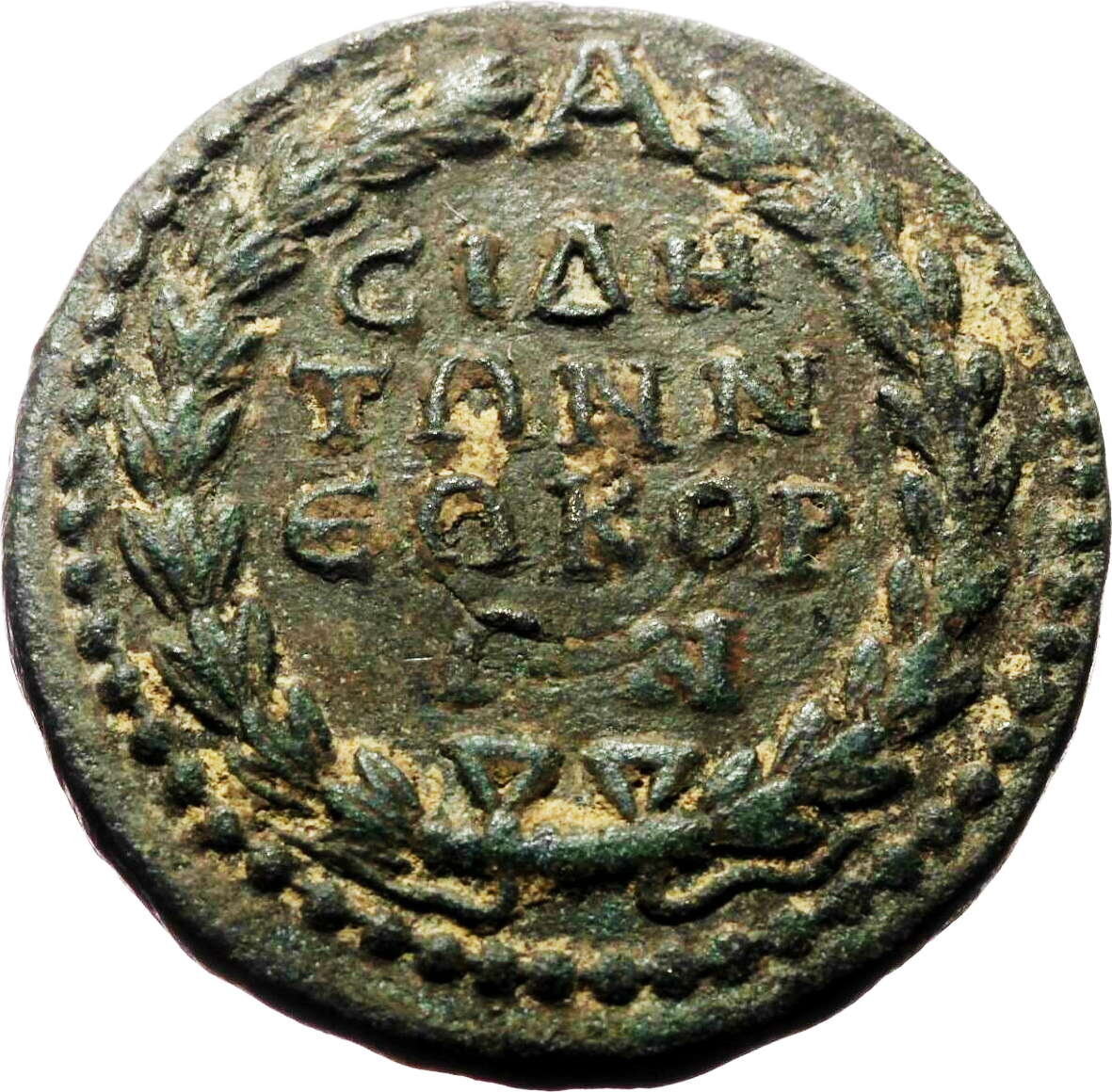
A tempting association of letters as indications of priority and associated with crowns comes from the coinage of Side. See the A at the center of the crown. Now the A on the coins of Side is their claim to be the first city among the Neocorates. It also appears on temple pediments, just hanging out in the legend, and on vexillum in coin designs, not just crowns.
18 cities issued coins with design that is typically described as “dropping a pebble into a (voting?) urn”. In total RPCOnline records 102 coin types with some version of this description spanning the Antonine period down to Valerian.

The figure with the so called pebble is invariably identified as divine and typically seated. The most common identification is Athena. But their are some interesting personifications esp. the Boule and Agon. However we should not be so certain in these catalogue identifications. All five types attributed to Agon, might equally be attributed to Tyche. The key attributes are a crown (mural? agonistic?) and a palm branch. Of the nine types identified as Boule only one is labeled as such. By contrast with or without pebble and urn when the personification Koinoboulion is identified on a coin she is invariability labeled as such.
I do not take these to be scenes with so called pebbles and urns as celebrating voting but rather the divine hand in the random selection necessary for a fair contest. The same imagery that can be read as put a spherical object (‘pebble’) into an urn, can just as easily be intended to show the object being removed from the same vessel.
The relationship of iconography of a deity with “pebble” (ball) and urn to agonistic events is made clearest by this rather poorly preserved specimen.

(vi and vii)
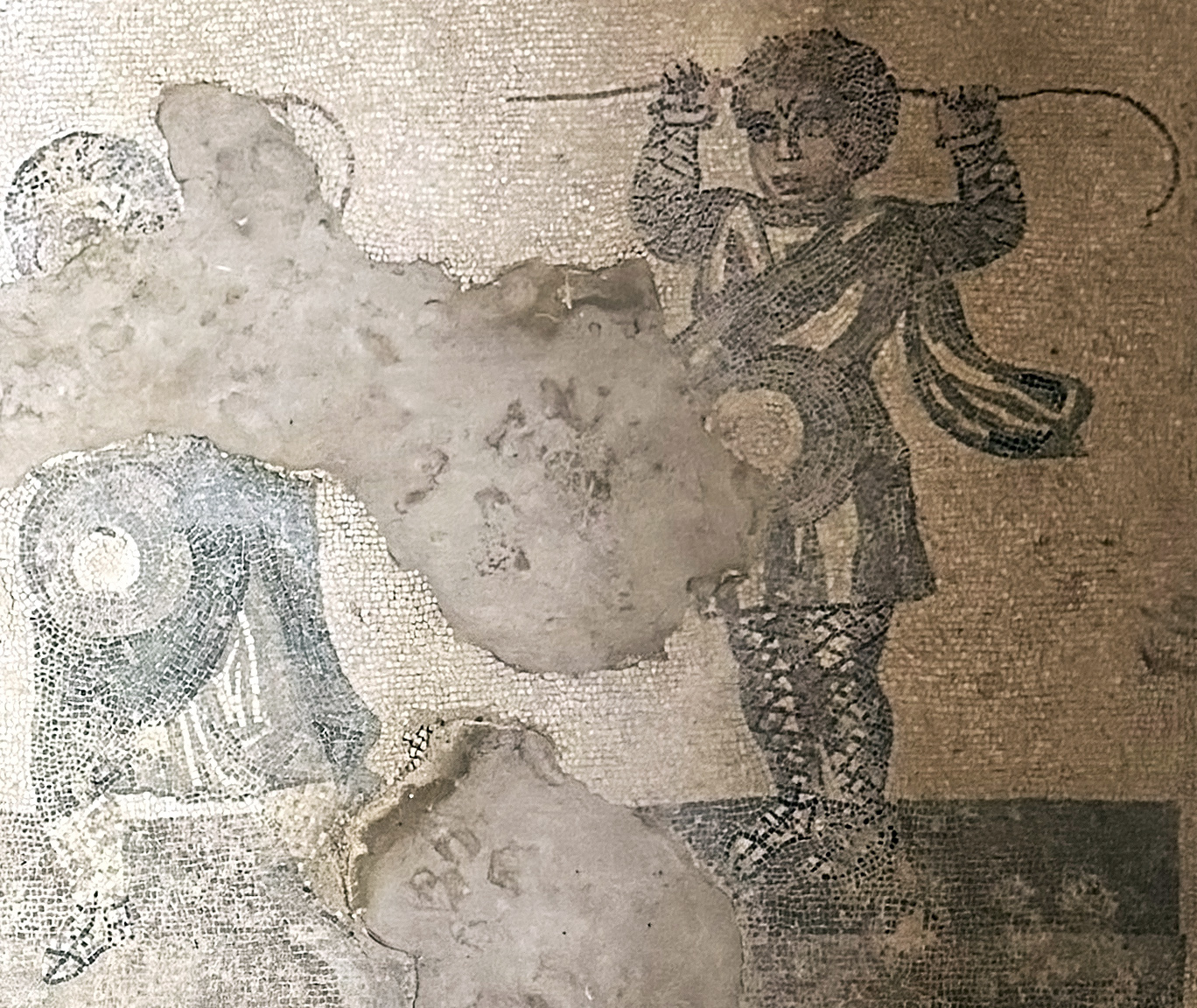
Figure vi is badly damaged but figure vii is nearly complete. The two figures interact with one another and bear key similarities. (Of course we have the forehead vs again.) Notice in particular the round protruding objects over their abdomens. This seems a late stylized version of the padded belly of the traditional comic actor. Both figures also hold very thin curved sticks. This type of ‘crook’ is also closely associated with comic actors. See below for pairing of such an object with a comic mask.
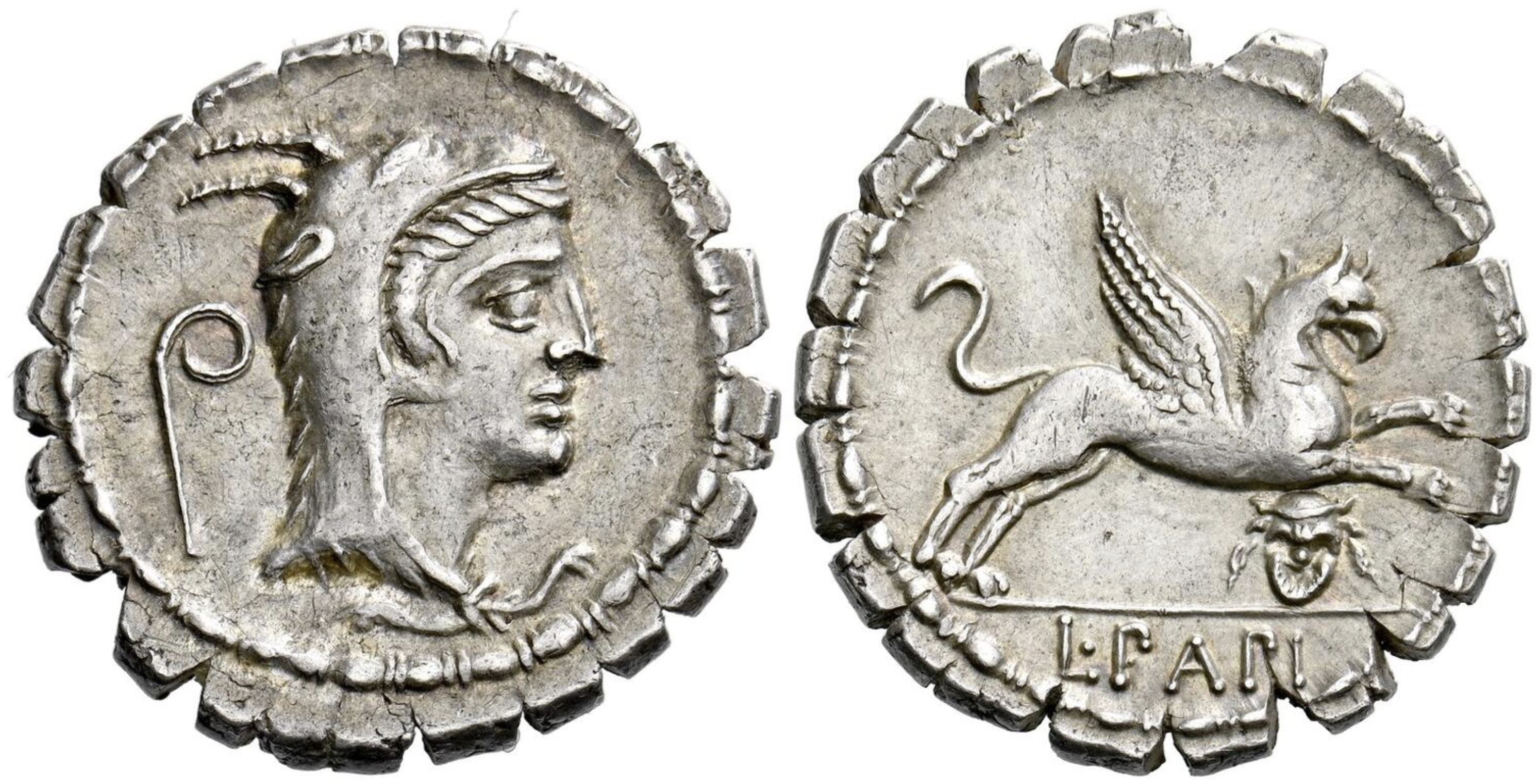
Likewise, tall textured boots were a key costume element for certain comic actors. Notice the over the knee bindings on the right hand figure:


Register (E)
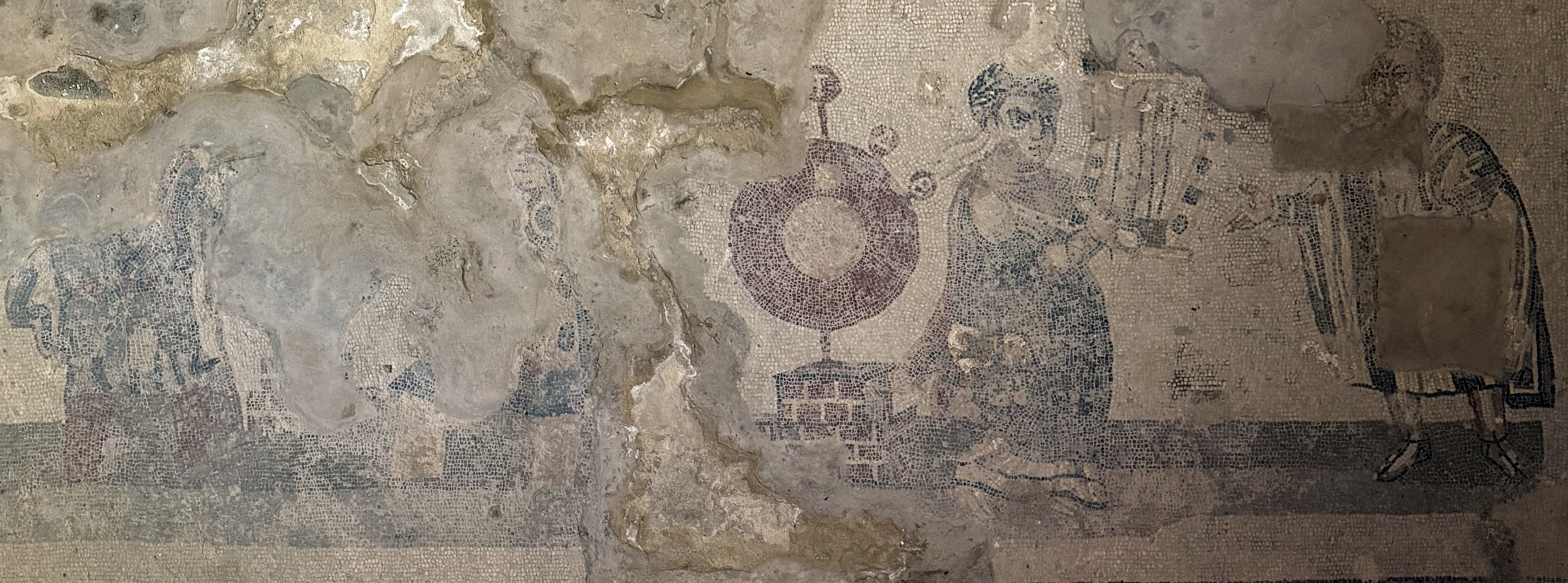
The extensive damage to the left half of this register makes interpretation especially difficult. I believe I can determine the remains of 6 overall objects/figures.
(i-iii)

The division of these remains into three objects/figures can be supported by the traces in the middle of pyramidal base made of reddish rectilinear blocks as seen elsewhere in this same mosaic. Perhaps it held another amphora as in the register above, but a narrower one. If this is the case the two objects/figures on either side may be interacting with the urn, i.e. drawing lots. My difficulty with this interpretation is what seems to be bases or rectilinear elements under the more organic forms. Let us interrogate this for each figure.
(i)

There is an S shaped curve of drapery on the left hand side. This is suggestive of cloth perhaps even a cloak on a human form. The irregular black lines on the white ground may indicate folds/pleats in an over garment. This could make the bottom band of a reddish color an undergarment perhaps with blocks of color red-grey-red-grey. I also wonder if there may have been some speculative or casual “restoration” work here that is fooling my eyes. Higher up on the figure(?), at about the the middle of the S shaped drapery there is a narrow horizontal band of alternating red and black tiles. Perhaps representing a belt? From the middle of this belt(?) there is a gentle sweeping line of tiles up to the right perhaps representing drapery over a shoulder. I see no trace of feet or arms.
(iii)
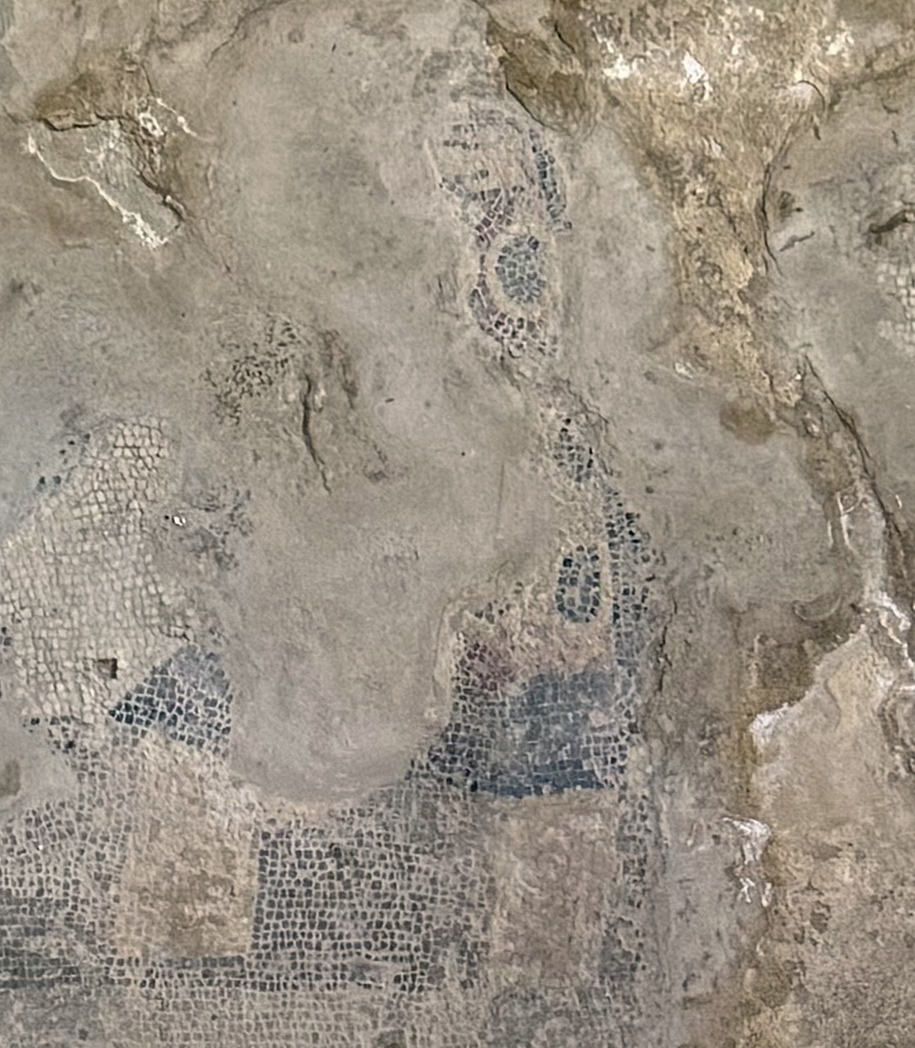
Here again we have alternating almost rectilinear blocks of color below what seems to be drapery. White and black boxes seem to alternate. Is it an undergarment or the base of an object? The impression of drapery seems clear from the irregular dark triangle to the left and the irregular series of circular patterns running in a vertical line on the right. This figure if such it seems to move forward the doughnut stand with the letter balls (iv, illustrated above in discussion of previous register).
(v-vi)
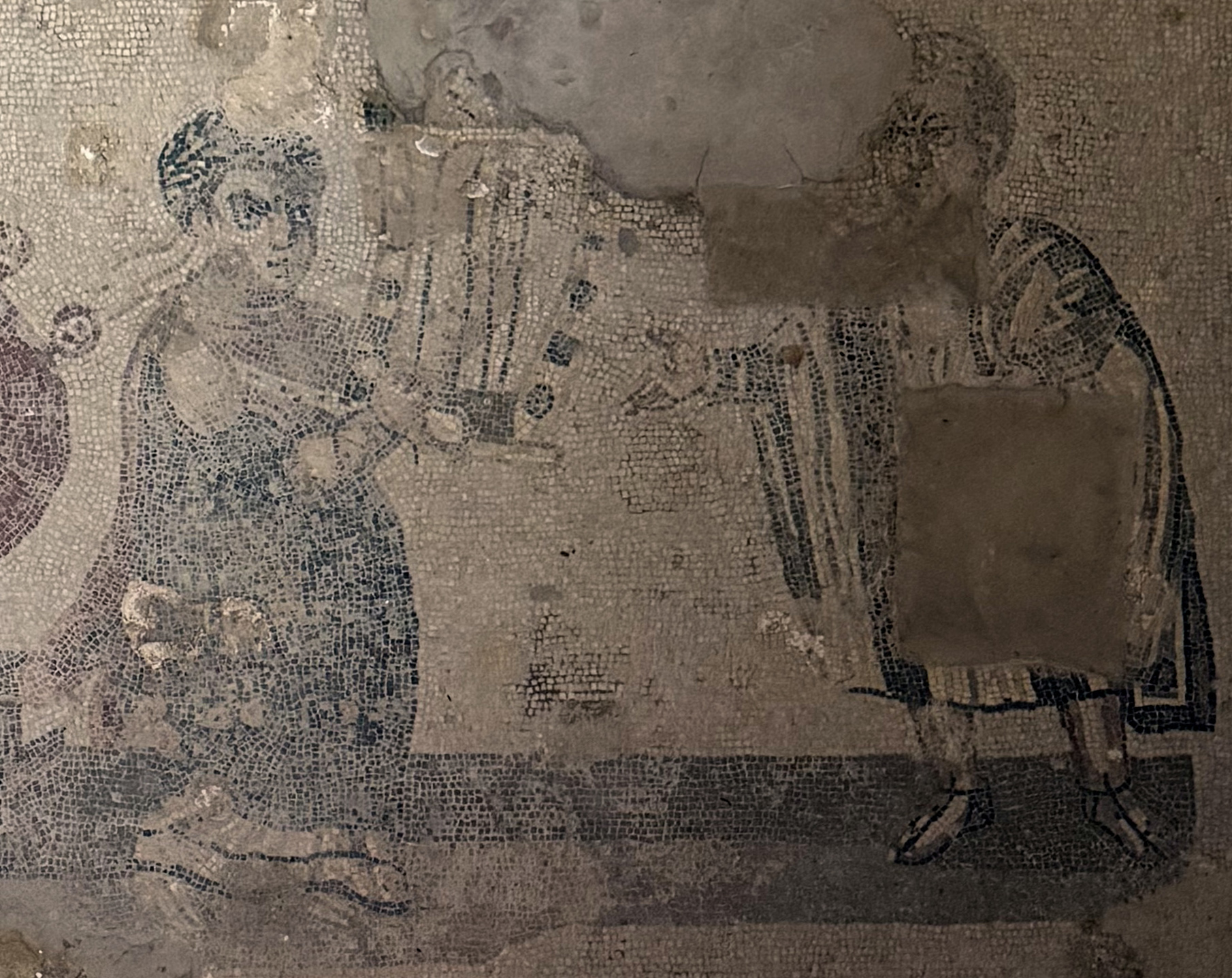
The two figures seem to gaze at each other intensely. Is it anger? A dispute over the contest? Is figure (vi) a judge or perhaps a singer? The lyre player with his plectrum and crown reminds me of the choragos from the Patras mosaic that is directing a group of boys in shorter striped tunics. The comparison is not perfect but suggestive.

So what?
I don’t think I’m done with this accidental project. I certainly have more I want to know and think about but this this the end of the first step. Observation. I always prefer to begin with articulating what I see and only then reading other perspectives on the same subjects.
My final thought is after looking at the groupings on the Patras mosaic I’m more convinced that we are seeing different competitive categories: tragedy, comedy, instrumental and choral performance. I suspect there may be a fifth category I cannot yet name or recognize. It will come in time.


 Liv Mariah Yarrow

A lot to digest in this post. On the strange instrument, two possibilities come to mind: (1) a simple long (2 meter?) trumpet that is bent back to make it easy to hold? (2) some sort of early trombone with a slide? Also, I wonder how often males are shown playing that double flute? I’m no expert, but all those I can think of have been female (including one on the replica plaque we brought back from our trip to Greece, which might skew my thinking on this. 🙂 )
(Wikipedia says the sackbut, predecessor to the trombone, showed up in Germany in the 15th century.)