
This is is another spin out of my mega Sertorian post with running notes. One pair of modern Spanish authors revived the Anna Perenna interpretation of RRC 366‘s obverse – on which I lean strongly towards Aequitas (links to recent post). AND, There is a whole edited volume on Anna Perenna with a chapter on these coins.
Ramsby, Teresa. 2019. “Ovid’s Anna Perenna and the Coin of Gaius Annius.” In Gwynaeth McIntyre, and Sarah McCallum (eds.), Uncovering Anna Perenna, 113–24. Bloomsbury. https://doi.org/10.5040/9781350048461.ch-007. [chapter ILL requested – book purchased but delayed delivery.]
While I wait to read more secondary scholarship here are some initial thoughts based primary evidence.
Generally speaking, I see a few strains running though our literary testimony, etymological and calendarical, i.e. antiquarian (Macrobius, Ovid), and allusions to actual ritual, cult practice (Ovid, Martial). My take away is that there was no fixed learned explanation for this deity but her cult was of significant. This is supported by the EXTENSIVE epigraphic and archaeological evidence from her shrine now kept and published in the catalogue of the collections of the Baths of Diocletian in Rome (book on my desk in Brooklyn, kicking myself now for not bringing it home for the winter break).
I tend to put little weight on the antiquarian tradition given that we know this was female centered festival of disputed origins ready for appropriation into whatever narrative was convenient to the elite male author. As I keep reading I’m v curious if I will find anything interpreting the the blood as menstrual rather than hymen breaking. I also feel it is far safer to interpret the goddess based on cult practice attested by material remains that clever literary representations, boring I know.
Literary Sources.
Macrobius.
And in the same month both public and private sacrifice is offered to Anna Perenna, so that we might prosperously pass the year [annare] and many years thereafter [perennare]. [Sat. 1.6; Loeb trans.]
Macrobius clearly derives from Ovid.
And to my thinking no small proof that the years of old began with March is furnished by the observation that Anna Perenna begins to be worshipped in this month. With March, too, the magistrates are recorded to have entered on office, down to the time when, faithless Carthaginian, thou didst wage thy war. Lastly, the month of Quintilis is the fifth (quintus) month, reckoned from March, and with it begin the months which take their names from numbers. [Ovid, Fasti, 3.145]
Ovid’s primary narrative makes Anna Dido’s sister, who then becomes a local nymph (cf. Vergil and Silius Italicus, both get chapters in above mentioned edited volume) and a clever alternate etymology before he nods to the many other explanations that exist:
“placidi sum nympha Numici: amne perenne latens Anna Perenna vocor.”
“I am a nymph of the calm Numicius. In a perennial river I hide, and Anna Perenna is my name.” [Ovid, Fasti, 3.653-4; Loeb trans.]
… Some think that this goddess is the moon, because the moon fills up the measure of the year (annus) by her months; others deem that she is Themis; others suppose that she is the Inachian cow. You shall find some to say that thou, Anna, art a nymph, daughter of Azan, and that thou didst give Jupiter his first food. [Ovid, Fasti, 657-660; Loeb trans.]
Besides these diverse explanations Ovid also mentions the story of a poor old woman who fed the plebs when they retreated to the Sacred Mount. He goes on to explain the ribald songs sung at here festival by young women by a story of her tricking Gavidius (who is aligned with Mars) into thinking she is Minerva whom he wants to wed and thus pleasing Venus. I take the songs to be actual cult practice and link it to Martial’s allusion.
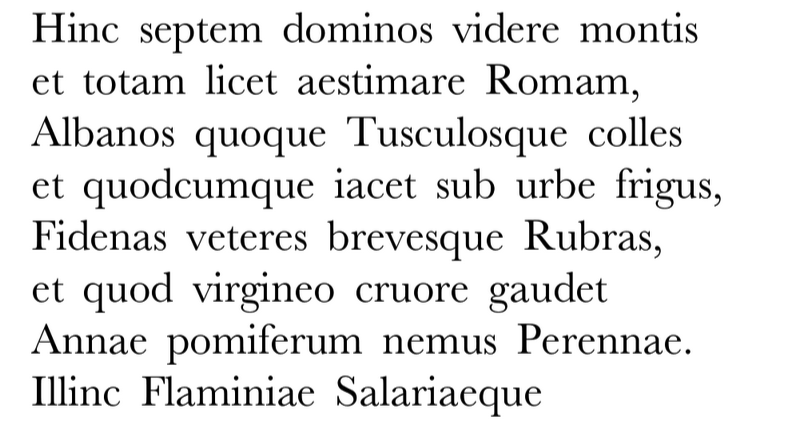
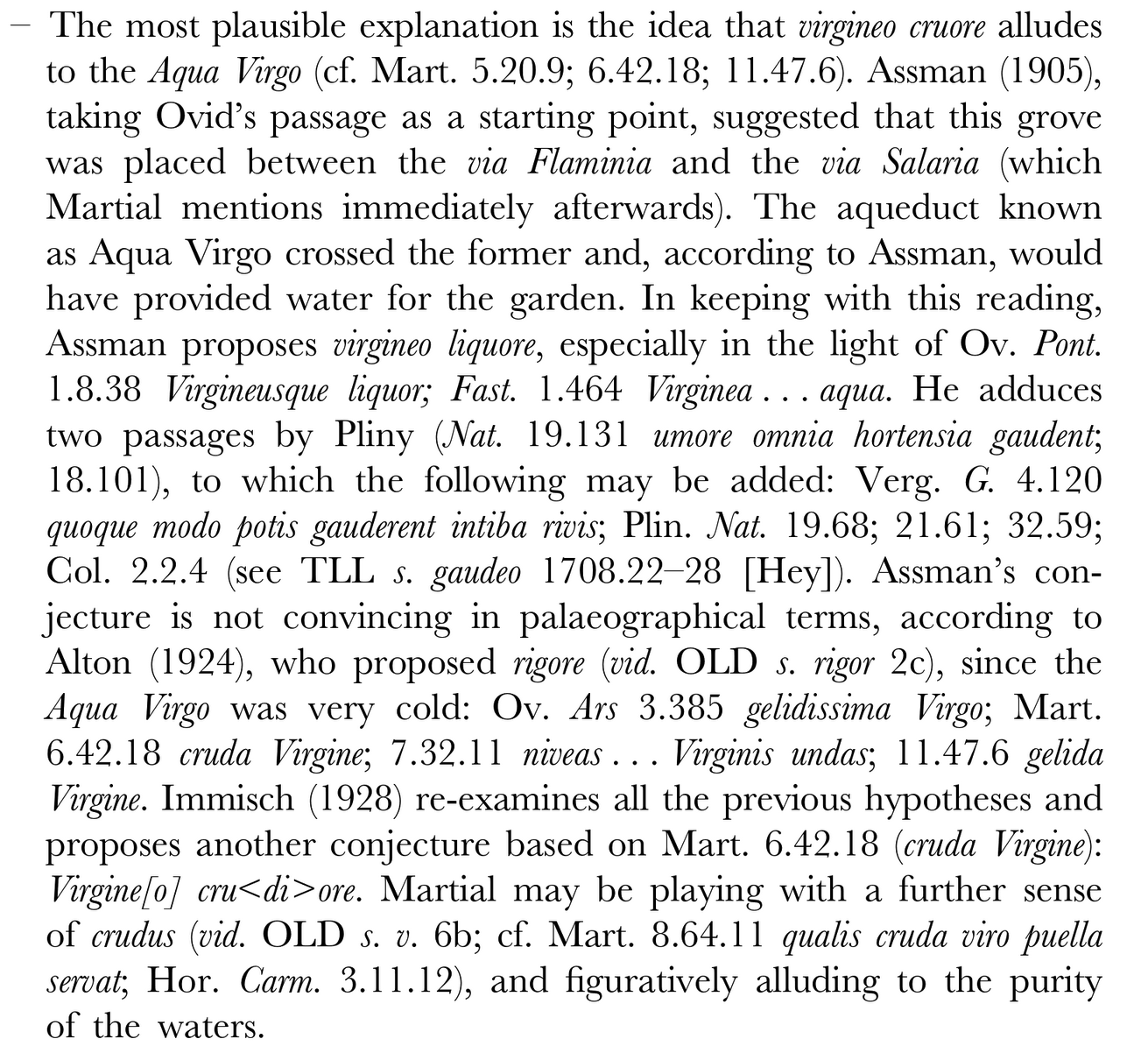
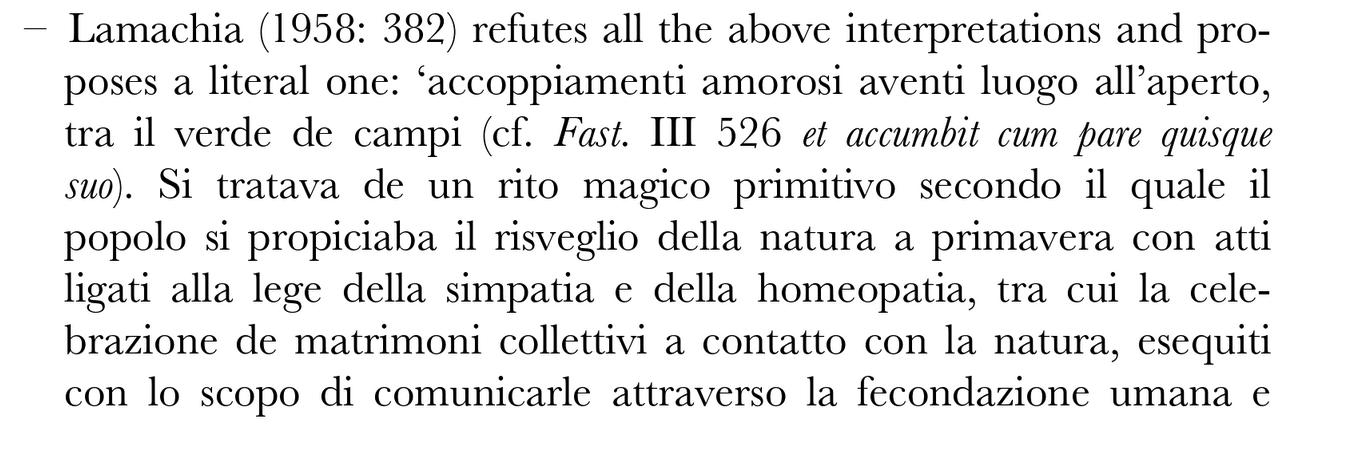
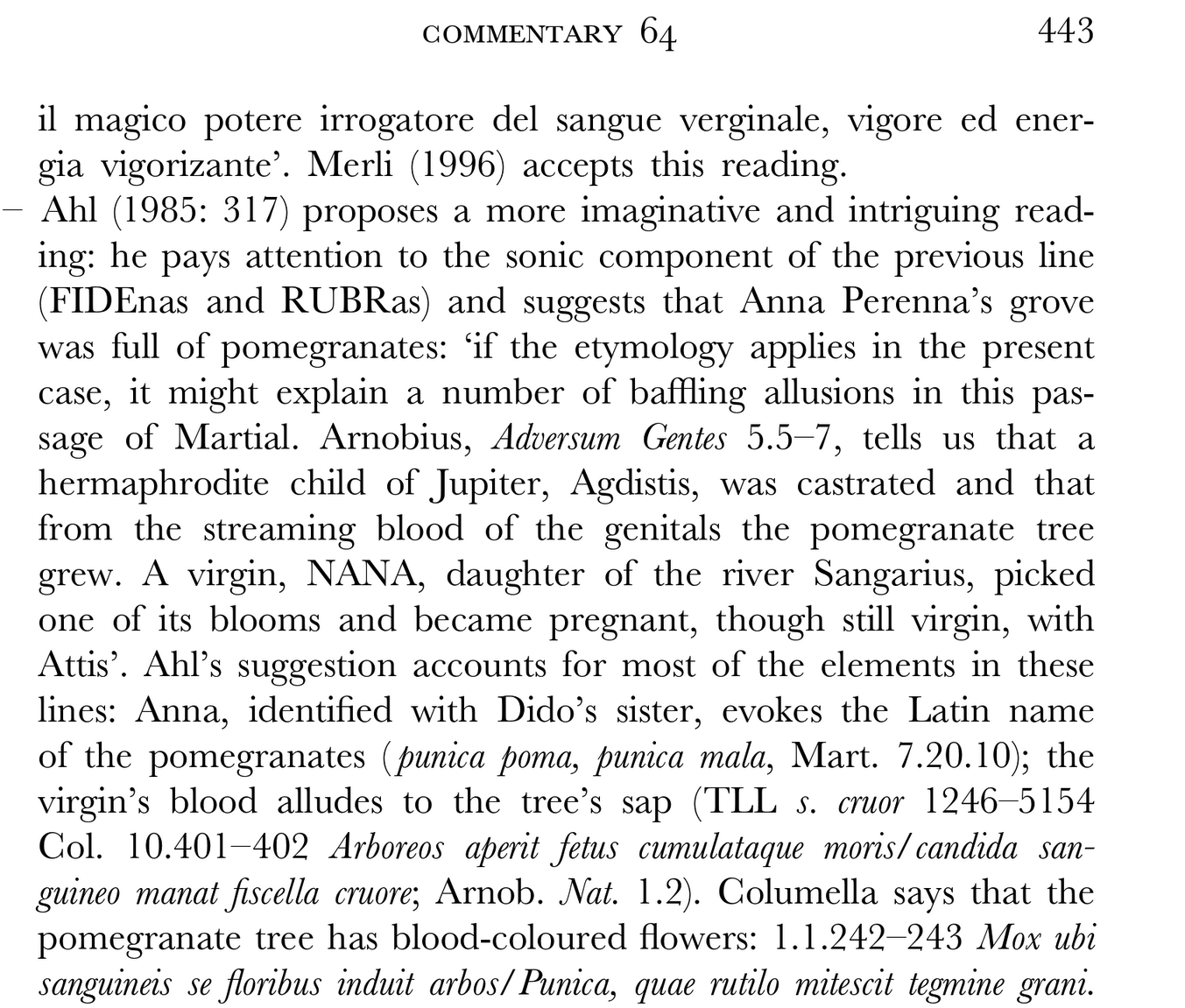
Martial IV.64.16-17 reading with
Moreno Soldevila, Rosario. 2006. Martial, Book IV : A Commentary. Boston: BRILL. [ebook available through my library]





 Liv Mariah Yarrow