

RRC 437. (earlier post, and other much earlier post)
I have far less to say here because Woytek and Zawadzka have said so much:
Woytek, Bernhard E., and Anna Zawadzka. “Ockham’s Razor. A Structural Analysis of the Denarii of Coelius Caldus (” RRC 437″).” The Numismatic Chronicle (1966-) 176 (2016): 135-153.
Where to find in the Schaefer Archive:
437/1: Binder 8, pages 165, 172, 173 (no clippings?).

Ok. So Bigger than either of the last two issues. Here we have 23 known Obverse dies and 33 known Reverse dies. But plenty of singletons among both so not all the dies by a long shot. Crawford estimated O=33, R=37.

Nicely the die links aren’t messy. There is one big cluster as you can see but always we can predict a sequence. Of course if we find more dies it might get messier, but generally speaking this is the mint working in a much more systematic way than it with the previous issue.
437/2: Binder 8, pages 178, 184, plus clippings in 400-499 batch. Note: Schaefer did not separate out types 3 and 4 and their subtypes but rather leaves them as part of 2.
Ok this really surprised me. I assumed mint workers working on the same issue for the same moneyer would use the same striking management approach. But oh no! They couldn’t be more different.
We have 17 reverse dies (the altar) and 24 ‘obverse’ dies, and except for one ‘pair’ when we have both dies identified every die is linked to every other die in some way. The other thing that feels weird or at least challenges my previous thinking is that Crawford over estimates the number of dies.
On average each obverse die links to about 2 reverse dies and each reverse die links to about 4 reverse dies. Could the altar side really be the anvil (obverse) die?
The only singletons are among the non-paired dies and could (should) be rechecked.
I’ve re arranged these rows and columns many times but not yet come up with anything that looks like a clear sequence.
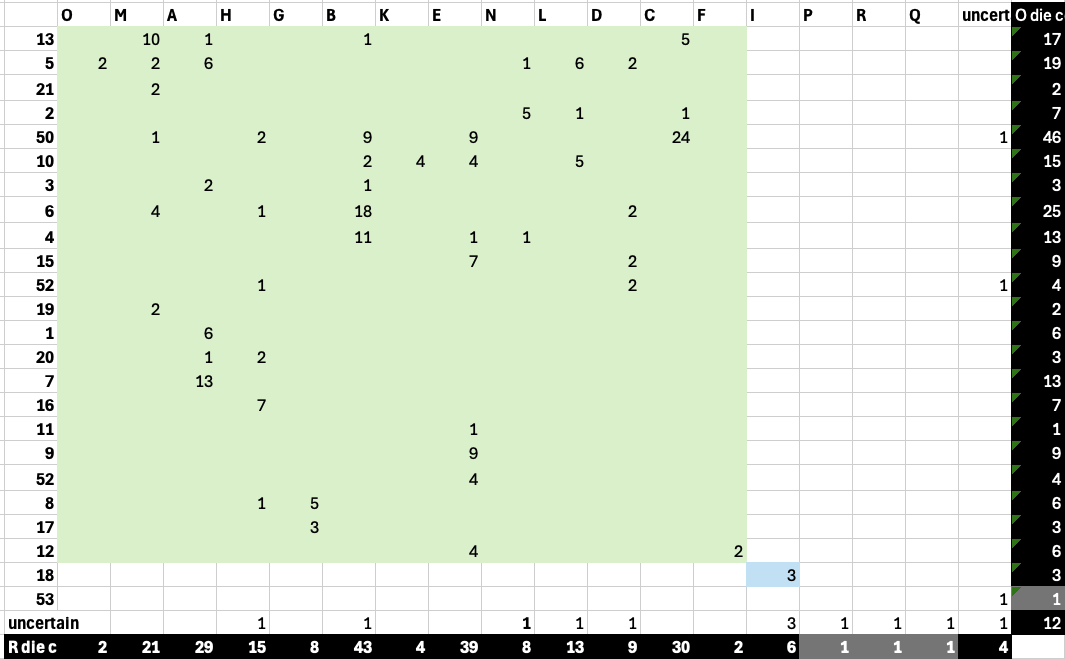
Generally speaking this issue looks like it is about twice the size of RRC 436/1.
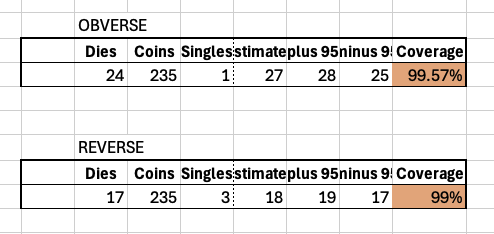
Thinking of the security of the dating of this type I’m looking at the hoards and it appearance as the ‘newest’ coin in the Casaleone Hoard has me wondering if it could (should?) move earlier in the sequence. The next newest coins are all from 54 BCE. The Brandosa Hoard (closing 49 BCE) could help with this judgement if one could compare the degree of wear.
These lists need to be checked for completeness, but basically I wanted to think about features of Caldus’ coinage that connect stylistically with other choices moneyer’s make:
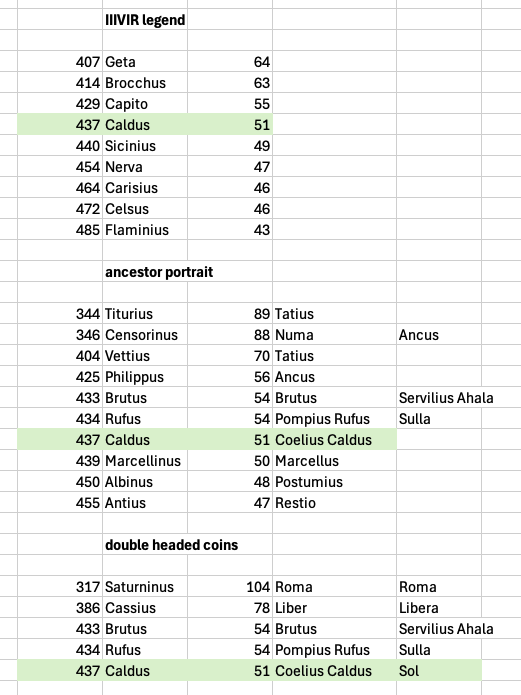
I see Caldus’ choices regarding IIIVIR and ancestor portraits and double headed coins as consistent with relative chronology that pulls him closer to Brutus, Rufus, and Capito’s choices. Rather than Marcellinus’ and Sicinius’ choices. This isn’t proof just part of my assessment of plausibility. Perhap Caldus could move back to 53?
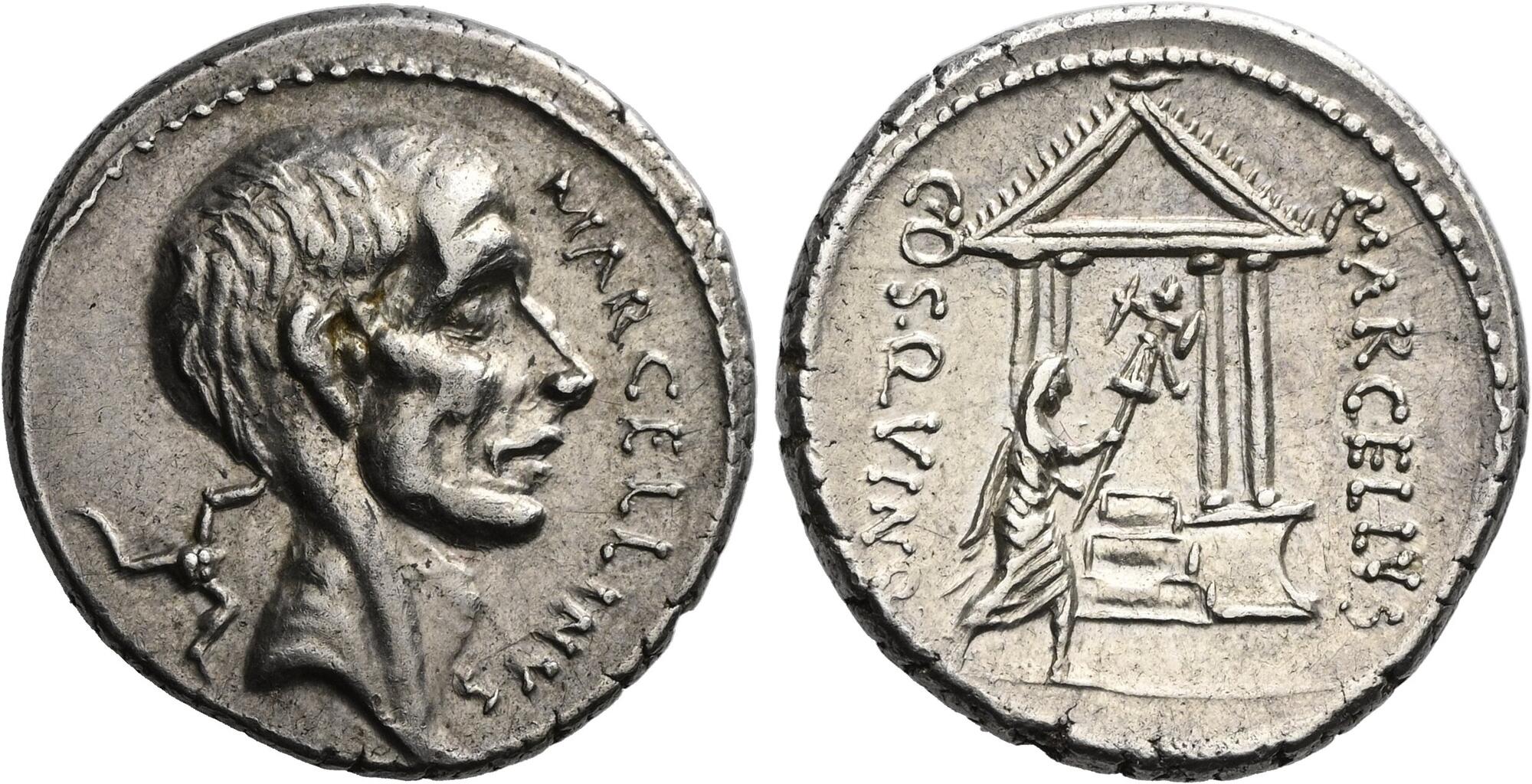
RRC 438/1 is struck by the presumed son of the consul of this year. (Earlier post)
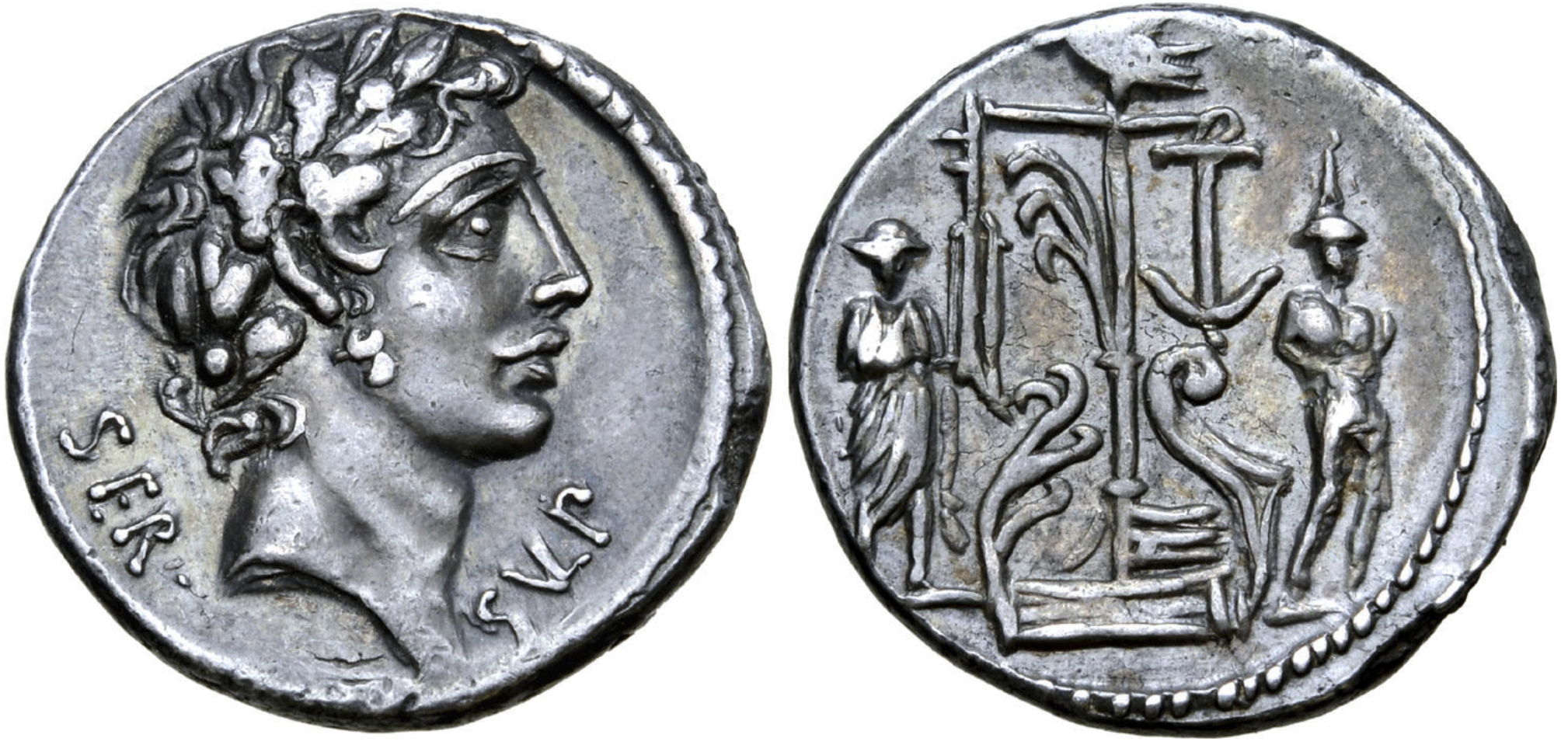

This is a very small issue we’re probably missing a couple of dies but not many. 8 obverses and 12 reverses are known.
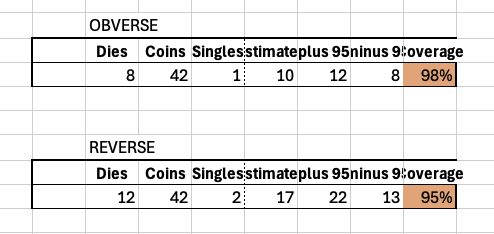
It is the most recent coin in the La Grajuela Hoard. Again, the next newest coins are all from 54 BCE. Perhaps this is just a function of volume of striking. I wonder how much the consulship of his father has influenced the dating of the type?
This issue is likely much smaller than Crawford guessed. The Schaefer Archive only documents 17 obverses and 14 reverses.
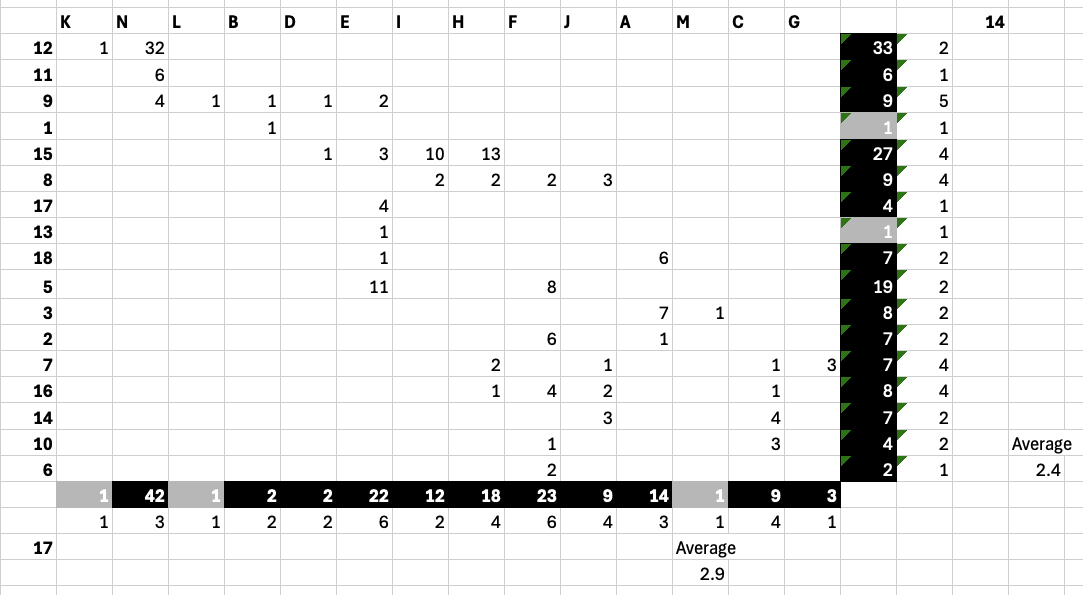

At the most generous Etsy formula suggests at most we might be missing 4 obverse dies and 2 reverse dies. This is a much small issue than Crawford estimated.

 Liv Mariah Yarrow