
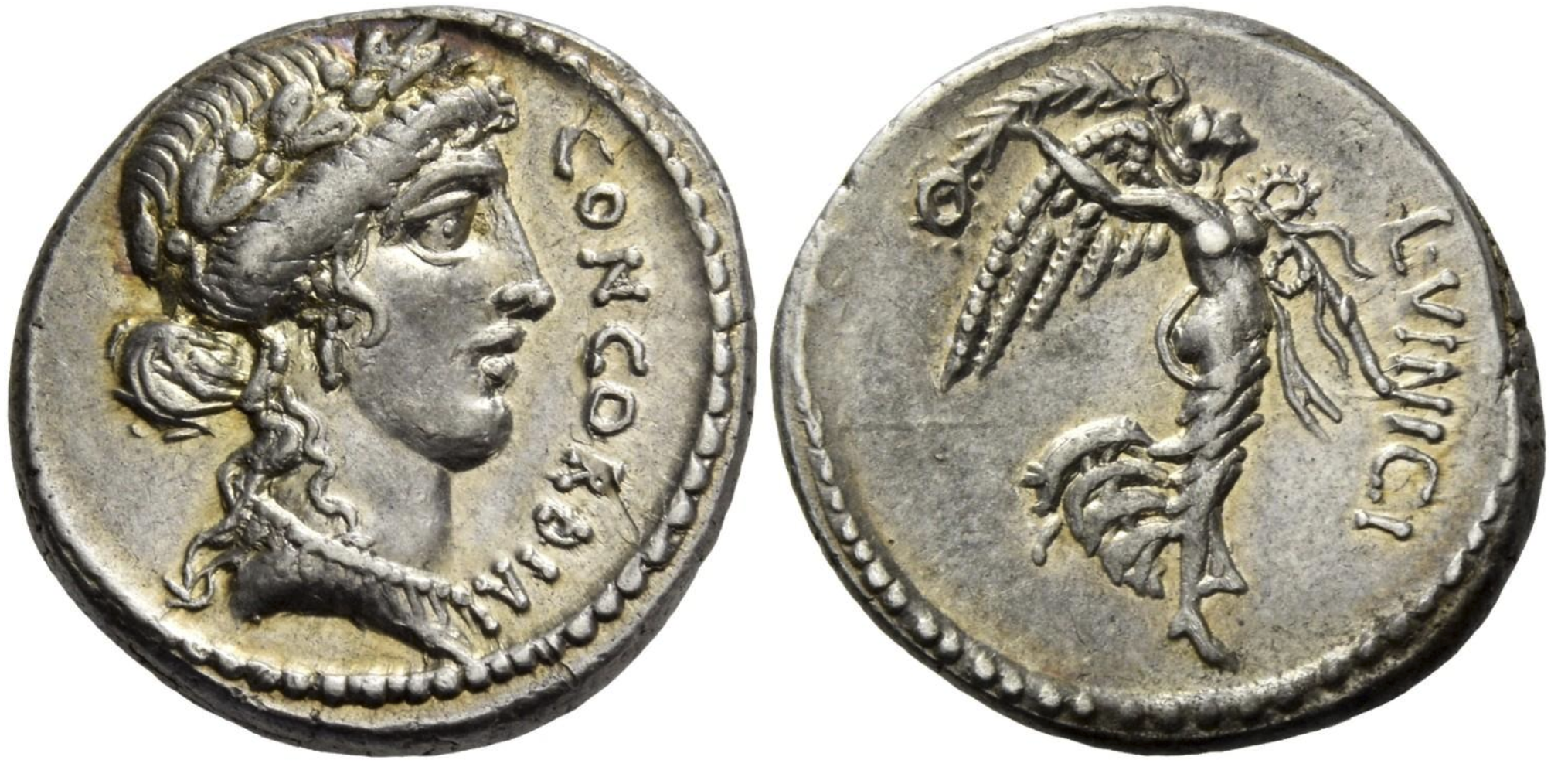

The last time I talked about this coin on the blog was over 10 years ago. I went back and fixed the images in that post ahead of writing this one.
The logic of the four wreaths referring to Pompey depends in large part on RRC 426/4, c. 56 BCE, created by Sulla’s son, Faustus.

As you may notice one of these crowns is not like the others. [One of these crowns is doing its own thing… 🎶] I was certain that I’d written about this earlier on the blog. But not here. I know I wrote about it in a lost paper on Faustus I deliver versions of at Cambridge, Princeton, and the NYC Coin Club early in my career (all before 2008), but try as I might the typescripts and word docs of that paper have been lost in fried hard drives and failure to back up my work in those early years. One reason I love my blog (and dropbox). I should have another search at some point. I wonder if a printout might be in my physical files at BC…
Anyway. I chose a specimen from trade so can see all the details that often fail to show up on other more worn specimens. Notice among other things the globe has lines on it. I talk about this and other globe symbolism in a publication from 2010. These lines were first drawn to my attention by Rick Witchonke a moment of looking at his collection with him I always hold dear.
Today, my eye is concerned with the big wreath or crown. Notice it has a double band. A center ornament and prominent fillets. At first I was worried the fillet might be close to a diadem and thus worrying for regal ambitions, but diadems are distinguished from fillets by having more than one tassle at the end and sometimes a decorative band above the tassle (earlier blog post with imagery for comparision).

Crawford identifies this larger crown as the corona aurea.

So, I have questions. This doesn’t seem like a popular move to have accepted this honor. Was it acceptable to put it on a coin? Can you have the crown and not wear it. Also isn’t this gold crown and the rest of this theater costume the sames as the triumphal costume? Why would this crown have a different iconography? Did Pompey not know the precedent set by Marius that wearing this stuff out of context makes you suspect?

We also have the testimony of Dio whom Crawford says “is wrong”, but how precisely I’m not certain even after looking at his reference to RRC 480.
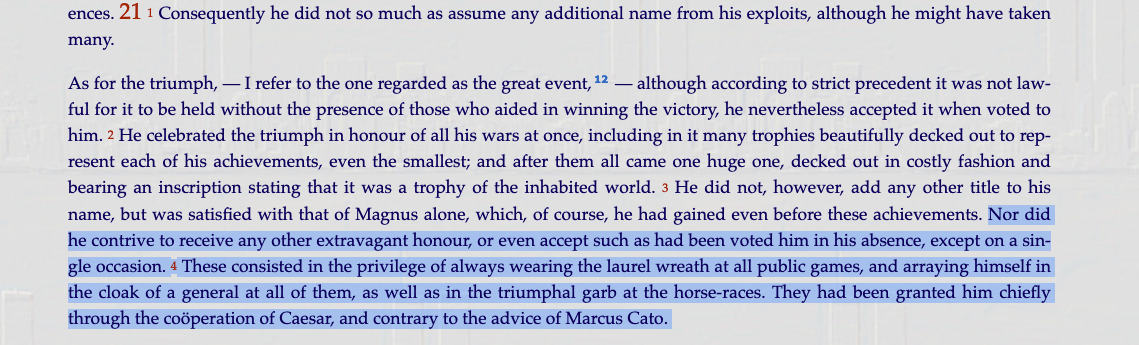
So perhaps what Crawford meant was that Cicero offers proof that Pompey actually used these honors at least into 60 BCE:
Cic. Att. 1.18
qui poterat, familiaris noster (sic est enim, volo te hoc scire) Pompeius, togulam illam pictam silentio tuetur suam
SB translation:

Shuckburgh translation with note:
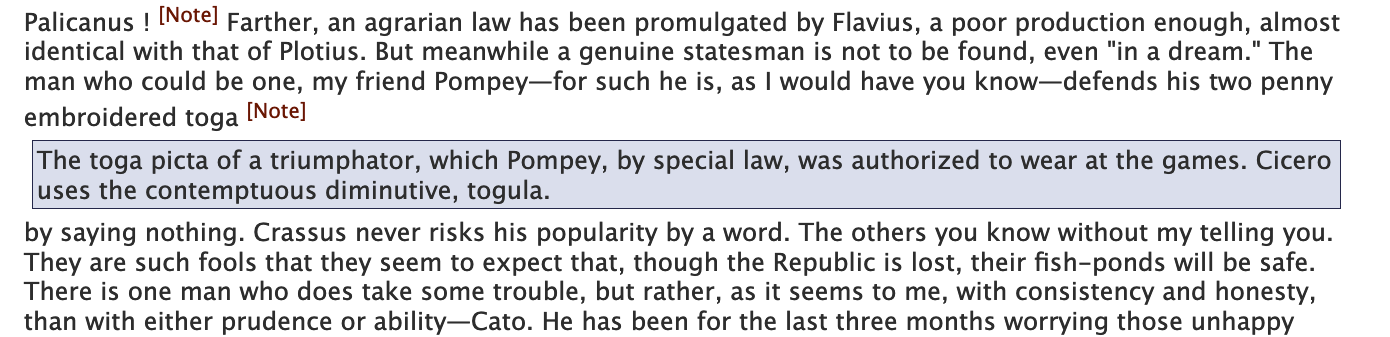
SB knows his rendering of tuetur is controversial so he offers in his commentary a better justification than is typical of his free translation style.
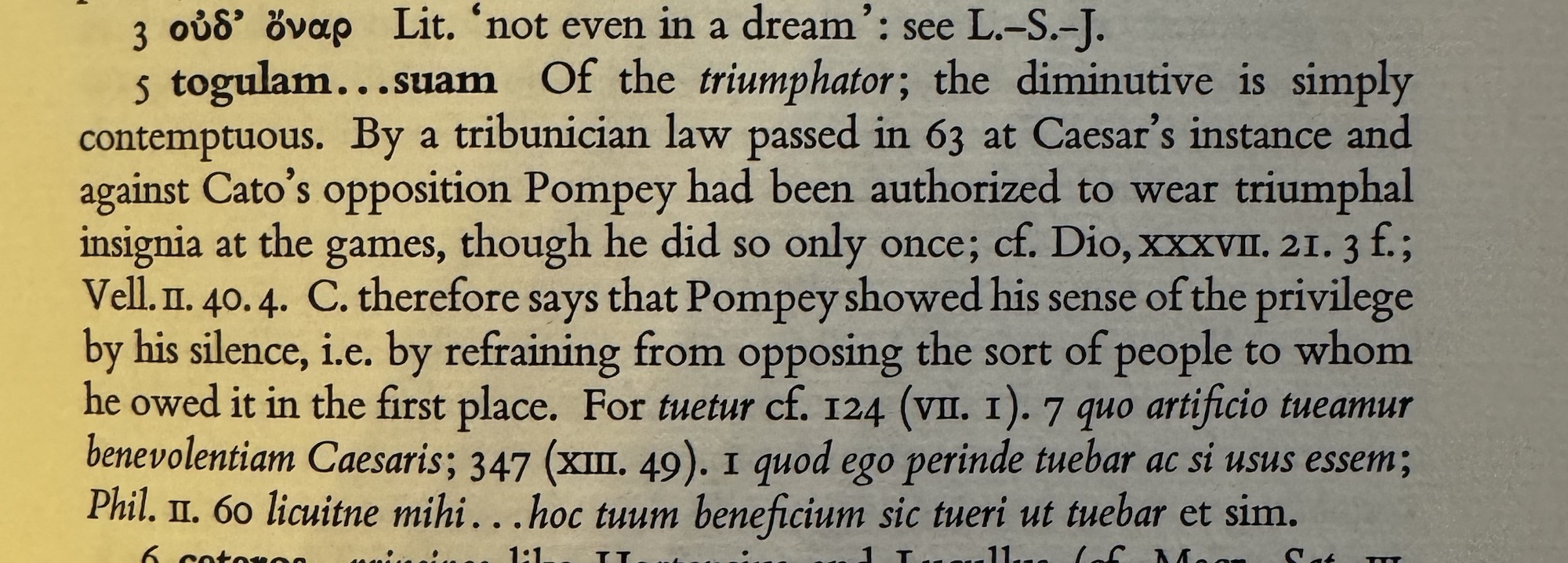
I believe Cicero over Vellius and Dio. Pompey clearly enjoyed his symbolic honors and indulged in them.
The funny part we should not over look is that his honors were different based on where he was showing off. Laurel wreath at an ordinary ludi, but at the circus races the triumphal crown. How is this different? The circus was a place where triumphal garb was worn by the leaders of the ludi, especially in the Ludi Romani and the Ludi Apollinares (See earlier post). I have two different posts on laurel wreath crowns that may be relevant (post 1, post 2). We also have this assertion about 292 BCE in Livy:
10.47.3 This year, for the first time, those who had been crowned for their deeds in war were allowed to wear their decorations at the Ludi Romani, and then, too, for the first time, palms were given to the victors after a custom borrowed from Greece.
We only have one depiction of the triumphal costume as a costume and that from 18 BCE. Notice the center medallion in the wreath.

We have four triumphators on the reverse of republican coins: Marius (RRC 326/1), Anonymous (RRC 358/1), Sulla (RRC 367) and Pompey (RRC 402/1). They all could be wearing laurel crowns but in no case is it distinct enough to really see. What is clear is the variety of things being held types of different branches (probably palm and laurel), caduceus, possibly a scepter… These traditions of representation and probably ritual could evolve.
On some die variations though. Pompey’s big crown looks a great deal like triumphal crown of 18 BCE.
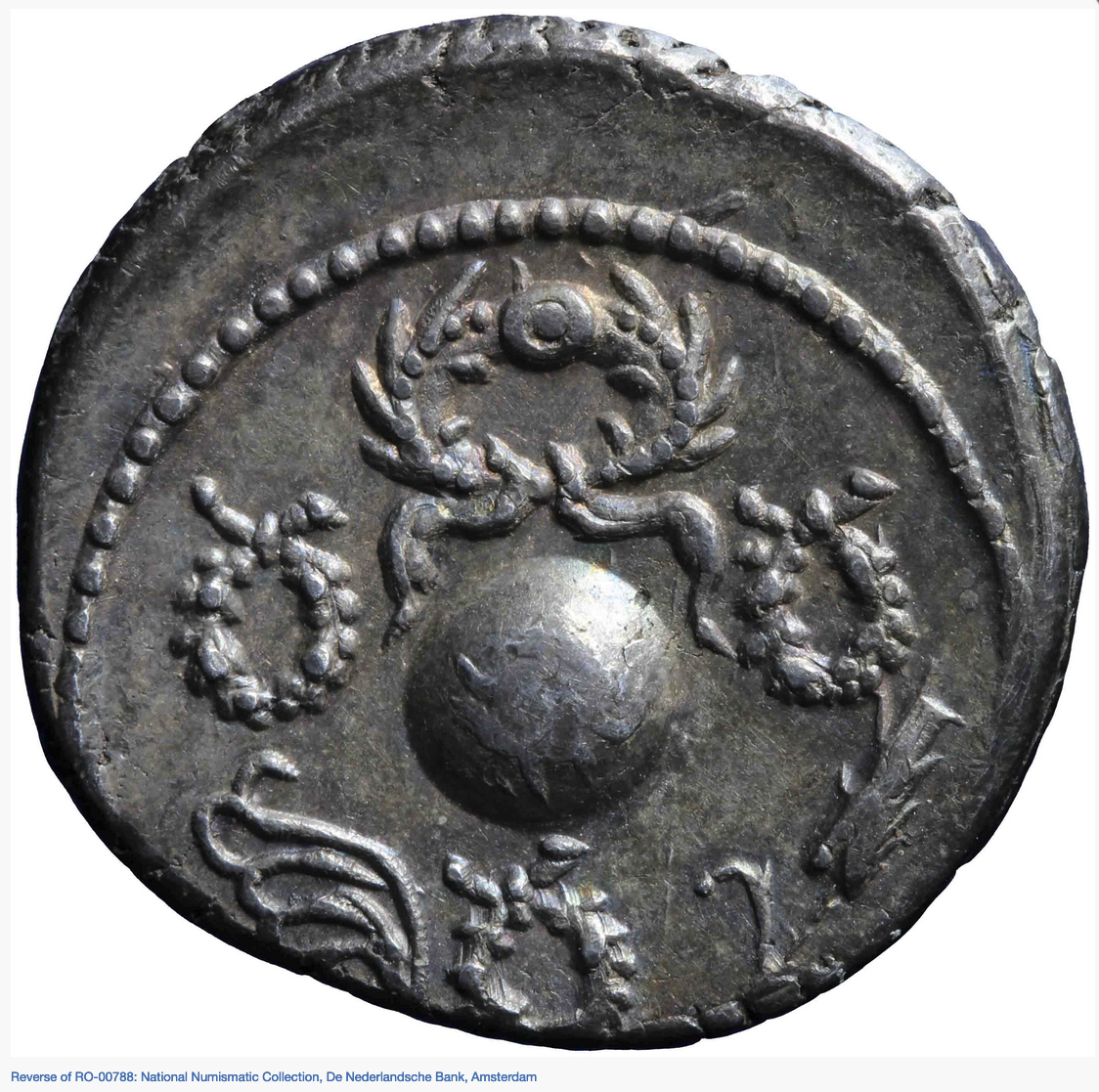
Why emphasize this one crown more than the triumphs? Aren’t the triumphs a bigger honor? Maybe it is as SB suggested that the one voted on by the people spoke to Pompey’s popularity more than his senatorial support.
Wowza. I’ve been writing for a long time and am still no where close to getting to my original question, how sure are we that the four wreaths on Vinicius’ coin are for Pompey…
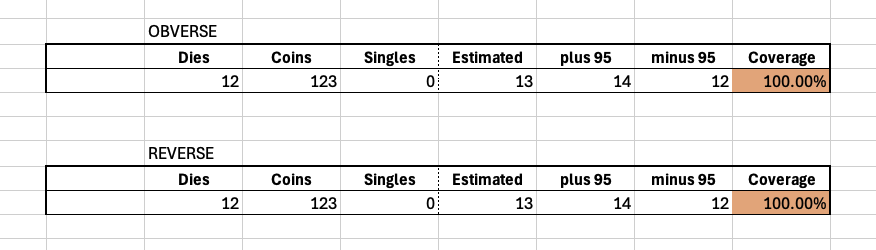
I decided to spend some time looking very carefully at the dies. There are 12 of both obverse and reverse.

I wasted time drawing this. Unlike many RR issues their doesn’t seem to be much ‘pairing’ of dies, even if they do still seem to use an equal number of obverse and reverse dies. In the process of looking at all the specimens collected by Schaefer, I’ve decided it is super hard to tell if any one wreath is supposed to be different than the other three. At first I thought that the one closest to the stomach of Victory might have extra prominent fillets but the one above that near her breast also have fillets at least on some dies. I could almost confince myself that the one hanging off the palm branch end was the most significant but not really.
This issue is slightly larger than Messala’s from yesterday’s post. It represents something more than 120,000 denarii and certainly much less than 450,000 denarii. For context, this would plausibly be about the same amount of monetary value as Cicero owed Caesar in the next year 800k in sestertii (4 sestertii per denarius). [Charts on die counts and pair counts at end of this post.]
So now I’m wondering how the heck we know it is from 52 BCE at all. It only appears in three documented hoards and none before 39 BCE. For contrast there are 61 hoards that close between 50 and 45 BCE, 17 over 100 coins, and one with well over 1000 coins. None have this type.
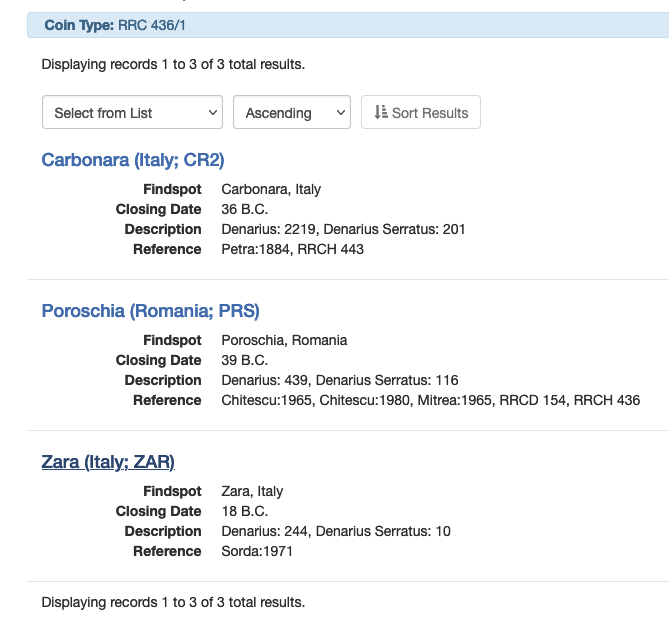
I worry this is a case of best prosopographical and iconographic fit…Vinicius is Tribune of the Plebs in 51 BCE so his coinage MUST be earlier seems to be part of the logic. But cast your mind back to my musing from about two months ago on how Vibius after being a Caesarean tribune in 51 BCE stays in the city and serves as money AFTER his tribunate.
Is it that there is no room for Vinicius in the Caesarian colleges?
49 – Sicinius, Mn. Acilius (not Nerius who is urban Quaestor), missing moneyer
48 – Pansa, Albinus, (joint issue), Saserna
47 – Plancus, Nerva, Restio
46 – Cordius, Carisius, Paetus
45 – Celsus, Palikanus, Asiculus
44 – FOUR AAAFF
That is pretty damn tight. Why would I want to run the thought experiment? Largely because in April of 46 Julius Caesar celebrated his own quadruple triumph. Four wreaths… And and even concordia could be a celebration of the end of civil war…
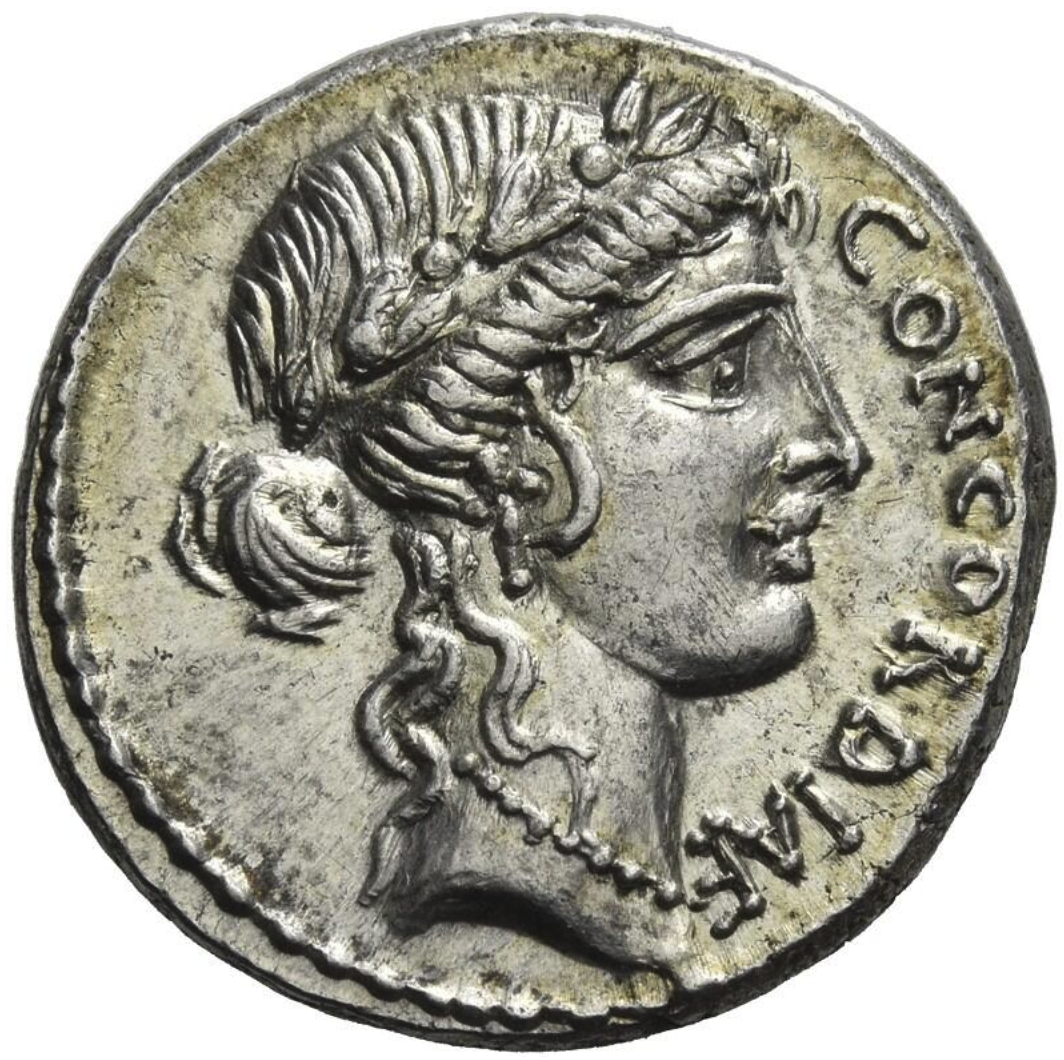
But we have one more clue. The case of the obverse legend. It is never in the nominative as is typical of labels instead it is in the DATIVE. To-For Concord. The depiction of the goddess is indistinguishable without the words from Venus Victrix.
| OBVERSE DIE | COUNT | REVERSE DIE | COUNT |
| 1 | 9 | A | 22 |
| 2 | 19 | B | 9 |
| 3 | 3 | C | 6 |
| 4 | 19 | D | 16 |
| 5 | 7 | E | 25 |
| 6 | 8 | F | 8 |
| 7 | 5 | G | 2 |
| 8 | 11 | H | 6 |
| 9 | 9 | I | 8 |
| 10 | 14 | J | 9 |
| 11 | 4 | K | 9 |
| 12 | 15 | L | 3 |
| Die Pair | Binder | Clippings | Total |
| 1:A | 2 | 7 | 9 |
| 2:G | 1 | 0 | 1 |
| 2:J | 3 | 6 | 9 |
| 2:K | 2 | 7 | 9 |
| 3:A | 1 | 1 | 2 |
| 3:G | 1 | 0 | 1 |
| 4:A | 2 | 0 | 2 |
| 4:C | 2 | 1 | 3 |
| 4:D | 3 | 10 | 13 |
| 4:H | 1 | 0 | 1 |
| 5:C | 2 | 1 | 3 |
| 5:D | 2 | 0 | 2 |
| 5:L | 2 | 0 | 2 |
| 6:F | 3 | 5 | 8 |
| 7:H | 2 | 3 | 5 |
| 8:B | 1 | 0 | 1 |
| 8:E | 2 | 8 | 10 |
| 9:I | 2 | 6 | 8 |
| 9:L | 1 | 0 | 1 |
| 10:A | 2 | 7 | 9 |
| 10:B | 2 | 3 | 5 |
| 11:B | 2 | 1 | 3 |
| 11:D | 0 | 1 | 1 |
| 12:E | 2 | 13 | 15 |

 Liv Mariah Yarrow
One thought on “Striking in 52 BCE”