
I was taught to investigate all primary evidence and formulate my own ideas before turning to the secondary literature. Then if I find something agrees with me I know my thinking is likely sound or at least based on similar logical deductions. If I find what I disagree with, I must then use those contrary conclusions to challenge my own thinking.
I’m finding this article challenging. Even though I and the author are reading mostly the same evidence…
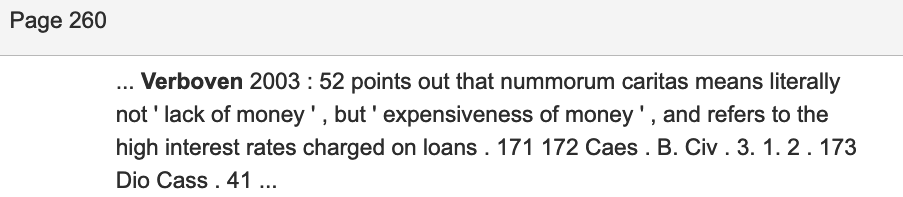
Verboven, Koenraad. “54-44 BCE. Financial or monetary crisis?.” In Credito e Moneta nel Mondo Romano, pp. 49-68. Edipuglia, 2003.
I thought best to see how others have received it. I’ve been going through the citations of the paper in later scholarship via Google scholar. Usually it is cited without comment or actual engagement. Sometimes listed in bibliographies without being even mentioned in the paper or footnotes. Those are of no use to me. It is just name dropping. (I do this too in my writing but it is v uninteresting). Below I collect a list of little snippets of deeper engagement but where it is only for a small point.
The first to peak any real interest from me was:
Collins, Andrew, and John Walsh. “Debt deflationary crisis in the late Roman Republic.” Ancient Society (2015): 125-170.

Negotiable debt instruments as a form of credit money makes lots of sense to me based on what I read in my Roman sources. What I notice however is that Collins and Walsh start their crisis in 49, NOT 54. I think my problem is that i don’t really believe the crisis started in 54 but rather that conditions were ripen for the crisis in the 5 years before 49. And my interest in 51-50 is just at the tail end before the crisis itself.
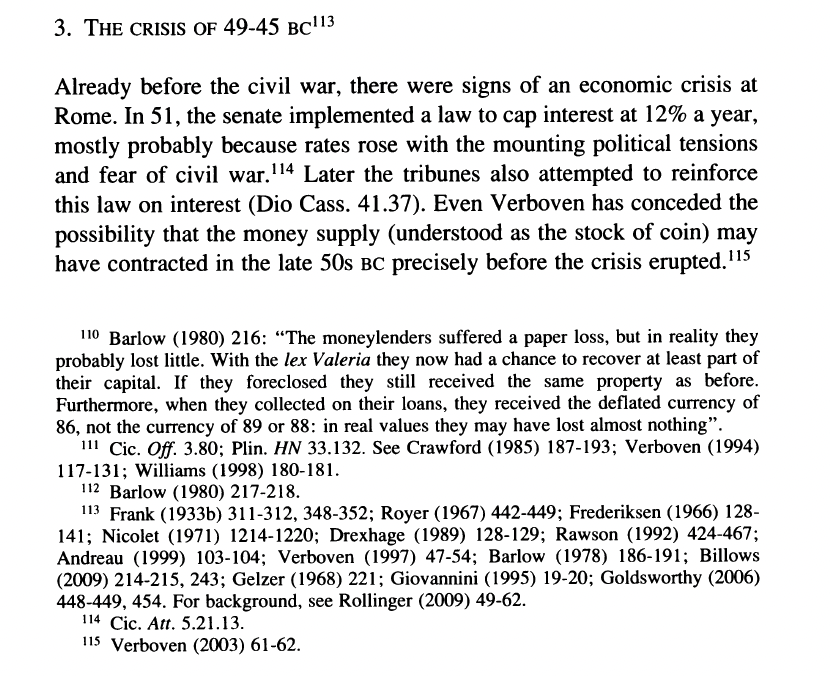
So now we come to the kicker: Does Cic. Att. 5.2.13 say what it is presumed here and by others to say? That interest rates were capped because they were sky-rocketing in relation to political tensions. This is not how I naturally read the episode or senatorial motivations. Let’s look at it together.
The Salmatians are ready to pay with 12% interest (in our terms which is APR, but 1% MPR in ancient reckoning). Scaptius, Brutus’ agent, objects and want 48% APR (4% MPR – quaternas in the Latin). Cicero says he wrote his edict to not allow such interest gouging in his province and his province alone. Scaptius counters with a SC from 56 BCE that says that the debt should be upheld by the governor as written. Cicero discovers there were two SCs from 56 BCE. The SC Scaptius envokes allowed a 4% interest, but wasn’t legal because of a lex Gabinia.
What is this lex Gabinia? Either it was passed in 67 (a plebicite) or 58 (consular lex). It is only known from this letter and A.6.2.7. It seems to have made invalid loans raised at Rome by provincial communities (whether this effected provincials more generally is unclear). The loan could be declared invalid and the parties fined. The first SC tried to give an exception, but Cicero judges that it insufficent:
at postea venit in mentem faeneratoribus nihil se iuvare illud senatus consultum, quod ex syngrapha ius dici lex Gabinia vetaret.
The second SC description is lost in the corrupt text. I find SB’s reconstruction plausible. That it allowed the loan but didn’t differentiate from other loans.
Cicero continues that Atticus must make Brutus see all of this. To support his judgement he invokes a recent decision of the Senate:
praesertim cum senatus consultum modo factum sit (puto, postquam tu es profectus) in creditorum causa ut centesimae perpetuo faenore ducerentur.
“especially as a senatorial decree has just been passed—I think since you left town—in the matter of money-lenders, that twelve per cent. simple interest was to be the rate.” (Shuckburgh)
“especially as the Senate recently passed a decree for creditors, after you left Rome, I think, fixing 1 percent simple interest as the legal rate.” (SB)
We are clearly missing some context though. If this was going to directly effect either Atticus or Cicero’s own finances he wouldn’t be so flippant in his summary of Lucceius’ judgement. Lucceius is likely Pompey’s agent in Cilicia and the one tasked with extracting payments from his debtors:

Cicero seems to be laughing at the idea that this measure could be compared to a general debt cancellation. He also seems to find the idea that payment delays were such a terrible blow to the state.
In all the other references to loans this SC does not come up again. Like the lex Gabinia it shows senatorial interest in the economy, but we just don’t know to whom it applied. We also see that from SCs of 56 BCE about the Salmatians that the Senate is delightfully fickle in these judgements and happy to make exceptions.
Dio 41.37 is often invoked as a continuation of what Cicero reports as an aside in A.5.21:

But I think this is apples and oranges:
ἐμετριάσθη μὲν καὶ πρὸ τούτου πρὸς δημάρχων τινῶν τὰ κατὰ τοὺς τόκους, ἐπεὶ δ᾿ οὐδ᾿ ὣς ἀπεδίδοντο, ἀλλ᾿ οἱ μὲν τῶν ἐνεχύρων ἐξίσταντο οἱ δὲ καὶ τὸ ἀρχαῖον ἐν ἀργυρίῳ ἀπῄτουν
Caesar takes action because the tribunes couldn’t get a lower interest rate to work. This isn’t an enforcing of an old law, this is a new tribunician action. μετριάζω means to regulate or moderate not to enforce. The problem according to Dio is that creditors would rather forfeit securities than pay and the creditors were demanding physical coin and not accepting securities. 49 was a cash hungry year. That is not the case in 51 or even early 50.
Kay, Philip. Rome’s economic revolution. OUP Oxford, 2014:
García Morcillo, Marta. “Mentality, motivation, and economic decision‐making in Ancient Rome: Cicero and Tullia’s shrine.” The Economic History Review 73, no. 3 (2020): 623-643.

Silver, M., 2011. Finding the Roman Empire’s disappeared deposit bankers. Historia: Zeitschrift für Alte Geschichte, pp.301-327. [but no page 9! in this article]

Woytek, Bernhard E. “Monetary innovation in ancient Rome: the Republic and its legacy.” In Explaining monetary and financial innovation: A historical analysis, pp. 197-226. Cham: Springer International Publishing, 2014.

Still to be checked; ILL requested:
Harris, William V. “Credit-money in the Roman economy.” Klio 101, no. 1 (2019): 158-189.

 Liv Mariah Yarrow
One thought on “Reading other People’s thoughts”