
Ok. I have finished my careful reread of Cicero’s letters between May 51 and November 50. This takes him from the outskirts of Rome to the far side of Cilicia and back again. He’s waiting for a triumph so he’s hanging out in December onwards outside the city but still in closer distance. He’s still corresponding but for all intensive he’s back in the swing of local politics, which are hot, very hot. We’re getting close to the Rubicon and the casting of die. Part of me wants to keep reading but a great deal more of me needs now to look away. Like turning off the news when the world all becomes to much. How I love the republic. How a hate its failures.
Now the task is to take my notes and start to decide what I think and to what degree is is similar to my previous thoughts. I’ve very intentionally not opened my past powerpoints for fear of trying shove my new work into stale thinking. My impression without a full review of my notes is that I found less than I thought I would. My other great impression is how greatly curated these letters are. We’re missing so many, not just those for Atticus, but so many others even from Cicero himself. This is not a complete corpus. Editorial hands have shaped our view. I need to remind myself what we know about this editing process, but not quite yet. I’ve pulled a couple things from the bookshelf to get me started and as a reminder to check for newer bibliography (everyone who has cited White; and those who cited Lintott).
I feel the editorial hand not just in what is missing and how often the existing letters even refer to that missing material! BUT also in how the selection of certain letters seems to direct our attention to certain virtues of Cicero and those around him or to tailor our view of certain characters. Appius is a pompous ass. So is Cato. Cicero is inflexibly moral (lawful good in D&D speak). Caelius is a clever juvenile. Tiro is well loved and care for. There is human complexity but a great deal of black and white. I feel led to certain conclusions. Brutus is missing. Pompey is missing. Caesar is missing. They all corresponded, but we’re not allowed to see them in this time frame. The letters to Atticus are the most beautiful and literary, full of quotes and grand standing, as if meant to read to a packed house. Even the letter of reference are exemplary rather than ordinary. As if the best of the lot has been creamed off and sent. Something for every occasion.
So let’s look at what I have. A partly complete Google earth map. (It keeps crashing; I need to learn a better tool for this type of work).

I want to be able to toggle on and off my various coded points. What journey stops are exact (orangy yellow). Where am I approximating his location (light yellow). How can I reflect time on a static map (right now only in written labels). And then more importantly what sites are of primary financial interest (blue debt; green other business). Nevertheless stepping back from all the minutiae even in this crappy version of the data we see that while Cicero traversed a very small part of our world he did manage a significant swath of his own Roman world and across a surprising contained latitude.
So next to categorize the data. I think of this something like how social scientists code qualitative data. Not exactly the same process, but not too far off either.
Money is the big category. Let’s brainstorm now labels stuff is likely to fit on based on my memory
- Debts, between Romans
- Cicero owes Caesar 820k and wants it paid off, Oppius and Atticus act as agents
- Cicero owes Atticus as a result of his desire to be seen as not taking public funds, expects to borrow to pay back Atticus
- Messalla owes Attilius (Cicero’s client?), but because of his legal problems Cicero tells Philotimus not to collect
- P. Valerius cannot pay Atticus back, is being materially supported by Deiotaurus
- One Egnatius may not repay Cicero
- Appius refuses to repay Caelius, goes in for prosecuting him instead
- Someone has paid Camillus for something they owe Cicero, but he doesn’t know what
- Debts, communities owing Romans
- Ariobarzanes is endebted to both Brutus and Pompey, who gets paid first?! OR AT ALL. Pompey is getting paid 33 attic talents ever 13 days and that doesn’t even cover monthly interest. Pompey is owed more than double what Brutus is owed, yet in the year of Cicero’s governorship Pompey got only 200 talents and Brutus a 100 talents.
- Salamis is endebted to Brutus, his agents are a huge problem and used to using Roman governmental authority to extract payment. Is the debt 106 talents or 200 talents? Is the interest rate 12% or 48%?
- Mylasa, Alabanda, Heraclea, Bargylia, Caunus all endebted to Cluvius the banker of Puteoli, but Pompey underwrites these debts. An agent named Euthydemus is involved. Cicero asks Asian gov. Thermus to check it out.
- Nicaea owes the young Pinnius for whom Cicero is serving as a guardian 8Mill; Cicero wants Nerva the governor to help collect.
- Sardis is possibly endebted to Anneius (he has legal wows there).
- Adiatorix (based in Pessinus) is endebted to Caelius, chances of repayment slight
- If Roman officials don’t devolve costs on provinces AND local magistrates don’t exploit thier own communities, they can pay their debts AND taxes. A.6.2.
- Taxation
- Tax exemptions for Roman property owners in the provinces? The case of Feridius.
- Publicani consult (advise) with governor on wording of edicts ahead of arrival in province.
- Communities complain that burdensome tax collection means they don’t have extra cash to spend on honors for Romans.
- Cicero considers himself a patron of company collection pasturing duties in Ephesus. Asks fellow governor to help his clients. P. Terentius Hispo. Ditto P. Rupilius collecting in Bithynia, letter to Quaestor.
- Publicani are FAST letter careers
- Appia imposed special taxes to honor Appius. Cicero halted this extra taxation.
- Curio proposes a tax on servile attendants? 100 S per head.
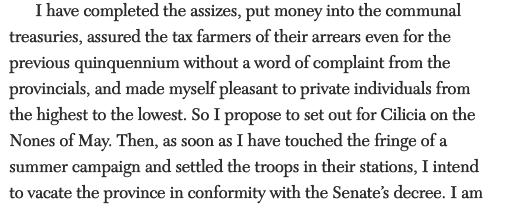
- If Roman officials don’t devolve costs on provinces AND local magistrates don’t exploit thier own communities, they can pay their debts AND taxes. Mention of present quinquennium and past quinquennium. Presumably taxation period of 5 years. F.2.13 echoing A.6.2. Back taxes paid without complaint.
- Other Business investments – These may be debt/moneylending related but it is often not explicit in the text.
- Atticus has financial interests in Ephesus and gets help from Asian governor
- T. Claudius Nero has business interests, both in Nysa and with a certain Pausanias of Alabanda and Servilius Strabo, gets help from governors
- Discussion of property sales and rivalries in business back in Italy, nothing relevant.
- Obligations that cost but aren’t expressed as purely financial
- The panthers for Caelius and Octavius, who will pay for the hunt?
- Purchase of Milo’s estate to save it
- Gifting a Philosopher a house in Athens
- Giving the role of praefectus to be excused from jury duty
- Letter carrying
- Publicani (not necessarily trustworthy but fast)
- Pomptinus was leaving Ephesus but for Appius’ sake turned back and delivered a message to Cicero in Laodicaea.
- Personal slaves and freedmen dedicated to the task
- Caring for vulnerable minors
- Honors for Romans from locals
- lex Cornelia tried to regulate
- Benefactions to local communities from powerful Romans. (mostly Athens)
- Sourcing a musical instrument
- sourcing pottery
- Cicero treated Cato’s clients well and expects something in return
- Cicero honored Cassius’ recommendation of Fadius and now wants political support in return
- hunting for self liberating slaves
- Letters with information about state of politics
- Devolution of expenses on Local communities
- Cicero did accept: boats, four beds and a roof, Stuff L. Tullius took under lex Julia.
- Refused payment to not provide winter quarters, saved Cyprians 200 talents
- Gavius wanted to take allowances Cicero says no, title, no pay
- Cicero won’t order hunt because of cost to locals
- Government Funding
- SC authorizes treasury to release funds
- Funds available in Laodicaea
- Lictors can serve as official letter carriers
- Must leave financial records in two cities (Tarsus, Laodicea, Apamea all candidates, S-B thinks the latter two based on F.2.17, I see A.6.7 seeing a deposit at Tarsus).
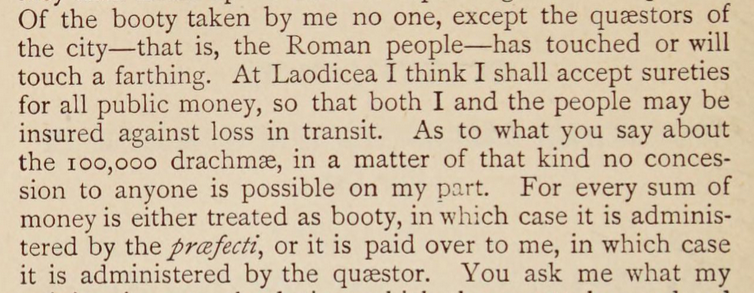
- Plunder will be deposited with City Quaestors
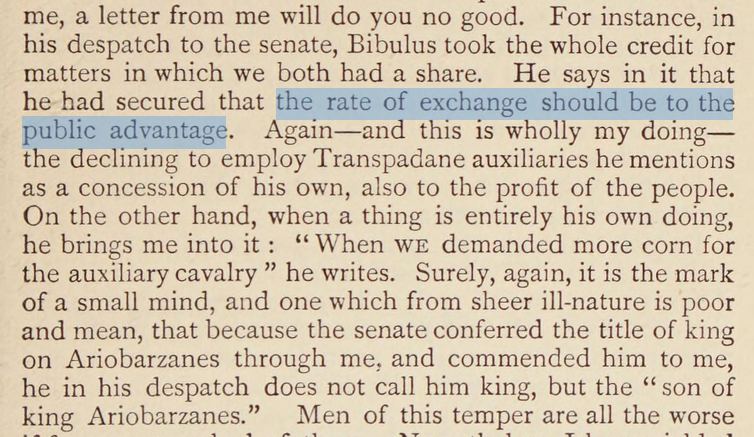
- rate of exchange negotiated to public advantage
- Fronting Money (kinda sorta like Banking)
- Depositing Money (kinda sorta like Banking)
- Offering to Underwrite a Line of Credit
- Sense of Financial Entitlement
- Agents managing Finances on Behalf of Others
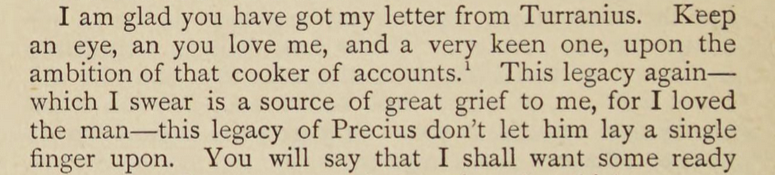
- Inheritances
- three discreet wills mentioned over four letters none that interesting drop from project
These categories overlap and that’s ok, even critical to my major point. My list will evolve as I sort my notes but that is ok too. Memory is fallable! Below I’m sorting the same information from my earlier post by my newly determined categories.
A work in progress. To be continued.
Debts, between Romans
Cicero owes Caesar 800k Sest, possibly with 20k interest (A.5.1, A.5.5, A.5.6: May 51, A.5.9: June 15, 51). Cicero is fretting about whether this is resolved (27 June 51, Athens, A.5.10),
Cicero makes explicit the connection between not exploiting provincials and his own debt. The money he borrowed from Atticus will have to be repaid by yet another loan. (A 5.15. 3 August 51. Laodicia.; cf. A.5.13. where the drawing of a line of credit at Ephesus is mentioned.)
Cicero has told his agent Philotimus not to collect on Messalla’s debt to Attilius (because of the Messalla’s recent conviction). A.5.19. 20 September 51.
??A.5.21: Does P. Valerius owe Atticus?

A.6.1. 20 February. Laodicaea. Possibly loan related:

and from the same mention of a debt owed (presumably to Cicero) by an Egnatius that may or may not be paid. Perhaps a man from Teanum Sidicinum.
F.8.12. Begun mid August but not posted until after 23 Sept. From Caelius.

The Latin is confused but it seems Appius as censor is looking to take action against Caelius and in doing so trying to show favor to Pompey. SB assumes Caelius has already gone over to Caesar at the is point.

Appius retaliated by charging Caelius under the lex Scantinia (immoral sex acts with the freeborn, maybe). Who charged him with the same in return. Tells Cicero he should take up his cause against Appius.
Debts, communities, foreigners owing Romans
Someone in Cicero’s province owes Sittius money, Caelius wants Cicero to help him collect. SB thinks this is really Caelius’ own money. (F.8.2. June 51; F.8.4. August 1, 51). Caelius has sent men to collect this debt; the same who will be transporting panthers! (F.8.9. 2 September 51). F.8.11. April. From Caelius. Mentions Sittius (related to the panther business).
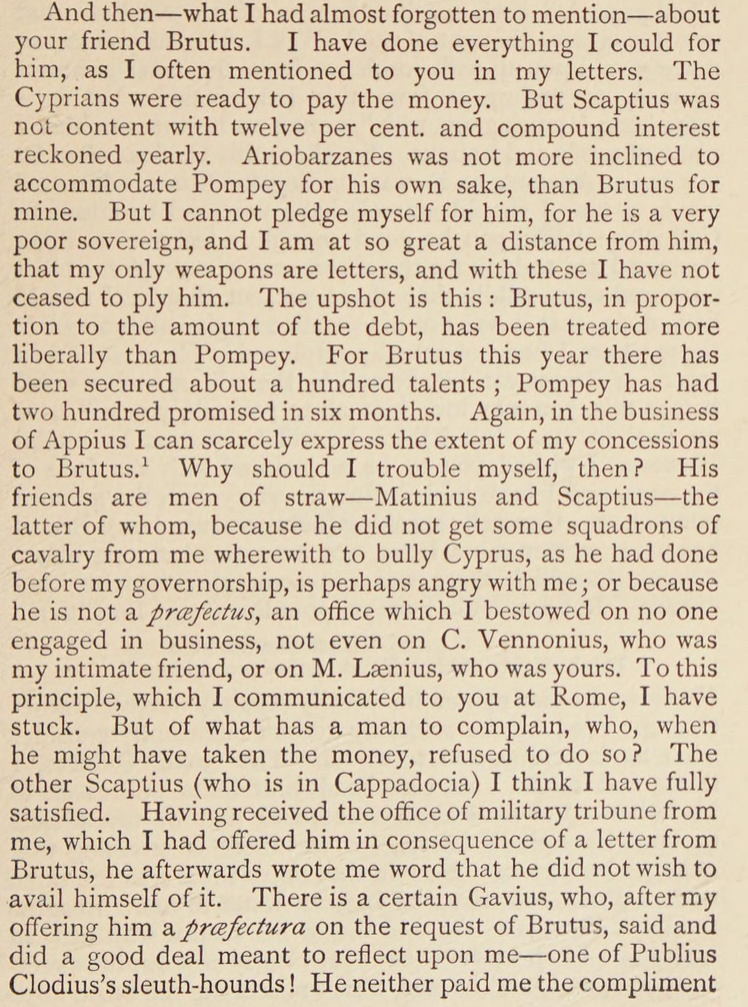
Ends letter by saying that he will settle up Brutus’ business (clearly a favor asked by Atticus) and do so better than Brutus could himself BUT his pupillum he cannot defend (against delinquency charges), because he is so poor and without resources. [A.5.18.51 September. Cybistra.] Cicero alludes to having cheered Brutus even as he denied extracting money from king Ariobarzanes. (A.5.20. 19 December 51, Pindenissum). Fullest summary of Brutus’ investments,A.5.21. February 13. Laodicaea.

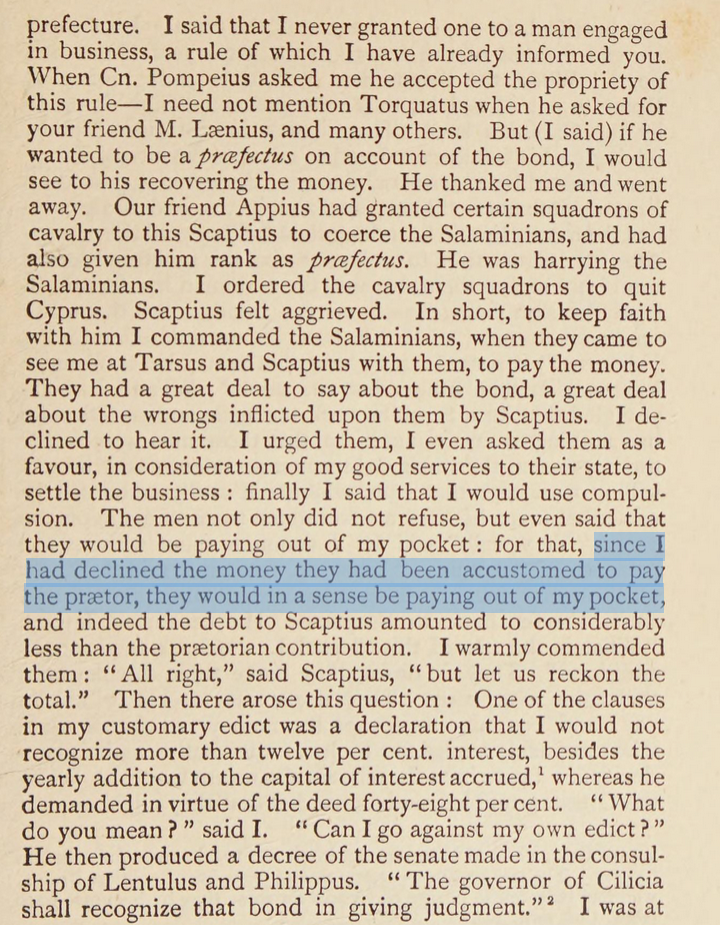

A.6.1. 20 February. Laodicaea. Apparently in a letter of 21st Sept. Atticus praised Cicero’s restraint with Appius and independence regarding Brutus. Long reflection on how Appius bled the province dry and how pleased Cicero is to reverse course and rescind his injustices.
Now follows the deep financial interests of Pompey and Brutus in Ariobarzanes:


Cicero’s efforts to separate government and business are bucking the common trend and ruffling feathers. He moves on to Salamis:


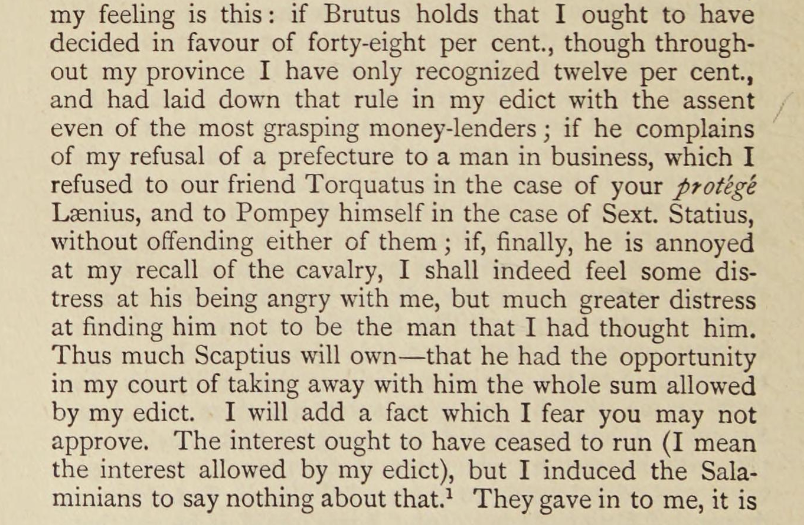
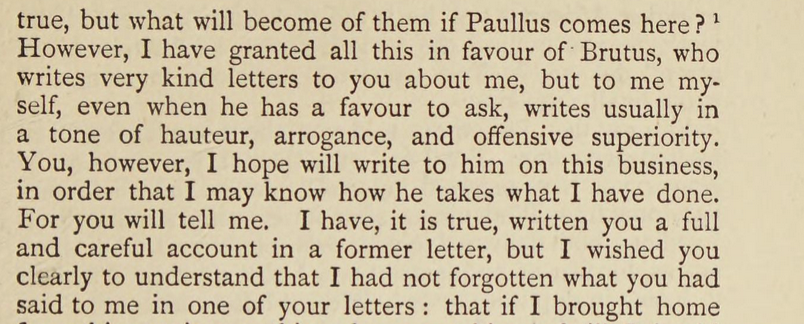

I find the idea that Paullus would favor Brutus because of family connections odd logic (S-B follows this logic too). The two brothers did not get along at all. Could it be another relationship between Paullus and Brutus? S-B worries that Paullus couldn’t get a province in light of Pompey’s law requiring a 5 year wait, but clearly Cicero thinks that law is not worth much given current political landscape and obviously he was correct just not in this way.

Invokes His own Republic as moral justification in the face of others’ anger at him sticking to his fiscal policies
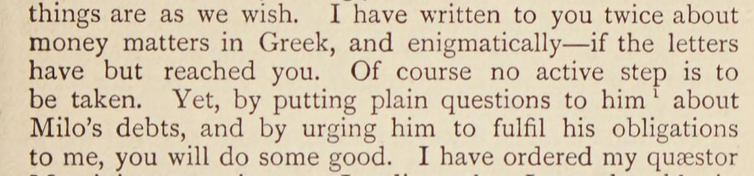
F.013.56. Date uncertain. Again to Thermus. Recommends Cluvius the banker of Puteoli. Mylasa and Alabanda owe him money. An Agent named Euthydemus told Cicero at Ephesus that Mylasa would send envoys to Rome. A specific individual in Alabanda has mortgaged property and needs to pay or surrender the property to Cluvius’ agents. Heraclea and Bargylia are also in debt to him, but can offer liens instead of payment. Caunus says they deposited the money they owe him but Cluvius is claiming it as unpaid. Pompey underwrites these debts to Cluvius.
F.13.61. Date uncertain. To Nerva governor of Bithynia and Pontus. Requests help collecting on a debt of 8Mill owed by Nicaea to a young man Pinnius for whom Cicero is serving as a guardian.
F13.57. Spring. Laodicaea. To Thermus (governor of Asia). Needs his military expert M. Anneius back and because of this needs Thermus to sort out Anneius legal woes with Sardis.
A.6.2. First week of May. Laodicaea. Responds to a letter Atticus sent via Brutus’ letter carrier.


F.2.18. June. Cilicia. To Caelius. Hungry for news. Reports Caelius’ men have left to try to collect on a debt. Down plays any hope of a triumph.

A.6.3. June. Cilicia.
Taxation
Caelius recommends an equites M. Feridius to Cicero who hopes to secure an exemption from taxation on certain lands. The Latin is a little obscure here and the financial arrangements thus also. This may be at the expense of locals in favor of Roman investor interest? (F.8.9. 2 September 51)
Communities already suffering from a lack of resources–local communities petitioned linking this expense to already burdensome tax collection. Informs Pulcher that he was met by publicani on Samos! who convinced him to change the wording of his edict [in their favor] by adopting a phrase from Pulcher’s edict. F.3.8. 8 October 51.
F.13.65. Date uncertain. Also labelled as to Nerva, but the community that needs to be influenced appears to the Ephesus and thus perhaps this also went to Thermus? S-B is silent. My own hypothesis. Cicero describes himself as a patron of whole tax company and P. Terentius Hispo in particular. They’re supposed to be collection pasturing duties.
F.13.9. Date uncertain. To Crassipes quaestor in Bithynia. Urges him to help publicani, esp. P. Rupilius.
F.8.7. February? From Caelius. Refers to another letter sent via Cicero’s freedman (implies safe method) lets it be known this is written in a rush to give to publicani (unsafe communication).
F.3.7. After February 11. Laodicaea. To Appius. Letter is travelling via Brutus’ messengers and written in haste. Commissioners from Appia delivered to Cicero a letter from Appius complaining Cicero’s policy stopping additional taxes has stopped a building project. Cicero assures Appius more of the members of the community want the tax halted than want it extracted.
Letters carried by Publicani mentioned for speed of delivery. A.5.21. February 13. Laodicaea.
A.6.1. 20 February. Laodicaea:
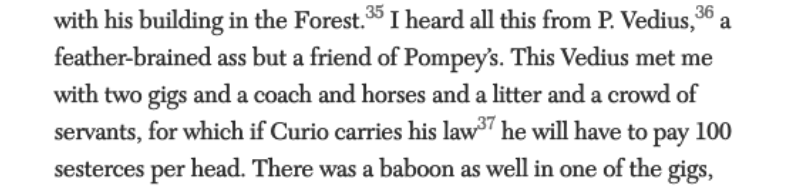
A.6.2. First week of May. Laodicaea. Responds to a letter Atticus sent via Brutus’ letter carrier.

F.2.13. early May. Laodicaea. To Caelius. Mostly trying to convince Caelius he does like Appius just as he likes Brutus and Pompey.
Inheritances
Cicero writes the exiled Memmius (pr. 58) seeking have him grant Patro(n), an Epicurean, Epicurus’ (ruined?) house in Athens, which Patron seems to claim was his by Phaedrus’ will, but Memmius owns through a decree of the Aeropagites. Cicero claims Atticus wants this to happen. (F.13.1. July 51. Athens.)
A.6.9. Athens. 15 October.
F.14.5. 16 October. Athens. To Terentia. Much concern about letter exchange and travel arrangements also political news

A.7.1. 16 October. Athens.

A.7.2. Brundisium. 25 November.

Other business investments
Atticus has financial interests in Asia (specifically Ephesus?), but the local governor Thermus has it in hand. Cicero only makes more introductions to Atticus’ people. (A.5.13. after 22 July. Ephesus.). Alludes to his helping Atticus’ business dealings via Thermus in Ephesus. (A.5.20. 19 December 51, Pindenissum). Again the same pressuring of Thermus (A.5.21)
Caelius alludes to Cicero having a negative view of Sempronius Rufus in relation to a business deal involving also Vestorius of Puetoli. Tuccius who is persecuted by Rufus seems to have been a close business associate of Vestorius: wares of both merchants have been found together in shipwrecks. See D’Arms 1980: 48-55 for full reconstruction of the relationship using A. 14.12 and A. 6.2.10 and epigraphic evidence. F.8.8. October. Rome.
F.13.64. Date uncertain. Labelled as to Nerva in manuscripts but seems more likely to have been to Thermus, so S-B and I concur. Recommends T. Claudius Nero’s business interests, both in Nysa and with a certain Pausanias of Alabanda and Servilius Strabo.
F.9.25. After February 11. Laodicaea. To Paetus. Spells out M. Fadius’ trouble: his brother Quintus has listed for sale a property jointly owned at Herculaneum. Marcus doesn’t want it sold. Cicero is soliciting help to settle outside of court. Marcus’ problems may stem from Mato and Pollio. (Cf. F13.59)
A.6.1. 20 February. Laodicaea. We don’t know why Philotimus was in the Chersonese or what the payment is for:
Later in same letter mentions of Lucceius putting a Tusculum property for sale and Lentulus Spinther putting everything but his Tusculum property on the market
Obligations that cost but aren’t expressed as purely financial
Caelius Rufus mentions the cost of employing someone to write down decrees, gossip, news, etc.. that he is sending to Cicero. (F.8.1, May 51) He wants to be paid in panthers for this new services (F.8.2, June 51; F.8.4, 1 August 51;) Caelius wants Cicero to send more than 10 panthers (the number secured by Curio via Patiscus and now gifted along with 10 more to Caelius). The feeding and transport of said panthers can be handled by the same men Caelius has sent to collect on Sittianam syngrapham! He’s willing to send more men if needed. For debt collection or panthers is ambiguous. Perhaps intentionally. They are one and the same. (F.8.9, 2 September 51). Almost as a postscript, Caelius mentions his entanglement with Curio who is opposing everything Caesar does. The entanglement is the gift of African animals, and thus Caelius presses Cicero to deliver panthers. He’s sent a Greek and a freedmen with the message but also to retrieve the animals and pressure Cicero. F.8.8. October. M. Octavius (curule aedile with Caelius; Appius’ father in law) wants panthers. Atticus suggested unlikely. Cicero says NO. No extra public expense. A.5.21. February 13. Laodicaea. F.2.11. April 4. Laodicaea. To Caelius. Cicero tries to assure Caelius that he’s working on the panthers BUT not using public funds/powers. Cicero must satisfy both his own reputation and also Caelius’ expectations. Patiscus is Caelius’ agent on the ground.
De pantheris per eos qui venari solent agitur mandatu meo diligenter.
Cicero is purchasing Milo’s estate after his exile to help preserve key assets and ensure his wife, Fausta’s, dowry is restored to her. (A.5.8, June 1, 51).
Cicero writes the exiled Memmius (pr. 58) seeking have him grant Patro(n), an Epicurean, Epicurus’ (ruined?) house in Athens, which Patron seems to claim was his by Phaedrus’ will, but Memmius owns through a decree of the Aeropagites. Cicero claims Atticus wants this to happen. (F.13.1. July 51. Athens.)
Let’s Atticus offer anyone the role of praefectus on his staff to get them out of jury duty (!).A.5.11. 6 July 51. Athens
This letter is being sent via a trusted mutual but Cicero explains most letters will be delivered via the private companies charged with land tax and customs collections. (A 5.15. 3 August. Laodicia; cf. conditions of writing in A.5.16, c. 14 August)
Has entrusted Deiotarus with son and nephew for campaign season. A.5.17. August. On the Road to Pilomelium? or Perhaps Iconium? Mentions his debt to Deiotarus for looking out for the boys. (A.5.20. 19 December 51, Pindenissum)
Cicero defends to Pulcher his decision to absolve local communities of sending representatives to Rome (to praise Pulcher). He frames it as an unnecessary financial burden on communities already suffering from a lack of resources– F.3.8. 8 October. Cilician plain.
Cicero promises to be on the look out for the right musical instrument for Phemio (presumed to be an enslaved musician in Atticus’ household, cf. A.6.16.7).
Requests Cato vote in favor of honors in the Senate to celebrate his successful military campaigns, part of the argument is base on services rendered to Cyprus and Commagene, Cato’s client states. F.15.4. January?
F.15.13. January? To Paullus. Cicero alludes to his endebtedness for past political support of Paullus, asks for him to support him on not staying in the province and a positive vote in senate on honors for Cicero.
F15.14. January? To Cassius. Network of mutual obligation is contructed through Cassius’ recommendation of Fadius and their shared connection to Brutus. Cicero mostly wants political support in return.
Cicero reports on other matters including his failure to recover two self liberating slaves: one case was mentioned in A.5.15 as a goal.A.6.1. 20 February. Laodicaea. The musical instrument for Phemius has been acquired at great cost as has some special pottery from Rhosus
A.6.1. 20 February. Laodicaea
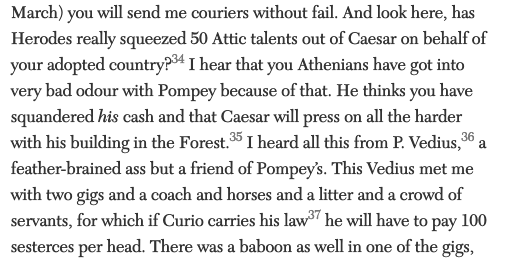
F.3.10. early May. Laodicaea. To Appius. Trying to convince him he has his back and that he loves Pompey and Brutus. Pomptinus was leaving Ephesus but for Appius’ sake turned back and delivered a message to Cicero in Laodicaea.
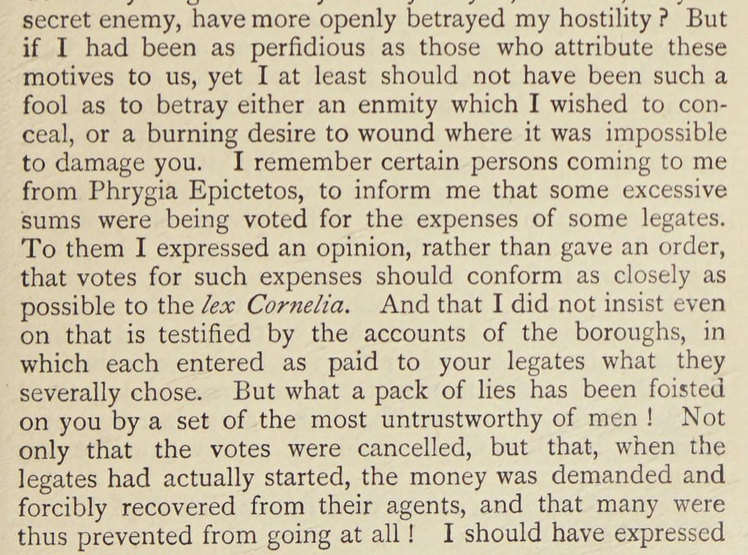
Cicero emphasizes how he has fulfilled past obligations:

More about loyalty to Pompey Appius’ daughter’s father in law. On account of his restoration. Also his letting him support Milo without repercussions. Ethnic prejudices… How could you believe a Phrygian or Lycaonian legate over me.
A.6.6. Side. 11 August.

Payment for services
Caelius Rufus mentions the cost of employing someone to write down decrees, gossip, news, etc.. that he is sending to Cicero. (F.8.1, May 51)
Devolution of expenses on local communities
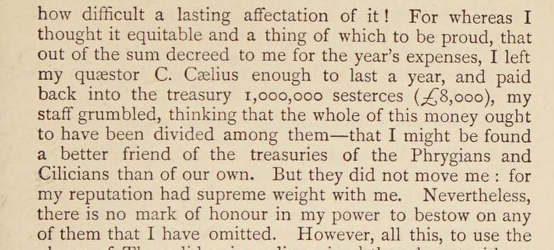
Cicero brags neither he nor his staff have taken anything from local communites (27 June 51 BCE, A.5.10, Athens; A.5.17 August 51). Long reflection on how Appius bled the province dry and how pleased Cicero is to reverse course and rescind his injustices. A.6.1. 20 February. Laodicaea.
Has boats from Rhodes and Mitylene as well as others for his own use, but also brags about no exploitation. {A.5.11. 6 July 51. Athens}
In order NOT to devolve expenses on local communities Cicero has put himself in debt to Atticus (A 5.15. 3 August 51. Laodicia.; cf. A.5.13).
General complaints about how the province has been drained of resources. Cicero now accepts four beds and a roof but not even hay or firewood. However he is often in a tent he says. A.5.16 c. 14 August. Between Synnada and Pilomelium.
M. Octavius (curule aedile with Caelius; Appius’ father in law) wants panthers. Atticus suggested unlikely. Cicero says NO. No extra public expense. A.5.21. February 13. Laodicaea. Cf. Other Panther discussions, but here we finally get explanation of why it is a problem. A.6.1. 20 February. Laodicaea.:

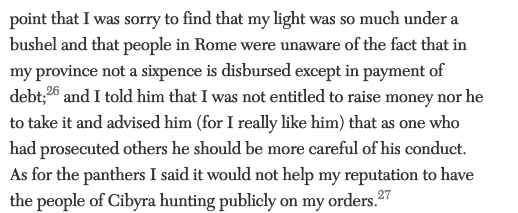
Also from A.5.21:


A.6.3. June. Cilicia.
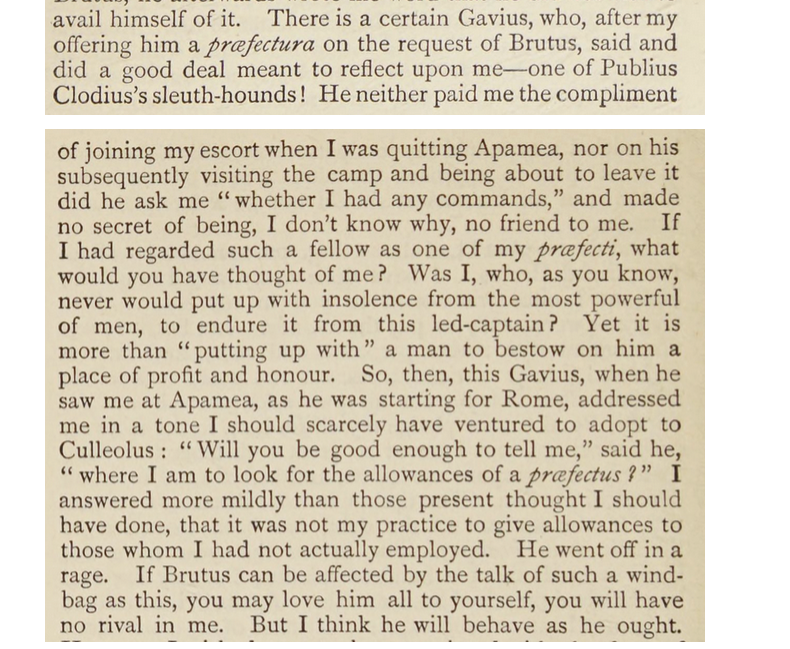
Government funding
Cicero needs an SC to pass to authorize a grant from Treasury to fund his provincial governorship, says Bibulus needs the same. (A.5.4: 12 May 51)
Cicero writes to Pulcher the out-going governor about their various travel and logistics:
perpaucos dies, dum pecunia accipitur quae mihii ex publica permutatione debetur, commorabor.
This sentence helps us see that even public funds do not necessarily need to be sent from Rome to fund provincial activities. Cicero can simply access the funds upon arrival. In combination with the previous quote, we see that Cicero had arranged to pick up cash for himself in Ephesus, and for his official duties in Laodicea. (F.3.15. 28 July 51. Tralles.)
F.2.19. Cilicia. After June 21st Lictors can serve as official letter carriers!
Must leave accounts in two cities Tarsus and Laodicea. A.6.7. End of June. Tarsus.
F.2.17. Tarsus 18 July. To Sallustius proq. Syria. Accounts will not be sent may be deposited at Apamea. Plunder will go to the city quaestors.
A.7.1. 16 October. Athens.
Depositing Money
Salamis debt /// temple…
Caunus debt payment deposited Cluvius disputes
Drawing on a Line of Credit
This sentence seems to me the clearest example of individuals being able to draw on lines of credit internationally rather than travel with vast sums of coin or bullion: “Ego praeterea rationem Philogeni permutationis eius quam tecum feci edidi.” (A.5.13. after 22 July 51. Ephesus; cf. A.5.15 that discusses this as a debt.)
F.16.4. Leucas. 7 November. To Tiro ill at Patrae.
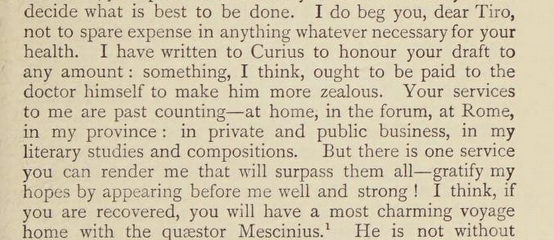
F.16.9. Brundisium. 26 November. To Tiro ill at Patrae.


Offering to Underwrite a Line of Credit
Sense of Financial Entitlement
Agents managing Finances on Behalf of Others
Cicero wants Atticus to be his agent to resolve matters with Caesar’s agent Oppius (A.5.1, A.5.5, A.5.6: May 51)
Milo is objecting to a freedman of Terentia, Philotimus, being a partner in the financial transaction. (A.5.8, June 1, 51), Caelius promises to ensure Philotimus doesn’t do anything wrong. (F.8.3, June 51). Cicero is fretting about Milo’s estate (27 June 51, Athens, A.5.10),
A.6.1. 20 February. Laodicaea. Possibly relevant:
A.6.4. Tarsus. Early June.

A.6.5. June 26. Tarsus.

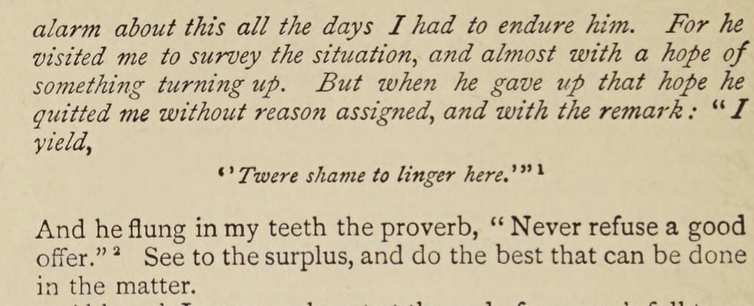
More reference in A.6.7. end of June. Tarsus
A.6.8. Ephesus. 1 October.

Bribery
Messalla (cos. 53) was guilty of bribery and that the jury should not have acquitted him, such as to make Hortensius regret defending him and winning. (F.8.2. June 51)
3 million sestertii were transferred from Pulcher (previous governor)’s estate to Servilius to try to secure a failed prosecution for extortion, the former’s own son testified to this. F.8.8. October. Caelius.
F.3.2. June. Cilicia. To Appius. Addresses him as if he were censor. Congratulates him on acquittal.

Judicial Role in Finances
Expresses anxiety about settling contracts in his province given pressures he’s already facing from locals and Romans even where he is not governor (A.5.13. after 22 July. Ephesus.)
Caelius recommends an equites M. Feridius to Cicero who hopes to secure an exemption from taxation on certain lands. The Latin is a little obscure here and the financial arrangements thus also. This may be at the expense of locals in favor of Roman investor interest? (F.8.9. 2 September.)
F.13.53. Date uncertain. to Thermus governor of Asia as for special treatment of L. Genucilius Curvus about property rights and in determination of the venue for any legal proceedings.
F.13.55. Date uncertain. Again to Thermus. Requests help for his legate M. Anneius in his ongoing legal suit with Sardis.
F.13.64. Date uncertain. Labelled as to Nerva in manuscripts but seems more likely to have been to Thermus, so S-B and I concur. Recommends T. Claudius Nero’s business interests, both in Nysa and with a certain Pausanias of Alabanda and Servilius Strabo.
A.6.1. 20 February. Laodicaea
Discussion of parts of Cicero’s edict including right to over turn bad faith contracts and allow locals to be tried under their own laws. He divided the edict in three parts, but first and foremost all the stuff about money to be paid to taxcollectors, debts, interest, etc…


Servilius was governor of Cilicia 78-74.
“I spent but two days at Laodicea, four at Apamea, three at Synnada, and the same at Philomelium. Having held largely attended assizes in these towns, I freed a great number of cities from very vexatious tributes, excessive interest, and fraudulent debt.” F.15.4. January? To Cato.
F.13.54. Spring. Laodicaea. To Thermus (governor of Asia). Recommends a Marcilius son of his interpreter. Specifically to help him stop the prosecution of his mother in law. Not certain the prosecution is related to finances… but seems likely.
F13.57. Spring. Laodicaea. To Thermus (governor of Asia). Needs his military expert M. Anneius back and because of this needs Thermus to sort out Anneius legal woes with Sardis.
F.3.2. June. Cilicia. To Appius. Addresses him as if he were censor. Congratulates him on acquittal.
Plunder
The amount for which captives are sold remains a question. Watt wants the number to be 12,000,000, S-B prefers 120,000. The main question to my mind is to what degree are these captives being ransomed to other loved ones, versus being sold as chattel slaves. The British museum quotes 2,000 sestertii for an unskilled or moderately skilled person. So did he sell 60 people or did he sell closer to 6000 people? If S-B is right. Cicero did not deserve that triumph if Watt is correct the triumph is more warranted. A.5.20. 19 December. Pindenissum.
F.2.17. Tarsus 18 July. To Sallustius proq. Syria. Accounts will not be sent may be deposited at Apamea. Plunder will go to the city quaestors.

 Liv Mariah Yarrow
Very interesting, even though I haven’t gotten to work on this famous historical context, your writing enthuses and makes me wish I had/could.
So, have you heard of “topic modeling?” It’s a big DH thing. I wonder if it could ever be useful. We basically do it anyway, but it’s something being used at scale with coding:
https://guides.library.upenn.edu/penntdm/methods/topic_modeling#:~:text=What%20is%20Topic%20Modeling%3F,within%20a%20collection%20of%20documents.
As for the mapping stuff, keeping track, I spent some time making a couple of maps for publication this week on ArcGISonline. I think it pays to have some familiarity with the entire ESRI platform. There are so many ways to keep track of spatial info in these ways, to export out and in. Basically, sitting with your GIS librarian and just getting a sense of how to use ArcGIS online could be great. I use FieldMaps out in the field to keep track of my ideas, and I use Story Maps with students. I mean, it’s a great way to have everything in one place, and I have moved away from Google MyMaps which used to be my teaching/thinking sketch pad. You can export anything in KML and throw it in Google *from ArcGIS, but it’s a great home base and your institution will give you a subscription…
Thanks for this!!