Aes Rude and Aes Grave, Praeneste Finds

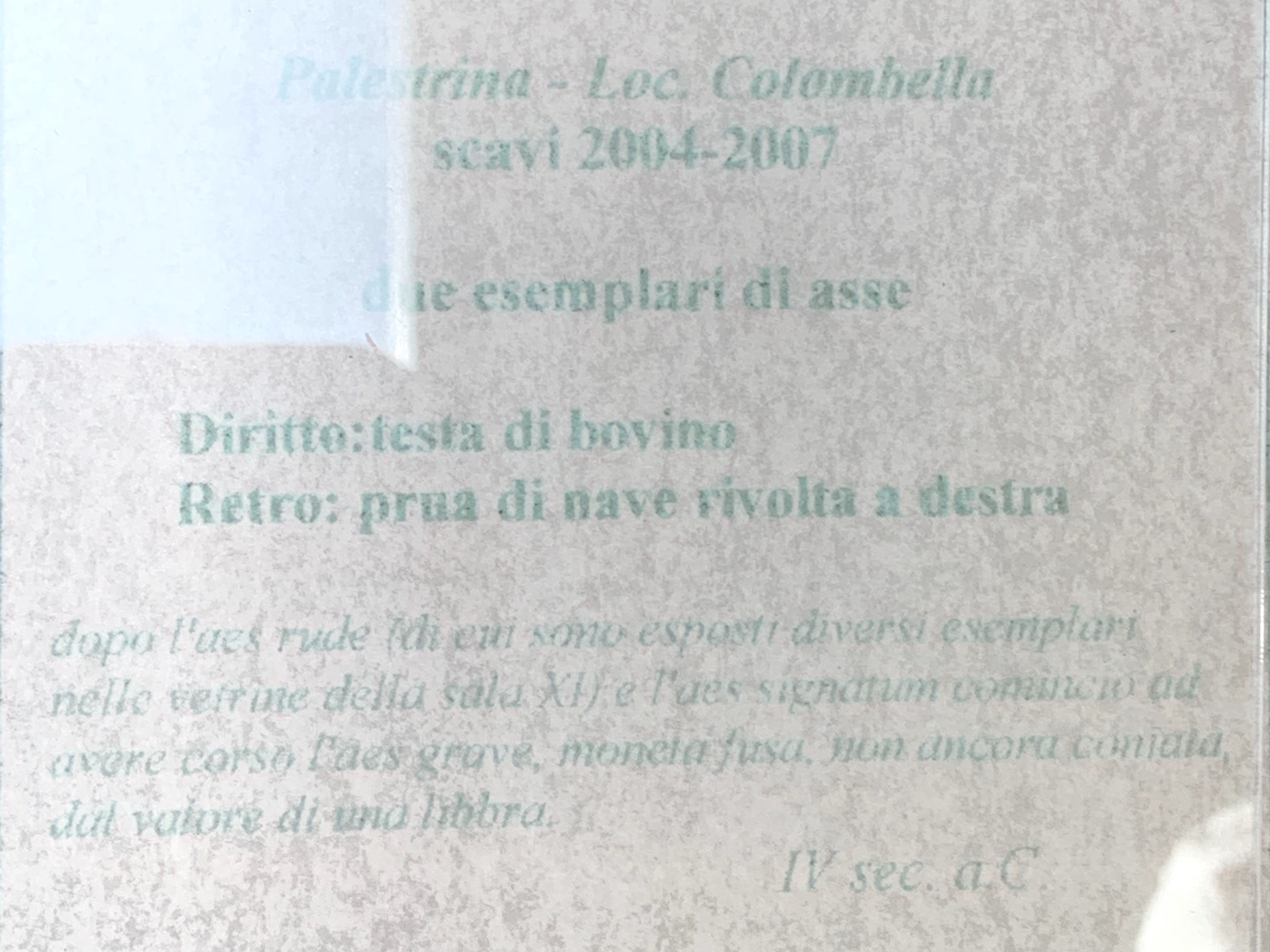
Two more bull/prow aes grave semisses have come to light at Praeneste in archaeological contexts and  are now on display in the museum.  This is HN Italy 359 = Vecchi 276 = Haberlin, pp. 157-158 (specimen in trade, second specimen in trade).  Thomsen ERC III: 149-150 thought these might be Roman aes grave but this has not been accepted by others.  Vecchi notes a weight range of 167.96-118.20g.

Previous finds were Praeneste prior to 1893 and the Ariccia 1848 hoard (c. 28 km SW of Praeneste, ~6 hour walk due to elevation changes).

Now with THREE pieces found at Praeneste, I think we should assume that it the place of manufacture until further evidence comes to light.

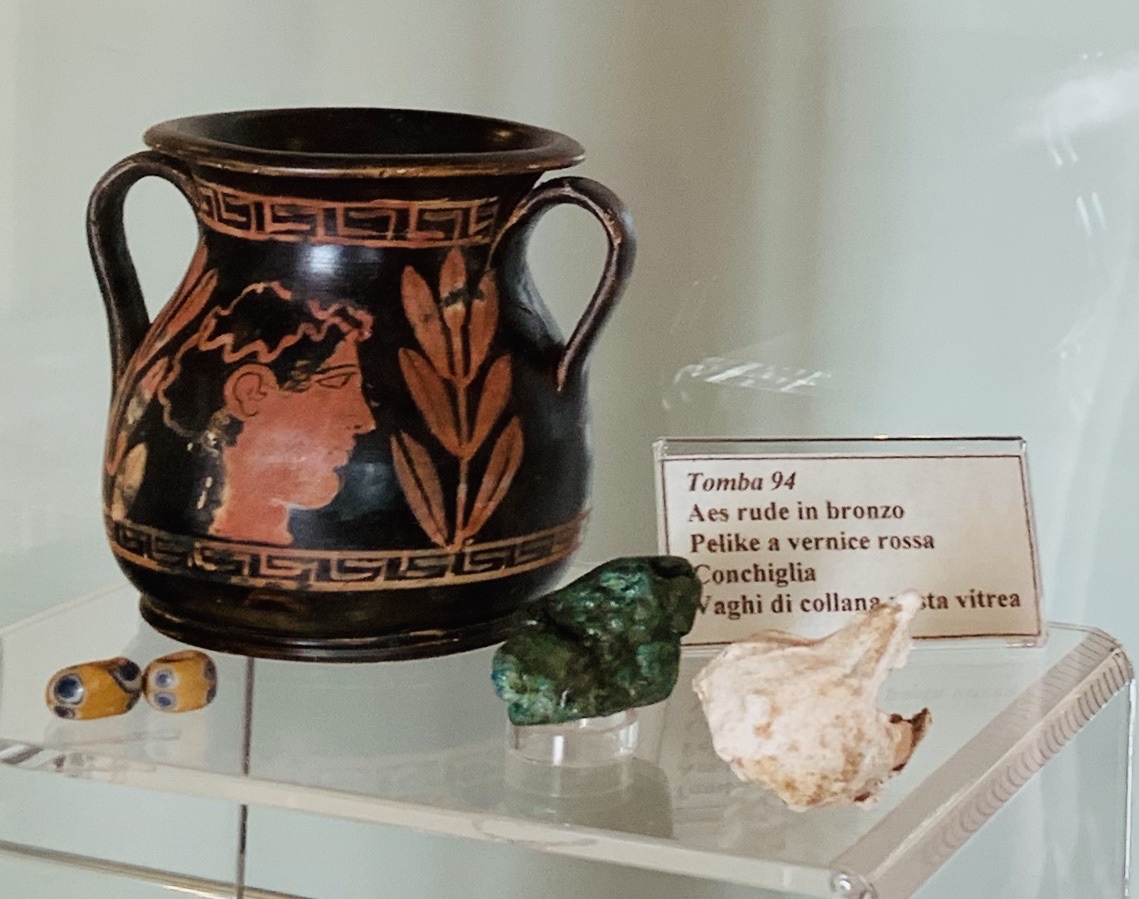
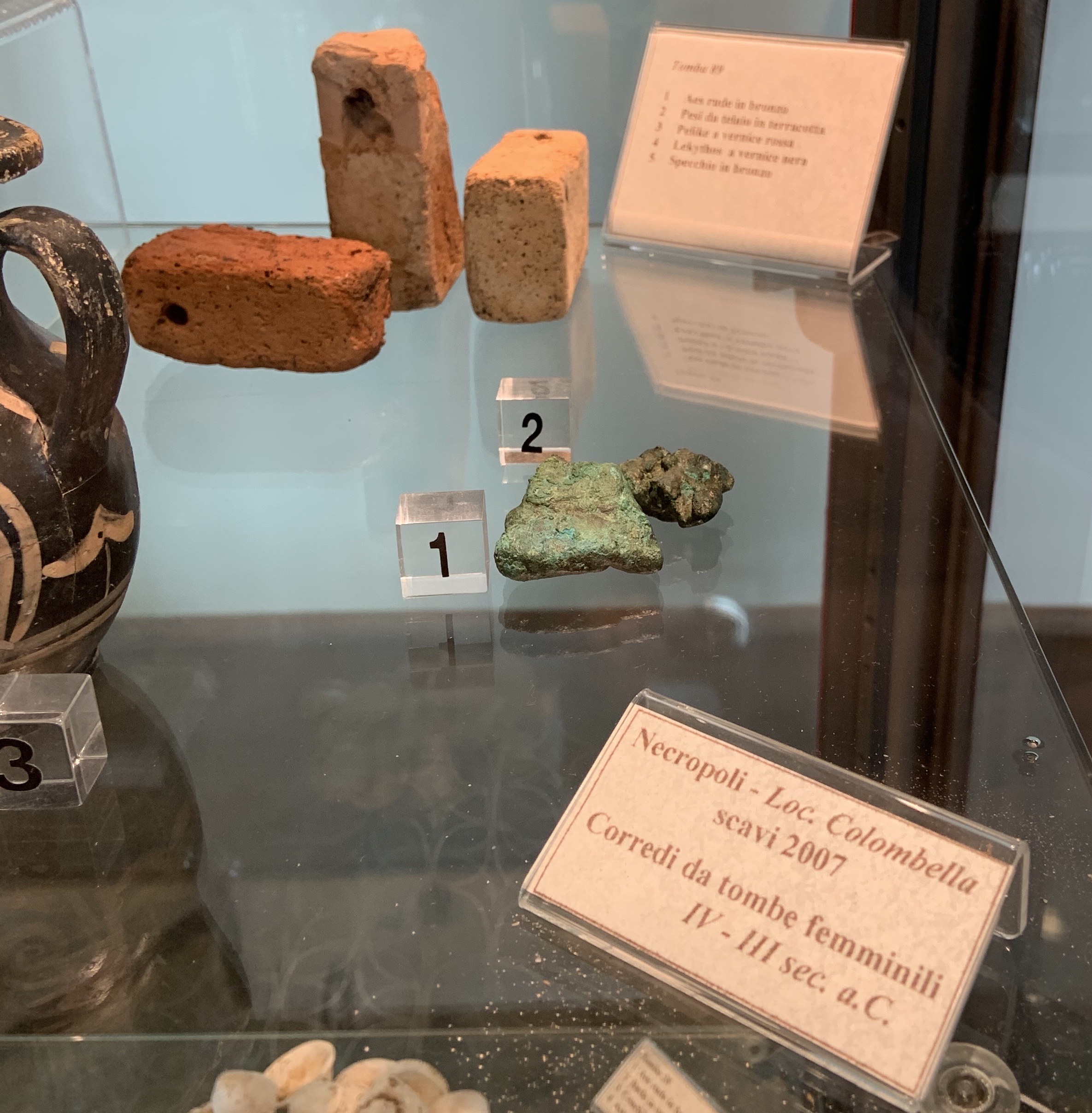
The other major thing to note is the regular use of aes rude in Funerary Contexts.  This was already observed in the 1907 excavations (see AJA 1908 summary below), but is now reconfirmed by the 2007 finds.

It seems that these aes grave may also be from funerary contexts as they were unearthed in the same Colombella excavations. – private correspondence with the excavator suggests the aes grave was NOT from a burial context.

img_0994

AJA 1908 report.

Vaglieri 1907 full details.

Capture.JPG

Update 1/12/23:

Possibly relevant bibliography for such finds:

Parente, Anna Rita. “La Lucania: necropoli e monete : (V-II secolo a. C.).” In Caronte: un obolo per l’aldilà, Edited by Cantilena, Renata., 276-288. Napoli: Macchiaroli, 1995.

Presence of coins in the grave goods of Greek and indigenous Lucanian necropolises. The phenomenon is recurrent in the Greek context, where the coin placed in the tomb probably has the symbolic function of a prestigious asset, in the manner of the obeloi and the aes rude (traditionally interpreted as pre-monetary objects). In the indigenous sphere the phenomenon is very rare and perhaps limited to cases of emulation of the Greek funeral practice

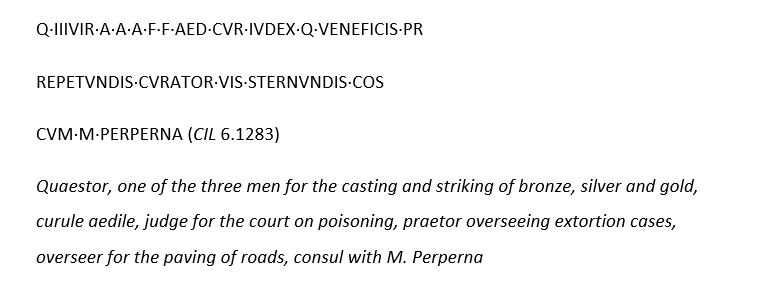
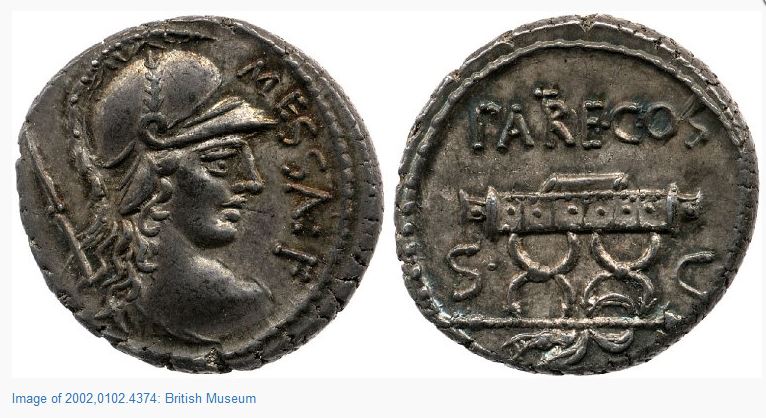
Ap. Claudius cos. 130 BCE, MONEYER?!

Capture.JPG

The traditional interpretation of this inscription makes it in honor of C. Claudius, moneyer of RRC 300.

But this article upsets that (full original pub on order from ILL) This is AE summary.

Capture.JPG

Machine translation cleaned up by moi.

“This article proposes that the name of Ap. Claudius Αρ. f. C. n. Pulcher, consul in 130 BCE, be restored instead of that of C. Claudius Αρ. f. C. n. Pulcher, consul in 92 BCE. Both were co-consuls with an M. Perperna. But Gaius, whose praetorship dates back to 95 BCE, was not praetor repetundis but praetor peregrinus and the curator uiis sternundis or uiarum curandarum is in better agreement with the chronology of Appius’ career. The family tree of the Claudii Pulchri reconstructed by Münzer is corrected as follows: the consul of 130 BCE would not be the son of the homonymous consul of 185 BCE (eldest son of Ap. Claudius Pulcher, consul in 212 BCE); he would be the grandson of the third son C. Claudius Pulcher, consul in 177 BCE.”

Some points that are very interesting to the numismatist:

1)  If this is true, then the title triumvir aere argento auro flando feriundo goes all the way back to the mid second century.

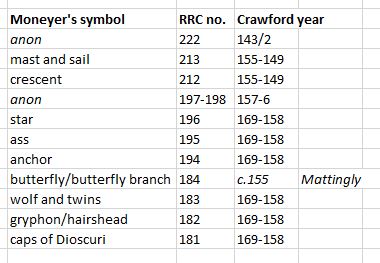
2) We don’t have a named coinage from the right date stuck by a Claudius.  Candidates for Appius issue would are limited and as follows:

Capture2.JPG

The argument seems to hang on whether Cicero’s Verrines is proof he was praetor peregrinus.

Capture.JPG

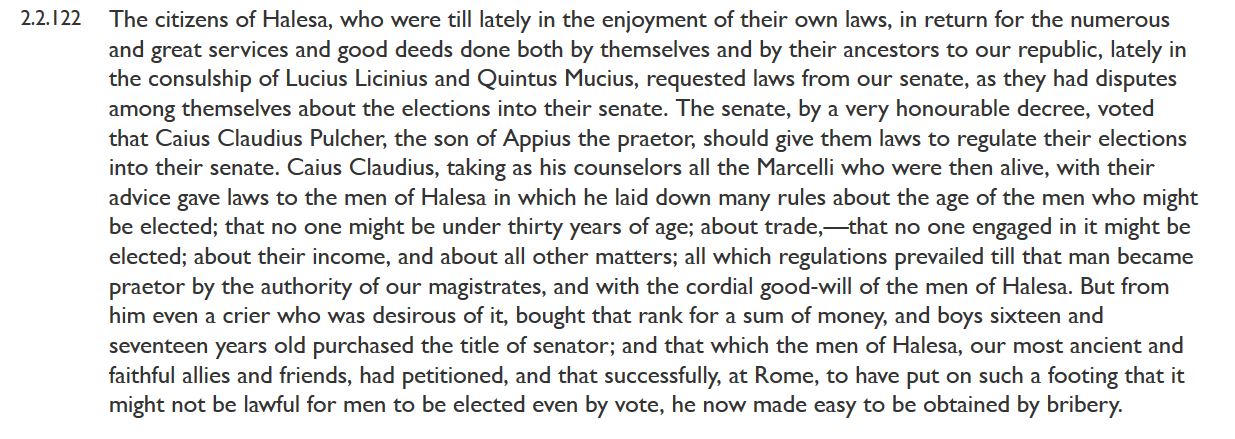
C. Claudius Appi filius pulcher praetor de senatu cooptando leges conscriberet.

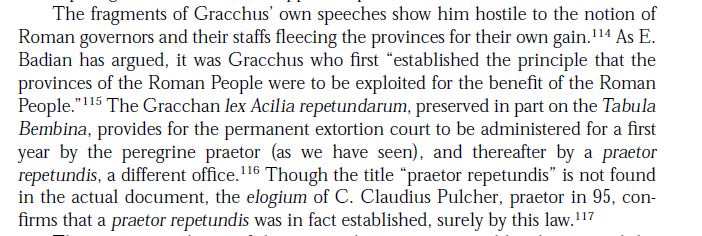
Brennan (2000: 237) is pretty certain about the timing of the creation of the title praetor repetundis and it is too late to be held by the cos. of 130…

Capture.JPG


How to be (or not be) on the job market?

I haven’t been on the market for ages, but here is a crack at some compassionate advice.  This post is in response to a tweet thread by Mark Letteney.

1. Getting a job won’t make you a better person.  It might not even make you a happier person. It certainly isn’t a reflection of your self worth.  Also, there is no right or wrong kind of job–except, of course, the right job is the one that keeps the wolves away and that doesn’t eat your soul and the wrong job is the opposite.

2. Write down somethings you like about yourself and tape it up above your desk next to a big sign above your desk: ” today and in the future I just need to keep the wolves at bay and feed my soul.” (Don’t skip this step: you’ll just have to do it later and it may be harder then.)

3. Okay.  Now go read job postings.  Don’t limit yourself to just one major search engine or professional placement service.  Diversify where you are looking and ask mentors and friends for help in this.

4. Decide how broadly it is right for you (and your dependents/partner(s)) to apply; cross out jobs you can’t accept for whatever reason. [pay too low? ethics of institution too different from your own? too short a contract for too hard a move?]  If this is hard, it is totally normal to talk to mentors and friends about these choices.  If someone starts pressuring you to apply for things that aren’t right for you, smile politely and walk away.

5. Create a timeline of deadlines and also self imposed deadlines, like how much time mentors and supportive friends need to read your cover letter and CV and help you catch stuff you missed.  Pre-circulate your materials to your letter writers in enough time for them to give you feedback and for you to integrate your feedback.

6.  How to write a cover letter [a template]

7. You should probably read those signs above your desk and do something nice about now.

8. For each job app tailor your cover letter and CV.  Do this by re-reading their job posting and also their own website and other promotional material.  Look for key phrases and ideas that you can reflect back to them without completely rewriting the materials.  If this is hard, reflect on why that may be.  Have a conversation with a mentor/friend about it.

9. Wait. You should probably read those signs above your desk and do something you genuinely enjoy about now.

10.  No interview requests? Keep applying.  Ask colleagues if they know about any likely upcoming opportunities.  Think broadly about what type of job might keep the wolves away and not eat your soul.

11. Interview invite? Time to do you research–this is not just online!  After you’ve got the lay of the land of public facing portion of the department.  Hit the rumor mill.  No, not the evil websites, never that.  They will just make you depressed.  I mean friends of friends. Who is the youngest person they hired?  What year?  Do you know anyone who was on the market that year?  What you really want is someone with some experience about the interview style of the department.  Free-for-all?  Structured questions?  Appropriate?  Random? Testing? Friendly?  You can’t control what the interview is like but the more you know the more likely you are to preform your best.

12. Once research is done or done-ish, it’s time to start creatively brain-storming what you’re going to bring to the table.  Think about generating some 12 anecdotes that show you in your best light.  They should cover a range of topics: exciting pedagogy, research, overlaps between research and pedagogy AND demonstrate breadth, and depth, and any key aspects mentioned in the job application.

[This is also my standard advice for prepping for oral exams.  You need discrete examples you know well and that you can flexibly deploy in conversation to illustrate a variety of topics/themes.  For instance, I love the bilingual footprint roof tile from Pietrabbondante and can talk about till the cows come home or I adore Julian and Augustan adaption of the republican forum and actually drew out diagrams in interviews to show evolution or I can wax poetic about how Batman is super useful for teaching the function of mythic retellings as a reflections of contemporary society.  What are your favorite gems?]

13. Mock interview.  Share your research on the institution and their interview style with a colleague/mentor, ask them to lean on their network to find 2-3 people who will interview you, ideally people you don’t know well and are a little senior.  Your goal is to be comfortable enough with your 12 anecdotes and general self confidence to adapt the material on the fly to new questions, without failing to answer the question.

Do not be afraid of re-articulating the question back to the interviewers and clarifying that they are trying to get at what you think they are looking for!

14. Stop talking to anyone who makes you feel insecure.  Mute them on social media.  And generally work on feeling awesome about yourself, your work, and also your general engagement with the field.  What have you read lately that got you excited?

15. Wear whatever makes you comfortable to the interview.  No really.  But remember that formal attire can, for some, feel like a suit of armor, psychic protection against the experience.  I like to think of it as a costume one wears to preform a piece of theater.  If choosing an outfit freaks you out.  Delegate the choice.  It is one of the few things someone else really can do for you in this long experience.

16. Remember the basics: eye contact, posture, body language, active listening.  Perform the person you want them to see and ideally you want to be (and probably already are even if you don’t know it in your heart yet.)  Think of yourself as already hired and these are your new colleagues.  Treat it like your first day of work and you really want to learn as much as possible so you can succeed at the job.  Ask questions and in those questions and your answers demonstrate your knowledge of their institution.

17. Send a thank you email.  Be brief, don’t gush.  If you skip this step it isn’t the end of the world.

18. Wait. Avoid rumor mill, esp. online.  Double down on your best support network.  You should probably read those signs above your desk again and do something you genuinely enjoy about now.

19. Getting a job won’t make you a better person.  It might not even make you a happier person. It certainly isn’t a reflection of your self worth.  Also, there is no right or wrong kind of job, except of course the right job is the one that keeps the wolves away and that doesn’t eat your soul and the wrong job is the opposite.

20. Be good and kind to some one else on the job market.

21. Give yourself permission to take days off from being on the market–even if you have applications out there. Wake up and say “today I am not on the market”.  Turning off email for 24 hours is not the end of the world.  We all need a mental break.  Make space to feel what it means to not be on the market and to just be you.
The Constitutional Crisis of 52 BCE

53-52 BCE is a scary year for Rome.  Violence meant elections weren’t held.  Pompey took on a sole consulship and for a time it looked like that was the end of the principle of collegiality in the highest magistracies.  It’s hard to imagine what living through that was like.
One window is offered by perhaps my favorite coin (RRC 435/1) which is rich anti-regal sentiments.

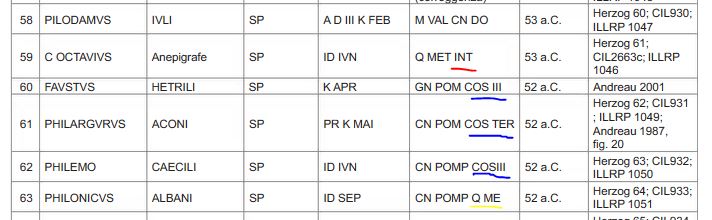
BUT look at this chart of tesserae numularia:

Capture.JPG

The move from interrex to sole consulship to finally the appointed colleague.  Ordinary business goes on but they need to find new ways to think about naming the year and counting time by consuls.

Link to article with chart.

Bonus coin image.

Capture1.JPG

More On Fighting Cocks

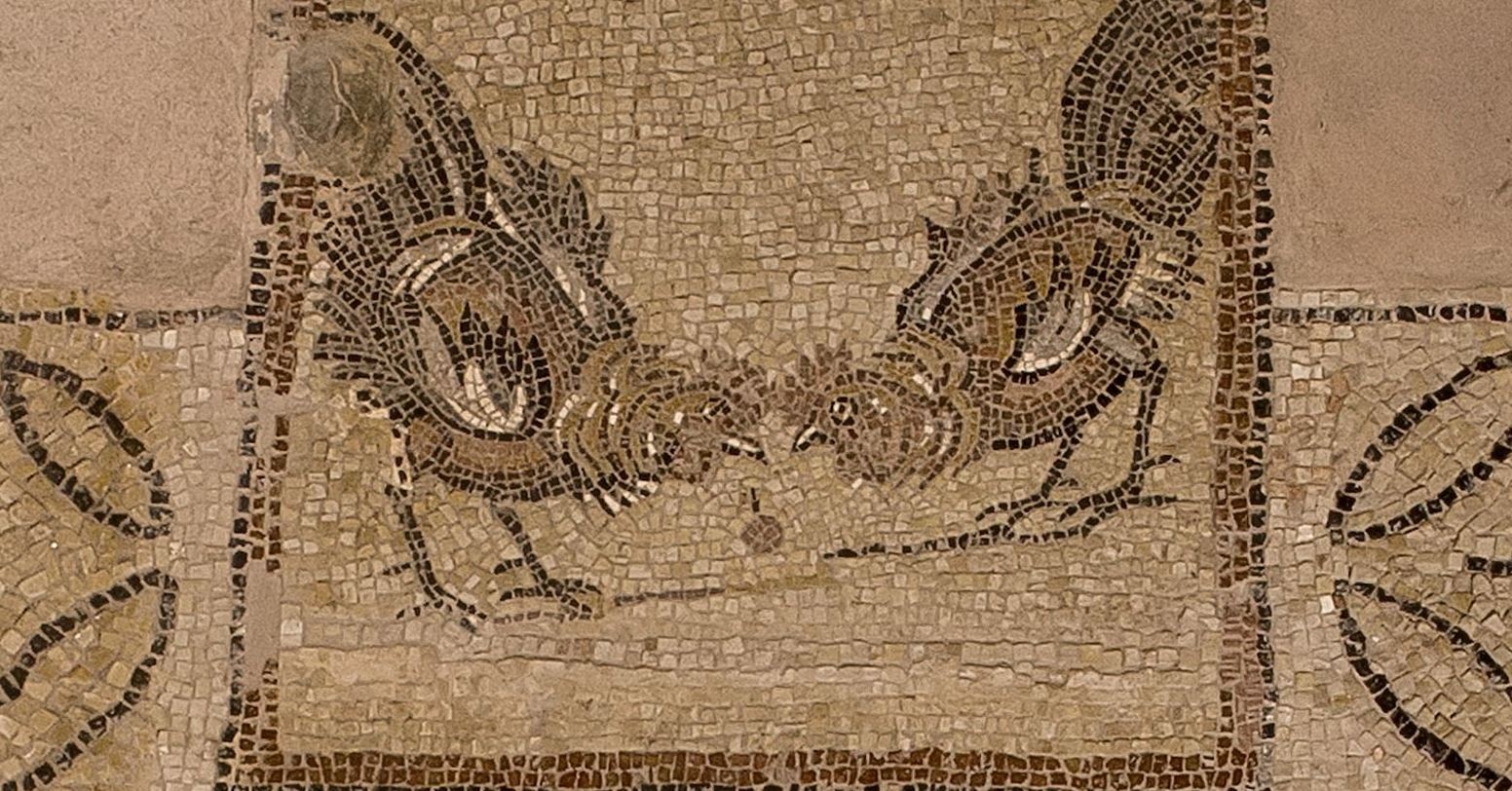
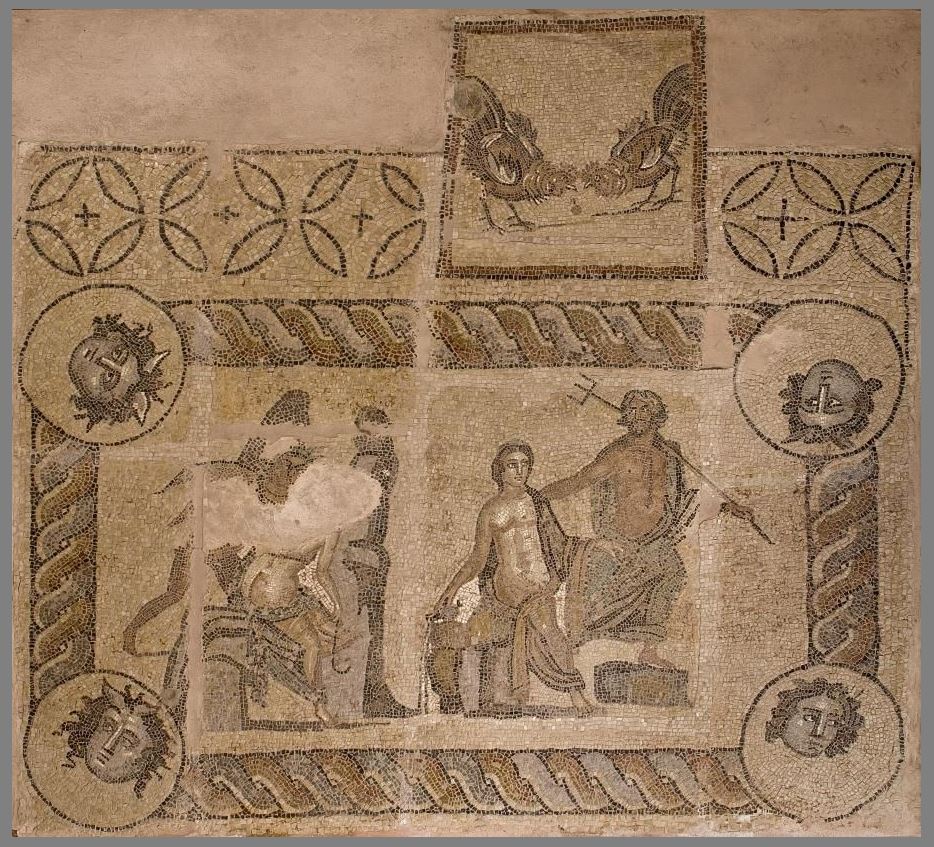
A kind colleague is reading a draft article of mine on Roman currency bars and pointed out to me that I missed Bruneau’s important (and well illustrated) 1965 article.

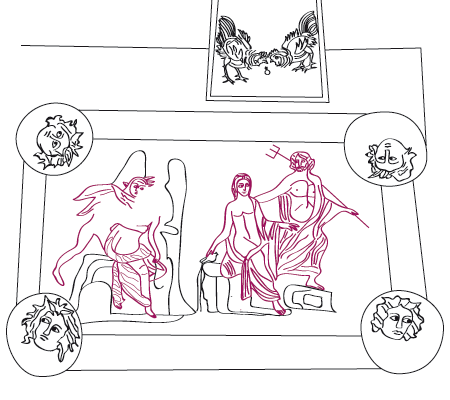
I am most taken by mosaic from a private villa on Crete that is now in the Chania museum.  The first two images are screen shots from the museum’s own website and even higher resolution is available there.

CaptureCapture3

This is from an excellent scholar’s blog, Alexandra Kankeleit, who has a long detailed post on the mosaic.

Capture1

My interest is of course because of RRC 12/1.

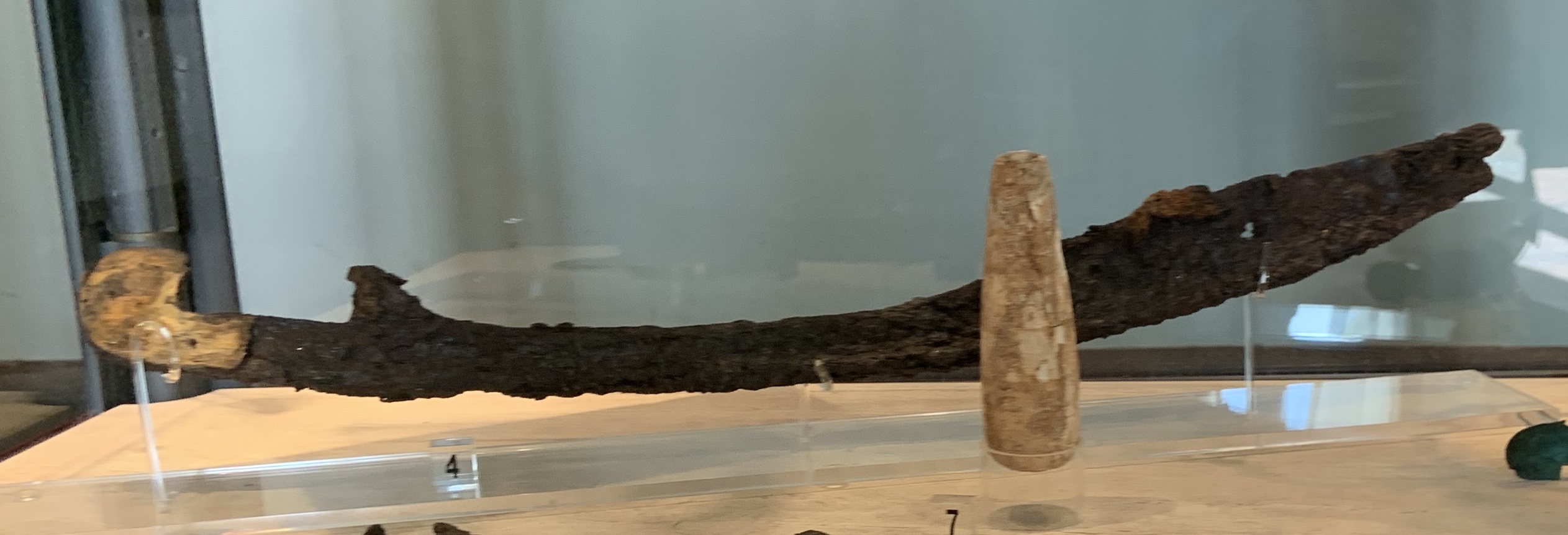
A Falcata at Praeneste ?

This tomb find has me questioning some of what I’ve written about sword iconography on the republican coin series.

Less worried about this find after seeing the distribution map (Kurtz 1991):

Capture

The BM has six falcata (although I can’t get them to come up on a collection search  in the database).

Update 21 Apr 2023:

As seen in the Vatican in the room for Etruscan Bronzes (cf. post on imagery of this type of weapon in Etruscan art)

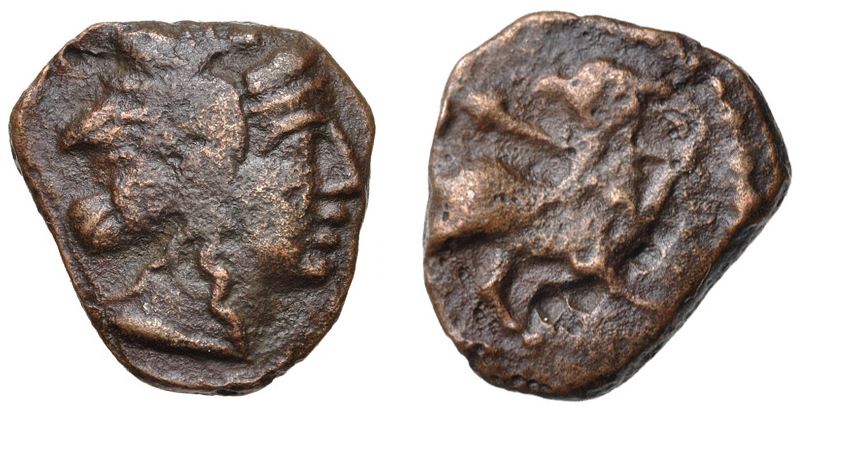
Dionysus and Panther at the Meta Sudans

This post is being updated and evolving: some edits have been made, more are likely to come.

Capture
Ex RBW collection

I’ve been reading a little about the Meta Sudans thanks to Harriet Flower’s new(ish) book. Its my bedtime reading right now.

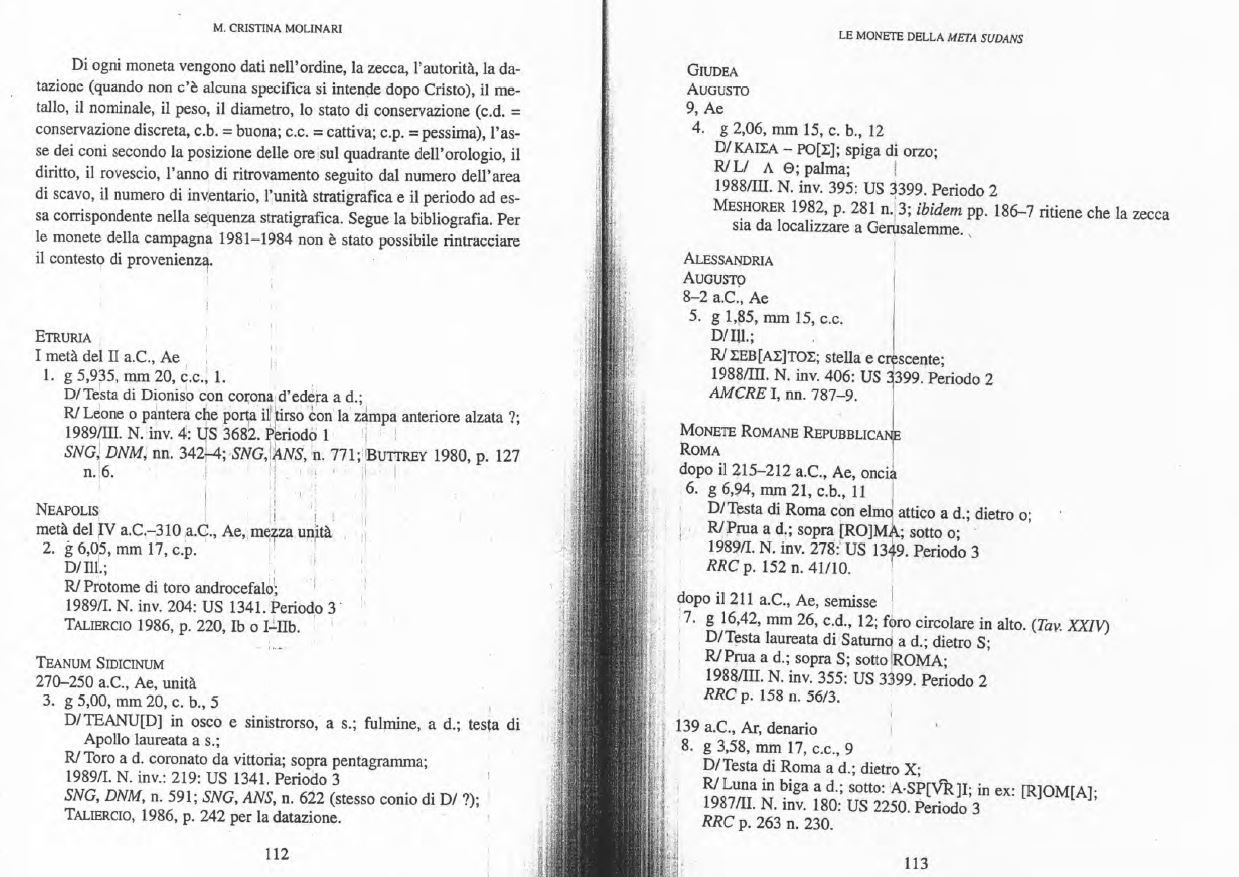
So was very excited to see Molinari published the coins.  Just some tantalizing info for those of us most interested in the Republic.

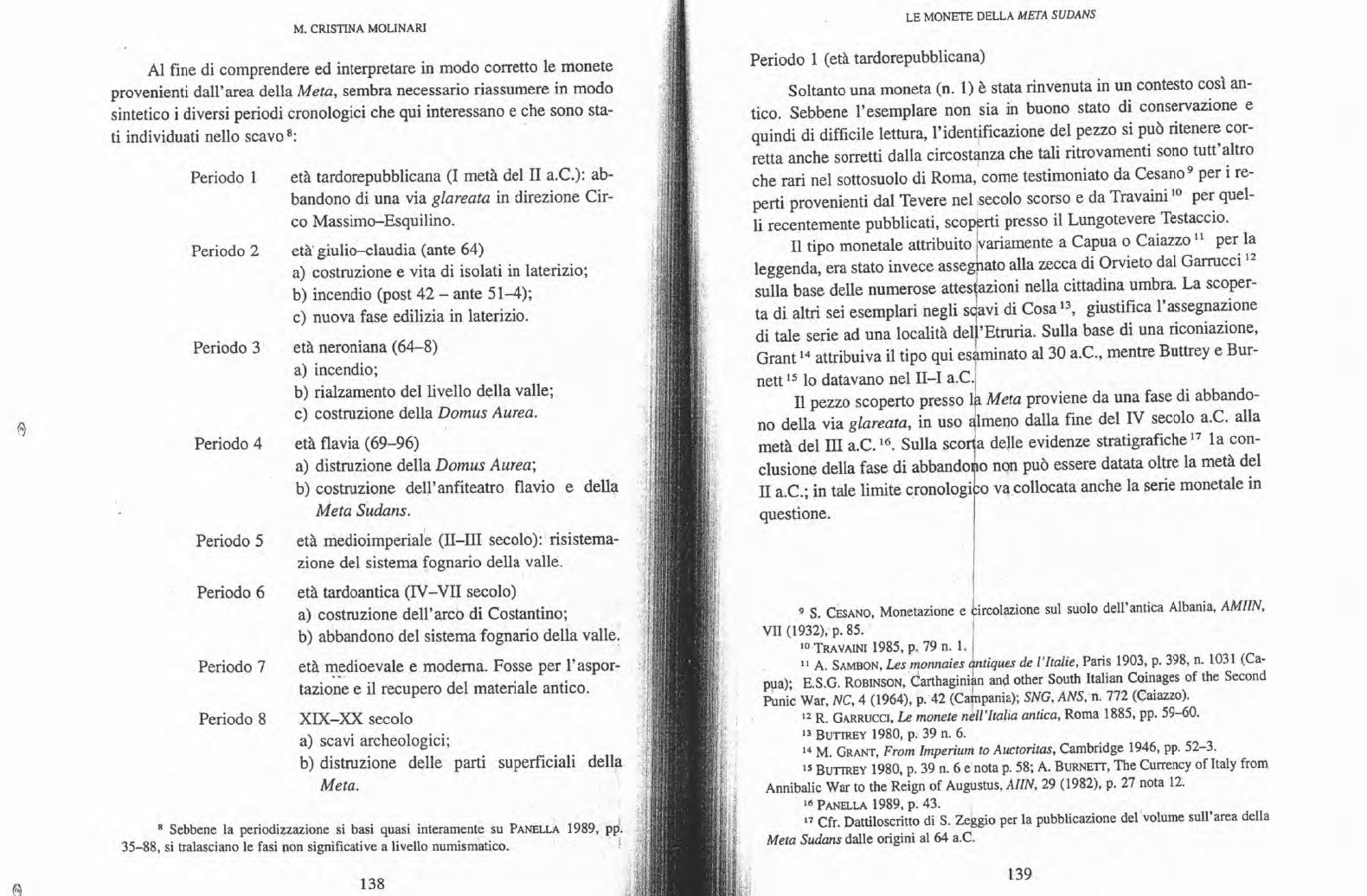
An English (Machine with Human editing ) Translation of a portion of Molinari’s 1995 piece.

“Period 1 (late-Republican age)
Only one coin (No. 1) was found in such an ancient context. Although the specimen is not in a good state of preservation and therefore difficult to read, the identification of the piece can be considered correct also supported by the fact that these findings are quite rare in the basement of Rome, as witnessed by Cesano for the finds coming from the Tiber in the last century and from Travaini for those recently published, discovered at the Lungotevere Testaccio. The currency type variously attributed to Capua or Caiazzo for the legend, was instead assigned to the mint of Orvieto by Garrucci on the basis of the numerous attestations in the Umbrian town. The discovery of six other specimens in the excavations at Cosa justifies the assignment of this series to a location called Etruria. On the basis of a reconception, Grant attributed the type mentioned here to 30 BC, while Buttrey and Burnett dated it to the II-I BC . The piece discovered near the Meta comes from a phase of abandonment of the via glareata, in use at least from the end of the IV century a.c. in the middle of the 3rd century BC. On the basis of the stratigraphic evidence the conclusion of the phase of abandonment cannot be dated beyond the middle of the second century BC .; in this chronological limit also the coin series in question should be placed.”

Images of Italian original text and accompanying catalogue entry below.

So… This picture of the dating of the abandonment of this particular via glareata needs to be reconsidered in light of overstrikes (over RRC 338/4 an LPDAP quadrans of c.91 and RRC 350B/1 a semis of c. 86 BCE) and further finds of this type that have now come to light:

Stannard and Sinner 2014 with additional information in Stannard and Sinner 2016

All the overstrike data is in Stannard 2017

Crawford 2002 in CH 9, p. 274 mentions that he knows of 3 overstrikes with the Janus in wreath / OPPI  (Romano-Sicilian?) undertype.  A CNG catalogue suggests that this undertype was made by M. Oppius Capito, Mark Antony’s naval prefect, circa 39-35 BCE, but that seems far too late… I think this is a misreading of Crawford’s meaning.   I cannot find just now an image of the coin Crawford means but it is described here.

On the lead tokens/coins discussed in 2014 also see:

Stannard, C., A. G. Sinner, N. Moncunill Martí and J. Ferrer i Jané (2017). A plomo monetiforme from the Iberian settlement of Cerro Lucena (Enguera, Valencia) with a north-eastern Iberian legend, and the Italo-baetican series. Journal of Archaeological Numismatics: 59-106.

They have a Numismatic Chronicle article forthcoming (2019 or 2020) on this topic and there is a Warwick blog post building on their material that discusses iconography of the man with a shovel.

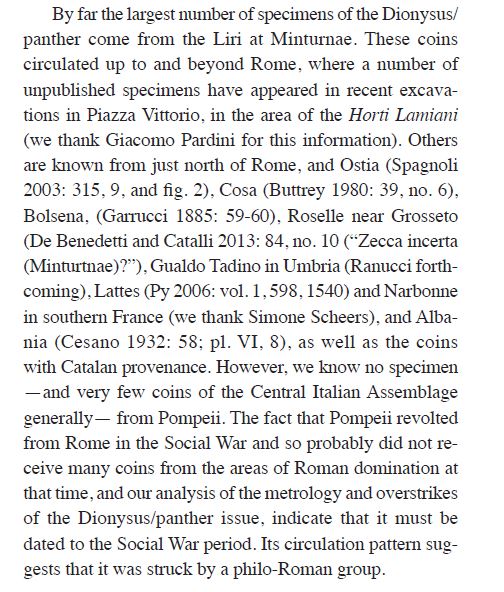
Distribution they summarize thus:

Capture.JPG

Why would a philo-Roman group overstrike Roman coins?!

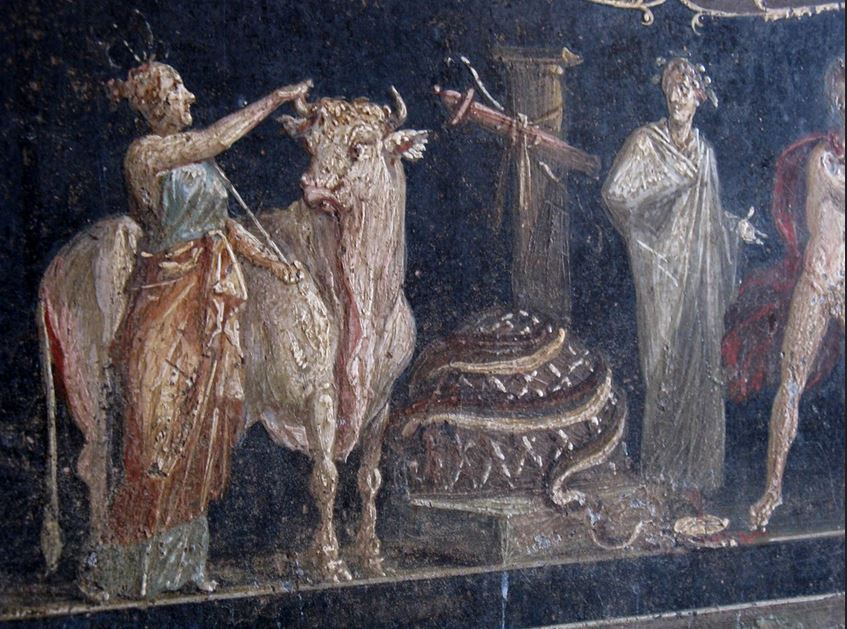
The Socii were ALL ABOUT Dionysus…

Also note that Molinari notes the find of an imitation quadrans found in Period 5 but dated c. 91 BCE as part of the Meta Sudans excavations.  Given that the Dionysus Panther type is being associated with a pseudo mint (Minturnae?) perhaps this should be brought into the conversation too:


Capture2

Capture

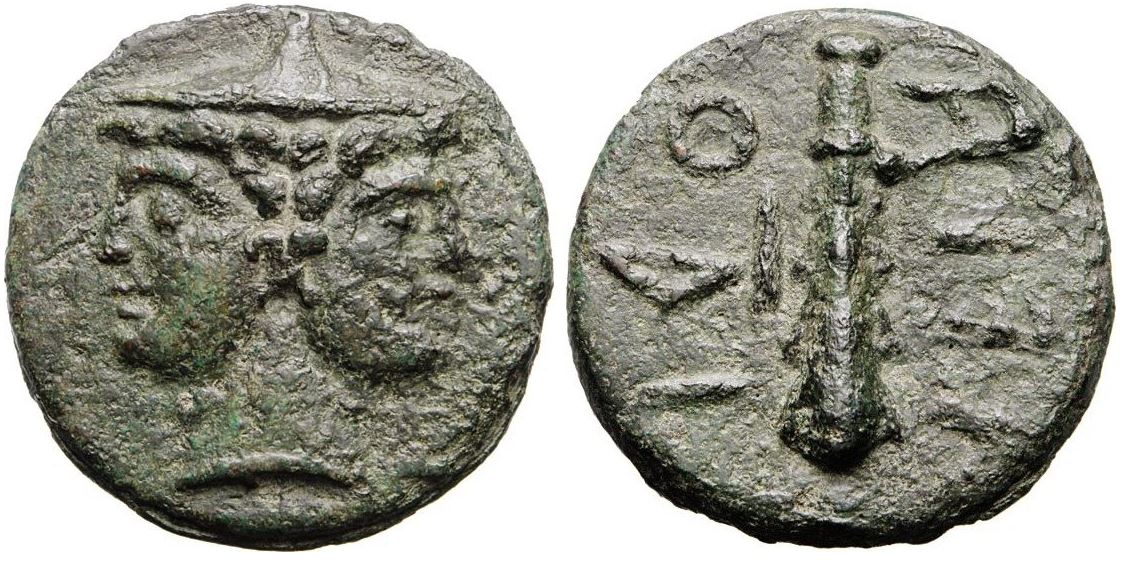
Janus, c. 235 BCE

Article link.

Capture1Capture

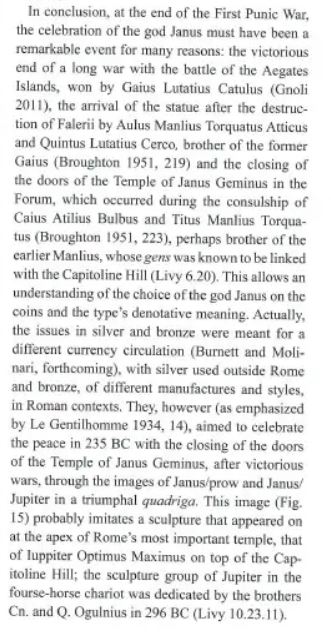
This short, dense well illustrated article is pretty convincing.

I want to think about what it means for other janiform heads on other (Non Roman) Janiform heads, esp. the third century aes grave of Volterra (Vecchi 128-144).  Vecchi thinks Roman types may be influencing Volterran choice in this instance.

Capture.JPG

235 BCE makes sense as a watershed date for the quadrigati and the janus/prow series, but it still leaves me wondering about the as of RRC 14 which Molinari and Jaia help put into a pre-Punic War context.