


MFA Faunus intaglio
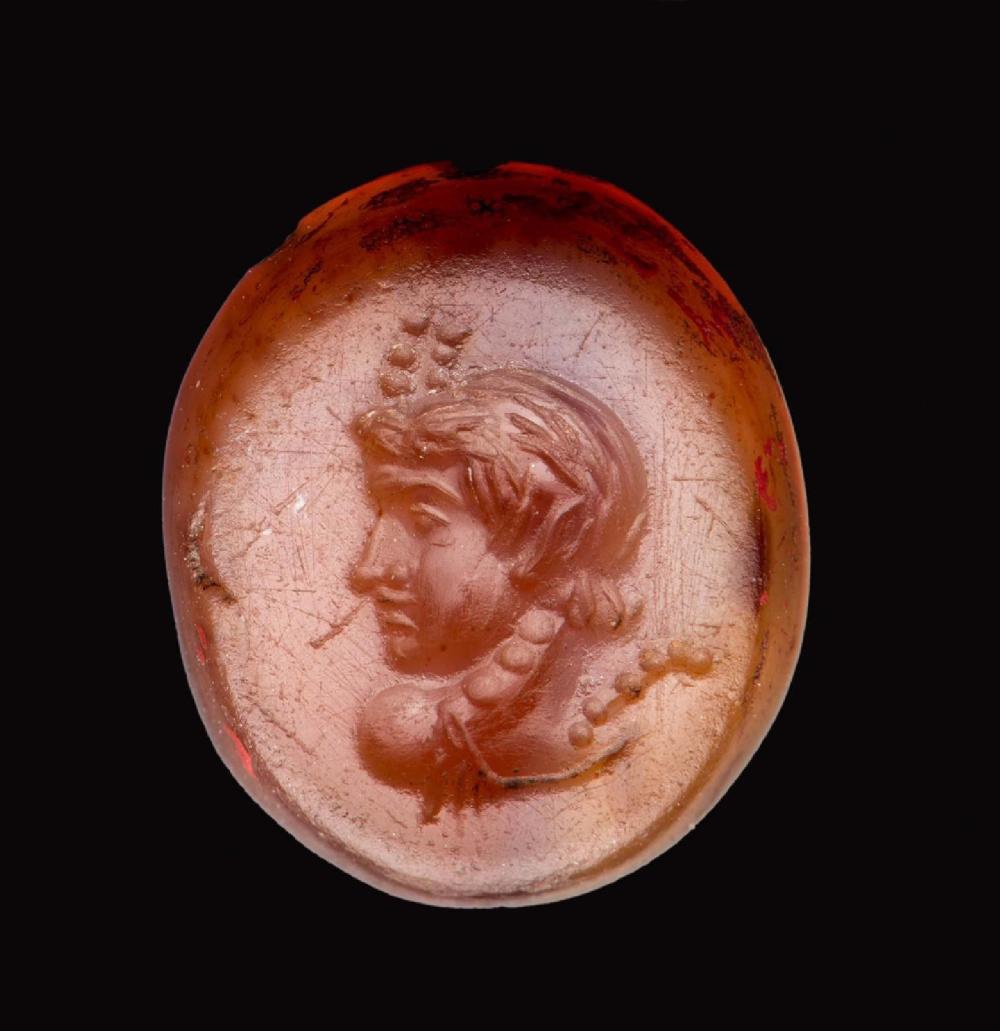
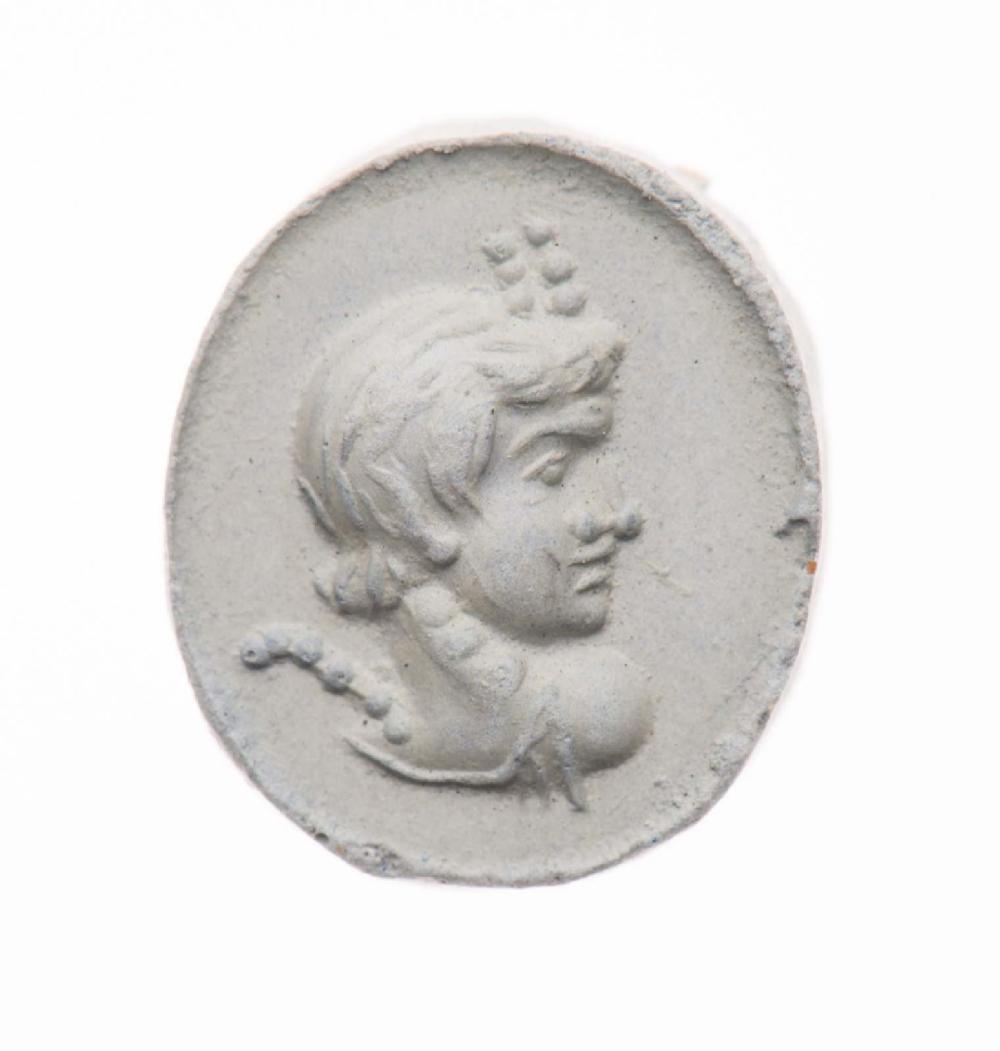

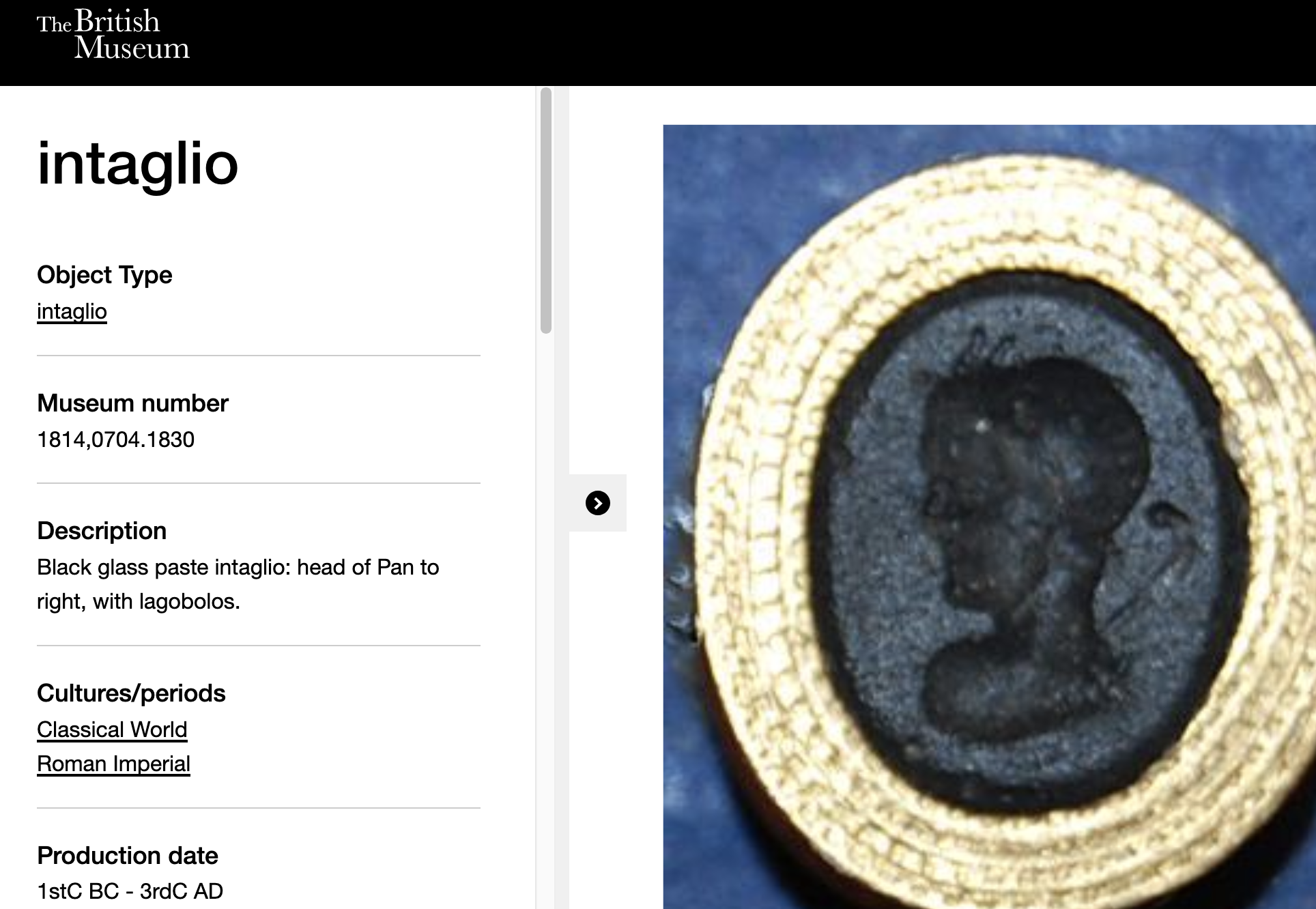

Bull and Snake
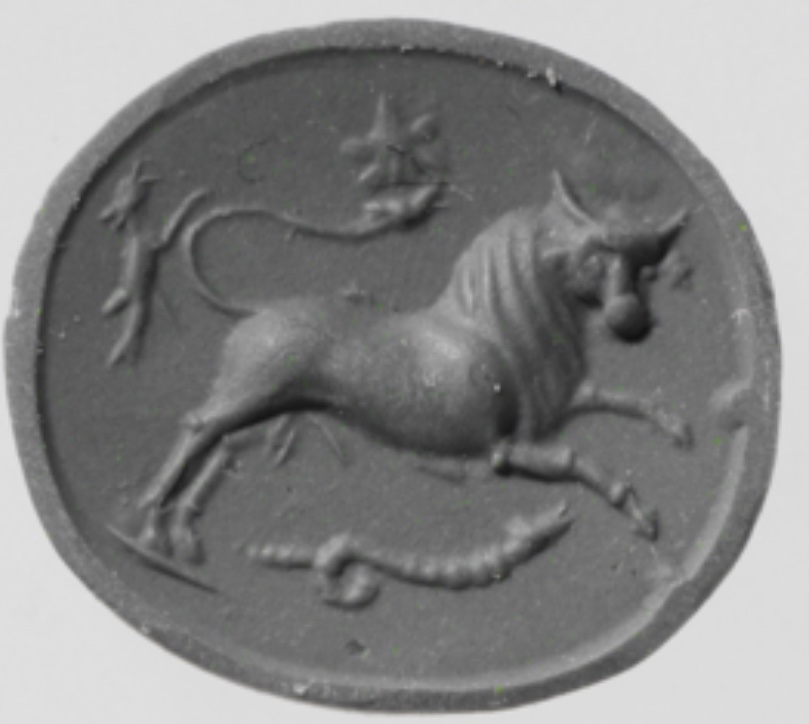
Connection to RRC 39/2 and derived types interesting…
What’s the creature behind? At first I thought a raven, but maybe too many legs for that? Also star suggests possible constellation/celestial meaning. Makes me think of the Mithraic tauroctony…
RRC 2/1 and Agathocles
Again, this is a more polished piece of text. And again, was originally drafted for a longer version of my forthcoming ANS-CUP book. That longer version wasn’t right for the series and ended up in the “archive” (meaning my languishing files of unpublished academic writing). I then thought that this might be part of a series of articles on early Roman History and Coinage, but last January as I started really working on revising existing drafts of the material and polishing for publication, I decided that this particular material just wasn’t ‘substantial’ enough for a peer-reviewed journal and I’ve no interest in writing a second book type treatment. I’m moving on in my interests for writing and research for formal publication.
BUT… all that said, I like this piece (but not as must as the last post on RRC 1/1) AND some of you may well like it too!
RRC 2/1 and Agathocles
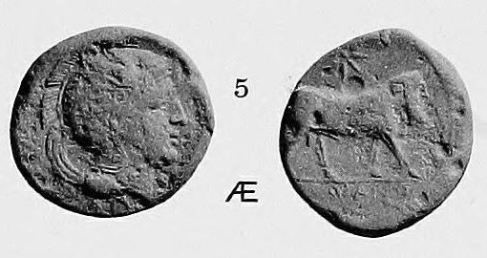
The so-called ‘second’ issue is only known from one specimen in the collection of the National Gallery in Naples (fig. 3). Similar to the first issue, it is unlikely to have been struck on any significant scale considering its poor survival rate. Without the aid of specific find spot information, die comparisons, and other numismatic methodologies based on the analysis of groups of coins, we only have the features of the single specimen to try to reconstruct an appropriate historical context. Two features lend themselves to possible comparison, the form of the apparently Latin legend and the rendering of the reverse design. The former is the basis for most modern interpretations, but the latter is also of interest to the historian.[1]
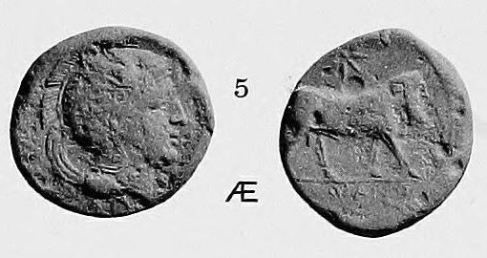
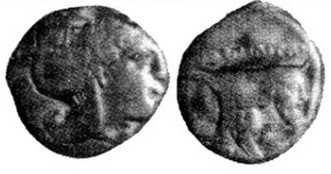
FIGURE 3: Naples 113828. No provenance recorded. c. 300 BCE, Bronze, 6.14 grams (?), 19 mm. [2] Obverse: Head of Minerva (Athena) in Attic Helmet decorated with hippocamp, Reverse: Man-Faced Bull in profile, above star, in exergue [R]OMANO. Illustrated at 2:1 scale. Image after Gàbrici 1904: pl IV.4, now in the public domain.
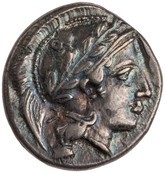
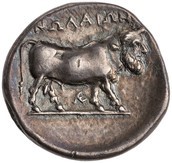
FIGURE 4: ANS 1944.100.2376. Bequest of E.T. Newell. c. 400-385 BCE, silver didrachm, 7.26 grams. Obverse: Head of Athena in Attic Helmet decorated with owl and olive wreath, Reverse: Man-Faced Bull in profile, NΩΛΑΙΩΝ above, ΛΕ in ligature between legs. Illustrated at 2:1 scale. ANS SNG 559 = Rutter 1979: Nola 9 = NO4 and NR7 = NH Italy 603. Image courtesy of the American Numismatic Society.
The specimen in question employs well-known South Italian types: a head of Athena in an Attic Helmet (Minerva to a Roman audience perhaps) which is strongly associated with Thurian coins, and a walking man-headed bull that recalls the exceptionally common use of man-faced bulls by Neapolis mint on coinage in its own name and on coins struck in the name of other cities. The particular rendering of the Athena obverse shares parallels with didrachms struck c. 400-385 BCE at the Neapolis in their own name and in that of Hyria and Nola (fig. 4).[3] These didrachms nearly all have a full bodied, man-faced bull in profile on the reverses. Gàbrici in the original publication of the Roman specimen noted the hippocamp (a winged horse with serpentine fish tail) as helmet decoration was unusual, especially on Campanian coins, although in style and fabric the Roman coin is similar to other Campanian issues.[4] Although not stylistically similar, I would note that a hippocamp also appears on the Attic helmet of Athena on the diobols struck at Arpi likely between 320 and 275 BCE, an ally of Rome at this time.
The Roman bronze also shows its man-headed bull in full profile, whereas the Neapolis mint typically renders the full-bodied man-headed bull on its bronze coinage with a three-quarter profile head and with Apollo on the obverse. The only exception to the three-quarter profile on the Neapolis bronzes is an unusual type dated c. 300 BC.[5] Like the Roman coin, it also places the ethnic in the exergue, but it surrounds the fairly typical laureate head of Apollo with a circle of dolphins and places a trident over the bull. The circle of dolphins recalls the coinage of Syracuse, and with the trident suggests an emphasis on naval prowess. On stylistic grounds we might hypothesize that the die for the Roman coin was carved at the Naples mint at about the same time as this specimen with Syracusan influences. The same Syracusan imagery, particularly the head surrounded by dolphins, is also seen on the precious metal coins of Neapolis.[6] This motif is used on some Siculo-Punic tetradrachms down to c. 300 and also on the tetradrachms of the early part of Agathocles’ reign in Syracuse, c. 317-305.[7] Both imitate earlier Syracusan types of the fifth and late fourth century.[8]
The likely historical context for both these precious metal issues and the bronze coin type from Neapolis is Agathocles’ political and military engagement with Southern Italy at the very end of the fourth century and beginning of the third. Unfortunately, our historical understanding of this engagement is severely hamstrung by the loss of Diodorus’ continuous narrative after 302 BC, although optimistic reconstructions have been attempted.[9] Our fragmentary sources do suggest regular campaigning, especially along the coastlines, c. 300-294 BC.[10] Trogus says that Agathocles was inploratus (beseeched, begged, implored) to come to Italy, but does not specify by whom and then goes onto talk about his engagement with the Bruttii. A passage of Strabo suggests that Tarentum is likely to have been the beseecher. And, yet how Tarentum might have benefited from Agathocles’ war with the Bruttii is not at all clear. Trogus leaves us in media res with Agathocles leaving the Bruttian campaign unexpectedly to return to Sicily on account of illness. We pick up the narrative a year or two later with Diodorus. Agathocles captures Corcyra from Macedonian forces and then ‘returns’ to the forces he’s left in Italy only to find his Etruscan and Ligurian mercenaries have been behaving badly towards his son. He kills two thousand mercenaries and for some reason, unclear from the text, this alienates the Bruttii. A botched attempt to capture the town leads to a night attack that sends Agathocles once again back to Syracuse. C. 295 he’s back in Italy capturing Croton and giving Iapygians and Peucetians ‘pirate’ ships. C. 294 he’s in the territory of the Bruttii besieging Hipponium, the future Vibo. And both years Stilpo, his naval captain, is harassing the Bruttian coastline. These data points are very minimal, but it is probably not too much of a stretch to take the Tarentine gold staters mentioned above as confirmation of the Tarentine/Agathocles relationship mentioned by Strabo.
It is logical to slip the Neapolis coins in this same 300-294 BC window and hypothesize some sort of diplomatic arrangement between Neapolis and the Syracusan king. The silver has three different known initials on it suggesting perhaps issues over a number of years (HN Italy 576). Bronze types have naval imagery on them (HN Italy 577 trident, 578 dolphin) and the literary sources suggest that Agathocles seems particularly eager to control shipping lanes in the course of his Italic and concurrent campaigns. We should thus probably locate these Neapolis coins fit in this same c. 300-294 BC window and hypothesize some sort of diplomatic arrangement, between Neapolis and the Syracusan king, perhaps a naval agreement given the naval imagery on the bronze coinage and the prowess of both communities in maritime affairs.
So where does that leave the unique Roman bronze (RRC 2/1)? Given we have no available hoard evidence and only a single known specimen, and the likelihood that the same engraver produced the dies for HN Italy 577 and 578 and RRC 2/1, the campaigns of Agathocles in Italy are some of our best dating evidence for RRC 2/1, c.300-294BC. I am not suggesting any particular Roman role in this hypothesized Neapolis-Syracuse alliance, only that it was concurrent with Rome’s own relationship with Neapolis.
The date of this second bronze issue is, however, typically derived from the date of Rome’s first silver coinage, an issue of didrachms with a bearded Mars in a Corinthian helmet on one side and the head of a bridled horse on the reverse (fig. 5). This is based primarily on a similarity in legends; both are read as ROMANO. This, however, is not enough for a certain connection between the two issues. They bear no other shared iconographic elements. Whereas RRC 2/1 is exceptionally rare and completely based on preexisting iconographic models, RRC 13/1 has a distinctively Roman iconography and has a wide well-documented distribution. There is no reason to rule out a potential historical context for either coin issue because it cannot be made to fit the other. Rather, there are good reasons for treating them as separate numismatic expressions.
[1] Thompson 1957: 141 discusses parallel types.
[2] Crawford’s data preferred here, but Gàbrici 1904: 100 records “diam. mm. 20. Peso gr. 10,15, poco usata.”
[3] Cf. Rutter 1979: plate 44, die-transference D with discussion on p. 68-76.
[4] Gàbrici 1906: 100.
[5] HN Italy 577; pace Rutter who identifies 573 as the prototype for RRC 2/1. In doing so he considers the star the key point of comparison not the rendering of the man-faced bull. 577 (= Taliercio IIa6) is closer in theoretical weight standard to Crawford’s weighing of RRC 2/1, but 573 (=Taliercio transition I-IIa) is closer to Gàbrici’s. I am indebted to Nick Molinari, a co-creator of manfacedbulls.wordpress.com, for drawing my attention to 577. Other published specimens of this same type include: SNG France 884-8; SNG ANS 462-4.
[6] HN Italy 576, cf. also gold issue of Tarentum (HN Italy 952-954) linked by Rutter to Cleonymus and the events of 303-302 BCE (Diod. 20.104).
[7] Siculo-Punic: Jenkins 70, 101, 188 among others; Agathocles: SNG ANS 633, 640, among others.
[8] Burnett 1977: 109-10.
[9] cf. Meister 1984, Nebu 2010. Meister, I believe, may have been led astray by his belief in the so-called ‘Philinus’ Treaty, on which Eckstein 2010. A better approach at the reconstruction may be possible from the hoard evidence, cf. Spadea 2011.
[10] Trog. 23.1-2 cf. Strabo 6.3.4; Diod. 21.2-4 and 8; Consolo Langer 1990, esp. 157-162.
RRC 1/1 and the Myth of Palaeopolis
This is a more polished piece of text. It was originally drafted for a longer version of my forthcoming ANS-CUP book. That longer version wasn’t right for the series and ended up in the “archive” (meaning my languishing files of unpublished academic writing). I then thought that this might be part of a series of articles on early Roman History and Coinage, but last January as I started really working on revising existing drafts of the material and polishing for publication, I decided that this particular material just wasn’t ‘new’ enough for a peer-reviewed journal and I’ve no interest in writing a second book type treatment. I’m moving on in my writing and research for formal publication.
BUT… all that said, I like this piece a lot AND some of you may well like it too!
RRC 1/1 and the Myth of Palaeopolis
Our understanding of the historical context for Rome’s first coin issue has been clouded by sensibilities of Augustan hindsight. What follows in this section a historiographical critique of the available literary sources followed by an integration numismatic evidence in light of that critique. The two major literary sources, Livy and Dionysius, are both problematic, but in very different ways. Livy follows a tradition that inserts a fictious state, Palaeopolis, into the narrative. Dionysius’ narrative survives only in a few rhetorical fragments. Both are products of the Augustan period and both are seeking to explain events of the late of fourth century in light of Rome’s later supremacy.
Livy’s account, our most detailed, works hard to exonerate the Neapolitans of any significant hostility towards Rome. Throughout his narrative, the Neapolitans are barely mentioned: Palaeopolis is the hostile community. When the Neapolitans appear, it is to emphasize that they were wholly cut off from communicating with or supporting the Palaeopolitans by the position of the Roman army (8.23.10, cf. 8.25.5). Livy speculates that it is the Samnites’ disregard for their treaties with Rome that inspires the Palaeopolitans to harass Romans living in the region (8.22.7), but assures his readers that it was pressure from Nola that led to the Samnite and Nolan garrisoning of Palaeopolis, not the desire of the Greek population (8.23.1). Eventually the bad behavior of this garrison, especially towards the women and children, leads the Greek statesmen to despair at the idea of accepting even more Samnite “help” and to concoct a successful plot to betray the city to Rome (8.25.6-8.26.5). Throughout the narrative there is an emphasis on strong ethnic divisions in the city with the Greeks being the least culpable of Rome’s adversaries: “the force from Tarentum composed of Greeks, they [sc. Palaeopolitans] were prepared to welcome, being Greeks themselves, and through their means they hoped to resist the Samnites and the Nolans no less than the Romans.” Livy then concludes with the following admission that he is aware of differing accounts and that he is using retrospective logic to reconstruct what he himself deems most probably:
I am quite aware that there is another view of this transaction, according to which it was the Samnites who surrendered, but in the above account I have followed the authorities whom I consider most worthy of credit. Neapolis became subsequently the chief seat of the Greek population, and the fact of a treaty being made with that city renders it all the more probable that the re-establishment of friendly relations was due to them. As it was generally believed that the enemy had been forced by the siege to come to terms, a triumph was decreed to Publilius. Two circumstances happened in connection with his consulship which had never happened before – a prolongation of command and a triumph after he had laid down his command. (Livy 8.26.6-7, Roberts trans. [public domain])
Notably, Livy’s account agrees with the records of the Augustan age fasti triumphales:
Q(uintus) Publilius Q(uinti) f(ilius) Q(uinti) n(epos) Philo II ann(o) CDXXVII / primus pro co(n)s(ule) de Samnitibus / Palaeopolitaneis K(alendis) Mai(is)
Quintus Publilius, son of Quintus, grandson of Quintus, Philo for the second time [triumphed] in the year 177, as the first proconsul, over the Samnites and the Palaeopolitans on the Kalends of May[1]
These are the only historical references to Palaeopolis, “the old city”, and its co-existence and separate identity from Neapolis, “the new city”. Oakley in his commentary on Livy is unilateral, “It is absurd to believe that in 327 there was a sovereign state called Palaeopolis.” He goes on to suggest how this error might have crept into the annalistic tradition and thus been preserved in Livy.[2] First, Palaeopolis might be synonymous with Parthenope, the “original” name of the settlement. Second, It may describe the region of the city located on the slightly higher ground of the Pizzofalcone promontory, just on the opposite side of the ancient harbor from the main center of the city.[3] The name Parthenope is first attested in a fragment of Lutatius (fl. 100 BCE), perhaps derived from Timaeus (fl. 260 BCE), that says Parthenope was the original colony founded by Cumaeans on the site, then destroyed by the mother-city, and subsequently re-founded with the name Neapolis in response to an oracle.[4] The story provides aetiological explanations for the name ‘New City’ and the city’s cult of the siren Parthenope. In common usage, however, the name Parthenope is not distinguished in any temporal or physical sense from the city of Neapolis, but is used instead as a poetic synonym popularized by Vergil’s Georgics (c. 29 BCE).[5] It is just possible, if unattested, that the slightly higher ground of the Pizzofalcone promontory could have been a district of the poleis, colloquially called the ‘the old city’.[6] However, we have no reason to believe that this area played a significant role, separate from the rest of the city, during the conflict with Rome.[7]
My contention is that Palaeopolis is a convenient alter ego adopted in order to retroactively absolve Neapolis of any anti-Roman past. Livy could not quite believe that after siding with the enemy it could have been granted such a favorable treaty with the Romans and be allowed to remain the leading Greek city on the Tyrrhenian seaboard. However, even Livy himself is not ready to commit to a complete separation of Neapolis and Palaeopolis. Geographically, he says it is not far from where now Neapolis is (haud procul inde ubi nunc). And, he goes on saying the two cities are inhabited by the same people (duabus urbibus populus idem habitabat)! Then, he narrates the origins of this populus, giving an origin story, similar to that given to Neapolis alone in all our other ancient sources.[8]
The death knell for any putative ‘Palaeopolis’ can be found in the long fragments of Dionysius’ account of the Samnite wars including the Roman embassy to Neapolis, and their decision to side against the Romans and accept Samnite aid.[9] Dionysius has significantly different interests from Livy in his more fulsome, if now fragmentary, treatment of the wars.[10] Dionysius is exceptionally concerned to display the strategy employed to repress a potential mutiny in the winter camps of Campania and the linger effects of this potential mutiny, a matter treated with less seriousness and with few consequences by Livy.[11] Dionysius also shows an interest in the narration of geographical and logistical matters nearly wholly absent from Livy.[12] On the specific engagement of Rome and Neapolis, the variations between the two accounts abound, beyond even Dionysius’ apparent unawareness of a community named Palaeopolis, separate and distinct from Neapolis. The Dionysius fragment comes from Porphyrogenitus’ compilation entitled, On Embassies. Unlike in Livy the injured party are not Romans living in Campania and the Falernian territory, but the Campanian friends of the Romans (τοὺς φίλους αὐτῶν Καμπανοὺς). These friends approach the Roman Senate and this causes a delegation to be sent to Neapolis to propose a mediated resolution, not a call to arms. Livy insists that the fetials are sent to Palaeopolis demanding redress, i.e. in his account Rome immediately moves to a threat of arms.[13] Dionysius has the Roman ambassadors address the Neapolitans at the same time as the Tarentines and Nolans.[14] These two additional sets of ambassadors ask the Neapolitans to reject an alliance with the Romans or their friends and reaffirm their friendship with the Samnites. Dionysius then reconstructs at length how the Neapolitans go about their decision-making. He emphasizes a division between the elite and the people with the former mostly supporting Rome, but being swayed eventually to leave the decision to a popular assembly (ἐπὶ τῷ δήμῳ and εἰς τὴν ἐκκλησίαν), not the boulē. The persuasive arguments before the assembly are (1) the treachery of the Romans (an echo of Dionysius’ earlier interests in the potential mutiny!); (2) the strength of the military resources to be provided to the Neapolitans; and (3) the recovery of Cumae and grant of agricultural lands in Campania. This last point is likely a reference to Cumae being admitted into the Roman franchise, civitas sine suffragio, in 338 BCE.[15] Still the elite are not swayed. but the people are: ‘the worse overpower their betters’ (καὶ τελευτῶντες ἐκράτησαν οἱ κακίους τῶν κρειττόνων). The Roman ambassadors must take back to Rome word of the impending conflict.
In the next fragment of Dionysius, we rejoin events with the Roman ambassadors laying out their complaints directly to the Samnites, among the alleged crimes is the following:
Roman Antiquities 15.7.3:
when the Neapolitans were afraid to declare war against us, you devoted all your zeal and efforts to encouraging them, or rather compelling them, to do so, and are paying all the expenses and are holding their city with your own forces.
ἐν δὲ τῷ παρελθόντι ἐνιαυτῷ Νεαπολίτας δεδιότας ἀναδεῖξαι τὸν καθ᾿ ἡμῶν πόλεμον ἁπάσῃ σπουδῇ καὶ προθυμίᾳ χρώμενοι παρωρμήσατε, μᾶλλον δ᾿ ἠναγκάσατε, καὶ τὰς δαπάνας ἐπιχορηγεῖτε καὶ τὴν πόλιν δι᾿ ὑμῶν αὐτῶν ἔχετε.
Later in the same speech comes the demand to withdraw from Neapolis the forces sent there (15.7.5: πρῶτον μὲν ἀπάγειν ὑμᾶς ἀξιοῦμεν τὴν ἀποσταλεῖσαν Νεαπολίταις συμμαχίαν). Then Dionysius puts the following rebuttal into the mouths of the Samnites (15.8.3, 5):
As for the city of Neapolis, in which there are some of our troops, far from wronging you if we as a state contribute some aid toward the safety of those who are in danger, it is rather we ourselves who seem to be greatly wronged by you. For, though this city had become our friend and ally, not just recently nor from the time when we made our compact with you, but two generations earlier, in return for many great services, you enslaved it, though you had been wronged in no respect. Yet not even in this action has the Samnite state wronged you; rather it is some men connected by private ties of hospitality, as we learn, and friends of the Neapolitans who are aiding that city of their own free will, together with some also who through lack of a livelihood, perhaps, are serving as mercenaries.
περὶ δὲ τῆς Νεαπολιτῶν πόλεως, ἐν ᾗ τῶν ἡμετέρων τινές εἰσιν, τοσούτου6 δέομεν ἀδικεῖν ὑμᾶς, εἴ τινα τοῖς κινδυνεύουσι βοήθειαν εἰς σωτηρίαν κοινῇ παρεχόμεθα, ὥστ᾿ αὐτοὶ δοκοῦμεν ὑφ᾿ ὑμῶν ἀδικεῖσθαι μεγάλα. φίλην γὰρ ἡμῶν καὶ σύμμαχον οὖσαν τὴν πόλιν ταύτην οὐκ ἔναγχος οὐδ᾿ ἀφ᾿ οὗ τὰς πρὸς ὑμᾶς ἐποιησάμεθα ὁμολογίας, ἀλλὰ δευτέρᾳ γενεᾷ πρότερον διὰ πολλὰς καὶ μεγάλας εὐεργεσίας, οὐθὲν ἀδικηθέντες ὑμεῖς 5κατεδουλώσασθε. οὐ μὴν οὐδὲ τούτῳ γε τῷ ἔργῳ τὸ κοινὸν ὑμᾶς τῶν Σαυνιτῶν ἠδίκησεν· ἰδιόξενοι δέ τινές εἰσιν, ὡς πυνθανόμεθα, καὶ φίλοι τῶν Νεαπολιτῶν οἱ κατὰ τὴν ἑαυτῶν προαίρεσιν τῇ πόλει βοηθοῦντες καί τινες καὶ δι᾿ ἀπορίαν ἴσως βίου μισθοφόροι. ὑφαιρεῖν8 δὲ τοὺς ὑπηκόους ὑμῶν οὐθὲν δεόμεθα·
The rebuttal seems intentionally contradictory and thus weak compared to the construction of the Roman claim: “yes, we have some troops there, but we’re old friends with them, and you’re the ones in the wrong, but it is not really our troops, just some individual relationships and maybe some mercenaries.” We have no further information surviving from Dionysius about the course of the war and its resolution. Yet, in what does survive we seem to have a subtler form of apologetic from that created by Livy and the Fasti by means of the creation of Palaeopolis. It was not the leaders of Neapolis which rebelled from Rome, only the populus, and in the end event the populus did not take up arms against Rome, they only admitted a garrison from which the Romans then ‘rescued’ them. In Livy’s narration a segment of the population also “come to their senses” and surrenders the city to the Romans. The key difference is that for Livy the sensible portion are the Greeks as an ethnic group, not simply the ruling class as in Dionysius.
In the passage quoted above, Livy expresses his incredulity that late fourth century Rome would have preserved and even honored a rebellious ally. We need not share this incredulity. Multiple sources, not least the numismatic evidence, point to Neapolis as an important link between communities of different ethnic groups in the region. As we just saw, this is very much how Dionysius imagines Neapolis’ position in the course of events, a city to be wooed and courted by all sides. From the numismatic evidence, Rutter has shown through extensive die links that all the Campanian coinage struck after 420 BCE was likely produced at Neapolis on behalf of those communities whose names those coins bear.[16] Die-links provide concrete evidence the two issues were produced in the same mint or that two mints were closely sharing resources, the former being the more likely scenario. These links include Neapolis didrachms with coins of the Campani, the people of Capua.[17] Another issue of the Campani shares at least two obverse dies with a Cumae issue.[18] And a die used to strike Neapolis didrachms was recut from a die used to strike coins in the name of the Hyrians.[19] These issues are likely to date to last decade of the fifth century. Around the first decade of the fourth century, another Neapolitan didrachm issue shares obverse dies with Nola.[20] Moreover, throughout this period Neapolitan die cutters were unmistakably drawing inspiration from other regional mints, such as Thurii and Syracuse.[21] In sum, the coins testify to close cooperation between the Greek-speaking communities of the coast (Neapolis, Cumae) and the Oscan-speaking communities of the interior (Capua, Nola), even as our historical sources emphasize violent conflict.[22] Both Strabo and Diodorus also comment on the mixed ethnic character of Neapolis, and how old magistrate lists are filled with Italic as a well as Greek names.[23] Velleius Paterculus seems to argue against such an understanding of Neapolis, choosing to emphasize its pure Greekness, uncorrupted by the Samnite influences as Cumae it mother-city was. Yet, the very need for such an assertion itself suggests a common alternate understanding of the ethnic character of Neapolis. Dionysius and Livy comment on how Neapolis is–or is not–‘acting Greek’ throughout their narratives.[24] Neapolis served a vital function in connecting regional populations one to another, and also to the wider Mediterranean world via its harbor.[25] It provided not just ‘inspiration’, but tangible assistance in the production of coinage for a variety of communities, long before Rome appears on its doorstep.
That Rome preserved Neapolis and offered a generous treaty is unsurprising, especially in light of Rome’s concern with securing her own position in Campania and in relation to the Samnites. “Palaeopolis” is the earliest Greek community to appear on the Roman triumph lists and appears in addition to a victory over the Samnites. It will be just over 45 years—that is more than a generation, almost two—before another Greek community, Tarentum, appears there.[26] Neapolis was just too useful to be destroyed (assuming along with Livy that the Romans were capable of this), or even to be left as a disgruntled, hostile foe. The Romans chose wisely; Neapolis remained loyal through the wars with Pyrrhus and first two Punic Wars.[27] Not until the strategic placement of a maritime colony of veterans at Puteoli in 194 BC was Neapolis’ regional significance effectively eclipsed.[28]
It is equally unsurprising that a Rome-Neapolis treaty of the late fourth century should result in coinage. As we’ve just seen, Neapolis served as the primary regional mint in Campania strike coins in the name of a number of regional communities with various ethnic identities from the late fifth century onwards.[29] Rome was entering a region where there was a numismatic ‘habit’. We cannot know whether the Romans asked for the coins or whether the Neapolis offered to create them. The resulting issue was a series of small bronze pieces produced from very few dies, meaning this first ‘Roman’ issue is unlikely to have had any significant economic function. There simply would not have been enough struck to represent a major state expenditure of any kind. It uses the Greek alphabet for the legend, ΡΩΜΑΙΩΝ (‘of the Romans’) and the type and fabric are typical of Neapolis (fig. 2).[30] The coin would have circulated easily with other Campanian issues. By issuing coins for the Romans, Neapolis was effectively treating Rome as no different than any of its other regional powers. Our literary sources attempt to read Roman exceptionalism into this period and to create tidy narratives with an us/them structure, be those Greeks versus Samnites or elites versus the masses. The first Roman coin tells a different story. It suggests a strategic negotiation of power between Naples and Rome which left both with greater regional influence.
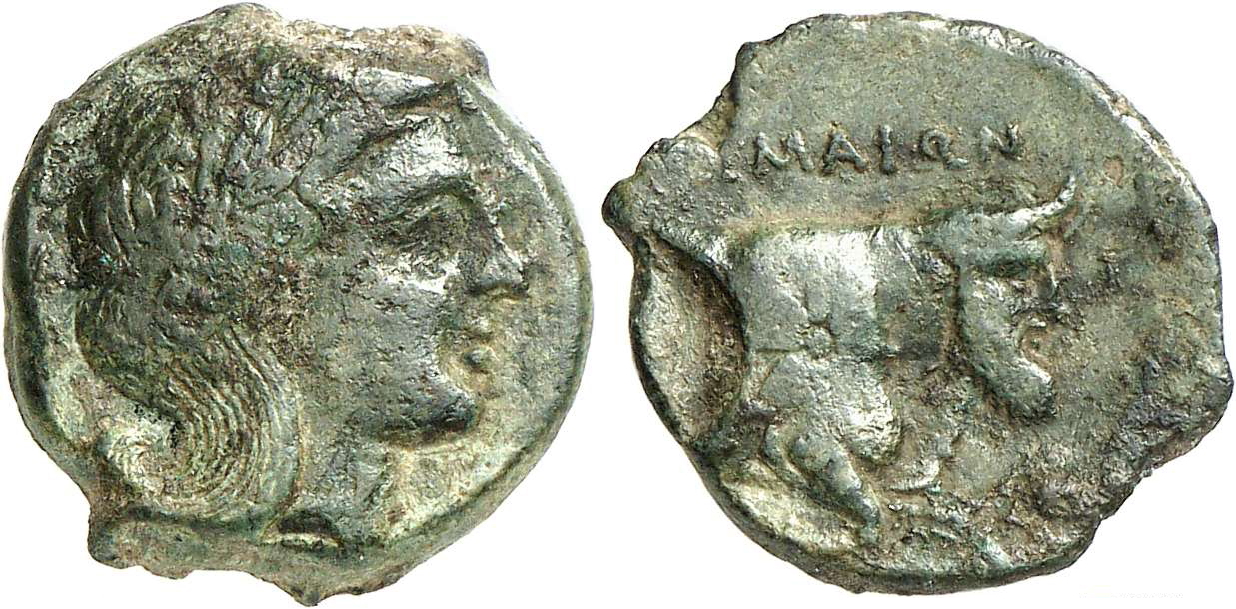
FIGURE 1: Berlin 18214344. Acquired from Friedrich Imhoof-Blumer in 1900. RRC 1/1 = HN Italy 251, shortly after 326 BCE, Bronze, 3.54 grams, 16 mm. Obverse: Head of Apollo, Reverse: forepart of a Man-Faced Bull with eight-rayed star on the shoulder, above [ΡΩ]ΜΑΙΩΝ (‘of the Romans’).
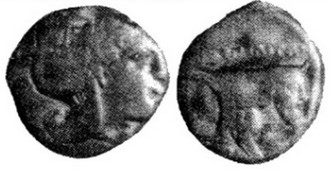
FIGURE 2: Taliercio Ic, 5, c. 325-320 BCE [image from man-faced bulls project]. Obverse: Head of Apollo, Reverse: forepart of a Man-Faced Bull with eight-rayed star on the shoulder, above ΝΕΟΠΟΛΙΤΕΩΝ (‘of the Neapolitans’).
[1] Degrassi 1954: 95; cf. Braccesi 1977-78 and Sumi 2005: 246-7.
[2] Oakley 1998: 643-5.
[3] cf. BNP s.v. ‘Neapolis [2]’.
[4] FRH 32 F 6 with commentary by Smith.
[5] Verg. Georg. 4.564, cf. Plin. NH 3.62: “On the coast stands Naples, itself also a colony of the Chalcidians, named Parthenope from the tomb of one of the Sirens” litore autem Neapolis Chalcidensium et ipsa, Parthenope a tumulo Sirenis appellate.
[6] Oakley 1998: 644, noting the comparative naming practices of areas within other Greek poleis (Polyb. 1.38.9 and Strabo 3.4.8).
[7] Oakley 1998: 645: “D.H. seems to imply that the garrison was to be placed in Neapolis itself, and that L.’s narrative is not easily applied to the strong hold of Pizzofalcone.”
[8] A colony of Cumae itself a colony of Chalcis: Ps. Scym. 236-243, Lutatius (FRH 32 F 6), and Vell. Pat. 1.4.1-2. Strabo, 5.4.7, like Livy, mentions Pithacusa in relation to the foundation, but is generally the most confused (cf. 14.2.10), favoring a narrative of waves of settlers, rather than a singular origin story associated with Cumae. Plin. NH 3.62 calls it just a Chalcidian settlement.
[9] 15.5-6 parallels Livy 8.22.5-10, 15.7-10 parallels Livy 8.23.1-13. Oakley 1998: 641-2 asserts Dion. Hal.’s narrative here has the ‘stamp of authenticity’ and ‘goes back to a Greek source, perhaps a local chronicle’.
[10] The fragments are preserved in the work of Constantine VII Porphyrogenitus; on the particular challenges of working with fragments from this collection see Toher 2017: 58-60.
[11] Dion. Hal. 15.3 and 4 cf. Livy 7.38.
[12] Dion. Hal. 15.4. The description bears some similarities to the style of Caesar’s Commentaries, on which Riggsby 2006, esp. chapter 1.
[13] On the discrepancies between these specific accounts, Rich 2011: 220-1; contra Oakley 1998: 647-9, he believes Dion. Hal.’s account situates events in 326 BCE and whereas Livy’s account would place these events in 327 BCE. Also cf. p. 213 where he notes emissaries in Livy who are certainly fetials being described in certain sources as legates or messengers.
[14] Oakley 1998: 645 see this element of Dionysius’ version echoed elsewhere in Livy: 8.23.1 and 25.5-8.
[15] Livy 8.14. Oscan-speaking Campanians had taken control of Cumae in 421 BCE: Livy 4.44, Diod. 12.76, Vell. 1.4; yet Strabo emphasizes its Greek character in his own day (5.4).
[16] Rutter 1979: 95-100 and passim.
[17] HN Italy 478, cf. HN Italy 554
[18] HN Italy 476, cf. HN Italy 532
[19] HN Italy 553, cf. HN Italy 540.
[20] HN Italy 563, cf. HN Italy 605
[21] HN Italy 554, 557, 559-561.
[22] See footnote 14 above.
[23] 5.4.7 and 16.18.1
[24] 15.5.1-3: “[actions] unbecoming to Greeks”, “greatly admired the Greeks”, “fight as befitted Greeks”; cf. Livy 8.22.4 with a negative connotation given to Greekness: gente lingua magis strenua quam factis.
[25] Cf. Ruffo 2010.
[26] Degrassi 1954: 98 on L Aemilius Barbula’s triumph in 280/79 BCE.
[27] Zon. 8.4; Polyb. 1.20.14; Livy 23.14.
[28] Salmon 1970: 97-9.
[29] Rutter 1979: 75, 82-83; cf. Crawford 1983a.
[30] Taliercio 1998, 1986, and Campana 1996. A good English introduction to the history and types discussed here can be found in Taylor 2010 (a pre-publication, online document: http://dx.doi.org/10.2139/ssrn.1676285). HN Italy identifies 568 = Taliercio Ib as the prototype for RRC 1/1, if this is accurate, then Ib.8 is the closest stylistic rendering, but Taliercio Ic, 5 must be considered as well (HN Italy 569) as it has an eight-, not four-pointed star, such as is visible on most RRC 1/1 specimens. The most complete illustrated critique of the typology is found in an independent online publication: https://manfacedbulls.wordpress.com/neapolis/.
Further bibliography
Kent, Patrick. “The Neapolitan affair: war without armies in early Italy.” The Ancient World 44, no. 1 (2013): 44-54.
Mapping Hellenistic family relationships
 
Pre-Publication Circulation for Feedback: Weight Standards of RRC 14 and 18
This is the current write up of my paper delivered at the Long Fourth Century Conference at Princeton this past Spring. Other disciplines have mechanisms of open peer review and comment pre-publication. This paper will likely appear (after blind peer review and more traditional feedback mechanisms) in a conference volume.
However, I offer it here for pre-publication comment. It will be stronger from the suggestions and observations of those who may be interested to read it in an early stage.
Mapping Hoards
If you’re not on Twitter you might miss Ryan Horne’s work. And as it is on Twitter, I might lose it unless I create a searchable record of it here!
Accounts of the discovery of the Vicarello votive deposit (hoard)
Translations are machine assisted with heavy human editing.
From Marchi as quoted in Colini 1967/8 [on file]:
“I made the decision to create baths for “ten to twelve of the patients” in pools that received the water “from below up … at the distance of just over half a meter from the source …, the primitive manhole (?, chiusino) which was located in the only existing pool, we agreed should be demolished, in order to connect the water with the new bathing pools: and it was only a few minutes that the pistons (steam pump) sent the spring water out of the well, when under the surface we began to discover that the manhole was cluttered with ancient metal … The water from the source was found to be a little less than forty degrees of the Reaumur thermometer, so that the first of the men who put it inside, barely managed to remove that small quantity which lay on a ridge of tile, which divided the manhole in two levels an upper and a lower and an upper … (then) a second worker went down both to destroy the part that was largely corroded by the heat and the force of the water and also to begin to bring out the metal that was ascending under that same partition. The work lasted several hours; thirteen workers took it in turns, all of whom came out badly burned and the metal retracted sufficed to fill 2 large tubs. On 22 January last, when the excavation was completed, we arrived at the site to take account of what had happened and to examine the metal. … ”
There is a little more but I am not completely certain of the meaning Italian phrasing, but believe it wonders at the miracle of discovery
Coloni also quotes De Rossi while bemoaning exact stratigraphy was not recorded as the material was removed:
“The layers of that heap of votive gifts kept exactly the chronological order, so that at first coins and vases of the imperial age were discovered, then coins of the Roman republic and of the surrounding peoples, bars and cast, and gradually passed from the aes signatum to aes rude, after which the metal ceased and even then the researches ceased, or rather, the search for objects that attracted the greed of the seekers failed. Under the metal clumps of rock appeared, which were considered to be the bottom of the basin. I am grateful to P. Tongiorgi, director of the Kircherian Museum, for having called my attention to some of the remains of these breccias that came to his museum along with most of the aes rude mentioned. I have learned that those stones are all flints, foreign to the nature of the volcanic rocks of the place; and in all the pieces, without exception, I saw visible traces of artificial cuts. Several are evidently knives, scrapers, small arrows and wedges, or from the paleolithic or neolithic age; the rest are fragments produced by the work that could belong to either era”.
Tognetti’s account of the ‘recovery’ of the gold and silver portion of the finds:
“Fr. Marchi wondered that not even the smallest silver and gold coin could be found among so many copper coins, and only a few silver pots of a few ounces each. Later it became simple to explain, as I understood it from the mouth of Fr. Francesco Tongiorgi.
Fr. Marchi died (10 February 1860). One day a stranger, but who later was identified presented himself to Fr. Tongiorgi, who had recently become the new Director of the Kircherian Museum, and showed him some vases of gold and silver, found, as he said, recently in some excavations, and for which (so much was their value and rarity!) demanded no less than 20,000 scudi, or about 100,000 Italian liras.
As soon as Father Tongiorgi held them in his name, reading the name of Apollo in some, he began to suspect that they were part of the treasure of Vicarello. But he soon put down all doubt; because seeing that one of the silver jars had a broken off handle. It was precisely that broken handle that Fr. Marchi had had since 1852, when he first went to Vicarello. That handle was kept in a display case in the Museum, and Fr. Tongiorgi found that it fit perfectly, and thus was part of that treasure. He then requested the name of the stranger bringing the artifacts and it soon came to be discovered that he was one of Vicarello’s workers in 1851-1852. Then Fr. Tongiorgi asked for some time in which to prepare an answer and immediately took himself to Fr. General Pietro Beckx, who in turn had recourse to S. Padre Pius IX. The latter, hearing all the facts well, replied that the theft was so clear, that we with all rights could agree the guilty party in court. However, he continued, that wretch who would certainly be sentenced to jail for life, is the father of a large family. We concern ourselves with more than just him, but also his wife and children. Take all the objects, and I will pay the 100,000 lire: then one half of those remain at the Kircher, the other half with go to the Vatican Museum. And so it was done. “
Colini himself writes (p. 43):
“The history of Vicarello’s vases is not over, because, on July 25th 1948, L’Osservatore Romano gave the sad news that – three days before – the gold jars had disappeared from the window in the room of the bronzes of the Vatican Etruscan Museum where they were kept and for all the work that has been done by the Vatican State police and
of the Italian State had not been recovered. I fear that they have been melted down: however it will not be bad that they are kept in mind if, on a happy day, they should reappear. We have luckily the photographs.”
Colini then goes on to describe tracking down other vases that came out of the deposit and were illegally sold to other buyers, ending up in Cleveland, BM, V&A etc…
Praeneste Aes Rude in Funerary and Ritual Deposits

“In the peperino sarcophagi some aes rude were recovered, ten of them also containing toilet articles…”

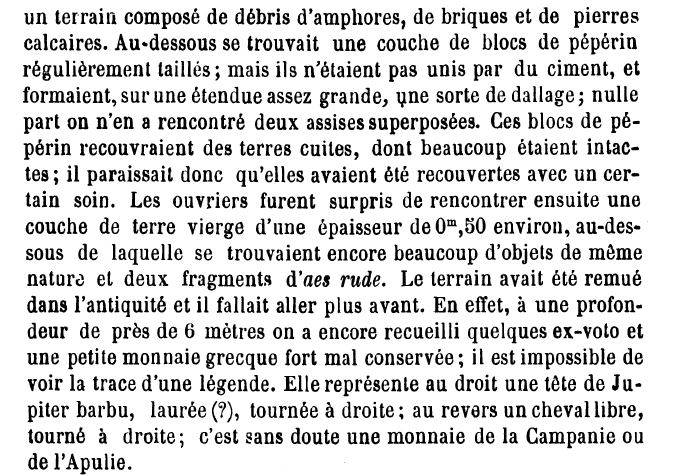
“In the second trench, at a depth of 250 cm, there is a layer composed of amphorae debris, bricks and calcareous stones, below which was a layer of peperino blocks regularly cut, but which were not joined with cement, and formed, to a large extent, a kind of pavement, and nowhere have we found two superimposed layers: these blocks of peperino covered terracottas, many of which were intact. It appeared, therefore, that they had been covered with some care, and the workmen were surprised to find a layer of virgin soil about 50 centimeters thick, below which there were still many objects of the same nature and two pieces of aes rude. The ground had been stirred in antiquity and it was necessary to go farther, for at a depth of nearly 6 meters there were found a few ex-voto objects and a small Greek coin, badly preserved. It is impossible to see the trace of a legend. The obverse had a bearded head of Jupiter, laureate (?), facing right; on the reverse a prancing horse turned to the right; it is undoubtedly a coin of Campania or Apulia.”
This could be a Syracusan coin of the time of Timoleon and the Third Democracy, circa 339/8-334 BCE, BUT that seems unlikely as I doubt a ~27mm diameter Greek bronze would be described as small. So, ding ding ding, I think we have an ID it really has to be a coin of ARPI (HN Italy 644, ~17mm)–Fernique had good instincts with the Apulia claim.
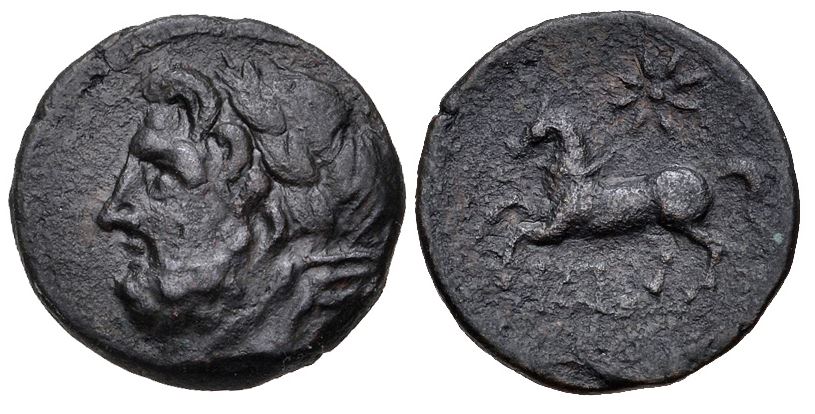
But now lets meditate on the fact that this was UNDER the layer with aes rude. This puts aes rude in use after the period in which this type was struck, ~325-275 BCE. It also gives a terminus post quem for all those terracotta votives!
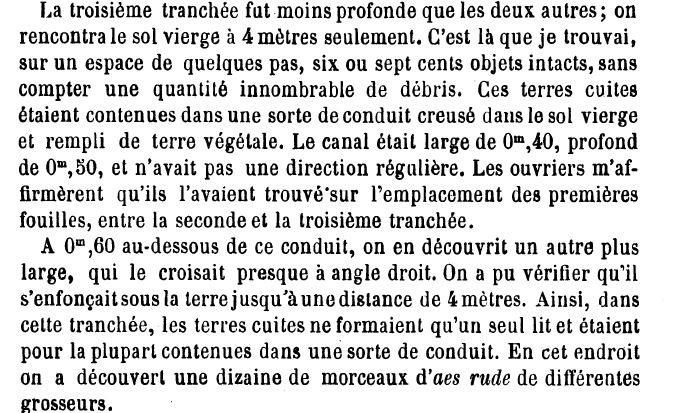
“The third trench was shallower than the other two; we met virgin soil only 4 meters down. It was there that I found, six or seven hundred intact objects, besides a great quantity of debris. These terracottas were contained in a kind of conduit dug in virgin soil and filled with topsoil. The channel was 40cm wide by 50cm deep, and did not have a regular direction. The workmen assured me that they had found it on this site during the first excavations, between the second and third trenches. At 60cm below this duct, a larger one was discovered, which crossed it almost at right angles. We could verify that it sank under the ground up to a distance of 4 meters. Thus, in this trench, the terracotta formed only one bed and were for the most part contained in a kind of conduit. In this place we have discovered about ten pieces of aes rude of assorted sizes.”
Here I like the importance of the work staff and how their local knowledge and expertise is acknowledged.
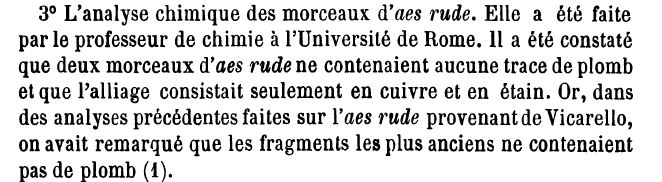

“A chemical analysis of the pieces of aes rude was conducted by a professor of chemistry at the University of Rome. It was found that two pieces of aes rude contained no trace of lead and that the alloy consisted only of copper and tin. However, in previous analyzes of aes rude from Vicarello, it had been noticed that the oldest fragments did not contain lead”
 Liv Mariah Yarrow