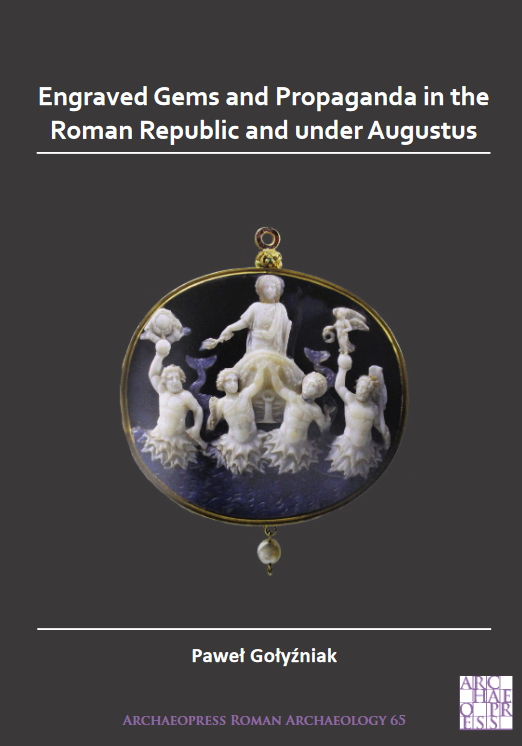
This is available for FREE OPEN ACCESS DOWN LOAD!
It has 1015 illustrations in FULL COLOR.
adventures in my head

This tweet thread on RRC 205 generated good conversation and supplementary images. I’m archiving on the blog to ensure I can find it when I next go looking.
Perhaps to me the most interesting is this fitting said to be from the area of Actium in the British Museum. It measures Height: 47.50 centimetres Length: 58.42 centimetres Width: 44.45 centimetres.

The other key observation on twitter is that there are more decorated prow stems on the Roman Republican Bronzes than have been noted in the major catalogues, a point well made by Michael Davis ( @Michael24441229)


I’ve been very focused in the pre 49 BCE period. This is likely to change as my research evolves over the next few years, but I realize that I am so much less familiar with coins after that date. Even ones I ‘know’ I’ve just spent less time thinking about.
This might be completely obvious but prior to today I saw a hodge-podge of symbols on this reverse rather than a programmatic message. My blind spot was the axe. If I thought about it at all I thought it was a priestly axe as those show up on other Caesarean coins. It doesn’t look much like those priestly ones though. Instead, I now read it as the axe that has been removed from the fasces. It seems so obvious that I assume others have seen this before.
Caesar in his role as perpetual dictator has brought peace and harmony (caduceus and clasped hands) to the world (orb)–or at least an end to conflict, if I was being snarky. Civil order has been restored (fasces) and thus military authority (axe) is no longer necessary.
The reading of the clasped hands on this specific coin is discussed Cornwall 2017, 65 no. 53.

Of course I’ve been thinking about it more since discovering this Cavino specimen in Glasgow, which takes its inspiration from the denarius but associates the imagery with the events of 56 BCE and the conference at Luca:
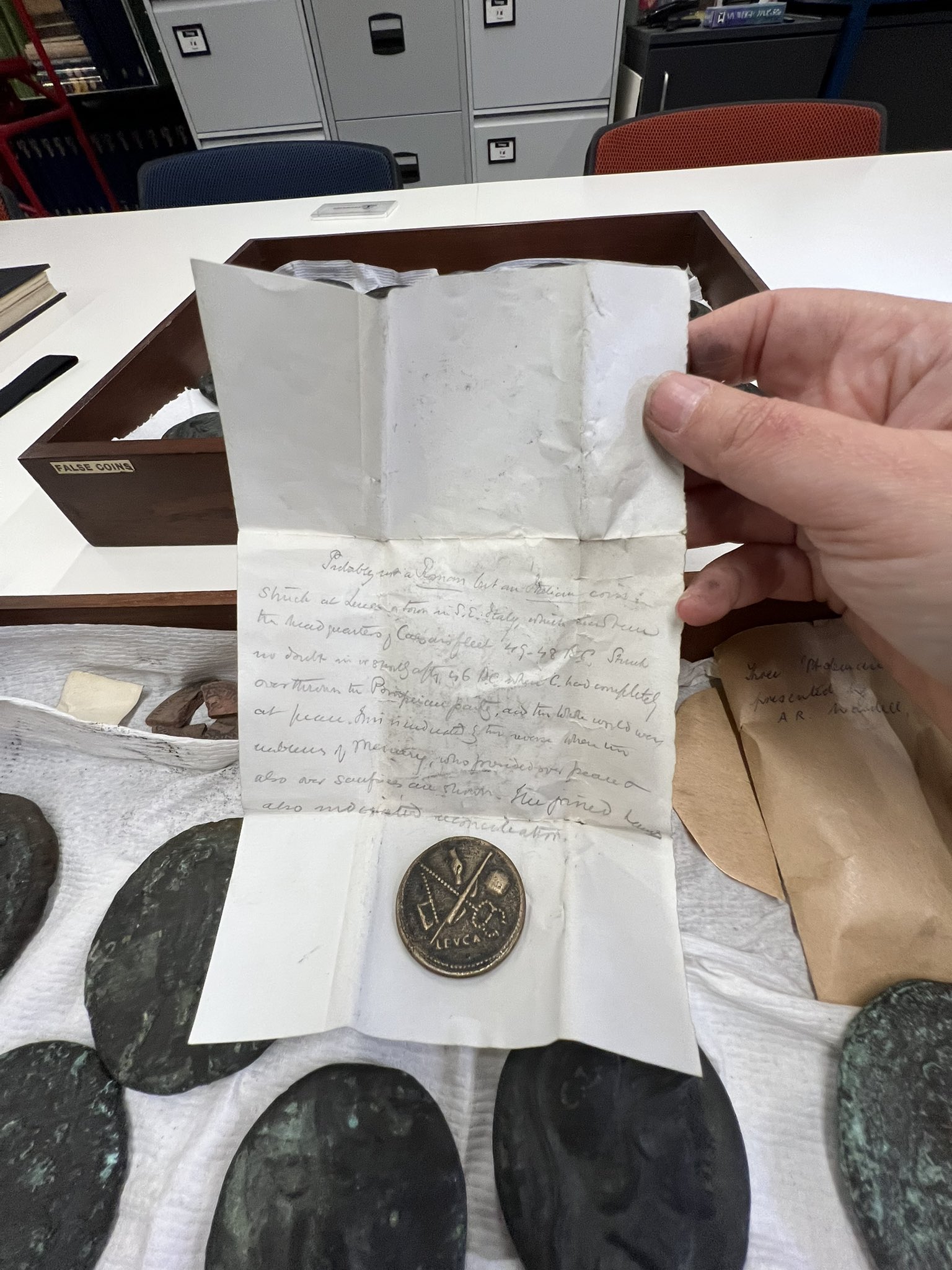
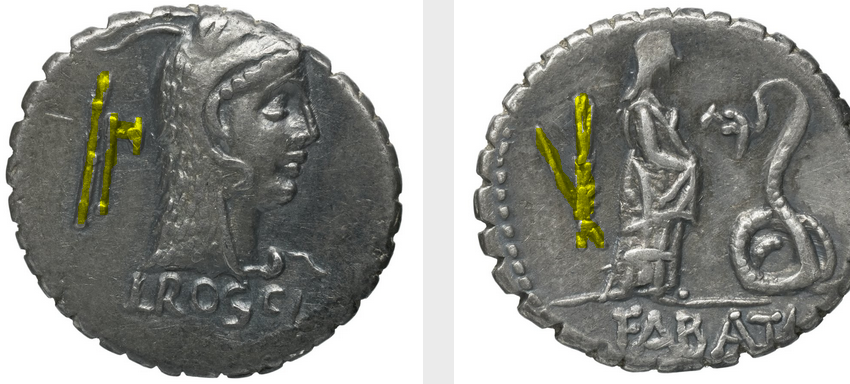
Some comparative iconography of fasces and axes
from the Fabatus Series (RRC 412/1)
As so often happens I was reading for something else and I came across this article.
Keaveney, Arthur. “Sulla and the Games of Hercules.” L’Antiquité Classique 74 (2005): 217–23.
and now I have an addition for any future edition of my book. This should have been cited in footnote 24 of chapter 4 (see pages 168 and 233).
Keaveney is a blistering invective against Wiseman’s interpretations of RRC 385/2. While it is not particularly collegial in tone, he raised some valid points and the two pieces of scholarship must be read in tandem.

BUT if I’ve read it correctly after all the criticism of Wiseman’s reading of Sullan evidence. He seems to accept there were games of Heracles and that this coin likely celebrated them. He suggests at the very end that maybe the games were not down graded because of Sulla but continued much like his ludi Victoriae. I still have no strong opinion.
I would note that Keaveney’s use of RRC 205/5 (n. 14 and corresponding text) shows a lack of awareness of Hercules as a standard god for any quadrans.
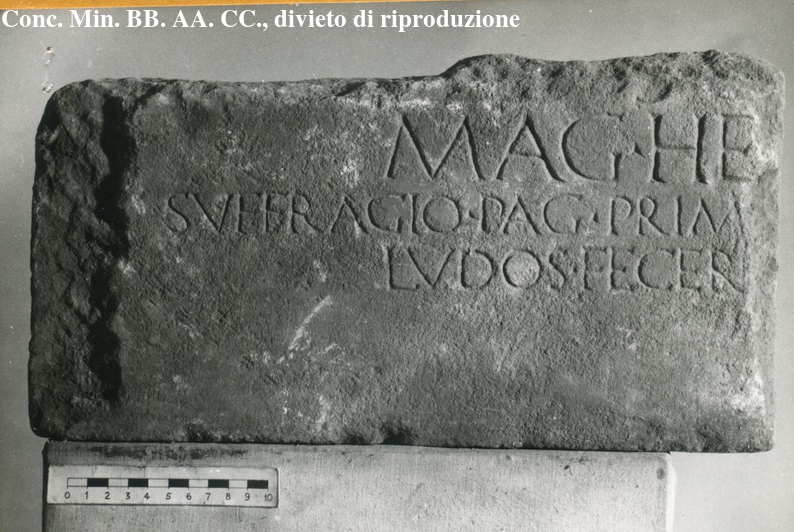
Besides the coin the certain evidence for the games includes two inscriptions
publication: CIL 06, 00335 (p 3004, 3756) = CIL 01, 00985 (p 728, 840, 964) = ILLRP 00703 = AE 1999, +00169 EDCS-ID: EDCS-17300541 province: Roma place:Roma
]r mag(ister) ludos / [3 Her]colei magno / [3]neo fecit
ILLRP says of it “saxum magnum in via Appia inter Casal Rotondo et Tor dei Selci”.
publication:CIL 06, 30888 (p 3758) = CIL 01, 00984 (p 964) = D 06081 = ILLRP 00701 = AE 1888, 00033 dating: -70 to -31 EDCS-ID: EDCS-18300897 province: Roma place:Roma
] / mag(istri) He[rc(ulis)] / suffragio pag(i) prim[i creati] / ludos feceru[nt]
ILLRP says of it “Fragmentum mamoris Graeci litteris aetatis Ciceronianae repertum Romae in monte Caelio”
I’ve been saying I’ll publish this paper for ages. Maybe I will but no time soon based on the length of my to do list. So I’m going to add it to my blog here just so that it is available. Perhaps it will generate comment.
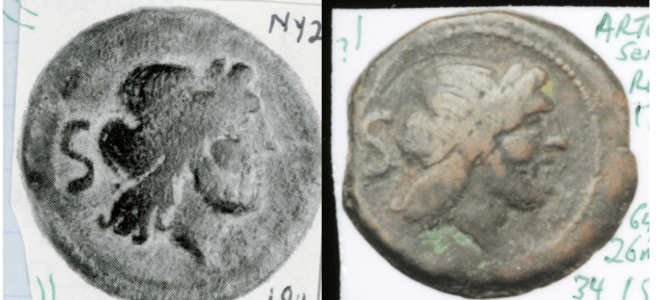
I’m pretty sure about this, but I also assume someone must have already said this in print somewhere? Maybe Russo? I’ve not found looked too hard yet, just throwing this post up because aha! moments are fun even if they are not actually new observations. Also this isn’t hugely unexpected we already knew the two issues were closely related and probably minted on Sardinia.
Here’s a specimen of MA series RRC 64/3. Schaefer thinks its is likely that all known specimens are struck by the same dies but not all are confirmed matches to one another because of quality of specimens.

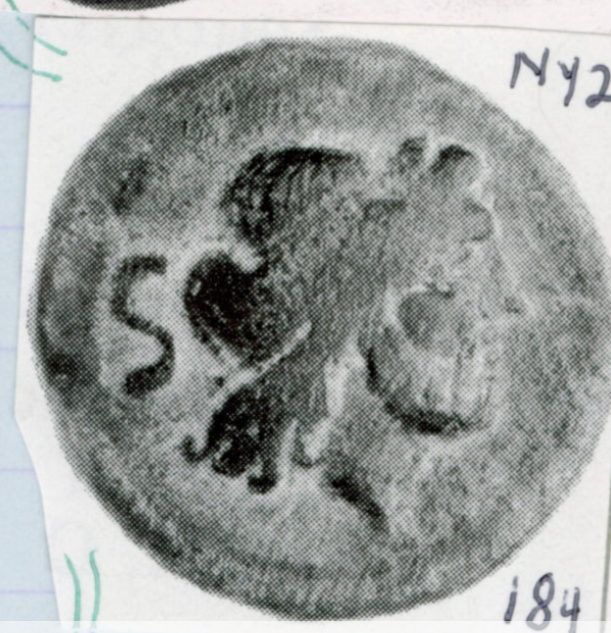
Now let’s look at a specimen of RRC 65/3 (which is even more rare than 64/3)


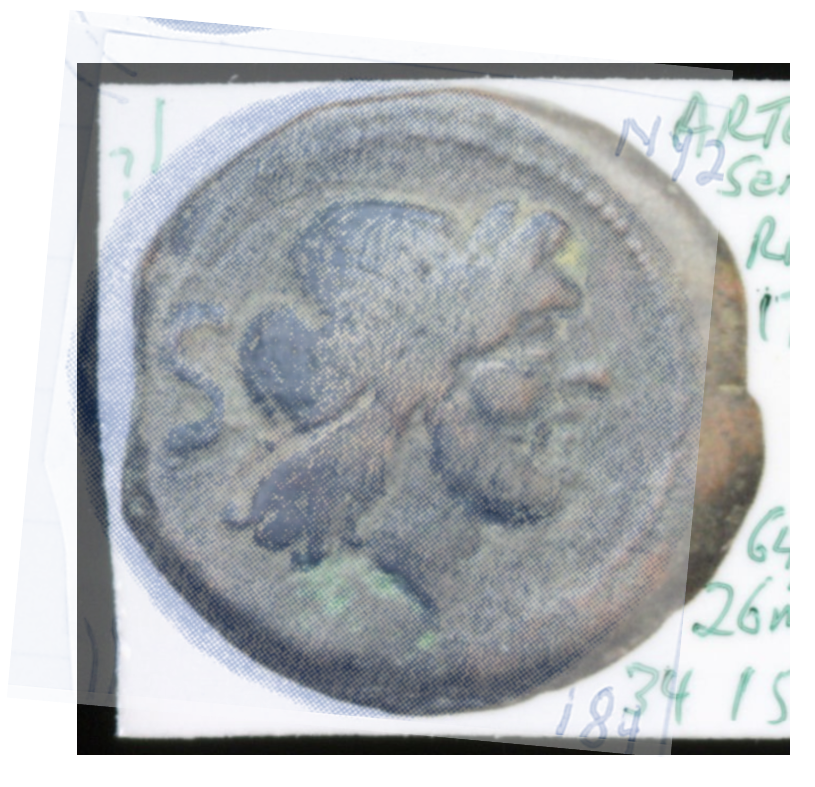

I’m checking some stuff for RRDP and thus finding lots of RR bibliography I might want to check out down the road.
M. Iunius Brutus : triumvir monetalis e quaestor. by Peppe, Leo. In: Istituto Italiano di Numismatica. Annali Vol. 43, 1996, p. 47-64.
Lucio Giunio Bruto : ricerche di storia, religione e diritto sulle origini della repubblica romana. by Mastrocinque, Attilio. Trento : Edizioni La Reclame, 1988
Muttonis Mutunus: Q. Titius and the Case of the Obverse Head /by Katz, Rebecca. In: International Congress of Numismatics XV International Numismatic Congress Taormina 2015 Proceedings p.671-675
The ‘bead and reel’ denarius of C. Vibius Pansa / Bruce R. Brace. In: Aureus Investments (Spring, 1988), p. 2-6, CF. The ‘bead and reel’ denarius of C. Vibius Pansa : again / Bruce R. Brace. In: Canadian Numismatic Journal Vol. 34, no. 4 (Apr., 1989), p. 131
Un interessante quinario di M. Porcius Cato (92 a.C. circa). by Spagni, Lopez. In: Noi con la lente anno 5, n. 3 (magg.-giugno 1993), p. 13-14
Les symboles sur les monnaies de M. Papirius Carbo et de L. Titurius Sabinus. by Vercoutre, A. [1893]
Un curioso denario di Lucio Titurio Sabino. by Spagni, Lopez. In: Bollettino Numismatico v. 9, no. 4 (Sept. 1972), p. 6-8
Le figurazioni degli assi di C. Marcius Censorinus. by Bartoccini, Renato. In: Il Gazzettino Numismatico v. 4, no. 1 (Feb. 1975), p. 46-52
La monetazione di L. Rubrius Dossenus / Patrizia Calabria. In: Rivista Italiana di Numismatica (Italy) Vol. 94 (1992), p. [65]-85
Quand Ogulnius frappa le quadrigat… / Mathieu Debaes. In: Liber amicorum Tony Hackens Louvain-la-Neuve : Association de numismatique professeur Marcel Hoc, c2007. p.179-191
A propos d’un as de C. Licinius Macer et de la répartition des attributions entre les triumvirs monétaires sous la République. by Thiry, Jean-Claude. In: Cercle d’études numismatiques. Bulletin Vol. 25, no. 1 (janv.-marc 1988), p. 1-6
Die Asse des C. Licinius Macer / Andreas Alföldi. In: Schweizer Münzblätter No. 92 (Nov., 1973), p. 117-119
Dio Cassius og numismatickken. by Kromann, Anne. In: Nordisk Numismatisk Unions Medlemsblad No. 4 (Aug., 1978), p. 65-69
Les deniers triomphaux de C. Valerius Flaccus. by Laffranchi, Lodovico. In: Demareteion I (1935), pp. 117-123
Les deniers de C. Valerius Flaccus frappés à Marseille et les dernières émissions de drachmes massaliotes / Andreas Alföldi. In: Revue Numismatique Ser. 6, Vol. 11 (1969), p. 55-61, pls. 6-13
L’aigle légionnaire sur les deniers frappés par Aulus Postumius et par Sextus Pompée. by Vercoutre, A. Verdun, 1897
Un portrait d’Aulus Postumius Albinus?. by Deonna, W. In: Actas y memorias de la sociedad española de antropologia, etnografia y prehistoria Madrid, 1947 v. 22, p. 5-13, 4 pls
Un ripostiglio di denari repubblicani da Albano / Giuseppina Ghini, Silvia Aglietti, Fiorenzo Catalli. by Ghini, Giuseppina; Aglietti, Silvia; Catalli, Fiorenzo. In: Rivista Italiana de Numismatica e Scienze Affini Vol. 109 (2008), p. 15-55 : ill., plan, photos ; 24 cm.
Der römische Münzmeister L. Rustius (1. Jh. v. Chr.) und seine Familie / Manfred Gutgesell In: Allgemeine Numismatik, Antike, Mittelalter, Neuzeit, Medaillen Bremen : Bremer Numismatische Gesellschaft, c1997 p.15-22
Nota su varianti inedite di denari repubblicani. I / by Armando Liati. Subject(s): Moneyers — Rome | Rome — Lucretius Trio, Cn In: Annotazioni Numismatiche Anno 5, Serie I (Marzo, 1995) Milan: Edizioni ennerres S.r.l.
Le denier de Lucius Farsuleius Mensor. by Vercoutre, A. Épinal, 1893
Das Bildnis des Konsuls Cn. Cornelius Lentulus Marcellinus. by Lahusen, Götz. In: Archäologischer Anzeiger Heft 1 (1985), pp. [113]-117
L’emissione del prefetto di Caesar Q. Oppius (CRA 550/3a-c). by Martini, Rodolfo. In: Annotazioni Numismatiche 2 (giugno 1991), p. 25-27; cf. Note sull’emissione in oricalco di Q. Oppius (CRA 550/3a-c). by Veronelli, Giorgio. In: Annotazioni Numismatiche 1 (febbr. 1991), p. 12-14
The Coins of Clovius and Oppius (RRC 476/1 and 550/1-3): new Evidence from Find-spots / Marta Barbato In: The Numismatic Chronicle London : Taylor & Walton, 1838- vol.175, 2015, p.103-116
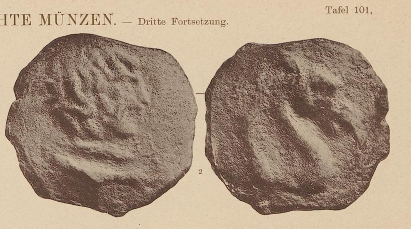
I only knew this specimen from drawing and now I find a photo of a cast in Haberlin’s ‘false friends’ plates! Pesaro, 340.2g.
Update 1.26.22:
Here’s the earliest record of this coin I have found thus far. Clearly same specimen. Were they actively forging these objects in 1767?!


 Liv Mariah Yarrow