AND I just learned SDA’s companion visa hasn’t yet been approved. Just my research visa. This will not be the last trip here…
adventures in my head

AND I just learned SDA’s companion visa hasn’t yet been approved. Just my research visa. This will not be the last trip here…
This is a 10 minute post, A “because I promised a coin a work day” post.
The legs of the curule chair resting on top of a base line out of which a serpent-like head rises on this type of Q. Metellus in Africa reminds of Caesar’s famous elephant coin.
I don’t have anything much more really to say, other than a caryx (Gallic ritual war implement) seems a likely identification or what ever creature the caryx itself is supposed to represent. This is not an educated view and luckily I don’t need to talk about either coin in my book. Someone far more qualified will handle the issue in the sequel!
Linderski, p. 174 n. 111 give references to various theories for the top Metellus coin.
The Caesar coin is hotly debated in many forums.
I’d want to see more specimens but I’d say the two are likely to be showing the same serpenty-thing, whatever it means. And, I suspect someone else has also drawn the parallel based on how the identification possibilities for both seem to run parallel in the literature.

I resorted to long hand. I left the house in the pouring rain and headed for a place of Milk and Honey. [It’s actually called that, but I drank coffee instead.] I brought a print out of chapter six to date and gave it a careful editing and started writing. Six new pages later I was feeling pretty pleased with myself. Still am really.
I left because a man left a backpack and ran out of the coffee shop. A clean cut white man with all the trappings of privilege. He asked if me and another anonymous coffee shop surfer would we be there for a while, dropped an expensive looking computer bag, and hustled out. He didn’t even wait for a response. He didn’t buy anything or even look towards the register. When he crossed the street and started walking down the opposite block, he slowed and began tucking in his shirt as he moved out of view. Yes, I watched him go. Maybe he hasn’t been in Brooklyn long. You just don’t do that. Who am I to him? And frankly, in this day and age I’m no more likely to carry a package on plane for a stranger than I am to watch a bag. Paranoid? Maybe. Is that a true representation of myself and my actions? Nope. I’ve watched a lot of bags for a lot of strangers over the years in a variety of locations and always ALWAYS turned down invitations to be a mule. [That’s another story.] Something must have hit me differently this time.
Most of my emigrant neighbors and friends of color are treated with suspicion on public transportation and in many other public and private spaces. It sucks. The pervasive culture of fear erodes trust in our shared institutions.
I was faced with a choice: Do I let myself think the worst of the kind of person whom no-one usually suspects? Something about his manner just made me nervy and on edge. Or, do I tell myself to get over it, tamp down my anxiety, and keep on drinking coffee and scribbling away?
I gave the backpack one last look and glanced around the place and decided that maybe I really could do with an afternoon run. I feel a little silly, but I don’t regret it. I guess the better thing to do would have been to say “No, you really shouldn’t leave your bag here unattended.” But after the fact (and his fast exit), I decided not to infect my overblown imagination regarding what the backpack could contain on my fellow coffee drinkers in our little gentrified haven. Frankly, I doubted anyone would share my sense that something was off. I’d “camped” enough for the day any how.
The run was lovely. Then I got to fight with the bank about a wire transfer to Turkey for a very long time. Again. That killed what forward momentum I had, besides entering edits during the discordant hold music. I had clear forgotten my little bout of paranoia earlier, until I came to this ritual confession of the contents of my day.
I keep wondering why I might have thought something was off. What was the trigger?
The owner of the previous establishment to occupy that space was the victim of a mob-style execution. The body was dumped in nearly unidentifiable condition a few states away. Actually, it was found quite close to where SDA’s parents live. Maybe that.
Maybe something else entirely.
Maybe I was just angry at his thoughtless (and largely correct) assumption that his privilege would let him drop a bag and walk away from it with no consequences.
I’m really glad the “trick” of writing by hand worked to get the words flowing in a continuous manner. My learning disability also means my fine motor skills are crap. I doubt anyone but me could decipher the scrawl.
As you’ll know from my previous post on bullae (i.e. Hellenistic terracotta seals, the impressions of signet rings) I think that the connections between engraved gems and coins haven’t been adequately exploited. Gem collections are still far more under cataloged than coin collections, but in the digital revolution more and more are thankfully going online, sometimes pre-publication. This creates problems regarding how to search. What terms will bring up in the right results? I was looking to get a sense of how often trophies appear on seal rings and up popped the image above. Rudders as symbols of fortune are pretty common on seal rings, but that isn’t a trophy above it. The photo is poor but I definitely see Hercules’ club from the top of which emerges a caduceus. Those might be palm branches but ears of grain (corn for our British friends) are more (?) common on these types of seals and I’m going with poppies for fertility on either side and maybe a plow below the rudder. A real mash up of symbols, rich pickings for many a scholar, but not really find-able as it is currently listed. Google image and that major social media site we’re all addicted to now do image searches base on similarity and facial recognition. There is no marketability in such an academic application, but that type of search technology could revolutionize our visual databases. The computer-aided die-study, of course, being the most seductive allusive dream. As more and more visual data comes on line we’ll need to get better about how we can sort and access it.
At very least working more “wiki” functionality into our academic databases would allow random users to leave notes or comments that might aid the project as a whole.
Numa is the second legendary king of Rome and more than the individual heroic founders of the city (Aeneas, Romulus, etc…) he gets his own numismatic commemorations in the late Republic. Moreover, he’s commemorated by a number of families in a variety of styles. The moneyer on this specimen has put Numa’s name on the diadem to save room on the flan for for his own name!
Perhaps most interesting is this denarius where his ‘portrait’ is unlabeled on the obverse:

But which is clearly identified with a legend on the bronze coinage in the same series:

Ancus Marcius, his grandson, also gets an obverse of his own:
Some of these commemorations are simply tying the moneyer to the legendary kings of Rome, but the the narrative of these kings was also particularly attractive. Numa especially was remembered for establishing religious traditions and thus the state’s continued well being through a correct relationship with the gods.
***
The last few days as I’ve been writing just about every image seems to me to lead to five new thoughts, leading off in a dozen different directions. I find I keep telling myself ‘not now!’ come back to it later. And yet, just the time to put a note in the correct file or update an old blog post (which amounts to the same thing these days) so I can come back to it later seems to consume all the space for writing. “Where was I?” feels like a constant refrain. I need to find away to stay more focused and efficient as a I fact-check what I’m writing. Perhaps that’s the difficulty: that I want to check my accuracy as I write, instead of saying what I generally believe to be true and then editing and correcting at a later stage.

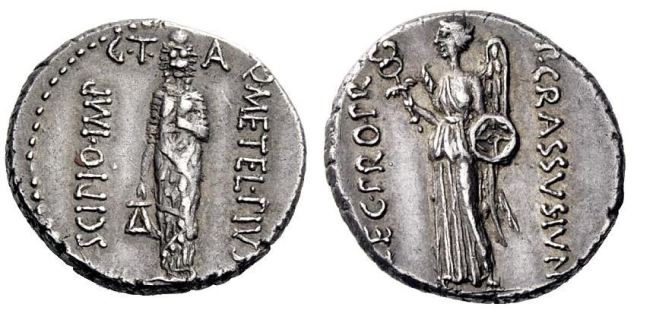
The fabulous Dr. Hannah of Oxford pointed out in comments that this type (RRC 460/4) would be relevant to yesterday’s post. That Victory carrying a caduceus: with victory comes peace! Such a perfect summation of Roman ideological rhetoric during the Civil Wars. I’ve been turning a blind eye to everything post Caesar’s crossing of the Rubicon, because that’s when the book terminates, but, of course, it is still the same monetary system. The chaos of the symbolism of that later period through Augustus really does deserve its own book and I prefer the earlier periods, but I am missing out on some fun with the present schema.
This type is really intriguing to me because of the other side.
The RRC description reads “Lion-headed Genius terrae Africae (head surmounted by disk), holding ahkh in r. hand…” That is no ahkh, that is the sign of Tanit, the patron goddess of Carthage. [A scholarly friend has suggested that there might in fact be a connection between the two symbols.]
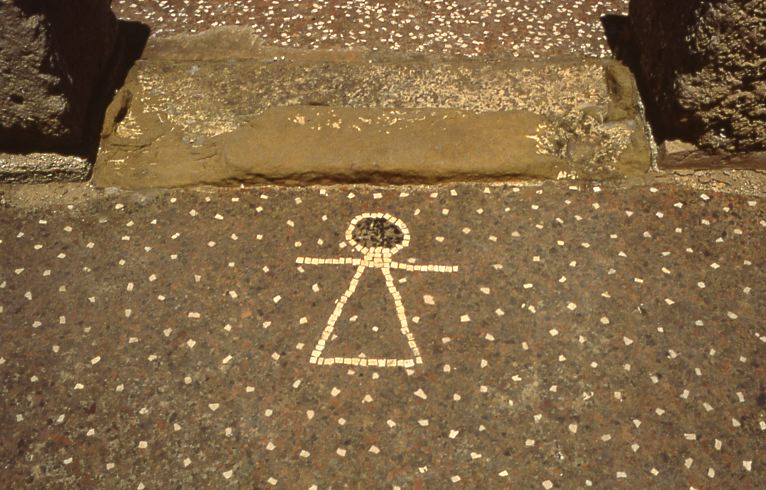

A flickr search or a google image search can give you a sense of the variations on this symbol and its contexts. And the image as a whole is clearly the same as this statue in the Bardo:


The connection was made in 1918. The publication is now in the public domain; see p. 241-242 for the relevant discussion. The identification as Genius Terrae Africae comes from the resolution of the “C . T . A” legend on the coin above the figure’s head by Babylon. I wonder if any other epigraphic parallels exist for this abbreviation or even the existence of this Genius in this form? Crawford (and others? ) see a link with the “Genius of Carthage” (Δαίμονος Καρχηδονίων) of Polybius 7.9.2.
Based on the abstract this might be relevant: Salcedo Garcés, Fabiola. – El relieve tetrarquico de Rapidum (Sour-Djouab, Argelia) : política y religión en el Africa romana. Antiquités africaines 1996 32 : 67-85.
Gabriela Vlahovici-Jones has given the type some discussion online. She treats the deity as “Sekhmet holding ankh” without any reference to Tanit.
Much of the concern over the identity of the Genius Terrae Africae or the Genius generally in N. Africa, seems to be in scholarship on the Late Antique and the Church Fathers, so for example this discussion and notes.
Linderski, Jerzy. “Q. Scipio Imperator.” In Imperium sine fine: T. Robert S. Broughton and the Roman Republic. (1996), pp. 144–185 is probably the most through description of the coin series.
And while we’re at it, I might as well mention that the sign of Tanit is often combined with a symbol similar too (and perhaps the same as?) the caduceus.

I’m no expert on North Africa so I’m going to stop here before I say anything stupid.
[Oh. And I think Victory is holding a shield not a patera (possibly even a Macedonian shield?)]
[Broken images and links update 10/10/25, no other changes to content made. For my published views on this topic, see page 154 of my 2021 coin book with CUP.]

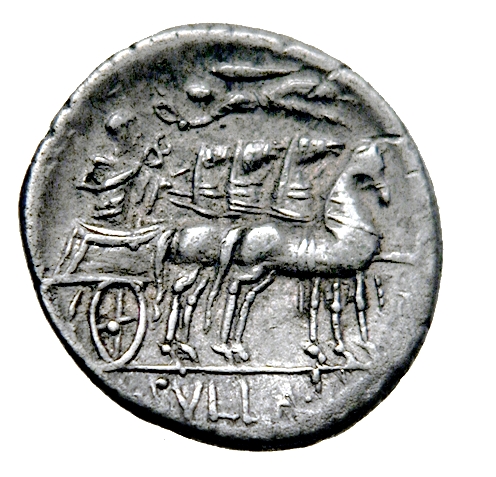
The figure on this reverse type is usually seen as representing Sulla triumphator. He’s clearly labelled as Sulla, but the caduceus in his hand is curious. “Victory hoped for” is Crawford’s reading. He doesn’t want to align it with the agnomen Felix because of the chronology of the time, though felicitas in the imperial times is most definitely shown with this attribute:

I tend to agree with Crawford and am puzzled because a caduceus is a very odd thing for a triumphator to hold:
After a thorough reconnaissance had been made, it was ascertained after a few days that all was quiet as far as the Gauls were concerned, and the whole force was thereupon marched to Privernum. From this point there is a twofold story. Some state that the city was stormed and Vitrubius taken alive; other authorities aver that before the final assault the townsmen came out with a caduceus and surrendered to the consul, whilst Vitrubius was given up by his own men. (Livy 8.20)
No, I don’t think Sulla is suggesting his willingness to surrender! This passage is even more explicit:
3 An indication of this is found in the following word and act of each of the two peoples: Quintus Fabius, a Roman general, delivered a letter to the Carthaginians, in which it was written that the Roman people had sent them a spear and a herald’s staff [‘caduceus’ in the Latin], signs respectively of war and peace; they might choose whichever they pleased and regard the one which they should choose as sent them by the Roman people. 4 The Carthaginians replied that they chose neither one; those who had brought them might leave whichever they liked; that whatever should be left them they would consider that they themselves had chosen. 5 Marcus Varro, however, says that neither the spear itself nor the staff was sent, but two tokens, on one of which was engraved the representation of a staff [‘caduceus’ in the Latin again]; on the other that of a spear. (Gellius, Attic Nights, 10.27)
[Update 24 Sept. 2013 – The sending of the spear and caduceus is proverbial in the Hellenistic World. See Polybius 4.52.4 and 24.12.1 with Walbank’s Commentary on the former.]
The herald’s staff was certainly read most often as a peaceful symbol, one of reconciliation and concordia. Just to give a taste of this, here are two coins one from 70 BC representing ‘concord’ between Italy and Rome and another from 48 BC during the Civil Wars of Caesar and Pompey.


Sulla is victorious and an imperator on this coin, but he is also togate and bearing the caduceus and through the later I believe he may also be suggesting his potential harmonious return. It didn’t turn out that way, of course, but that may well have been how he wished to be seen. He certainly wished to be remember as one who restored order.

Came across this image of a very earlier coin in the Roman series and immediately thought about our discussion the other day of this specimen and the Bocchus monument:

Wiseman has some good comments on the symbolism:

Images and some links added 1-6-25.

RRC 358/1 – with beautiful new photo.
There is only one of these coins known. It’s in Berlin, although a modern photo is not available on their website. One coin and thus just one set of dies isn’t much evidence to go on. It’s dated purely on stylistic and prosopographical grounds to c. 83 BC. The RRC entry says it represents a triumphator. The figure in the quadriga holds a trophy and palm branch(?) and seems to have some sort of spiky substantial head piece on. Holding a trophy is not typical triumphal iconography. In fact the only references to a triumphator holding a trophy in his triumphal chariot in the republican period which I know of is Plutarch’s Marcellus, and that is in connection with his dedication of the spolia opima. Flower has argued that his is the only historically likely case of this type of dedication, a view nuanced by Beard 2007: 292-295. I’m not ready to say that the figure in the chariot is Marcellus, esp. not without some connection between the moneyer and Marcellus or some other identifying characteristic. Marcellus and his spolia opima do appear latter on coins (RRC 439/1; 50 BC).
The motif of chariot and trophy is not alien to the republican series:
90 BC, RRC 342/4-6 Minerva in a ‘fast’ quadriga holding trophy
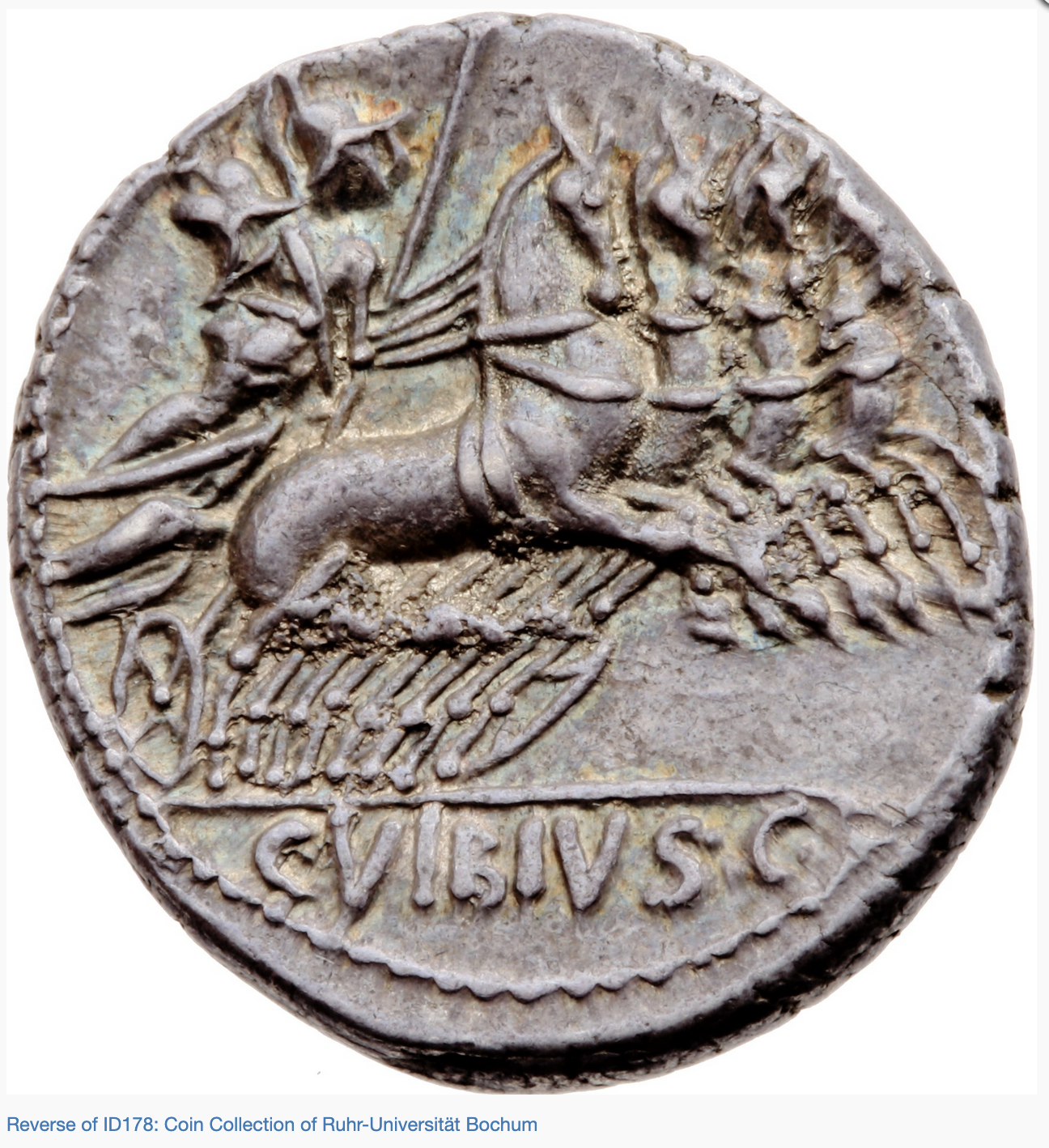
130 BC, RRC 255/1 Hercules in a ‘slow’ quadriga hold trophy

131BCE, RRC 252/1 Mars in ‘fast’ quadriga holding trophy
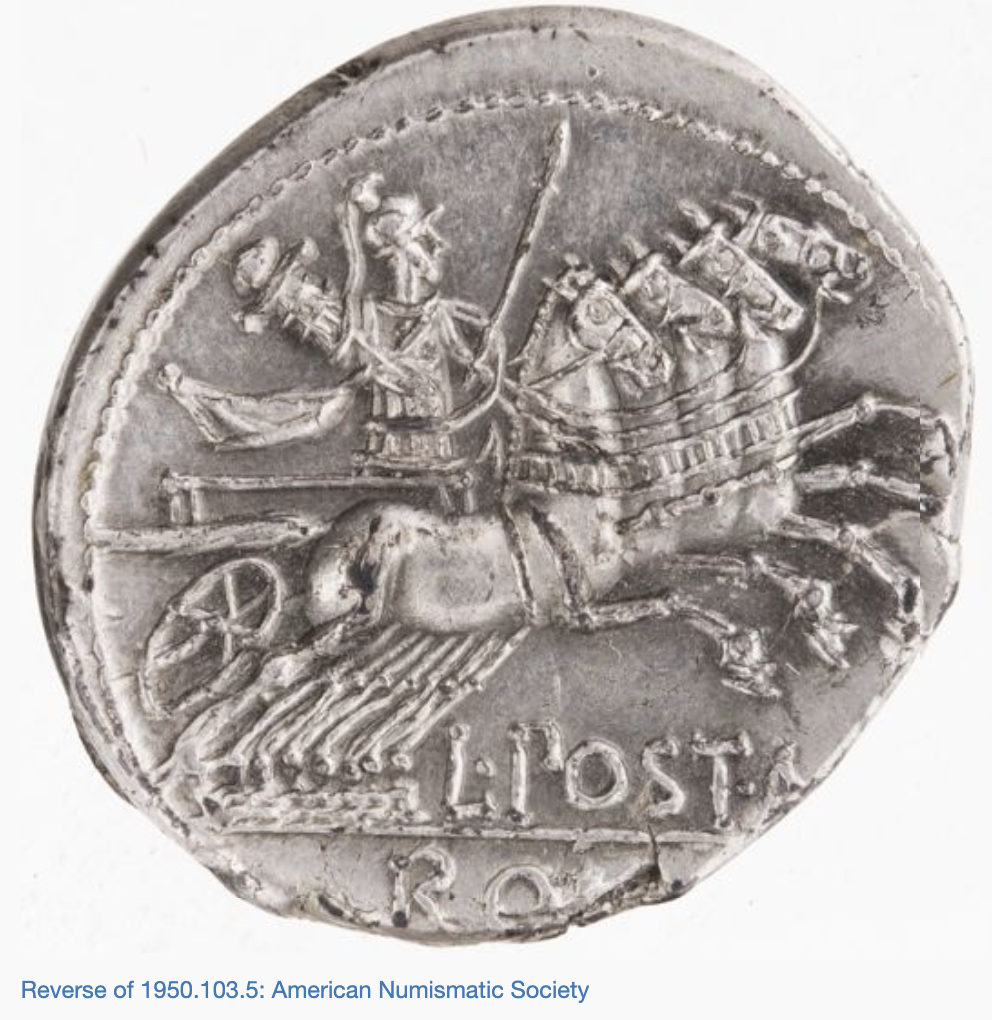
134 BCE, RRC 244/1 Mars in ‘fast’ quadriga holding trophy
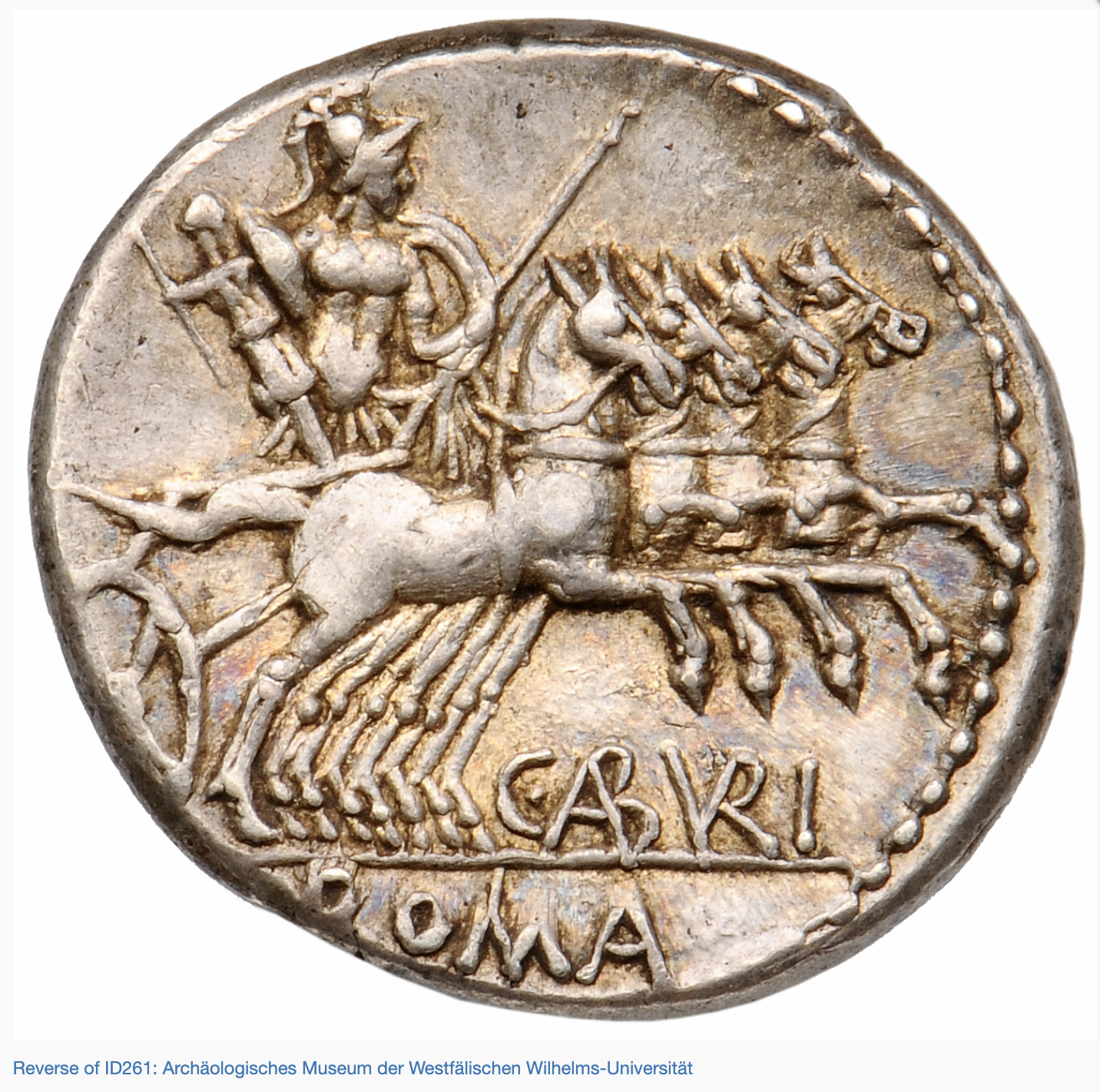
(Cf. also RRC 306/1 Mars naked trophy over shoulder and RRC 335/3 Naked warrior standing on cuirass next to trophy)
Both the laurel wreath and the bead and reel borders have plenty of precedents on the series, neither in any helpful pattern I can see (notes below).
The three-quarters profile chariot is unusual as is the lack of indication of motion in the horses, neither slow, nor fast, just still. The stillness and the palm branch and the laurel wreath are the best arguments for seeing this as triumphal.
The head on the obverse is usually identified as Jupiter but it isn’t a typical representation of him. My first reaction when looking at the head type is to see it as Hercules, but this may be overly influenced by his later iconography during the high empire. This sort of image:

[Herakles was associated with athletics going back to Pindar and this ‘portrait’ style has Hellenistic antecedents. – 1/6/26]
All in all my thoughts tend in a conservative and reductive direction. I’m not sure we can be certain of the identity of the figures depicted on either the obverse and reverse type. The unexplained elements I’d want answered are regarding the headgear and also the long flowing drapery off the figure and out the back of the chariot. Isn’t the latter usually associated with a female deity? I’d also want an explanation for why this palm branch is more “S” shaped instead of a single fluid arch such as Victory normally holds. Perhaps its the 3/4 perspective or perhaps its some other attribute:

Given its low production its hard to see it as a large, or significant, or influential issue. A curiosity, but perhaps not historically meaningful?
—
Similar border types (post 49BC types excluded)
Laurel Wreath Borders: RRC 232/1 – 138BC (chunkier, fixed bottom tie); 290/6 – 114/113BC (Unica – non vide); 324/1 – 101BC (distinct central stem); 329/1 – 100BC (loose thin, but same V execution); 336/1 -92BC (loose thin, but same V execution, not all v’s close: some become more parallel); 342/3a – 90 BC (non vide); 402/1- 71 BC (Pompey Aureus – perhaps most stylistically similar but lacks definitive dot at top join of Vs); 411/1a -64 BC (more leaf like, space at bottom); 418/1-2 – 61BC (more leaf like with berries and tie at bottom).
Bead and Reel: RRC 97/1a&b Luceria, 211-208BC; 103/1a Apulia 211-210BC; 236/1 (occasionally?!) 137BC; 366/2 82-81 N. Italy and Spain; 384/1 79BC; 392/1 75 BC; 409/1&2 67 BC
—
Update 30 November 2013: Compare the radiate crown on this representation of Jupiter below. The triumphator is said to have dressed like the statue of Jupiter on the Capitoline who is dressed in regal costume. Can’t be bothered to look up the reference but surely in Beard or Versnel.


Kinda looks like a Christmas wreath, doesn’t it? This occurred to me yesterday when I was in a local boutique buying bangles as Eidi for the young people who invited me to celebrate with their family today. [I’m really excited.] The woman in the shop suggested an up-sell: gold cloth bags to hold each bangle set. My first reaction was “ooo …nice! well-worth 2 bucks” and then she pulled them out of the cupboard and they had a holly leaf and berry design over them. I quickly back pedalled. I can’t exactly bring gifts looking like I used left over Christmas wrapping. I was worried about being perceived as uncouth or insensitive. At the same time it was Muslim woman in a muslim shop advising me on my purchase. I took them home and wrapped them myself.
And then when I got home I find myself reading about the reception of the cult of Cybele, a.k.a. the Magna Mater, in Rome. This is the first coin at Rome to depict the goddess.
Her cult object was originally an aniconic (non-figurative) black stone. That got set inside a silver statue. And, all the Roman representations follow the Greek model. I’m not going to go on about this as there is an award winning book on the subject. Most intriguingly in the earliest archaeological layers of her temple at Rome terracotta plaques representing Juno Sospita were found. This is not one of those finds, but gives a visual point of reference as to what Juno Sospita’s iconography looked like in the early period.

What’s my take away? I know that Eid isn’t Christmas, and I also know there is nothing inappropriate about borrowing one set of traditions to augment the celebrations of a different religion. The elisions are more comfortably made by insiders, than outsiders. I find the phenomenon bemusing, but not confusing. After all the holly and the ivy and the presents and many other festive trappings all entered Christian celebrations from earlier pre-existing religious traditions.
I don’t want to stretch the parallels with ancient worship too far. Monotheism and polytheism often work very differently, so too communally versus individually driven worship. And, yet. I think my understanding of Cybele is just a little more nuanced for having gone present shopping.
 Liv Mariah Yarrow