
Thank you, Mildenberg.

His Dream Collection. I am rather taken with the idea of a ‘dream collection’.
adventures in my head

Thank you, Mildenberg.
His Dream Collection. I am rather taken with the idea of a ‘dream collection’.

Ideally, one dates coins by the hoard evidence. People squirrel away pots of money and for whatever reason never come back for their savings. These groups of coins help numismatists figure out which coins were minted in what sequence. The numismatist takes all the hoards and tries to arrange them into a sequence of newest to oldest based on the contents. They end up with a much more complicated version of a chart like this one with the coin makers down one side and hoards down the other with the number of attested specimens of each specimen listed:

The wear of the coins — a subjective judgment up to a point — can be used to bolster support for such a relative chronology. So in our fictitious chart it would be reassuring if the coin of Bob was really worn and crummy looking in the Greece hoard, but the specimens in the Bahamas and Cayman hoards were nice and shiny. So far so good for accuracy. But what about Gigi and Heidi? Did they make coins at the same time? Or, did one come before the other? Would wear help in such a case? Would we trust that kind of assumption? What would we say if their coins looked really, really similar in all the fine details? What would we say if the looked totally different, not just different subject, but as if artists with two totally polarized styles did the carving? Would that make them less likely to have been made at the same time? What criteria would we use to make the judgment? Observation of stylistic similarities and differences often influences how coins are grouped in our relative chronologies. The similarities or differences are not themselves wholly subjective, but the interpretation of their meaning is. Even once one has a fairly decent relative chronology, it needs to be hung on an absolute dateline.
Look at the chart again. Notice three hoards all close with coins by Frank: Exeter, Easton, and Edmonton. And there sure are a lot of Frank’s coins left around, even in the Greece hoard. Here the numismatist might assume that Imaginaria (the hypothetical state whose hypothetical coins we’re studying) was at war. Wars are expensive. Lots of coins get made to pay troops and suppliers, etc. Lots of people also get scared and hide their coins. And, lots of people also die, making it harder for them to come back and find their pots of coins. Not great for them. Very useful for the numismatist. But can we be sure? What would be really useful is if it turned out we had an exact date from some literary text that said that Eastalia (ancient Easton) was burned to the ground on 14 February 530 AND that a professional archaeologist found the Easton hoard under the layer of destruction firmly associated with this known historical event. But that rarely happens. Usually hoards are found by metal detector hobbyists in areas never likely to be professionally excavated let alone tied to a literary record. More commonly we take stray finds of coins from controlled excavations in areas associated with major historical events to help establish a terminus ante quem for specific coin types and then tie that back into the relative chronology of the hoard evidence (e.g. Morgantina vel Numantia).
But that’s not all! The Roman republican numismatist has many more tricks up his sleeve. Meet our comrade: Prosopography. It is the subtle art of constructing an Ancient Who’s Who. It tries to figure out the inter-generational and marital relationships and career path of each known historical figure. To do this it uses inscriptions and literary testimony and combines those with assumptions about typical naming customs in specific families, regulations governing the holding of public office and more. Why would this help the numismatist date coins? Well, if we know an Edgar was elected to a magistracy that had a minimum age requirement of 45 in 542 and we think the typical age for a moneyership was thirty, then maybe we can assume that the coins of Edgar were made about 527. If it is the same Edgar and the time separating his magistracy and his moneyship were at the standard interval and if our assumptions about what that interval is are all correct. Still, it’s better than outright guessing. Ancient historians use the evidence they have. We might also use this type of evidence to help our relative sequencing. The order in which Isaac, Justin, and Kira held some later office might provide a clue to the order in which they held the moneyership.
There are also times when specific issues are tied to known historical events and that information is then tied back into our relative chronology. Sometimes the coins are absolutely associated with an event but the historians and coins geeks like to fight about when the event really happened base on a wide range of evidence (e.g. founding of Narbo). Other times the association of coins with a well dated historical event is based on assumptions about what the image meant to the original viewer (e.g. the oath scene on the coins TI.VETVR). These historical arguments become relevant to the whole series as the relative chronology from the hoards is hung onto these apparently fixed points.
Surely it’s not so shaky as all this? No, not completely. We know there were three moneyers each year and so for the Roman Republic (not Imaginaria discussed above) we also get to divide our group of moneyers into ‘colleges’ and if we feel confident (on stylistic grounds?!) about those colleges then we can sequence our relative chronology into years more easily. And, every once in a while we get a new big hoard with a useful closing date and it confirms and/or updates our preexisting arrangements (e.g. The Mesagne Hoard). Good archaeological evidence also comes along periodically. And, scholars with bigger brains than mine have been working on the arrangement and refining the details for a very, very long time. The relative chronology is likely to shift but not drastically so. The absolute chronology is probably good within at least five years (so Crawford himself, RRC I p. 74 speaking about the 2nd century in particular).
The problem comes in how both numismatists and historians (and archaeologists too?) treat the years given to coins. Certitude is a dangerous thing. RRC for most types affixes a specific year. Modern databases are great things but most aren’t programmed to accept the input of anything but a specific year or range of years. None of the major coin databases I use have included data about post-Crawford dates. This creates a default to Crawford. However, updating the dates to new scholarship doesn’t really fix the intellectual problem. The dating of any one coin in the series is usually based on dozens of assumptions about the plausibility of its place in the sequence and the relationship of that sequence to real time. There is no one place any scholar, let alone student, can go to have all thought assumptions spelled out for the individual coin type. The discussion and charts are condensed and focused on portions of sequence and their interrelationship. It’s not a house of cards, but it is not bedrock either. There is no open invitation to inspect the foundations in the minutia.
And the minutia is often what interests historians.
A few precious coins once in a rare while get their own independent date based on other criteria. When the historian opens a coin catalog or database each type has a specific year or year range attached to it. This then informs how the type is discussed along side literary accounts. The archaeologist may even use these dates to determine the deposition dates of certain related finds. Dates are one of the things that makes coins relevant to other discussions. Change the date of a coin by a few years or even just change the sequence of two coins and the whole picture changes.
Crawford dates this coin to 134 BC. Mattingly to 133 BC. Not that big of a difference. Both use this hoard as the basis of their arguments.

However, this very similar coin showing the same monument is put five years later in 128 BC by Mattingly, but one year earlier, 135 BC, by Crawford. Mattingly has the advantage of the “New Italy Hoard” to reverse the relative position of the two coins and suggest a gap between their issue. [Hersh, NC 1977: 24-27 with Crawford, Survey Num. Research 1979: 172f. and which for some reason I can’t find in the Hoard Database. Grr.]

Thus we now think the representation of the monument became more elaborate not less in the second representation and that it was revived rather than continued. (I find a a satisfying logic in the fact that the earlier coin with its radical departure from traditional Roman coin iconography would say ROMA on it.) Moreover, where do we fit this celebration of the Minucius who suppress the populist Maelius and then distributed his grain to the people at a low price for which he was honored with said monument. (I link here to Livy, but there are also relevant references in Dion. Hal. 9.4, Pliny NH 18.15 and 34.21.) Obviously there is some link between this narrative, the coin image used at this time, and the political circumstance surrounding Tiberius Gracchus’ famous tribunate of 133 BC. But what? We used to think it was the image used the year before Gracchus now we need to consider what it means for the imaged to be deployed in the same year and for the image to be revived five years later. And then what about this coin of M. MARCI MN.F?
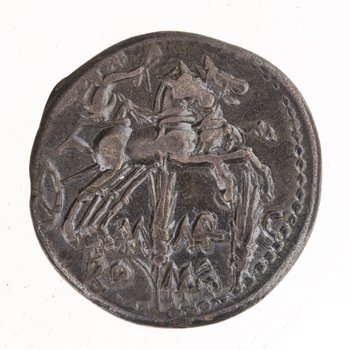
Everyone is pretty sure those big ears of grain popping up under victory recall an ancestor (even his father perhaps?!) who distributed grain at a cheap price as aedile (Pliny, NH 18, 15). But as far as I can tell the hoards help us not a lick on the relative chronology between this assertion and the similar one made by the first Minucius coin above. Mattingly fits it in the year before and sees the Minucius as an elaborate rebuttal to Marcius’ claim. Crawford has it coming after. The historian worried about the political climate at the time of the Gracchi would sorely like to know which.
Enough. For now.

Nearly every one knows the Juvenal quote about Bread and Circuses, or thinks they do, especially after the Hunger Games. First let’s have a bit more context from Juvenal himself:
if the old Emperor had been surreptitiously
Smothered; that same crowd in a moment would have hailed
Their new Augustus. They shed their sense of responsibility
Long ago, when they lost their votes, and the bribes; the mob
That used to grant power, high office, the legions, everything,
Curtails its desires, and reveals its anxiety for two things only,
Bread and circuses. ‘I hear that many will perish.’ ‘No doubt,
If you’d like to check the Latin, click here. In case you’ve landed on this page and aren’t quite sure who Juvenal is exactly, in short: he’s a poetic satirist living under the Roman empire. Think a potential guest contributor on both Howard Stern and the Daily Show. This passage finds a dark humor is some ‘facts of life’:
A brutal dictatorship is in power. The citizen body, especially the poor are disenfranchised. They reconcile themselves to their powerlessness in any significant political decision-making and demand only food and … what? Entertainment? Spectacle? Is that what circuses are?
Circuses are part of Ludi specifically the chariot races, but the circus space could be used for other public spectacles as well. Circuses are part of religious ritual. They were either part of regular annual festivals honoring a specific divinity or set of divinities, or they were one-off affairs given in thanksgiving to the gods for some benefit to the community as a whole, including military victories, protection from disease, the ascension of a new leader, major anniversaries, or the life of a recently deceased individual. The sacrifices made to put on the ‘games’ (i.e. expenditure of resources) and the participation of the whole community ensured the continuing relationship between the state as a whole and the gods. The well-being of the city and the empire depended on maintaining divine protection and blessings.
Juvenal seems to be trivializing the common concerns of the man in the street, but are they so trivial? Government is responsible for the basic infrastructure that makes living possible. Bread is a good start, a fine synecdoche. Let’s add in clean water, protection of the food supply more generally, perhaps some sanitation and even, if we want to get really radical, building codes and fire brigades to avert urban disasters. A decent agrarian policy, market regulations, and open shipping lines don’t make great poetry, but they do bake bread!
Circuses, Juvenal’s other synecdoche, or “part for the whole”, stands for the pleasure of the spectator to be sure. However, that individual pleasure isn’t a choice; it’s an obligation, a civic duty. After other forms of civic engagement are suppressed, only the ‘circus’ remains a space for political expression. Moreover, the gods do not take kindly to being shunned. The well-being of the whole is dependent on complete communal participation. Atheists, Epicureans, and Monotheists were a dangerous breed. That type of thinking endangered the stability of state by threatening divine relations through non-participation in the state cult. The leaders of the state protected the well-being of the city and empire by ensuring divine favor. “Circuses” and other ritual acts where the means by which such favor was maintained. How else could natural disaster, plague, or the barbarian hordes be averted?
Life under a brutal regime concentrates the minds of the people on the essentials. Moreover, a savvy autocrat or oligarch knows as much. He can give “the part for the whole”, cheap grain to mask the inadequacies of the socio economic system. Hungry people take what they can get. The Roman with a loaf of bread still wanted access to the means of production and a functioning market place.
Pulling the Juvenal quote into modern discourse out of context has despicable consequences. It trivializes poverty, suggesting gluttony rather than hunger drives the demand for “bread”. Moreover, it obliterates the ways in which all public infrastructure is our common “bread”. Our private economic resources do not make us independent from the system of government. We gained those resources within the system of public works and regulations provided by the state, from roads and schools to public defense and the farm bill. Like it or not, there is no opt-out option, any more than there was for the religious rites of the ancient city.
Within academic discourse the “bread and circus” view of Roman history tends to portray spectacles and food distribution as means of social control or self-aggrandizement on the part of patron. This is not unrelated to the trivialization just discussed. Should not the ordinary Roman care about the government’s ability to provide for the needs of the community? Would not a good leader be judged by his capacity to improve the public infrastructure and to actively seek divine blessings?
Today, I am sitting down to write about ‘popular politics’ in the last 100 years of the republic as presented on coins. I will be trying to escape “Bread and Circuses” thinking.
– Signed a Grateful and Unashamed Childhood Food Stamp and Welfare Recipient
—
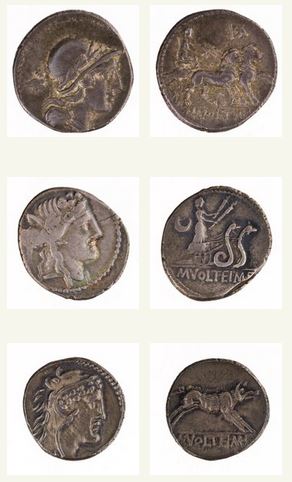

M. Volteius produced a series of five denarii on the theme of the Roman Ludi in 78BC (so Crawford and Hollstein, but contra Hersh and Walker who date the series to 75BC). Ludi is usually translated as “games”, but are better thought of as religious festivals. We’ve already talked about one of these coins regarding architectural issues. The series still remains problematic:
Also noted by Crawford is the lack of clarity of which divinity is intended by the helmeted and wreathed head on the obverse of the Cybele coin; he lists Attis, Corybas and Bellona as early suggestions. Wisemen in his 2000 chapter seems to endorse an idea originating with Alföldi and tentatively exploited and contextualized by Fishwick 1967, namely that the goddess is the Cappadocian Goddess Ma usually associated with Bellona or in Plutarch with ‘Selene, Athena, or Enyo’. Fishwick’s piece shows the imperial epigraphic references to Bellona elided with Virtus and the close association of that cult with the Magna Mater. Crawford himself on p. 307 of RRC vol 1 seems to suggest that Bellona is intended on Volteius’ coinage. The divinity on the obverse should within the logic of the series be one honored alongside Cybele. Three gods only have attributes on the reverse: Jupiter is paired with his temple, Hercules with the boar, Apollo and the tripod, but Ceres in her chariot is represented with the Father Liber who shares her festival. So Cybele in her chariot ought to have a similar companion on her obverse?
A standard reading would suggest that Volteius is promising personal largesse at such Ludi if selected as an aedile. This becomes a little bit more problematic when we consider that the Ludi he honors are put on by both curule and plebian aediles. It is hard to think he is actively “campaigning” for both. The selection is also not complete: the Floralia and the Plebian Ludi are both missing. More over the types honor the divinities but do not in anyway recall the spectacles or other public benefits of the ludi as some other ‘promotional’ coin types do.
Also confusing is the inscription of the Apollo coin:

S C D T is resolved by Crawford as stips collata dei thesauro or something similar recalling the original funding by individual contributions of this festival. It is hard not to see the SC as more readily read as Senatus Consulto as appears on so many other coins. This would leave the question of the DT. Dumtaxat is the most common resolution of this abbreviation in Latin inscriptions, usually preceding a number or measurement being translated ‘precisely’. There are far fewer of the Apollo coins surviving that any of the others in the series.

I’m really stuck on this Alföldi article. [See yesterday’s post for references.] He makes the assertion that the snake on an omphalos is the iconography of Apollo, not Aesculapius. He uses Etruscan cinerary urns as comparative evidence:
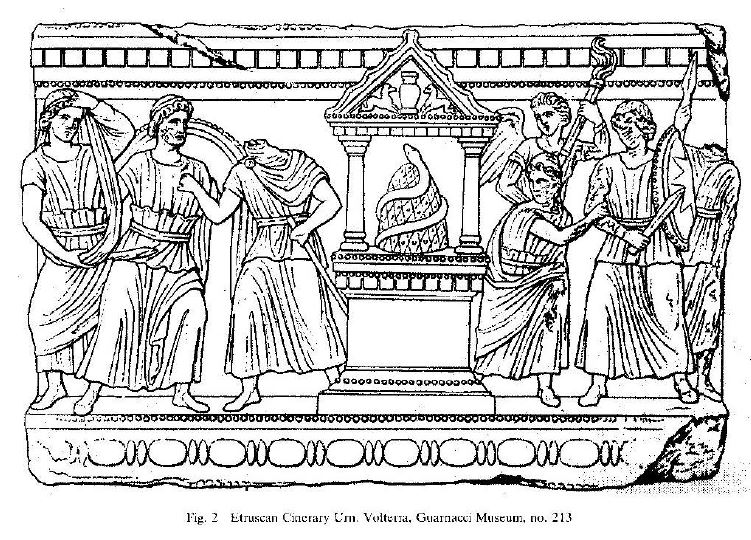
Yet these visual examples do not specifically link the image to Apollo they only show Italic usage. The image is clearly Delphic as Alföldi asserts. A point illustrated by the late 4th century Amphictonic Hemidrachms:


But this is by no means exclusive. The same reverse type was used at Pergamon after 133 BC to celebrate Aesculapius as Soter (savior):

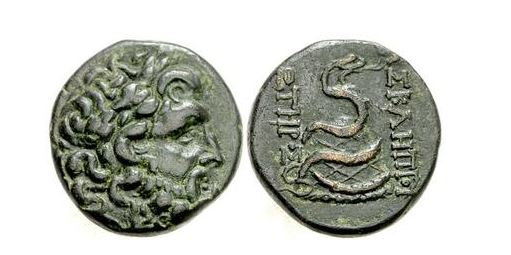
Aesculapius has been a popular interpretation of the allusions on L. Rubrius Dossenus’ coins because of literary testimony of a plague in 87 BC. However, if Apollo is meant than these coins might be linked to the Veiovis / Apollo coins of the Marians. The interpretation of which remains controversial:
Wiseman T. P. (2009). Remembering the Roman People: Essays on Late Republican Politics and Literature. Oxford, 72-78; contra RRC and Luce, T. J. (1968). “Political Propaganda on Roman Republican Coins: Circa 92-82 B.C.” American Journal of Archaeology 72.1: 25-39.
Also see newer post for iconographic parallels.

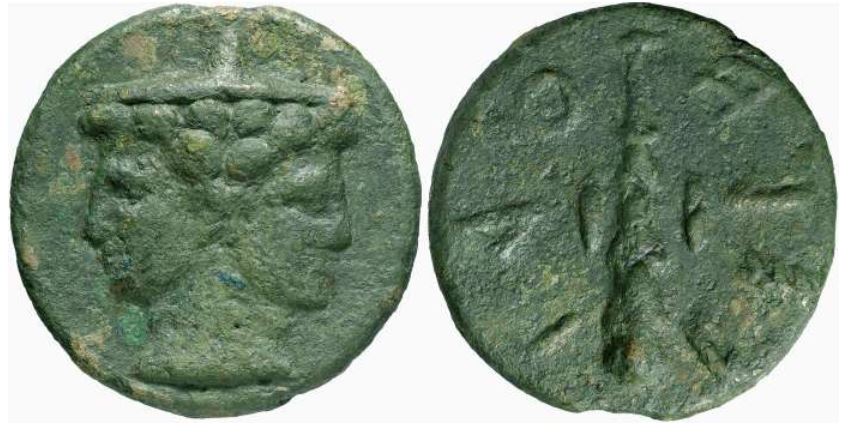
This as of L. Rubrius Dossenus (c. 87 BC) has, instead of the standard Janus, a janiform head combining Hercules and Mercury. Alföldi connects this image, not to the palestra hermerakles imagery representing sound mind and sound body, but instead to a rather unusual vase image. (See yesterday’s post for bibliographical citation).
Update 7/1/2020: Crawford judged Alföldi’s interpretation implausible in his 1984 Edinburgh catalogue. See McCabe for summary.

The thing to notice is that the body of the figure is covered in eyes. This is the standard means of depicting Argos Panoptes, the giant covered in uncountable eyes set to guard Io and killed by Hermes. He is the mythological representation of the ever vigilant watcher.
A more recent monograph on the Polygnotos painter questions whether the standard identification of the figures (i.e. Hermes slaying Argos to free Io) on this most unusual vase are correct given how much it diverges from the standard representation:

Maybe this is not Hermes or Io, I grant their iconography isn’t typical, but Panoptes is surely intended on the vase given how his body is covered with eyes. Perhaps we’re not seeing the right Argos Panoptes narrative here; the scholia on Euripides knew of other adventures in which he was a more positive protector, even if the vast majority of literary accounts are on Io. There is even an early suggestion that Argos only had 4 eyes like a Janiform god:
Hesiod or Cercops of Miletus, Aegimius Frag 5 :
“And [Hera] set a watcher upon her [Io], great and strong Argos, who with four eyes looks every way. And the goddess stirred in him unwearying strength: sleep never fell upon his eyes; but he kept sure watch always.”
Is Alföldi’s suggestion plausible? Maybe. The vase certainly isn’t the standard representation but it is of Italic origin and we may be missing other key evidence. That said, the vast majority of viewer would have been more familiar with the palestra imagery. Cf. Cicero’s reference to wanting such a statue (ad Att. 1.10.3):

We imagine this would be something like this:

Or like this one in the Boston MFA Collection:

That it is the two individual deities combined in one image which is intended on the coin seems to me to be more likely, given that the inclusion of the attributes of both in the design. This is not that visible on the specimen, but is noted by Crawford and can be seen on this coin of Andrew McCabe:

See how a club and caduceus jut out on either side below the chin and above the shoulder.
Why did Alföldi find the Argus explanation so attractive? It allowed him to connect the coin to contemporary politics especially the vigilance of the Marians in anticipation of Sulla’s return. (He dates the series to 86 BC.)
All that said it is also possible the Cicero/Palestra theory is a red herring. Cicero might not have meant double herms but instead statues like this:


A little later aside (11/11/13): In that way that so often happens, I came across an odd coin with slightly similar imagery today. Perhaps, I noticed it because I’d been looking at these janiform/bifrons heads yesterday. I’m putting it up just so I have a note of it, should it ever prove relevant:

Another potential piece of comparative evidence (found 23/12/13):

Listed on Flickr as:
Janus-herm with addorsed head of Pan [or Zeus Ammon?] and Hercules, Marble, Roman, 1st c. CE; George Walter Vincent Smith Art Museum, 51.2002.10; Springfield, Massachusetts, Gift from the Estate of Dr. Melvin N. Blake and Dr. Frank Purnell
Update 30/1/2014: Discussing Janiform head could also lead to an investigation of this sort of object:

3/22/14 update: Compare the coinage of Volaterrae with the image of Argos on the vase painting above. Note in particular the hat and the club:
Also of interest is the iconography of the Etruscan god, ‘Culsans’:
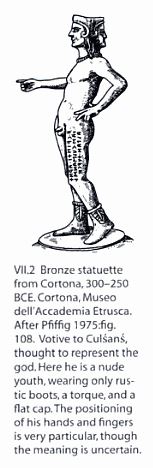

Note that the official museum catalogue website describes the headdress on this statue as a wild animal skin.

Returning to the book has been a jarring experience today. I managed to exhibit huge internal resistance. For example, it seemed very important today to refine my file and image backup system and clear my hard drive of duplicate files using the latest search software. Anyway. Not knowing where to start or even which chapter I wanted to tackle next, I opened the very first item in my file of scholarship to be reviewed and incorporated as relevant.
Alföldi, A. (1976). “The giant Argus and a miracle of Apollo in the coin-propaganda of Cinna and Carbo.” In In Memoriam Otto J. Brendel: Essays in Archaeology and the Humanities, 115-119. Mainz.
This is mostly on the bronzes of L. Rubrius Dossenus (RRC 348). However, very confusingly he says “Another reference to this function [sc. Rubrius’ theoretical aedileship] is given hy the representations on his quadrans: the head of Kybele on the obverse and her lion on the reverse announce the ludi Megalenses, celebrated in honor of the Magna Mater.” No such coin is listed by Crawford for this money and I can find no other reference to such a quadrans. How did Alföldi come to think one existed?
My searches led me a reference to the type above on this website. The anonymous author of that website is certain the image represents Cybele and to be sure the iconography is be close. The author even wants to go so far as to down date the coin (and the rest of the series?!) from Crawford’s suggested 217-215 BC to 204 BC when the cult of the Magna Mater was introduced to Rome. [See my earlier post with links and also Bowden, H. (2012). “Rome, Pessinous, and Battakes: Religious Encounters with the East.” In C. Smith and L. M. Yarrow (Eds.), Imperialism, Cultural Politics, and Polybius, 252-62. Oxford.]
Crawford simply identifies the observe as “Female bust, r., draped and wearing turreted crown” but on p. 719 of his second volume he suggests that the head may be the personification of the city of Rome herself. He seems to be imagining something along the lines of the Tyche of Antioch.
This struck me as a rather radical suggestion regarding a means of representing Rome, in contrast to the iconography of Roma or the Genius of Rome. The underlying assumption of both the website and RRC is that the mural or turreted crown represents a specific thing: Cybele or Tyche or a City Goddess. All of these are right and there is some decent scholarship explaining how they connect one to another. Reading up on this I was struck by this passage in the article just linked:
As “turrita” (with the mural crown) in Virgil’s Aeneid (6.785), the Magna Mater stands for the rule of the urbs Roma over the entire world (orbis).
Here’s the Vergil passage with Anchises in the underworld prophesying to Aeneas:
Behold, my son, under Romulus’ command glorious Rome
will match earth’s power and heaven’s will, and encircle
seven hills with a single wall, happy in her race of men:
as Cybele, the Berecynthian ‘Great Mother’, crowned
with turrets, rides through the Phrygian cities, delighting
en huius, nate, auspiciis illa incluta Roma
imperium terris, animos aequabit Olympo,
septemque una sibi muro circumdabit arces,
felix prole uirum: qualis Berecyntia mater
inuehitur curru Phrygias turrita per urbes
laeta deum partu, centum complexa nepotes,
omnis caelicolas, omnis supera alta tenentis.
huc geminas nunc flecte acies, hanc aspice gentem
Romanosque tuos.
Vergil’s metaphor certainly equates Rome’s walls with Cybele’s turreted crown, thus drawing the two together. I’m not sure we can push this back into the late 3rd century, but the goddess on the coin may very well have recalled more than one association in the minds of its earliest viewers.
Update 17/1/2014, just adding a finer specimen:

This specimen also makes me wonder about reverse figure. Is this a ludic scene recalling riding competitions at religious festivals? The figure seems to have a whip but no other weapons. Is this an early precursor of the desultor and rider types seen later in the republic? The whole series has unusual types… Best image of the series as a whole.
Update 31/1/2014:
A nice parallel to the Virgil Passage:
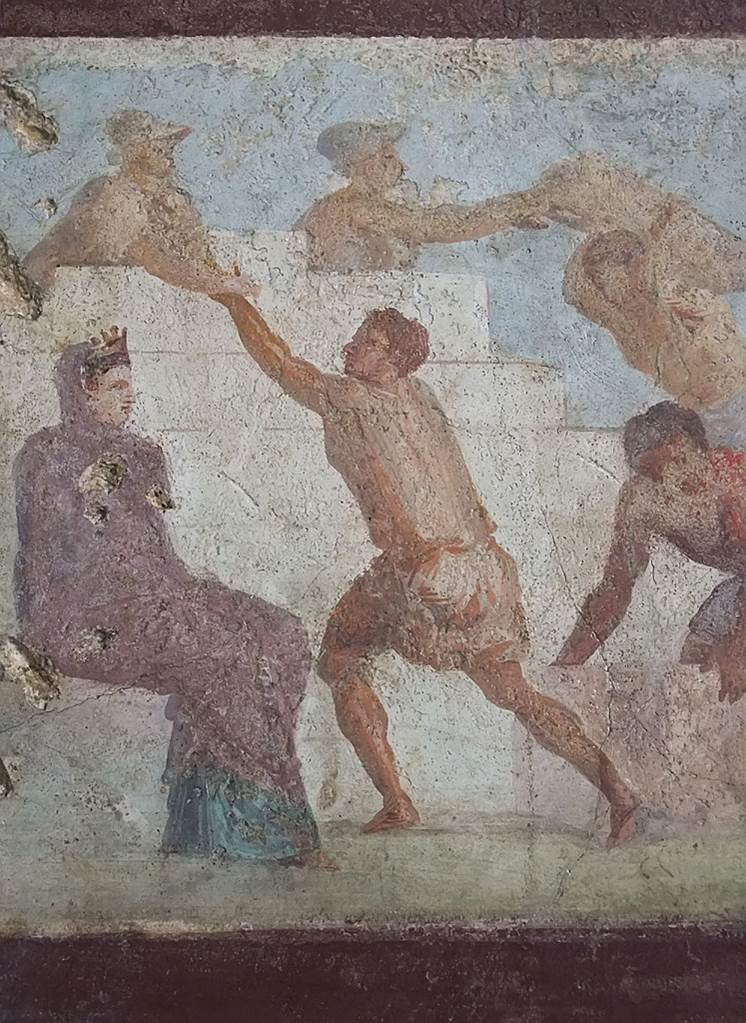
Part of the fresco narrative the origins of Rome from the family tomb of T. Statilius Taurus on the Esquiline. Now on display in Palazzo Massimo.
Update 27 February 2014: Note this turreted goddess on Sicilian coinage, Acra (SNGANS 902):


I am staying in the home of some lovely Ottoman scholars. Thus I picked up Yeğenoğlu’s Colonial Fantasies to read with my grilled cheese (as ya do). First, it had me wondering what parts of our other travel blog or even this blog or my social media feed might unwittingly be perpetuating Orientalist dialogues, patterns, topoi etc. Something like an antiquarian curiosity had me reading a Social History of Ottoman Istanbul before bed of late. Even that book itself — although careful to distinguish between its bedrock of in-culture sources and outsider perspectives and speculations — still seems ready fodder for such curiosities, turning the city and the history into a spectacle for a new crop of Anglophones eager for tales of the mysterious East.
Then, I came across the Said quote above. Reading it in Yeğenoğlu‘s context, I suddenly stopped seeing the word Orientalism and in its place saw Classics. How often I find myself drowning in footnotes of detail. Crafting my cross references at times with more care than my own reactions or observations. Those are nothing without the substructure of academic scaffolding.

Most all my time is spent on learning Turkish: writing little essays on my last holiday, constantly comparing the grammar to Latin, and struggling with vocabulary. Tonight we came home in good spirits from the class and a fun exchange with our vegetable seller. I put on Cicero’s On the Nature of the Gods on Librivox while cooking dinner. Normally we listen together to such things at bedtime, and usually Greek or things I’m unlikely to ever write about. I do enjoy just listening sometimes, remembering that my ‘primary evidence’ is good literature too. It occurred to me that if I needed a little break from Turkish Cicero might keep the mind ticking over in a useful way hands free. So… the spinach is sitting half washed in the sink and i’m in my new office at my new standing desk trying to spit out a little thought:
The article I just sent off said a good deal about representations of fides on coins. I’m struck here by the connection of it with societas generis humani. The L&S (no OLD with me in Turkey, I will confess!) says of societas:
The Cicero passage surely supports this implication. My attraction to the passage is that it gives a nice illustration of how fides is associated with divine bonds in human society. It demonstrates how the ‘virtue’ is conceived of in a foundational manner, of practical significance to all associations. but also more than practical, something dependent on the sacred as well.
Anyway, spinach awaits. After the exam (my first in how many years I dread to think?!) we’re going to pop out east to see a ruin and museum or two for 48 hours and then straight on with the coin book. I finished the book review Friday and tweaked and sent it off Sunday, so it’s not ALL been Turkish.
anon.

Crawford says of this coin:

This type of logic permeates RRC. Given enough time with the series one starts to think that this type of symbolic language must have been pervasive at Rome. But is this actually how people thought? Are the name plays obscure or obvious to their audience? Is it a Roman phenomenon or something much wider?
Yesterday (because of the book review I’m diligently working at), I was thinking about the legacy of Pythagoras. Not a figure I can say I’ve cared much about in the past, beside mentioning the legendary connection to Numa in some of my classes or this rather fun video. Of course, he shows up on some provincial coins of Samos. But I was surprised to learn that May thought there might be a fifth century portrait on a coin from Abdera.
Here is what Burkert, Lore and Science in Ancient Pythagoreanism, 1972, p. 110 says:
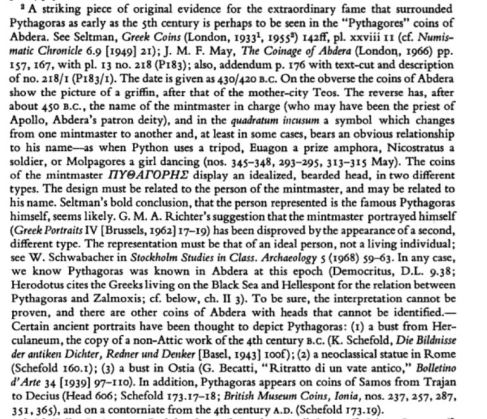
I’ve singularly failed to find you an image of this coin. And after ‘wasting’ a hour and a half plus looking for it (and in the mean time getting rather visually acquainted with the mint of Abdera — what a great series!), I decided that it had nothing to do with the review or the book and so I’d better drop it. The only tangential connection is this use of visual puns on the moneyer’s name. Take for instance this beauty:
 The moneyer, Dionysas, has the head of Dionysus. And here’s Python and his tripod:
 The British Museum has their whole (?) collection of Abdera coins up with photos. It’s a great shame its not searchable by inscription and May number. [The ANS has the May numbers, but few images and the legends are not transcribed.] A look through the BM collection suggests straight off that not all images are naming puns, even if some certainly are.
Did real people think like this or was this a coin designers’ game? Enter, Timeaus (via the anonymous author of On the Sublime):
Or Timeaus via Plutarch:
This is prophetic, symbolic thinking, not iconography, but nonetheless I detect a similar type of name=symbol association as we find on the coins. Perhaps we could marshal Timeaus as part of an argument for decode-ability of the logic behind our numismatic symbols. And perhaps Abdera + Timeaus = some background to just what exactly the Roman moneyers thought they were communicating with their symbolic language.
—
Update 5/19/14: An old piece of scholarship that does a fine job of surveying the use of visual puns in media other than coins.
 Liv Mariah Yarrow