239 out of 410 days: Lessons Learned, Again

simon-price

This morning I started weeping as I read about the Agonalia.

Simon Price was an amazing scholar, a brilliant teacher and one of most kind and humane men I’ve ever known.  He gave me my first teaching job.  Back summer term of 1997 I had a series of undergraduate tutorials with him on Roman religion.  I’d been to his lectures the previous term and was in awe of all the rich materials, tidbits of evidence from here and there he marshaled together into a captivating narrative, a narrative that showed something of all the questions left to be asked.  He’d stand by the window in his black robe and look out of the room as he talked, making sense of the patchwork quilt of sources he’d assembled on a single handout.

The tutorials were good, but it was summer and Oxford was full of distractions.  I found the way of thinking about the history of religion, very different from reading Polybius.  The Isis essay was fine, a novelty really, but boy did I struggle the week on Ovid’s Fasti.   He wanted me to answer the question what use is this poem to the historian.   I thought I’d never read anything quite so dull.

This morning I started by reading the Fasti.  I love every bit of it.  Like a sibylline book, every time I read it, it seems new  again and perfectly relevant to my project at hand.   I never seem to be able to see or understand or remember a passage of it until the moment I need it.  Simon was right, of course.  He tried to teach me to read it.  At least I got there eventually.

I regret most fervently never writing to him before he passed away about what he meant to me. Or just to say thank you.  If there is someone you should write to, trust me it will be better to do it now, than redraft the letter over and over again in your mind for all the years to come.

238 out of 410 days: A Fashion for Ships

One shouldn’t really talk about those Fonteian coins as I was doing yesterday without adding in this coin of Q. Lutatius Cerco (quaestor, but whose quaestor?).  It was minted between the two other issues with full ship reverses.  It is given by Crawford a historical not legendary interpretation.  It’s seen as a celebration of the navel victory of C. Lutatius Catulus in 241 BC.  It clearly inspired by the first Fonteian coin and in turn inspires the design of the second.  The element it adds to the design are the overlapping shields above the oars.  This is a feature also seen on sculptural reliefs.  The reason this seems important to me is that the supposed doliolum of symbolic importance on the stern of the second Fonteian coin, looks to me as just another shield added for decoration:

Silver coin.

On some specimens like this one that haven’t been rubbed smooth it even seems to have the same line decoration.  I’ve not been able to find a parallel of a shield placed in this position on a ship depicted in other media. (Largely because looking for one is a distraction from the book!)

I should have also brought the Lutatius coin into my previous discussion of prow stems.

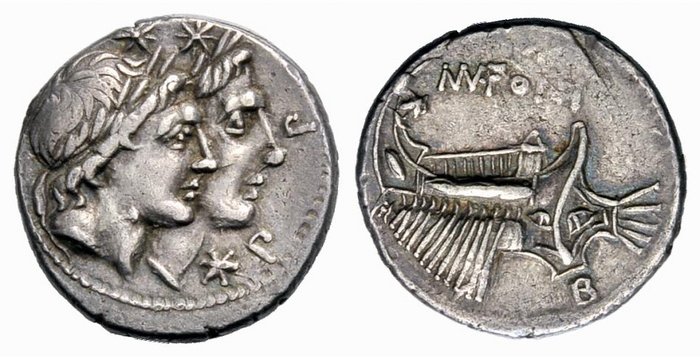
Postscript.  Do those two big stars on Roma’s helmet recall the dioscuri/penates?  Notice the stars over the Penates heads on Mn. Fonteius’ coin.

Update 2/12/14:  

Reverse of RRC 342/7b. 1969.83.492


Notice the dioscuri caps in front of the prows on this rather rare variation on the standard design of the as.  There is a victory palm above.  Perhaps further evidence that there is some association between navel victory (victories?) and the Dioscuri?

Update 4/29/14: Compare the placement of the rear shield on this representation:

Link to Getty Cast of Roman Bireme without a stern shield but with a similar stern terminus.

Another Getty Image.

and another.


Dei Penates Publici and the Dioscuri

Obverse of RRC 455/2a. 1944.100.3299

So later in the day I’m still thinking about those pesky penates and their iconography.  The most indisputable example is from late in the Republican series, c.47 BC, the image above.  It has two heads side by side just like the earlier issues and labels them very clearly. Diadems instead of laurel crowns but otherwise very similar and clearly labeled.  The other time they appear on the obverse of a coin is just one year (according to Mattingly) after the Fonteius coin I discussed in the last post.  Notice the abbreviation DPP = Dei Penates Publici.

Obverse of RRC 312/1. 1937.158.28

One of the things that is said quite often is that the iconography of the DPP is elided with that of the Dioscuri.  The best proof of this is actually that Fonteius coin with its PP inscription and the stars over the foreheads.  The text passage that is usually cited is this one from Dionysius:

In this temple there are images of the Trojan gods which it is lawful for all to see, with an inscription showing them to be the Penates. They are two seated youths holding spears, and are pieces of ancient workmanship. We have seen many other statues also of these gods in ancient temples and in all of them are represented two youths in military garb. 

No mention of the Dioscuri here.  Just a visual description.  One that in fact sounds awfully like that which we see on this coin representing the Lares Praestites (early post):

Reverse of RRC 298/1. 1937.158.17

Then there is question of the degree to which we want to argue in reverse like this.  We’re basing (with good reason I think) each earlier image on the next more clearly labelled instance of the same iconography.  So the first Penates/Ship coin by a Fonteius (RRC 290/1) has a janiform laureate head not two jugate heads.  In this it looks quite a bit like this  MUCH early didrachm standard obverse:

Obverse of RRC 28/3. 1941.131.15

How do we know this earlier image is of the Dioscuri, not say the Dei Penates?

Then finally there is the issue of saying the Dioscuri connection the coins is an indication of their connection with Tusculum.  What do the Dioscuri have to do with Tusculum?  They were honored there but not really any more than other towns as far as I can tell.  Here’s the often cited Cicero passage:

“And what of those other instances? As when, for example, the statue of Apollo at Cumae and that of Victory at Capua dripped with sweat; when that unlucky prodigy, the hermaphrodite, was born; when the river Atratus ran with blood; when there were showers frequently of stone, sometimes of blood, occasionally of earth and even of milk; and finally, when lightning struck the statue of the Centaur on the Capitoline hill, the gates and some people on the Aventine and the temples of Castor and Pollux at Tusculum and of Piety at Rome — in each of these cases did not the soothsayers give prophetic responses which were afterwards fulfilled? And were not these same prophecies found in the Sibylline books?

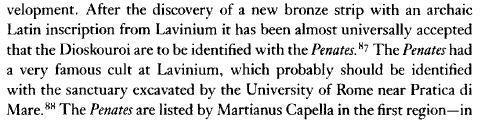
The penates on the other hand are most often associated with Lavinium, if anywhere other than Rome.  And if the ship is carrying the Trojan gods to Italy on the reverse of those Fonteii coins, it seems like Tusculum might be the big red herring in the conversation.  Until we add in this aureus of 43 BC (as per Woytek’s Arma et nummi, 2003):

Gold coin.

The stars and pilei make clear the Dioscuri emphasis and the reverse is a most unusual representation of the walls of Tusculum with its main gate.  The walls and height of Tusculum was proverbial and usually linked to some legendary origin (Telegonus or Circe):  Hor. Ep. 1.29‐30. Ov. Fast. 3.92, Sil. Ital. 12.535, Hor. Od. 3.29.8, Prop. 2.32.4, and Sil. Ital. 7.692.  The representation is similar to but different from the DPP.  Does it help us resolve the Fonteian coins?  I’m not sure, but it keeps Tusculum strongly in the mix.

Update 4/16/2014:  Note this claim in Torelli 1995: 114:

Capture

Capture

Discussion of the inscription can be found here.

Lavinium - Lamina

Weinstock 1960 is here.

Key Bibliography: Galinsky 1969: 141-169.

237 out of 410: Similar Images, Different Interpretations?

Faulty image display corrected and examples replaced with new specimens on 11/25/25.

Specimen of RRC 290/1 in trade

This is a lovely example of the coin of C. Fonteius.  Notice the care taken with the details.  The dog or wolf’s head on the ram about prow is particularly impressive.  It’s even clearer on this specimen.  The ship has been given a crew and a prominent helmsman.  The rudder is emphasized as is the aplustre and the fillets off of it.  His brother or cousin Mn. Fonteius made a similar coin (RRC 307/1) a few years later:

Berlin Specimen

This is another version of this second issue that looks a little different:

Specimen in trade

The differences are small, but significant. PP is added to the obverse, resolved Penates Publici [Crawford’s subtype A].   The other difference is the oval shape in the stern of the ship.  Crawford in 1971 identified this as a doliolum containing the sacra of Troy and hypothesized a connection between the Dioscuri, the penates publici and these sacra.

I find this plausible if not certain.  My issue comes with the identification of RRC 290/1 the earlier coin.  Crawford happily extends the Dioscuri interpretation back to the janiform head on 290, but gives a completely different reading of the ship.  He sees it as connected to Telegonus the founder of Tusculum’s overseas origins.  This seem a stretch.  The two coins produced in the same family with nearly identical images should, I think, have the same explanation.  If one represents the arrival of the sacra from Troy, so does the other.

Here’s the comparative image Crawford discusses:

Image

Update 2/11/14:

The three quarters perspective used on RRC 307/1 is a familiar style for depicted Roman galleys in Pompeian frescoes:

Roman Galleys


How early were the Penates associated with the Aeneas narrative?  Apparently some time before the third century at least (Ennius fragment):

Capture1
Capture

Rhodios, founder of Rome

Mosaic with a wolf suckling twins at Ma’arrat al-Nu’man, Syria, with inscription showing that the mosaic came from a hospital built in 511.

The first time I saw an image of this mosaic I thought the spellings of the names very odd.  PWMYΛΛΟC and PWΔC, except the delta looks like it has a tail like a funny iota script.  So perhaps its reads PWAiC, but that doesn’t make much sense either.  At with point I stopped worrying about it because its way after my period and just a distraction from getting this book done.  

Then today I started thinking about that odd letter in the twin’s name who isn’t Romyllos or Romulus or however you want to spell it.  I was reading Wiseman’s chapter on L. Brutus in his Unwritten Rome (2008) and I read this fragment of Alcimus (FGrH 560 F 4 = Festus 326-8L):

Alcimus says that Romulus was the son of Aeneas’ wife Tyrrhenia, and from Romulus was born Aeneas’ granddaughter Alba, whose son, called Rhodius, founded Rome.

Wiseman goes on (p. 302 ff.) to explain that ardea means heron and so does rhodios in Greek and so this passage is about Ardea claiming to be founder of Rome.  

Anyways.  I doubt a late Syrian mosaicist was following Alcimus or anything.  

236 out of 410 days: Alliteration and Translation

obverse


Tatius, legendary king of the Sabines and co-regent at Rome for 5 years with Romulus, is used by two moneyers in the Republic as an obverse type.  Tatius appear in some of the earliest Latin literature in a famously alliterative line of Ennius:

O Tite, tute, Tati, tibi tanta, tyranne, tulisti

What a mouthful!

The translations too often depend on what people think the context is:

By yourself, Titus Tatius the tyrant, you took those terrible troubles.

Warmington in the Loeb clearly assumes a negative context (above).  This reading has been endorsed again by a recent introductory essay on Ennius.  [Not bad little introduction to his alliterative tendencies there too.]  By contrast Elliott very recently has swung out to an opposite positive direction:

You yourself, Titus Tatius, earned yourself so great a reward.

I rather like this more neutral rendering (It is widely quoted thus (an example), I’ve not bothered tracking down who the original translator is):

O Titus Tatius, Tyrant, what great things you have brought upon yourself!

Reading Ennius as having a negative portrayal of Tatius makes it more difficult to explain his presence on coins.  The desire to commemorate him on the state coinage pre-supposes a positive legacy.  

The coin, I suppose, evokes something closer to the sentiments of this line of Propertius:

qui quaerit Tatium veterem durosque Sabinos,

hic posuit nostra nuper in urbe pedem.


He’s only lately set foot in this city who asks for the ancient Tatius or the strict Sabine. 

Propertius says chaste and modest girls might existed in the past but that’s not how this are now or appear to be in the various mythological allusions.

It seems that Tatius has a reputation (along with his fellow sabines) as a guarantor of moral rectitude, perhaps an allusion to his (their) punishment of Tarpeia?

Reverse of RRC 344/2b. 1987.26.59


For smart things about Sabines on Coins, see Farney.

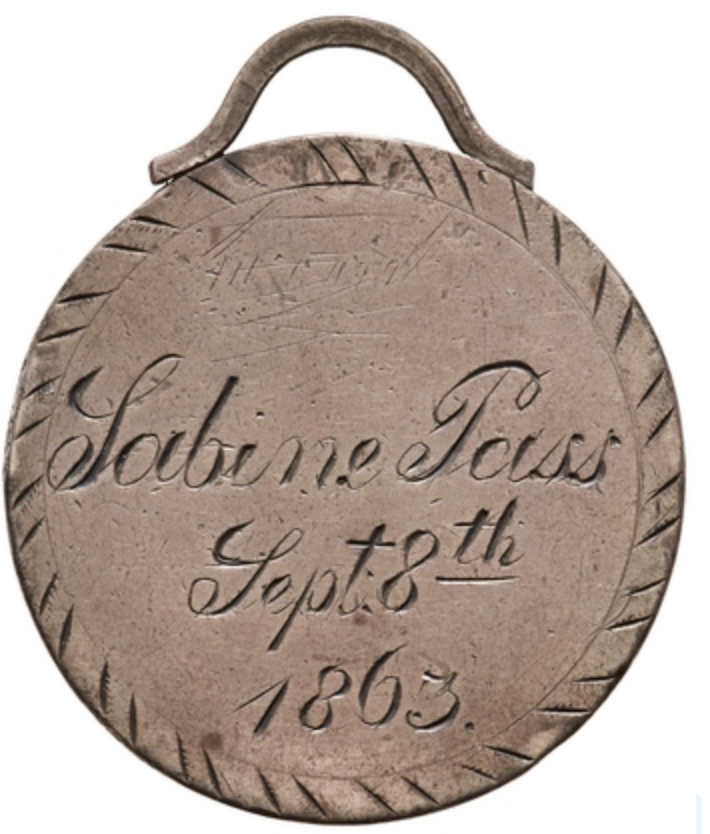
Sabine Pass

ANS specimen

Sometimes there is a danger of learning something completely unrelated to Greco-Roman antiquity when using a coin database.  I searched “Sabine” expecting to return RRC 344/1 [I was thinking about the iconography of two figures carrying two other figures].  Which the search did, but I also got back a handful of medals like the one above.

The Second Battle of Sabine Pass took place on September 8, 1863, and was the result of a Union expedition into the Confederate state of Texas during the American Civil War. It has often been credited as the most one-sided Confederate victory during the conflict.  …

… In recognition of the victory, local residents smoothed off Mexican dollars, stamped them with the battle and date, plus individually the name of each soldier, hung them on green ribbons and presented them to the troops. Approved by the Confederate Congress, the Davis Guards Medal is believed to be the only official military decoration issued by the CSA [wikipedia]

Needless to say anything that rare and historic is likely to inspire forgeries.   A number of the specimens in the ANS collection have notes saying such and such cast doubt on the authenticity of the specimen.  Here are all the ANS specimens together.  Interestingly only the ones with soldiers’ names are listed as possible forgeries.

The coin conversion is particularly interesting to me.  I’d also love to know who and when named the pass and the adjoining Sabine Lake.  The habit of naming places with Classical allusions is one I associate most strongly with New England, especially Upstate New York.

Catanaean Brothers

reverse

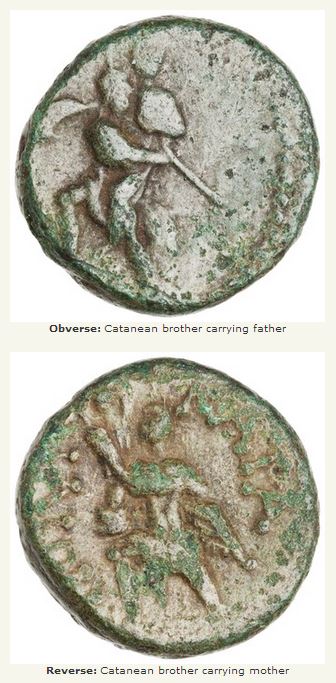
I’m trying to make up my mind whether I think RRC 308/1 represents one of the Catanaean Brothers as most scholars think or if I am swayed at all by Evans’ claim that it is really Aeneas. Above is a coin of Catana showing the brothers.  Here is the Republican coin:

Reverse of Silver Denarius of M. HERENNI, Rome, 108 BC - 107 BC. 2002.46.104

There two literary accounts of the  brothers.  One is Hyginus’ list .  I give the two proceeding entries and the two after for context:

[254] CCLIV. THOSE WHO WERE EXCEPTIONALLY DUTIFUL


Xanthippe, when her father Mycon was shut up in prison, nourished him with her own milk.
Tyro, daughter of Salmoneus, killed her sons on account of her father.
In Sicily when Mount Aetna first began to burn, Damon rescued his mother from the fire, and Phintias his father, too.
Aeneas, likewise, in Troy bore out from the fire his father Anchises on his shoulders, and rescued Ascanius his son.
Cleops and Bitias were sons of Cydippe, a priestess of Argive Juno.

… 

The juxtapostion and connection of the brothers with Aeneas suggests that in the Augustan period at least they were linked together.  This makes sense in light of Sextus Pompeius Pius’ coin type:

Reverse of RRC 511/3a. 1937.158.342

The other literary source is the anonymous poem Aetna.  The story serves as its closing climax:

Once Aetna burst open its caverns and glowed white-hot: as though its deep-pent furnaces were shattered, a vast wave of fire gushed forth afar upborne by the heat of the lava-stone, just as when the ether lightens under the fury of Jupiter and plagues the bright sky with murky gloom. Corn-crops in the fields and acres soft-waving under cultivation were ablaze with their lords. Forests and hills gleamed red. … They think they have escaped, but the fire catches them: it consumes its prisoners’ booty: and the conflagration feeds itself, set on sparing none or only the dutiful. Two noble sons, Amphinomus and his brother, gallantly facing an equal task, when fire now roared in homes hard by, saw how their lame father and their mother had sunk down (alas!) in the weariness of age upon the threshold. Forbear, ye avaricious throng, to lift the spoils ye love! For them a mother and a father are the only wealth: this is the spoil they will snatch from the burning. They hasten to escape through the heart of the fire, which grants safe-conduct unasked. O sense of loving duty, greatest of all goods, justly deemed the surest salvation for man among the virtues! The flames held it shame to touch those duteous youths and retired wherever they turned their steps. Blessed is that day: guiltless is that land. Cruel burnings reign to right and left. Flames slant aside as Amphinomus rushes among them and with him his brother in triumph: both hold out safely under the burden which affection laid on them. There — round the couple — the greedy fire restrains itself. Unhurt they go free at last, taking with them their gods in safety. To them the lays of bards do homage: to them under an illustrious name has Ditis allotted a place apart. No mean destiny touches the sacred youths: their lot is a dwelling free from care, and the rightful rewards of the faithful.

Can you represent just one Catanaean brother? There are other coins of Catana that show just one brother and parent per side, but they are still both there…

 Image

What would the contemporary Roman have seen?  Perhaps either narrative?  I’m not willing to follow Evans wholeheartedly but some doubt seems warranted.

Postscript.

nec sanctos iuvenes attingunt sordida fata: /securae cessere domus et iura piorum.

The Loeb translation of the poem really doesn’t do justice to the last line and the thematic emphasis of the last word.  PIUS.

230 out of 410 days: Minotaurs on Roman Legionary Standards

Image

Image

Here’s the Pliny quote:

The eagle was assigned to the Roman legions as their special badge by Gaius Marius in his second consulship. Even previously it had been their first badge, with four others, wolves, minotaurs, horses and boars going in front of the respective ranks; but a few years before the custom had come in of carrying the eagles alone into action, the rest being left behind in camp. Marius discarded them altogether. Thenceforward it was noticed that there was scarcely ever a legion’s winter camp without a pair of eagles being in the neighbourhood.

Horses, Wolves, Boars are all featured on the Republican coin series.   Not so much, minotaurs …  It’s not really an argument, but surely something went wrong in Pliny’s account or the manuscript or something… Very strange.  But then there is the Festus to back it up…

MINOTAURUS. The figure of the Minotaur was among the military insignia, because the projects of the general should not be less mysterious than the labyrinth which held this monster. The Minotaur, it is said, was the fruit of the love of Pasiphae, wife of King Minos, and a bull. But others say that Taurus was just the name of her lover.

A little background on Roman Military Insignia.

Update 8/12/2016:  The thing to read on this subject is:

Capture

Update 9/2/25:

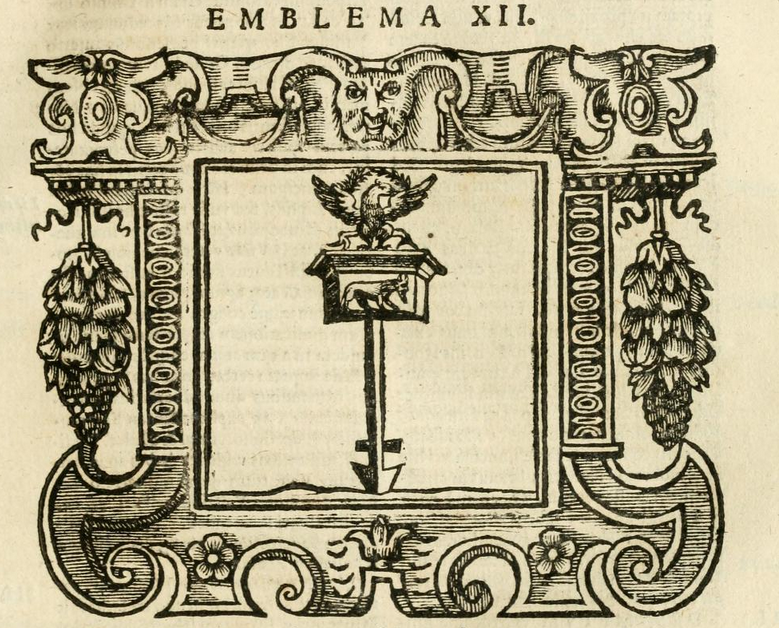
This emblemata might explain why some decided the minotaur standard was a manfaced bull.