I’m not worrying about the image above, I just think it is a pretty picture and one that can help students enter the iconographic and narrative thought world in which man-faced bull coinage was stuck.
I am worrying about the dating of RRC 2/1: Thurian-style Athena obverse, full man-faced bull, walking right in profile, star above. An image of which can be found on Molinari’s website, here. Scroll down to #355, clicking on it provides a better resolution. There is only one known specimen. I’ve talked about how problematic that can before, twice in fact it seems.
I was adding a note in my current chapter draft about HN Italy 753 being the prototype for the reverse of this first ROMANO coin (so HN Italy says), and decided to have another scroll through Molinari’s collection of Neapolis man-faced bull images (MFB hereafter). The thing is that even though HN Italy 753 has an eight-rayed star above the MFB on some specimens, the MFB has a 3/4 profile head. A similar 3/4 profile head is found on all the full-bodied MFBs on bronzes of Neapolis, as far as I can tell. [Other images are available via Luigi Graziano’s project].
Whoever carved the dies for RRC 2/1 was more familiar with a MFB in profile, rather than in 3/4s profile. That makes it seem rather unlikely to me that he was looking at a bronze of Neapolis, let alone was also someone engraving dies for the Neapolis mint.
I suspect somewhere in Molinari’s great collection of images one could find a better possible parallel, say something like the Hyira silver coins. Obviously no star and wrong placement of ethnic, but overall a better ‘model’. Crawford sees a sea-horse/sea monster/pistrix or whatever you want to call it on Athena’s helmet. That might be another point when comparison shopping.
Obviously dating based on iconographic models is problematic anyway. We need a few good hoards. But don’t we always.
Update 15 April 2025. I see people have been reading this post. Please note that the Mars Eagle Roman gold shows no evidence of Ptolemaic origins. See now Suspene, AVREVS.
Gold stater, Taras, c. 280 BC. ANS 1997.9.159. Vlasto 35. HN Italy 983.
There is a tight series of gold issues from Pyrrhus’ arrival in Tarentum (HN Italy 983-992). They share common controlmarks and are signed by the same magistrates. A variety of denominations are known: stater, 1/2 stater, 1/4, 1/3, 1/8, 1/10, 1/12, and 1/16. A variety of dieties appear on the obverse, Zeus, Apollo, Athena, Heracles. The reverses types include a biga, a dolphin rider, a biga of dolphins, an owl, and on three denominations an eagle, such as that illustrated above.
This eagle bears much in common with an eagle to appear at the end of the century on Roman gold:
RRC 44/3. ANS 1967.153.4.
Here is a link to a variety of illustrated specimens of the Roman issue. When writing about this issue Meadows has made a very strong case that the iconography reflects Ptolemaic support. I give only a little quote here (1998: 128):
Could it mean the same thing at Tarentum? I think it very likely indeed. Hammond 1988 makes a strong case that the Ptolemy that sent military aid to Pyrrhus for his campaign in Italy was Philadelphus base on this portion of Justin:
11 Nor was Pyrrhus of Epirus neglected by him, a king who would be of great assistance to whichsoever side he attached himself, 12 and who, while he desired to spoil them one by one, sought the favour of all. 13 On going to assist the Tarentines, therefore, against the Romans, he desired of Antigonus the loan of vessels to transport his army into Italy; of Antiochus, who was better provided with wealth than with men, a sum of money; and of Ptolemaeus, some troops of Macedonian soldiers. 14 Ptolemaeus, who had no excuse for holding back for want of forces, supplied him with five thousand infantry, four thousand cavalry, and fifty elephants, but for not more than two years’ service. 15 In return for this favour, Pyrrhus, after marrying the daughter of Ptolemaeus, appointed him guardian of his kingdom in his absence; lest, on carrying the flower of his army into Italy, he should leave his dominions a prey to his enemies.
The relationship between Ptolemy II and Pyrrhus has been documented at more length by Adams 2008.
The numismatic evidence strengthens the claims of both Hammond and Adams AND suggests that it was far more than troops and elephants that Ptolemy II sent to Italy.
Update 4/6/2014: I was very happy to read this paragraph in Wolfgang Fischer-Bossert 2013 paper supporting a Pyrrhic dating for the eagle type at Taras on the silver.[Image links to full paper.]
HN Italy 933
Postscript 5 March 2014. If one is worrying about the use of the ‘Ptolemaic’ eagle in Italy, then this type of Larinum (c. 210-175, HN Italy 626) should also be thrown into the mix. Inspired by the Roman gold in all likelihood:
Reverse of Bronze triens, Larinum. ANS 1944.100.2090.
I’ve discussed coins of Larinum from this period before, here. And of course there is RRC 23/1.
Update 11 March 2014: Just a note to self. Consider also the coinage of Alba Fucens, Latin colony of 303 BC. HN Italy identifies three types, all silver obols (241, 243, and 244) that have Athena in a Corinthian helmet and an eagle on a thunderbolt, dating to c. 280-275. Crawford CMRR p. 47 sees the issue and those of Norba and Signia as likely struck to pay troops in the War against Pyrrhus.
Silver obol, Alba Fucens. ANS 1944.100.2059. SNG ANS.1.112.
The Stazio and Mertens’ literature is on order from ILL. The Italian Wikipedia has an article on the Monetaziono di Alba Fucens. There is an odd specimen in trade that I’d like to understand what’s going on with the mark behind the eagle better, looks like a fillet or maybe a striking artifact of some kind, image #1 and image #2. Also see HN Italy p. 11 and 180 for a little discussion of how the eagle and fulmen have been interpreted as symbols of Alexander the Molossian. I’d like to learn more about this coin type as well sometime. It’s a small bronze (Athena, Attic Helmet/close winged eagle and MOΛOΣΣΩN).
Update 5/26/14:
The scholar who seems to be most actively writing about Eagles on Coins in Italy is Carroccio. Most of his relevant papers are online with obvious titles, but the note the issue also comes up in his 2008 piece on Moneta Apula… also online on academia.edu.
Campania, Capua. 216-211 BC. Æ Biunx (25mm, 18.20 g). Bust of Tyche or Fortuna right wearing crown of turrets; strigil and two stars (mark of value) behind Horseman galloping right, with lance pointed forwards; w:murex shell below. SNG ANS 203; SNG France 488; SNG Morcom -; HN Italy 485. From the Tony Hardy Collection. Ex Italo Vecchi II (12-13 September 1996), lot 73.
So I wish I has a slightly better picture of this Capuan type (above) to set next to this Roman uncia (39/5):
They share detailed similarities right down to the rendering of the turrets, the necklace and drapery. There is another related Capuan type as well, but it’s of a small denomination and has fewer parallels:
Campania, Capua. c216-211 BC. AE Uncia. Turreted female head right, thunderbolt on headdress; pedum behind, star below / Warrior on horseback right, holding long spear pointed forwards; star behind, murex shell below. BMC 11-12.
Update 1-28-23: Please do not cite this post. My published views on this topic can be found in my 2021 article (full unformatted text;publisher’s link).
This post is dedicated to the most estimable Prof. Kellogg, who has taught many to always listen to the sacred chickens.
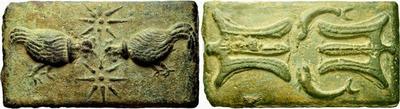
In Trade (links to specimen)RRC 12/1 5lb Currency Bar 270BC, Rostrum Tridens, Chickens eating corn, Stars. British Museum; 1940s incendiary bomb damage at side. Photo from Andrew McCabe’s Flickr set.
These fabulous currency bars appear in many a PowerPoint presentation to illustrate the Roman practice of divination prior to battle via the consumption of grain by sacred chickens. If the birds eat, the gods are happy for the Romans to engage in combat. The most famous incident is the Sea Battle of Drepana (249BC) when Claudius Pulcher is said to have been so enraged that the birds wouldn’t eat that he cast them into the sea, saying: ‘If they won’t eat, let them drink!’. Anyway, great story and thanks to this excellent account by another blogger, I’ve got no need to review the sources here.
The idea that the bars show sacred chickens is only loosely endorsed by Crawford, who with uncharacteristic ambivalence, records the type as ‘two chickens facing each other and apparently eating; between, two stars’. He is more definite in vol. 2, p. 218:
This ἀλέκτωρ isn’t a sacred chicken, but a cock! A symbol of virility and bellicosity. Look again at the currency bars above, those birds have some impressive combs and plumage, visible even with corrosion on the bars. The kicker is when we look at the pattern of coin iconography at Roman colonies and allied communities struck in the 1st Punic War, notice the combination of star and cock:
Suessa Aurunca, Bronze circa 265-240, 5.45 g. Helmeted head of Minerva l. Rev. Cockerel r. SNG Copenhagen 588. Historia Numorum Italy 449. From the Giancarlo Silingardi collection, with export licence issued by the Republic of Italy.Teanum Sidicinum, Bronze circa 265-240, 7.02 g. Head of Minerva l., wearing crested Corinthian helmet. Rev. TIANO Cock standing r.; in upper field l., star. Sambon 1004. SNG Copenhagen 594 (this obverse die). SNG ANS 626. AMB 56 (this coin). Historia Numorum Italy 435.Aquinum. Bronze c.265-240, 5.87 g. Helmeted head of Minerva l. Rev. Cock r.; behind, star. ANS 114. SNG Cop. 101. SNG France 228. H.N. 432Cales, Bronze circa 265-240, æ 5.53 g. Helmeted head of Minerva l. Rev. CALENO Cock standing r.; in field l., star. Sambon 916. SNG Lloyd 53. SNG Copenhagen 323. SNG ANS 193., HNI 435.
There are also coins of this same type from Caiatia (HN Italy 433) and Telesia (HN Italy 457). Discussion can be found in Crawford’s Coinage and Money (1985), p. 47. They all seem to be carved by a single die engraver and I’d not be surprised to find obverse die links. As a group they are all are overstruck by Neapolis coins from the 250s (Taliercio III,a; cf. discussion by Burnett and Crawford 1998 in essays for M. Jessop Price).
Anyway, the iconographic choice on the currency bars probably has less to do with religious ritual and more to do with selecting a symbol of military prowess. The head-down, two cock rendering of the motif probably has more to do with the design challenges of the oblong bar. The two birds echo the double design of the other side.
And, just by-the-by. the Latin for chicken, as in sacred chicken, is pullus, which is well distinguished from the gallus, or cock.
Update 4/25/16:
Notice the stance of these two fighting cocks and the imperial eagle above.
This is a didrachm of one of Rome’s colonies, Suessa Aurunca. This type is usually dated to the time of 1st Punic War. The colony had been established in 313 BC as part of the Samnite Wars (Livy 9.28). The place makes little mark on the literary narrative, appearing in such sleepy contexts as Cato’s recommendation on where to get a wagon or a mill.
The type is identified as a Dioscurus, i.e. either Castor or Pollux without his brother. My first impression is that it looked rather like a desultor to me.
Obverse of RRC 480/21. ANS 1937.158.296 . Image links to a selection of other coin types also showing desultores.
This got me wondering what we actually know about desultores. Less than you might think, I can assure you! And many of our references are metaphorical (e.g. Cicero, Pro Murena 57). There are only about 13 references in Latin literature. The only certain testimony we have of their performance is during Julius Caesar’s triumphal games, and here they seem to be performances by elite youth (Suet. Iul. 39). That they show up on the republican series more than once suggests they were a significant feature of Roman religious festivals or other celebrations, but which and when is up for debate. Perhaps my favorite reference is their use in a piece of Augustan era Roman jurisprudence by Labeo preserved in the Justinian digest (19.5.20).
What about the Suessa coin above? Dioscurus or desultor? The confusion is more understandable when we look at this passage from Hyginus:
LXXX. CASTOR: Idas and Lynceus, sons of Apharesu from Messene, had as promised brides Phoebe and Hilaira, daughters of Leucippus. Since these were most beautiful maidens – Phoebe being a priestess of Minerva, and Hilaira of Diana – Castor and Pollux, inflamed with love, carried them off. But they, since their brides-to-be were lost, took to arms to see if they could recover them. Castor killed Lynceus in battle; Idas, at his brother’s death, forgot both strife and bride, and started to bury his brother. When he was placing the bones in a funeral monument, Castor intervened, and tired to prevent his raising the monument, because he had won over him as if he were a woman. In anger, Idas pierced the thigh of Castor with the sword he wore. Others say that as he was building the monument he pushed it on Castor and thus killed him. When they reported this to Pollux, he rushed up and overcame Idas in a single fight, recovered the body of his brother, and buried it. Since, however, he himself had received a star from Jove [Zeus], and one was not given to his brother, because Jove said that Castor and Clytemnestra were of the seed of Tyndareus, while he and Helen were children of Jove, Pollux begged that he be allowed to share his honor with his brother. This was granted him. [From this comes the expression “redeemed by alternate death”; and even the Romans preserve the practice. When they send out bareback riders, one man has two horses, and a cap on his head, and leaps from one horse to the other, just as Pollux takes turns with his brother.]
Thus, at least to Augustan era eyes, confusing the iconography of the Dioscuri and Desultores was no surprise. Back to the mid third century. I think it unlikely to have a Dioscurus without his brother and without another identifying mark like the star. The palm branch is agonistic imagery and there is no reason that the coin can’t be an agonistic type.
So I was looking at the Neapolis coins that served as prototypes for the earliest coins in the name of Rome. And, Apollo has a very flippy hairdo of a not terribly typical type. Here’s another to prove I’m not making this up:
That flip was feeling familiar. And not from just the Roman type (RRC 1/1):
Here’s a link to one more of these. Anyway. It struck me that that hair flip is visually quite related to the neck flap that appears on Roma’s helmet on certain early types like these:
But that’s clearly not the direction of influence. The culprit must be the pegasi of Corinth that became so common in S Italy at the end of the 4th century BC:
The interesting iconographic borrowing isn’t really the Roma helmets, but the Neapolis (and soon-to-be-Roman) Apollo who gets his flip and snaky tendrils by way of Athena’s Corinthian manifestation.
Update 4 March 2014: Check out images of Roman types at Nick Molinari’s site, note especially the image of the RRC 2/1, known from only one specimen.
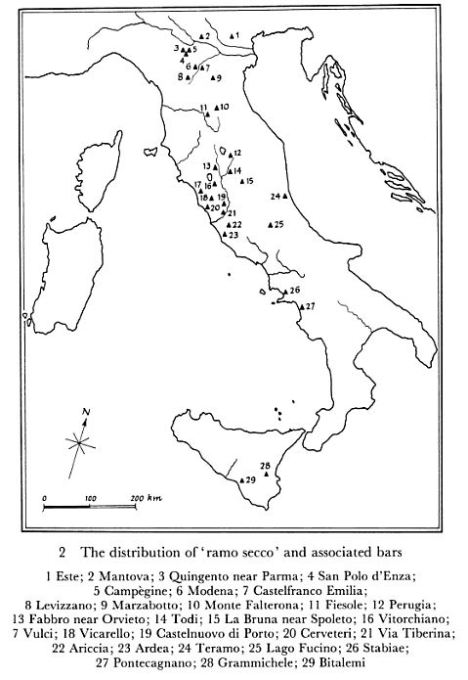
ANS 1949.100.2; Acquired From: J. P. Morgan coll.Purchased June 10, 1949; Previous Collection: J. P. Morgan = Sangiorgi, 15 Apr. 1907 (Strozzi), 3; found at Fabbro near Orvieto, see maps below.
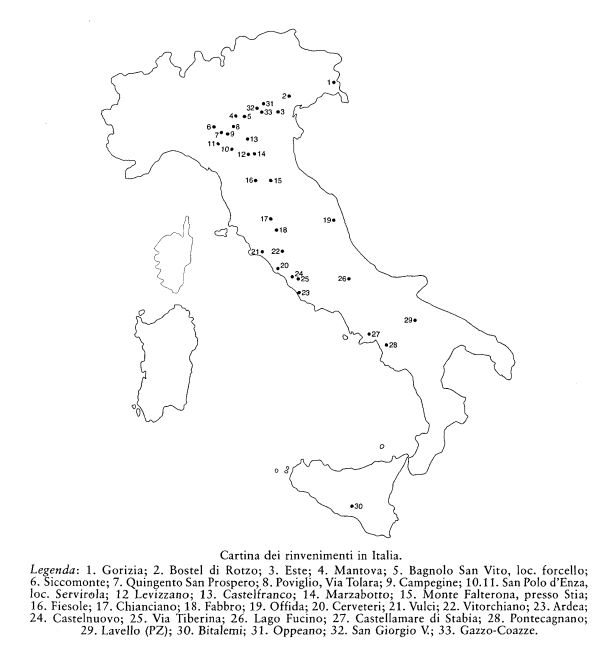
So I was happy to find today that there was in fact an update to Crawford’s 1985 map:
It broadens the picture some and removes other disputed finds. The great shame is that it still doesn’t give a picture of any Illyrian finds… I was happy to see that the find spot of the ANS specimen above could be located on both maps!
So I was skimming the ANS catalogue trying to collect my thoughts about the Italian context for early Roman coinage. Most of the examples of cast coinage from non-Roman mints seems comfortably familiar. Wheels, Tridents, Anchors, Clubs are all motifs found at Rome and elsewhere. I particularly like the animals, roosters and sleeping dogs especially. But then I came across this specimen above: “Female Head in Murex Shell”. So different! Even if the other side, a Pegasus, is by contrast strikingly familiar in a numismatic context. Anyway the unexpected-thing-in-a-shell motif reminded me of course of our discussion of gem stone themes, earlier. It certainly fits that motif well.
Postscript 5 March 2014. There is no image of that mule coming out of a shell on the BM site, but I just wonder if it isn’t more likely to be an ass. The ass is known for its generous male genital endowment and Henig argues that the shell is a symbol of a female sexual organs. You see why I wonder about it being a mule… Anyway, in further support of Henig’s fertility theory of the shell motif, there is the other BM specimen (illustrated) where two rabbits issue forth from the shell.
Postscript 19 Jan 2021. I see it noted in a catalogue that there are known renaissance forgeries of this type.
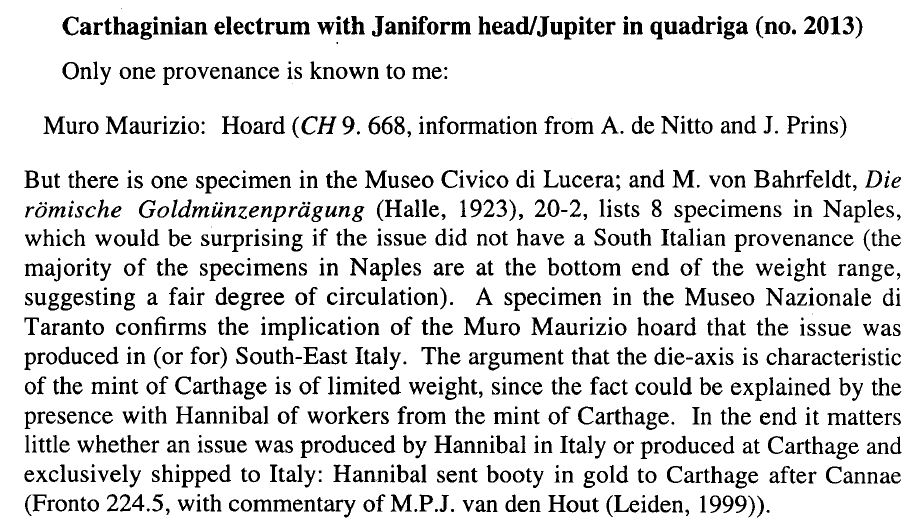
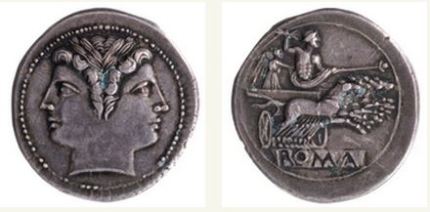
A week of archaeological sites was a lovely break from writing. Yesterday and today have just been reading literature on file and looking over notes for the next chapter. I thought I’d throw up this coin (HN Italy 2013) and Crawford’s 2002 comments:
From: M.H. Crawford, “Provenances, Attributions, and Chronology of Some Early Italian Coinages,” CH IX (2002), pg. 274.
I’m always nostalgic about this type. I have strong memories of the first time I ‘found’ it in the old Ashmolean coin room and how much I loved bringing students in to see it and talk about its relationship to Roman types (RRC 28/3):
—
My favorite line out of this article of Crawford is certainly:
“It is no good simply lying in one’s bath and thinking that such-and-such an issue looks rather nice in such-and-such a year…”
I never dare do such a thing, but I did read this just as I was thinking how nice a bath sounded on a cold rainy Istanbul afternoon. He startled me into keeping at my computer. No bad thing.
The other Crawfordian gem of today’s readings was pretty much all of his 2009 article on aes signatum. Just to give a bit of the flavor, it begins “The term aes signatum seems to be taking an unconscionable time dying” and contains a choice observation about “typical Anglo-Saxon insouciance about anything written in German, or even in French” followed by a pointed suggestion that in this case “maybe the insouciance was justified”. (SNR 88 (2009): 195-197).
This specimen has two clear impressions on it. I suspect it is just double struck but I wanted to put a note to myself to see if it might in fact be an overstrike. It’s an extra interesting specimen as it has a fixed provenance Capalbio, Italy, 1954 (RRCH 258).



 HN Italy 933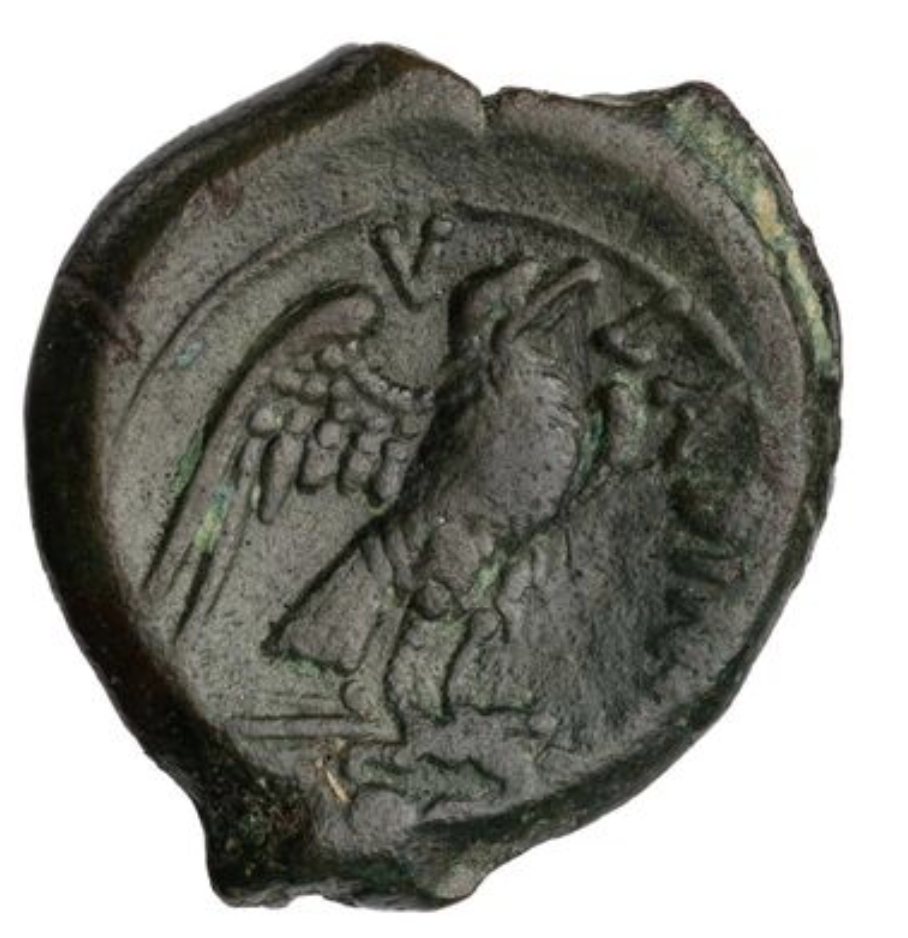








 Liv Mariah Yarrow