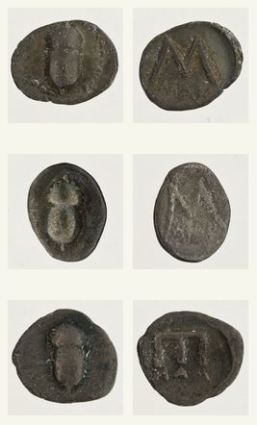
Metapontum and early Latin Coinage

Crawford’s suggestion of a Metapontum as the mint for the first Roman didrachm is very much out of favour.  Here’s the relevant footnote in RRC vol. 1 p. 46 n. 9 third (!) paragraph:

Image

Here’s Vagi in the brilliant new Essays Russo 2014 (p. 80):

Image

And so we find Russo’s son also following his father in the catalog of the JD collection part II:

 We have decided to share Rutter’s opinion who in Historia Numorum Italy attributes these coins to the Naples mint contrary to Crawford who assigns them to the mint of Metapontum. That said however, we have decided to refer to the coin as an obol and not as a litra as suggested by both Rutter and Crawford. The reasons for this decision are very simple: we obviously agree that this coin belongs to Crawford’s series 13, which was intended for trades with Magna Grecia. On this basis, it seems only logical that we refer to it as an obol and not a litra. Its weight and its general appearance are consistent with coaeval obols of Camapianian mints such as: Fistelia, Peripoloi Pitanai and Allifae, which most probably were circulating along with this coin.

Capture.JPG
JD collection of Roman Republican Coins.
Obol, Neapolis 320-300, AR 0.66 g. Head of Mars r., wearing Corinthian helmet; behind, oak spray (?). Rev. Head of horse r.; behind, corn ear and before, ROMANO downwards. Fiorelli Annali 1846, p. 23 and pl. I, fig, 29. Garrucci pl. 77, 18. Bahrfeldt RN 1900, pp. 33-34, 31 and pl. 26, 1 (possibly this obverse die). Sydenham 2. Crawford 13/2. Historia Numorum Italy 267.

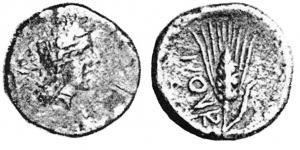
So I got thinking about this because of how Norba borrows Metapontum’s type for its obol during the Pyrrhic War:
Image
HN Italy 248

There is only one of these coins known, but it comes with a good archaeological provenance. The original report is online here. And also here.

L. Cesano, Monete rinvenute negli scavi di Norba, in NSA 1904, 423-426

PANVINIROSATI, FRANCO. Moneta unica di Norba. In: Archaeologia Classica, Vol. 11 (1959), pp. 102-107, pi. 40.

On sacred context, but not the coin itself:  S. Quilici Gigli, Norba: la topografia del sacro, in Ostraka 20, 2012, pp. 411-419.

Vagi makes a very plausible explanation for the corn-ear with the horse head to allude to the Festival of the October Horse, a harvest festival in honor of Mars.  Metapontum is a red herring for the Roman series, but what does Metapontum have to do with the Latin obols?  Why do we find her type borrowed on the coins of Norba?

Also RRC 13/2 as an obol perhaps helps set a precedence that influenced the denominational choice for the Latin mints (Norba, Signia, and Alba Fucens) of the Pyrrhic War.

292 out of 410 days: Signia

Kombination af to masker og et vildsvinehoved. Romersk ringsten
Combination of two masks and a wild boar’s head. Roman ringstone, 100-300 Cornelian. 1,1 x 1,6 cm. Inventory number: I1538. Thorvaldsens Museum.

Sometimes I tell myself I’m too obsessed with the connection between gems and coins.  And then one of my hunches pays off and the obsession comes back full swing.  In case the above image doesn’t set off exciting alarm bells in your head, allow me to remind you what the coins of Signia, a Latin Colony, during the Pyrrhic War looked like:

Capture
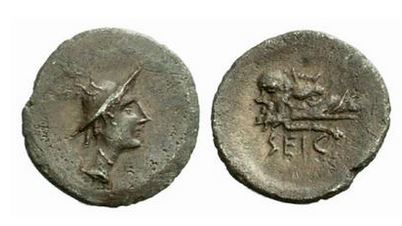
Latium, Signia. Obol circa 280-275, AR 0.64 g. Head of Mercury r., wearing petasus; below neck, dolphin r. Rev. Mask composed of Silenus head l., and boar’s head r.; below, SEIC. Campana CNAI 1b (this reverse die). BMC 3 (this reverse die). Historia Numorum Italy 343 var.

[I show this particular specimen just so I can point out that it reappeared back on the market with a brand new patina, all nice and shiny and toned just one year later, and fetched a much higher price.  I think it looked just lovely before some one decided to ‘fix’ it.]

Let me assure you that the gem above is by no means a one off.

Image
Beazley Archive Reference Number: 716; Description: Heads of a BOAR and a man conjoined. Inscribed in Greek THIE. Current Collection: Walters Art Museum, Baltimore: 42.1070; Previous Collections: Story-Maskelyne, M.H.: The Marlborough Gems (1870): no. 716. Material: Jasper

And based on descriptions without images the Thorvaldsens Museum has a number more similar gems, Inventory numbers: I1537,  I1539,  I1722, I1536.   The last two are of particular interest as they are glass pastes which suggests the image had resonance with members of a variety of different social classes.

This particular type even made the BBC!

Roman intaglio
From a 30 March 2010 article ‘Guernsey, the Roman Empire’s trading post’. Image links to article.

What the heck does it mean?  Was it the badge of some particular noble?  Or like grylloi is it a humorous, apotropaic emblem? Or a philosophic meditation on the theme of man and beast?  Or all these things?  or something else entirely?

OR! the penny drops!  Is it a visual pun?!  Signia in Latin is also the plural form of the neuter noun meaning: standard, seal, sign, signal, proof, indication from the verb signo to mark, stamp, designate, sign, seal.  The type chosen is a very very common seal type.  [This is why I blog by the way. It took writing the whole damn post for that penny to drop and me to make the obvious connection.]  This is a really exciting idea to me.  Name puns are all over Roman Republican coinage to show its early early adoption is Latium is especially good. I think it provides a missing link of sorts between the ideas I explored in this earlier post discussing Republican habits, the Abdera series, and Timeaus.  [I’ve talked about puns a lot on this blog, but that post is the best of the lot I think.]

For follow-up later: Henig has some clever things to say about gems usually.  There are two possibly related gems (CG72 and CG 354)  in the Fitzwilliam that he’s written up in his 1994 catalogue.  Must get those pages from ILL…  Strangely none returned in BM, Met, or Boston MFA searches all of which have robust gem collections.

As an aside, I find it funny that Mercury on the obverse is wearing a necklace or similar band.  At first I thought at first it might be an unfortunate die break, but it shows up on a different die as well, but not all of the dies.  Also what the heck does Mercury have to do with dolphins?  Could it have anything to do with bizarre composite deity on the coins of Bursio who has wings and a trident (RRC 352/1)?  I doubt it.  But finding any representation Hermes or Mercury with any nautical attributes is tricky.

Update 4/11/2014:  If more canting types from Italy are sought, consider Rutter’s note at HN Italy 446, an obol of  the Saunitai with a javelin head on the reverse, σαύνιον = javelin.  He gives a date of c. 325.

Update 7/12/2017:

Another example of this gem type from Gori:

Capture.JPG

cf. also this other Gori plate.


291 out of 410 days: San Martino in Pensilis Hoard

Image

The San Martino in Pensilis hoard and Andrew Burnett’s analysis thereof is probably the most important new information on third century Roman and Italian Silver issues from the last decade.  Highlights included:

  • Evidence of a significant gap (ballpark 300-260BC) between Rome’s first and second silver issues
  • The first Roma and Pistis Locrian coin in a hoard context
  • 30 ‘fresh’ coins of Teanum, Cales, and Suessa!  (No Cora specimen, alas.)

My scanned photocopy was really crappy, so I’m just delighted to realize that it’s available open access via Persée.  No more squinting for me today!  I’m also intrigued by the location of this hoard, just north of the Gargano (if you go, you must try the mysterious and delicious Lesina eel!).  It’s just down the road from Larinum (see earlier posts).  The Frentani became allied to the Romans in 304 BC and somewhere around the mid third century Larinum shifted from minting Neapolis type bronzes with Greek legends, to Roman type bronzes with Latin legends (well Oscan language, Latin Alphabet) (HN Italy 622 vs. 623).

San Martino in Pensilis - View

Who Issued Aes Grave?

Image
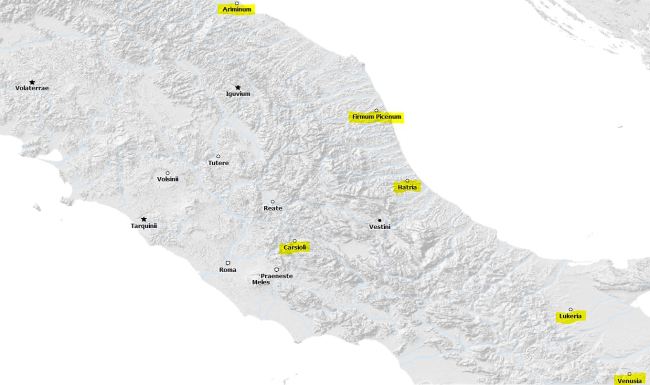
Communities issuing aes grave with Latin Colonies highlighted (missing Volceii, sorry). Map cannot capture the numerous types not attributed to any specific location or group. Map created using AWMC: à-la-carte Map to which it links. [FYI – runs best for me in firefox rather than other browsers.]
Crawford CMRR discusses the cast currencies of Italy in five groups (p. 43-46):

  • an as of about 300g maybe from 1st Punic War:  Tarquinii, Tuder, Reate, Praeneste, Carseoli, and Firmum
  • a heavier as (350-450g): Ariminum, Hadria, Vestini, another unidentified mint maybe Asculum Picenum
  • an as of about 300g followed by reductions probably from 2nd Punic War: Luceria and Venusia
  • reduced as from rebel communities during 2nd Punic War: Volceii and Meles
  • issues of Etruria and Umbria (including Iguvium on map above) on 200g standard from time of 1st Punic War

He summarizes circulation and weight standard thus:

Image
From CMRR p. 46 (links to page).


Cora didrachm

Image
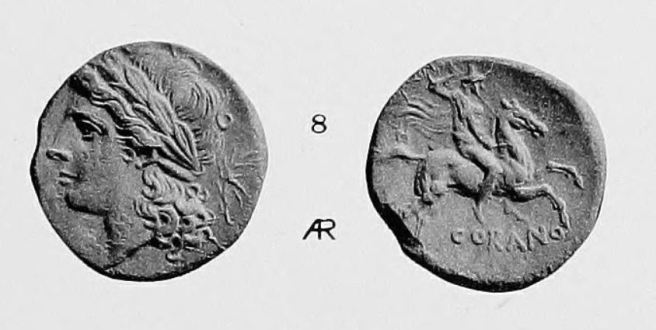
AR didrachm of Cora. c. 275-250 BC. head of Apollo l., laureate; horseman r., wearing conical helmet and spearing downwards; below, KORANO (see below). HN Italy 247. Drawing after Paris specimen. from Millingen’s 1831 publication.

I was surprised to have so much trouble finding an image of this type.  Thus I thought I’d throw up this bad screen shot and link just to help the next numismatist so struggling.  HN Italy obviously knows more specimens than the Paris one as a weight range is given (6.1-6.4 g); I’ve not tracked down their locations.  Millingen, although wrong to re attribute the coin to Sora, was correct to see it paralleling issues of Cales, Teanum, and Suessa. See my earlier post.

Update 10 April 2014:  I’ve revised my thinking on this issue.  I”m not sure it really parallels the issue of  Cales, Teanum, and Suessa that well.  Key differences in my mind are the lack of any additional symbols on the obverse and the placement of the legend on reverse in the field not in an exergue.   It is also missing from the San Martino in Pentilis hoard which has decent number of all three of the others.  I am thus skeptical we can really associate this coin with the others and by extension with the 1st Punic War.

Update 7 January 2015: A specimen from Naples was published in the same piece that gives us our first look at RRC 2/1.  Isn’t that fun!?  Images link to original publication.  Based on this photograph I’m inclined to say that the HN Italy reading of the legend is in error.  It should be CORANO not KORANO.  Also HN Italy does not mention the palm branch (?) behind Apollo’s head.  The hat shape of the rider seems distinctive.

Capture1

Capture

290 out of 410 days: The Impression Elephants Make

Image
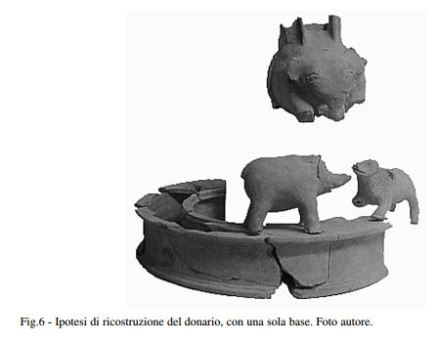
From L. Ambrosini, ‘Un donario fittile con elefanti e Cerbero dal santuario di Portonaccio a Veio’. Image links to PDF with more images and references.

Image

I ended up at this article by way of this coin type from Etruria:

ETRURIA. Val di Chiana. Æ 18 mm (4.68 gm). Head of an African right / Elephant right with bell hanging from neck, Etruscan letter below. SNG ANS 36. SNG Morcom 44. HN Italy 69.
From catalogue: Commentary on this enigmatic issue has focused on the significance of the elephant, which appears to be Indian rather than African. This zoological observation seems to rule out a reference to the Carthaginian elephants and thus poses a challenge to dating this coin to the time of the Second Punic War. Yet E.S.G. Robinson, in NC 1964, pp. 47–48, proposed an interpretation that overcomes these difficulties. He submitted that the association of the elephant with an African head, probably representing the animal’s driver, points to an African origin. Rather than dating the coin issue to the time of Hannibal’s invasion, Robinson drew attention to the disaffection of Rome’s Etruscan allies in 208–207, centered on the town of Arretium, and suggested that the coin types expressed the seditious hope that Hasdrubal would arrive to reinforce his brother. In these historical circumstances, the elephant was a symbol, perhaps copied from earlier coin types, rather than a portrayal from life.

There are a number of these coins in the ANS collection and also a good selection in the acsearch.info database.  The main publication is:

Baglione, M.P. 1976. Su alcune serie parallele di bronzo coniato. In Contributi introduttivi allo studio della monetazione etrusca. Atti
Convegno Napoli 1975: 153-180. Roma.

Baglione records 158 known specimens at that time, the vast majority in public collections.  Baglione endorses (if I’ve read the Italian right!) Robinson’s dating and notes that W. V Harris, Rome in Etruria and Umbria (Oxford 1971) p. 140 also follows Robinson’s interpretation. I’m wary of dating by type alone and would like some new good hoard or excavation evidence to confirm this hypothesis.  I’d also think a little die study might be of use to get an idea of the size of the issue: it seems at first glance that we’re looking at multiple dies for each letter under the elephant (four different Etruscan letters are well attested) and a number of obverse dies.   Elephants do appear elsewhere in the Second Punic War on the coinage of rebelling Italic communities.  The most impressive example being the aes grave of Meles in Samnium which copy the Barcid silver coinage (Robinson, Essays Mattingly, 1956: 40, fig. 3A; HN Italy 441-42 (but no illustrations)).

I’m more interested in the unusual votive offering.    Ambrosini draws the parallel with the famous plate in the Villa Giulia (inv. 23949) with a depiction of a war elephant and her cub.  There is a second similar plate from maybe Sardinia that I can’t put my hand on a reference at this moment. from Corsica:

Picture1

Roma mediorepubblicana; Aspetti culturali di Roma e del Lazio nei secoli IV e III a.C (Rome 1973), no. 33 = Villa Guilia and no. 34 = Corsica.

The votive offering confirms the theme of elephant and cub in a military context.  That, of course, made me think of that passage in Dionysius that I quoted in a previous post about how the Roman’s wounded a cub to gain a tactical advantage over Pyrrhus’ use of elephants.

Update 3-19-2018:

Note that Cassius Dio believes that Etruria was recruited by Pyrrhus. But this account has been dismissed by scholars.

Let us remember that Ptolemaic Egypt supplied not only the elephants but also some 9,000 troops, both cavalry and infantry.

Ariminum types, Roman Currency Bar types

Image
ANS Specimens of Ariminum Cast Bronze. Click image form more details.

It strikes me that that the cast bronze types of Ariminum bear a marked similarity to the types of the Roman currency bars.  Ariminum became a Latin colony in 268 BC and the cast bronze dates to sometime after that date.  The one type I couldn’t find to illustrate has a shield as the reverse type.  Its as seems to be heavier than the Roman (350-400g) and it divides the as into a base-10, instead of base-12 fractions.  It shares these characteristics with Hadria and Vestini (Crawford, CMRR, p. 43 & HN Italy p. 17).

Ariminum types above all represent different denominations. [Scale can be so deceptive in online images!] Shield = quincunx, Sword and scabbard = quadrunx, trident = teruncius, dolphin = biunx, rostrum = uncia, shell = semuncia.

This suggests they were created as a series at one moment in time.  Perhaps they took their inspiration from the currency bars?  With the exception of the shell all of these are well known images on the bars.  Below is a collection of images to refresh your memory.  And one more specimen of Ariminum, the trident of which better parallels the bars.

AND, just as icing on the cake, the rostrum on the uncia confirms Kondratieff’s interpretation of the currency bar iconography from a different angle.  [HN Italy got the uncia identification right, but still kept the trident of RRC.]

There is nothing that comes to mind that would preclude the possibility that the shield and sword currency bars were made at the same time as the naval types…

File:Aes Signatum.jpg

1. République (-280 à -27) - Delcampe.fr

Image
You may know ancient Ariminum better by its modern name Rimini.

Update 4/22/2014: The main study of the Ariminum mint is available online: G. Gorini, La monetazione di Ariminum, Revue Numismatique 2010


288 out 410 days: Heavy Acorns

In trade
RRC 14/7. Semuncia circa 280-265, Æ 14.36 g. Acorn. Rev. Σ. Haeberlin pl. 40, 23-27. Aes Grave 40. Sydenham 14. Thurlow-Vecchi 7. Historia Numorum Italy 274.

Crawford say on p. 40 of CMRR:

Andrew Burnett acutely points out that the weight standard  of the semunciae of the first issue of cast bronze [sc. RRC 14] makes it clear that they represent a point of transition to the second, which is heavier than the first (the reasons are mysterious).

This point is still raised in serious scholarly works such as Alessandro Maria Jaia and Maria Cristina Molinari’s NC piece of 2011 (p. 90).   How exactly does this work?  And what does it mean?

Here’s Crawford in RRC vol 2 p. 595:

Image

I’m still unclear on the whole subject (hence the blogging about it…).  Does it mean that the heavy semuncia of RRC 14 shows a tendency to think about the pound as heavier than 322g?

A 322g as should have a 13.42 ish semuncia as its the 1/24th denomination.

In the ANS collection, the weights are: 19.47, 13.43, 23.78(!), 14.76.

A search of acsearch.info, returned these numbers: 18.49, 14.36, 23.51.

Not a large sample size but woah that’s some variation in the data.   And three, maybe four, of these seven specimens weigh enough to be a plausible weight for a uncia in the same series.

The ANS collection has RRC 14/6 specimens weighing: 20.2, 25.73, 29.33, 22.76, 19.64, 20.79, 25.22.

So what about the ‘heavy series’ RRC 18, no semuncia for comparison but we do have an uncia.  And remember on weight standard of 334g we should expect as weight of about 27.83 g for the 1/12th piece.

The ANS weights for RRC 18/6 are: 18.1, 18.42, 21.51, 26.13, 28.15, 32.57, 22.97, 39.36, 23.61

Holy variation, batman!  But again four of our RRC 14/7’s would fit comfortably into the lower end of this observed data set.

Time to step back and ask a really basic question.  How do we know its a semuncia and it goes in this series?  I opened up Crawford’s list of the Nemi finds.  Not one example of RRC 14/7.  There are for context 50 specimens of other RRC 14 denominations including 11 uncia (weights for the four specimens in Nottingham = 28.19, 27.04, 26.77, 27.46, cf. weights of RRC 18/6: 19.96, 29.09, 24.86, 28.55).  Jaia and Molinari 2011 (link above) have an appendix of all the hoards of just RRC 14 and 18 aes graves (i.e. those that should have an early closing date).  No semuncias. Not surprising really, small change isn’t the most desirable for hoarding.

Well, there is a big sigma on it, right?  That has got to stand for semuncia.  And we’ve got the comparative evidence of RRC 21/7 with an acorn and sigma on each side.  Still.  The weights bother me.  And it also really bothers me how much the type looks like the obols of Mantineia:

Image
ANS specimens. Click image for full refs.

One heck of a coincidence.

And I’m not really less confused that when I started writing this post, but I do have a mad urge to start collecting a big spreadsheet of specimen weights.  I’ll resist for now.

Update: See now also this newer post on related material.


The Roar of the Boar?

Reverse of RRC 18/4. 1969.83.420
Reverse of RRC 18/4. ANS 1969.83.420

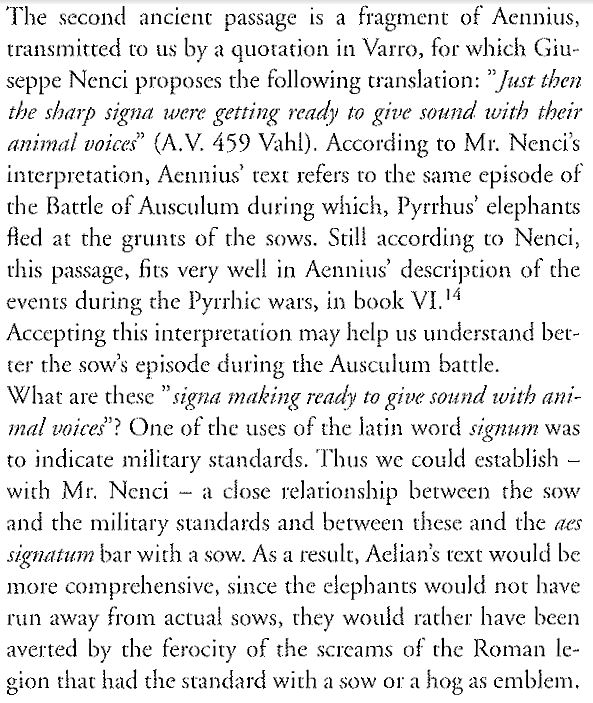
The coin above is just there as a reminder that boars do appear on early Roman coinage in other contexts.  The main point of this post is put up this curious theory about the elephant and pig currency bar (RRC 9/1):

ImageImage


Taken from p.462 of Borba Florenzano, Maria Beatriz ‘Aes signatum bars, signa and coins: emblematic objects and apotropaism’ from XII. lnternationaler Nurnismatischer Kongress, Berlin 1997 (2000), 460-465.

My earlier post about military standards is here.  I don’t really believe the rest of Maria Beatriz Borba Florenzano’s framing of the issue in terms of Roman religious thinking and this rationalizing view doesn’t account for the other folkloric accounts of elephants and pigs, but it is still an intriguing thought…  And who doesn’t love a bit of Ennius now and again.  Unfortunately for her argument and for our own hope of some answer to the pig problem, Skutsch pretty much tore apart Nenci’s reading of this line in his BICS 1977 article.

I would just note in comparing the boar above to our friend the sow below, that both are represented with an impressive line of bristles down their backs.  I do think, however, the two engravers have carved the animals in such away as to plainly distinguish their genders. And, I have my doubts that the legions would use the female, instead of the male, as their totemic creature… 

Image