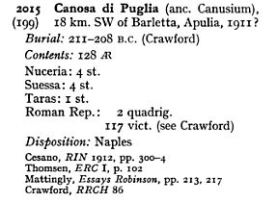
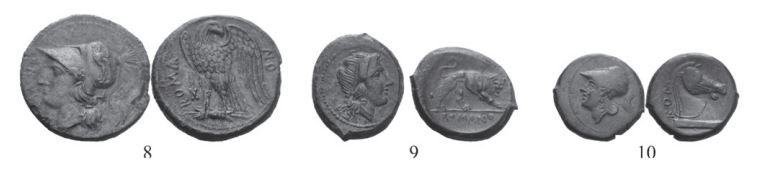
So I’d been revising my thinking on the Cora didrachm a bit of late and that made me wonder if I needed to also think again about Nuceria issues. Crawford lumps them together, speculating it was a means of distributing booty. I was pleased to see Nuceria specimens next to Suessa specimens in this hoard even if they will be much earlier than its deposition date:
Update 4/16/2014: When thinking about Nuceria and Cora and how their striking relates to that Teanum, Suessa, and Cales, don’t forget the silver didrachms of Paestum, again very rare and the jury is still out on dating (HN Italy 1180). Image here.
ANS specimens of RRC 21/7 = HN Italy 294. Click image for full details.
Last time I was worrying about acorns, I was mostly on about RRC 14/7. This is the other ‘heavy’ acorn. Many of the specimens on the market do seem ‘heavy’ for being a 1/24th piece of a 265g as, or at least a quick scan suggests, but the ANS specimens are lighter: 11.75-13.9g. They are not so heavy that they seem particularly problematic in the weight standard, cf. the ANS uncia specimens of the series which are all much heavier.
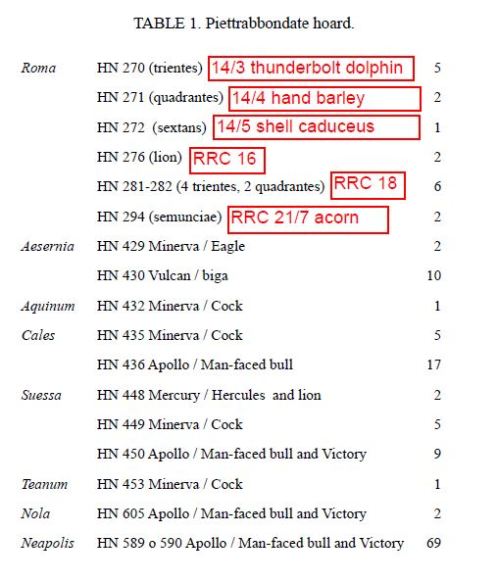
My interest was peaked by how they show up in this hoard:
Image links to source publication. Marks in red are my annotations. [Note: the correct citation for the Nola bronze is HN Italy 607. Also see below for discrepancy between this report of the hoard and that in IGCH.]So here RRC 21/7 is hanging out all by its lonesome with a bunch of RRC 14s and 18s. I’m not really sure why RRC 21/7 couldn’t go with the RRC 18 series. The types of RRC 21 echo the obverse types of RRC 14, so that would make the acorn fit with RRC 21. Must take a look to see if we have any other hoards with RRC 21/7 out in the cold…
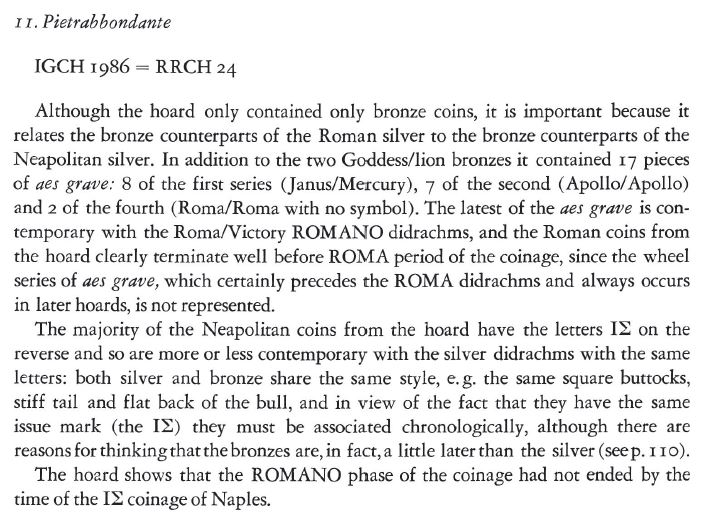
Here’s Burnett 1977 on the importance of the above hoard:
Image links to online version of the publication.
If the statement about the semuncia being contemporary with the Roma/Victory didrachms is true this would pull this hoard’s date down to the end of 1st Punic War based on Burnett’s 2006 reading of the San Martino in Pentilis hoard. The presence of the Minerva/Cock types and the Aesernia types with the subsequent Man-faced bull issues leads me to think this is a hoard from a transitional phase between the two. I’d be inclined to agree with M. C. Molinari that it predates both the Pratica di Mare and Teano Hoards…
Okay, here’s one more complication. R. Russo in Numismatica Sottovoce proposed that RRC 16, 17, and 23 were single series (23 = double unit, 16 = unit, 17 = half unit) minted at Neapolis after the Battle of Beneventum. This seems too early to me and I hesitate to break RRC 23 away from it Messane mint connection. But neither of these points directly challenge them being a series.
But if RRC 16 was really contemporary with RRC 17 that would detract from M. C. Molinari’s ordering of these three hoards as RRC 16 is present in Pietrabbondante… I find myself leaning more away from Russo’s idea of a series.
Something seems to have gone wrong in the transcription of the hoard totals in the above publication. Here’s the entry from IGCH:
Note that the number of uncertain have been attributed to Neapolis above and the 126 of Neapolis have been missed out. I don’ t think it overly affects the interpretation of the hoard in source publication. The original publication of the hoard with all the details has been digitized, although it takes forever to load.
Appius Claudius Pulcher, T Manlius Mancinus and Q. Urbinius; Denarius 111 or 110, AR 3.98 g. Helmeted head of Roma r.; behind, quadrangular device. Rev. Victory in triga r.; in exergue, T.MANL.AP·CL·Q·VR. Babelon Manlia 2 and Claudia 3. Sydenham 570a. Crawford 299/1b.
T. Quinctius. Denarius 112 or 111, AR 3.92 g. Bust of Hercules seem from behind, head l., club above r. shoulder. Rev. Desultor to l.; behind, B. Below horses, TI – Q on sides of rat l.; in exergue, D·S·S incuse on tablet. Babelon Quinctia 6. Sydenham 563. Crawford 297/1a
So this is a pretty left field thought. But as I’m thinking about the coins of Teanum I can’t help but think how weird it is to have a triga, a three-horse chariot. It’s not really a well known or convenient hitching configuration. One could speculate that it comes from copying a quadriga type like that found at Selinus or other Sicilian mints where the front horse rather obscures the next one so that it almost looks like a three horse configuration.
Could there have been a little fad for drawing inspiration from old allied coins of the Punic Wars at the end of the second century? Probably not. Let’s call it a fun coincidence.
Update 4/18/14: I came back to this post briefly when I read this passage in Woytek’s chapter in Metcalf’s Handbook (p. 326):
Ritter, H. W. (1982). Zur römischen Münzprägung im 3. Jh. v. Chr. Marburg.
Update 4/30/14: On die engravers making errors in the number of horses they carve when copying a prototype, see:
Hollstein, Wilhelm. – Ein kurioser Quadrigatus im Kestner-Museum Hannover. NNB 1996 45 (9) : 8. AP Abstract: Among the Quadrigati the museum (=> 60-10031) is a specimen (No. 107), in which the Quadriga has five horses with ten front, but eight hind legs.
Bronze Coin, Frentani. ANS 1957.172.36. SNG ANS 1.129. HN Italy 621.
Check out the legends on each side of this coin. They are both FRENTREI, but with the Rs looking for all the world like Ds and the F like an 8. Oscan isn’t really that far off the Latin or Greek alphabet:
It’s main difference is that its written right to left (like Hebrew and Arabic), rather than left to right (like English and kin). I like the above specimen because it has the same name written in different directions on each side. L>R on the obverse; R>L on the reverse. It’s as if we get a little window into the moment of evolution of the language among the Frentani.
It uses a locative ending like the first coin of Larinum to show a Roman influence. The coins of Larinum during the Hannibalic War period continue to be of influence for the swap between Oscan and Latin and the D/R letter forms (see Rutter in HN Italy, no. 624).
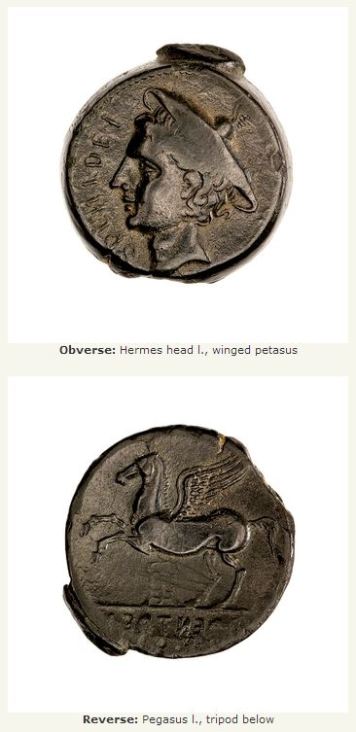
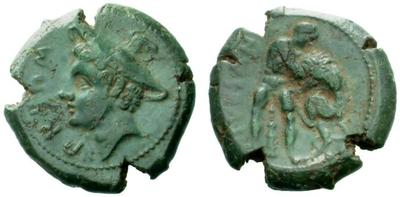
post script. Doesn’t the little beanie hat style of Mercury’s wings remind you a little of how they were rendered on Suessa’s bronzes… or at Teanum ?
Looking again at the coins of Suessa, Cales, and Teanum, especially specimens which have been on the market, it occurred to me how heavily used the obverse dies seem to be, especially at Teanum:
Even after the obverse die break in ways to mar the face of the god portrayed they keep on being used. Such intensity is not consistent with a ‘vanity project’ but instead with a more rushed economically driven agenda. Not a bad die study opportunity here. [The last two are the same obverse die as this Fitzwilliam Specimen; interesting specimen with a prow mint symbol at CNG site].
The other curiosity that might hint at wide circulation (and by extension striking in some significant volume) is the fact that the Boii of the Po river valley (aka Cisalpine/Transpadine Gaul) borrowed the type of Cales’ bronzes for an obol silver issue:
The specimen above is called a ‘drachm’ and the catalogue notes the assignment to the Boii is provisional. (We need a few good hoards or excavation finds…)
This last one is listed as possibly from the Danube region.
Modern critical edition, translation, and commentary available here (p. 41-45).
Relevant bibliography:
Le Bohec, Yann. – La marine romaine et la première guerre punique. Klio 2003 85 (1) : 57-69 carte.
Harris W. V. – The development of the quaestorship, 267-81 B.C. Classical Quarterly1976 XXVI : 92-106. Abstract: There were two new quaestorships in 267, not four, as usually supposed, and they probably shared some of the duties of the quaestores urbani. Two more quaestorships were added for Sicily and Sardinia, and in 197 the total was probably raised to ten, a figure maintained until Sulla. The quaestores classici of 267 probably represented a tightening of Roman control in Italy.
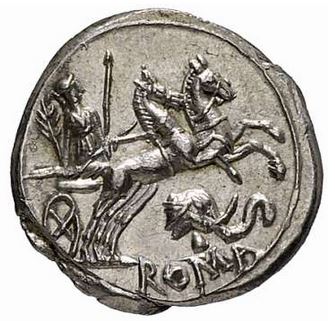
RRC 262/1. I had a little itch in my brain that elephants wearing bells were some how familiar to me when I included the coin below in my previous post.
ETRURIA. Val di Chiana. Ca. 208–207 BC. SNG ANS 36. SNG Morcom 44. HN Italy 69.
I realize it must have been because of the bell on the elephant head on RRC 262/1. The bell must have been a prominent feature on war elephants to make it onto the coin iconography…
addendum. HN Italy 2666 is an AE coin of ~18mm diameter with a bust of Nike on the obverse and an elephant with a bell on the reverse. Trunk curves outwards, not inward. The mint and date is unknown. Two more specimens are in Copenhagen.
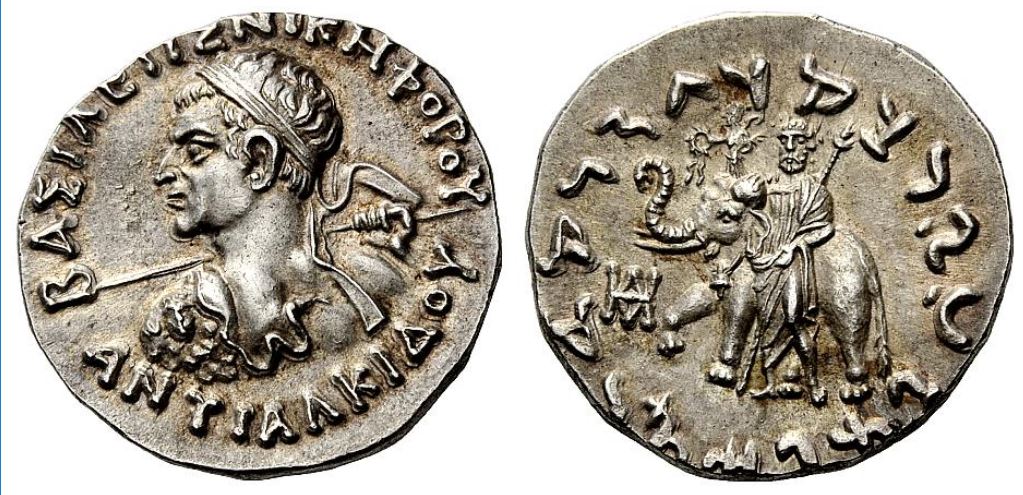
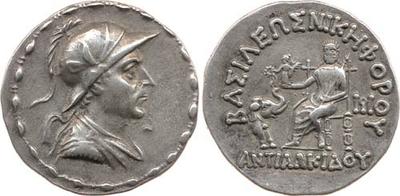
Update 6/6/2014: Elephants with Bells also seems to be a Bacrian motif:
8/22/16: and Indo-Greek
Update 4/11/18: So funny to learn while I was observing all this some one else what writing an article on it!
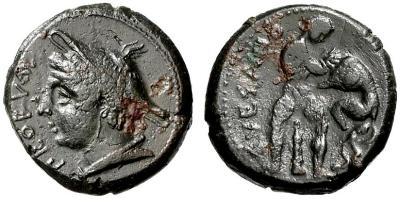
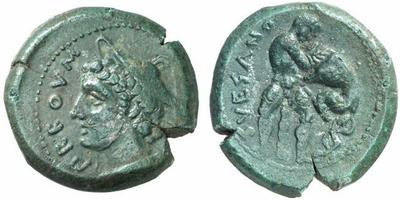
Historia Numorum Italy no. 448 is listed with just one legend PROBOM. (P is actually closer to a Π with a short right leg. Note open form of R. These features consistent throughout). A specimen with clearly this legend is illustrated in the plates. Most of the specimens in trade are from different dies with variant readings:
PROBVM
PRBOVM
PRBOM
The meaning of the legend is unclear. HN Italy suggests it comes from probus, meaning valid. Although the basic meaning ‘honest, good’ seems fine to me too.
It is connected to a similar legend at Beneventum on a type, the imagery of which is a mirror image of RRC 15/1 (HN Italy 440):
SAMNIUM, Beneventum . 265-240 BC. Æ 20mm (7.03 gm). BENVEN-TOD, laureate head of Apollo left / PR-O-P-OM, horse prancing right; pentagram above. SNG ANS -; BMC Italy pg. 68, 1; Sambon 193; SNG Morcom -; Laffaille -. Image from CNG.
The correct resolution of the legend may be aided by consideration of the variant spellings observed.
Beneventum became a Latin colony in 268 and Suessa in 313. These coins are associated with the First Punic War. Hercules wrestling the Nemean Lion is a common enough artistic theme, known especially at the mint of Heraclea Lucaniae and occasionally at Tarentum.
Addendum. I wasn’t really happy with the probum meaning ‘approved’ as it seemed a strange thing to me to write on a coin. Out of keeping with typical legends (ethnics, magistrates, mint marks, the very occasional labeling of the image). I even tried to convince myself Probus could be an epithet or title for Mercury or something. I didn’t manage. Just a red herring. But … then I remembered the inscriptions on the Egadi rams of a roughly contemporary date.
We’ll known more once the inscriptions are published on there own, but for now the use of the probo, probare, probavi on the rams is enough to let me think probum on the coin is more plausible than I first thought.
[Disturbingly, if you google image search, ‘Beneventum Apollo Coin’, the first image that returns of the coin is hosted on some satanic-esque website obsessed with pentagrams. Reminded me of a time a student of mine unwittingly submitted a project full of images from some awful white power website. Appropriation of the past to support modern ideologies is a dangerous thing, especially on the intertubes.]
1) I hate the use of the word ‘real’ in the sense of ‘real world’ or ‘real job’. It is invariably used to trivialize the work and position of the individual who is not partaking in someone else’s definition of real. It implies one’s life occupation is a delusion without value, usually meaning monetary value. I once even had a senior administrator at my own college tell me my department ‘was the happiest la-la-land of academia’. He meant it as a compliment to my managerial skills, I think. While academics are used to hearing the phrase ‘real world’ in anti-intellectual contexts, I suspect its also a classist sentiment. One that disparages the labor of those who do work different from one’s own. The handy thing about it as a slur is that its perfectly acceptable to say to someone’s face AND its flexible enough to be used against those both above and below the speaker on the socio-economic scale.
2) I hate drafting. I’m usually a write it once and never change it kind of gal. I sweat over each damn sentence. The blog has effectively tricked me into drafting. I just had an awesomely productive writing morning for the book, largely inspired by various disparate posts written scattered over many months. No one sentence in the book draft matches the blog and yet boy it was easier to bang out those words with the posts up in front of me.







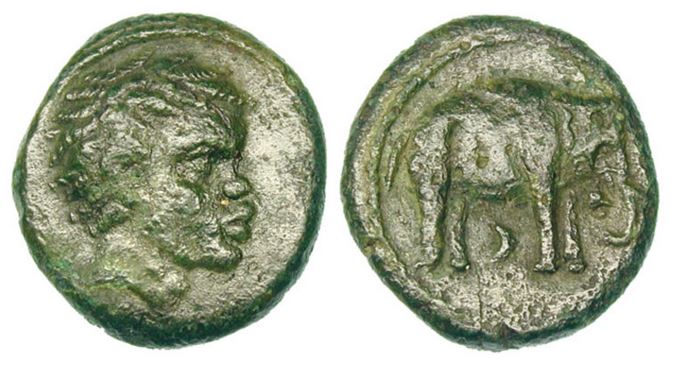 ETRURIA. Val di Chiana. Ca. 208–207 BC. SNG ANS 36. SNG Morcom 44. HN Italy 69.





 Liv Mariah Yarrow
