The San Martino in Pensilis hoard and Andrew Burnett’s analysis thereof is probably the most important new information on third century Roman and Italian Silver issues from the last decade. Highlights included:
Evidence of a significant gap (ballpark 300-260BC) between Rome’s first and second silver issues
The first Roma and Pistis Locrian coin in a hoard context
30 ‘fresh’ coins of Teanum, Cales, and Suessa! (No Cora specimen, alas.)
My scanned photocopy was really crappy, so I’m just delighted to realize that it’s available open access via Persée. No more squinting for me today! I’m also intrigued by the location of this hoard, just north of the Gargano (if you go, you must try the mysterious and delicious Lesina eel!). It’s just down the road from Larinum (see earlier posts). The Frentani became allied to the Romans in 304 BC and somewhere around the mid third century Larinum shifted from minting Neapolis type bronzes with Greek legends, to Roman type bronzes with Latin legends (well Oscan language, Latin Alphabet) (HN Italy 622 vs. 623).
Communities issuing aes grave with Latin Colonies highlighted (missing Volceii, sorry). Map cannot capture the numerous types not attributed to any specific location or group. Map created using AWMC: à-la-carte Map to which it links. [FYI – runs best for me in firefox rather than other browsers.]Crawford CMRR discusses the cast currencies of Italy in five groups (p. 43-46):
an as of about 300g maybe from 1st Punic War: Tarquinii, Tuder, Reate, Praeneste, Carseoli, and Firmum
a heavier as (350-450g): Ariminum, Hadria, Vestini, another unidentified mint maybe Asculum Picenum
an as of about 300g followed by reductions probably from 2nd Punic War: Luceria and Venusia
reduced as from rebel communities during 2nd Punic War: Volceii and Meles
issues of Etruria and Umbria (including Iguvium on map above) on 200g standard from time of 1st Punic War
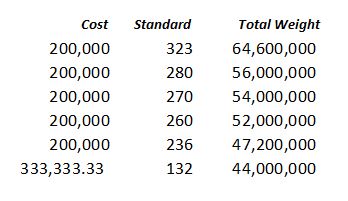
He summarizes circulation and weight standard thus:
AR didrachm of Cora. c. 275-250 BC. head of Apollo l., laureate; horseman r., wearing conical helmet and spearing downwards; below, KORANO (see below). HN Italy 247. Drawing after Paris specimen. from Millingen’s 1831 publication.
I was surprised to have so much trouble finding an image of this type. Thus I thought I’d throw up this bad screen shot and link just to help the next numismatist so struggling. HN Italy obviously knows more specimens than the Paris one as a weight range is given (6.1-6.4 g); I’ve not tracked down their locations. Millingen, although wrong to re attribute the coin to Sora, was correct to see it paralleling issues of Cales, Teanum, and Suessa. See my earlier post.
Update 10 April 2014: I’ve revised my thinking on this issue. I”m not sure it really parallels the issue of Cales, Teanum, and Suessa that well. Key differences in my mind are the lack of any additional symbols on the obverse and the placement of the legend on reverse in the field not in an exergue. It is also missing from the San Martino in Pentilis hoard which has decent number of all three of the others. I am thus skeptical we can really associate this coin with the others and by extension with the 1st Punic War.
Update 7 January 2015: A specimen from Naples was published in the same piece that gives us our first look at RRC 2/1. Isn’t that fun!? Images link to original publication. Based on this photograph I’m inclined to say that the HN Italy reading of the legend is in error. It should be CORANO not KORANO. Also HN Italy does not mention the palm branch (?) behind Apollo’s head. The hat shape of the rider seems distinctive.
From L. Ambrosini, ‘Un donario fittile con elefanti e Cerbero dal santuario di Portonaccio a Veio’. Image links to PDF with more images and references.
I ended up at this article by way of this coin type from Etruria:
ETRURIA. Val di Chiana. Æ 18 mm (4.68 gm). Head of an African right / Elephant right with bell hanging from neck, Etruscan letter below. SNG ANS 36. SNG Morcom 44. HN Italy 69. From catalogue: Commentary on this enigmatic issue has focused on the significance of the elephant, which appears to be Indian rather than African. This zoological observation seems to rule out a reference to the Carthaginian elephants and thus poses a challenge to dating this coin to the time of the Second Punic War. Yet E.S.G. Robinson, in NC 1964, pp. 47–48, proposed an interpretation that overcomes these difficulties. He submitted that the association of the elephant with an African head, probably representing the animal’s driver, points to an African origin. Rather than dating the coin issue to the time of Hannibal’s invasion, Robinson drew attention to the disaffection of Rome’s Etruscan allies in 208–207, centered on the town of Arretium, and suggested that the coin types expressed the seditious hope that Hasdrubal would arrive to reinforce his brother. In these historical circumstances, the elephant was a symbol, perhaps copied from earlier coin types, rather than a portrayal from life.
Baglione, M.P. 1976. Su alcune serie parallele di bronzo coniato. In Contributi introduttivi allo studio della monetazione etrusca.Atti Convegno Napoli 1975: 153-180. Roma.
Baglione records 158 known specimens at that time, the vast majority in public collections. Baglione endorses (if I’ve read the Italian right!) Robinson’s dating and notes that W. V Harris, Rome in Etruria and Umbria (Oxford 1971) p. 140 also follows Robinson’s interpretation. I’m wary of dating by type alone and would like some new good hoard or excavation evidence to confirm this hypothesis. I’d also think a little die study might be of use to get an idea of the size of the issue: it seems at first glance that we’re looking at multiple dies for each letter under the elephant (four different Etruscan letters are well attested) and a number of obverse dies. Elephants do appear elsewhere in the Second Punic War on the coinage of rebelling Italic communities. The most impressive example being the aes grave of Meles in Samnium which copy the Barcid silver coinage (Robinson, Essays Mattingly, 1956: 40, fig. 3A; HN Italy 441-42 (but no illustrations)).
I’m more interested in the unusual votive offering. Ambrosini draws the parallel with the famous plate in the Villa Giulia (inv. 23949) with a depiction of a war elephant and her cub. There is a second similar plate from maybe Sardinia that I can’t put my hand on a reference at this moment. from Corsica:
Roma mediorepubblicana; Aspetti culturali di Roma e del Lazio nei secoli IV e III a.C (Rome 1973), no. 33 = Villa Guilia and no. 34 = Corsica.
The votive offering confirms the theme of elephant and cub in a military context. That, of course, made me think of that passage in Dionysius that I quoted in a previous post about how the Roman’s wounded a cub to gain a tactical advantage over Pyrrhus’ use of elephants.
ANS Specimens of Ariminum Cast Bronze. Click image form more details.
It strikes me that that the cast bronze types of Ariminum bear a marked similarity to the types of the Roman currency bars. Ariminum became a Latin colony in 268 BC and the cast bronze dates to sometime after that date. The one type I couldn’t find to illustrate has a shield as the reverse type. Its as seems to be heavier than the Roman (350-400g) and it divides the as into a base-10, instead of base-12 fractions. It shares these characteristics with Hadria and Vestini (Crawford, CMRR, p. 43 & HN Italy p. 17).
Ariminum types above all represent different denominations. [Scale can be so deceptive in online images!] Shield = quincunx, Sword and scabbard = quadrunx, trident = teruncius, dolphin = biunx, rostrum = uncia, shell = semuncia.
This suggests they were created as a series at one moment in time. Perhaps they took their inspiration from the currency bars? With the exception of the shell all of these are well known images on the bars. Below is a collection of images to refresh your memory. And one more specimen of Ariminum, the trident of which better parallels the bars.
There is nothing that comes to mind that would preclude the possibility that the shield and sword currency bars were made at the same time as the naval types…
You may know ancient Ariminum better by its modern name Rimini.
I’m fond of Croatia for many reasons. Great landscape. Great memories. One more reason to love the country is their freely accessible database of scientific publications: Hrcak. Here’s what a simple search for ‘coins’ brings back. Most publications are in Croatian, but with English abstracts, some are bilingual. Particularly interesting are the hoard reports…
RRC 14/7. Semuncia circa 280-265, Æ 14.36 g. Acorn. Rev. Σ. Haeberlin pl. 40, 23-27. Aes Grave 40. Sydenham 14. Thurlow-Vecchi 7. Historia Numorum Italy 274.
Crawford say on p. 40 of CMRR:
Andrew Burnett acutely points out that the weight standard of the semunciae of the first issue of cast bronze [sc. RRC 14] makes it clear that they represent a point of transition to the second, which is heavier than the first (the reasons are mysterious).
I’m still unclear on the whole subject (hence the blogging about it…). Does it mean that the heavy semuncia of RRC 14 shows a tendency to think about the pound as heavier than 322g?
A 322g as should have a 13.42 ish semuncia as its the 1/24th denomination.
Not a large sample size but woah that’s some variation in the data. And three, maybe four, of these seven specimens weigh enough to be a plausible weight for a uncia in the same series.
So what about the ‘heavy series’ RRC 18, no semuncia for comparison but we do have an uncia. And remember on weight standard of 334g we should expect as weight of about 27.83 g for the 1/12th piece.
Holy variation, batman! But again four of our RRC 14/7’s would fit comfortably into the lower end of this observed data set.
Time to step back and ask a really basic question. How do we know its a semuncia and it goes in this series? I opened up Crawford’s list of the Nemi finds. Not one example of RRC 14/7. There are for context 50 specimens of other RRC 14 denominations including 11 uncia (weights for the four specimens in Nottingham = 28.19, 27.04, 26.77, 27.46, cf. weights of RRC 18/6: 19.96, 29.09, 24.86, 28.55). Jaia and Molinari 2011 (link above) have an appendix of all the hoards of just RRC 14 and 18 aes graves (i.e. those that should have an early closing date). No semuncias. Not surprising really, small change isn’t the most desirable for hoarding.
And I’m not really less confused that when I started writing this post, but I do have a mad urge to start collecting a big spreadsheet of specimen weights. I’ll resist for now.
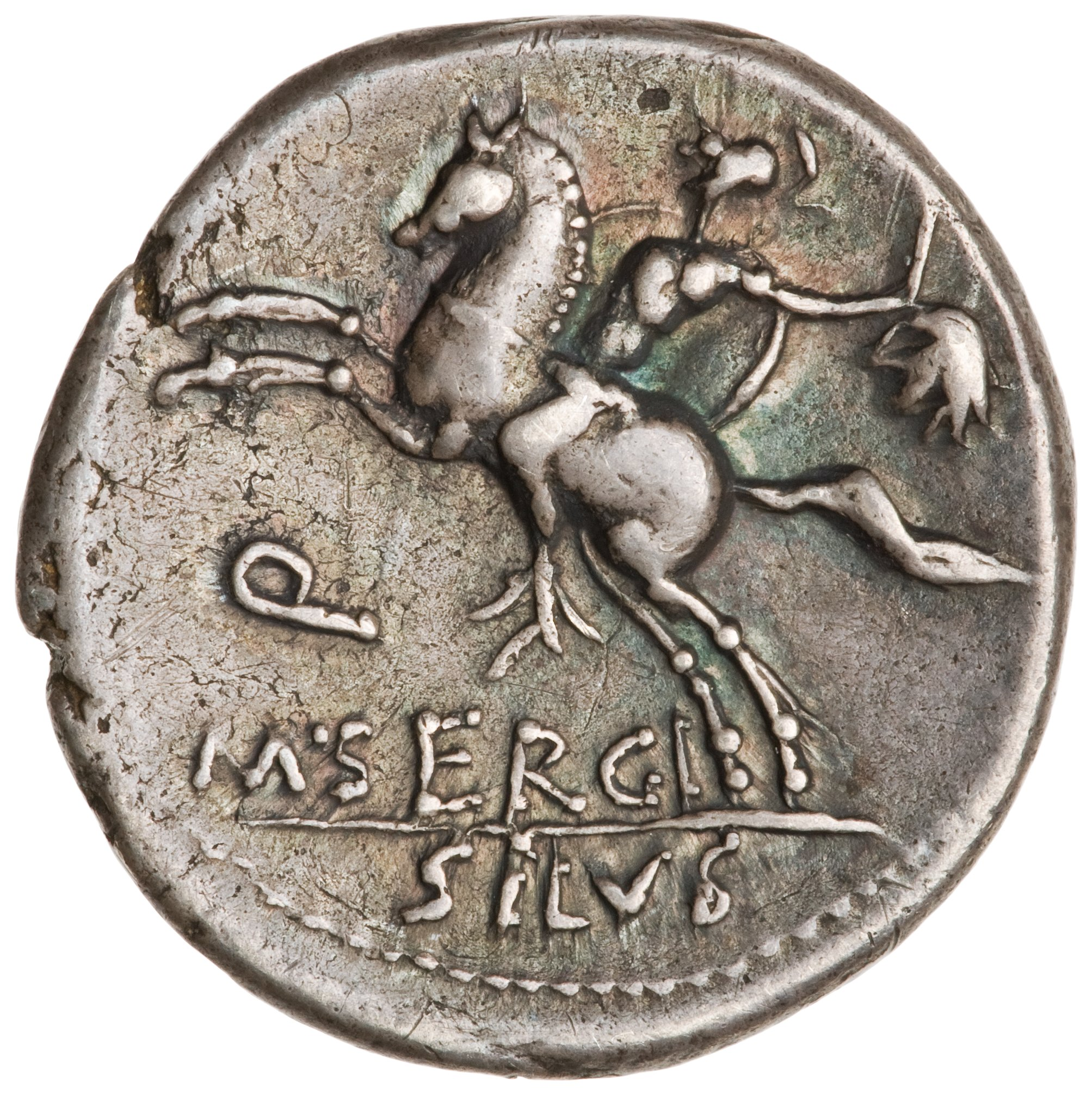
The coin above is just there as a reminder that boars do appear on early Roman coinage in other contexts. The main point of this post is put up this curious theory about the elephant and pig currency bar (RRC 9/1):
Taken from p.462 of Borba Florenzano, Maria Beatriz ‘Aes signatum bars, signa and coins: emblematic objects and apotropaism’ from XII. lnternationaler Nurnismatischer Kongress, Berlin 1997 (2000), 460-465.
I would just note in comparing the boar above to our friend the sow below, that both are represented with an impressive line of bristles down their backs. I do think, however, the two engravers have carved the animals in such away as to plainly distinguish their genders. And, I have my doubts that the legions would use the female, instead of the male, as their totemic creature…
RRC 498/1. C. Cassius with M. Aquinus. Aureus, mint moving with Cassius 43-42, AV 8.41 g. M·AQVINVS·LEG· – LIBER – TAS Diademed head of Libertas r. Rev. C·CASSI – PR·COS Tripod with cauldron, decorated with two laurel branches. B. Cassia 12. C 2. Bahrfeldt 56. Sydenham 1302. Sear Imperators 217. Calicó 63.
I was thinking about tripods in a totally different framework when I came across the very smart work of Carsten Hjort Lange (again!). In his 2009 book, Res Publica Constituta, he gives a new reading of the famous plaque from the Palatine in light of the use of tripods on the coinage of 42 BC (p. 172ff). A great read, but too long to extract here just follow the link!
I also came across a reading of the Tripods on the Coins of Herod (same time frame) that I thought delightfully sensible:
Obverse of Bronze Coin, Jerusalem, 40 BC – 4 BC. ANS 1944.100.62799From p. 110 of The Coins of Herod: A Modern Analysis and Die Classification edited by Donald Tzvi Ariel, Jean-Philippe Fontanille (Brill 2011). Image links to google books.
Gem of glass paste imitating sard, engraved with a terminal figure of Hermes, before which stands a youth holding a wreath and palm-branch in his left hand, and a cock on his right. BM 1923,0401.420; Gem no. 2794
I was writing up my thoughts for the book on the symbolism of the cock on coinage during the First Punic War this morning. [An issue touched upon in an earlier post, here.] The idea that in the Greek world the cock need not be directly linked to Hermes, but more generally be a symbol of bellicosity and manliness, is well summarized by this book.
This might help explain the pairing of cock and Minerva (Athena) on coins of Suessa, Teanum, et al (for images see earlier post). But I was still playing around with the Mercury association in my mind, when I came across the glass paste above.
Here we see the epitome of manhood, the victorious young athlete standing before a terminal Herm. He has his prize crown and palm-frond and in thanksgiving for his victory he offers the god a cock. [Just like the victor in the Callimachus epigram quoted in the previous post!] The cock symbolizes at once his victory and his virility. A Herm’s most notable feature was its phallus. Although we are often think of Mercury (Hermes) as first the god of commerce, we must remember he ended up as such by his status as the fecund god, the wealth-bringer. Just as cock is slang for male genitalia today, so in the ancient world the cock encapsulated a similar semantic range of meaning as the phallus: power, especially masculine power, the (pro)creative power that leads to wealth and to overcoming one’s adversaries.
Anyway, the glass paste is a ‘gem’ of a summation of the symbolism of the cock, so I thought I’d share. Okay, back to my other writing.
Post Script.
When two cocks appears facing each other on gems it is most often a representation of a cock fight, thus a type of agonistic scene, often with victory imagery incorporated into the design: