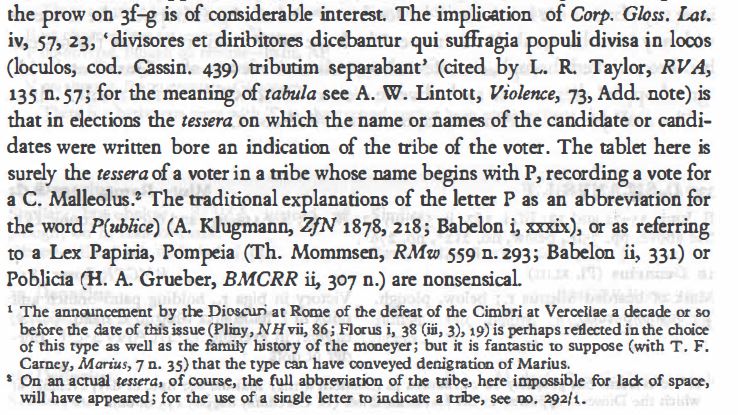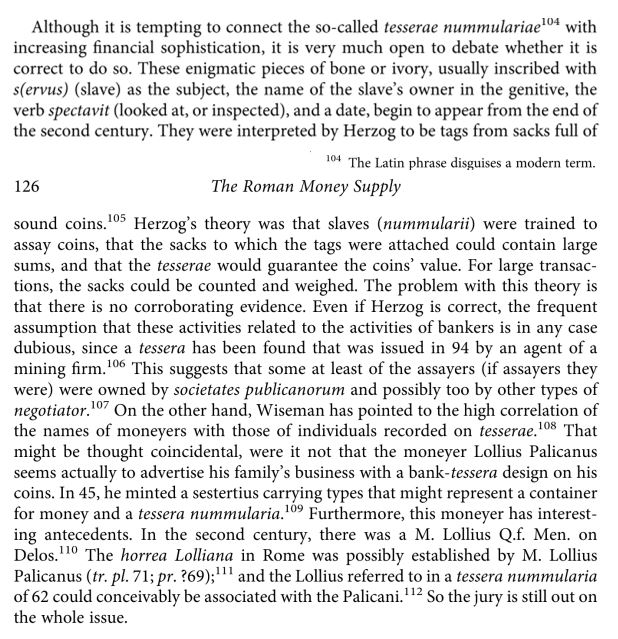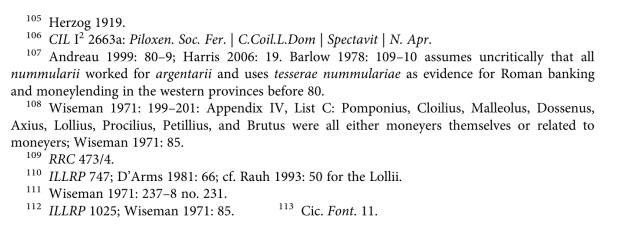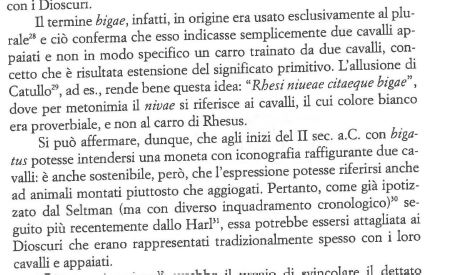
This morning, I was reading through all the goodies that ILL has delivered electronically during the post-Passover flood of activity back in Brooklyn and was just dead impressed (again) by the types of connections Michael Crawford can make. This paragraph above is from a relatively hard to find conference volume:
M. H. Crawford, ‘The Oscan inscriptions of Messana’ in Guerra e pace in Sicilia e nel Medlterraneo antico, VIII-III sec. a.C.; arte, prassi e teoria della pace e della guerra (2006), 521-525, at p. 525.
The rest of the article will be of interest to numismatists for his comments about the choice to use Greek on the coinage being a reflection of coinage as a ‘Greek phenomenon’. He also has some good comments on the choice of types by the Marmertini.
I’d love to have a photo of the front of the altar in the passage quoted above. I’ve put the Rix on ILL order. In case you’re unfamiliar with the awesome Pompeii inscription here are my comments on it in print:
Here’s an old pic I took when writing that article:
The one point I’m a little fuzzy on is did anyone actually record seeing a Latin inscription on the plaster over the Oscan one in Pompeii? Or are we just assuming it must have had one? Also could some high tec imaging process allow us to see under the Mamertine stucco inscription to let us read what if anything it is covering up?
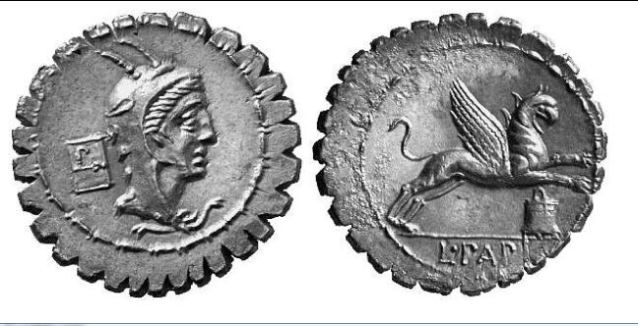
Ex Slg. Sir Arthur Evans (= Katalog Burlington Exhibition 1903) Tf. 101, 82, Slg. Jameson 449 und Slg. Walter Niggeler (=Auktion Leu + M&M Basel 1965) 82. Cf. SNG ANS 531. 7.15 g.
So I read this bit of Polybius (below) and landed right back at this coin (above):
For Hiero and Gelo not only gave seventy-five silver talents, partly at once and the rest very shortly afterwards, to supply oil in the gymnasium, but dedicated silver cauldrons with their bases and a certain number of water-pitchers, and in addition to this granted ten talents for sacrifices and ten more to qualify new men for citizenship, so as to bring the whole gift up to a hundred talents. They also relieved Rhodian ships trading to their ports from the payment of customs, and presented the city with fifty catapults three cubits long. And finally, after bestowing so many gifts, they erected, just as if they were still under an obligation, in the Deigma or Mart at Rhodes a group representing the People of Rhodes being crowned by the People of Syracuse. (5.88.5-8)
The context is c.226BC and Rhodes’ use of its recent earthquake to solicit diplomatically expedient gifts. [Link to some relevant scholarship]
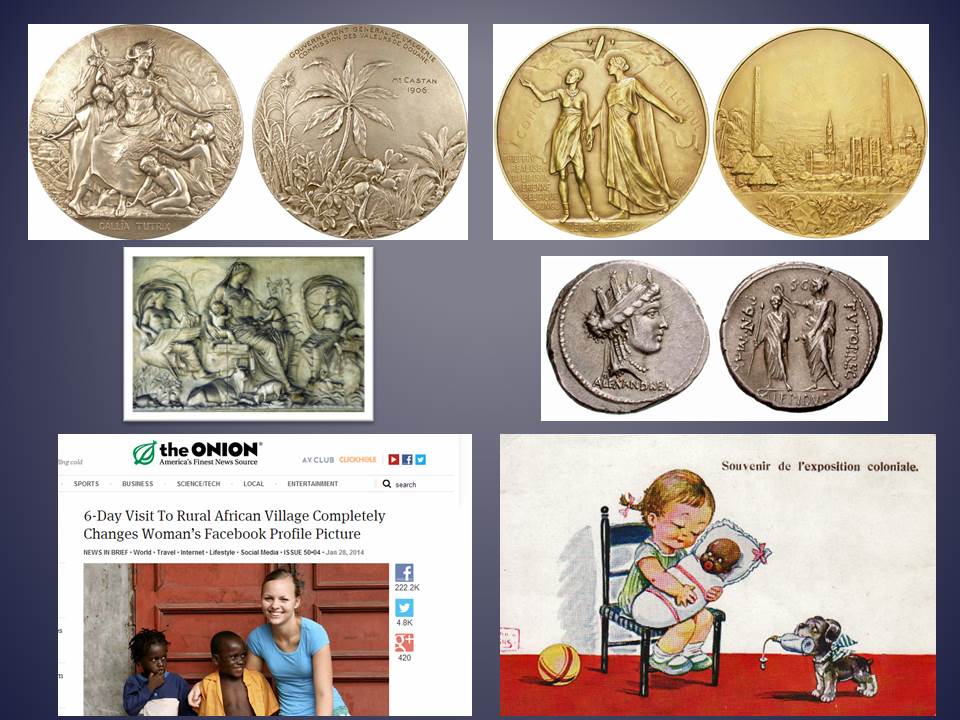
A) It’s good context for the above coin on the personification of political bodies in honorific art forms in 3rd Century BC.
B) It might suggest that the coin type imitates a statue group or potential statue group or the known style of a type of statue group. This isn’t crazy lots of coin types derive from statues of one sort or another.
C) It made me think about who crowns whom in Hellenistic art in what context. Under the Empire cities shake hands rather than crown one another. Nike crowns everybody. She’s kind of a whore that way. It’s kind of her M.O. Ditto Eros (Cupid). Then this came to mind:
Nice Picture, but don’t believe the Flickr caption.
The crowning obviously honors and emphasizes the status of the crowned, but what about the crowner? Does it diminish the status of Syracuse to bestow the crown? Or in fact is it a statement of inherent superiority if one can crown another? We need only think of Napolean’s anxiety about being crowned by the Pope and thus his decision to crown himself and his queen.
On a more serious note, Walbank as always is full of goodness:
it be resolved by the People of Byzantium and Perinthus to grant to the Athenians rights of intermarriage, citizenship, tenure of land and houses, the seat of honor at the games, access to the Council and the people immediately after the sacrifices, and immunity from all public services for those who wish to settle in our city; also to erect three statues, sixteen cubits in height, in the Bosporeum, representing the People of Athens being crowned by the Peoples of Byzantium and Perinthus; also to send deputations to the Panhellenic gatherings, the Isthmian, Nemean, Olympian, and Pythian games, and there to proclaim the crown wherewith the Athenian People has been crowned by us, that the Greeks may know the merits of the Athenians and the gratitude of the Byzantines and the Perinthians.
Update 1/5/2016: My thoughts on this are maturing. I think there must have been a very typical statue group that was developed for such a representation and the Nero/Agrippina is a late example of the general type. This informs how I am thinking about types like RRC 419/2 and other crowning scenes on coins. Cf. Also the Corinth Crowning Ptolemy group attested by Athenaeus drawing on Kallixeinos and discussed by Pollitt (here and here).
Update 5/1/14: This isn’t precisely related to the rest of this post, but I wanted to be able to find this passage again when thinking about the Locrian coin (Pliny, NH 34.32):
This demonstrates Romans receiving honors from S. Italian Cities for their role as protector a decade before Locri’s coin. I also like the sentence about this being a means of establishing foreign clients. I doubt the Thurians saw it that way!
1/20/16: Constantine and the Tyche of Constantinople
In view of the fact that the Boii and rest of the Gauls were offering for sale various articles and an especially large number of captives, the Romans became afraid that they might some day use the money against them, and accordingly forbade anybody to give to a Gaul either silver or gold. (Zon. 8.19)
I came across this odd little quote in the fragments of Cassius Dio in the midst of the narrative of events preceding the Second Punic War. This got me thinking about the monetization of the region and led me back to this passage in R. Haeussler, Becoming Roman? Diverging identities and experiences in ancient northwest Italy (2013), p. 98:
The chapter from which this is pulled is a nice example of a historian integrating numismatic evidence into the narrative. Anyway this further led me to discover that all of Ermanno A. Arslan’s publications are online. A very exciting resource. And, I also got to read some of the work of Giovanni Gorini who also seems to have put much of his publications online.
So in some regions, like Turdetania in Further Spain [the most unfortunate place name ever!], it has been suggested that the issuing of bronze coinage is a reaction to Roman regional engagement, a vehicle to help with the collection of taxes, etc. So, S J Keay, “The Romanisation of Turdetania” Oxford Journal of Archaeology 11.3 (1992), 275-315, esp. 288ff. By contrast, the current suggestion seems to be that the peoples of Northern Italy were already engaged in the use and production of silver coinage before their engagement with the Romans.
The passage from the epitome of Dio (above) is interesting because of how it sees a connection between the acquisition of silver and gold and military readiness. It ties trade and commerce directly to war resources. The trade doesn’t give the Gauls more resources–they already have a good deal of material wealth–instead it gives them a type of resource, gold and silver (coins?!) which make it easier to engage in warfare.
And, here’s a nice pic of a padane drachma just so this post has one:
Poor drawing from Millingen of BM specimen. Image links to catalogue entry without image. Note: Millingen describes this coin as AE in his text and that agrees with our knowledge of the type, but on the plate he identifies it as AR.
HN Italy 609 transcribes the pesky reverse legend of this type: r[e]gvinumra/valanum. The online BM catalogue concurs. The old BMC reads as follows:
This raises some questions in my mind about the readings of the first and penultimate letters on the first line. The old catalog reads them as R (Oscan for /d/) and D (Oscan for /r/). Rs and Ds cause no amount of confusion in their Oscan reversal, notably in antiquity at Larinum. The new catalogues (HN Italy and BM online) both read the same letter in both positions… r … by which I assume they mean an Oscan D … you see how the confusion can creep in!
I thank Dan Diffendale for reminding me of Crawford’s Imagines Italicae, vol. 2, p. 906 and sharing images via Twitter (7/30/2018).
His argument is complex and he quickly shifts into aligning the Dioscuri as the Penates, an issue we’ve discussed before. His resolution doesn’t seem immediately obvious to me, as it seems to require us to believe the name of the gods was broken in the middle and written on two lines and does not explain the full text. It comes down to the two inscriptions sharing at most a three letter sequence in common.
I’d really like to see a publication of the coin type with high quality images of the specimens and some discussion detailed reasoning by an Oscan expert, something I am most certainly not!
This is from Plutarch’s Flamininus 16.4. After yesterday’s post I couldn’t help but share this gem. I like how both passages are topped and tailed by the word pistis, using word placement to frame and contextualize the rest of the content. Posts on Pistis and Fides.
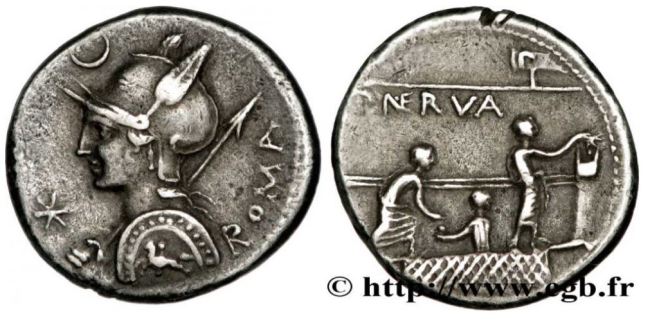
RRC 16/1a. ANS 1969.83.7. Image links to all ANS specimens of this type.
I came across the passage of Crawford below and decided I might kick the main discussion of the type above out of the chapter I’m working on at the moment (Rome and Italy) and put it in the previous one (The Legendary Past).
Since Crawford wrote this passage (RRC II.714) thinking about Lycophron and Roman foundation legends has developed. Here’s Wiseman’s translation of the relevant passage from his Remus:
Coin geeks will know Aphrodite Castnia from the coins of Metropolis in Thessaly [links to an example with a side story from the collector illuminating acquisition practices]. Literary buffs will be more likely to reference Callimachus Iambus 10; Kerkhecker 1999: 207:
Wiseman 1995 has shown many ways lions may be present in the now lost myths of the foundation of Rome before the establishment of the Romulus and Remus tradition (p. 63ff) and has endorsed Stephanie West’s dating of the above passage and others to the second century (181 n. 5).
The lion and goddess seem to me very much in the South Italian and Sicilian repertoire of iconography (cf. Velia and Syracuse for Lions among other mints), evoking power and divine protection, but not necessarily an intersection with a specific foundation narrative.
And I’m still moving away from Russo’s suggestion that RRC 16, 17, and 23 form a series, amongst other reasons already discussed, because of Crawford’s comments about the different circulation patterns of RRC 16 and 17 in CMRR, p. 38 with App. 9 (p. 285) listing hoards.
The very first episode actually narrated in Polybius’ Histories doesn’t really let the Romans come off that well. The garrison they sent to Rhegium seizes the city for themselves rather than protecting it. This episode is set by Polybius in the back drop of the Pyrrhic War and he says after the war, as soon as they could, the Romans laid siege to the town and punished mercilessly their own garrison. The episode begins and ends with references to pistis (= fides = [good] faith). Now, Polybius is probably hazy on the details. See Walbank’s commentary (follow link above) for the nitty gritty details, but key points therefrom include:
” Dion. Hal. xx. 4 records that the garrison was against Bruttians, Lucanians, and Tarentines, and was sent in the consulship of C. Fabricius (282).”
“The Roman reduction of Rhegium (cf. 6. 8) is in 270; Dionysius (xx. 16) and Orosius (iv. 3. 3–6) attribute it to the consul C. Genucius, but his colleague Cn. Cornelius Blasio triumphed de Regineis (act. tr.).”
So 12 years is an awful long time to leave this rogue garrison hanging out in S. Italy… I also find the triumphal fasti entry interesting. We usually talk about funny business with the triumph in the civil wars and allied rebellions of the Late Republic but this appears to be a really early case of a Roman claiming to have defeated a foreign enemy when fighting other Roman, or former Roman, soldiers. And of course it made me think about this coin and its broadly Pyrrhic context and Locri’s status as a neighbor of Rhegium. The whole episode was quite an object lesson for the Locrians…:
Reverse of Silver stater, Locri Epizephyrii. Pistis (= fides = fidelity) crowns Roma. ANS 1944.100.7030
HN Italy 210. First Cosan bronze issue. Image from Buttrey’s classic 1980 publication, to which it links.
This issue of Cosa imitates Rome’s first didrachm (RRC 13/1). It’s date post 273BC (the founding date of Cosa) has sometimes been used to try to draw down the date of Rome’s first didrachm, the idea being that iconographic borrow would be unlikely over a gap of some 40-50 years. The gap doesn’t bother me.
I was just intrigued by the dolphin addition to the design. Buttery says its there “bronze to identify Cosa as a port” (p. 22). Need this be true? I’m just recalling the dolphin neck terminus we find on the obverse of the coins of Signia:
Latium, Signia. Obol circa 280-275, AR 0.69 g. Head of Mercury r., wearing petasus; below neck, dolphin r. and below chin, caduceus. Rev. Mask composed of Silenus head l., and boar’s head r.; below, SEIC. Sambon 164. SNG ANS 115. Campana CNAI 1a. Historia Numorum Italy 343.
Segni is most certainly not on the sea. And as I mentioned in passing in another post, Mercury isn’t particularly associated with nautical imagery and dolphins. I’m wondering it is not a design element considered aesthetically pleasing at the bottom of a protome to ease the transition. Two examples an argument does not make. I’ll keep my eye out for more.
So I’d been revising my thinking on the Cora didrachm a bit of late and that made me wonder if I needed to also think again about Nuceria issues. Crawford lumps them together, speculating it was a means of distributing booty. I was pleased to see Nuceria specimens next to Suessa specimens in this hoard even if they will be much earlier than its deposition date:
Update 4/16/2014: When thinking about Nuceria and Cora and how their striking relates to that Teanum, Suessa, and Cales, don’t forget the silver didrachms of Paestum, again very rare and the jury is still out on dating (HN Italy 1180). Image here.
ANS specimens of RRC 21/7 = HN Italy 294. Click image for full details.
Last time I was worrying about acorns, I was mostly on about RRC 14/7. This is the other ‘heavy’ acorn. Many of the specimens on the market do seem ‘heavy’ for being a 1/24th piece of a 265g as, or at least a quick scan suggests, but the ANS specimens are lighter: 11.75-13.9g. They are not so heavy that they seem particularly problematic in the weight standard, cf. the ANS uncia specimens of the series which are all much heavier.
My interest was peaked by how they show up in this hoard:
Image links to source publication. Marks in red are my annotations. [Note: the correct citation for the Nola bronze is HN Italy 607. Also see below for discrepancy between this report of the hoard and that in IGCH.]So here RRC 21/7 is hanging out all by its lonesome with a bunch of RRC 14s and 18s. I’m not really sure why RRC 21/7 couldn’t go with the RRC 18 series. The types of RRC 21 echo the obverse types of RRC 14, so that would make the acorn fit with RRC 21. Must take a look to see if we have any other hoards with RRC 21/7 out in the cold…
Here’s Burnett 1977 on the importance of the above hoard:
Image links to online version of the publication.
If the statement about the semuncia being contemporary with the Roma/Victory didrachms is true this would pull this hoard’s date down to the end of 1st Punic War based on Burnett’s 2006 reading of the San Martino in Pentilis hoard. The presence of the Minerva/Cock types and the Aesernia types with the subsequent Man-faced bull issues leads me to think this is a hoard from a transitional phase between the two. I’d be inclined to agree with M. C. Molinari that it predates both the Pratica di Mare and Teano Hoards…
Okay, here’s one more complication. R. Russo in Numismatica Sottovoce proposed that RRC 16, 17, and 23 were single series (23 = double unit, 16 = unit, 17 = half unit) minted at Neapolis after the Battle of Beneventum. This seems too early to me and I hesitate to break RRC 23 away from it Messane mint connection. But neither of these points directly challenge them being a series.
But if RRC 16 was really contemporary with RRC 17 that would detract from M. C. Molinari’s ordering of these three hoards as RRC 16 is present in Pietrabbondante… I find myself leaning more away from Russo’s idea of a series.
Something seems to have gone wrong in the transcription of the hoard totals in the above publication. Here’s the entry from IGCH:
Note that the number of uncertain have been attributed to Neapolis above and the 126 of Neapolis have been missed out. I don’ t think it overly affects the interpretation of the hoard in source publication. The original publication of the hoard with all the details has been digitized, although it takes forever to load.