Denarius 19/18, Rome. Moneyer M. Durmius. M DVRMIVS – III VIR Bust of young Hercules to r., wearing diadem and carrying club on r. shoulder. Rev. CAESAR AVGVSTVS SIGN RECE Kneeling, bare headed Parthian to r. holding signum to which is attached a vexillum marked X. 3,82 g. RIC 314. BMC 59. C. 433b. Ex L. A. Lawrence Coll., Auction Glendining, London, 7 December 1950, lot 359. UBS auction 78, lot 1299.
My favorite thing about numismatic databases are the things that pop up that I wasn’t looking for. This is a great example. There aren’t many known specimens, but there are two in the British Museum (example 1, example 2). Its obverse clearly echoes a much earlier republican didrachm (RRC 20/1).
Anonymous moneyer. AR Didrachm (6.85g) minted at Rome, 270-265 BC. Diademed head right of young Hercules, with long sideburn; club and lion’s skin over right shoulder. Reverse : ROMANO. She-wolf standing right, head reverted, suckling the twins Romulus and Remus. Sear 24; RSC 8; Craw 20/1; Syd 6. Provenance: The Hunter Collection; Ex Superior Stamp & Coin, NYINC Auction, December 8-9, 1995, lot 847. Ira and Larry Goldberg auction 72, lot 4115.
It’s always interesting to see an awareness of earlier types surfacing after such an extended period–over two centuries regardless of how one wishes to date RRC 20/1. That said, it also raises questions about why this earlier type might have been attractive in this moment under Augustus. Hercules is usually associated with his rival Antony. As is Hellenistic Kingship. The connotations of the obverse type seem at odds with the Augustan program. Perhaps this explains its rarity? Perhaps the moneyer thought better of the design choice? A choice which at first which might have been attractive simply because of its antiquity and Augustus’ own rhetoric of conservative restoration?
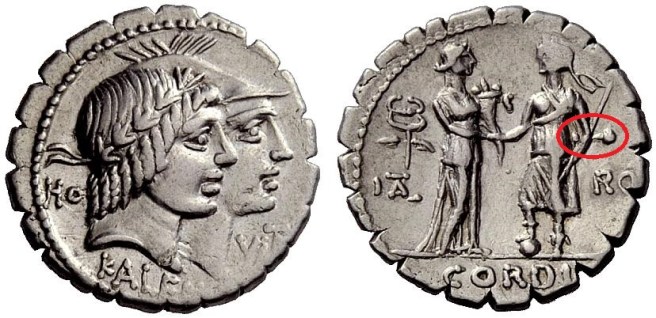
Q. Fufius Calenus and Mucius Cordus. Denarius serratus 70, AR 3.98 g. Jugate heads of Honos and Virtus r. Rev. Italia, holding cornucopia, and Roma, holding fasces and placing r. foot on globe, clasping their hands; at side, winged caduceus. Babelon Fufia 1 and Mucia 1. Sydenham 797. Crawford 403/1. NAC 54, lot 922.
Crawford called the object in Roma’s left hand on this coin a fasces. This doesn’t make a huge amount of sense as one doesn’t carry fasces in the crook of one’s arm, but instead with the axe high over one’s shoulder. The classic example is the Brutus coin (RRC 433/1). Moreover the republican coin series has a pretty definite iconography of what fasces should look like on a coin and specimens of RRC 403/1 just don’t fit the type. The long stick may well be a scepter. This would make some sense, if one agrees that those fillets off Roma’s head indicate she’s wearing a diadem. The diadem and the scepter probably deserve a post of their own, exploring particularly the appropriation of Hellenistic regal iconography for the personification of Roma. Alternatively, the fillets may be only the fillets of a victory crown without any regal connotations. For now, however, I’m just concerned with the little blob circled in red above.
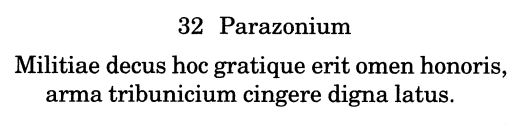
This is likely to be a parazonium. What, one might ask, is a parazonium? Well, besides being a numismatic term for iconography better known from the imperial period, it is a dagger or short sword worn on the left hand side off the girdle. Our only literary testimony is Martial Epigrams 14.32:
The word itself is derived from the Greek, although it is pretty rare in Greek texts as well: in the TLG it shows up only in a fifth century CE lexicon and one equally late hagiography. I don’t think this type is our earliest examples of Roma with a parazonium; it’s already part of her iconography on RRC 335/1 (one example, another example) and probably also on RRC 391/3. What this type does do nicely is suggest that the parazonium is already perhaps a linking piece of iconography between virtus and Roma. On the imperial coinage by the time of Nero the parazonium is a common attribute for reverse personifications of virtus.
If you are interested in this question the person to whom you should be listening is Bill Dalzell, not me. My writing this piece put us in touch and I now defer to his wisdom on the matter.
Dalzell, Bill. “Early Coins and Currency of the Republic of Liberia.” American Journal of Numismatics (1989-) 36 (2024): 403–72. https://www.jstor.org/stable/27352958.
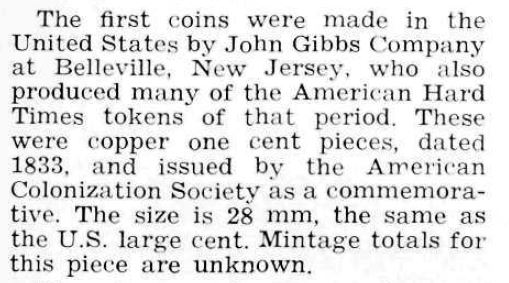
The short answer is I don’t know, but I have some concerns about the common assertions. This is the statement by Colver and Harley in their 1971 piece in Calcoin News:
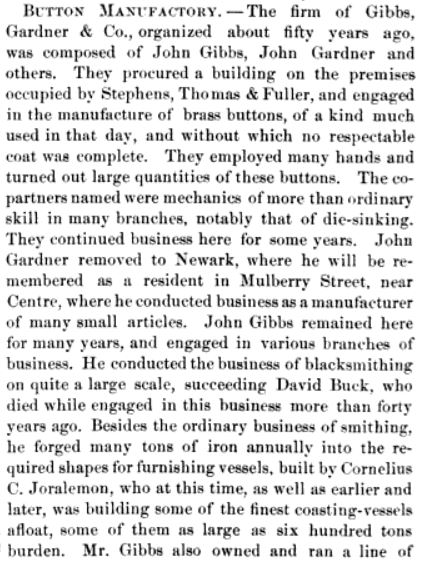
This might go back to Low’s comments in AJN 1899:
But the problem starts to rear its head here. How does Low know about Gibbs, Gardner & Co’s foreign contacts? It’s hard to see Gibbs, Gardner & Co actively involved in the manufacture of coins and coin like objects as early as 1833. It’s not even clear the company existed at this point, let alone had already diversified from buttons into coins and tokens. Where did Low get his 1835 date? Maybe from the1884 History of Essex and Hudson Counties. The language ‘about 50 years ago’ is frustratingly vague.
Notice that in 1884 the token/minting production of the company is seen as too insignificant to mention. If the 1833 Liberia coin was made by Gibbs, Gardner & Co., it would be one of the first commissions of a fledgling company.
The January annual report of the American Colonization Society from 1833 makes only the briefest mention of the coins:
Though in the view of the Managers, it is essential that Liberia should become an agricultural colony, and therefore that no measures should be adopted tending to elevate commerce at the expense of agriculture; yet the inconveniences arising from the want of a circulating medium, have caused them to resolve on the introducing a small quantity of coin. It is proposed that this coin shall bear appropriate devices and inscriptions, and that the amount shall in no degree exceed what may be required by the actual necessity of the Colony.
The coinage doesn’t even get its own budget line in the treasurer’s reports.
Are there any other candidates? Remick in the 1965 Numismatic Circular speculates:
A page of my image notes from my pre-blog days. The images are all from the ANS. Click to be taken to ANS collection of RRC 405/5 specimens. Or click on the title of this post to see all the images at a higher resolution within the post itself.
It may not be immediately obvious but this little spate of blog posts are all coming out of my efforts to wrap my head around representations of Monarchy on the Republican Coin Series, a topic I’m attempting to work up for a conference paper submission today.
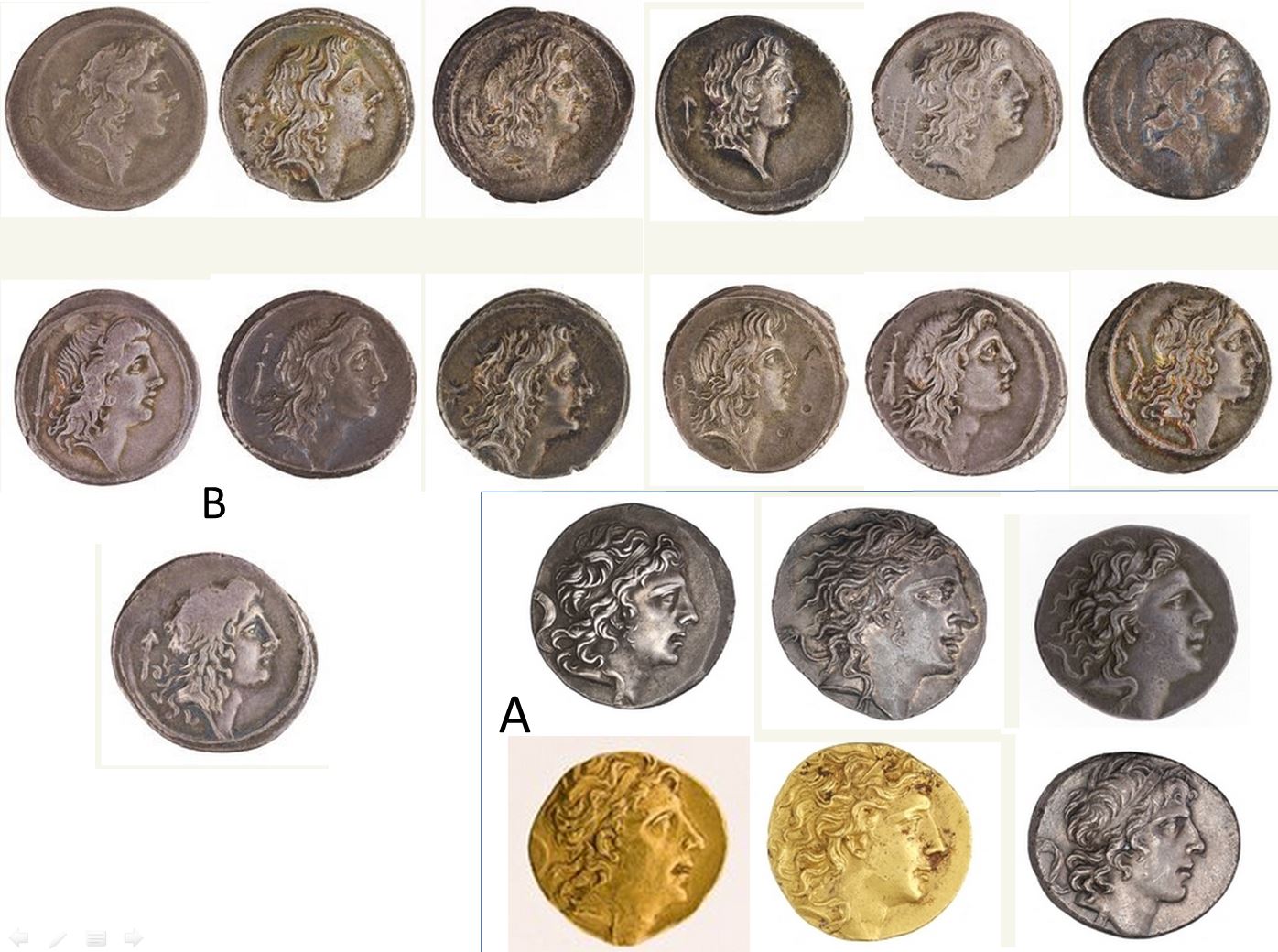
Gem scholars have long recognized the stylistic connection between Mithridates Tetradrachms and this republican coin type. Cf. Vermeule 1970: 206.
Crawford proposed Mercury as an other possible identification of the intended deity. The iconographic parallel is striking but I find myself ambivalent about whether it is just an artistic choice of style or an intended reference to the Pontic king. It’s part of a complicated series perhaps alluding the the cult of Fortuna at Praeneste and/or other Italic cults. How it fits into the series as a whole has alluded explanation.
I would just note that with the new dating based on the Messange Hoard of RRC 405 to 58 BC, this potential regal allusion comes in the midst of a spate of such allusions to foreign kings on the reverses of the series:
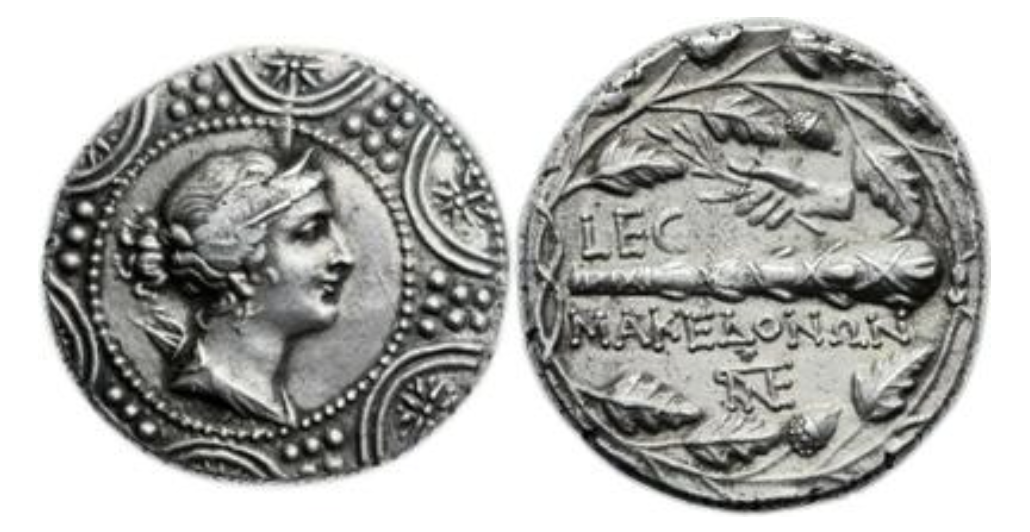
Perseus of Macedon (reverse of RRC 415/1; 62 BC)
Aretas of Nabataea (reverse of RRC 422/1; 58 BC)
Ptolemy V of Egypt (reverse of RRC 419/2; 58 BC)
Bocchus of Mauritania and Jugurtha of Numidia (reverse of RRC 426/1; 56 BC)
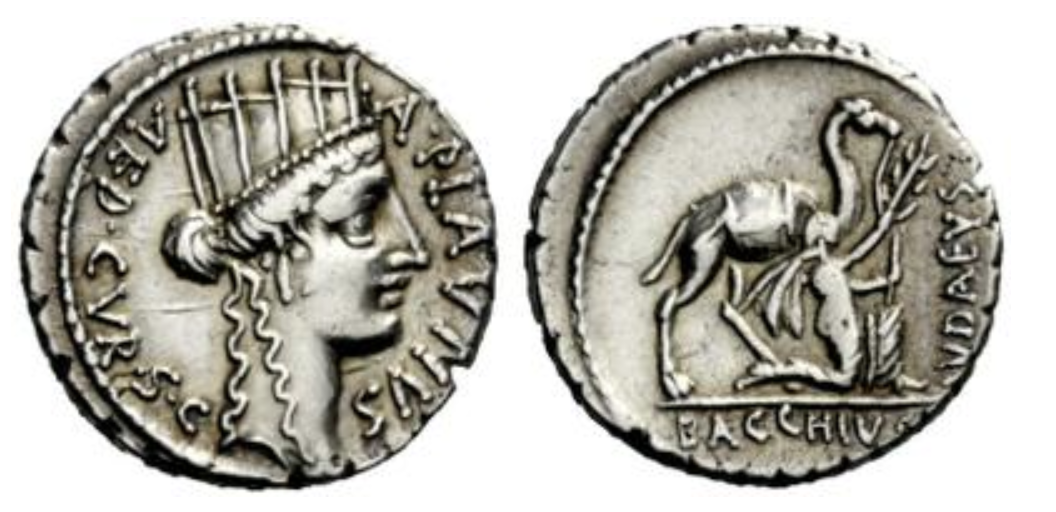
Bacchius of Judaea (reverse of RRC 431/1; 55 (or 54?) BC)
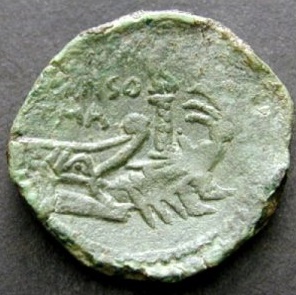
C. Marcius Censorinus, As, Rome, 88 BC, AE (g 11,33″; mm 29; h 8), Jugate heads of Numa Pompilius, bearbed, and Ancus Marcius, not bearbed, r.; on l., NVMA POMPILI; on r., [ANCVS MARCI], Rv. Two ships crossing; behind, spiral column on which statue of Victory; above, C CENSO / ROMA. Crawford 346/4a. Art Coins Roma 8, lot 350.I think the form of the column on this bronze issue can be productively used as comparative evidence for how numismatic artists thought to represent monolithic columns. The importance of the rendering of the shaft can be seen even on less well preserved specimens:
A. Takalec AG Sept 2008, lot 258
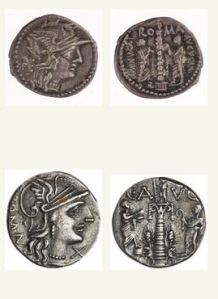
This is relevant for how we think about the rendering of the column on the early Minucian coins:
ANS sample specimens of RRC 242/1 and 243/1. Image links to further examples as well as these.
Evans in her 2011 paper originally presented at Glasgow congress emphasizes the uniqueness of the form of this column:
The form of the column itself also requires some comment, owing to its archaic-looking features. I can find no parallel to this type of column shaft in Greek, Etruscan or early Roman sources, nor can I find any early versions of rusticated column drums. (p.659)
She continues with a comparison to the column on the Marsyas coin (RRC 363) saying:
The shaft of the column can be shown as smooth, or fluted in a spiral or, on a small number of dies, with rounded drums with moldings between each drum. If this Marsyas depicts the statue of Marsyas in the Forum (as generally acknowledged), then the column shown is the Columna Maenia, erected in 338 (Plin. NH 34.20). Although the column shaft is not shown in a consistent fashion, when it is shown with rusticated drums, the die engraver may again be
referring to the early date of the column.
I cannot readily identify any specimens in trade or at the ANS or BM collections I would readily describe as rusticated or spiral (with the possible exception of Ghey, Leins & Crawford 2010 363.1.16). Finally she concludes that:
the shaft of the column injects a note of fantasy to the depiction
I cannot particularly agree, especially in light of the above bronzes. It seems to me that the articulated column shaft is one banal means of rendering a column on a coin. The shaft is a red herring in any argument for the historicity of the Minucian monument.
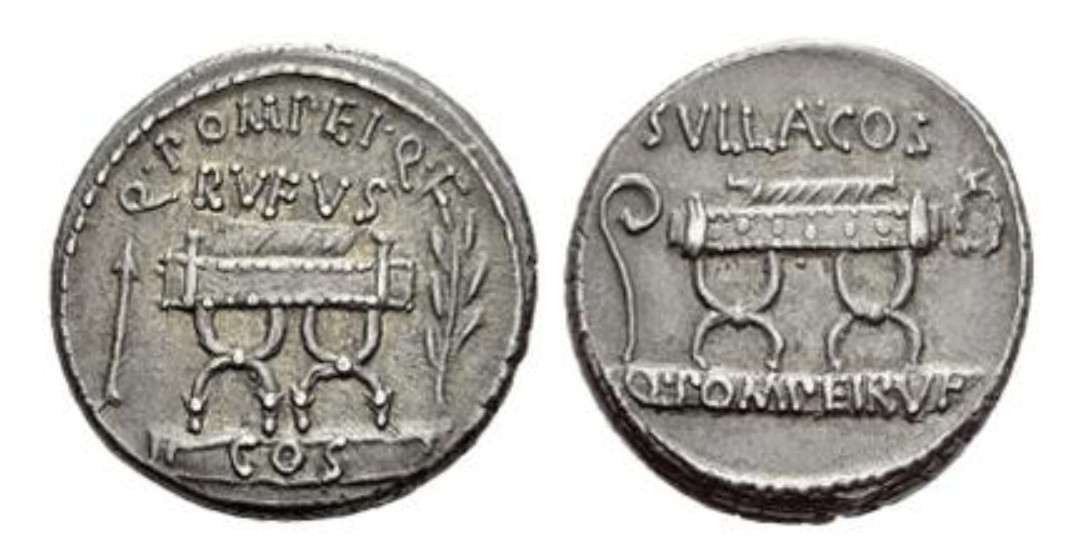
This seems to be the earliest coin (c.53BCE, RRC 435/1) in which the symbols of Hellenistic kingship, the diadem and the scepter, are used in such a way as to suggest their rejection in favor of the traditional symbols of Roman power in this case the curule chair. For this coin, the context is the threat of Pompey assuming sole control of the Roman state.
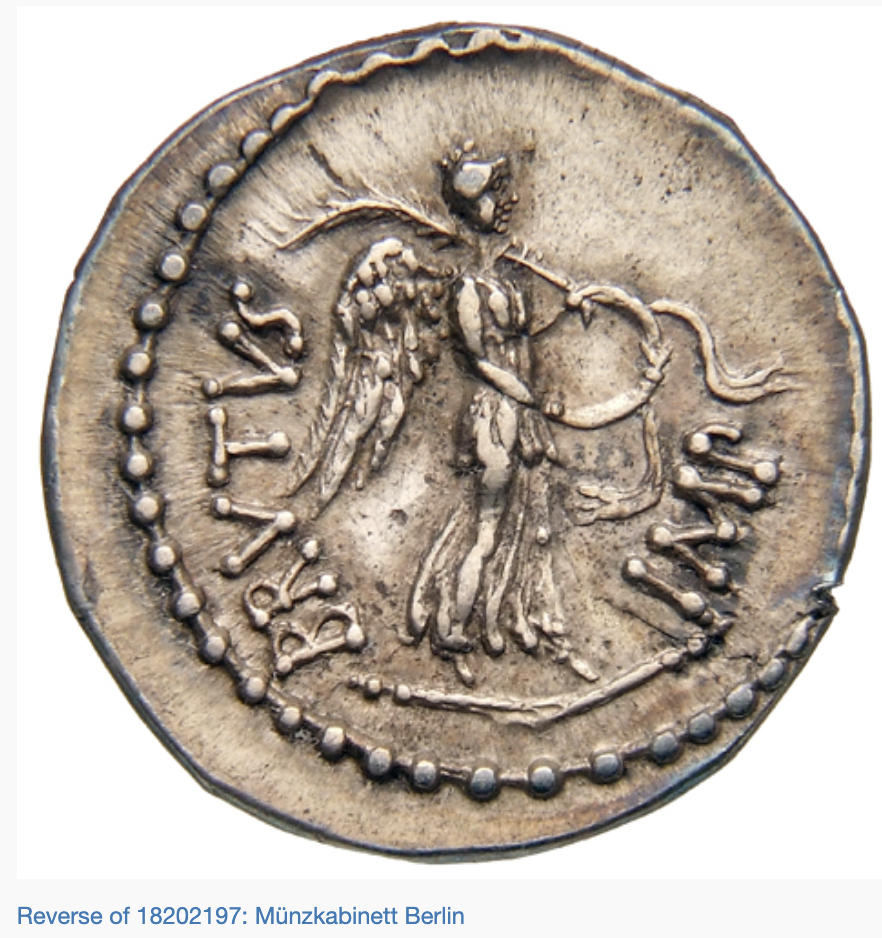
We see a similar iconographic strategy on a coin of Brutus after the murder of Julius Caesar (RRC 507/2):
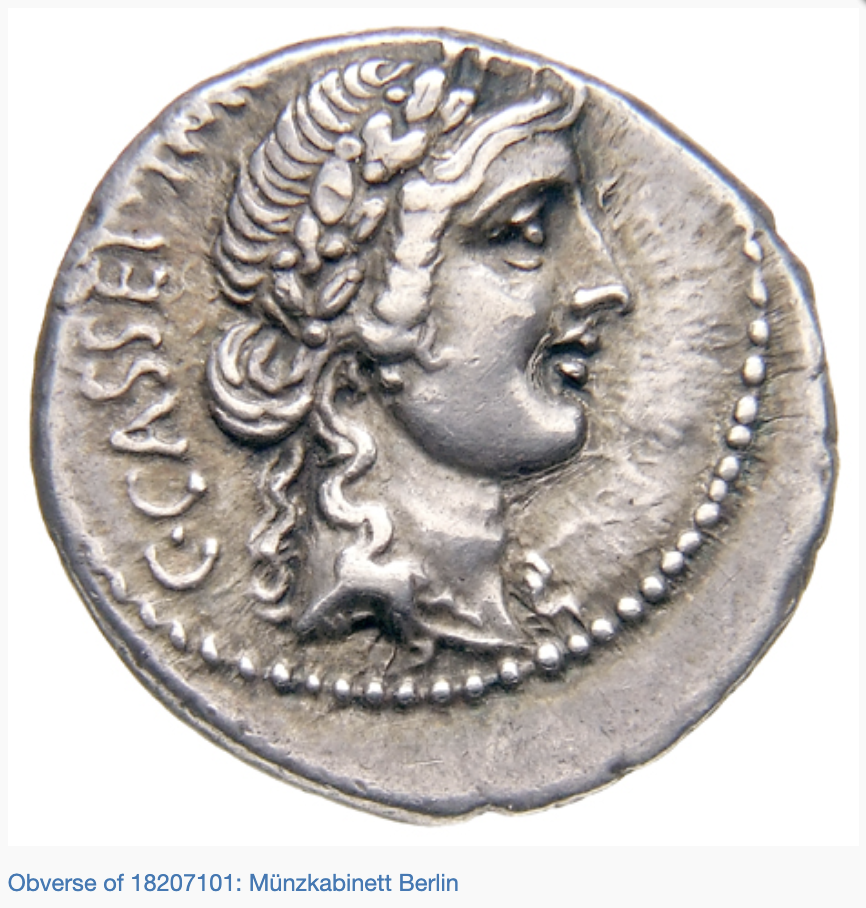
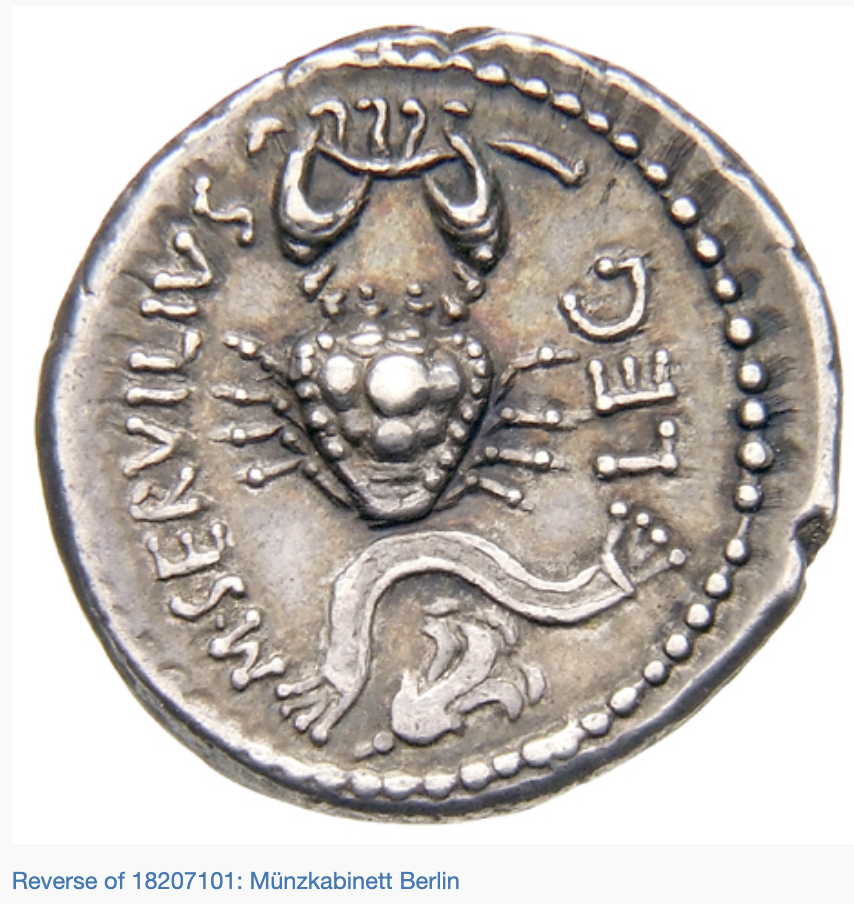
The question in my mind is should a similar interpretation also apply to this type (RRC 505/3):
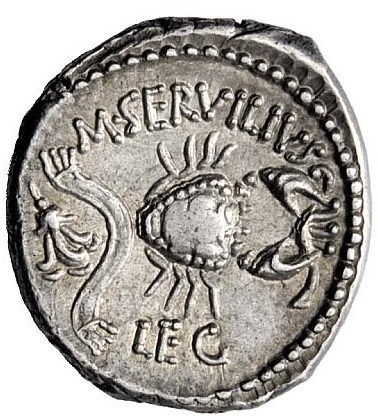
Today the type is invariably photographed with the orientation shown above, but Crawford had his plates printed at the 90 degree rotation of the reverse:
Crawford is silent on the symbolism of diadem saying only: “Part of one issue of Cassius records his capture of Rhodes after a battle at Myndus, opposite the island of Cos; the rose of Rhodes and crab of Cos both figure, together with an aplustre as a symbol of victory” (p. 741). I must say, the aplustre doesn’t seem very victorious to me as it is clutched in the claws of the crab. Or perhaps its just Cos offering the naval victory to Cassius…
I also think I prefer symbolically the crab and aplustre read as over and above the more diminished Rhodian rose and the diadem, just as the curule chair symbolically sits over the diadem and sceptre in the first type above.
“Cassius, having taken Rhodes, behaved himself there with no clemency; though at his first entry, when some had called him lord and king, he answered that he was neither king nor lord, but the destroyer and punisher of a king and lord.”
I’m not sure this is specifically the allusion the die engraver was aiming at but it is certainly a reflection of the same rhetorical impulse.
Silver cistophorus, Laodiceia ad Lycum. ANS 1967.144.1. Stumpf 92.a. (?Ex Leu and M&M 3 Dec 1965, lot 419?)
Reading a PhD dissertation draft on Asia Minor and came across a reference to this coin type and others issued in the name of Cicero during his time as governor in the province of Cilicia (51/0 BC).
Other known specimens include:
M TVLLIVS M F CICIIRON (sic) PROCOS above (STUMPF 91): Berlin 35/1909 = Hirsch 21, 16 Nov. 1908, 3550; M – TVLLIVS / IMP above (STUMPF 92-93, PINDER 201): Paris 2726; Athens = Hierapytna hoard; Berlin (Löbbecke); Berlin 453/1891; ANS 1967.144.1 = Leu and Münzen und Medaillen; 3 Dec. 1965 (Niggeler), 419 (but TVLLIV / IMP)
[I disagree with the reading of the ANS specimen. I think a small badly formed S is visible after the V.]
Anyway, I’m throwing it up here because these cistophori don’t get enough press in the average undergraduate or graduate classroom when Cicero’s governorship is discussed.
For more on this chapter in Cicero’s career the thing to read is:
Magnus Wistrand: Cicero Imperator. Studies in Cicero’s correspondence 51–47 BC. (Studia Graeca et Latina Gothoburgensia, XLI.) Pp. viii + 230. Göteborg: Acta Universitatis Gothoburgensis, 1979. Paper.
To read about how Cicero became Imperator in his own words click here.
Reading time is short for this draft so I must crack on. More later. We sure want to connect this caduceus with our early discussions of its symbolism…Not to mention IMP as a coin legend.
I really shouldn’t open a coin database on a day I need to prep teaching, its far too distracting. I’m keeping this post shortish just so I have a note of the issue.
We’ve talked else where about the symbolism of the caduceus and its association with peace. Given that, when I first saw this coin my impression was that branch behind Caesar’s head was an olive branch, but it’s labelled by Crawford a laurel branch. So after a bit of poking around I’m fairly convinced that republican engravers were quite sloppy about the difference between these two species in their numismatic representations. So for instance it’s mostly context that let’s us say these are olive branches not laurel branches, i.e. representations of peace (supplication!?), not victory.
As an aside the Macedonian type is a great example supporting Clare Rowan’s thesis that Roman images of power were often created in the provinces (cf also the numismatic portrayals of the supplications of Bocchus and Aretas).
Similarly laurel branches are identified as such based on context:
So with comparative iconography really struggling to offer any help, how do we resolve the type of species and its symbolism on the Caesar coin? We could rely on a semantic bleeding over from the caduceus. Or we could use a bit of deductive reasoning. Laurels connoting victory are usually laurel wreaths not branches. Laurel branches are more often associated with the cult of Apollo and as there is no good reason to bring the cult of Apollo in the mean being the Caesar coin, we might conclude that an olive branch is more likely…
Update 1/17/16:
Both Laurel and Olive Branches are attested in ancient cases of Supplication:
Naiden, Ancient Supplication (OUP 2006) :
Added 1/19/16:
Pliny NH 15.40: The laurel itself is a bringer of peace, inasmuch as to hold out a branch of it even between enemy armies is a token of a cessation of hostilities. With the Romans especially it is used as a harbinger of rejoicing and of victory, accompanying despatches and decorating the spears and javelins of the soldiery and adorning the generals’ rods of office. From this tree a branch is deposited in the lap of Jupiter the All-good and All-great whenever a fresh victory has brought rejoicing, and this is not because the laurel is continually green, nor yet because it is an emblem of peace, as the olive is to be preferred to it in both respects, but because it flourishes in the greatest beauty on Mount Parnassus and consequently is thought to be also dear to Apollo, to whose shrine even the kings of Rome at that early date were in the custom of sending gifts and asking for oracles in return, as is evidenced by the case of Brutus…
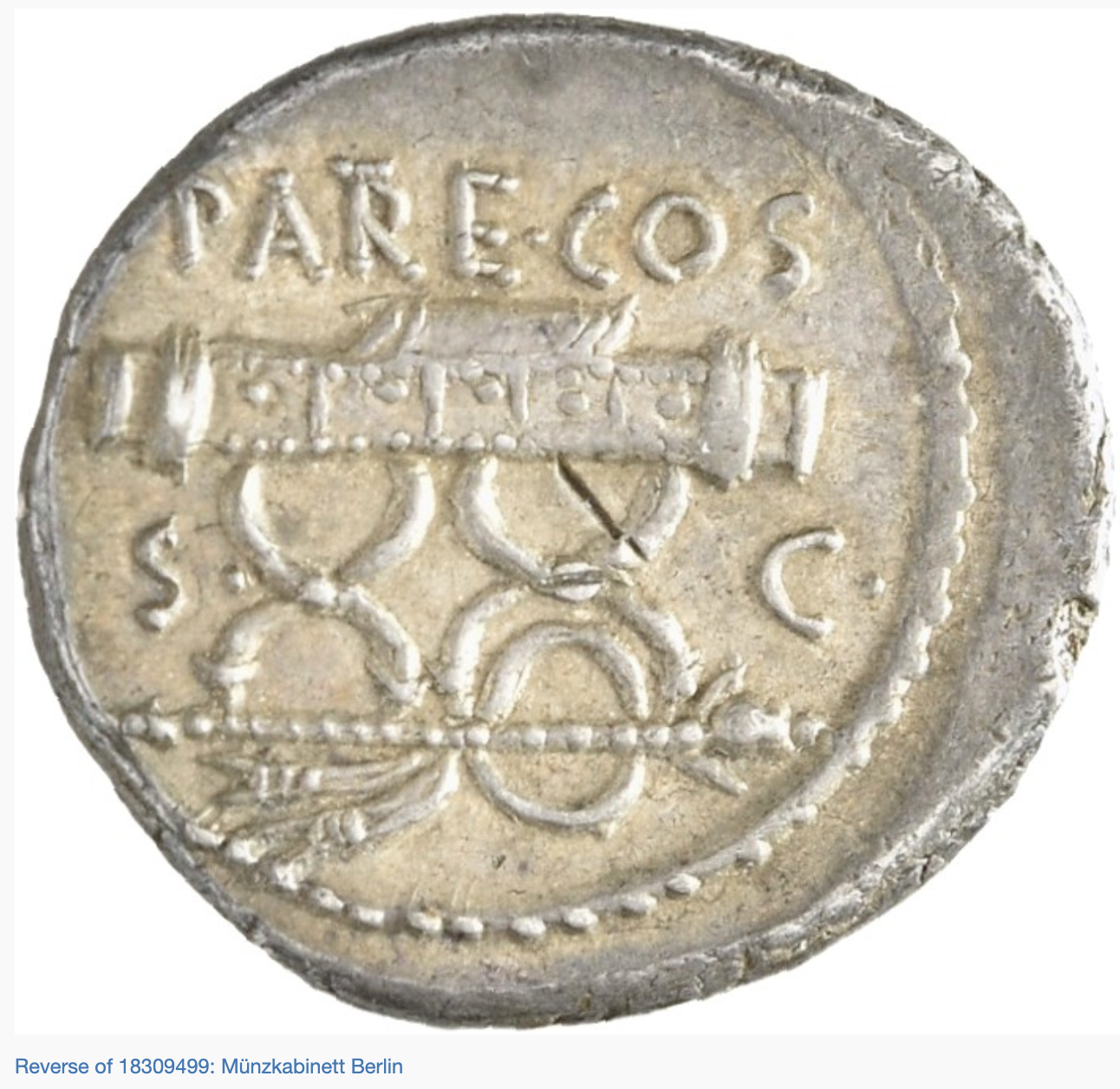
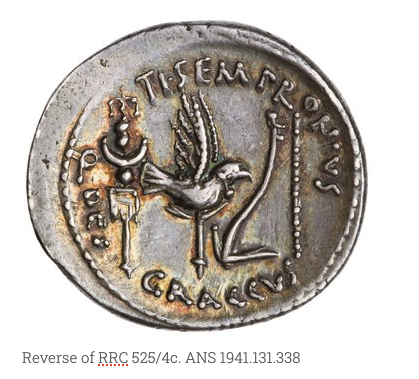
A while back when I first looked at this type I asked a colleague who works on science and technology in the ancient world and their representations in literature what he thought about Crawford’s suggestion that this “staff” is actually a measuring tool, specifically the decempeda. He wrote back that he thought it a plausible identification and added:
“It doesn’t have ten divisions, but I don’t think that matters; it’s clearly some kind of ruler. Also called ‘pertica’: see Propertius 4.1.127-130 for association with land confiscation. And ps.-Vergil Dirae (‘Curses’) line 45.” The key line reads:
What the literary tradition suggests is a generally negative connotation of symbol. An emphasis on the confiscation aspects of its application. Could this really be a numismatic symbol? Is it just a staff? I’ve been a bit ambivalent, until today.
I was skimming for a good Caesar coin or two in the ANS database for my next class and came across this beauty. Outside the time frame of my book project, but still very interesting indeed.
Here we have a young Ti. Sempronius Gracchus (quaestor designate!) trading on the reputation of his famous name by aligning himself with contemporary land distributions, particularly to Caesar’s veterans. Notice the Legionary standards set right next to a plow and our measuring stick.
The flip side of confiscations is always distributions. The power of the measuring stick as political symbol is its appeal to those to benefit from the rearrangement of property holdings. Its power as a literary device is just the opposite.
What resonance would the symbol have in Sicily c. 209-208 BCE? The Romans certainly engaged in some territorial redistributions on the island as rewards to their allies. I do not want to say RRC 78 refers to any one such confiscation and allocation, but as an illustrative example, I provide a passage from Livy (26.21) that will be quite familiar to numismatists already:
Not the least conspicuous feature of the spectacle was the sight of Sosis the Syracusan and Moericus the Spaniard who marched in front wearing golden crowns. The former had guided the nocturnal entry into Syracuse, the latter had been the agent in the surrender of Nasos and its garrison. Each of these men received the full Roman citizenship and 500 jugera of land. Sosis was to take his allotment in that part of the Syracusan territory which had belonged to the king or to those who had taken up arms against Rome, and he was allowed to choose any house in Syracuse which had been the property of those who had been put to death under the laws of war. A further order was made that Moericus and the Spaniards should have assigned to them a city and lands in Sicily out of the possessions of those who had revolted from Rome. M. Cornelius was commissioned to select the city and territory for them, where he thought best, and 400 jugera in the same district were also decreed as a gift to Belligenes through whose instrumentality Moericus had been induced to change sides. After Marcellus’ departure from Sicily a Carthaginian fleet landed a force of 8000 infantry and 3000 Numidian horse. The cities of Murgentia and Ergetium revolted to them, and their example was followed by Hybla and Macella and some other less important places. Muttines and his Numidians were also roaming all through the island and laying waste the fields of Rome’s allies with fire. To add to these troubles the Roman army bitterly resented not being withdrawn from the province with their commander and also not being allowed to winter in the towns. Consequently they were very remiss in their military duties; in fact it was only the absence of a leader that prevented them from breaking out into open mutiny. In spite of these difficulties the praetor M. Cornelius succeeded by remonstrances and reassurances in calming the temper of his men, and then reduced all the revolted cities to submission. In pursuance of the senate’s orders he selected Murgentia [i.e. Morgantina], one of those cities, for the settlement of Moericus and his Spaniards.
Images and links fixed 3-4-26. Nothing else changed.
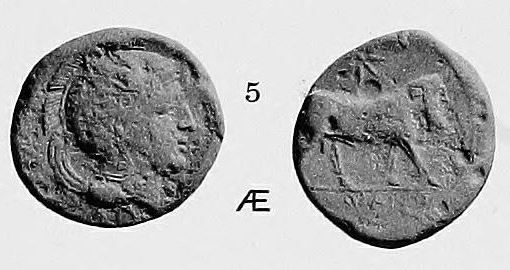
“287. Apollo right, four dolphins surrounding, dotted border / MFB right with head in profile, trident above, NEOΠOΛITΩN in ex. (Sambon 650). Circa 300-275 BC. Æ 18mm (7.25 gm). Laureate head of Apollo right; four dolphins around / Man-headed bull standing right; trident above. SNG France 884; SNG ANS 463; HN Italy 577.(Source: Classical Numismatic Group: cngcoins.com )” From: manfacedbulls.wordpress.com
It’s the day before classes begin. And, I’m very happy to have gotten most of my class prep for the semester out of the way earlier this month. The transition from Istanbul to Brooklyn was temporarily all consuming, along with other personal matters of a rather happy sort. Anyways, I’m not sure the future of this blog post-sabbatical, but today it seems useful once again. Here’s hoping in between classes and meetings there will be many more moments to obsess about coins.
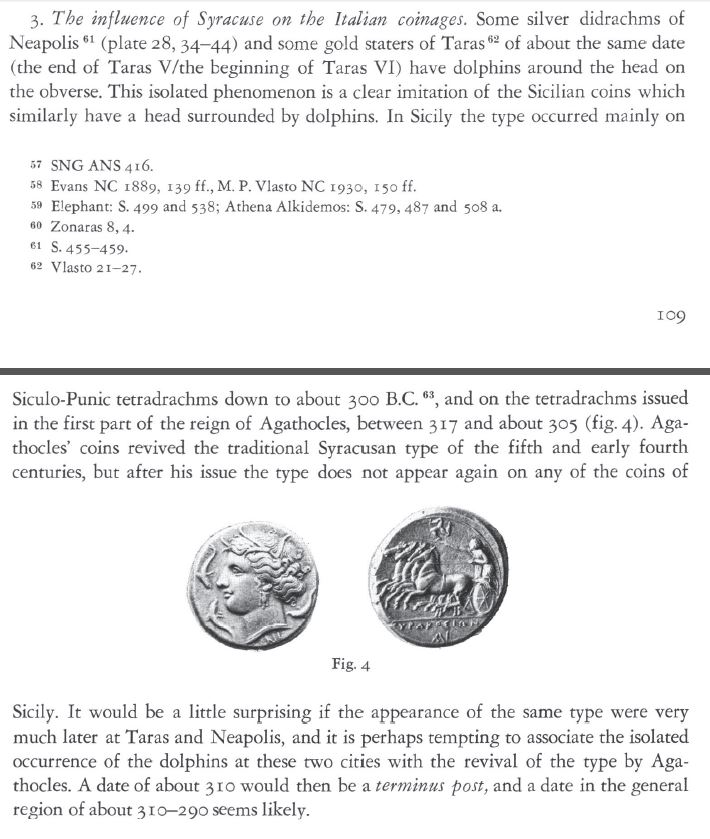
Of course, the most unusual feature of the above coin isn’t the profile instead of 3/4s head of the man-faced bull, but instead the dolphin wreathing the obverse head as commonly found on the coinage of Syracuse. Here’s Andrew Burnett on the phenomenon in silver (SNR 56 (1977); image links to full article):
Here’s a link to images of the silver (see nos. 455-459) from Neapolis and an example of the Tarentine gold staters. The problem comes with trying to reconstruct what the heck Syracusan imagery is doing on the coinages of these two cities at this particular time. Our historical understanding of Agathocles policy is Southern Italy is severely hamstrung by the loss of Diodorus’ continuous narrative after 302 BC. Meister in the CAH VII part I, p. 405ff. does his best to reconstruct a narrative but its perhaps over full. He’s convinced that Agathocles is trying to build a series of alliances against Carthaginian power: “a carefully considered plan lay behind the Syracusan ruler’s Italian policy – he clearly aimed to consolidate the entire forces of the western Greek world under his hegemony for the planned new confrontation with Carthage” (p. 406). True? False? We just don’t have the sources to make this kind of claim. I suspect that Meister is too influenced in this by his belief in the so-called Philinus Treaty, in which Carthage promised to stay out of Italy and Rome out of Sicily c. 306 BC.
What do we know? There seems to be near continuous campaigning by Agathocles or his generals, c. 300-294 BC. Our first source is Trogus 23.1-2. He says that Agathocles was inploratus (beseeched, begged, implored) to come to Italy, but doesn’t specify by whom and then goes onto talk about his engagement with Brutti. A passage of Strabo suggests that Tarentum is likely to have been the beseecher (6.3.4):
And yet how Tarentum might have benefited from Agathocles’ war with the Brutti is not at all clear. Trogus leaves us in media res with Agathocles leaving the Bruttian campaign unexpectedly to return to Sicily on account of illness. We pick up the narrative a year or two (?) later with Diodorus 21.2-3. Agathocles captures Corcyra from Macedonian forces and then ‘returns’ to the forces he’s left in Italy only to find his Etruscan and Ligurian mercenaries have been behaving badly towards his son. He kill 2000 mercenaries and for some reason this alienates the Brutti (whom he’s subsequently subdue?!). A botched attempt to capture the town leads to a night attack that sends Agathocles once again back to Syracuse. c. 295 he’s back in Italy capturing Croton and giving Iapygians and Peucetians ‘pirate’ ships (Diod. 21.4). c. 294 he’s in the territory of the Brutti besieging Hipponium, the future Vibo (Diod. 21.8). And both years Stilpo his naval captain is harassing Bruttian coastline (21.4 & 8). [Link to Diodorus]
These data points are really minimal. It’s probably not too much of a stretch to take the Tarentine gold staters as confirmation of the Tarentine/Agathocles relationship mentioned by Strabo. There are other examples of the Tarentine’s referring to their foreign allies on their coins, although these are invariably controversial in interpretation.
It’s logical to slip the Neapolis coins in this same 300-294 BC window and hypothesize some sort of diplomatic arrangement between Neapolis and the Syracusan king. The silver has three different known initials on it suggesting perhaps issues over a number of years? [A die study would clear up that question.] Bronze types (that illustrated above and HN Italy 578) have naval imagery on them (trident and dolphin respectively) and we can notice that Agathocles seems particularly eager to control shipping lanes in the course of his Italic and concurrent campaigns. So perhaps we might speculate that the arrangement with Neapolis was related to some sort of naval agreement.
As primarily a Romanist my real question is how does Rome particularly fit into this mess? My feeling is the RRC 2/1 is likely to have been engraved at Neapolis by the same engraver who did HN Italy 577 and 578 in roughly the same time frame. The rendering of the legends and the man-faced bull are the primary points of the overlap. And the absence of this profile man-faced bull otherwise on the Neapolis speaks for a tight chronology. So I’m going to go out on a limb here and say that the campaigns of Agathocles in Italy are some of our best dating evidence for RRC 2/1, c.300-294BC, given we have no available hoard evidence and only a single known specimen.
Update 8 January 2015: Just ILL-ed Spadea, Roberto. “Crotone tra i Dionisi ed Agatocle.” pp. 107-120 in Krise und Wandel : Süditalien im 4. und 3. Jahrhundert v. Chr. : internationaler Kongress anlässlich des 65. Geburtstages von Dieter Mertens, hrsg. von Richard Neudecker. Wiesbaden : Reichert, 2011. This uses hoard evidence from 2005 to look at Agathocles impact on Croton. Tangentially related but always good to see hoards being worked into the historical narrative.








![C. Marcius Censorinus, As, Rome, 88 BC, AE (g 11,33"; mm 29; h 8), Jugate heads of Numa Pompilius, bearbed, and Ancus Marcius, not bearbed, r.; on l., NVMA POMPILI; on r., [ANCVS MARCI], Rv. Two ships crossing; behind, spiral column on which statue of Victory; above, C CENSO / ROMA. Crawford 346/4a. Art Coins Roma 8, lot 350.](https://livyarrow.org/wp-content/uploads/2014/10/capture1.jpg?w=294)







 Liv Mariah Yarrow