Where were the first Liberian Coins manufactured?

If you are interested in this question the person to whom you should be listening is Bill Dalzell, not me. My writing this piece put us in touch and I now defer to his wisdom on the matter.

Dalzell, Bill. “Early Coins and Currency of the Republic of Liberia.” American Journal of Numismatics (1989-) 36 (2024): 403–72. https://www.jstor.org/stable/27352958.


specimen in trade

The short answer is I don’t know, but I have some concerns about the common assertions.  This is the statement by Colver and Harley in their 1971 piece in Calcoin News:

Capture

This might go back to Low’s comments in AJN 1899:

Capture

But the problem starts to rear its head here. How does Low know about Gibbs, Gardner & Co’s foreign contacts?   It’s hard to see Gibbs, Gardner & Co actively involved in the manufacture of coins and coin like objects as early as 1833.  It’s not even clear the company existed at this point, let alone had already diversified from buttons into coins and tokens.  Where did Low get his 1835 date?  Maybe from the1884 History of Essex and Hudson Counties.  The language ‘about 50 years ago’  is frustratingly vague.

Capture

Notice that in 1884 the token/minting production of the company is seen as too insignificant to mention.  If the 1833 Liberia coin was made by  Gibbs, Gardner & Co., it would be one of the first commissions of a fledgling company.

The January annual report of the American Colonization Society from 1833 makes only the briefest mention of the coins:

Though in the view of the Managers, it is essential that Liberia should become an agricultural colony, and therefore that no measures should be adopted tending to elevate commerce at the expense of agriculture; yet the inconveniences arising from the want of a circulating medium, have caused them to resolve on the introducing a small quantity of coin. It is proposed that this coin shall bear appropriate devices and inscriptions, and that the amount shall in no degree exceed what may be required by the actual necessity of the Colony.

The coinage doesn’t even get its own budget line in the treasurer’s reports.

Are there any other candidates? Remick in the 1965 Numismatic Circular speculates:

Capture

Why is Scovill a candidate? Perhaps because Wm. Scovill is known to have been a paying contributor to the American Colonization Society by the mid 1840s at least.  And his company was well established with many government contracts by this period, having been founded in 1802.

That’s what I know so far.  I may just have to let it go.

Mithridates on the Republican Coin Series?

Capture
A page of my image notes from my pre-blog days. The images are all from the ANS. Click to be taken to ANS collection of RRC 405/5 specimens. Or click on the title of this post to see all the images at a higher resolution within the post itself.

It may not be immediately obvious but this little spate of blog posts are all coming out of my efforts to wrap my head around representations of Monarchy on the Republican Coin Series, a topic I’m attempting to work up for a conference paper submission today.

Gem scholars have long recognized the stylistic connection between Mithridates Tetradrachms and this republican coin type. Cf. Vermeule 1970: 206.

Capture

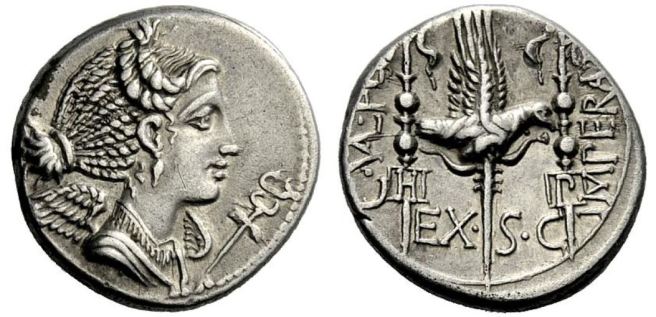
Crawford proposed Mercury as an other possible identification of the intended deity.  The iconographic parallel is striking but I find myself ambivalent about whether it is just an artistic choice of style or an intended reference to the Pontic king.  It’s part of a complicated series perhaps alluding the the cult of Fortuna at Praeneste and/or other Italic cults.  How it fits into the series as a whole has alluded explanation.

I would just note that with the new dating based on the Messange Hoard of RRC 405 to 58 BC, this potential regal allusion comes in the midst of a spate of such allusions to foreign kings on the reverses of the series:

  • Perseus of Macedon (reverse of RRC 415/1; 62 BC)
  • Aretas of Nabataea (reverse of RRC 422/1; 58 BC)
  • Ptolemy V of Egypt (reverse of RRC 419/2; 58 BC)
  • Bocchus of Mauritania and Jugurtha of Numidia (reverse of RRC 426/1; 56 BC)
  • Bacchius of Judaea (reverse of RRC 431/1; 55 (or 54?) BC)

Spiral Columns? Rusticated Drums?

C. Marcius Censorinus, As, Rome, 88 BC, AE (g 11,33"; mm 29; h 8), Jugate heads of Numa Pompilius, bearbed, and Ancus Marcius, not bearbed, r.; on l., NVMA POMPILI; on r., [ANCVS MARCI], Rv. Two ships crossing; behind, spiral column on which statue of Victory; above, C CENSO / ROMA. Crawford 346/4a. Art Coins Roma 8, lot 350.
C. Marcius Censorinus, As, Rome, 88 BC, AE (g 11,33″; mm 29; h 8), Jugate heads of Numa Pompilius, bearbed, and Ancus Marcius, not bearbed, r.; on l., NVMA POMPILI; on r., [ANCVS MARCI], Rv. Two ships crossing; behind, spiral column on which statue of Victory; above, C CENSO / ROMA. Crawford 346/4a. Art Coins Roma 8, lot 350.
I think the form of the column on this bronze issue can be productively used as comparative evidence for how numismatic artists thought to represent monolithic columns.  The importance of the rendering of the shaft can be seen even on less well preserved specimens:

A. Takalec AG Sept 2008, lot 258

This is relevant for how we think about the rendering of the column on the early Minucian coins:

ANS sample specimens.  Image links to further examples as well as these.
ANS sample specimens of RRC 242/1 and 243/1. Image links to further examples as well as these.

Evans in her 2011 paper originally presented at Glasgow congress emphasizes the uniqueness of the form of this column:

The form of the column itself also requires some comment, owing to its archaic-looking features. I can find no parallel to this type of column shaft in Greek, Etruscan or early Roman sources, nor can I find any early versions of rusticated column drums. (p.659)

She continues with a comparison to the column on the Marsyas coin (RRC 363) saying:

The shaft of the column can be shown as smooth, or fluted in a spiral or, on a small number of dies, with rounded drums with moldings between each drum. If this Marsyas depicts the statue of Marsyas in the Forum (as generally acknowledged), then the column shown is the Columna Maenia, erected in 338 (Plin. NH 34.20). Although the column shaft is not shown in a consistent fashion, when it is shown with rusticated drums, the die engraver may again be
referring to the early date of the column.

I cannot readily identify any specimens in trade or at the ANS or BM collections I would readily describe as rusticated or spiral (with the possible exception of Ghey, Leins & Crawford 2010 363.1.16).  Finally she concludes that:

the shaft of the column injects a note of fantasy to the depiction

I cannot particularly agree, especially in light of the above bronzes.  It seems to me that the articulated column shaft is one banal means of rendering a column on a coin.  The shaft is a red herring in any argument for the historicity of the Minucian monument.

The Diadem on Anti-Autocratic Coin Types

This seems to be the earliest coin (c.53BCE, RRC 435/1) in which the symbols of Hellenistic kingship, the diadem and the scepter, are used in such a way as to suggest their rejection in favor of the traditional symbols of Roman power in this case the curule chair.  For this coin, the context is the threat of Pompey assuming sole control of the Roman state.

We see a similar iconographic strategy on a coin of Brutus after the murder of Julius Caesar (RRC 507/2):

The question in my mind is should a similar interpretation also apply to this type (RRC 505/3):

Today the type is invariably photographed with the orientation shown above, but Crawford had his plates printed at the 90 degree rotation of the reverse:

1275129

Crawford is silent on the symbolism of diadem saying only: “Part of one issue of Cassius records his capture of Rhodes after a battle at Myndus, opposite the island of Cos; the rose of Rhodes and crab of Cos both figure, together with an aplustre as a symbol of victory” (p. 741).  I must say, the aplustre doesn’t seem very victorious to me as it is clutched in the claws of the crab.  Or perhaps its just Cos offering the naval victory to Cassius…

I also think I prefer symbolically the crab and aplustre read as over and above the more diminished Rhodian rose and the diadem, just as the curule chair symbolically sits over the diadem and sceptre in the first type above.

The Cassius coin is often connected to this quote from Plutarch’s Life of Brutus 30:

Cassius, having taken Rhodes, behaved himself there with no clemency; though at his first entry, when some had called him lord and king, he answered that he was neither king nor lord, but the destroyer and punisher of a king and lord.”

I’m not sure this is specifically the allusion the die engraver was aiming at but it is certainly a reflection of the same rhetorical impulse.

1/17/16: on Crabs on coins:

http://www.jstor.org/stable/750132

12/1/25:

Images replaced, citations corrected, broken links fixed.

Cicero Imperator

obverse
Silver cistophorus, Laodiceia ad Lycum. ANS 1967.144.1. Stumpf 92.a. (?Ex Leu and M&M 3 Dec 1965, lot 419?)

https://i0.wp.com/numismatics.org/collectionimages/19501999/1967/1967.144.1.rev.noscale.jpg

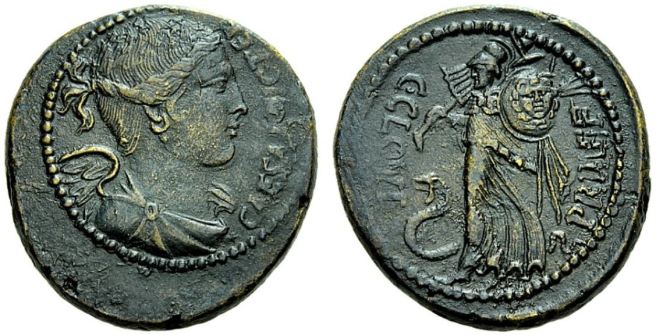
Reading a PhD dissertation draft on Asia Minor and came across a reference to this coin type and others issued in the name of Cicero during his time as governor in the province of Cilicia (51/0 BC).

Other known specimens include:

M TVLLIVS M F CICIIRON (sic) PROCOS above (STUMPF 91): Berlin 35/1909 = Hirsch 21, 16 Nov. 1908, 3550; M – TVLLIVS  / IMP above (STUMPF 92-93, PINDER 201): Paris 2726; Athens = Hierapytna hoard; Berlin (Löbbecke); Berlin 453/1891; ANS 1967.144.1 = Leu and Münzen und Medaillen; 3 Dec. 1965 (Niggeler), 419 (but TVLLIV / IMP)

[I disagree with the reading of the ANS specimen.  I think a small badly formed S is visible after the V.]

Anyway, I’m throwing it up here because these cistophori don’t get enough press in the average undergraduate or graduate classroom when Cicero’s governorship is discussed.

For more on this chapter in Cicero’s career the thing to read is:

Magnus Wistrand: Cicero Imperator. Studies in Cicero’s correspondence 51–47 BC. (Studia Graeca et Latina Gothoburgensia, XLI.) Pp. viii + 230. Göteborg: Acta Universitatis Gothoburgensis, 1979. Paper.

To read about how Cicero became Imperator in his own words click here.

Reading time is short for this draft so I must crack on.  More later.  We sure want to connect this caduceus with our early discussions of its symbolism…Not to mention IMP as a coin legend.

keyword: Tullius

Laurel Branches vs Olive Branches

Obverse of RRC 494/24. 0000.999.3394
Obverse of RRC 494/24. ANS 0000.999.3394

I really shouldn’t open a coin database on a day I need to prep teaching, its far too distracting.  I’m keeping this post shortish just so I have a note of the issue.

We’ve talked else where about the symbolism of the caduceus and its association with peace.  Given that, when I first saw this coin my impression was that branch behind Caesar’s head was an olive branch, but it’s labelled by Crawford a laurel branch.  So after a bit of poking around I’m fairly convinced that republican engravers were quite sloppy about the difference between these two species in their numismatic representations.  So for instance it’s mostly context that let’s us say these are olive branches not laurel branches, i.e. representations of peace (supplication!?), not victory.
In trade
In trade

As an aside the Macedonian type is a great example supporting Clare Rowan’s thesis that Roman images of power were often created in the provinces (cf also the numismatic portrayals of the supplications of Bocchus and Aretas).

Similarly laurel branches are identified as such based on context:

In trade

In trade

So with comparative iconography really struggling to offer any help, how do we resolve the type of species and its symbolism on the Caesar coin?  We could rely on a semantic bleeding over from the caduceus.  Or we could use a bit of deductive reasoning.  Laurels connoting victory are usually laurel wreaths not branches.  Laurel branches are more often associated with the cult of Apollo and as there is no good reason to bring the cult of Apollo in the mean being the Caesar coin, we might conclude that an olive branch is more likely…

Update 1/17/16:

Both Laurel and Olive Branches are attested in ancient cases of Supplication:

Naiden, Ancient Supplication (OUP 2006) :

Capture

Capture

Added 1/19/16:

Pliny NH 15.40: The laurel itself is a bringer of peace, inasmuch as to hold out a branch of it even between enemy armies is a token of a cessation of hostilities. With the Romans especially it is used as a harbinger of rejoicing and of victory, accompanying despatches and decorating the spears and javelins of the soldiery and adorning the generals’ rods of office. From this tree a branch is deposited in the lap of Jupiter the All-good and All-great whenever a fresh victory has brought rejoicing, and this is not because the laurel is continually green, nor yet because it is an emblem of peace, as the olive is to be preferred to it in both respects, but because it flourishes in the greatest beauty on Mount Parnassus and consequently is thought to be also dear to Apollo, to whose shrine even the kings of Rome at that early date were in the custom of sending gifts and asking for oracles in return, as is evidenced by the case of Brutus…


Measuring Sticks, Decempeda, Pertica etc…

Denarius, Sicily circa 209-208, AR 4.48 g. Helmeted head of Roma r.; behind, X. Rev. The Dioscuri galloping r.; below, staff and ROMA in tablet. Sydenham 208. Crawford 78/1. NAC 33 (2006), lot 204.

A while back when I first looked at this type I asked a colleague who works on science and technology in the ancient world and their representations in literature what he thought about Crawford’s suggestion that this “staff” is actually a measuring tool, specifically the decempeda.   He wrote back that he thought it a plausible identification and added:

“It doesn’t have ten divisions, but I don’t think that matters; it’s clearly some kind of ruler. Also called ‘pertica’: see Propertius 4.1.127-130 for association with land confiscation. And ps.-Vergil Dirae (‘Curses’) line 45.”   The key line reads:

nam tua cum multi uersarent rura iuuenci,
    abstulit excultas pertica tristis opes.

Even though many bullocks ploughed your fields, the merciless measuring-rod stole your wealth of land.

What the literary tradition suggests is a generally negative connotation of symbol.  An emphasis on the confiscation aspects of its application.  Could this really be a numismatic symbol?  Is it just a staff?  I’ve been a bit ambivalent, until today.

I was skimming for a good Caesar coin or two in the ANS database for my next class and came across this beauty.  Outside the time frame of my book project, but still very interesting indeed.

Reverse of RRC 525/4c. 1941.131.338
Reverse of RRC 525/4c. ANS 1941.131.338

Here we have a young Ti. Sempronius Gracchus (quaestor designate!) trading on the reputation of his famous name by aligning himself with contemporary land distributions, particularly to Caesar’s veterans.  Notice the Legionary standards set right next to a plow and our measuring stick.

The flip side of confiscations is always distributions.  The power of the measuring stick as political symbol is its appeal to those to benefit from the rearrangement of property holdings.  Its power as a literary device is just the opposite.

What resonance would the symbol have in Sicily c. 209-208BC?  The Romans certainly engaged in some territorial redistributions on the island as rewards to their allies.  I do not want to say RRC 78 refers to any one such confiscation and allocation, but as an illustrative example, I provide a passage from Livy (26.21) that will be quite familiar to numismatists already:

Not the least conspicuous feature of the spectacle was the sight of Sosis the Syracusan and Moericus the Spaniard who marched in front wearing golden crowns. The former had guided the nocturnal entry into Syracuse, the latter had been the agent in the surrender of Nasos and its garrison. Each of these men received the full Roman citizenship and 500 jugera of land. Sosis was to take his allotment in that part of the Syracusan territory which had belonged to the king or to those who had taken up arms against Rome, and he was allowed to choose any house in Syracuse which had been the property of those who had been put to death under the laws of war. A further order was made that Moericus and the Spaniards should have assigned to them a city and lands in Sicily out of the possessions of those who had revolted from Rome. M. Cornelius was commissioned to select the city and territory for them, where he thought best, and 400 jugera in the same district were also decreed as a gift to Belligenes through whose instrumentality Moericus had been induced to change sides. After Marcellus’ departure from Sicily a Carthaginian fleet landed a force of 8000 infantry and 3000 Numidian horse. The cities of Murgentia and Ergetium revolted to them, and their example was followed by Hybla and Macella and some other less important places. Muttines and his Numidians were also roaming all through the island and laying waste the fields of Rome’s allies with fire. To add to these troubles the Roman army bitterly resented not being withdrawn from the province with their commander and also not being allowed to winter in the towns. Consequently they were very remiss in their military duties; in fact it was only the absence of a leader that prevented them from breaking out into open mutiny. In spite of these difficulties the praetor M. Cornelius succeeded by remonstrances and reassurances in calming the temper of his men, and then reduced all the revolted cities to submission. In pursuance of the senate’s orders he selected Murgentia [i.e. Morgantina], one of those cities, for the settlement of Moericus and his Spaniards.

Agathocles, Neapolis, Tarentum and Rome, c. 300-294 BC

coin25
“287. Apollo right, four dolphins surrounding, dotted border / MFB right with head in profile, trident above, NEOΠOΛITΩN in ex. (Sambon 650). Circa 300-275 BC. Æ 18mm (7.25 gm). Laureate head of Apollo right; four dolphins around / Man-headed bull standing right; trident above. SNG France 884; SNG ANS 463; HN Italy 577.(Source: Classical Numismatic Group: cngcoins.com )” From: manfacedbulls.wordpress.com

It’s the day before classes begin.  And, I’m very happy to have gotten most of my class prep for the semester out of the way earlier this month.  The transition from Istanbul to Brooklyn was temporarily all consuming, along with other personal matters of a rather happy sort.  Anyways, I’m not sure the future of this blog post-sabbatical, but today it seems useful once again.  Here’s hoping in between classes and meetings there will be many more moments to obsess about coins.

Back in March Nick Molinari pointed out to me the coin above and how it is a good parallel to RRC 2/1. That lead me to put a note about in my book manuscript.  Yesterday, I came across the passage and found a marginalia by a helpful reader “explain or cut”.  I realized I hadn’t really thought it through it myself.

Of course, the most unusual feature of the above coin isn’t the profile instead of 3/4s head of the man-faced bull, but instead the dolphin wreathing the obverse head as commonly found on the coinage of Syracuse.  Here’s Andrew Burnett on the phenomenon in silver (SNR 56 (1977); image links to full article):

Capture

Here’s a link to images of the silver (see nos. 455-459) from Neapolis  and an example of the Tarentine gold staters.  The problem comes with trying to reconstruct what the heck Syracusan imagery is doing on the coinages of these two cities at this particular time.  Our historical understanding of Agathocles policy is Southern Italy is severely hamstrung by the loss of Diodorus’  continuous narrative after 302 BC.  Meister in the CAH VII part I, p. 405ff. does his best to reconstruct a narrative but its perhaps over full.  He’s convinced that Agathocles is trying to build a series of alliances against Carthaginian power: “a carefully considered plan lay behind the Syracusan ruler’s Italian policy – he clearly aimed to consolidate the entire forces of the western Greek world under his hegemony for the planned new confrontation with Carthage” (p. 406).  True? False? We just don’t have the sources to make this kind of claim.  I suspect that Meister is too influenced in this by his belief in the so-called Philinus Treaty, in which Carthage promised to stay out of Italy and Rome out of Sicily c. 306 BC.

What do we know?  There seems to be near continuous campaigning by Agathocles or his generals, c. 300-294 BC.  Our first source is Trogus 23.1-2.  He says that Agathocles was inploratus (beseeched, begged, implored) to come to Italy, but doesn’t specify by whom and then goes onto talk about his engagement with Brutti.  A passage of Strabo suggests that Tarentum is likely to have been the beseecher (6.3.4):

Capture

And yet how Tarentum might have benefited from Agathocles’ war with the Brutti is not at all clear.  Trogus leaves us in media res with Agathocles leaving the Bruttian campaign unexpectedly to return to Sicily on account of illness.  We pick up the narrative a year or two (?) later with Diodorus 21.2-3.  Agathocles captures Corcyra from Macedonian forces and then ‘returns’ to the forces he’s left in Italy only to find his Etruscan and Ligurian mercenaries have been behaving badly towards his son.  He kill 2000 mercenaries and for some reason this alienates the Brutti (whom he’s subsequently subdue?!).  A botched attempt to capture the town leads to a night attack that sends Agathocles once again back to Syracuse.  c. 295 he’s back in Italy capturing Croton and giving Iapygians and Peucetians ‘pirate’ ships (Diod. 21.4). c. 294 he’s in the territory of the Brutti besieging Hipponium, the future Vibo (Diod. 21.8).  And both years Stilpo his naval captain is harassing Bruttian coastline (21.4 & 8). [Link to Diodorus]

These data points are really minimal.  It’s probably not too much of a stretch to take the Tarentine gold staters as confirmation of the Tarentine/Agathocles relationship mentioned by Strabo.  There are other examples of the Tarentine’s referring to their foreign allies on their coins, although these are invariably controversial in interpretation.

It’s logical to slip the Neapolis coins in this same 300-294 BC window and hypothesize some sort of diplomatic arrangement between Neapolis and the Syracusan king.  The silver has three different known initials on it suggesting perhaps issues over a number of years? [A die study would clear up that question.] Bronze types (that illustrated above and HN Italy 578) have naval imagery on them (trident and dolphin respectively) and we can notice that Agathocles seems particularly eager to control shipping lanes in the course of his Italic and concurrent campaigns.  So perhaps we might speculate that the arrangement with Neapolis was related to some sort of naval agreement.

As primarily a Romanist my real question is how does Rome particularly fit into this mess?  My feeling is the RRC 2/1 is likely to have been engraved at Neapolis by the same engraver who did HN Italy 577 and 578 in roughly the same time frame.  The  rendering of the legends and the man-faced bull are the primary points of the overlap.  And the absence of this profile man-faced bull otherwise on the Neapolis speaks for a tight chronology.  So I’m going to go out on a limb here and say that the campaigns of Agathocles in Italy are some of our best dating evidence for RRC 2/1, c.300-294BC, given we have no available hoard evidence and only a single known specimen.

Capture

Update 8 January 2015:  Just ILL-ed Spadea, Roberto. “Crotone tra i Dionisi ed Agatocle.” pp. 107-120 in Krise und Wandel : Süditalien im 4. und 3. Jahrhundert v. Chr. : internationaler Kongress anlässlich des 65. Geburtstages von Dieter Mertens, hrsg. von Richard Neudecker. Wiesbaden : Reichert, 2011.   This uses hoard evidence from 2005 to look at Agathocles impact on Croton.  Tangentially related but always good to see hoards being worked into the historical narrative.

For a reconstruction of Agathocles’ Italian engagements that emphasizes tensions with Rome, see Decebal Nebu, “Agathocles and the Italic Powers at the Beginning of the 3rd Century B.C.” Revista Pontica  43 (2010): 37-50.

Ripped from the Stage?

A. Postumius A. f. Sp. n. Albinus. Denarius serratus 81, AR 4.05 g. Draped bust of Diana r., with bow and quiver over shoulder; above head, bucranium. Rev. Togate figure standing r. over rock, holding aspergillum over bull; between them, lighted altar. Babelon Postumia 7. Sydenham 745. Crawford 372/1. NAC 54 (2010) lot 919.

Peter Wiseman has put much scholarly energy into expounding how stage performances have influences our received narrative histories [for instance this book].  Not everyone believes this, but it is certainly a good starting point to introduce some skepticism into one’s reading of ancient histories.  I’m editing the section of the book on the coin above and have amongst my marginalia a note to find out whether it has been suggested that Plutarch’s narrative (from Juba) is ultimately derived from a stage production (Roman Questions 4):

Why do they, as might be expected, nail up stags’ horns in all the other shrines of Diana, but in the shrine on the Aventine nail up horns of cattle?  Is it because they remember the ancient occurrence?For the tale is told that among the Sabines in the herds of Antro Curiatius was born a heifer excelling all the others in appearance and size. When a certain soothsayer told him that the city of the man who should sacrifice that heifer to Diana on the Aventine was destined to become the mightiest city and to rule all Italy,  the man came to Rome with intent to sacrifice his heifer. But a slave of his secretly told the prophecy to the king Servius, who told Cornelius the priest, and Cornelius gave instructions to Antro to bathe in the Tiber before the sacrifice; for this, said he, was the custom of those whose sacrifice was to be acceptable. Accordingly Antro went away and bathed, but Servius sacrificed the heifer to Diana before Antro could return, and nailed the horns to the shrine. This tale both Juba and Varro have recorded, except that Varro has not noted the name of Antro; and he says that the Sabine was cozened, not by Cornelius the priest, but by the keeper of the temple.

It seems ripe for staging with far more characters and drama than another version.  Also notice how much of the action happens off stage and the drama is the dialogue between characters, except the final sacrifice.  It’s the trope of the cunning slave that really gets me me thinking in the direction of ancient theater.  But all my searches have turned up nothing.  I really wanted to put a footnote in and don’t really want to work up and defend the idea further myself.  So I think its out of the book for now.  Not the coin.  Just the theater angle.

I did come across an intriguing suggestion from C. J. Smith (Roman Clan 2006: 39):

A peculiar story in Plutarch, but taken from Juba and Varro, is suggestive of the kind of myth-making in the late Republic; it is connected with the foundation of the temple of Diana, founded by Servius Tullius, and has a Sabine duped by a Cornelius over the sacrifice of a heifer; evidence from coins may suggest that the same story was told of a Postumius. n.98

n. 98 – Plut. QR 4 = Mor. 264CD; Juba FGrH 275 F12. Cf. Livy 1.45.3 with Ogilvie (1965) 183–4; Val. Max. 7.3.1; Vir. ill. 7.10–14; Zonar. 7.9. There was a prophecy that the outstanding heifer in Antro Curiatius’ herd would, when sacrificed in the temple of Diana on the Aventine, bestow on the city of the one who sacrificed it dominion over Italy, but Cornelius the priest told Curiatius to bathe before sacricifing, and then Servius sacrificed the animal and hung its horns (cornua, hence Cornelius) in the temple. For a coin with a bust of Diana on the obverse and a scene of sacrifice on the reverse, see RRC 372; the moneyer was A. Postumius Albinus, who was related to the annalist. Livy gives the story without the names, and it seems that only Juba had got the story in full, since Varro’s version is slightly different again.

My basic line in the book is there is good evidence for an affinity between the gens Postumia and Diana from multiple moneyers.

Unrelated gossip: I heard it on the Classics grapevine that T.P. Wiseman was the model for Albus Dumbledore as J.K. Rowlings, Professor at Exeter.  Fun thought, even if not true.

I will always associate Harry Potter with Numismatics as on 8 July 1999, the release date of the third book, I was attending the Institute For Classical Studies, University of London, Summer Schools in Numismatics, led by Meadows and Williams with Crawford and Burnett and co making guest appearances.  One of my fellow students was a Glaswegian. I confessed to liking what was at the time a children’s book that had made the nightly news, not world phenomenon.  He in turn bragged that he wording the cafe where Rowlings wrote the first two novels.  Can’t remember his name.  I loved children’s literature before Rowlings and enjoy it even more that her success means publishers give other authors longer word counts and cross market to adults more readily.

Now, If only I had a longer word count for my book!

No More Meaningful Than a Postage Stamp?

One can’t seem to give a paper at a conference about coin designs without someone asking, if they’re really any more meaningful than a modern postage stamp [usually in a really special tone of voice].  Because of this ever present question and the resulting need to justify oneself, an apologetic reference to the metaphor is found in most modern books on ancient coin types (examples here and here and here).

The old trope comes from a 1950s debate between Jones and Sutherland.  Jones in Essays Mattingly 1956 and Sutherland’s rebuttal in the widely read 1959 JRS article.  [The latter some kind soul has put up on the web.]

Here’s the thing that gets me.  Who are coin geeks to disparage stamps?!?!  You’ve got to be kidding me that academics and enthusiasts alike can’t see the problem with this analogy as a negative analogy.  There is good, fascinating work out there about the importance of stamp imagery as a vehicle for studying national identity, social norms, cultural trends over time…  Why aren’t we reading this work?

Here’s a good place to start:

The next time someone brings up postage stamps, I’m going to congratulate them on their great positive analogy showing the power of studying coin imagery.
[And if you’ve said this to me or in my hearing in the last two weeks, don’t worry I’m not actually insulted, I just like a good rant. ;-)]
Bye-the-bye.  Just to prove there is an enthusiast for everything here’s a great website that specializes just in images of coins on stamps!