Roma Aeterna in the 3rd Century BC?

Reverse of RRC 39/4. ANS 1969.83.100.
Obverse of RRC 39/4. ANS 1969.83.100

So I don’t think I’ve ever thought particularly hard about this uncia type although the types of RRC 39 are exceptionally fascinating as a group (see my previous comments on the semiuncia).  I ended up here because I was trying to better understand the context of a passage in Dionysius today:

Yet this village [sc. Pallatium, Evander’s foundation,] was ordained by fate to excel in the course of time all other cities, whether Greek or barbarian, not only in its size, but also in the majesty of its empire and in every other form of prosperity, and to be celebrated above them all as long as mortality shall endure. (D. H. 1.31.3)

So this seems related to the idea of Rome as the Eternal City, but I realized I knew next to nothing about the origins of this concept.  Turns out its right in Dionysius’ own day with the earliest Latin articulation being Tibullus (c.55-19BC):

Romulus aeternae nondum formaverat urbis (Elegies 2.5.23)

This brought me to a survey article written in 1965 that included this intriguing paragraph on the iconography of aeternitas (p. 29):

Capture
Capture

I’m not endorsing (yet) this interpretation of the type, but it a sharp observation and a intriguing possibility I’d like to think about another day when I have more time!   From a numismatic perspective one would have to also consider in this context all the other republican issues which juxtapose the sun and the moon: RRC 309/1, 310/1, 390/1, 474/5, and 494/20b.

Update on 10/11/15:

Dionysius’ reception of the concept of Rome as the Eternal City is some what problematized by his version of the Marcus Curtius story as preserved in the fragmentary books (14.11).  He says Curtius had to throw himself into the gap to give Rome more strong young men.  Livy’s version instead says the self sacrifice will result in Rome being Eternal (7.5).  The date of book 7’s composition is debatable.

Update 10/12/15:  I want to think more about how Gowing’s argument may fit into all this:

Gowing, Alain M. – Rome and the ruin of memory. Mouseion (Canada) 2008 8 (3) : 451-467 ill. [rés. en franç.]. • The importance attached to buildings is reflected in Roman culture generally, but nowhere better documented than in the Augustan program of restoration. A significant portion of that program existed to preserve the legacy and memory of Rome as manifested in buildings. Yet Romans were aware that no building could last forever ; the impermanence of buildings, especially in comparison with the immortality conferred by literary endeavours, is a standard trope in Latin literature. The eternity to which the phrase « urbs aeterna » – first attested in the poetry of Tibullus and Ovid – refers does not reside in buildings, but in the timeless landscape Camillus remembers and describes in his speech in Livy 5, 54, 2-3.  [Abstract and Citation from L’Année Philologique]

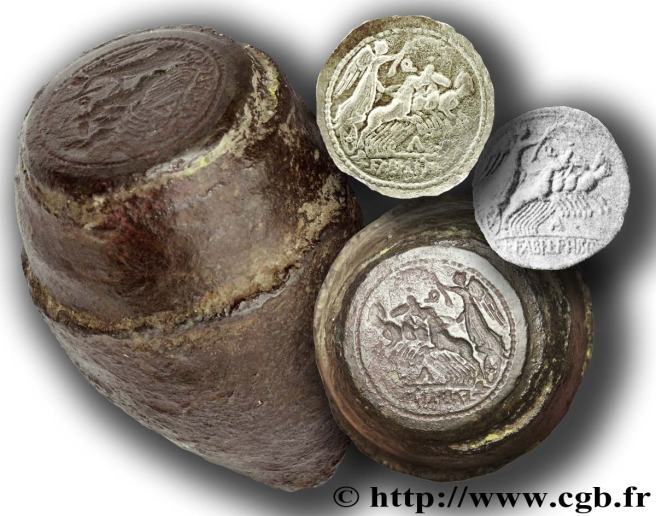
Specimen that sold in 1910:

Mapping Augustan (and Republican!) Rome

Capture

While looking for a way to visually represent Dionysius’ understanding of the City of Rome I finally came across this website which I feel I should have known about much earlier.  I had resorted to the pulling the large paper maps out of my hard copy of the original publication and marking each spot with a penny to get an idea of his coverage.

Those interested in the republican coin series will immediately recognize the utility of having a searchable map of urban topography.  I give the screen shot above just to show you what can be done.

Check out Digital Augustan Rome!

Trigas

Reverse of RRC 382/1b. ANS 1944.100.1925

There are two coins in the Roman republican coin series and one from Teanum from the time of the First Punic War that display a triga, a three horse chariot.  All have Victory (Nike) as the driver.  I’ve always found this a rather weird design as opposed to the biga or quadriga (2 and 4 horse chariots), but not worried too much about it.  For my previous thoughts on these coins and more images follow this link.

Anyway, as I settled back in Dionysius this morning (It’s Yom Kippur today.  No classes and thus a much welcome writing day from me!), I came to this passage in his description of the ludi Romani:

 In the chariot races two very ancient customs continue to be observed by the Romans down to my time in the same manner as they were first instituted. The first relates to the chariots drawn by three horses, a custom now fallen into disuse among the Greeks, though it was an ancient institution of heroic times which Homer represents the Greeks as using in battle. For running beside two horses yoked together in the same manner as in the case of a two-horse chariot was a third horse attached by a trace; this trace-horse the ancients called parêoros or “outrunner,” because he was “hitched beside” and not yoked to the others.  (Dion Hal. 7.73.2)

I think this well explains the one horse on the Roman republican coins looking back at the others as if it were loose.  This may be trying to represent the trace horse.  I might also want to investigate further a connection between the moneyers of RRC 299/1 and 382/1 and these ludi.  It also makes me revisit my earlier thoughts about trying to connect the Roman triga to the Teanum triga.  Perhaps this is a mistake as the Teanum coins do not seem to attempt to represent the third horse as on a trace.

So finally after a very long time this blog says something about coins again.  That feels good.  I’m sad I’m not in Taormina but 5.5 month old twin girls and a full teaching load are not really compatible with mid-semester international travel….

Update 5/20/22:

RPC trigas

Twitter Convo (highlights of which were one pseudo anonymous bronze coin of Athens and this very useful article on Etruscan funerary art) :

Update 8-29-25:

Thomas Thomas 1843 catalogue

Other names for (and stories about) the Augur’s Lituus

In Rome likewise a sacred hut of Mars, built near the summit of the Palatine, was burned to the ground together with the houses round about; but when the area was being cleared for the purpose of restoring the buildings, it preserved unharmed in the midst of the surrounding ashes the symbol of the settlement of the city, a staff curved at one end, like those carried by herdsmen and shepherds, which some call kalauropes and others lagobola. With this staff Romulus, on the occasion of taking the auspices when he was intending to found the city, marked out the regions for the omens. (Dion. Hal. RA 14.2.2).

We often see the lituus on republican coins and interpret it as a symbol of an augurship in the family or of the money himself.  I thought I’d just file this passage away here, so that I keep in mind that at lease in the Augustan era it was associated with the city founding and the pastoral origins of Romulus, and that Dionysius gives us here a variety of Greek names for the implement (Greek below).  In this fragment the survival of the lituus is compared to the survival of the sacred olive tree on the acropolis in Athens, a symbol of the life of the city itself.  This seems to me to indicate that the lituus might just be able to be read as a symbol of Rome itself…at least to some Greek scholars residing in Rome at the end of the first century.

Cf. Cic. Div. 1.30

And whence, pray, did you augurs derive that staff, which is the most conspicuous mark of your priestly office? It is the very one, indeed, with which Romulus marked out the quarter for taking observations when he founded the city. Now this staff is a crooked wand, slightly curved at the top, and, because of its resemblance to a trumpet, derives its name from the Latin word meaning ‘the trumpet with which the battle-charge is sounded.’ It was placed in the temple of the Salii on the Palatine hill and, though the temple was burned, the staff was found uninjured.

and Cic. Div. 2.80

Then dismiss Romulus’s augural staff, which you say the hottest of fires was powerless to burn, and attach slight importance to the whetstone of Attus Navius.

Omitte igitur lituum Romuli, quem in maximo incendio negas potuisse comburi; contemne cotem Atti Navi.

Greek of DH quoted above:

Ἐν δὲ τῇ Ῥώμῃ καλιάς τις Ἄρεος ἱερὰ περὶ τὴν κορυφὴν ἱδρυμένη τοῦ Παλατίου συγκαταφλεγεῖσα ταῖς πέριξ οἰκίαις ἕως ἐδάφους, ἀνακαθαιρομένων τῶν οἰκοπέδων ἕνεκα τῆς ἐπισκευῆς, ἐν μέσῃ τῇ περικαύστῳ σποδῷ τὸ σύμβολον τοῦ συνοικισμοῦ  τῆς πόλεως διέσωσεν ἀπαθές, ῥόπαλον ἐκ θατέρου τῶν ἄκρων ἐπικάμπιον, οἷα φέρουσι βουκόλοι καὶ νομεῖς οἱ μὲν καλαύροπας, οἱ δὲ λαγωβόλα καλοῦντες, ᾧ Ῥωμύλος ὀρνιθευόμενος διέγραφε τῶν οἰωνῶν τὰς χώρας, ὅτε τὴν πόλιν οἰκίζειν ἔμελλεν.

The Greek Vocabulary of Clemency

I’m trying to figure out who (if anyone) has talked about Larcius the first dictator in Dionysius of Halicarnassus as model for good Roman leadership at the end of the Republic and beginning of the Principate. Basically, I’m checking to see who has read the passage the way I want to read it.  This brought me to Dowling’s book on Clementia, p. 4.   She mostly focuses on the Empire, but puts the concept in an earlier context.  Here’s the bit I wanted to share with you (Clicking on this photo will make it bigger):

Capture

Basically, I just want to put in a footnote pointing out that ἐπιείκεια as the Greek word for Clementia can be pushed much earlier on the basis of Dionysius 5.76.1:

οὓς πρὸς συγγενεῖς καὶ φίλους ἀναγκαζόμενοί τινες ἀναιροῦνται, ἐπιεικεστέρων μᾶλλον ἢ δικαιοτέρων ᾤετο δεῖν αὐτοῖς διαλύσεων.
those [sc. wars] which men are forced to undertake against kinsmen and friends, he thought they ought to be settled by an accommodation in which clemency outweighed the demands of justice.  (Cary Trans.)

Disarming the People? Ancient Perspectives on Weapons Bans

The passage below comes from Dionysius’ extended digression on the tyranny of Aristodemus at Cumae.  A common argument in favor of a broad interpretation of the US second amendment and the right to bear arms is to allow the people to defend themselves against tyrannical government.  You can read about this and how it have entered the rhetoric of the presidential campaign in 2015 here

I found it interesting to find tyranny in antiquity characterized by a weapons confiscation followed by the imposition of a police force.  It seems such weapons confiscations maybe a very old historiographical theme.  The other one that pops immediately to mind is the order by the Roman consul to the Carthaginians to surrender all arms as the second condition of their surrender into the faith of the Romans (Polybius 36.6.5ff.).

When he had said this and thereby filled all the common people with wonderful hopes, he established two institutions which are the worst of all human institutions and the prologues to every tyranny — a redistribution of the land and an abolition of debts. He promised that he would take upon himself the care of both these matters if he were appointed general with absolute power till the public tranquillity should be secured and they had established a democratic constitution. When the common people and the unprincipled rabble gladly accepted the proposal to pillage the goods of other men, Aristodemus conferred upon himself the supreme command, and proposed another measure by which he deceived them and deprived them all of their liberty. For pretending to suspect that the rich would raise disturbances and insurrections against the common people on account of the redistribution of the land and the abolition of debts, he said the only means he could think of to prevent a civil war and the slaughter of citizens and to guard against these miseries before they happened, was for all of them to bring the arms out of their houses and to consecrate them to the gods, in order that they might make use of them against foreign enemies who should attack them, whenever the necessity should arise, and not against one another, and that in the mean time they would be suitably placed in the keeping of the gods. When they agreed to this also, he disarmed all the Cumaeans that very day, and during the following days he searched their houses, where he put to death many worthy citizens, alleging that they had not produced all their arms for the gods. After this he strengthened his tyranny by three sorts of guards. The first consisted of the filthiest and the most unprincipled of the citizens, by whose aid he had overthrown the aristocracy; the second, of the most impious knaves, whom he himself had freed for having killed their masters; and the third, a mercenary force, consisting of the most average barbarians, who amounted to no fewer than two thousand and were far better soldiers than any of the rest. (DH 7.8.1-3)

I’m just getting back to work after maternity leave.  A piece of mine that was partly worked out here on the blog has finally been published.  You can read it here.  Fair warning, my next speaking engagement is on Dionysius of Halicarnassus, so I’m on a bit of historiographical kick at the moment.

The Palm Tree as a Symbol of the Jewish State

For the most part, I’m very happy to follow chapter 9 ‘Between Rome and Jerusalem: The Date Palm as a Jewish Symbol’ in Steven Fine’s 2005 book, Art and Judaism in the Greco Roman World.  It’s a broad and nuanced survey, but in the end concludes that the primary reason for the equation of Judaea with the Date Palm is because it was the most readily identifiable and desirable regional export, and could, on top of that, be given a symbolic meaning that did not offend the Jewish prohibitions against graven images.

However, two key pieces of early evidence aren’t illustrated by Fine, only discussed.  Hence, I thought I might put them up for the curious here.  [I do love connections between seals and coins!] These images are taken from ‘Two Bullae of Jonathan, King and High Priest’, p. 257-259 of Ancient Jerusalem Revealed (1994).  This summarizes and expands two previous publications.

Capture

Based on comparison with the legends of the coins of the Hasmonean kings, Avigad concludes that these two bullae are imprints of the seals of Alexander Jannaeus (103-76 BCE).

Capture

Capture

Capture

Capture

As Avigard says:

Capture

Capture1

Note that originally in the first of the 1974 publications Avigard identified the High Priest Bulla as displaying a club; his opinion was revised on the discovery of the second bulla and the new identification as a palm tree was first made in his second 1974 article.

For later follow up:

A gem with a palm tree.

Also cf.

J. J. Winckelmann, Description des pierres gravées du feu Baron de Stosch, dédiée à son Eminence Monseigneur le Cardinal Alexandre Albani (1760), 564, Kat.Nr. VIII,14 Zenon; Image of impression on Arachne

“Judaea Capta” Scholarship

Vespasian. 69-79 AD. Sestertius, 27.02g. Rome, c. Summer 71 CE. Obv: IMP CAES VESPAS AVG P M TR P P P COS III Head laureate r. Rx: IVDAEA – CAPTA around, S C in exergue, Judaea seated right on cuirass in attitude of mourning under palm tree, Jew with hands tied behind back standing right on other side of tree, captured arms on ground left and right. RIC 233 (C ). BM 532. Paris 491. Cohen 233 (8 Fr.). Ex Dr. Stephen Gerson Collection. Gemini , Auction VI, lot 434.

So I was poking around for the right thing to cite on the “Judaea Capta” coins.  I wanted something more than a set of catalog numbers, something that actually put them in context as a whole.  This was surprisingly difficult to find; most scholarship seems to assume that they are so famous the intended audience already knows the basics.  I eventually got to

[Don’t get too excited that is just a link to where you can buy a copy of the article if you can’t order it from ILL or it’s not in your local library. The author hasn’t put a copy on open access, as far as I can see.]
The article does a good job of tying provincial and Roman issues together and providing a wider historical context.  It’s readable and well footnoted, even if one may wish to bicker over any small points.  It’s far more complete in its overview than the two page piece by C. Kraay in the Israel Numismatic Journal 1963, the most common ‘general’ citation one sees for these coins.  It’s a shame it’s not in a numismatic journal or one on JSTOR or somewhere else its likely to come to the attention of a wider audience.  Hence my inclination to give it this general shout out.

Full disclosure.  I did overlap briefly with Zarrow in grad school and I find his twitter account pretty awesome too.  Lots of lovely images and a good number of coins.

Hercules Revived

Denarius 19/18, Rome. Moneyer M. Durmius. M DVRMIVS – III VIR Bust of young Hercules to r., wearing diadem and carrying club on r. shoulder. Rev. CAESAR AVGVSTVS SIGN RECE Kneeling, bare headed Parthian to r. holding signum to which is attached a vexillum marked X. 3,82 g. RIC 314. BMC 59. C. 433b. Ex L. A. Lawrence Coll., Auction Glendining, London, 7 December 1950, lot 359. UBS auction 78, lot 1299.

My favorite thing about numismatic databases are the things that pop up that I wasn’t looking for.  This is a great example.  There aren’t many known specimens, but there are two in the British Museum (example 1, example 2). Its obverse clearly echoes a much earlier republican didrachm (RRC 20/1).

Anonymous moneyer. AR Didrachm (6.85g) minted at Rome, 270-265 BC. Diademed head right of young Hercules, with long sideburn; club and lion’s skin over right shoulder. Reverse : ROMANO. She-wolf standing right, head reverted, suckling the twins Romulus and Remus. Sear 24; RSC 8; Craw 20/1; Syd 6. Provenance: The Hunter Collection; Ex Superior Stamp & Coin, NYINC Auction, December 8-9, 1995, lot 847. Ira and Larry Goldberg auction 72, lot 4115.

It’s always interesting to see an awareness of earlier types surfacing after such an extended period–over two centuries regardless of how one wishes to date RRC 20/1.  That said, it also raises questions about why this earlier type might have been attractive in this moment under Augustus.  Hercules is usually associated with his rival Antony.  As is Hellenistic Kingship. The connotations of the obverse type seem at odds with the Augustan program.  Perhaps this explains its rarity? Perhaps the moneyer thought better of the design choice?  A choice which at first which might have been attractive simply because of its antiquity and Augustus’ own rhetoric of conservative restoration?

Roma and the Parazonium

Crawford 403
Q. Fufius Calenus and Mucius Cordus. Denarius serratus 70, AR 3.98 g. Jugate heads of Honos and Virtus r. Rev. Italia, holding cornucopia, and Roma, holding fasces and placing r. foot on globe, clasping their hands; at side, winged caduceus. Babelon Fufia 1 and Mucia 1. Sydenham 797. Crawford 403/1. NAC 54, lot 922.

Crawford called the object in Roma’s left hand on this coin a fasces.  This doesn’t make a huge amount of sense as one doesn’t carry fasces in the crook of one’s arm, but instead with the axe high over one’s shoulder.  The classic example is the Brutus coin (RRC 433/1).  Moreover the republican coin series has a pretty definite iconography of what fasces should look like on a coin and specimens of RRC 403/1 just don’t fit the type.  The long stick may well be a scepter.  This would make some sense, if one agrees that those fillets off Roma’s head indicate she’s wearing a diadem. The diadem and the scepter probably deserve a post of their own, exploring particularly the appropriation of Hellenistic regal iconography for the personification of Roma.  Alternatively, the fillets may be only the fillets of a victory crown without any regal connotations. For now, however, I’m just concerned with the little blob circled in red above.

This is likely to be a parazonium. What, one might ask, is a parazonium?  Well, besides being a numismatic term for iconography better known from the imperial period, it is a dagger or short sword worn on the left hand side off the girdle. Our only literary testimony is Martial Epigrams 14.32:

Capture Capture1

The word itself is derived from the Greek, although it is pretty rare in Greek texts as well: in the TLG it shows up only in a fifth century CE lexicon and one equally late hagiography.  I don’t think this type is our earliest examples of Roma with a parazonium; it’s already part of her iconography on RRC 335/1 (one example, another example) and probably also on RRC 391/3.  What this type does do nicely is suggest that the parazonium is already perhaps a linking piece of iconography between virtus and Roma.  On the imperial coinage by the time of Nero the parazonium is a common attribute for reverse personifications of virtus.

RRC 403/1