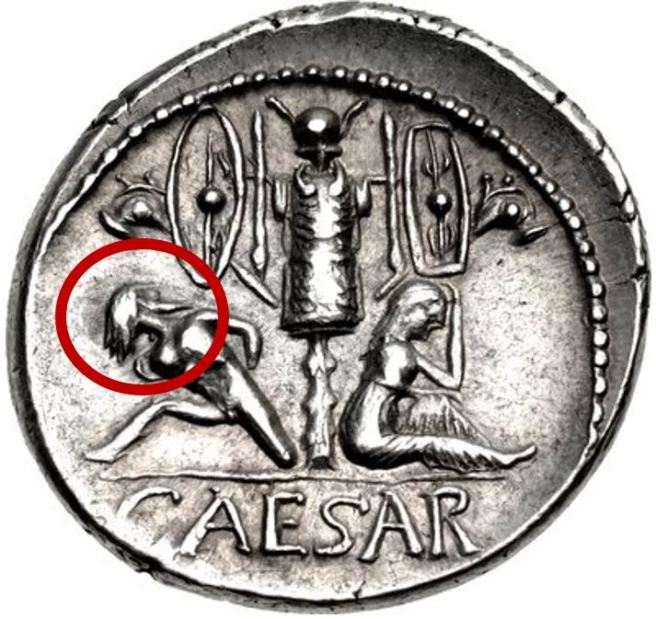
This below is from p. 41-2 of Kropp’s book. I’m suspicious of this interpretation of 422/1. I’ve ordered the citation from ILL but as far as I know the comparative visual evidence is all much later…
The saddle stuff is fascinating though! Esp. That the Roman designer of the type knew enough to include it. The other similar type from a few years later doesn’t show the same saddle (431/1).
So I never noticed before that the middle trophy on this type issued by Sulla’s son, Faustus to honor Pompey, makes a distinction between the middle trophy and the outer two. But on some specimens it’s clearly visible that the central helmet is shown with a triple crest (or side horns?!) and the outer two helmets only have a single central decoration. The type is thought to reflect Pompey’s signet ring and in design both that ring and this type recall Sulla’s coinage and later signet ring. (426/3 CRRO entry).
This portrait of Caesar had wide spread importance. I’m interested in it here not because of it’s numismatic significance, but in fact for how it’s talked about by art historians. This passage from an old article concerned with identifying a sculpture head as Caesar, or not, uses an interesting logic about why Mettius’ portrait was influential and how it relates to both gems and glass-pastes. Under all this are some assumptions about how iconography develops and disseminates that I want to think about more in future:
This image is from this 2013 article by Andreas Kropp. He also has some comments on the coin type in his monograph of the same year on p. 39 and here in this other article. I wanted to put it up here to connect it with my earlier post on the iconography of crowning, esp. as it has two figures doing the crowning as in the literary testimony from Demosthenes quoted there AND because it helps us think even more about the power structures implied by the act of crowning, as well as by hand clasping iconography of the reverse.
Update 2/27/16: cf. also RRC 470/1c: What’s interesting is that the crowning is symbolically equivalent here supplication with a branch….
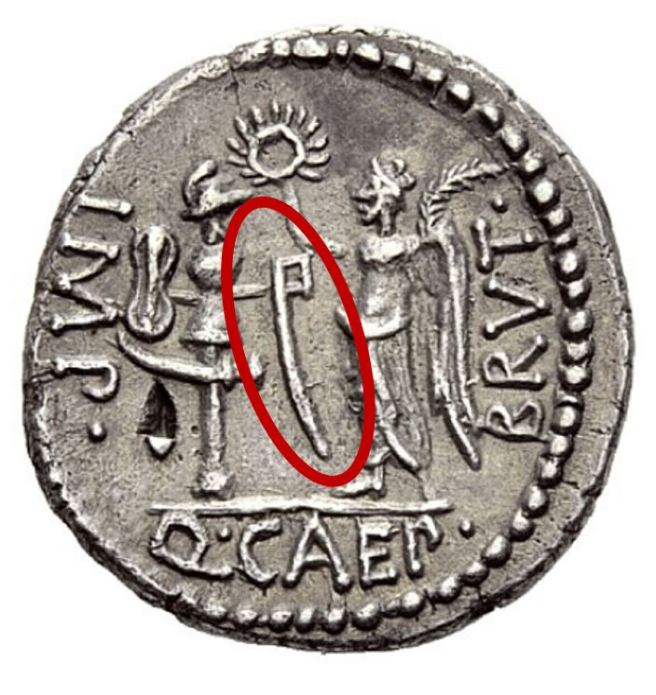
This obverse type Crawford identifies as Roma (292/1) on the basis of comparison with this gem (apologies for poor image) which (apparently) bears the inscription AVE ROMA:
Links to original publication on Archive.org
I just wanted to throw up this coin type (494/35) as well to put all three next to each other for future reference:
Links to acsearch.info entry
Notice the emphasis put on rendering Roma’s hand clutching the spear before the shield. Also notice the variation in shield designs.
Update 4/25/16:
Little did Crawford know there was a better parallel right in the BM collection (1923,0401.408). Notice the star and crescent which has become crescent and denomination mark on the denarius. Even the shield design is the same!
This type (430/1) minted by the son of the the Triumvir, Crassus, doesn’t I think get enough attention. The Venus is clearly Venus Victrix who appears on Pompeian types (cf. esp. 424/1 and 426/3) and will soon be co-opted by Caesar (cf. 465). The reverse shows a standing Amazon leading her horse with her face in 3/4s profile. This and the shield and cuirass below the horse make me 90% certain this is a statue being portrayed or at very least the designer is borrowing from a well known statue type and the cuirass and shield are part of the support system of the horse statue.
The reverse brought to mind this passage from Appian about Pompey’s adventures with the Amazons (12.103):
I feel I’m forgetting some famous Amazon statues at Rome in the republican period that would be relevant in this context. I’ll remember at some point, or not.
Is it then a proverb of ours or of yours that a Phrygian is usually made better by beating? What more? Is not this a common saying of you all with respect to the whole of Caria, if you wish to make any experiment accompanied with danger, that you had better try it on a Carian? Moreover what saying is there in Greek conversation more ordinary and well known, than, when any one is spoken of contemptuously, to say that he is the very lowest of the Mysians? For why should I speak of Lydia? What Greek ever wrote a comedy in which the principal slave was not a Lydian?
As the sella curulis and fasces come up again and again on the republican coin series, I wanted to put a note up here of this iconography from Vulci (c. 300-280 BCE).
This is the front of the sarcophagus of Ramtha Vishnai and Arnth Tetnies (Now in the MFA Boston). The couple join right hands on the far left of this snippet (the center of the panel itself). Behind the husband are his attendants, one carries a chair and the other a rod, and then behind these are the musicians.
Update 20 Apr 2023:
Spotted this curule chair on a long small bronze relief in the Vatican 2023-04-15. More pictures of the same relief are in my camera back up on dropbox if they every become relevant.
Off blog (and a little on the blog) I’ve worried quite a bit about the coins of the Minucii. I came across a different view of potential comparative iconography today, the work of a mid 20th century Etruscan scholar.
links to JSTOR
It was easy enough to get an image this:
I’ll have to track down her other references later…