Roman Imperial Pietas, pre-Vergil

Let us, O conscript fathers, think as highly of ourselves as we please; and yet it is not in numbers that we are superior to the Spaniards, nor in personal strength to the Gauls, nor in cunning to the Carthaginians, nor in arts to the Greeks, nor in the natural acuteness which seems to be implanted in the people of this land and country, to the Italian and Latin tribes; but it is in and by means of piety and religion, and this especial wisdom of perceiving that all things are governed and managed by the divine power of the immortal gods, that we have been and are superior to all other countries and nations.

Why does Rome rule?  They are on the best terms with the gods.  This message is fully explored in the Vergil’s Aeneid (cf. esp. the prophesy of Jupiter in BK I) and so many other examples of Augustus’ ‘restoration’.   Here we get to hear the same ideology from Cicero in 56BC (Har. 19).  Nice to see the seed.

Post-Script.  I also notice that Africa and Syria and Asia a left off this list of other types of people?  Is this because the stereotypes of these ethnicity are so wholly negative?

Active vs. Passive Voice, some thoughts for Tea and others

Hello.  Welcome to my academic blog.  This where I re-trained myself how to write.  When I was a graduate student each sentence was an agonizing construction.  I couldn’t move on to the next until it perfectly captured the idea I wanted to express.  This was slow and stressful.  It also made me less open to revision and restructuring than I should have been.  One of the first great pieces of writing advice I ever received was to write like I teach or lecture.  I started calling my drafts “scripts”and putting in “stage directions” this helped me think about how my thoughts sounded and sequentially communicated the points of evidence my argument required.   I love writing letters and casual sketches.  This blog transformed by writing again by giving me a drafting space for serious ideas in my most casual voice.  I enjoy my research.  I find it hard at times, funny at times.  It isn’t linear.  My final research needs structure but my first tackling of a piece of evidence doesn’t have to be such.

WHAT THE HECK does this have to do with active/passive voice?  Too much passive voice is a way teachers and peers habitually criticize the style of our writing.  Yes, you may want a gripping writing style, one with a varied, distinctive authorial voice but this may have nothing to do with your verb choice!

  1. Why do you think you use too much passive voice? In what context did you learn this rule?  Who has said this criticism to you most recently?  Did they justify their criticism with regard to a particular instance of your writing?  Or, did they just present it as a truism?
  2. Take a few of academic book chapters and peer reviewed articles in your field that you really admire.  Randomly select a couple of pages from each.   Photocopy them and then highlight each and every verb on the page.  One color for active and one color for passive.   Do your academic heroes really avoid passive voice?   When are they using active voice the most?
  3. When you sit down to write, take a deep breath, and just write.  Don’t worry about grammar, syntax, or style.  (Do worry about making some basic citations – so you don’t have to reconstruct these from nothing later.)   Give yourself permission to write what ever words come.  Even sentences don’t matter, resort to lists if that makes it easier.
  4. Re-read your work after a night’s sleep.  Re-word and add and delete freely.

BUT, Professor Yarrow, I do that and I still can’t figure out how to get rid of the dreaded passive voice?!  Ok, Ok.  Here are some basic tips, but really this is usually a red herring issue.

5. Go back to those highlighted pages.  Are there ‘active verbs’ that you highlighted that are really just doing the passive verb’s job?  ‘X illuminates Y’,  ‘Juxtaposing blah and blah, reveals blah blah blah blah…’  That sort of jargon.    Borrow some verbs and sentence structures from your academic heroes.

6. Remember that active voice is most relevant in, well, ACTIVE parts of your writing.  Narration is most typical.  When describing what happened you should be able to report actor, action, and result in active voice.   When you are describing what is relevant about a piece of evidence or how it move your argument forward those are also points where active verb choices are more called for.

7. One of the big problems with passive voice is that it suppresses agency.  The lamp was broken.   The lamp was broken by Billy.  Billy broke the lamp.  As a historian you are seeking out not just what happened but also the why and by who.   It may feel safer not to ascribe agency, but it is your job.  After the Civil War, thousands of blacks were displaced.  What displaced them?!  We could write instead: The Civil War displaced thousands of blacks.  It’s active voice sure, but is it really intellectually any stronger?!  The first may be more honest as it leaves open the question of agency.

But really.  Don’t worry about it.  It is usually a lazy criticism, an excuse not to engage with the substantive intellectual issues OR an inability to suggest or guide positive reframings.

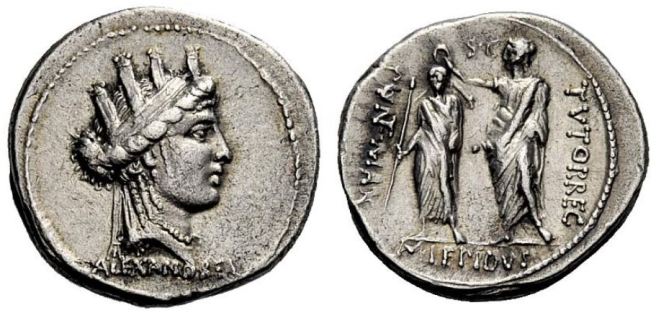
I am Spartacus!, wait, wait, I mean, I am Orestes…

So if you don’t get this image.  Google it.  It’s rather a touchstone of modern cinema.  I was delighted to come across this passage of Cicero in my readings today and learn that the dramatic scene has a classical antecedent on the Roman stage!   I must learn more about the Dulorestes of Pacuvius, in which Thoas, King of the Tauri, wishes to kill whichever of the two captives brought before him was Orestes.  Cicero writes in the de Finibus:

Do we forget the strong emotion that we feel when we hear or read of some deed of piety, of friendship or of magnanimity? But I need not speak of ourselves, whose birth, breeding and education point us towards glory and towards honour; think of the uneducated multitude, — what a tempest of applause rings through the theatre at the words:

I am Orestes,

and at the rejoinder:

No, no, ’tis I, I say, I am Orestes.

And then when each offers a solution to the king in his confusion and perplexity:

Then prithee slay us both; we’ll die together:

as often as this scene is acted, does it ever fail to arouse the greatest enthusiasm? This proves that all men without exception approve and applaud the disposition that not only seeks no advantage for itself, but is loyal and true even to its own disadvantage.

Earlier in the same work he’d introduced the moral dilemma of the two friends in this manner:

or being Pylades will you say you are Orestes, so as to die in your friend’s stead? or supposing you were Orestes, would you say Pylades was lying and reveal your identity, and if they would not believe you, would you make no appeal against your both dying together?

A Glimpse at International Banking, 50 BCE

Of the booty taken by me no one, except the quaestors of the city—that is, the Roman people—has touched or will touch a farthing. At Laodicea I think I shall accept sureties for all public money, so that both I and the people may be insured against loss in transit. As to what you say about the 100,000 drachmae, in a matter of that kind no concession to anyone is possible on my part. For every sum of money is either treated as booty, in which case it is administered by the praefecti or it is paid over to me, in which case it is administered by the quaestor.

This is a very, very cranky letter (even for Cicero!) written as he’s leaving his governorship of Cilicia at the end of his term to the (much lower ranking) proquaestor serving as acting governor in the adjoining province of Syria.  The interesting part to me is the idea that there was such sophisticated banking that Cicero could choose not to travel with the vast amount of wealth he acquired and instead take only the surety of the deposit with him back to Rome.  This isn’t just good enough for personal transaction, but also for state business.

Interested in this sort of thing?  The go-to book is Hollander, Money in the Late Roman Republic.

A Ship of State Metaphor in Cicero

ne mi quidem ipsi tunc placebat diutius abesse ab rei p. custodia ; sedebamus enim in puppi et clavum tenebamus ; nunc autem vix est in sentina locus

This is from a very free letter to L. Papirius Paetus in the last months of 46 BC.  What I enjoy about this usage of a common metaphor (Plato’s Republic, Sophocles’ Oedipus Rex) is its creativity and sarcasm.  It is not didactic or ideological in function here, but rather a colorful expression of frustration.

I did not myself at that time desire to absent myself for any length of time from the guardianship of the constitution: for I was sitting at the helm and holding the rudder; whereas now I have scarcely a place in the hold.

Monuments in the Middle Republic

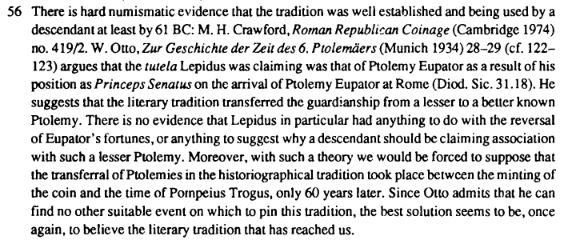
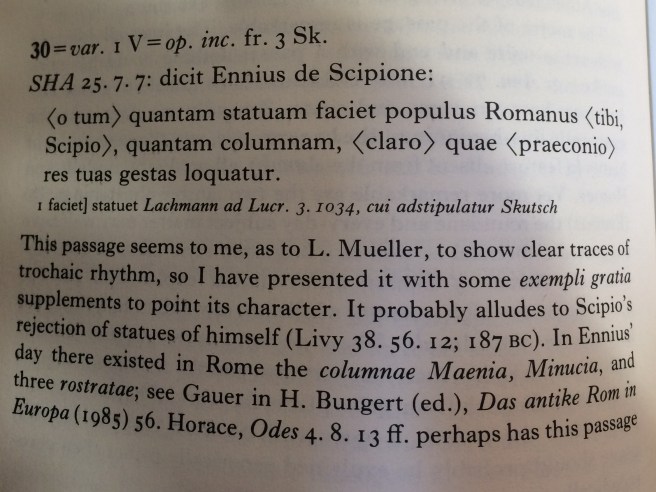
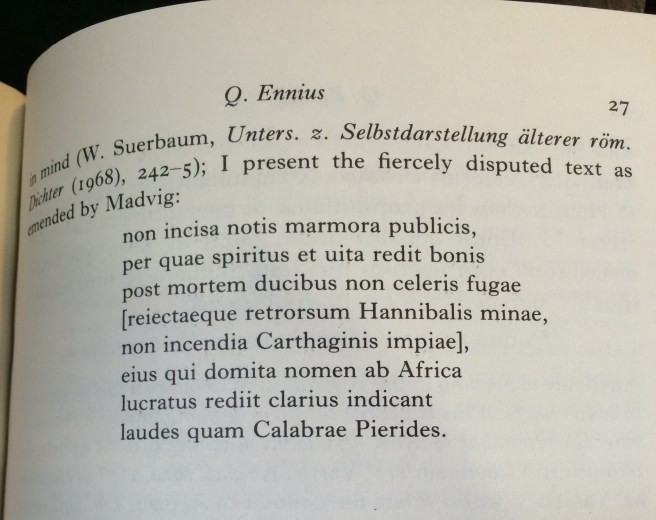
Since Meadows and Williams 2000, we’re in the habit of talking about coinage as monuments in miniature.  Given how much Augustus (and later generations) changed the face of Rome, it is hard to recover the physical culture of commemoration in the city and even harder is to ascertain early attitudes towards such monuments.   All of which means we have less to frame our understanding of the coins.  BUT, nicely we have this self aware fragment (reliquia really) of Ennius, preserved in the Historia Augustae 25.7.6-8:

These barbarians, then, Claudius overcame by his own inborn valour and crushed in a brief space of time, suffering scarcely any to return to their native soil. What reward for such a victory, I ask you, is a shield in the Senate-house? What reward is one golden statue? Of Scipio Ennius wrote: “What manner of statue, what manner of column shall the Roman people make, to tell of your deeds?” We can say with truth that Flavius Claudius, an emperor without peer upon earth, is raised to eminence not by any columns or statues but by the power of fame.

Here is Courtney 1993:

IMG_1697IMG_1698

Horace Ode 4.8 does remain VERY disputed.

Echoes of Ennius?

I’m playing with the idea that regibus regna reddere might have sounded Ennian to Cicero’s audience or that he might have been inspired for the alliterative turn of phrase from his exposure to Ennius.  Just speculative, but here are some supporting details:

When commenting on Aeneid 3.333 (…regnorum reddita…) Servius is reminded at least by the verb of Ennius:

more veteri pro ‘data’ accipiendum est: ‘re’ ergo abundat. Ennius annalibus “ad illa reddita nuptam”, et alibi “isque dies post aut Marcus quam regna recepit” pro accepit. aut ‘reddita’, quod Heleno debebatur imperium.

Skutsch on his commentary on F.56 of Ennius’ Annales does not believe that there is anything particularly archaic about this use of reddere.

Statius uses the phrase reddere regna to start THREE different lines in his Thebiad (2.541, 7.390, 10.583).  Book 7 in particular is known for having Ennian echoes.

Among the fragments of Ennius we find:

 mortalem summum Fortuna repente

Reddidit †summo regno famul †ut †optimus esset (Ann. 312-313)

parentes vinculis exemisse, patri regnum reddidisse atque ita in (Euhem. 90)

And, of course, alliteration is often associated with Ennius…