as reported by Vitale 1998:
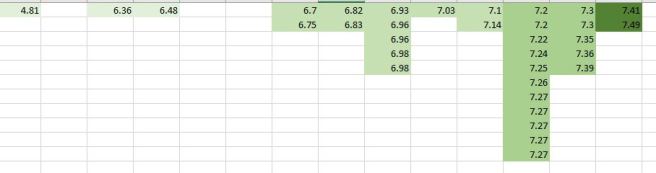
No real surprises, but I still love the way a histogram makes the target weight clearer than a simple ‘average’.
adventures in my head

as reported by Vitale 1998:
No real surprises, but I still love the way a histogram makes the target weight clearer than a simple ‘average’.
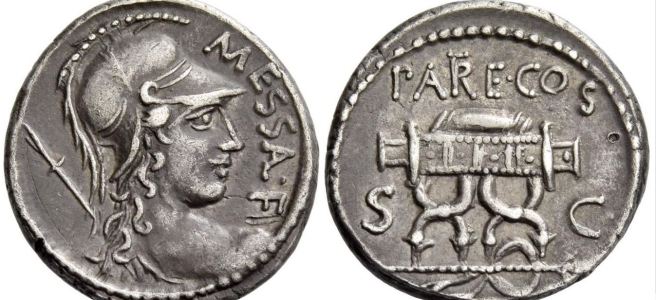

Would it change how we thought about the career of Marcus Valerius Messalla, suff. cos. 32 BCE and patron of Tibullus if he happened as a young man to have made such an anti regal coin (RRC 435/1)? Messalla the patron and suffect consul was famously republican in character: it would be nice to have this as ‘proof’ of his early and outspoken leanings in that direction.
Syme thought they could be the same person (JRS 1995: 157), Crawford allowed it:

The Digital Prosopography of the Roman Republic notes it but does not take it as fact.
Wikipedia gives a nice summary of the man but takes it as fact his father was cos. of 61 BCE, only noting that there are other suggestions.

This cinerary urn from the Copenhagen Glyptotek got me thinking:

The catalogue interpretation is that is a variation of the fatal duel with spirit as judge, usually taken to be Eteocles and Polynices. That type is common enough (see image below), but this dual sarcophagus seems to show a different narrative (as catalogue notes) notice beard vs. beardless and all the different head gear.
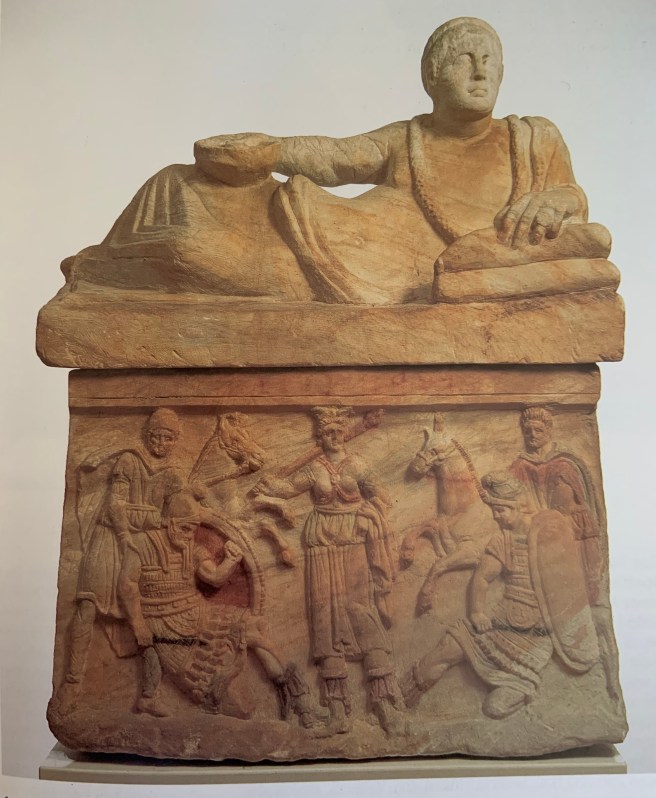
However that spirit coming from the Rocks in that top picture sure looks a lot like Tarpeia in some depictions….

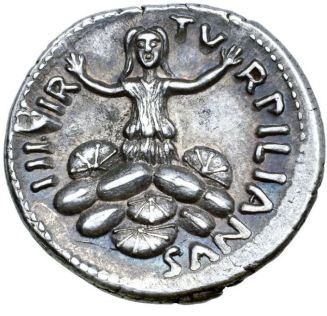
Just be clear I don’t think the winged figure is Tarpeia but she and her ilk may be the model for Tarpeia iconography. I think it is likely given the snake with the winged central figure that she is a spirit of a particular place.
4 July 2021:
This intaglio also has that same design feel. Torso emerging from rocks or shields

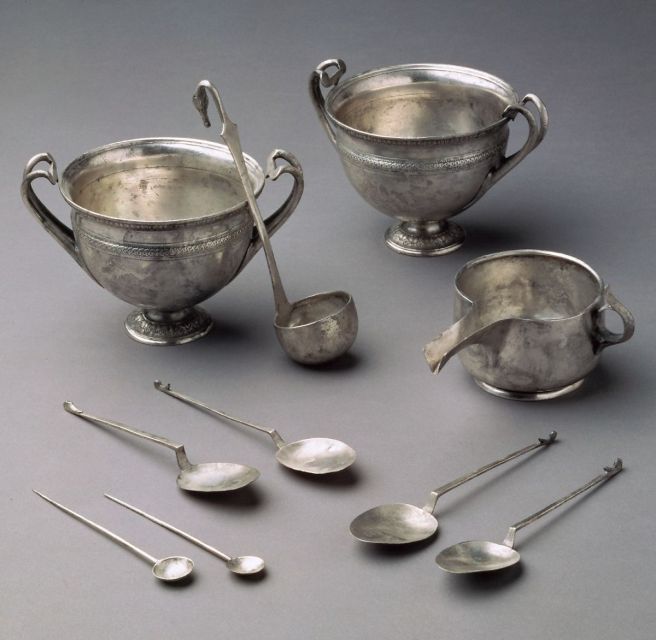
This hoard of silver is Tivoli and thought to be late republican in date.
You can go see it in the Met in NYC.
My interest (today) is in the reported weights and the inscriptions on one of the two cups and the ladle as reported in:
Oliver, Andrew Jr. 1965. “Two Hoards of Republican Silver.” Bulletin of the Metropolitan Museum of Art, 23(5): pp. 176–77.


So if we do some math and are a little less sure that Roman pound was 327 grams exactly this is what the objects tell us about the ball park of the Roman pound.

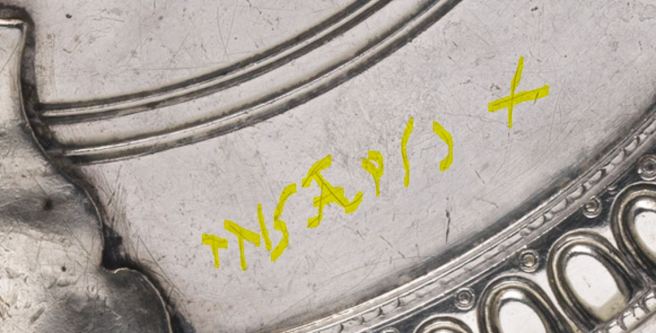
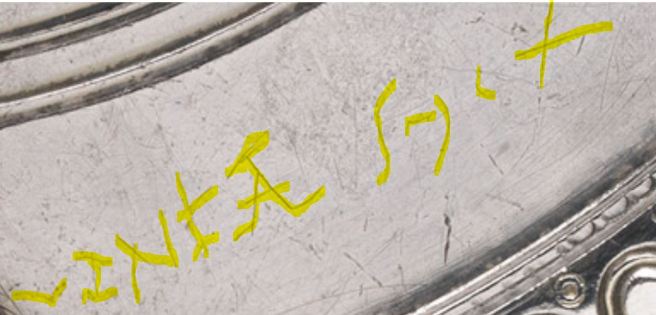
I don’t know how much is likely to be worn away from polishing or chemical reactions over time. Both factors. Another factor is I’m not so sure on the resolution of the number II P(ondo) seems clear but then I see IIS (2.5?) and then four dots follows by SC VII. Not sure how IIS plus for dots = 11 ounces….
The precision must be performative, not just ‘theft’ prevention. (We don’t see shaving of coins in the republic or Roman world generally). I’m guessing these pieces may have been part of dowry for which an exact value was recorded and that the recording of the weight on the object is part of the performance of the fulfillment of that obligation.
The pitcher (oinochoe) from the Arcisate Treasure is also thought to be Campanian manufacture and 1st Cent BCE and also has a woman’s name. It’s 350 grams and claims to be precisely a pound (BM 1900,0730.4):


—
Another that is hard to transcribe:

Bibliography on other silverware with weight inscriptions
Late antique plate in Getty with large disparity between inscribed weight and reconstructed weight.
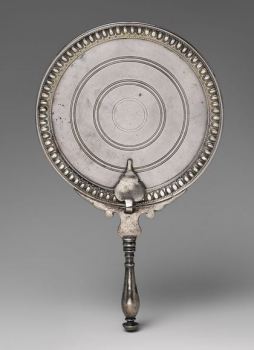
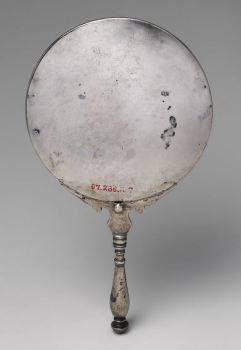
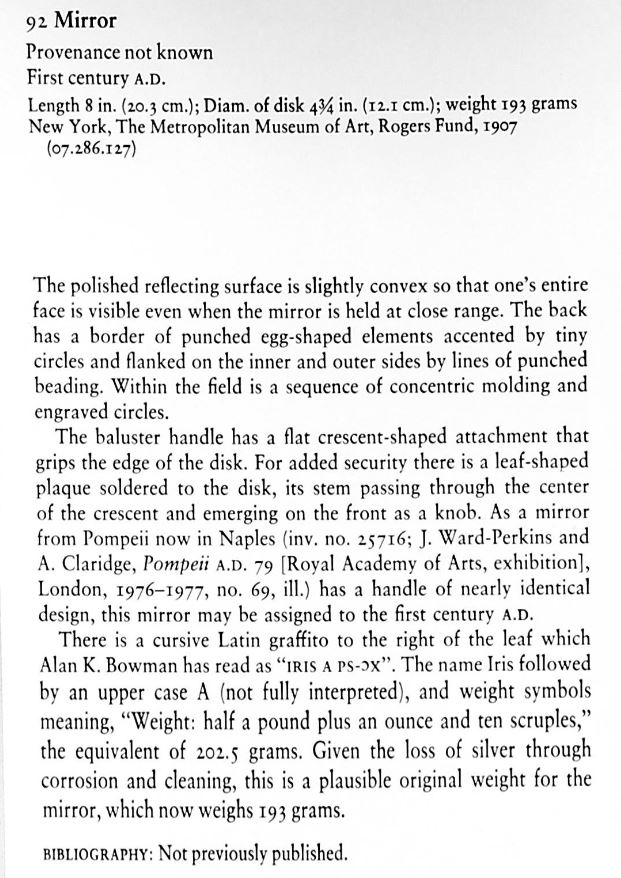
This MET mirror (Campania? 1st Cent AD?) is supposed to have a weight and owner’s name inscription, but I cannot see it…, ILL-ed Bibliography…

Some smart tweets from Gareth Harney
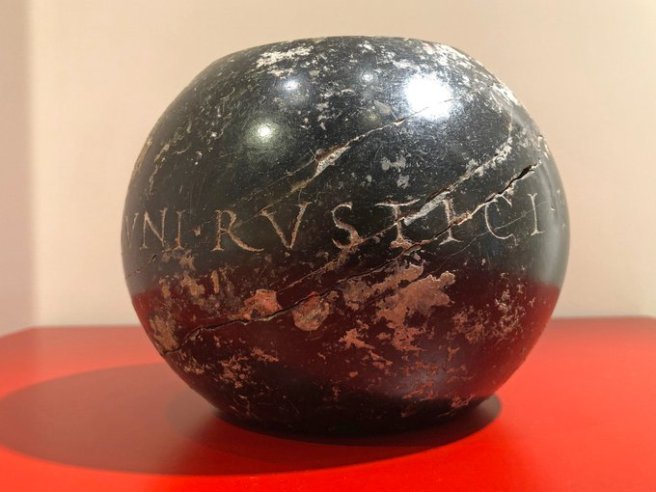
So I would LOVE to see Zilberstein and Ben-Efraim’s method of reconstructing original mass applied to this object.
It’s a 10 pound weight from Rome with the name of a well known historical figure that can be dated with in a decade or so. Balsalt also is far more stable than most other materials so if we can determine its original volume and then mass we’d have a very good idea about what the official pound weighed in Rome at this time!
It is in the Allard Pierson Museum, University of Amsterdam
BM 1966,0328.18 seems to claim that it is an “official” weight from the Temple of Opes (Wealth), but if so it would give a very heavy pound indeed, 356.8g!

A long time ago I wrote this in a draft of the book that has now been superseded by a very different version (without any real discussion beyond a footnote about the pound…word limits and all):
“Duncan-Jones uses the figure 322.8g for the Roman pound based solely on weights in the Naples collection.[1] Other estimates are more wide ranging and often higher. Crawford surveyed various estimates noting their different source materials – coins, stone weights, balances, metal weights – and in the end used c. 324g, with the caveat that it was not reasonable to assume “that the Romans were able to maintain the weight of their pound absolutely constant, at all times and in all places”.[2] He conceptualizes the target weight standards for the precious metal coins as fractions of the Roman pound, 6 scruples for the didrachm, 4 scruples for the early denarius, sometimes falling to 3 scruples.[3] A scruple was a fractional measure, 288 scruples in a pound, 24 in an uncia or ‘ounce’.[4] One finds other scholars using other figures sometimes with no particular justification; so for instance, Heinrichs uses c. 327g without further comment in his discussion of Gratidianus’ reforms of 85/84 BC, a figure common enough in Late Roman and Byzantine studies.[5]
[1] Duncan-Jones 1994: 214-215; 1995: 110.
[2] Crawford 1974: 591.
[3] Crawford 1974: 3, 7, 11, and 34.
[4] The same vocabulary of was used by Romans to also discuss small divisions of land and time, so a scruple could also be 1/288th of a iugerum or 1/24th of an hour as well.
[5] Heinrichs 2008: 265-6; cf. Entwistle 2008: 39″
This morning I’m worrying again about want we can know or not know about the Roman pound and other weight standards in antiquity. Riggsby does not concern himself with reconstruction of the weights itself but instead with how Romans thought about weights, which lends itself to very much to an idea about the futility of a search for a universal standard (2018: chapter 3).
I also have some older posts on weights here on this blog.
All I really want to do in this post is record new stuff that might be relevant to a future write up on the topic.
Stone weights from Jerusalem! Not useful for ‘reconstructing’ the Roman pound, but certainly very useful for thinking about standardization in a community that had a cultural habit of regularly weighing. Also what is the whole unit? what are its standard fractions and multiples? Along with linked article which is newer also:
Reich, Ronny. “The distribution of stone scale weights from the Early Roman Period and its possible meaning.” Israel exploration journal 59, no. 2 (2009): 175-184.
Abstract: In Jerusalem were discovered 525 measuring weights, which date from the 1st century BC and 1st century AD The study of 168 of them, in stone, reveals that Jerusalem is the main city of this region to include so many (elsewhere, they are metal), and they are concentrated in the private houses of the Temple district and in the residential area of the upper town. Although these weights could be used to weigh certain foods (eg meat), their usefulness was not primarily commercial but religious: it was a matter of weighing a tithe of food, offered by each household to the priest’s family.
Gill, David W. J.. “Inscribed silver plate from tomb II at Vergina.” Hesperia 77, no. 2 (2008): 335-358.
Abstract: Five items of silver plate from tomb II at Vergina are inscribed with their ancient weights. The inscriptions, using the acrophonic and alphabetic systems, suggest that the pieces were made to a drachma weight of ca. 4.2 g. This weight of drachma was introduced to Macedonia by Alexander the Great and does not appear to have been used by Philip II. The inscriptions on the silver add to the cumulative evidence provided by the cremated remains, black-gloss saltcellars, and iconography of the lion-hunt frieze, that tomb II was the final resting place not of Philip II, but of Philip III Arrhidaios and Adea Eurydike.
[Riggsby has a good discussion on why donatives/votives might have custom of precise weights recorded on them so that the divine or dead receiver not be ‘cheated’ of any of their fair portion. Good thematic connection with interpretation of Jerusalem weights, re: precision being about religious/pious scruples, pun intended.]
Hadad, Shulamit. “Weights from the Early Roman period at Ramat Hanadiv.” Israel exploration journal 57, no. 2 (2007): 208-210.
Abstract: Publishes seven lead and copper alloy weights from excavations of 2000-2004, of ill defined context but datable of the 1st century. 1st-1st century AD. AD according to the associated ceramic and glass. A weight of 28 g carries the Greek letter H, 8 (drachmas) = 30 g.
[Inscription is interesting, but assumption we know what 8 drachmas were ‘supposed’ to weigh seems ill founded.]
Alberti, Maria Emanuela, ed. Weights in context: Bronze Age weighing systems of Eastern Mediterranean : chronology, typology, material and archaeological contexts : proceedings of the international colloquium : Roma, 22nd-24th November 2004. Studi e Materiali; 13. Roma: Istituto Italiano di Numismatica, 2007.
From Weingarten’s AJAonline review the following jumps out at me:
“In Egypt there are no secure weights before the Fourth Dynasty, and most early weights are squared stones; the Old Kingdom Gold Deben (13.6–13.9 g) fluctuates by as much as ±7%.”
“While the main local unit at Ebla was the 7.8 g shekel at 60 units to the mina, Ascalone and Peyronel (49–70) demonstrate, from in situ weights in Royal Palace G, that units based on 50 and 40 shekels were also found—sometimes all three in the same room (L 3532).”
“Two weights from the cella of Temple N (dedicated to the sun-god Shamash?) suggest that the words “weight of Shamash” symbolically indicate a “correct” standard of measure with concomitant concepts of justice and rectitude.”
Mari during Zimri Lim’s reign: “Although based on the same unit, documents distinguish “weights of the king’s office” from “weights of the market.” The “weight of the city of Karkemish” is also mentioned, as is a set of weights belonging to a man named Burqân, who witnessed loans between merchants.”
Thera: “one large cone marked with a circle—the sign of an Egyptian deben—weighs 91 g, exactly a deben”
“An Old Babylonian copy of a Sumerian law attributed to Ur-Nammu, first king of the Ur III, boasts, “I standardized weight stones from the pure one shekel weight to the one mina weight.” Such standards were probably placed in the temple of Nanna in Ur; a number of inscribed weight stones were dedicated in this and other temples.”
Crete: “More than 100 copper ingot fragments from the artisans’ quarter suggest intentional division into Minoan fractions.”
[Again there is a tension between the seeking of precise standards and the observed variation. More interesting than the modern interpretations of the variations are the ancient ways of dealing with the samevariation (i.e. identifying weights themselves and location, religious ‘guarantees’, regal posts of standardization… The last quote in bold may be good comparative evidence for aes rude.]
De Zwarte, Ruud. “On the use of the balance as a device for measuring commodities and the accuracy of ancient weighing.” Talanta 26-27 (1995): 89-139.
Abstract: An attempt is made to rectify the wide-spread misunderstanding regarding the adjustment of ancient weights and to demonstrate that a basic principle of mass measuring was already known in various parts of the world millenniums before our era.
This article on early Islamic weights is very certain about c. 324 based on weight of water volume in Byzantine times:
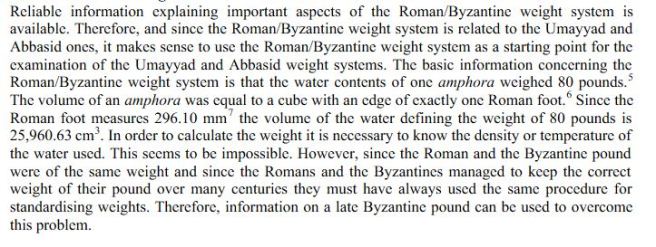
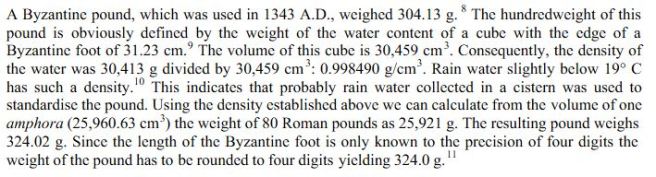
[I will have to chase footnotes to find primary evidence; all the citations are too secondary literature.]
Steelyards are another means for finding local weight standards (link to article)
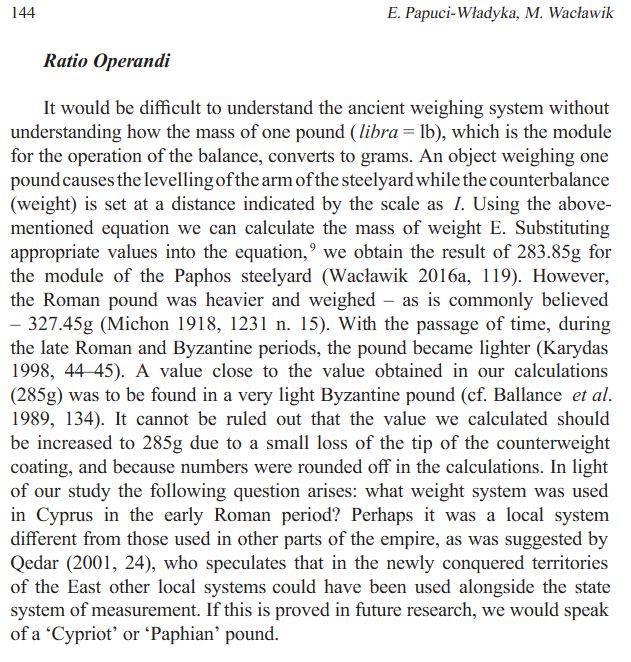
[Use of Michon as authority on ‘true’ weight of Roman pound is interesting… This number corresponds to Crawford’s highest quoted weight (1974: 591) and derives from the weighing of coins by Boeckh 1838.]

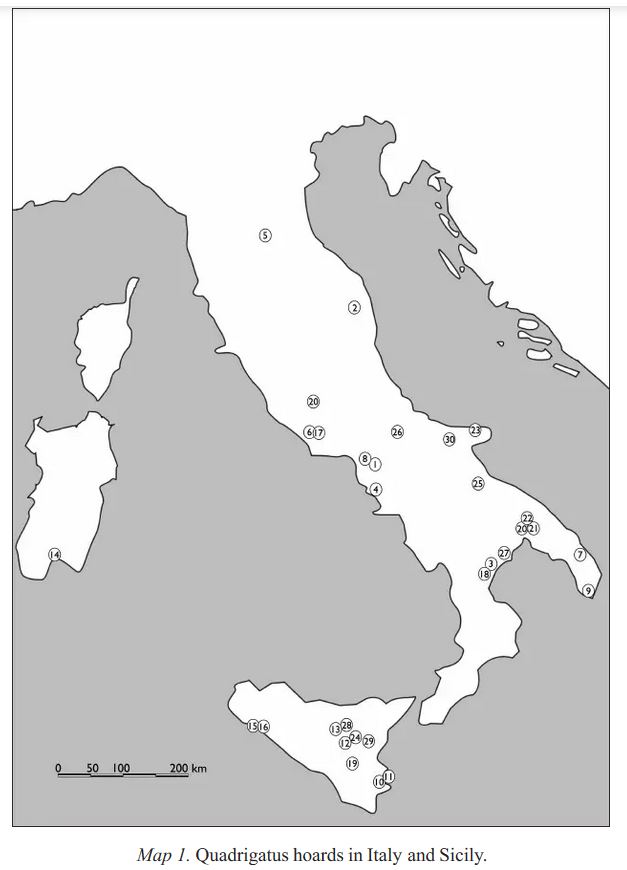
If you, like me, find the continuing scholarly conflicts over the dating of the quadrigatus a little confusing, I would like to recommend to you the following:
Bernard’s NC 2017 Review Article
It revisits not only
Bernard notes that interpretation depends on pre-supposition of scholars. In the later case he emphasizes “a large cache of late Roman lamps near the sanctuary in which the quadrigatus was found” (p. 504 n. 8)
Key scholarship to which Bernard points includes:


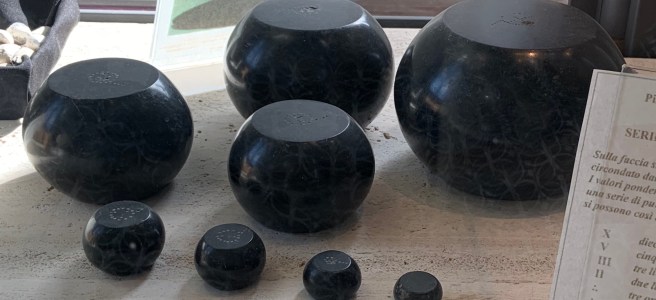
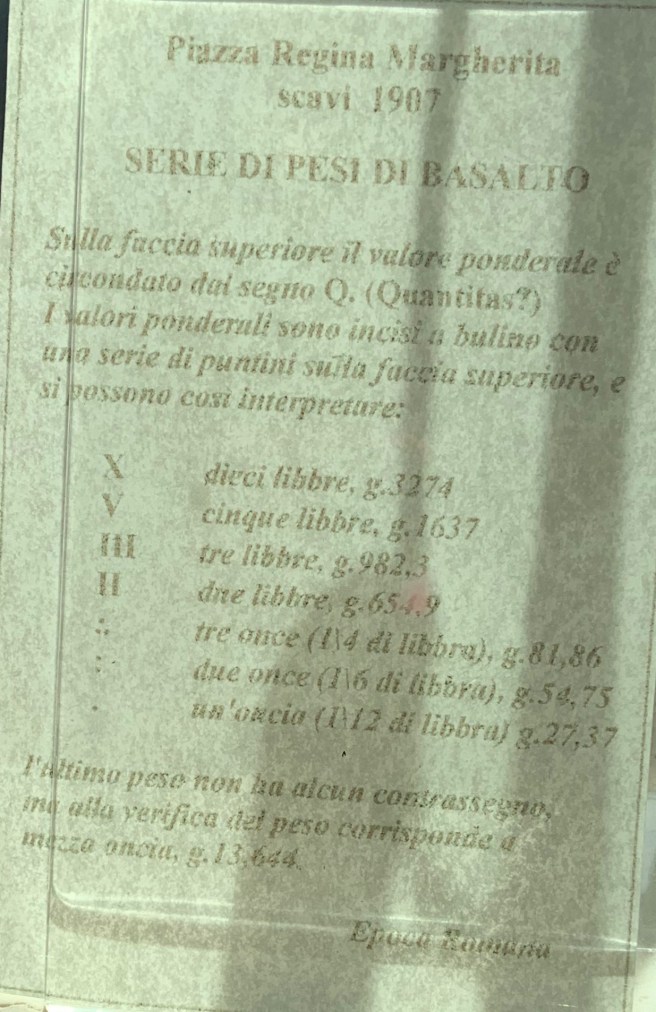
Things to notice regarding this Praeneste find from 1907 excavations:
Q – likely stands for Quaestor as on coins
The per ‘pound’ basis of each ‘denomination’ is as follows:
X – 327.4
V – 327.4
III – 327.433
II – 327.45
… – 327.44
.. – 328.5
. – 328.44
The basalt is much more resistant to corrosion than similar metal weights.


Location of Piazza in relationship to sanctuary:

View of back of cathedral from sanctuary of Fortuna, again to show relationship of find spot to sanctuary.

View the other direction. Note shadow of cathedral bell tower to orientate yourself:


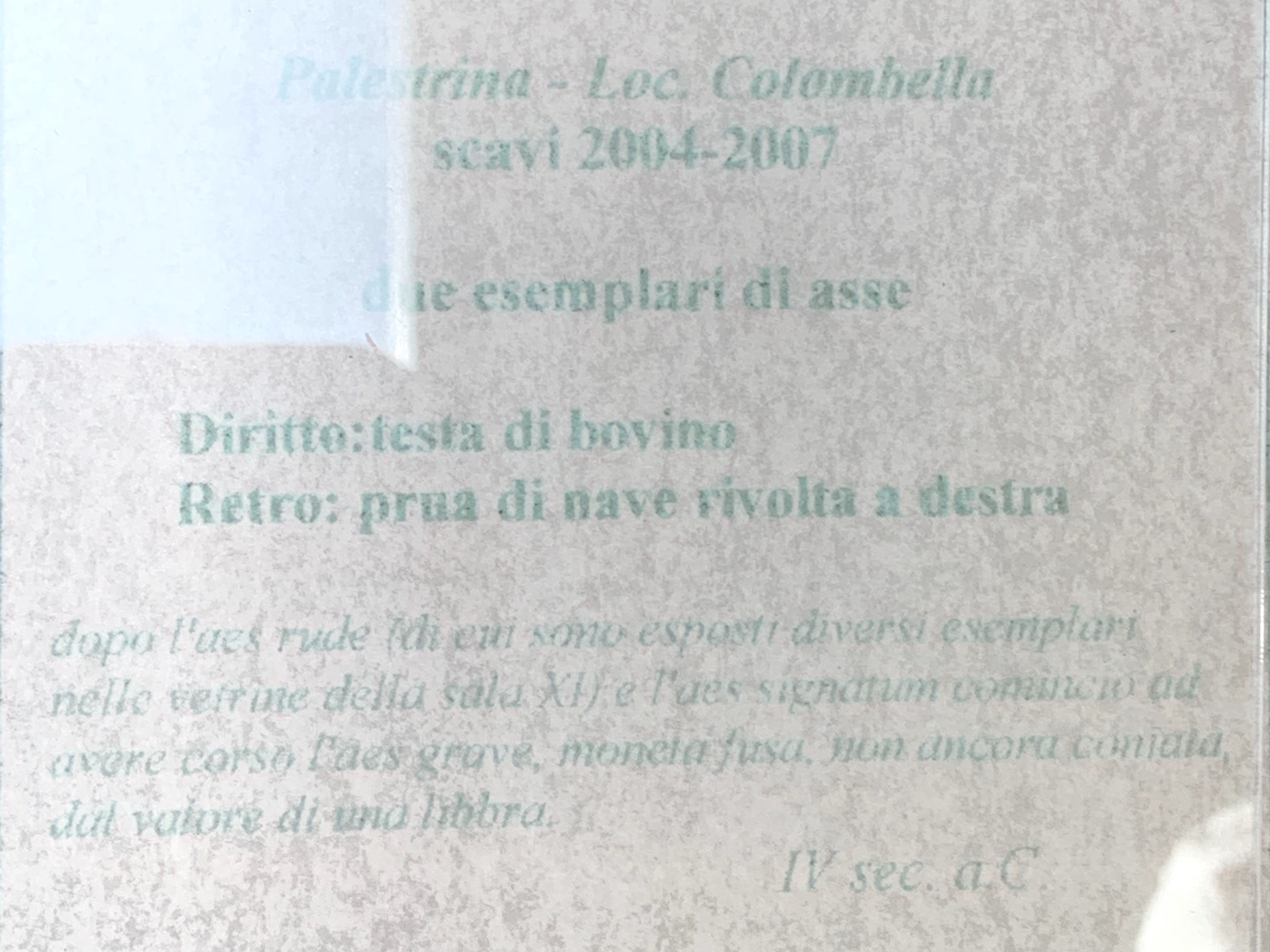
Two more bull/prow aes grave semisses have come to light at Praeneste in archaeological contexts and are now on display in the museum. This is HN Italy 359 = Vecchi 276 = Haberlin, pp. 157-158 (specimen in trade, second specimen in trade). Thomsen ERC III: 149-150 thought these might be Roman aes grave but this has not been accepted by others. Vecchi notes a weight range of 167.96-118.20g.
Previous finds were Praeneste prior to 1893 and the Ariccia 1848 hoard (c. 28 km SW of Praeneste, ~6 hour walk due to elevation changes).
Now with THREE pieces found at Praeneste, I think we should assume that it the place of manufacture until further evidence comes to light.
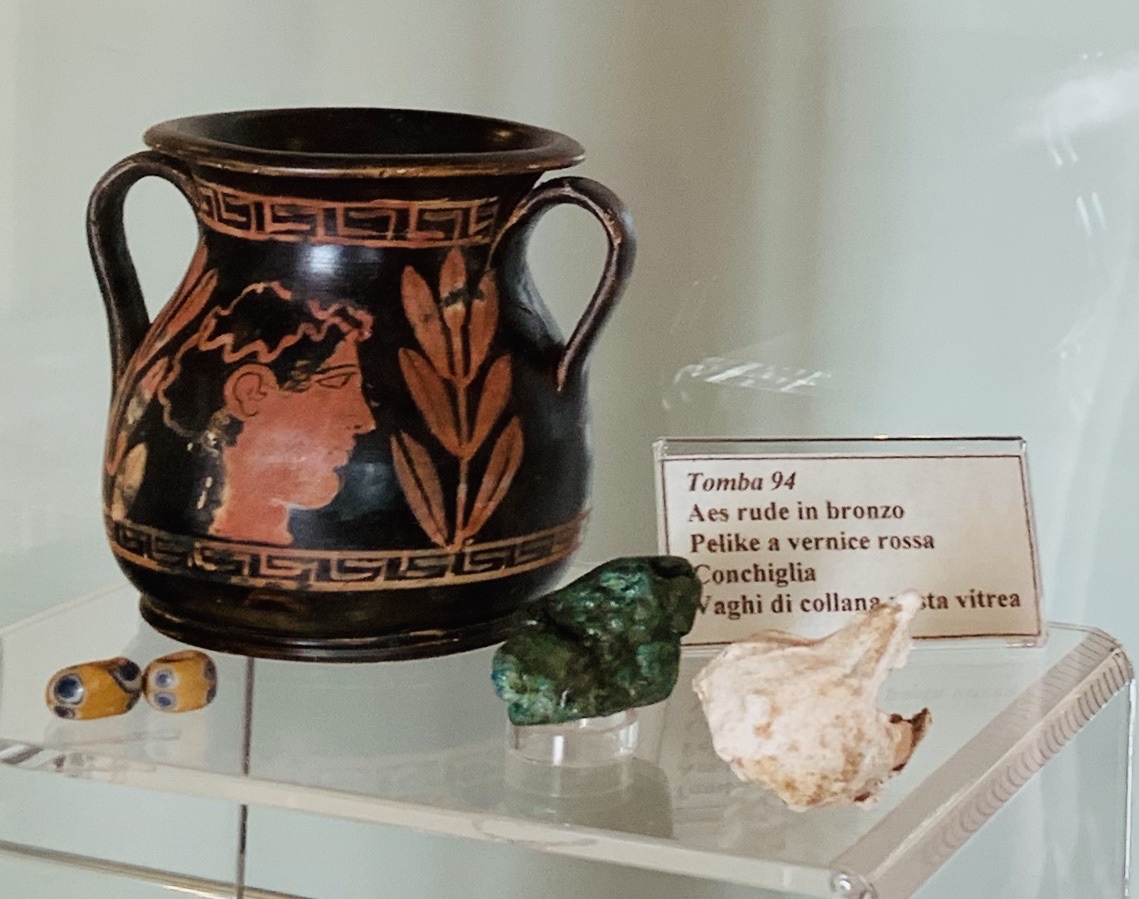
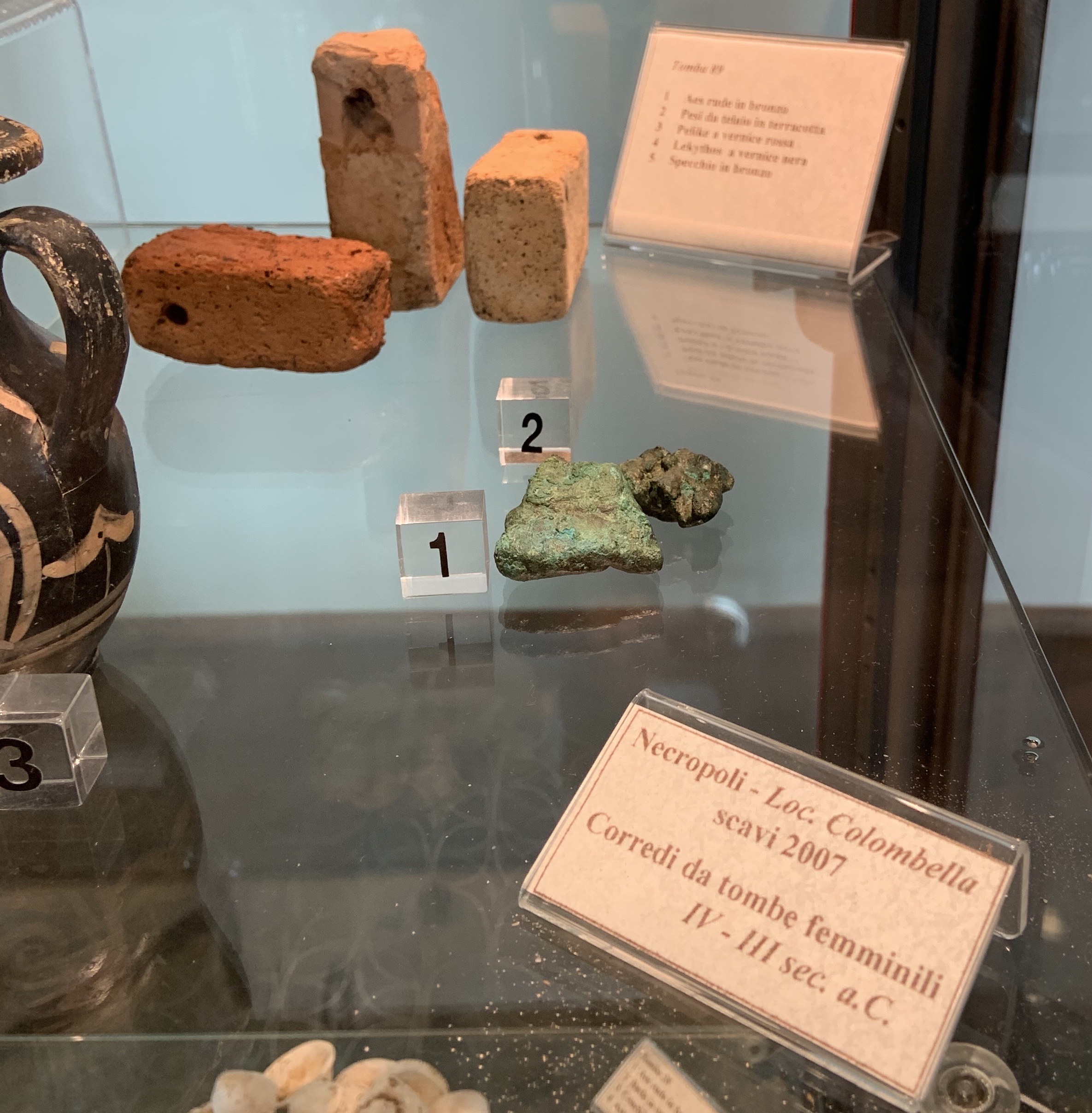
The other major thing to note is the regular use of aes rude in Funerary Contexts. This was already observed in the 1907 excavations (see AJA 1908 summary below), but is now reconfirmed by the 2007 finds.
It seems that these aes grave may also be from funerary contexts as they were unearthed in the same Colombella excavations. – private correspondence with the excavator suggests the aes grave was NOT from a burial context.






Update 1/12/23:
Possibly relevant bibliography for such finds:
Parente, Anna Rita. “La Lucania: necropoli e monete : (V-II secolo a. C.).” In Caronte: un obolo per l’aldilà, Edited by Cantilena, Renata., 276-288. Napoli: Macchiaroli, 1995.
Presence of coins in the grave goods of Greek and indigenous Lucanian necropolises. The phenomenon is recurrent in the Greek context, where the coin placed in the tomb probably has the symbolic function of a prestigious asset, in the manner of the obeloi and the aes rude (traditionally interpreted as pre-monetary objects). In the indigenous sphere the phenomenon is very rare and perhaps limited to cases of emulation of the Greek funeral practice

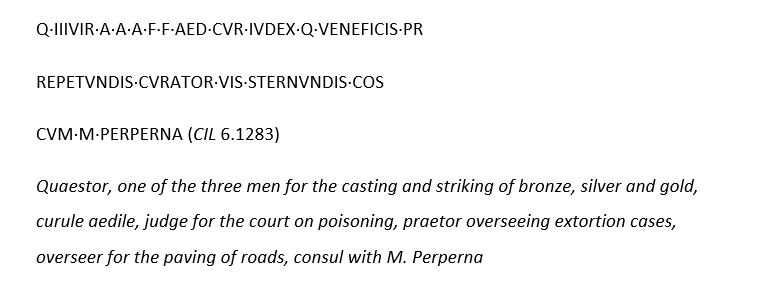
The traditional interpretation of this inscription makes it in honor of C. Claudius, moneyer of RRC 300.
But this article upsets that (full original pub on order from ILL) This is AE summary.

Machine translation cleaned up by moi.
“This article proposes that the name of Ap. Claudius Αρ. f. C. n. Pulcher, consul in 130 BCE, be restored instead of that of C. Claudius Αρ. f. C. n. Pulcher, consul in 92 BCE. Both were co-consuls with an M. Perperna. But Gaius, whose praetorship dates back to 95 BCE, was not praetor repetundis but praetor peregrinus and the curator uiis sternundis or uiarum curandarum is in better agreement with the chronology of Appius’ career. The family tree of the Claudii Pulchri reconstructed by Münzer is corrected as follows: the consul of 130 BCE would not be the son of the homonymous consul of 185 BCE (eldest son of Ap. Claudius Pulcher, consul in 212 BCE); he would be the grandson of the third son C. Claudius Pulcher, consul in 177 BCE.”
Some points that are very interesting to the numismatist:
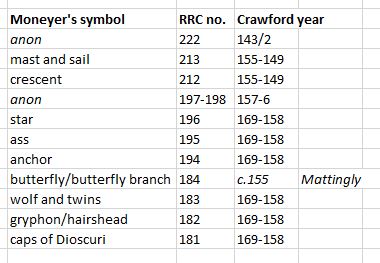
1) If this is true, then the title triumvir aere argento auro flando feriundo goes all the way back to the mid second century.
2) We don’t have a named coinage from the right date stuck by a Claudius. Candidates for Appius issue would are limited and as follows:
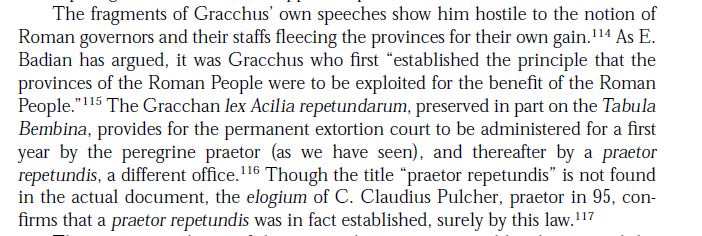
The argument seems to hang on whether Cicero’s Verrines is proof he was praetor peregrinus.
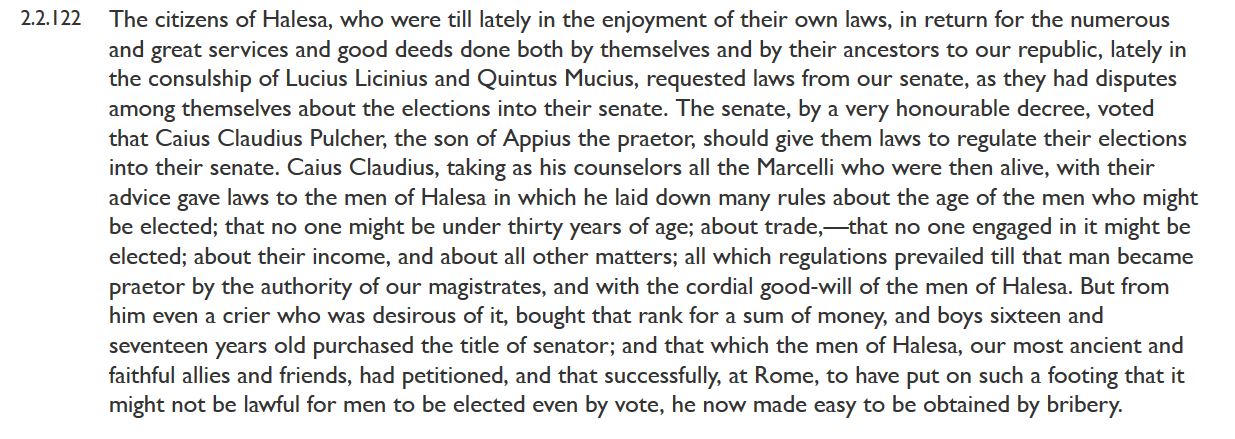
C. Claudius Appi filius pulcher praetor de senatu cooptando leges conscriberet.
Brennan (2000: 237) is pretty certain about the timing of the creation of the title praetor repetundis and it is too late to be held by the cos. of 130…
 Liv Mariah Yarrow