Notes on the Capitoline

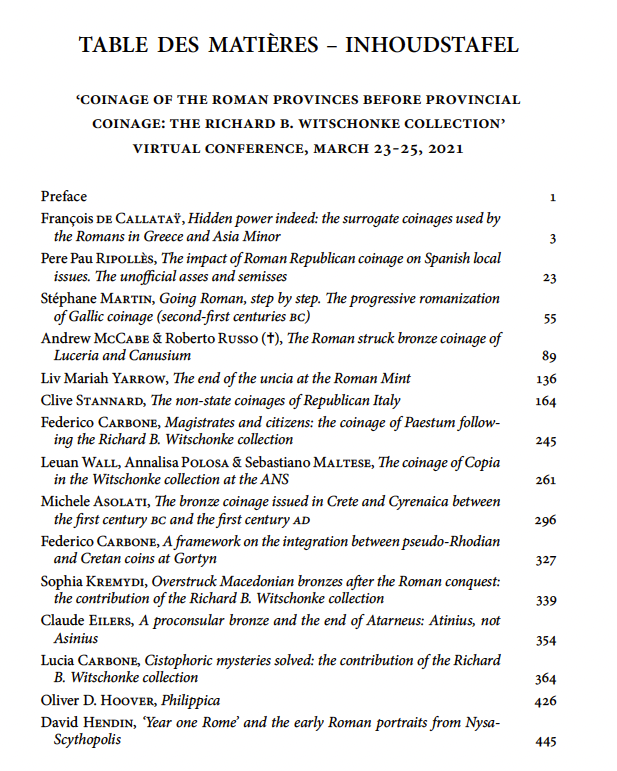
Listening to fascinating panel on new excavations on the Capitoline highlighting work especially in collaboration with the DAI in Rome with La Sovrintendenza Capitolina.

They may have found a whole complex of roof tiles from including decorated mold made elements and also post holes potentially associated with wooden equipment used in building (think cranes for lifting blocks). (7th to 3rd BCE is the date of the times)

The tiles seem to have been deposited in a phase of later construction. Perhaps in the post Pydna era when monumentalization takes off in the city. Parallels might be drawn with better understood phases on the Palatine in the sanctuary area of Victory and Magna Mater temples.

There is also clear documentation now of the temple podium that was incorporated/covered by the Prussian hospital.


non-sequitur.

I love the term ‘fiddle drill’!


I asked for clarification of the opening remarks that briefly highlighted of the importance of archival work, specifically comparing older drawings of the hill and Severan map to identify the temple of fides on the Capitoline. Ortwin Dally praised the book of Rousse [sp? – must find reference and link], while also pointing out that the temple is at the foot of the hill, perhaps better associated with the sanctuary area of San Omobono. He wondered how we disentangle the surviving fragments to confirm they really come from a single temple rather than multiple structures. He also pointed to the literary testimony, particularly Livy. Fides was attested to be one of the earliest temples, before Ops and Mens. Livy also discusses the removal of statues. Yet matching names of temples attested literature as ‘on the Capitoline” to archaeological structures remains difficult. On avenue for future exploration is the attested finds of military diplomas found on Capitoline [I must learn more on these!].


I did not hear the whole paper on the roof tiles to catch Carbone and Sharpless speaking on archaeological finds of coins at the villa of Hadrian. They did such an amazing job. I hate these parallel sessions and dashing between different panels to catch individual papers, but this is how we conference….
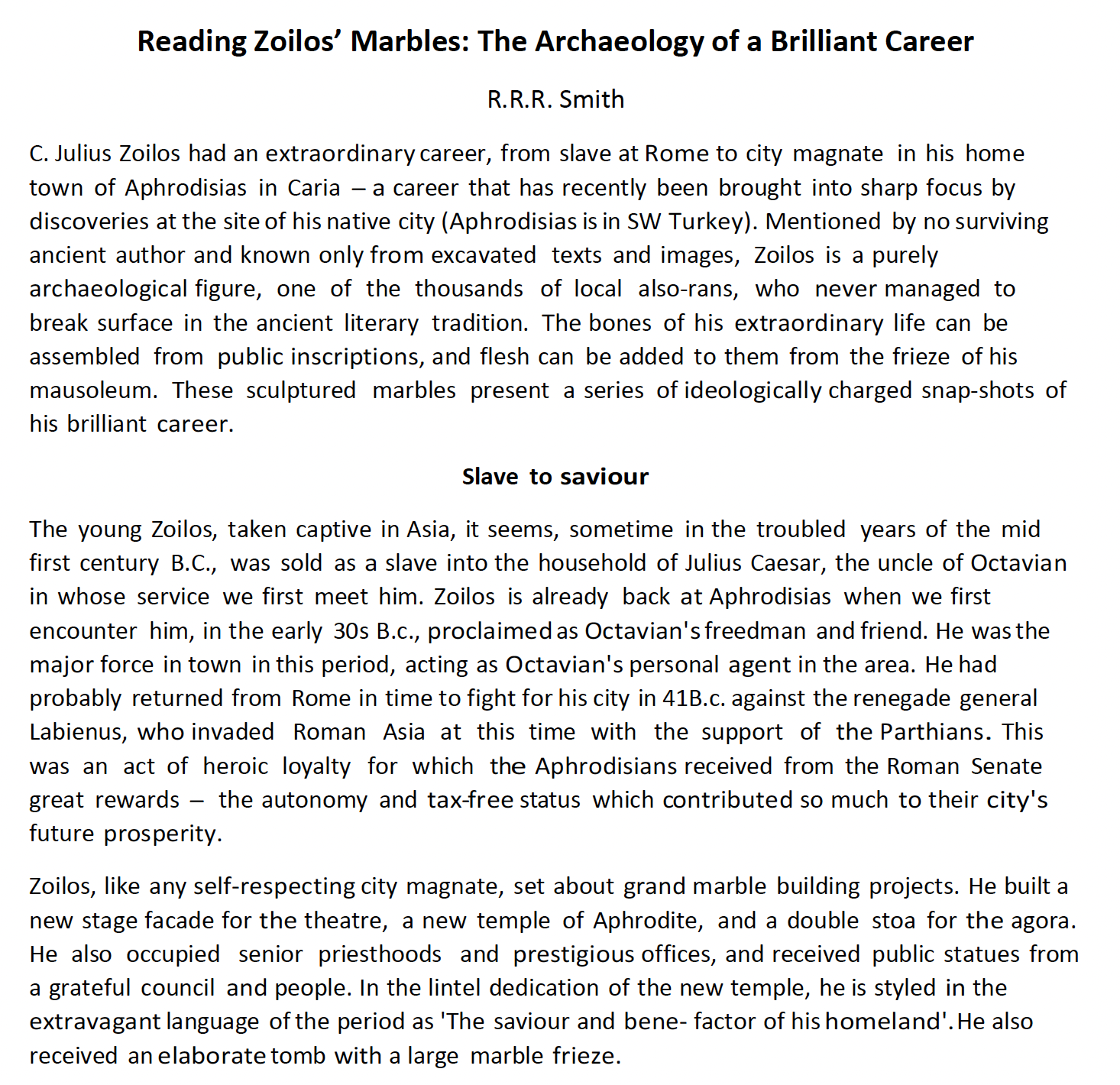
Natal Alienation, nullified?!

Listening to Max Meyer (Brown) talk about the trees at Aphrodisias and of course Zoilos got a shout out. Listening to a brief summary of his career, I immediately thought about Orlando Patterson’s concepts of enslavement and the key role of natal alienation. I often teach manumission in the Roman context as perpetuating natal alienation by perpetuating the enslaved person’s structure in the Roman familia. I often teach this through naming customs.

BUT Zoilos managed to use his manumission to in fact elevate his status in his community of origin and seems to have retained his original name at least in part. An exception that proves the rule… I want to think more.

For context.


non sequitur.

The trees discussed were date palms. Speaker connected to Ishtar, fertility, and economic display of imported plants needing special call. No particular mention of date palm association with Phoenicia. I am thinking also of Nicolaus of Damascus being the name-sake of Augustus’ favorite dates. It also provides a great precedent for the trees of the Flavian templum pacis and might just possibly take some influence from the plantings in the theatre of Pompey at Rome. I wonder about other precedents.

Phalloi at the Fire

Listening to a stunningly good paper by Abigail Straub (UMich) on her work on Pompeii Bakeries and their religious protections. (Well worth making it to this 8am session and even skipping a coin session — I feel guilty about the latter!)

The points I want remember are the representations of Vesta with donkeys, the Vestalia, but most importantly the placing images of phalloi at the hearth/oven mouth. This made me think immediately of one of the narratives of Servius Tullius’ conception:

They say that from the hearth in the palace, on which the Romans offer various other sacrifices and also consecrate the first portion of their meals, there rose up above the fire a man’s privy member, and that Ocrisia was the first to see it as she was carrying the customary cakes to the fire, and immediately informed the king and queen of it. Tarquinius, they add, upon hearing this and left beholding the prodigy, was astonished; but Tanaquil, who was not only wise in other matters but also inferior to none of the Tyrrhenians in her knowledge of divination, told him it was ordained by fate that from the royal hearth should issue a scion superior to the race of mortals, to be born of the woman who should conceive by that phantom. (Dion. Hal. RA 4.2.1-2)

Can’t wait to see Straub’s final dissertation. A real shame this paper was scheduled at exactly the same time as Sinead Brennan-McMahon (Stanford), “Queer Spaces in Pompeii? Phallic Aesthetics and Shared Communities”. I’d have loved to seen both and be able to think about how the two papers might be in dialogue with each other.

Did I give too many As?!

Let me start by saying this was the best class I’ve ever taught and the students were extra ordinarily dedicated. Many are education majors destined to teach in NYC public schools. I’m deeply impress with them all and I’m also realizing that teaching Roman art (material culture) gives me even more joy than teaching history courses (and let me tell you I love teaching Roman history!!).

As an educator, I’m deeply committed to treating my students fairly and sticking to my word, especially about something so meaningful as grades. This semester was a new prep and thus I had to imagine a new grading structure appropriate to goals of the course and its content. I decided on 54% examination (proof of learning, command of information), and 46% participatory assignment (low and high stakes activities that took meaningful effort and were graded on degree of engagement). I also have a policy of accepting a wide variety of activities and assignments submissions as means of earning additional points or making up missed work. No late penalties.

Yes I’m a big softy. BUT are these policies distorting student grades. I was worried perhaps I’d shifted too far away from grades being a meaningful reflection of learning. So….
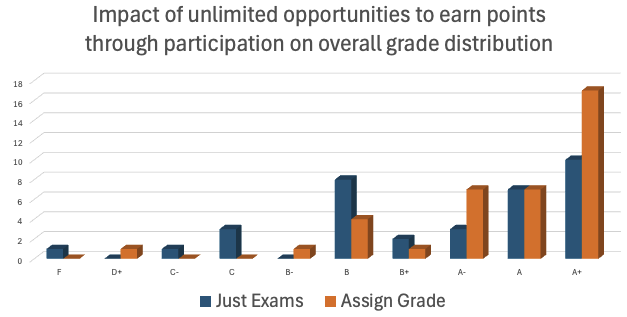
As a proxy for ‘what if’ I calculated each student’s grades based on exams alone and then compared that with the real grades they earned according the rules set out in the syllabus.
For exactly 50% of the students the participation gave them no advantage or disadvantage over the grade they would have gotten if I’d just awarded grades based on exams. 95% of these students who experienced no GPA change would have gotten an A or A+ in the course on exams alone. 32% of that 50% (so 16% of the class) did shift from A to A+, an honorary distinction with no effect on GPA. Two students who did A+ work on the exams only earned A- grades because their scores on (lack of engagement with) participation assignments, but I can live with that.

My takeaway is that perhaps for the needs of the top half of the class I may need to refine my exam writing to better differentiate levels of learning.

What my policy did do is shift weaker test-takers into a higher grade position. The average change was .7 GPA points. (when there was a change) That’s a B to an A- for instance. If you take the class average, my policies overall averaged about a .3 GPA point increase, that’s a B to a B+.

estimated GPA “increase”% of Students
.311%
.43%
.711%
116%
1.33%
1.73%

Generally speaking, I feel good about rewarding students for active learning be it in class activities or museum visits. They teach how to look at images, how to take notes, and that it is not enough to ‘know’ — one also has to engage with the material.

So yeah. I gave a LOT of As and may refine my points structure slightly, esp. on exams, but I think I’ll keep my approach to open ended points. Why close the door on learning when it is helping lift up the students who struggle most?

Fantasy Pieces

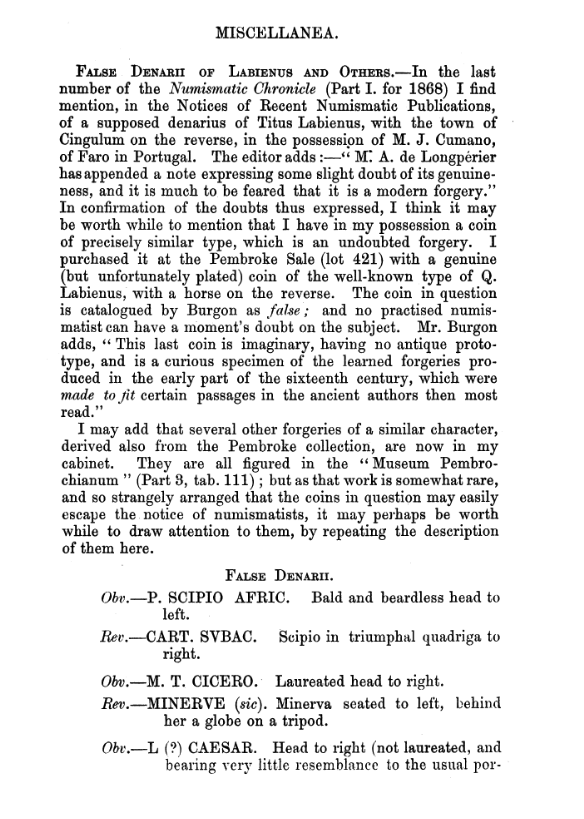
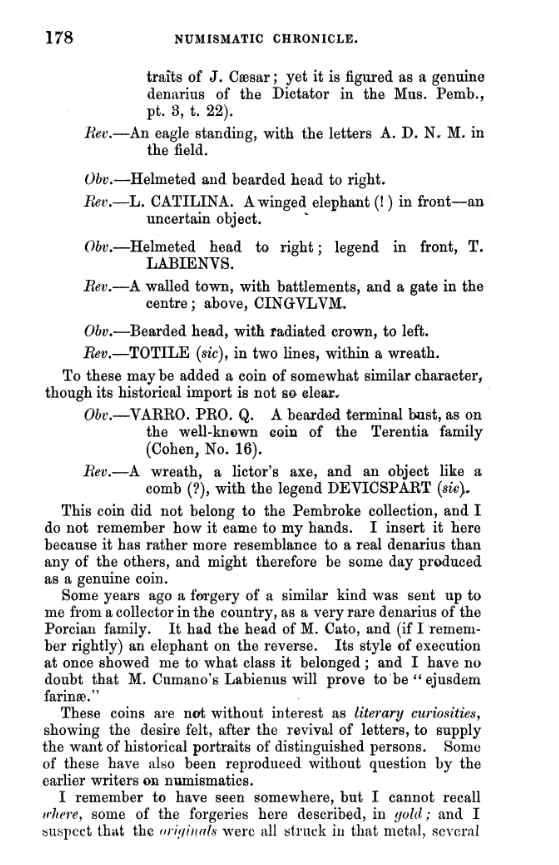
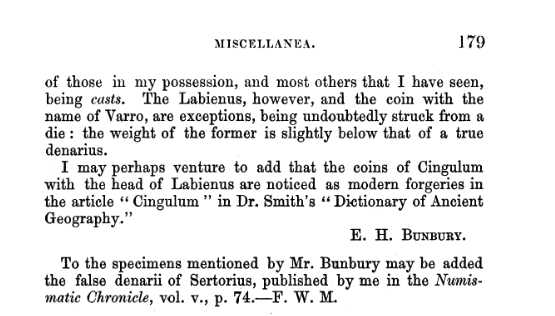
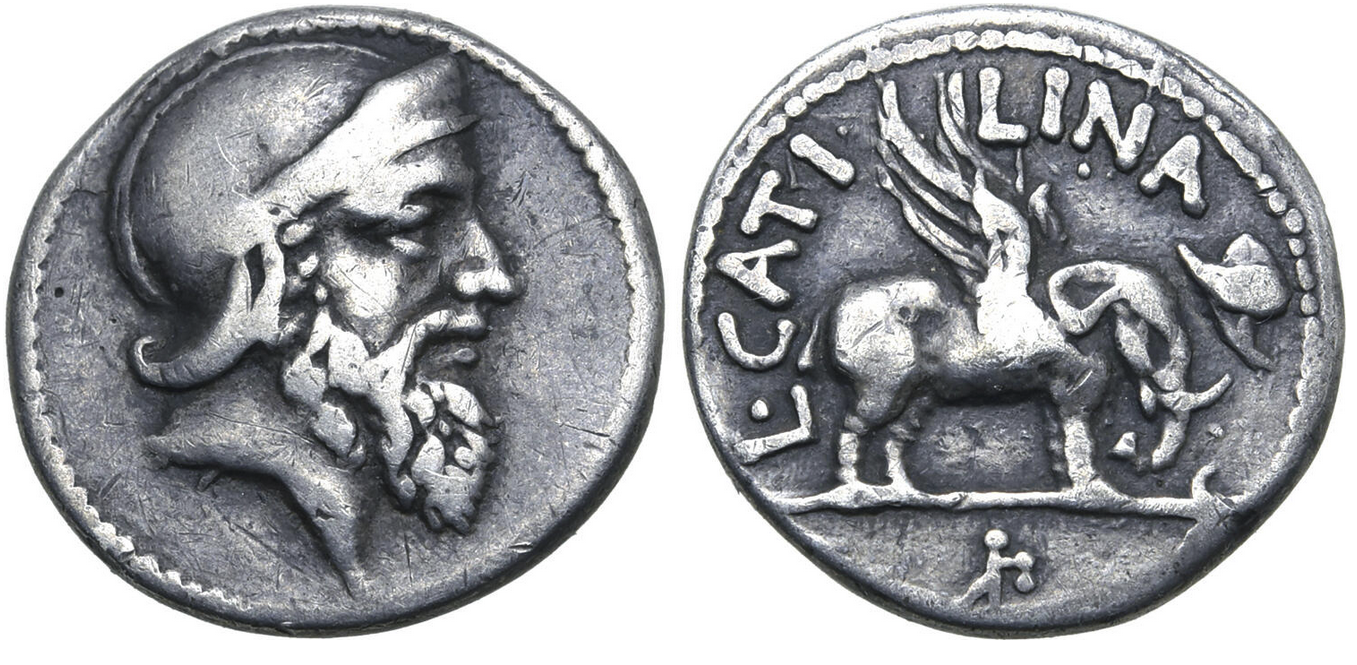
Typically when fantasy coins of Roman republican theme are discussed the citation given is mid nineteenth century, a less than 3 page note in NC. I give it in full below. It does not use the term ‘fantasy’. The term seems popular in 20th century numismatic periodicals targeted at collectors, not peer-reviewed scholarly journals. Most of the types discussed are modern in inspiration as well as manufacture. There are of course exceptions, often religiously motivated ones (one example).

If you know things I should read on false or fantasy Roman republican themed pieces please do let me know. This is a sustained interest of mine. I don’t count in this category the Dassier RR series (a favorite of mine!) for all it may have fed a similar market or the Becker pieces as that seems more to be true forgeries. I’m looking for more along the Paduan line. Of educated knowing imitations. Just like what Bunbury discussed.

Do you have images you think belong here? I’m not looking dispute any coin’s legitimacy, but rather collect those where others have already made a statement that the specimen (type?) is a fantasy.

Bunbury, E. H. “False Denarii of Labienus and Others.” The Numismatic Chronicle and Journal of the Numismatic Society 8 (1868): 177–79. http://www.jstor.org/stable/42680462.

This note came with no images. Let’s rectify that.

L. Catilina! Flying Elephant! last(?) auctioned 2022
Cleopatra Selene! Crocodile! Bilingual! Last(?) auctioned 2007
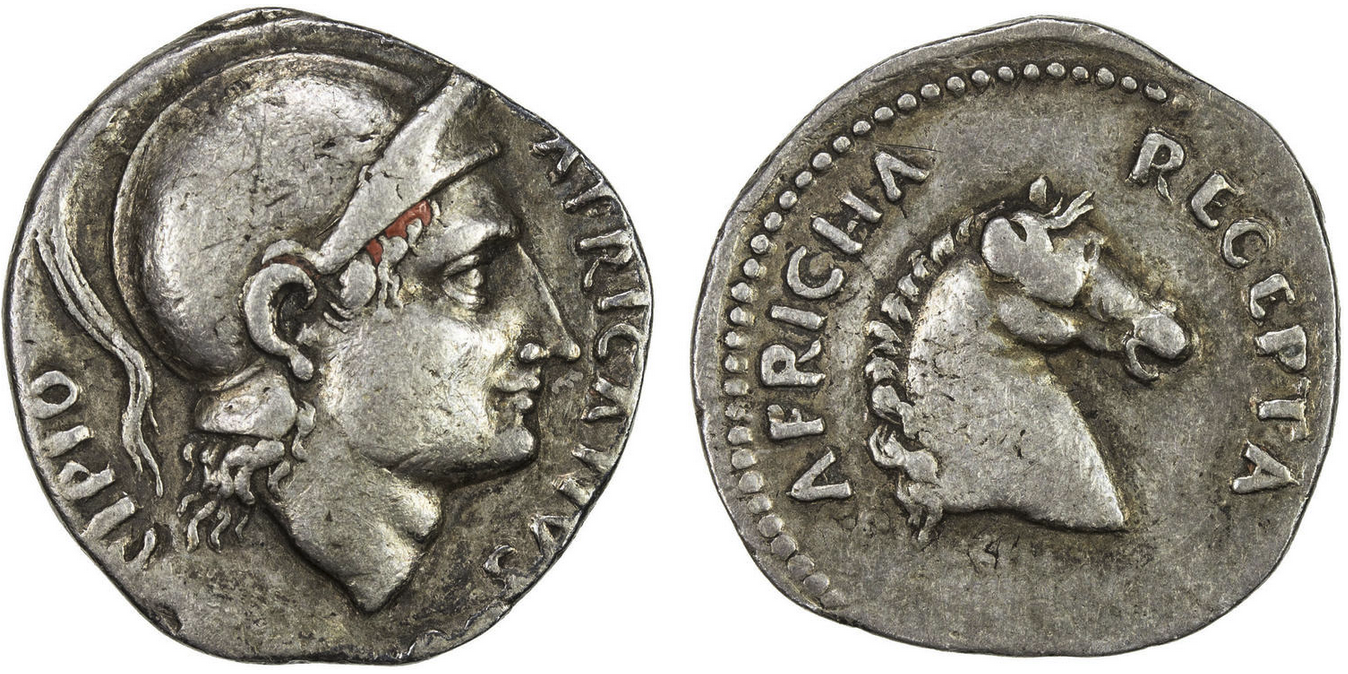
Scipio Africanus derived from early didrachms! overstruck on real denarius! last(?) auctioned 2020 and other example

Classification is difficult… Would this even count?!

Caesar “mule”, Aeneas and Elephant, last(?) auctioned 2015
L. Antonius quinarius with crossed fasces! and scepter! last auctioned 2020. I wonder what the DER SON was mean and the thing called an altar by the sales catalogue is a throne like that often shown with a thunderbolt. It is related to the iconography of the so-called pulvinar of Antonine coinages showing Commodus and his brother as infants enthroned (provincial, imperial).

The Scipio Africanus and Catalina denarii remind me of the same sort of ‘these coins should exist’ logic of the Cocles ‘restoration’ coins made under Trajan:


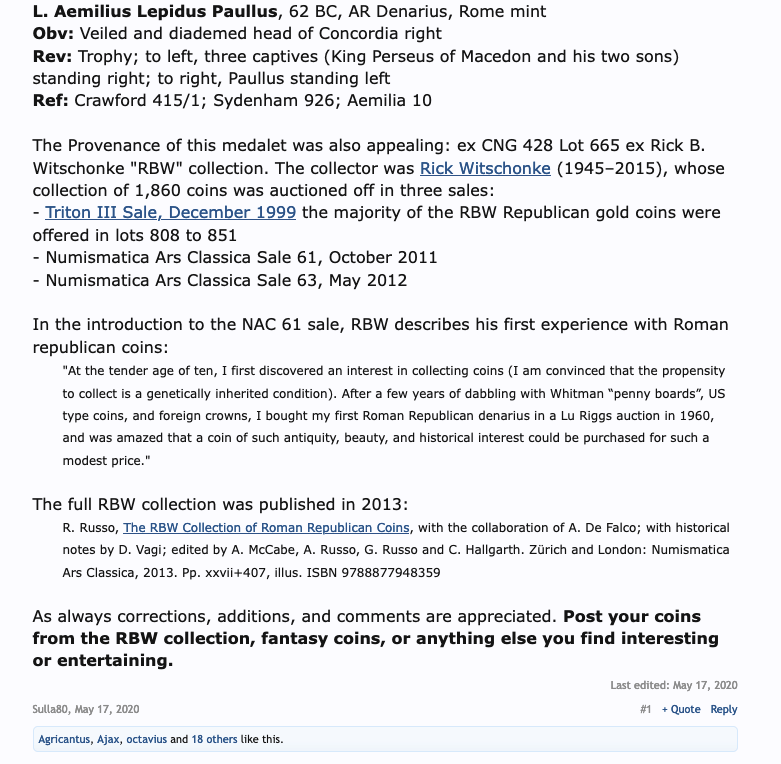
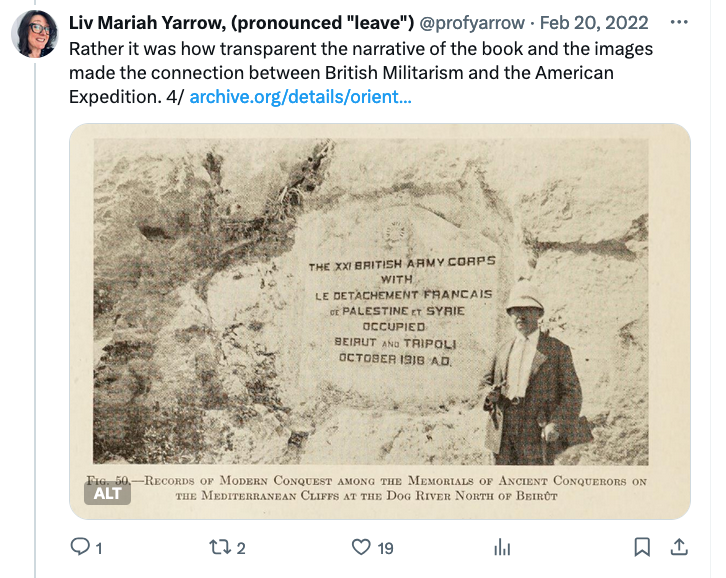
Stephen Minnoch provided a link in the comments to content that is relevant. I am adding screenshots to archive it here. It parallels nicely the Caesar fantasy above.

Prizes

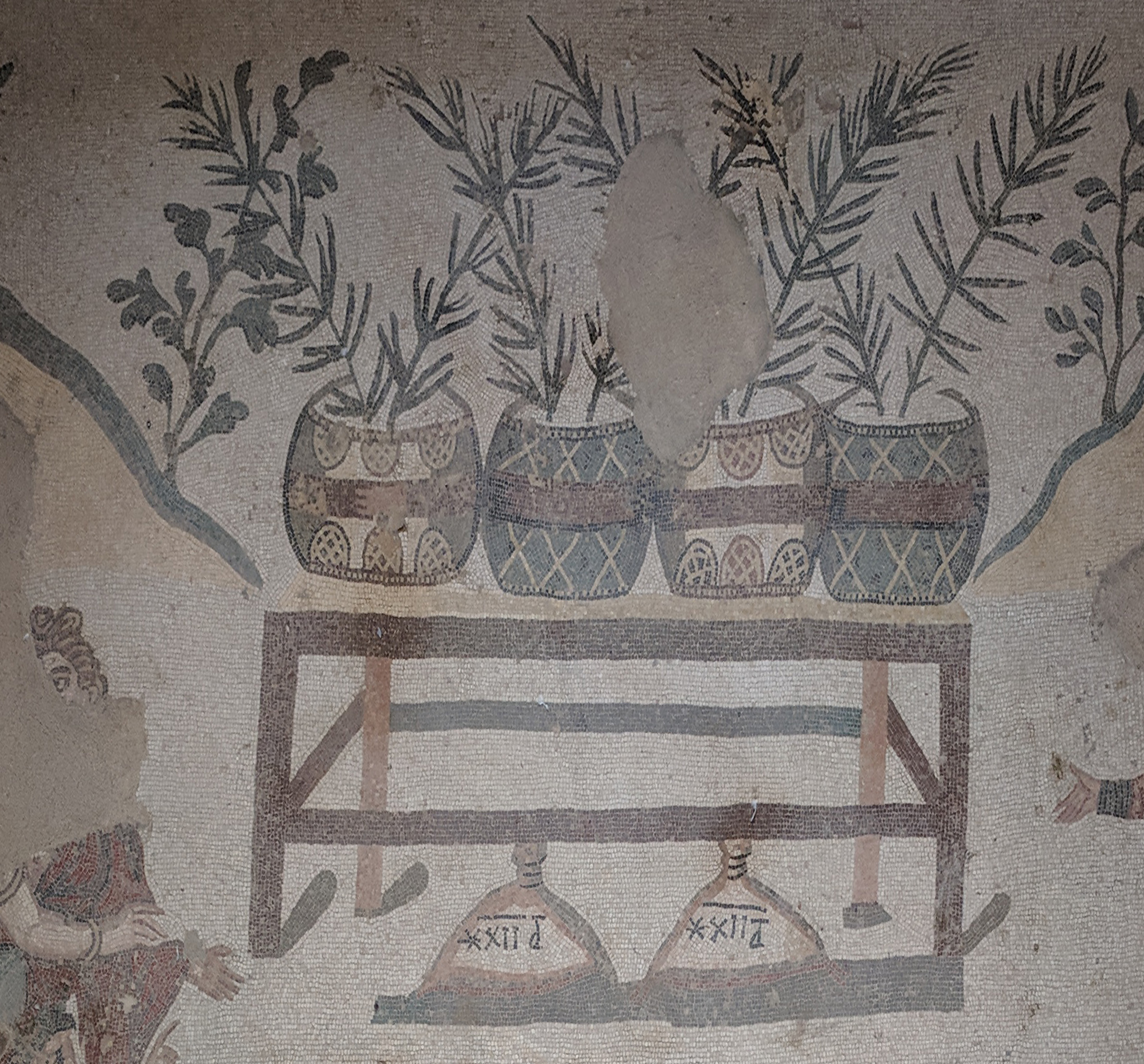
Wikimedia image of Piazza Armerina Mosaic (Villa Casale)
Detail of same with skew removed in photoshop

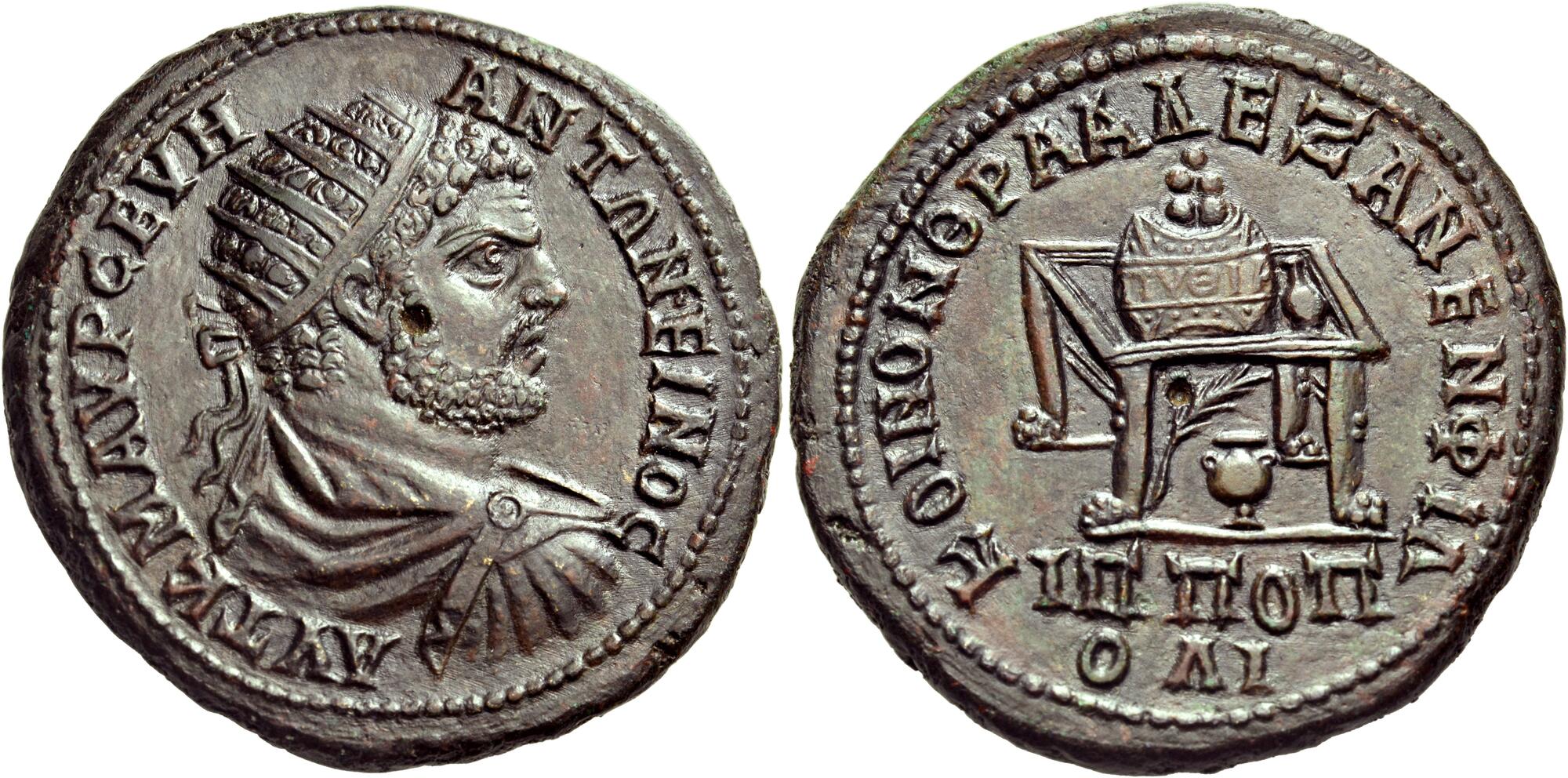
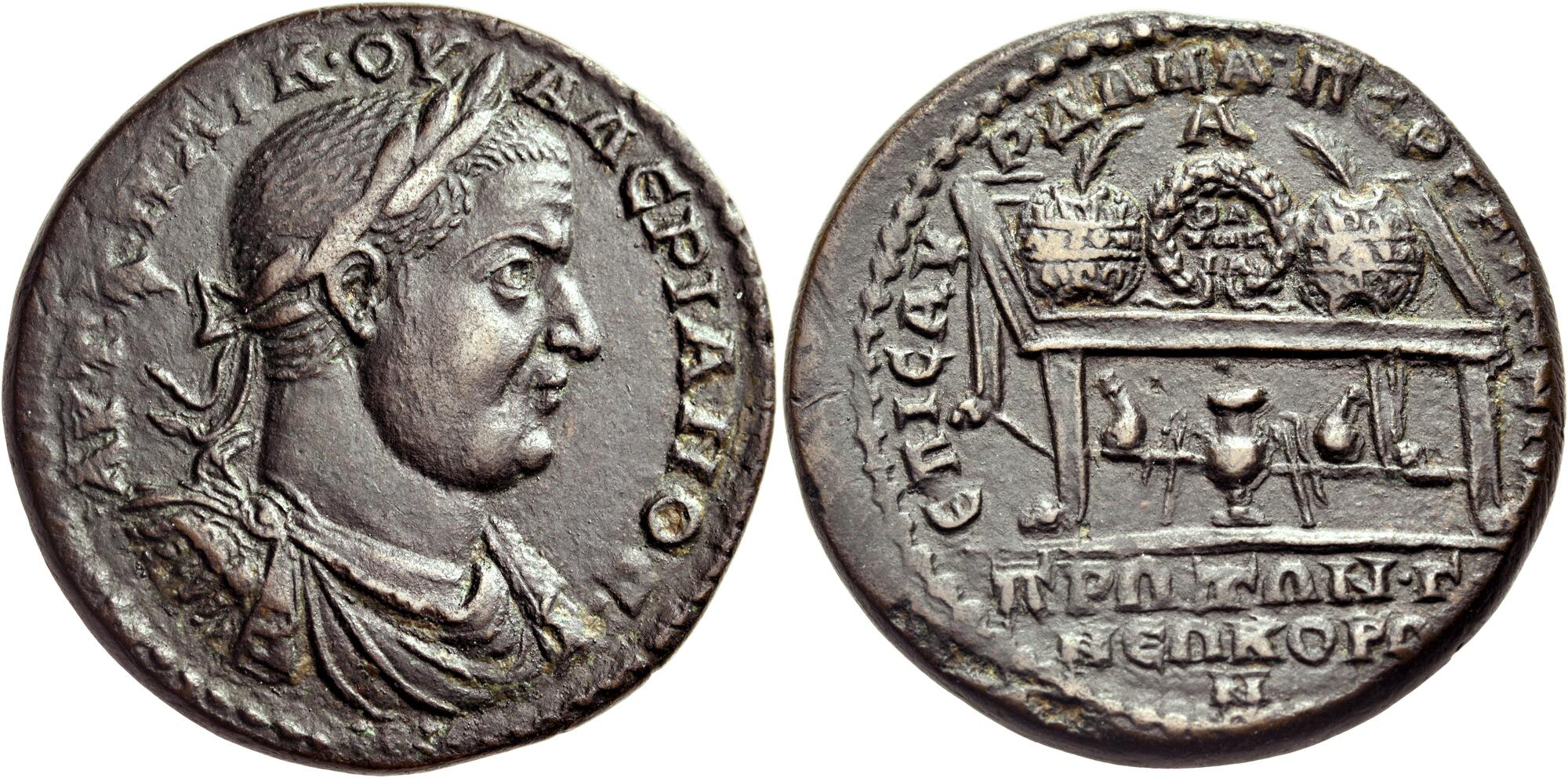
The prize crowns and palms on a table will be familiar to numismatists familiar with Roman provincial coinage (relevant results from RPC Online).

The bags of money are less common. Even more tantalizing is the writing on the bags. The line above multiplies the number by 1000. X with a horizontal line is regularly used as the symbol for the denarius on Diocletian’s price edict in both Latin and Greek versions and comes before the numeral. The edict is roughly the same date as the mosaics.

Aphrodisias fragment
Detail of Aigeira fragment

The lower case d with a line a the top is another figure I don’t immediately recognize. A puzzle for tomorrow, but one I feel sure will make me slap my forehead as soon as see the answer.

The unit of account for Diocletian’s Price Edict was the denarius, not the ‘denarius communis’ a fiction (not unlike the so-called aes signatum). See Jones 2017 who demonstrates the term was created by Lépaulle in 1888. In fact even the name of the Edict is a 19th century creation:

From Prantl 2011.

I find myself again wanting to read more MHC:

Michael Crawford, Diocletian’s edict of maximum prices at the Civil Basilica in Aphrodisias. Aphrodisias, 13. Wiesbaden: Reichert Verlag, 2023. Pp. 260. ISBN 9783752006858. (BMCR review)

On ILL order:

Burnett, Charles, ‘The Palaeography of Numerals’, in Frank T. Coulson, and Robert G. Babcock (eds), The Oxford Handbook of Latin Palaeography (2020; online edn, Oxford Academic, 10 Nov. 2020), https://doi.org/10.1093/oxfordhb/9780195336948.013.96,

Now, I really should put in some pictures of coins.

In trade
In trade

In both the coins above we see the motif of five circles usually described as apples but I do wonder if that if a firm attestation or if they might be coins. We also see in the second of the two, the one with only one crown, a small purse on the table next to the crown. Or so it is traditionally identified. On the specimen below you can see two purses looking more like purses under the table flanking the prize vase.

In trade

Why does teaching prep have to be so distracting?!

My Day Job – an ask

It is giving Tuesday. You might be the giving sort. You might not.

Link to Give.

Here’s my plea. I set down a sabbatical to finish book three and picked up the chairship of my department in large part because I believe in the LGI and the right of everyone regardless of family background or economic means to learn Latin and Greek. (an earlier essay on the value of studying ancient languages)

The LGI is older than I am and has trained the best philologists in our field and enabled hundreds of others who came late to the field to pursue their dreams of studying the Greek and Roman World. There are a hundred more medievalists, and political scientists, and religious scholars, art historians and philosophers who used and continue to use the LGI to access more directly and accurately the texts relevant to their research.

It has no permanent faculty. We count on our long term PT faculty giving up their summers (and good deal of their springs in preparation) year after year to make this possible. They do. The LGI engenders deep commitment from all its faculty and staff. It is a grueling intensive program that gets results. Our students wouldn’t succeed without this dedicated faculty.

Enrollments are high. We could admit more if we could support more to study in NYC. We could admit more if we could recruit and train more faculty. If we had staff to support the back end.

This campaign is our first giving Tuesday ask. The LGI needs an endowment to protect it from the winds of fortune at a public institution of higher ed.

And, once it is more secure, I can more comfortably go back to writing books (and more blog posts along the way).

So if you are giving sort and like this blog, please chip in a little something. Each donor shows that we have supporters. Give 100. Give 10. Give 1000! Give 10,000?

Anyway. I had to ask.

Link to Give.

Back to your regularly scheduled programming.

Bilingual coin of Cleopatra Selene and Juba II (BM specimen)

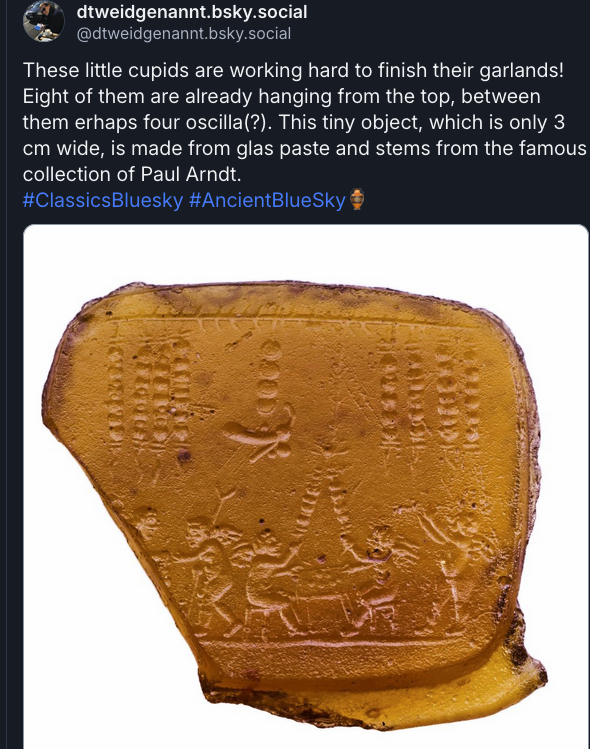
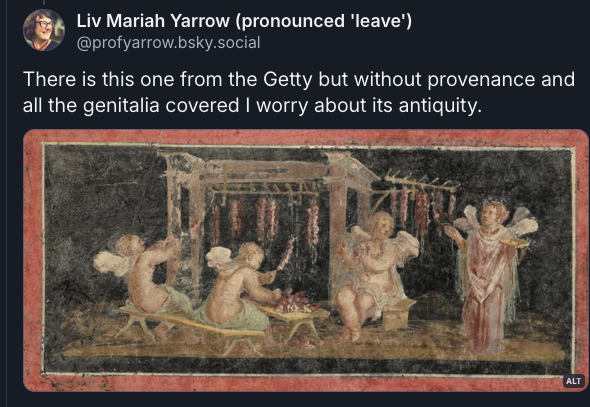
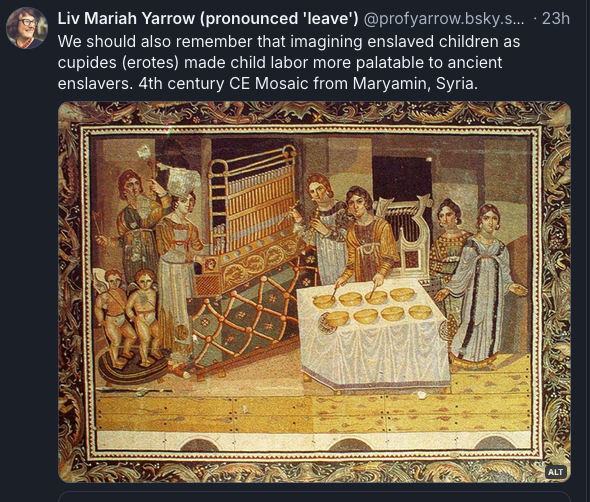
Cupids and Enslavement

I’m just archiving a Blue Sky conversation and ensuring I can find the topic of erotes (cupides) and child labor and slavery when my brain wants to return to it. I put the bibliography at the end because I wasn’t sure how ‘original’ my thinking was on this. Sometimes I say stuff so much I come to believe it without remembers to check in with my colleagues. Sloppy intellectual thinking.

Just a little possibly relevant bibliography

Mitchell, Elizabeth. “The Other Classical Body: Cupids as Mediators in Roman Visual Culture.” PhD diss., Harvard University, 2018.

Neuenfeldt, Lori P. “Eros and Erotes in the late antique mosaics of Antioch.” MA diss., FSU, 2009.

Slater, W. J. “PUERI, TURBA MINUTA.” Bulletin of the Institute of Classical Studies, no. 21 (1974): 133–40.

Beckmann, Sarah E. “The Naked Reader: Child Enslavement in the Villa of the Mysteries Fresco.” American Journal of Archaeology 127, no. 1 (2023): 55-83.