Scaurus’ Aedileship and Pompey’s Theatre

So I was reading a old blog post as I’m writing about Scaurus’ aedile issue for other reasons.  This made me re read this passage of Pliny below.  Do you know what’s really weird about this?  At the very moment Scaurus is importing 360 columns for a temporary theater, his former commander Pompey is in the process of building a REALLY opulent permanent theatre on the Campus Martius that will be dedicated in just 3 short years.  Pliny tells us that largest of the columns went to Scaurus’ atrium afterwards, but what about the rest?!  Did he auction them off?  Did they end up in Pompey’s theatre complex.  Was the whole thing a way of getting extra mileage and spectacle out of the Pompeian building project.  How did Pompey feel about it if it wasn’t?  Surely upstaging your former commander was a bad idea.  How did Pompey feel about Scaurus’ claiming the Aretas victory… ? The politics of 58BC makes my brain hurt.

Pliny NH 36.116:

In the ædileship of M. Scaurus, three hundred and sixty columns were to be seen imported; for the decorations of a temporary theatre, too, one that was destined to be in use for barely a single month. And yet the laws were silent thereon; in a spirit of indulgence for the amusements of the public, no doubt. But then, why such indulgence? or how do vices more insidiously steal upon us than under the plea of serving the public? By what other way, in fact, did ivory, gold, and precious stones, first come into use with private individuals? Can we say that there is now anything that we have reserved for the exclusive use of the gods? However, be it so, let us admit of this indulgence for the amusements of the public; but still, why did the laws maintain their silence when the largest of these columns, pillars of Lucullan marble, as much as eight-and-thirty feet in height, were erected in the atrium of Scaurus? a thing, too, that was not done privately or in secret; for the contractor for the public sewers compelled him to give security for the possible damage that might be done in the carriage of them to the Palatium. When so bad an example as this was set, would it not have been advisable to take some precautions for the preservation of the public morals? And yet the laws still preserved their silence, when such enormous masses as these were being carried past the earthenware pediments of the temples of the gods, to the house of a private individual!

Hybrid or Imitation?

Capture
Links to acsearch.info entry

NAC cataloging is usually above question, but I’m going to need some die links to convince me that this is actually a hybrid and not an ancient imitation.  I agree with what ever ancient decided to cut it open to check it’s purity.  It looks a wee bit fishy as an authentic product of the Roman mint.  (Although I acknowledge controls on the style of dies isn’t particularly strong at the mint)  It’s an interesting specimen either way!

Aretas III = Rex amicus et socius?

Capture2
Links to acsearch.info entry

This below is from p. 41-2 of Kropp’s book. I’m suspicious of this interpretation of 422/1.  I’ve ordered the citation from ILL but as far as I know the comparative visual evidence is all much later…

CaptureCapture1

The saddle stuff is fascinating though!  Esp.  That the Roman designer of the type knew enough to include it.  The other similar type from a few years later doesn’t show the same saddle (431/1).

A Triple Crest on Pompey’s Seal Ring

Capture.JPG
Links to acsearch.info entry

So I never noticed before that the middle trophy on this type issued by Sulla’s son, Faustus to honor Pompey, makes a distinction between the middle trophy and the outer two.  But on some specimens it’s clearly visible that the central helmet is shown with a triple crest (or side horns?!) and the outer two helmets only have a single central decoration.  The type is thought to reflect Pompey’s signet ring and in design both that ring and this type recall Sulla’s coinage and later signet ring.  (426/3 CRRO entry).

Mettius’ Caesar Portrait and other Media

Capture1
Links to acsearch.info entry

This portrait of Caesar had wide spread importance.  I’m interested in it here not because of it’s numismatic significance, but in fact for how it’s talked about by art historians.  This passage from an old article concerned with identifying a sculpture head as Caesar, or not, uses an interesting logic about why Mettius’ portrait was influential and how it relates to both gems and glass-pastes.  Under all this are some assumptions about how iconography develops and disseminates that I want to think about more in future:

Capture
Links to Jstor (go to p. 57 for this passage)

Here’s the Amethyst discussed:

11.195.6
Links to Met Museum

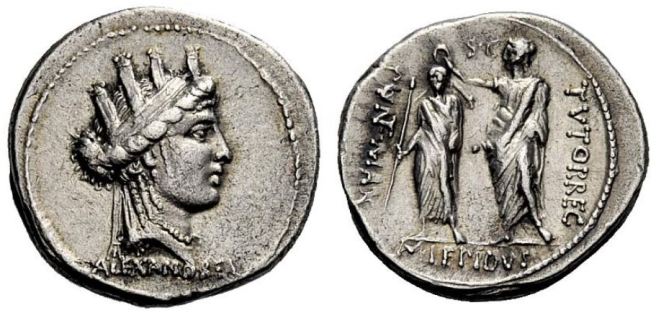
A Double Crowning of Sorts

Capture

This image is from this 2013 article by Andreas Kropp.  He also has some comments on the coin type in his monograph of the same year on p. 39 and here in this other article.  I wanted to put it up here to connect it with my earlier post on the iconography of crowning, esp. as it has two figures doing the crowning as in the literary testimony from Demosthenes quoted there AND because it helps us think even more about the power structures implied by the act of crowning, as well as by hand clasping iconography of the reverse.

Update 2/27/16:  cf. also RRC 470/1c: What’s interesting is that the crowning is symbolically equivalent here supplication with a branch….


Roma with Shield and Spear

Capture
Links to acsearch.info entry

This obverse type Crawford identifies as Roma (292/1) on the basis of comparison with this gem (apologies for poor image) which (apparently)  bears the inscription AVE ROMA:

Capture3
Links to original  publication on Archive.org

I just wanted to throw up this coin type (494/35) as well to put all three next to each other for future reference:

Capture2
Links to acsearch.info entry

Notice the emphasis put on rendering Roma’s hand clutching the spear before the shield.  Also notice the variation in shield designs.

Update 4/25/16:

Little did Crawford know there was a better parallel right in the BM collection (1923,0401.408).  Notice the star and crescent which has become crescent and denomination mark on the denarius.  Even the shield design is the same!

Gem of glass paste imitating sard, engraved with a bust of Athena wearing a helmet and aegis; in the field is a star and crescent.
Glass paste intaglio engraved with a bust of Athena wearing a helmet and aegis. In the field is a star and crescent (see BM Cat. Gem 2778).  Pen and ink with grey wash and traces of graphite underdrawing on a sheet of paper, which is stuck down onto a second sheet together with 2010,5006.1260 - 1264; the assemblage framed in a graphite border.

(Drawing is BM 2010,5006.1262)

Update 1.26.22:

source

Update 2/1/2024:

This is probably also Roma. Image from a BBC news story on BM thefts

See also later post on problems identifying personifications of Roma vs. Virtus for similar images without shield.

Pompey and the Amazons

Capture1
Links to acsearch.info entry

This type (430/1) minted by the son of the the Triumvir, Crassus, doesn’t I think get enough attention.  The Venus is clearly Venus Victrix who appears on Pompeian types (cf. esp. 424/1 and 426/3) and will soon be co-opted by Caesar (cf. 465).  The reverse shows a standing Amazon leading her horse with her face in 3/4s profile.  This and the shield and cuirass below the horse make me 90% certain this is a statue being portrayed or at very least the designer is borrowing from a well known statue type and the cuirass and shield are part of the support system of the horse statue.

The reverse brought to mind this passage from Appian about Pompey’s adventures with the Amazons (12.103):

Capture

Cf. Plutarch, Life of Pompey 35

Mayor even thinks Amazons were displayed in Pompey’s triumph in 61 BC.  She bases this on this passage from Plutarch:

Capture
I feel I’m forgetting some famous Amazon statues at Rome in the republican period that would be relevant in this context.  I’ll remember at some point, or not.